




TL;DR: Forex spreads are the gap between the bid and ask price, a cost paid on every trade before any commission. Compare accounts by all-in cost per round trip, meaning the spread plus both commission legs in pips and dollars. A 1.5-pip spread on one standard lot of EUR/USD costs $15 before commission. Forex spreads widen around the 5:00 PM New York rollover and major news, so check them at the hours you actually trade.
Forex spreads are the first cost every currency trade pays. You buy at the higher price, sell at the lower one, and the gap is gone before the market moves a single pip.
Some accounts add a commission on top. Others build their whole charge into a wider spread and advertise "no commission." Here is where traders usually get caught: they compare the banner numbers, not the trade.
Neither label tells you what a trade costs. You need one number: the spread plus every commission leg, in pips and dollars, for the size you trade, at the hour you trade. Get that number right and the rest of the comparison gets easy.
What Forex Spreads Are
A forex spread is the difference between the price at which you can buy a currency pair (the ask) and the price at which you can sell it (the bid). The SEC's investor bulletin on forex calls this bid-ask spread "an inherent cost of trading": the wider it is, the more it costs to buy and sell a currency, apart from any commission.
The spread is not posted as a separate line item. It is built into the prices you get, which is exactly why it is easy to underestimate.
A commission is different. It is a separate fee, usually charged when a position opens and again when it closes. Some providers charge only a spread, some charge a tight spread plus a commission, and some charge both a markup and a commission. The SEC bulletin warns that "commission-free" does not mean free, because the dealer's charge may sit inside a wider spread.
Retail spot forex is also an off-exchange market, which shapes how forex spreads are set. The CFTC reminds traders that in over-the-counter forex you trade against your dealer, and the dealer earns money when you trade more often, lose money, or pay fees, spreads or commissions. Knowing exactly how you pay is part of knowing who you are trading with.
Bid and Ask Prices in a Forex Quote
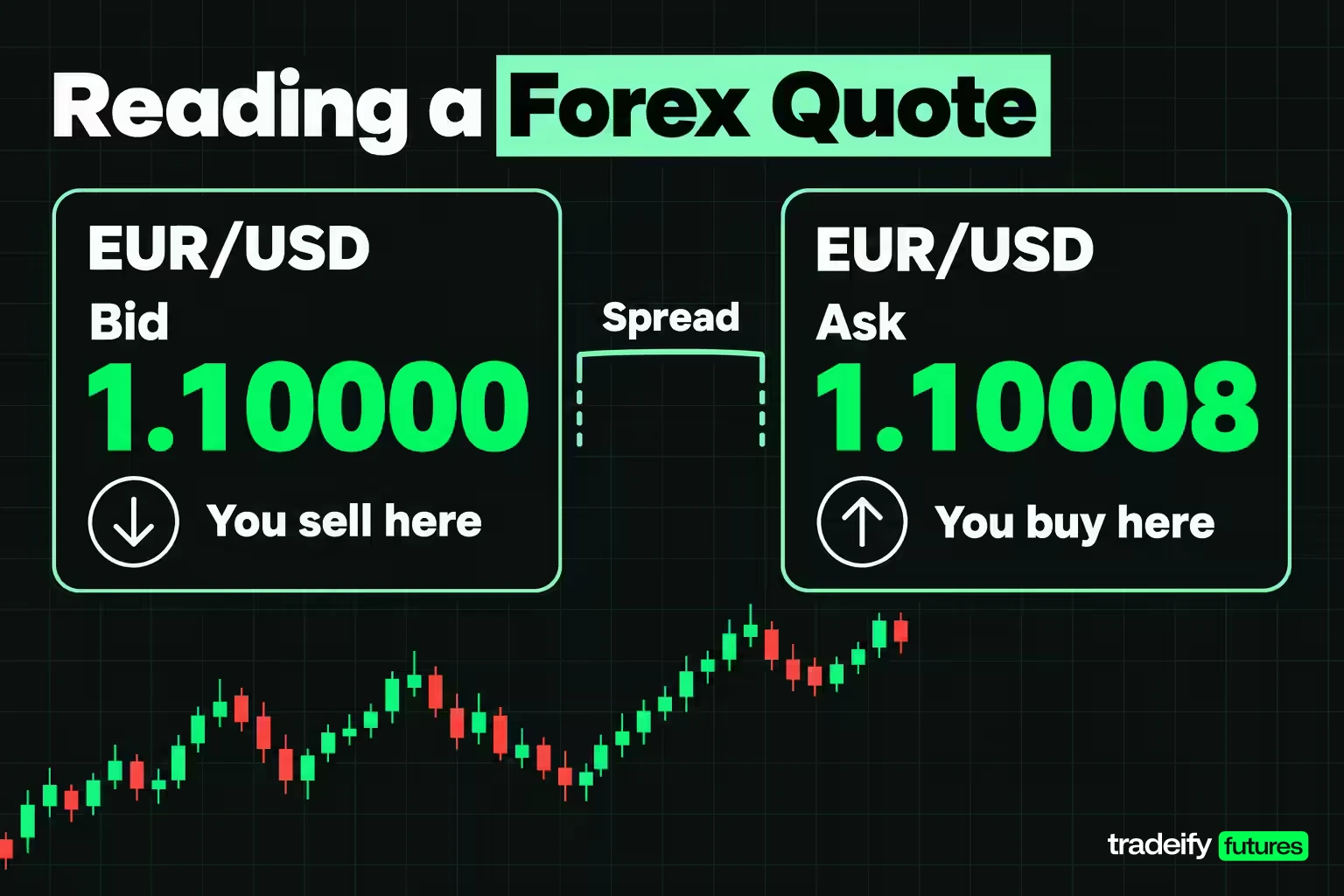
Every forex quote has two sides. For EUR/USD, an illustrative quote might read 1.10000 bid and 1.10008 ask.
- The bid is what you receive if you sell euros for dollars.
- The ask is what you pay if you buy euros with dollars.
- The ask is higher than the bid, and the gap is the spread.
So a buyer enters at the ask, 1.10008. If the price does not move and that trader closes immediately, the position is sold at the bid, 1.10000. The trade loses the spread, 0.8 pips, without the market doing anything.
That is why a new position shows a small loss the moment it opens. Nothing went wrong. You just paid the spread.
Which side your chart draws matters too. A long position is closed at the bid, but a short position is closed at the ask. If your chart is drawn from bid prices (check the platform setting), a short trade's stop can trigger while the line on screen still sits a little below the stop. When the spread widens, that gap gets bigger.
How to Calculate Forex Spreads in Pips and Dollars
The calculation takes two steps: find the spread in pips, then turn pips into money.
The forex spread formula
Spread in pips = (ask − bid) ÷ pip size
On most pairs one pip is 0.0001, the fourth decimal place. On yen pairs one pip is 0.01. Many platforms show one more digit, a fractional pip or pipette, so a five-digit EUR/USD quote of 1.10008 has a last digit worth one tenth of a pip.
Using the illustrative quote, 1.10008 − 1.10000 = 0.00008, which is 0.8 pips.
Turning spread pips into dollars
Spread cost = spread in pips × pip value per lot × number of lots
For a pair quoted in US dollars, such as EUR/USD, pip value is simple:
| Position size | Units | Value of one pip | Cost of a 0.8-pip spread |
|---|---|---|---|
| Standard lot | 100,000 | $10 | $8 |
| Mini lot | 10,000 | $1 | $0.80 |
| Micro lot | 1,000 | $0.10 | $0.08 |
When the US dollar is not the quote currency, pip value has to be converted. On USD/JPY, one pip on a standard lot is ¥1,000, worth about $6.67 at an illustrative rate of 150.00. On EUR/GBP, one pip on a standard lot is £10, worth $13.00 at an illustrative GBP/USD of 1.30. Your platform does this conversion live. Still, know why the same "1 pip" costs different amounts on different pairs, or two quotes that look identical will not be.
What a 0.3 spread means
A 0.3 spread means the ask is 0.3 pips above the bid. On EUR/USD that is $3 per standard lot and $0.30 per mini lot. It is a tight quote, typical of raw-spread accounts on the most liquid pairs during busy hours, and it usually comes with a separate commission.
How Forex Commissions Work
Commissions are quoted in several ways, and mixing them up is the most common comparison error.
- Per side: charged when you open and again when you close. An illustrative $3.50 per side per standard lot costs $7 for the completed trade.
- Round turn: one figure covering both the open and the close. A $7 round-turn commission is the same as $3.50 per side.
- Per notional: charged per $100,000 (or per million) of US dollar value traded, on each leg.
The notional method changes with the pair and price. FOREX.com's pricing page explains its raw-pricing commission of $7 per $100k USD traded, charged on each leg. Buying 100,000 USD/JPY means buying $100,000, so the commission is $7, or $14 round trip. Buying 100,000 EUR/USD at 1.1000 means $110,000 of dollar value, so the commission is $7.70 per side, $15.40 round trip.
To compare a commission with a spread, convert it to pips:
Commission in pips = round-trip commission ÷ pip value
A $7 round trip at $10 per pip is 0.7 pips. Add it to the spread and you have the all-in cost:
| Pricing model (illustrative) | Spread | Round-trip commission | All-in cost per standard lot | All-in in pips |
|---|---|---|---|---|
| Spread only | 1.0 pip ($10) | $0 | $10 | 1.0 |
| Tight spread plus commission | 0.3 pips ($3) | $7 | $10 | 1.0 |
| Zero spread plus commission | 0.0 pips ($0) | $10 | $10 | 1.0 |
All three cost the same here, even though one advertises a zero spread and another advertises no commission. The label is marketing. The all-in number is the cost.
Raw Spread vs Spread-Only Accounts
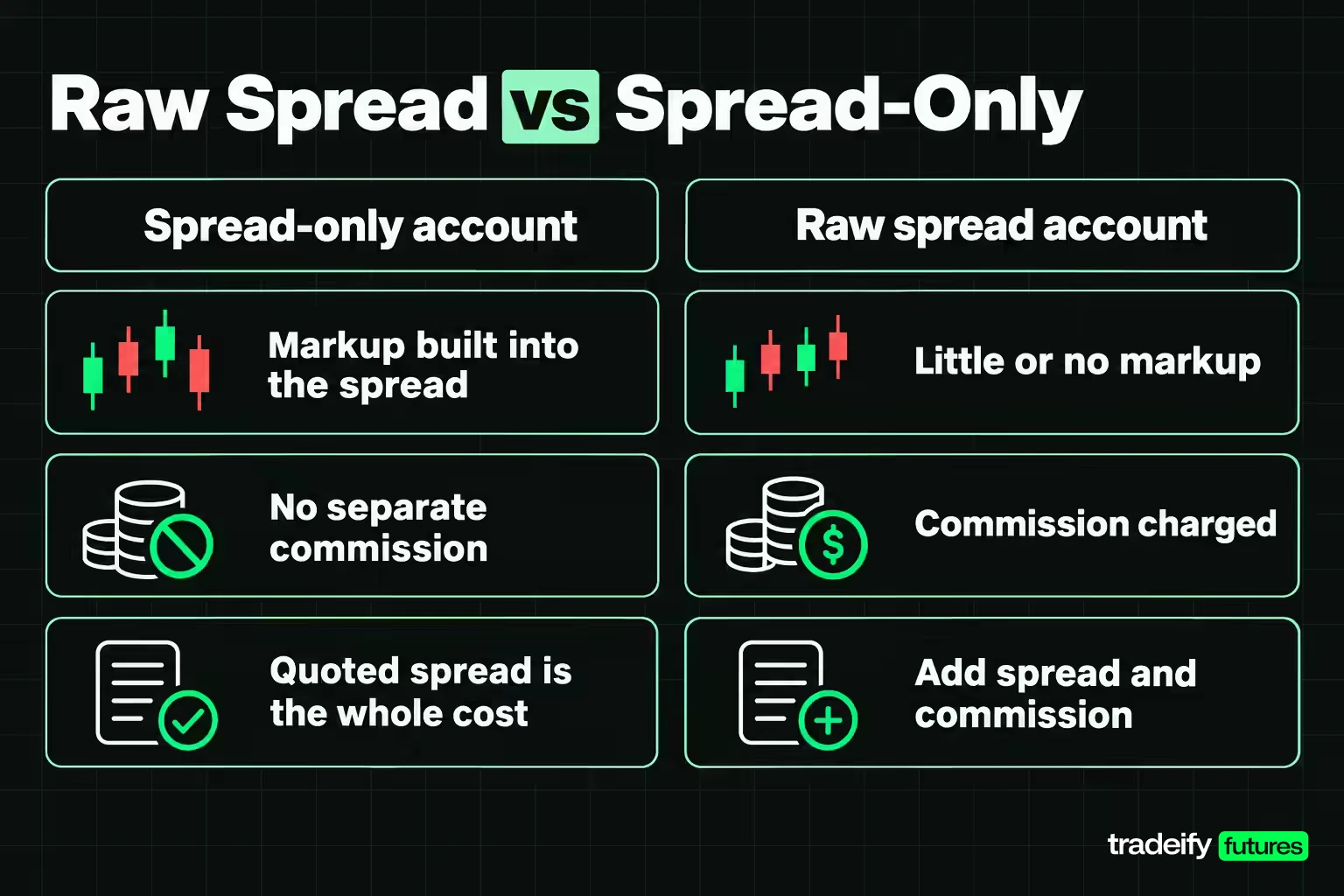
Retail forex providers usually offer two pricing models, and each one shows forex spreads differently.
Spread-only or standard accounts
The provider takes the price it receives from its liquidity sources and widens it. That markup is its fee. There is no separate commission, so the quoted spread is the whole visible cost. OANDA's US pricing page, for example, describes its spread-only account as one where "our commission is wrapped into the spread."
Raw spread or ECN-style accounts
A raw spread is the price from the provider's liquidity sources with little or no markup. The spread can be close to zero on major pairs, and the provider charges a commission instead. "Raw" does not mean zero: the spread still moves with the market.
A real comparison from published data
FOREX.com publishes the median ("typical") spread for each account type over the previous full calendar month. As of November 4, 2026, its page showed September 2026 medians of 1.5 pips on EUR/USD for the spread-only account, and 0.1 pips for the raw account plus $7 per $100k per side.
On one standard lot of EUR/USD at 1.1000:
| Account | Median spread cost | Commission | All-in cost |
|---|---|---|---|
| Spread-only | 1.5 pips = $15 | $0 | $15 |
| Raw pricing | 0.1 pips = $1 | $15.40 | $16.40 (about 1.64 pips) |
In that month, the "no commission" account was slightly cheaper on EUR/USD at the median, which surprises a lot of traders who assume raw pricing always wins. The answer can flip at other hours, on other pairs, or when one account's spread widens more than the other's. Compare all-in figures for your own pairs and hours, not headline numbers.
US rules help here. The NFA requires a dealer that advertises "commission free" to disclose prominently how it is paid, and each trade confirmation must show the commission and fees plus either the markup or, for dealers that do not pass orders straight through, the mid-point spread cost.
Fixed vs Variable Forex Spreads
Forex spreads come in two types.
Variable (floating) spreads move with the market. They are often tightest when liquidity is deep and widen when it thins or uncertainty jumps. Raw and most spread-only accounts use variable spreads.
Fixed spreads stay at a set width in normal conditions. They are usually offered by dealers who act as market maker and take the other side of client trades. The appeal is predictability: you know the cost before you click.
The trade-off shows up in fast markets. A dealer holding a fixed spread when the real market has widened can requote, asking you to accept a new price, or reject the order. NFA rules say that if a US dealer requotes when the market moves against it, it must also requote when the market moves in the customer's favor, and it cannot advertise "no slippage" while it requotes or can adjust prices after execution.
CME Group's 2026 article on the daily FX close adds context: many providers internalize part of their client flow rather than hedging every trade, so for that flow the provider is the counterparty. That does not make fixed or variable spreads good or bad. It means you should read the account agreement and understand how the provider handles volatile moments.
Which type suits you depends on when you trade. If you trade busy hours on major pairs, variable spreads are usually tighter. If you value a known cost and trade calm periods, fixed spreads can be simpler. Neither removes the risk of a worse fill when the market moves fast.
What Makes Forex Spreads Widen
Forex spreads reflect how much it costs a liquidity provider to quote a price it may not be able to hedge. Anything that raises that cost widens the spread.
Liquidity and the currency pair
The more a currency trades, the more counterparties compete to quote it. The BIS 2025 Triennial Survey put global FX trading at $9.6 trillion per day in April 2025, with the US dollar on one side of 89% of trades, the euro at 28.9%, the yen at 16.8% and sterling at 10.2%. Pairs built from those currencies usually carry the tightest spreads. Exotic pairs, with far fewer quotes, carry much wider ones.
Time of day and the 5 PM New York rollover
Spot FX trades around the clock on weekdays, but liquidity is uneven. It is usually deepest when major financial centers overlap and thinnest in the gaps between them.
The thinnest stretch is often the hour after 5:00 PM New York time, when the spot value date rolls and banks close one book and open another. CME Group's September 2026 article on this hour notes that listed FX futures stop trading from 5:00 to 6:00 PM New York time, while retail platforms keep quoting but wider. Its description: a spread of a fraction of a pip in liquid hours "can expand to several pips through the rollover and considerably more on less liquid crosses."
Economic releases and unexpected news
Scheduled data such as inflation, employment and central bank decisions can reprice a currency in seconds. Liquidity providers widen quotes before and during these releases because the risk of quoting a stale price is high. Unscheduled political or economic shocks do the same with no warning. OANDA's pricing page, for example, states that its spreads can be wider than usual at market opens and closes and around major international or geopolitical events.
Volatility
When prices are moving fast, each quote is riskier to hold, so the gap between bid and ask grows. Volatility and thin liquidity often arrive together, which is why spreads can jump rather than drift wider.
Tight vs Wide Forex Spreads by Currency Pair
There is no universal "good" spread. Tight and wide forex spreads only make sense for a given pair, account type and time of day.
As a reference point, here are FOREX.com's published September 2026 median spreads for its spread-only account (read November 4, 2026), with the spread expressed as a share of an illustrative price:
| Pair | Median spread (pips) | Illustrative price | Spread as share of price |
|---|---|---|---|
| USD/JPY | 1.7 | 150.00 | 0.011% |
| EUR/USD | 1.5 | 1.10 | 0.014% |
| GBP/USD | 2.1 | 1.30 | 0.016% |
| USD/MXN | 45.5 | 18.00 | 0.025% |
| USD/ZAR | 101.2 | 17.50 | 0.058% |
Two lessons come out of this spread table. First, majors sit in the low single digits of pips on a spread-only account, while exotics run to tens or hundreds of pips. Second, pips are not comparable across pairs. A 45.5-pip spread on USD/MXN looks enormous next to 1.5 pips on EUR/USD, but as a share of price it is less than twice as wide, because USD/MXN pips are tiny in value. Comparing spreads as a share of price, or in dollars per $100,000 traded, is fairer.
Is a 1 pip spread good?
A 1-pip spread on EUR/USD is competitive on a spread-only account: FOREX.com's published September 2026 median for that account type was 1.5 pips. On a raw-pricing account, 1 pip would be wide, since that account's September median on EUR/USD was 0.1 pips before commission. On GBP/JPY or any exotic pair, 1 pip would be unusually tight. Judge it against the same pair, the same account type and your own trading hours.
How Spread Costs Change Break-Even and Profit
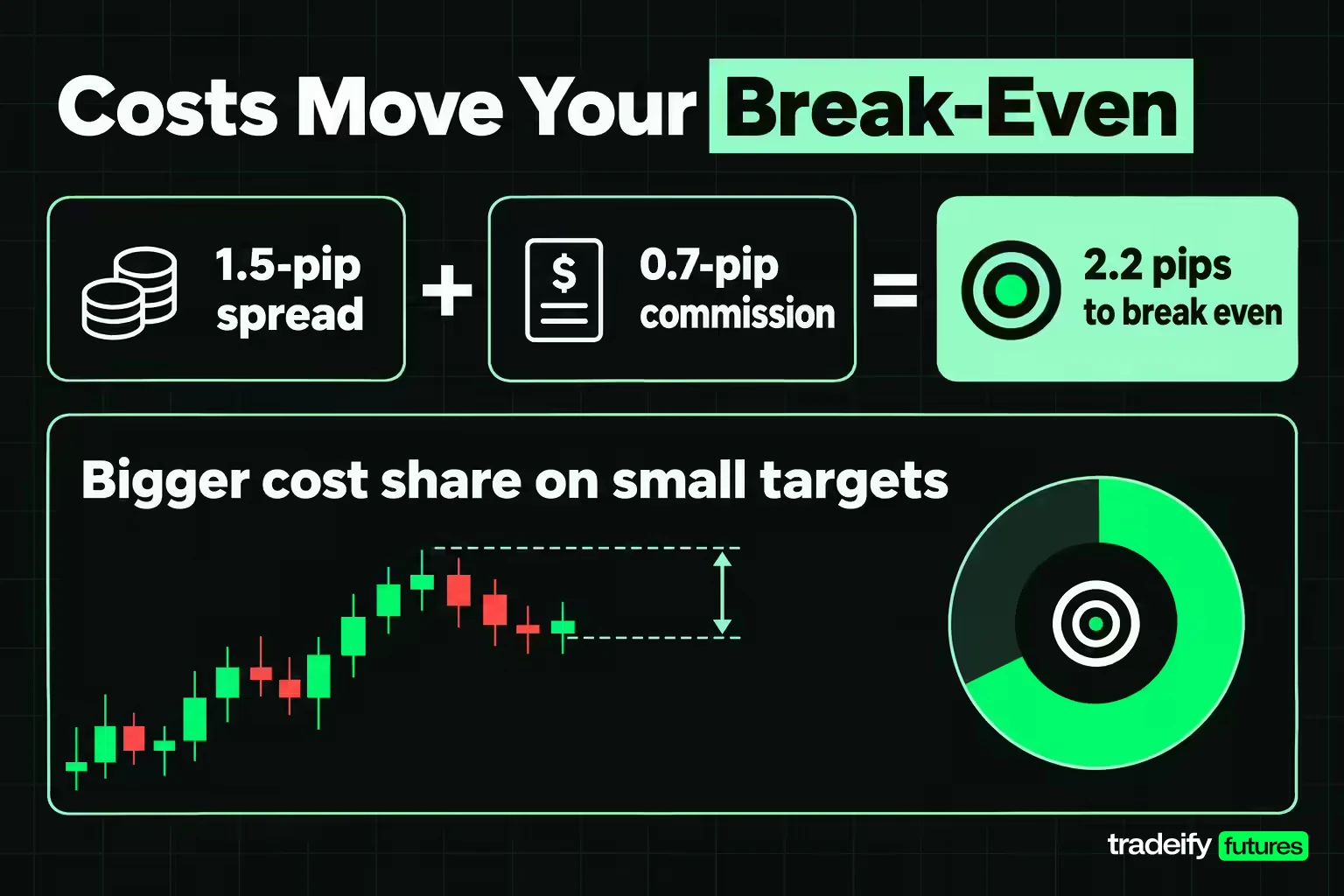
A long trade opens at the ask and closes at the bid. Before it can show a profit, the bid has to rise by the full spread plus the commission in pips. With an illustrative 1.5-pip spread and a 0.7-pip commission, the trade needs a 2.2-pip move just to reach break-even.
The cost matters most relative to the size of the move you are trying to capture:
- With a 5-pip target, a 1.5-pip all-in cost is 30% of the target.
- With a 50-pip target, the same 1.5-pip cost is 3%.
The SEC bulletin makes the same point in plain terms: for frequent traders, transaction costs can turn what might have been profitable trades into losing ones.
There is a second, quieter effect: costs change the win rate a strategy needs. A system that wins 5 pips and loses 5 pips breaks even at a 50% win rate before costs. Add 1.5 pips of cost to every trade and winners net 3.5 pips while losers cost 6.5 pips. Now the same system needs to win 65% of the time just to stay level.
That is the gap between a backtest and a live account. A strategy tested without realistic spreads can look profitable on paper and still lose money once real costs show up.
Spreads in Scalping and Day Trading
Short-horizon traders feel forex spreads most, because they pay them many times over on small targets.
Imagine a trader who scalps EUR/USD with 10,000-unit positions, takes 20 round trips a day and pays 1.5 pips all-in each time. At $1 per pip, that is $30 a day in spread and commission, or $600 over 20 trading days, before a single winning or losing pip. The same trader taking two longer-range trades a day pays a fraction of that. Simple is not the same as cheap.
Spreads also affect where stops sit. A stop placed only a few pips from entry can be hit by a spread spike alone. CME Group's article gives a hypothetical example: a trader long EUR/USD from 1.0850 with a stop at 1.0830 sees the mid-price hold at 1.0838, still 8 pips above the stop. Through the 5:00 PM New York rollover, the spread widens from half a pip to 18 pips, the bid prints 1.0829, and the stop triggers even though the mid-price never reached it.
For day traders, the practical spread rules are simple:
- Know whether your platform triggers stops on the bid, the ask, the last price or the mid.
- Avoid holding tight stops into the rollover hour and into major releases.
- Size the stop distance for the widest spread you have seen in that pair and hour, not the average.
How to Monitor Forex Spreads
Monitoring forex spreads turns a vague cost into a number you can plan around. Confidence about your costs without a log is a guess.
Watch the live spread on your platform
Most trading platforms can show both bid and ask in the quote window, and many add a spread column or let you display the ask line on the chart. Turn these on. Seeing forex spreads live at your entry time is more useful than any average.
Use a spread indicator or alert
Many platforms and add-on indicators can plot the bid-ask spread as a line under the price chart, so you can see it tighten and widen through the day. Some let you set an alert when the spread passes a threshold you choose, such as twice your normal entry spread. Treat that alert as a filter: if the spread is above your planned cost, the setup has to wait or be skipped, because the trade you planned is no longer the trade on offer.
Log the spread with every trade
Record the bid, the ask, your fill price, position size and commission on each trade. After a few weeks, sort the log by hour. You will usually find a clear pattern: tighter forex spreads in your pair's busiest hours, wider ones near the rollover and around releases.
Two numbers from that log do most of the work. The median spread is your planning cost. The widest spreads you logged, say the worst one trade in ten, are your stress cost, the one to use for stop distance and position size.
Check trade confirmations for the real spread cost
US dealers must show commission and fees on each trade confirmation, plus the markup they add or the mid-point spread cost, under NFA rules. That figure tells you what each trade really cost, not what the marketing page promised.
Compare with published medians
Some providers publish monthly median spreads by pair. Compare your logged spreads with those figures. If yours are consistently wider, check whether you trade at quiet hours or whether your account type is not the one the medians describe.
How to Reduce Forex Spread Costs
You cannot remove forex spreads, but you can stop paying more than you need to.
- Trade liquid pairs. Majors such as EUR/USD and USD/JPY usually carry the tightest spreads.
- Trade the busiest hours for your pair. Spreads are usually tightest when the pair's main financial centers are open.
- Stay out of the rollover hour. The hour after 5:00 PM New York time is often the least liquid of the day.
- Step aside around major releases unless your plan is built for them, and widen your cost assumption if it is.
- Use limit orders where your strategy allows, so you choose the price instead of paying whatever the ask is.
- Choose the pricing model that fits your size and pairs, compared on all-in cost.
- Trade less often if your edge is small. Fewer, better trades pay fewer spreads.
The first three cost nothing and fix the biggest spread problems. Switching account type is worth the effort only after you know your real all-in cost.
How Forex Spreads Affect Margin and Leverage
Forex spreads and margin interact because the spread is charged against your equity the moment you open a trade.
US retail forex rules (17 CFR 5.9) require a security deposit of at least 2% of notional value on major pairs and 5% on others, which works out to a maximum of 50:1 and 20:1 leverage. The CFTC's example: a 2% requirement lets you open a $100,000 position with $2,000.
How much leverage for $100
With $100 at a US dealer, the most you could open on a major pair is $5,000 of notional value (50:1). At an illustrative EUR/USD price of 1.10, a 1,000-unit position is $1,100 of notional and needs a $22 deposit. A 4,000-unit position is $4,400 of notional and needs $88.
How spreads eat into margin
On that 4,000-unit position, a 1.5-pip spread costs $0.60 at entry. If the spread widens to 10 pips at the rollover, a long position marked at the bid shows a $4.00 hit, 4% of the $100 account, without the mid-price moving. With $88 tied up as margin and only $12 of free equity, a spread spike plus a small adverse move can push the account toward a margin call or forced liquidation, depending on the dealer's rules.
The lesson is not that leverage is forbidden. High leverage simply leaves no room for costs, and the more of your equity is posted as margin, the more a spread spike matters.
Spreads on Currency Futures vs Spot Forex
Currency exposure does not have to come through a spot dealer. CME currency futures trade on a central order book, and their spread works differently.
In spot forex, the dealer sets the quote you see. In futures, the bid and ask are the best resting orders from all participants, and the smallest possible gap is one tick. The 6E Euro FX contract covers 125,000 euros with a minimum tick of 0.00005, worth $6.25, which is half a pip. The M6E Micro EUR/USD contract covers 12,500 euros with a tick of 0.0001, worth $1.25, one pip.
Commissions and exchange fees on futures are charged separately from the spread, so the all-in method is the same: spread in ticks plus the round-trip commission. CME Group's article also notes that listed FX futures simply stop trading during the daily break, so no stop can trigger on a widened quote while the book is closed, though the market can reopen at a different price.
On our accounts, we don't offer spot forex or CFDs; currency trading runs through CME futures such as 6E, 6B, 6J, 6A, 6C, 6S, M6E and M6A. At the time of writing, our all-in round-trip commission is $6.20 per 6E contract and $1.60 per M6E, and positions are closed by 4:45 PM ET.
Forex Spreads and Commissions FAQ
What are raw spreads in forex?
A raw spread is the bid-ask spread from a provider's liquidity sources with little or no markup added. It is often a fraction of a pip on major pairs. The provider charges a separate commission instead, so compare the raw spread plus commission with a spread-only account's quote.
What does 0.3 spread mean?
It means the ask is 0.3 pips above the bid. On EUR/USD that costs $3 per standard lot or $0.30 per mini lot, before any commission.
Is 1 pip spread good?
On EUR/USD in a spread-only account, 1 pip is competitive. On a raw-pricing account it would be wide, and on exotic pairs it would be unusually tight. Always compare against the same pair, account type and trading hours.
How much leverage for $100 dollars?
At a US dealer, retail leverage on major pairs is capped at 50:1, so $100 can support at most $5,000 of notional value. Using the maximum leaves no room for spread costs or small moves, so most of that capacity is usually best left unused.
Is the spread charged when opening or closing a trade?
Effectively both: you buy at the ask and sell at the bid, so one spread is paid across the round trip. If the spread is wider when you close than when you open, you pay more than the spread you saw at entry.
Why do forex spreads widen at 5 PM New York time?
Forex spreads widen then because liquidity is at its thinnest of the day. The spot value date rolls at 5:00 PM New York time, banks close their books and listed FX futures pause for an hour. With fewer liquidity providers active, retail quotes stay up but wider.
Putting Forex Spread Costs Into a Trade Plan
Before your next session, write down three forex spread and cost numbers for the pair you trade: the spread you see at your usual entry time, the round-trip commission in pips, and the all-in cost per lot in dollars. Then compare that cost with your average target. If costs eat more than a fifth of your target, the strategy depends on near-perfect fills. Fix that before you touch entries, indicators or size.
After a few weeks of logging real spreads and fills, use the median cost for planning and the worst spreads you have seen for stop placement and sizing.
Forex and futures trading involve substantial risk and can produce losses larger than expected, especially with leverage. Spreads, commissions and slippage vary by provider and market conditions, and published spreads are historical, not a promise of future pricing. Evaluation and funded prop-firm accounts are simulated. This article is educational and is not financial or investment advice.


