.svg)

.svg)
.svg)



TL;DR: The most damaging backtesting mistakes are look-ahead bias, curve fitting, testing only favorable market periods, using bad data, ignoring delisted instruments, assuming perfect fills, omitting commissions and slippage, changing rules after seeing results, judging too few trades, and skipping out-of-sample or forward validation. Before you trust an equity curve, lock the rules, model realistic execution, test broad conditions, record every variation, and protect a true holdout period. Hypothetical results can challenge a strategy, but they cannot promise live or funded-account performance.
The backtest looks good. Maybe too good.
The equity curve rises in a neat line. Drawdown stays manageable. The best parameter sits right where you hoped it would. You are already thinking about position size or which funded-account evaluation to buy.
Slow down at that exact moment.
A clean result can come from a real edge. It can also come from information you did not have, fills you could not get, failed instruments missing from the sample, or ten rounds of rule changes made after you saw the losses.
The test should answer, “Could I have executed these written rules without knowing the future?” If it only answers, “What fits this history best?” the conclusion may be invalid before the first live trade.
These 10 backtesting mistakes show where that happens, why it matters, and what would make the result more credible.
Backtesting Mistake One Uses Future Data
Look-ahead bias appears when a decision uses data that was not available at the decision time. The chart still looks normal, which is why the mistake is easy to miss.
A common example is entering at a bar’s closing price because the strategy uses the completed bar’s high, low, or close to produce the signal. The signal is known only after the bar closes. A fill at that same close may be impossible unless the method explicitly models an order submitted before completion.
Other examples include:
- Using a later economic revision in an earlier test period
- Ranking instruments with end-of-day data before that day ended
- Calculating an indicator with a centered window that includes future bars
- Using today’s index membership to trade past constituents
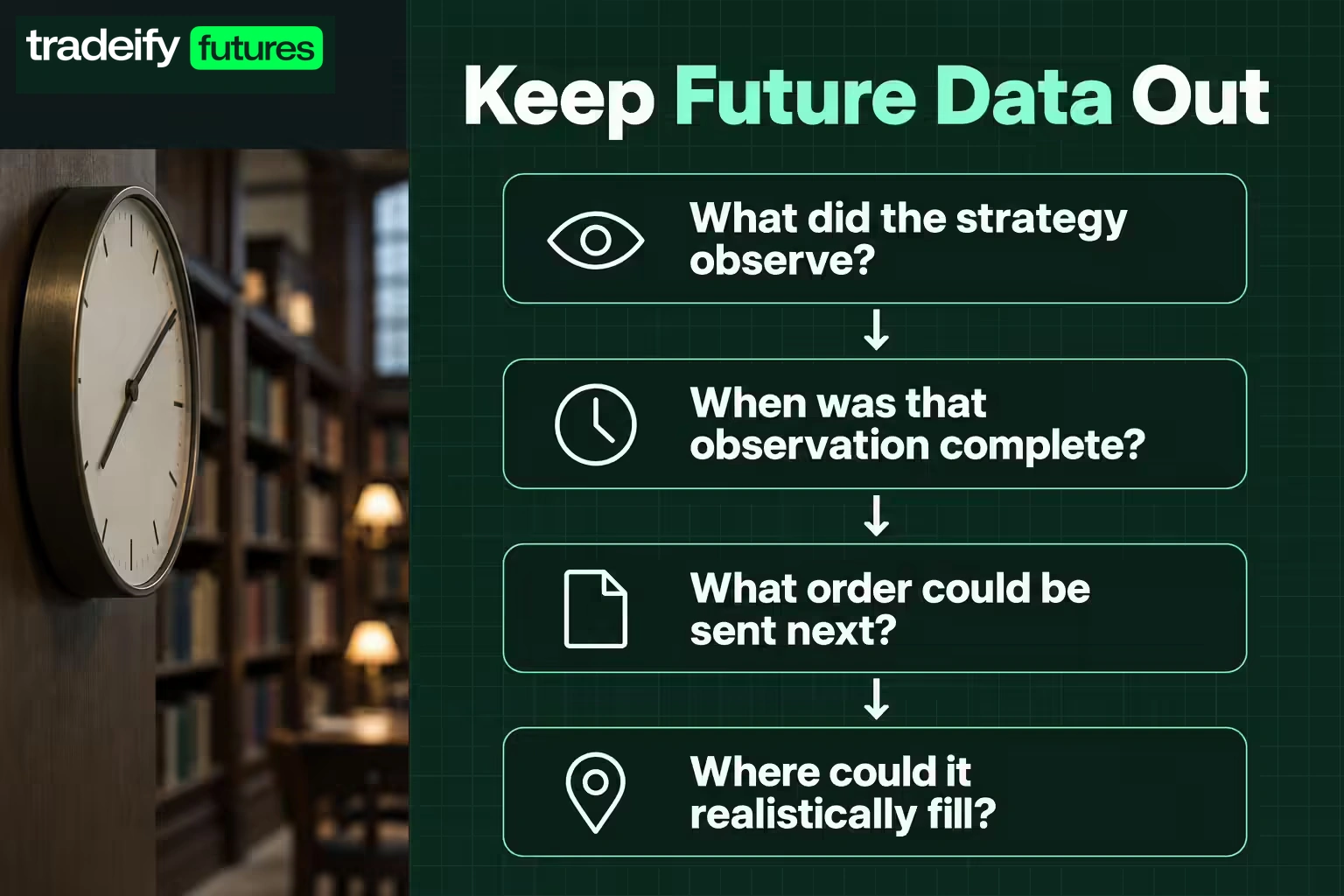
Use a simple decision chain. What did the strategy observe? When was that observation complete? What order could be sent next? Where could it realistically fill?
If any step depends on the finished bar while claiming a fill inside that bar, the sequence is invalid. Stamp every input with the earliest time it could have been known, then delay the decision or fill until the next executable moment.
Backtesting Mistake Two Overfits the Past
Overfitting is the most dangerous backtesting mistake because it can make a weak strategy look precise. If you keep adjusting rules until they fit past market conditions, the result may fail as soon as volatility, participation, or market structure changes. The hard part is admitting that the winning test may be the luckiest version, not a durable strategy.
Changing a moving-average length from 18 to 19 may seem harmless. Testing hundreds of lengths, stop sizes, sessions, filters, and exits creates a multiple-testing problem. The winning version may describe noise rather than a durable market behavior.
Research on backtest overfitting explains why searching many variations against a limited sample can produce statistical mirages. The danger increases when the researcher reports only the winner and forgets how many candidates lost.
Keep a variation log. Record every parameter set, filter, and market tried.
Then look at the shape of the result. A stable idea should usually have neighboring settings that remain usable. One perfect setting surrounded by failure is a warning. If moving a stop by one tick destroys the edge, the strategy may be describing noise with impressive precision.
Backtesting Mistake Three Uses One Market Condition
A trend strategy tested during a persistent trend is not a general strategy. It is a description of one favorable period.
That does not make the strategy worthless. It changes the claim. You may have a conditional method for trending conditions, not an all-weather system. The next job is to define how those conditions are identified without using hindsight.
Your sample should include different volatility, liquidity, and directional conditions. For futures, that may include quiet sessions, fast news-driven sessions, contract roll periods, overnight activity, and extended ranges.
The goal is not to make the strategy work everywhere. It is to learn where it should not be traded.
Observation: volatility contracts and follow-through disappears. Interpretation: the setup may be outside its tested condition. Condition: your regime filter must be present before entry. Action: skip the trade. Invalidation: if the filter cannot be defined without looking at the outcome, it is not a usable guardrail.
Split performance by regime and check whether most of the profit comes from a narrow cluster. If removing a few exceptional weeks destroys the result, the edge is less stable than the headline return suggests.
Backtesting Mistake Four Uses Poor Market Data
Bad inputs create precise-looking bad outputs. A decimal place does not make the source data trustworthy.
Missing bars, incorrect timestamps, duplicated trades, stale quotes, wrong session settings, and adjusted prices can all change signals. Futures tests need extra care around contract rolls. A continuous contract may be useful for analysis, but its synthetic price history may not match an executable contract series.
Before trusting results:
- Check timezone and daylight-saving handling
- Confirm regular and overnight session definitions
- Inspect missing or duplicated bars
- Verify corporate actions for equities
- Review futures contract roll logic
- Compare a sample of prices with a second source
Data cleaning is not busywork. It is part of the strategy because a rule cannot be more reliable than the timestamps, prices, and instrument history feeding it.
Spot-check winning and losing trades against a second source. If the strategy’s best days line up with missing bars, bad rolls, or unusual adjustments, pause the conclusion until the data is repaired.
Backtesting Mistake Five Hides Failed Instruments
Survivorship bias occurs when the sample contains only instruments that still exist or still qualify today. It quietly removes some of the failures you needed the test to see.
A stock strategy tested on current index members ignores companies that were removed, acquired, delisted, or failed. That can make historical selection look safer and stronger than it was.
The same logic applies to funds, crypto assets, and markets. If an instrument disappears from the dataset after failure, the test may keep the winners and erase part of the risk.
Use point-in-time membership and delisted data when the strategy selects from a changing universe. If that data is unavailable, state the limitation and narrow the claim.
Do not patch the gap with confidence. “Tested on today’s surviving universe” is a smaller but more honest statement than “works across the market.”
Backtesting Mistake Six Assumes Perfect Execution
The chart touches your price, so the test records a fill. Real orders do not work that neatly.
Imagine a bar that trades through both your stop and target. A candle shows the full range, not the sequence. If the tester always awards the target first, the backtest is making the most favorable decision after the fact.
A limit order may sit behind other orders. A stop can fill beyond its trigger in a fast market. A bar can trade through both the target and stop without showing which came first. Market orders cross the spread, and larger orders may consume several price levels.
The CME liquidity methodology describes bid-ask spread, order-book depth, and cost to trade as distinct liquidity measures. That is the practical point: printed price alone does not prove an executable fill.
Use conservative rules for ambiguous bars, model the bid and ask when possible, and test worse execution.
Then ask what would change the conclusion. If one tick of extra slippage destroys the strategy, the margin for error is too thin. If the result remains acceptable under a realistic adverse-fill scenario, the execution assumption has room to be wrong.
Backtesting Mistake Seven Omits Trading Costs
Gross profit is not net profit. The smaller the target and the higher the trade count, the less room you have to pretend otherwise.
Commissions, exchange fees, spreads, slippage, platform charges, data costs, and financing or holding costs can change the result. High-frequency and small-target strategies are especially sensitive because the cost repeats often and consumes a larger share of each expected win.
CME’s review of trading costs in FX markets separates direct transaction fees, the bid-ask spread, and position-holding costs. The exact cost varies by product and provider, but the testing lesson is broad: use the costs that match the market and execution path.
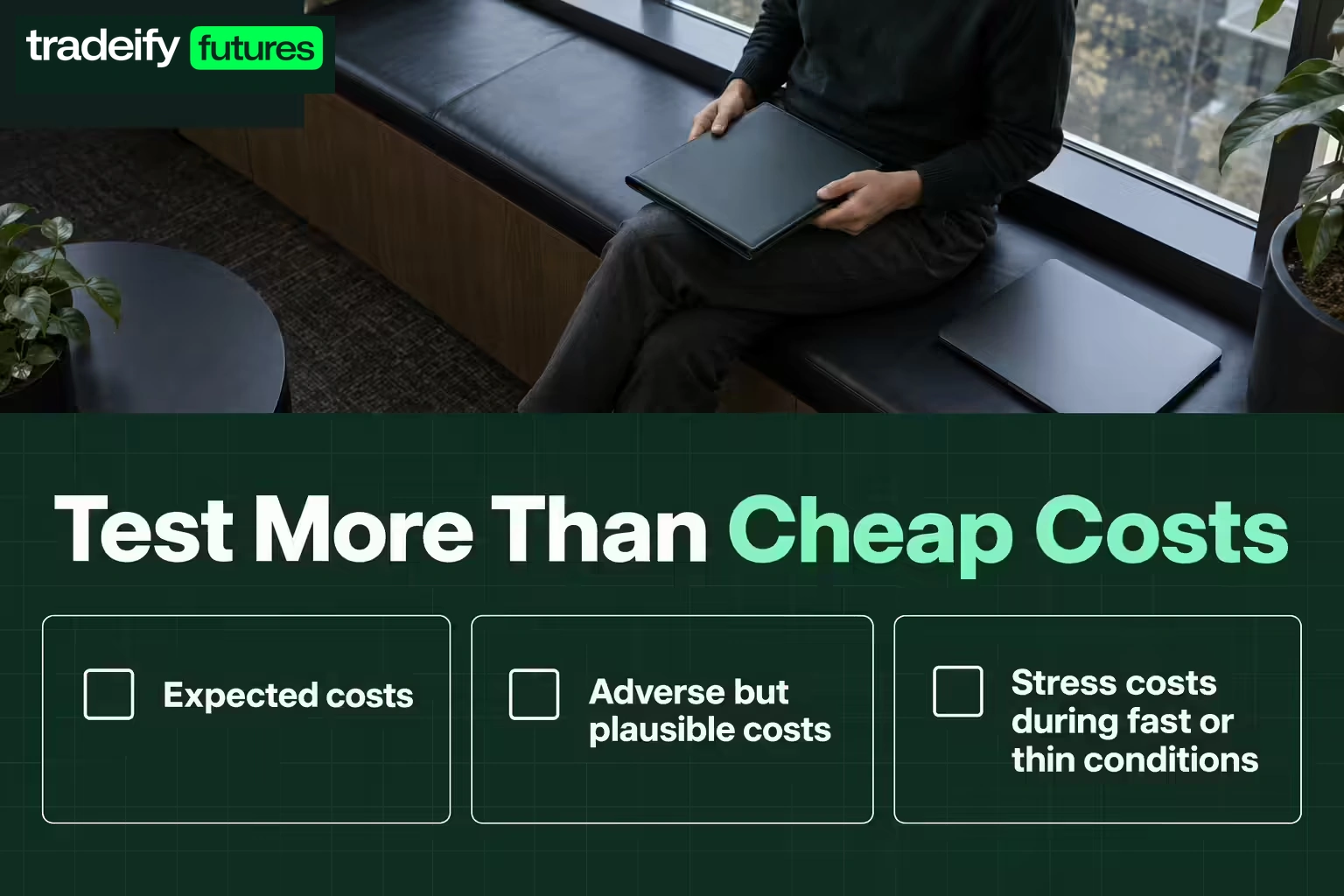
Run at least three scenarios:
- Expected costs
- Adverse but plausible costs
- Stress costs during fast or thin conditions
A strategy that remains acceptable across the range deserves more attention than one that works only at the cheapest assumption.
This test also changes behavior. When you know the real cost per trade, a marginal setup stops looking free. Skipping it can be part of the edge.
Backtesting Mistake Eight Changes Rules Mid-Test
You notice a losing month and add a filter. Another period struggles, so you adjust the stop. A third period still looks rough, so you exclude a session.
By the end, every historical problem has a custom repair. That is hindsight dressed as development.
Write the entry, exit, sizing, session, and invalidation rules before the run. Freeze them for the selected sample. If you learn something useful, create a new version and test it on untouched data.
Version control matters even for discretionary strategies. Save the rule date, the reason for the change, and the data already viewed.
The rule exists to keep learning separate from scoring. Once you have studied a period and changed the strategy because of it, that period cannot serve as a clean final test. Your memory has already seen the answer.
Backtesting Mistake Nine Uses Too Few Trades
Ten wins can feel persuasive, especially when you want the strategy to be ready. They are still ten observations.
A small sample can hide losing streaks, weak regimes, and the true variation of returns. It can also make one large winner carry the entire result.
There is no universal minimum trade count because dependence, holding period, market variety, and payoff distribution matter. One hundred nearly identical trades during the same condition may provide less information than a smaller set across several independent periods.
Review:
- Total trades and independent setups
- Winners and losers by condition
- Average and median outcome
- Largest winner’s share of total profit
- Maximum losing streak
- Drawdown duration
- Sensitivity to removing the best trades
Do not use a round number as proof of adequacy. Use enough evidence to encounter the failure modes the strategy claims to manage.
If the test has never produced the losing streak your risk plan assumes, that does not prove the streak cannot happen. It may mean the sample has not been challenged yet.
Backtesting Mistake Ten Skips Out-of-Sample Validation
Development data teaches you the rules. It should not also provide the final exam.
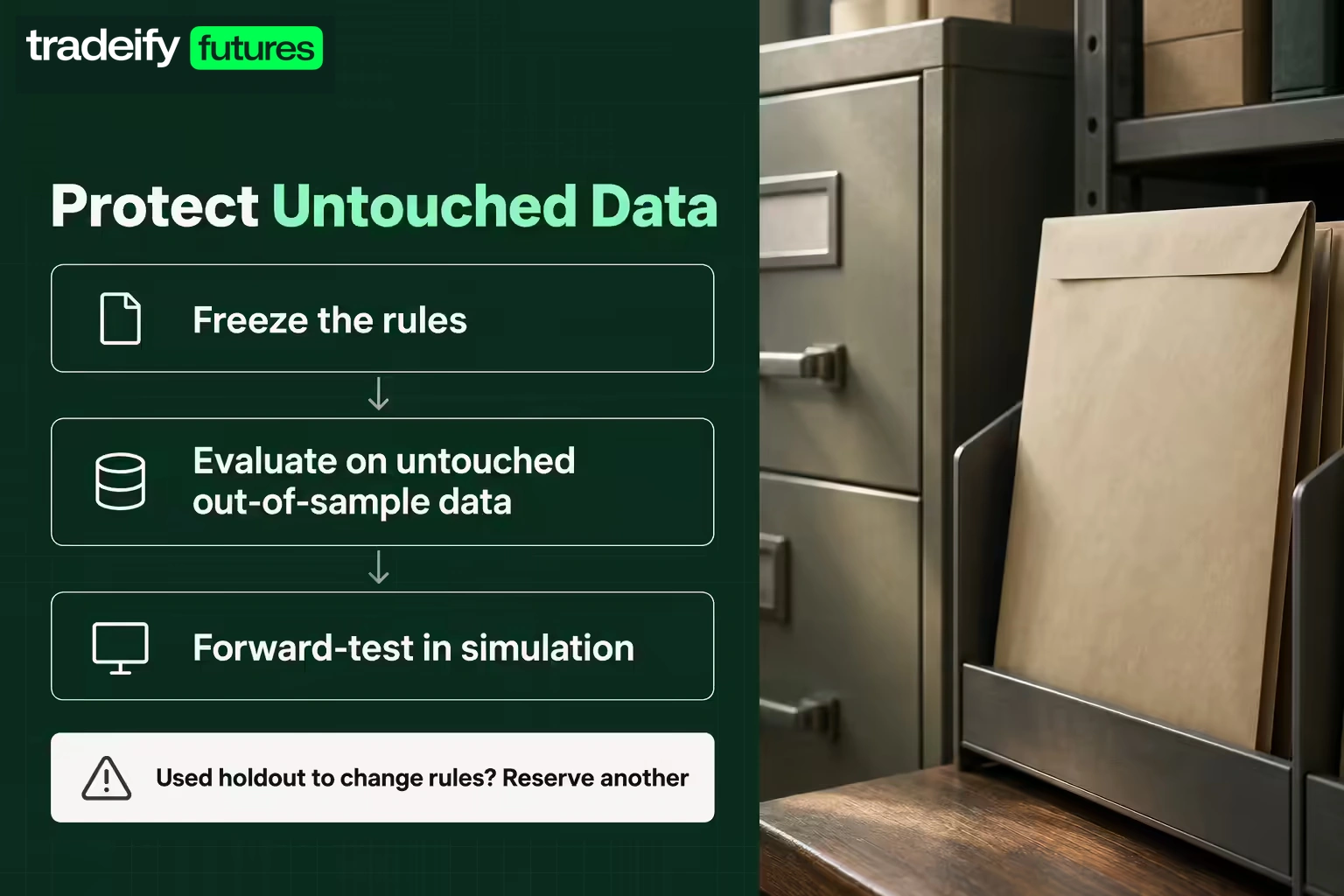
Reserve a later period that remains untouched until the strategy is locked. If the result survives, move to forward simulation where signals arrive one at a time and execution decisions cannot be revised after the fact.
A practical sequence is:
- Define the hypothesis and market behavior
- Build rules on an in-sample period
- Test stability across parameter ranges
- Freeze the rules
- Evaluate on untouched out-of-sample data
- Forward-test in simulation
- Review live or evaluation risk at the smallest appropriate scale
Do not keep reopening the holdout set after every failure. Once you use it to make a change, it becomes development data and a new holdout is needed.
Forward simulation adds a different test. Can you take the valid setup after two losses? Can you leave a slow session alone? Can you accept a clean stop without rewriting the rule? Those behaviors are part of execution, and a historical equity curve cannot answer for you.
How to Validate a Backtesting Process
Use this final check before treating a result as decision-ready.
- The strategy has a stated market hypothesis
- Every input was available at the decision time
- Every order uses an executable timing assumption
- Data errors and universe changes were reviewed
- Costs and slippage are included
- All tested variations are logged
- Results are segmented by market condition
- The trade sample contains meaningful losses and drawdowns
- A locked out-of-sample period remains
- Forward simulation follows the same written rules
The CFTC’s discussion of hypothetical performance disclosures warns that simulated results do not represent actual trading, may miss effects such as liquidity, and benefit from hindsight. That does not make backtesting useless. It defines the job correctly.
A backtest is a filter for weak ideas and a rehearsal for rules. It is not a guarantee of profit, a prop firm pass, or a funded-account payout. Futures and leveraged products can produce substantial losses, and evaluation limits can end an account before a long-run edge has time to appear.
Fix Backtesting Mistakes Before Adding Risk
The cleanest next step is specific. Lock one strategy version. List every assumption. Rerun the test with realistic timing, costs, and adverse fills. Keep one period untouched.
If the result weakens, do not rush to repair the equity curve. Write down which assumption failed and whether the market idea still makes sense. Better to lose an attractive backtest than to pay for the mistake in real time.
.svg)
.svg)
.svg)
.svg)




.webp)