



TL;DR: Intrinsic vs extrinsic value splits an option's premium into what is in the money now and what the market pays for time and uncertainty. Intrinsic value never drops below zero. A $100 call at $10.50 with the stock at $108 holds $8 intrinsic and $2.50 extrinsic. Extrinsic value is the rest of the premium, and it falls to zero at expiration. Split every quote before you compare strikes, because the mix tells you what has to happen for the trade to work.
You buy a call, the stock moves your way, and the option is down anyway. That moment confuses a lot of newer options traders, because they were watching direction and never looked at what the premium was made of.
The intrinsic vs extrinsic value split fixes that blind spot. Once you can see how much of a premium is current in-the-money value and how much is a payment for time and volatility, you stop comparing contracts by price tag and start comparing them by what each one needs to happen.
Intrinsic vs Extrinsic Value in an Option Premium
Intrinsic vs extrinsic value is the standard way to break an option premium into two parts. The Options Clearing Corporation's disclosure document, "Characteristics and Risks of Standardized Options," describes the premium as consisting of two components: intrinsic value and time value. The Options Industry Council adds that time value is also known as extrinsic value.
The relationship is simple:
Option premium = intrinsic value + extrinsic value
Intrinsic value is the amount, if any, by which the option is in the money. Extrinsic value is everything the buyer pays above that amount.
The disclosure document gives a clean example. With a stock at $45, a 40 call trading at $6 carries $5 of intrinsic value and $1 of time value.
That one split answers two different questions about an option premium:
- Intrinsic value answers "what is this option worth if it expired right now?"
- Extrinsic value answers "how much am I paying for what might happen before expiration?"
Neither part is good or bad on its own. The split describes where the price comes from, and each part reacts to different forces, which is exactly why it matters when a trade starts going sideways.
What Intrinsic Value Means in Options
Intrinsic value in options is the in-the-money amount of a contract at a given moment. "Intrinsic" means belonging to the thing itself, and in an option, the part that belongs to the contract itself is the gap between the underlying price and the strike, in the holder's favor.
Three rules follow from that definition:
- Only in-the-money options have intrinsic value. At-the-money and out-of-the-money options have zero.
- Intrinsic value never goes below zero. An option holder has a right, not an obligation, so a contract that is out of the money is simply worth nothing on exercise rather than a negative amount.
- Intrinsic value depends only on two numbers: the underlying price and the strike. Time, volatility and interest rates do not enter the calculation.
That last point is why intrinsic value is a snapshot, not a forecast. A call with $4 of intrinsic value today keeps that $4 only if the stock stays where it is. A drop in the underlying can shrink intrinsic value or erase it.
Intrinsic value also does not tell you whether a trade made money. The buyer paid a premium, and profit depends on that cost, not on intrinsic value alone.
How to Calculate Intrinsic Value on a Call Option
Call option intrinsic value is the amount the underlying price sits above the strike, with a floor of zero:
Call intrinsic value = max(underlying price - strike price, 0)
A call is in the money when the underlying trades above the strike, because the right to buy at the strike is worth more than buying at the market.
Suppose a stock trades at $108 and you look at a $100 call (illustrative prices):
- Underlying price: $108
- Strike price: $100
- Call intrinsic value: max($108 - $100, $0) = $8
If the same stock falls to $96, the $100 call has zero intrinsic value. It does not have negative $4 of intrinsic value, because nobody is forced to exercise a right to buy at $100 when the market price is $96.
The options disclosure document walks through the same logic. With a stock at $46, a 40 call has $6 of intrinsic value. If the stock declines to $44, the call's intrinsic value is only $4. At $40 or below, the call has no intrinsic value at all.
For call buyers, the rule cuts both ways. Every dollar the stock moves over the strike adds a dollar of intrinsic value per share, and every dollar it gives back takes one away.
How to Calculate Intrinsic Value on a Put Option
Put option intrinsic value is the amount the strike sits above the underlying price, again with a floor of zero:
Put intrinsic value = max(strike price - underlying price, 0)
A put is in the money when the underlying trades below the strike, because the right to sell at the strike is worth more than selling at the market.
Suppose a stock trades at $92 and you look at a $100 put (illustrative prices):
- Strike price: $100
- Underlying price: $92
- Put intrinsic value: max($100 - $92, $0) = $8
If the stock rallies to $104, the $100 put has zero intrinsic value.
The options disclosure document uses a matching example: with the stock at $46, a 50 put has $4 of intrinsic value. If the stock rose to $50 or higher, the put would have none.
Put intrinsic value is the mirror image of call intrinsic value. A put gains a dollar of intrinsic value for every dollar the stock falls under the strike, and loses it as the stock recovers.
Related lesson: Review in-, at-, and out-of-the-money options
What Extrinsic Value Means in Options
Extrinsic value in options is the part of the premium above intrinsic value. The options disclosure document defines time value as whatever the premium is in addition to intrinsic value, the part that reflects the time remaining before expiration.
Traders use "extrinsic value" and "time value" interchangeably, but extrinsic is the more accurate word. Time is not the only input. Implied volatility, interest rates, dividends and plain supply and demand all feed the amount above intrinsic value.
The Options Industry Council describes time value as the amount an investor is willing to pay above intrinsic value, reflecting hope that the option gains value before expiration. That is a fair way to read it. Extrinsic value is what you pay for the chance that something changes before the contract runs out.
Three things make extrinsic value different from intrinsic value:
- It exists only before expiration. At expiration it is zero.
- It is not anchored to the underlying price alone. It can rise or fall while the stock sits still.
- Out-of-the-money options are made entirely of it.
A buyer pays extrinsic value and needs the underlying to move far enough, fast enough, to cover it. A seller collects extrinsic value and accepts the obligations and risks of the short position in exchange.
How to Calculate Extrinsic Value From an Option Quote
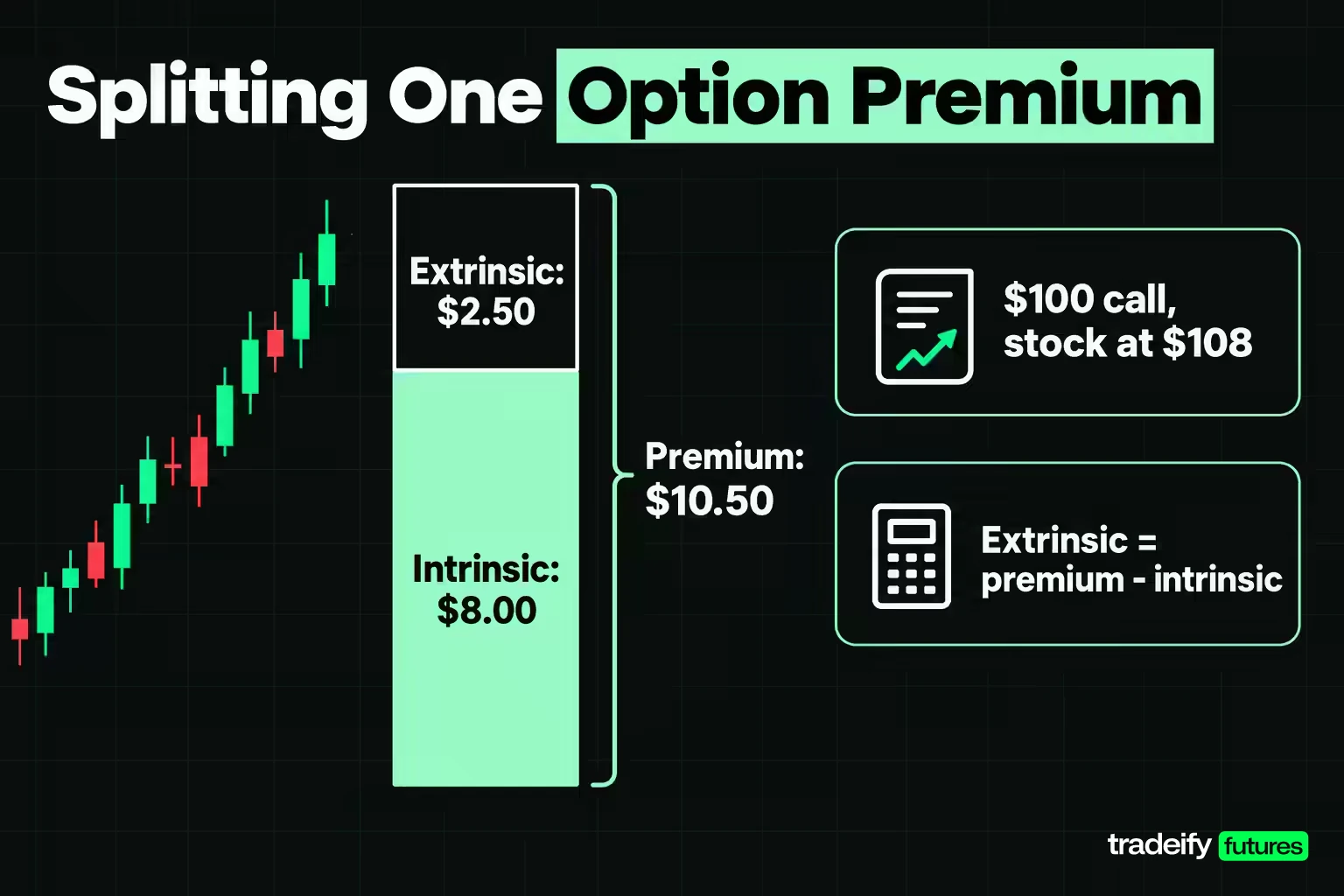
Extrinsic value is calculated by subtracting intrinsic value from the option's premium:
Extrinsic value = option premium - intrinsic value
Take a $100 call quoted at $10.50 while the stock trades at $108 (illustrative prices):
- Premium: $10.50
- Intrinsic value: $108 - $100 = $8.00
- Extrinsic value: $10.50 - $8.00 = $2.50
Now take a $110 call quoted at $3.20 with the same stock at $108:
- Premium: $3.20
- Intrinsic value: $0, because the call is out of the money
- Extrinsic value: $3.20
The second call has no intrinsic value but still has a price. Every cent of it is extrinsic.
Converting extrinsic value to dollars per contract
Option quotes are per share, and a standard equity option contract generally represents 100 shares. Investor.gov's options bulletin uses the example of a $2.20 premium equal to $220 per contract.
So the $10.50 call costs $1,050 per contract, of which $250 is extrinsic value. The $110 call costs $320 per contract, all of it extrinsic.
Which quote to use when calculating extrinsic value
Use the price that matches the decision you are making. If you are buying, the ask is what you will likely pay. If you are selling, the bid is closer to what you will receive. A last-traded price can be stale, and a wide bid-ask spread can make the midpoint look better than any fill you will actually get.
The options disclosure document warns that premiums do not have to match any theoretical pricing formula, last sale or other option price at a given moment. Treat any extrinsic value calculation as a reading of the current quote, not a statement of fair value.
Intrinsic and Extrinsic Value for ITM, ATM and OTM Options
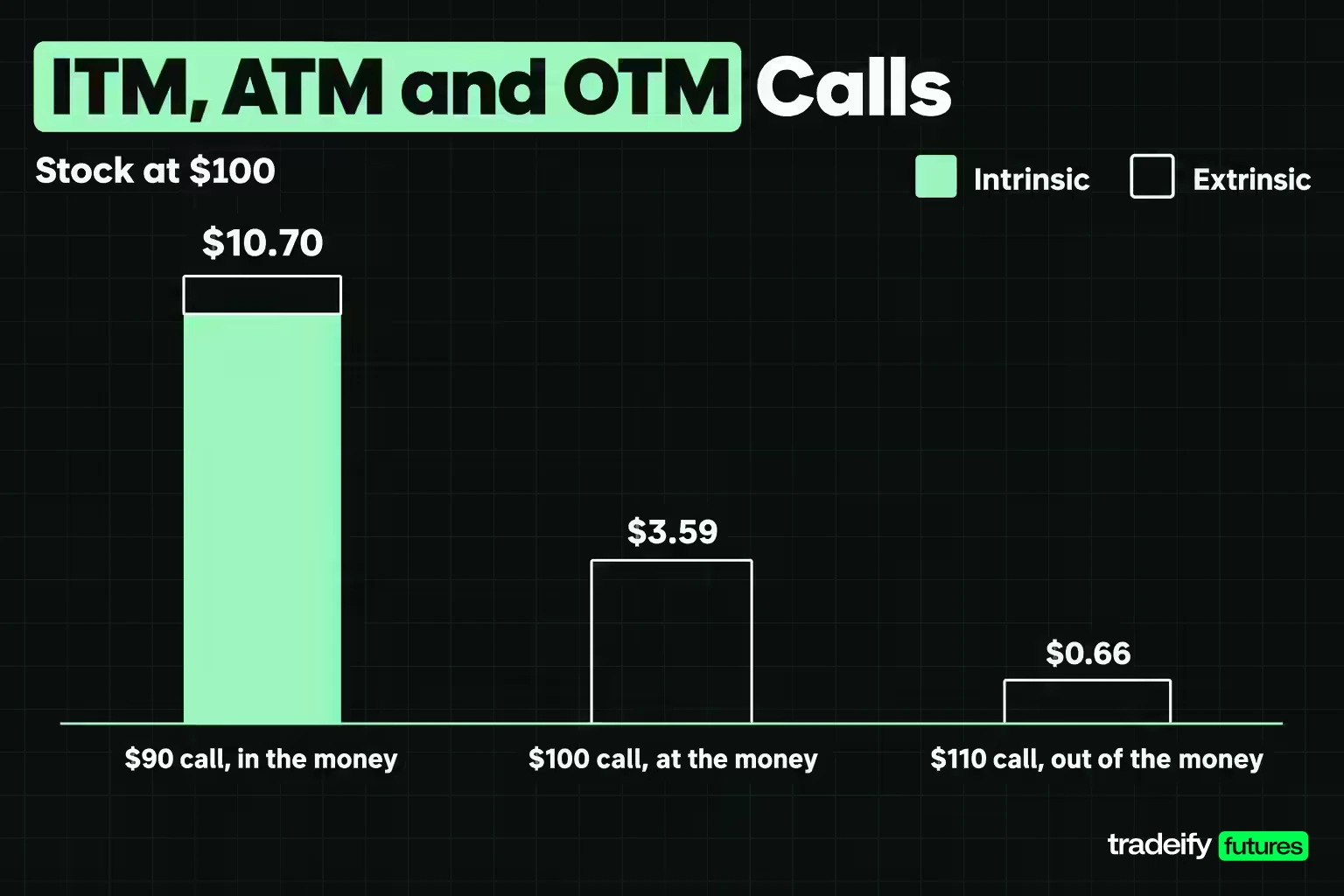
Intrinsic and extrinsic value shift in a predictable pattern as you move across strikes from in the money to out of the money. The table uses Black-Scholes model values computed for this guide (stock at $100, 30 days to expiration, 30% volatility, 4% interest rate, no dividends). They are illustrative, not market quotes.
| Strike | Call premium | Call intrinsic | Call extrinsic | Put premium | Put intrinsic | Put extrinsic |
|---|---|---|---|---|---|---|
| $90 | $10.70 | $10 | $0.70 | $0.40 | $0 | $0.40 |
| $95 | $6.65 | $5 | $1.65 | $1.33 | $0 | $1.33 |
| $100 | $3.59 | $0 | $3.59 | $3.26 | $0 | $3.26 |
| $105 | $1.66 | $0 | $1.66 | $6.32 | $5 | $1.32 |
| $110 | $0.66 | $0 | $0.66 | $10.29 | $10 | $0.29 |
What the strike table shows about moneyness
The pattern in the model matches what the options disclosure document describes:
- In-the-money options carry intrinsic value plus a little extrinsic value. The $90 call is $10.70, and only $0.70 of that is extrinsic. The disclosure document notes that an option substantially in the money normally has very little time value.
- At-the-money options carry the most extrinsic value. The $100 call and $100 put are 100% extrinsic, and their extrinsic value is the largest in the table, because a small move decides whether they finish in or out of the money.
- Out-of-the-money options are all extrinsic, but less of it. The $110 call is $0.66 of pure extrinsic value. The disclosure document says a substantially out-of-the-money option has only time value, normally less than an at-the-money option's.
A cheap out-of-the-money option is not a low-risk option. It is small in dollars, but it is entirely made of the part of the premium that disappears at expiration.
Worked Examples of Intrinsic vs Extrinsic Value
Worked examples make intrinsic vs extrinsic value easier to use in a real comparison. Assume a stock trades at $52 and you are looking at two calls and two puts. The premiums are hypothetical, quoted per share, and each contract covers 100 shares before fees.
| Contract | Premium | Intrinsic value | Extrinsic value | Extrinsic share of premium | Break-even at expiration |
|---|---|---|---|---|---|
| $50 call | $4.20 | $2.00 | $2.20 | 52% | $54.20 |
| $55 call | $1.40 | $0 | $1.40 | 100% | $56.40 |
| $55 put | $4.60 | $3.00 | $1.60 | 35% | $50.40 |
| $50 put | $1.30 | $0 | $1.30 | 100% | $48.70 |
Call intrinsic and extrinsic value in the worked example
The $50 call costs $4.20, or $420 per contract. Its intrinsic value is max($52 - $50, $0) = $2.00, so $2.20 per share ($220 per contract) is extrinsic. The stock needs to reach $54.20 at expiration for the buyer to break even.
The $55 call costs $1.40, or $140 per contract. It is out of the money, so all $1.40 is extrinsic. The stock needs to clear $56.40 at expiration to break even.
The $55 call is cheaper in dollars, yet it depends entirely on a move. The $50 call costs more, but about half of its price is already in the money.
Put intrinsic and extrinsic value in the worked example
The $55 put costs $4.60, or $460 per contract. Its intrinsic value is max($55 - $52, $0) = $3.00, so $1.60 is extrinsic. The stock needs to be at or under $50.40 at expiration for the buyer to break even.
The $50 put costs $1.30 and is entirely extrinsic. The stock needs to fall to $48.70 by expiration for the buyer to break even.
Choosing between high-extrinsic and high-intrinsic options
None of the four contracts in the $52 stock example (a $50 call, a $55 call, a $55 put and a $50 put) is better in the abstract. The split shows what each one needs, and that is the real comparison. A contract that is 100% extrinsic needs the move to arrive before time and volatility drain the premium. A contract with more intrinsic value behaves more like the stock itself and has less to lose from time passing, though it costs more up front and can still lose value if the stock moves the wrong way.
If your view depends on a fast move, an all-extrinsic contract can lose money when the move is late, too small, or arrives with falling implied volatility.
What Drives Extrinsic Value Up or Down
Extrinsic value moves with several inputs at once. The Options Industry Council lists the major factors in an option premium as the underlying price, the strike, time until expiration, implied volatility, dividends and interest rates, with dividends and rates having a lesser effect.
Implied volatility and extrinsic value
Implied volatility is the market's pricing of future movement, not a direction call. The options disclosure document notes that, all else equal, options on more volatile underlying assets command higher premiums.
This Black-Scholes illustration holds a $100 call on a $100 stock fixed at 30 days and a 4% rate, and changes only implied volatility:
| Implied volatility | $100 call premium | Extrinsic value |
|---|---|---|
| 20% | $2.45 | $2.45 |
| 30% | $3.59 | $3.59 |
| 40% | $4.73 | $4.73 |
Because the call is at the money, the whole premium is extrinsic, and a 10-point change in implied volatility moves it by more than a dollar.
Implied volatility drop that shrinks extrinsic value
This is where traders get caught. Imagine buying a 30-day $100 call on a $100 stock at $4.73 with implied volatility at 40% ahead of a scheduled event. The next day the stock rises to $102, but implied volatility falls to 30%.
The model values the call at $4.68 with 29 days left: $2 of intrinsic value and $2.68 of extrinsic value. The stock moved your way and the option is still down slightly, because the extrinsic value fell from $4.73 to $2.68 while intrinsic value rose only $2. Had implied volatility stayed at 40%, the same call would be worth about $5.79.
Reading the direction correctly and making money on the option are two different decisions. The second one also needs the price of volatility to cooperate.
Interest rates, dividends and liquidity
The options disclosure document says higher interest rates tend to raise call premiums and lower put premiums, and lower rates do the reverse. Expected cash dividends also feed stock and index option prices, and the disclosure document lists the depth of the market for the option among pricing factors.
Liquidity matters in a practical way. A wide bid-ask spread means a chunk of the extrinsic value you pay at the ask may never be recoverable at the bid.
Time Decay and Extrinsic Value Into Expiration
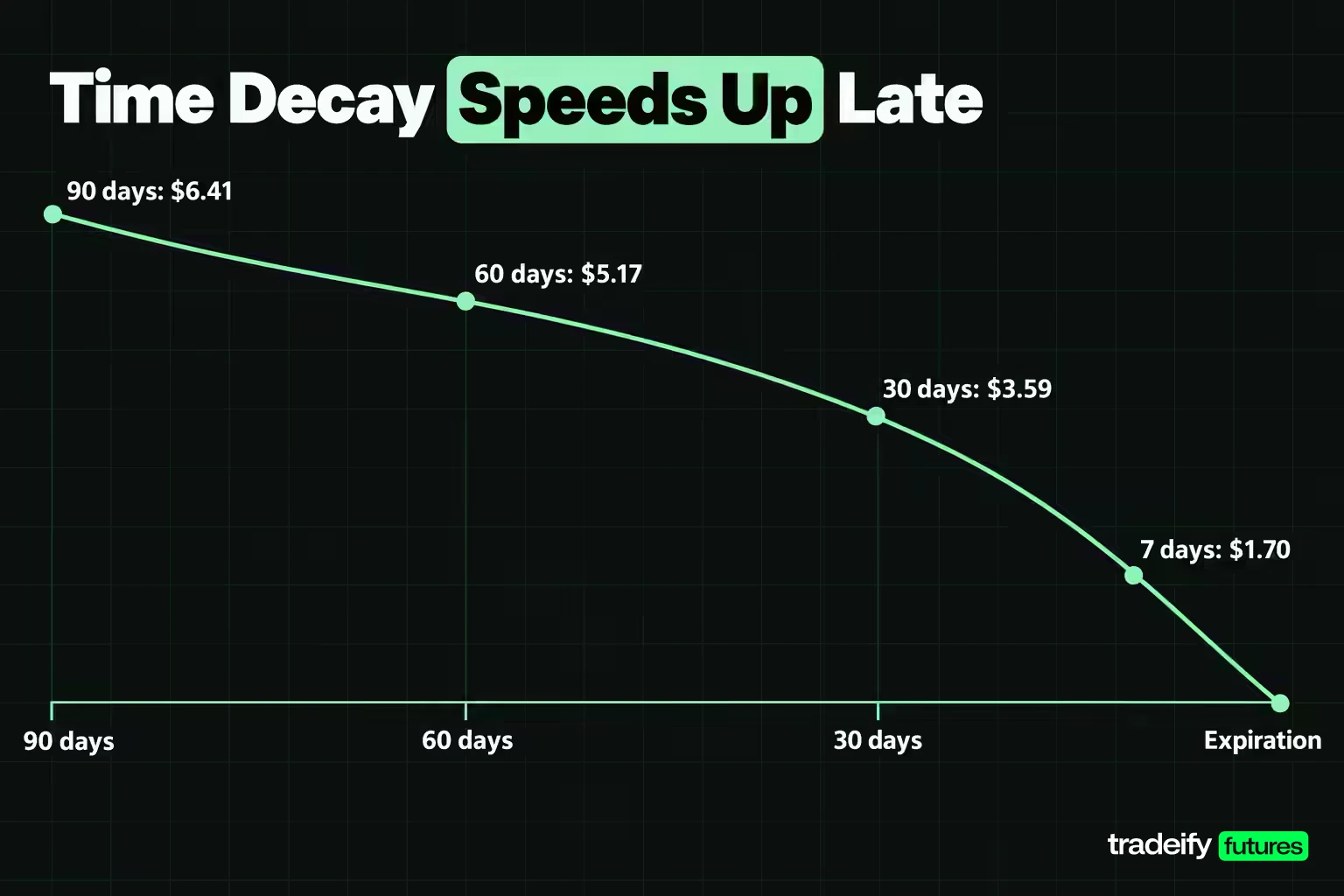
Time decay is the steady loss of extrinsic value as an option approaches expiration. The options disclosure document calls an option a "wasting" asset: if it is not sold or exercised before expiration, it becomes worthless. It adds that, all else the same, time value usually decreases as expiration approaches, and the decrease accelerates as time to expiration shortens.
A Black-Scholes illustration shows how uneven that decay is. It values a $100 at-the-money call with the stock held at $100, 30% volatility and a 4% rate:
| Days to expiration | $100 call value (all extrinsic) |
|---|---|
| 90 | $6.41 |
| 60 | $5.17 |
| 30 | $3.59 |
| 14 | $2.42 |
| 7 | $1.70 |
| 1 | $0.63 |
| 0 | $0 |
The week from 90 to 83 days costs this option about $0.27. The final 7 days cost $1.70. Theta is the Greek that estimates this daily decay, and it gets larger for at-the-money options as expiration nears.
"All else the same" matters. A jump in implied volatility or a sharp move in the stock can outweigh a day of decay, so the premium rarely falls in a smooth line.
What happens to intrinsic and extrinsic value at expiration
At expiration there is no time left for a new outcome, so extrinsic value is zero. An option is then worth its intrinsic value, if any, subject to its settlement terms.
Two checks follow:
- An out-of-the-money option has zero intrinsic value at expiration and can expire worthless.
- An in-the-money option can still lose money for its buyer. If you paid $4.20 for a $50 call and the stock is $53 at expiration, the option has $3 of intrinsic value, but the trade loses $1.20 per share ($120 per contract) before fees.
Why exercising early can give up extrinsic value
Exercising an American-style option before expiration captures only intrinsic value. Whatever extrinsic value remains is lost. The options disclosure document notes that closing transactions may let a holder realize remaining time value that would be lost in an exercise.
Take a $100 call quoted at $10.50 with the stock at $108 (illustrative prices). Exercising captures $8 of intrinsic value, while selling the option captures $10.50. Exercise leaves $2.50 per share, or $250 per contract, on the table.
Intrinsic Value vs Market Price
Intrinsic value vs market price is a distinction that applies to both options and stocks, with a different meaning in each.
Option intrinsic value vs the option's market price
For an option, the market price is the premium, and intrinsic value is the floor component inside it. The options disclosure document says an American-style option may ordinarily be expected to trade for no less than its intrinsic value before expiration, although occasionally one trades below it. European-style options, which cannot be exercised at all times, are more likely to trade below intrinsic value when they are not exercisable.
So most of the time, an option's market price equals intrinsic value plus a positive extrinsic value. When a quote looks like it sits under intrinsic value, check the inputs first: a stale underlying price, a stale option print or a wide spread usually explains it. If the price is real, the option's style and exercise terms are the next things to check.
Stock intrinsic value vs the share price
For a stock, "intrinsic value" means something else: an estimate of what the business is worth, as opposed to what the market is paying today. Berkshire Hathaway's Owner's Manual defines it as "the discounted value of the cash that can be taken out of a business during its remaining life," and adds that the calculation is not so simple.
The general formula behind that definition is a discounted cash flow:
Stock intrinsic value = sum of each future cash flow / (1 + discount rate) raised to the number of years until it arrives
A toy example: if a business could pay out $5 a share every year for 10 years and nothing after, discounting at 10% gives a present value of about $30.72 a share. Change the cash flow forecast or the discount rate and the answer changes, which is why two analysts can reach very different intrinsic values for the same stock.
The key difference: an option's intrinsic value is a fixed calculation from two observable prices. A stock's intrinsic value is an estimate built on assumptions about the future.
Using Intrinsic and Extrinsic Value in Trading Decisions
Intrinsic and extrinsic value become useful when they change what you do. The split shows what each position is really betting on.
How option buyers can use the value split
Buyers pay extrinsic value, so they need the move to beat it. Practical ways to apply that:
- Compare extrinsic value, not just premium. Two strikes with similar prices can carry very different amounts of extrinsic value.
- Match expiration to the expected timing of the move. A short-dated, all-extrinsic contract leaves little room for the move to be late.
- Know what in-the-money options buy you. More intrinsic value means the option tracks the stock more closely and loses less to decay, at a higher dollar cost and with real downside if the stock reverses.
- Be careful around scheduled events. Extrinsic value often reflects expected volatility, which can drop once the news is out.
How option sellers can use the value split
Sellers collect extrinsic value, and decay works in their favor if nothing else changes. That trade-off has a cost: a seller's risk can be large, the option can be assigned, and a sharp move can turn a small credit into a big loss. Extrinsic value is the compensation for carrying that risk, not free income.
A premium check before an options trade
Run these steps in order before placing an options order:
- Record the underlying price, strike, call or put, expiration and the executable bid or ask.
- Calculate intrinsic value with the right formula.
- Subtract intrinsic value from the premium to find extrinsic value.
- Convert per-share figures to contract dollars using the multiplier.
- Note the days left and any scheduled event that could move implied volatility.
- Check the bid-ask spread and size before trusting the displayed mark.
- Define the exit, the maximum premium at risk and what would invalidate the idea.
If nearly all the premium is extrinsic, the trade depends on timing and volatility as much as direction. That is not a reason to skip it, but it is a reason to size it as a premium you can lose in full. The options disclosure document warns that an option holder can lose the entire amount paid in a relatively short period.
Intrinsic and Extrinsic Value in Options on Futures
Intrinsic and extrinsic value work the same way when the underlying is a futures contract instead of a stock. The underlying price in the formula is the futures price, and the multiplier comes from the contract.
CME's rulebook for options on E-mini S&P 500 futures sets the trading unit as an option on one E-mini S&P 500 futures contract, quoted in index points, with each point worth $50 per option contract.
An illustrative example: with the futures at 6,000, a 5,900 call quoted at 140 points has 100 points of intrinsic value ($5,000) and 40 points of extrinsic value ($2,000), for a total premium of $7,000 per contract.
Futures traders who never touch options can still use the split. Option premiums show how much movement the market is paying for, and extrinsic value tends to swell before scheduled data and shrink after it. That context helps explain why a futures market can whip around a release.
On our Tradeify accounts you trade futures such as ES, NQ, CL and GC, not options. We don't offer options of any kind, and our funded accounts are simulated, so treat this guide as general options education and the futures context as the part that carries over.
Intrinsic vs Extrinsic Value FAQ
What is the difference between intrinsic and extrinsic value of an option?
Intrinsic value is the amount an option is in the money right now. Extrinsic value is the rest of the premium, paid for time, volatility and other pricing inputs. Together they equal the option's premium.
Can intrinsic value be negative?
No. Intrinsic value has a floor of zero. A call with the stock under its strike and a put with the stock over its strike both have zero intrinsic value.
Is extrinsic value the same as time value?
The terms are used interchangeably. Extrinsic value is more precise, because implied volatility, interest rates, dividends and supply and demand also shape the premium above intrinsic value.
What does "intrinsic" mean?
Intrinsic means belonging to the thing itself. In options it is the value the contract holds from its strike and the current price alone. In stocks it is an estimate of what the business is worth apart from its share price.
What is the difference between intrinsic value and acquired value?
Intrinsic value is worth something has in itself. Acquired, or extrinsic, value comes from outside factors such as what others will pay or what something leads to. In options, intrinsic value comes from the strike and price, while extrinsic value comes from time and market expectations.
What is the formula for calculating the intrinsic value of a stock?
The common method is a discounted cash flow. You estimate the cash a business can return in future years and discount each amount back to today. The result depends heavily on the forecasts and discount rate you choose.
What is the 7% rule in stocks?
The 7% rule is a loss-cutting guideline popularized by Investor's Business Daily. It says to sell a stock if it falls 7% or 8% below your purchase price. It is a risk rule of thumb, not a valuation method, and it has nothing to do with option pricing.
Why can an option lose value when the stock moves in my direction?
The move may be too small or too slow to offset time decay, implied volatility may fall, or the spread may widen. Intrinsic value can rise while extrinsic value falls faster.
Read the Intrinsic and Extrinsic Value Split Before Every Order
The intrinsic and extrinsic value split takes about a minute per contract and changes how you read every quote. Before your next options order, write down the premium, the intrinsic value and the extrinsic value side by side.
Then ask one question: does this idea need only direction, or does it also need a specific pace and a stable or rising implied volatility? If the answer is the second one and the contract is mostly extrinsic, either pick a contract with more time or more intrinsic value, or size it as a premium you are prepared to lose in full.
Options can lose their entire premium quickly, short options can carry losses far larger than the premium collected, and futures and options on futures use leverage that can magnify losses. Model values and examples in this guide are illustrative. Prop firm evaluation and funded accounts are simulated. This material is for education only and is not investment advice.


