




TL;DR: Mutual funds pool investor money into one managed portfolio, bought and sold only at the next end-of-day NAV. The real decision is whether a fund's job, holdings, risk and total cost fit your goal. On $10,000 over 10 years at 6%, a 1.00% expense ratio ends about $1,284 behind a 0.20% one. Loads of 2% to 5%, 12b-1 fees and taxable distributions also cut the return you keep.
Mutual funds let one purchase spread your money across dozens or thousands of stocks or bonds, chosen by a manager or by an index rule. That convenience is the reason they sit at the center of so many retirement plans and brokerage accounts.
It is also why people skip homework they would never skip on a single stock. A mutual fund still has a strategy, a cost structure, a tax profile and a portfolio that can fall in value. This guide covers how mutual funds work, how they are priced and taxed, what they really cost, and a repeatable way to choose one.
What Are Mutual Funds
A mutual fund is an SEC-registered open-end investment company that pools money from many investors and invests it in stocks, bonds, short-term money market instruments or a mix of them. The combined holdings are the fund's portfolio, and an SEC-registered investment adviser manages it.
When you buy shares of a mutual fund, you do not own the individual stocks or bonds directly. Each fund share is a proportional claim on the whole portfolio and on the income and gains or losses it produces.
"Open-end" is the defining feature. The fund sells new shares to anyone who wants to buy and buys back (redeems) shares from anyone who wants to sell, so the number of shares outstanding changes every day. You trade with the fund itself, or through a broker or adviser acting for you, not with other investors on an exchange.
That sets mutual funds apart from two close relatives:
- Closed-end funds raise money once, then list on an exchange. Their share price moves with supply and demand and can sit above or below the value of the holdings.
- Unit investment trusts (UITs) buy a mostly fixed portfolio in a one-time offering and terminate on a preset date.
One more point belongs in the definition. Mutual funds are not bank deposits. They are not guaranteed or insured by the FDIC or any other government agency, and you can lose some or all of the money you invest.
How Mutual Fund Pricing Works With NAV
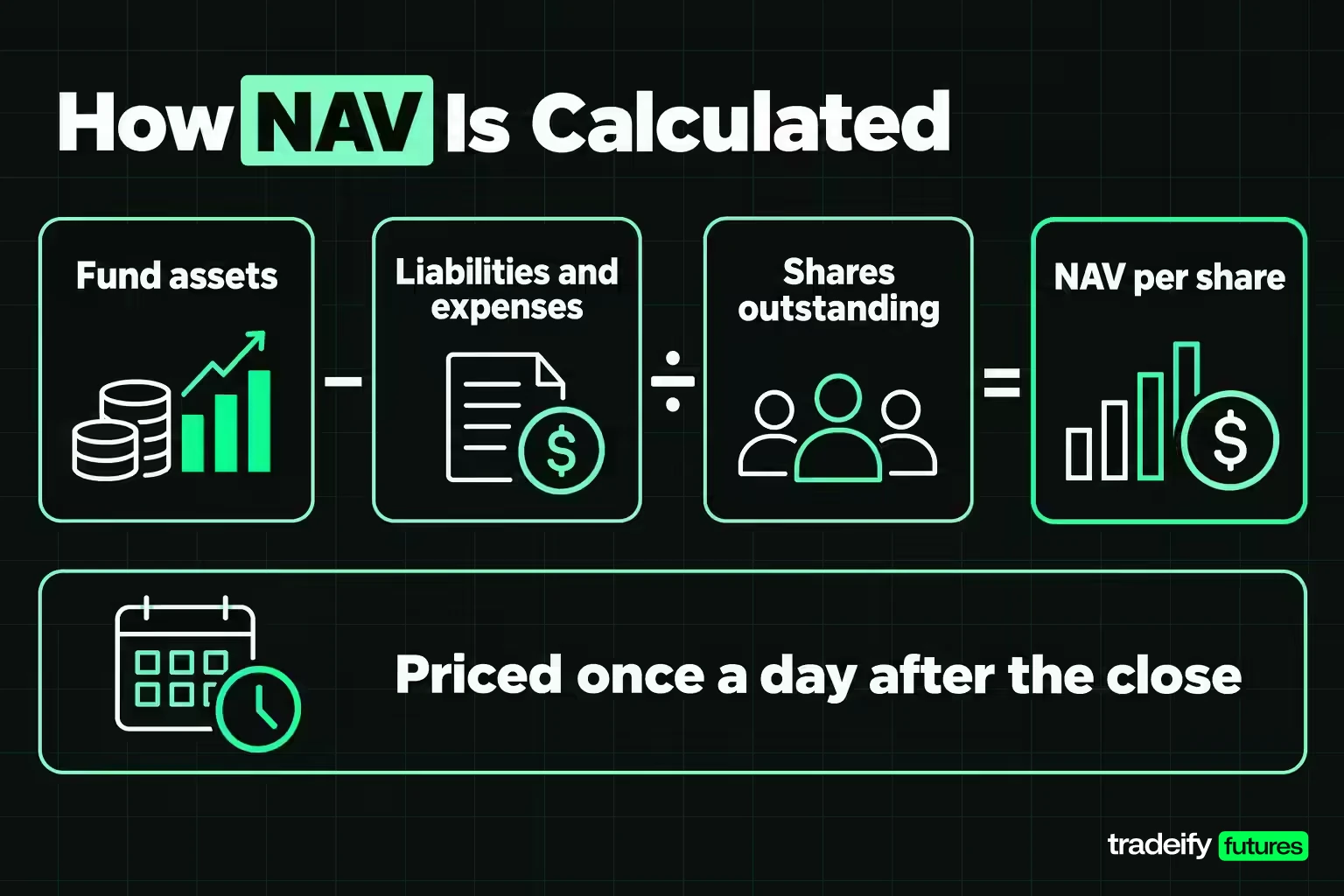
Mutual fund shares are priced at net asset value (NAV), calculated once per business day after the markets close. NAV per share is the value of everything the fund owns, minus its liabilities and accrued expenses, divided by the number of shares outstanding.
A round illustrative example shows the math:
- Portfolio value: $105 million
- Liabilities and accrued expenses: $5 million
- Shares outstanding: 4 million
- NAV per share: ($105 million minus $5 million) divided by 4 million = $25.00
Forward pricing and what it means for your order
SEC Rule 22c-1 requires funds to buy and redeem shares at the NAV "next computed" after they receive your order. This is called forward pricing.
In practice, an order you place mid-morning and an order you place just before the fund's daily cutoff both get the same end-of-day NAV. You do not know your exact price when you submit the order, and you cannot use a limit price or a stop on a mutual fund.
For an investor adding money every month, that is a feature: nobody can trade the fund at a stale price, and timing within the day does not matter. For a trader used to watching a quote, it is the single biggest mechanical difference from stocks, ETFs and futures.
Why the NAV level does not tell you much
A $10 NAV is not "cheaper" than a $100 NAV. Because mutual funds create and cancel shares constantly and pay out income and gains, the NAV level says little about quality or value. FINRA's guidance is to compare mutual funds by total return over time rather than by NAV.
How Mutual Funds Make Money for Investors
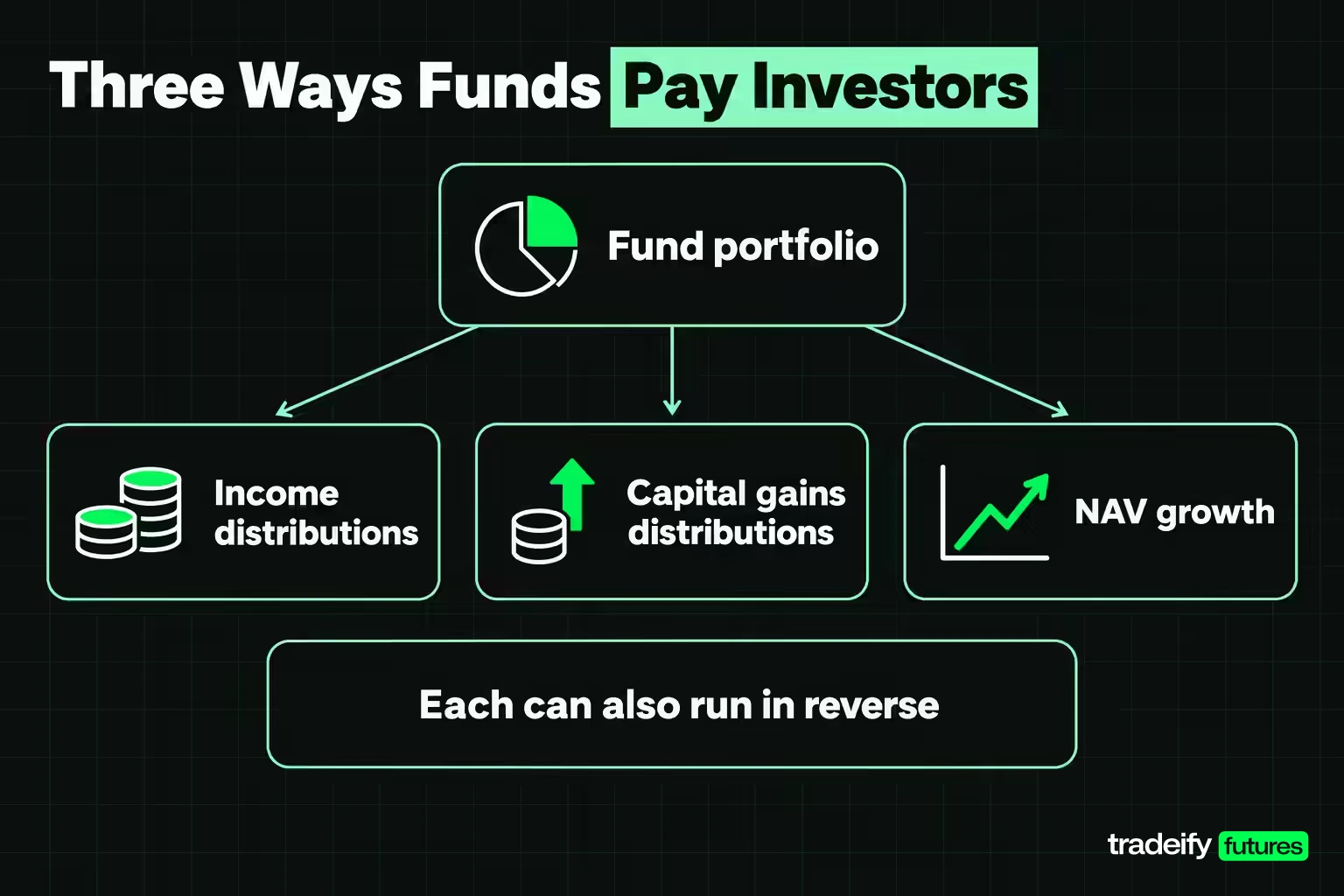
Mutual funds can pay off for an investor in three ways, and every one of them can also run in reverse.
- Income distributions. Stocks in the portfolio pay dividends and bonds pay interest. The fund passes nearly all of that income, minus expenses, to shareholders.
- Capital gains distributions. When the fund sells holdings for more than it paid, it realizes gains. Net gains, after realized losses, are usually distributed toward year end.
- NAV growth. If the market value of the portfolio rises after expenses, the NAV rises, and you capture that gain when you redeem.
Most mutual funds let you take distributions in cash or reinvest them automatically in more shares. Reinvesting keeps the money compounding inside the fund. Taking cash turns the fund into an income source.
Why a distribution is not free money
A distribution moves value from the fund to your pocket, so the NAV drops by about the same amount. Here is a round illustrative example:
- You own 500 shares at a $20 NAV, worth $10,000.
- The fund distributes $1.00 per share, or $500.
- The NAV falls to $19, so your shares are worth $9,500.
- You now hold $9,500 in shares plus $500 in cash, still $10,000 before tax.
Your wealth did not grow on distribution day; it changed form. In a taxable account, part of it may now be taxable. That is why total return (price change plus distributions) is the number that matters, not the distribution yield alone.
What $10,000 in mutual funds can do over five years
There is no single answer to "what happens to $10,000 in five years," because it depends on what the fund owns and what markets do. Running illustrative steady annual returns through $10,000 × (1 + r)^5 shows the range:
| Assumed annual return after fees | Value after 5 years |
|---|---|
| -2% | $9,039 |
| 4% | $12,167 |
| 8% | $14,693 |
Real returns are not steady. A stock fund can fall sharply in one bad year and take years to recover, while a short-term bond fund moves much less in both directions. Five years is also a short window for a stock fund, which is why the outcome range is so wide. Costs matter too: in the same illustration, a 5% front-end sales charge leaves $9,500 invested, which grows to $12,713 at 6% a year versus $13,382 with no sales charge.
Types of Mutual Funds
Thousands of mutual funds exist, but they fall into a handful of major categories. The category tells you the fund's job and its main risk, and that should drive the decision more than the fund's name or last year's return.
Stock mutual funds
Stock funds (equity funds) invest mainly in shares of companies. Within the category, objectives vary widely:
- Growth funds look for companies with above-average expected earnings growth.
- Value funds look for stocks the manager believes are underpriced.
- Equity income funds focus on dividend-paying stocks.
- Small-cap, mid-cap and large-cap funds stick to one company-size range.
- Sector funds concentrate on one industry, such as technology or healthcare.
- International, global, regional and emerging markets funds invest outside, or partly outside, the US.
A broad total-market fund and a narrow sector fund are both "stock funds," but their concentration risk is not remotely the same.
Bond mutual funds
Bond funds (income funds) hold government, municipal, corporate or other debt. Owning a bond fund is different from owning one bond: a single bond promises a set interest rate and your principal back at maturity, while a bond fund holds many bonds with different maturities and has no maturity date of its own. Bond fund prices can fall when interest rates rise or when credit quality weakens. High-yield bond funds own lower-rated debt and carry more credit risk.
Balanced and target-date mutual funds
Balanced funds hold a mix of stocks and bonds at target percentages stated in the prospectus. Target-date funds (lifecycle funds) are usually funds of funds that shift from stocks toward bonds and income as a named year approaches, such as a 2035 fund.
The year in the name is a planning reference, not a promise. Two 2035 funds can hold very different amounts of stock, and a target-date fund that buys other funds can charge two layers of fees.
Money market mutual funds
Money market funds buy short-term, high-quality debt such as Treasury bills and commercial paper, and they aim to keep a share price of $1. They are often used to park cash, but they are investments, not insured bank accounts.
Index, sector and specialty mutual funds
Index funds track a benchmark such as the S&P 500 instead of picking securities. Socially responsible and ESG funds apply stated ethical or environmental screens. Funds of funds invest in other mutual funds, which adds diversification and a second layer of costs.
What a mutual fund name has to mean
SEC Rule 35d-1 (the "names rule") requires a fund whose name suggests a focus, such as "Technology" or "Growth", to invest at least 80% of its assets in that focus under normal conditions. The remaining fifth can go elsewhere, so check the latest holdings report, not just the name.
Active vs Index Mutual Fund Management
Every mutual fund has professional management, but "management" means two different things depending on the fund.
- Actively managed funds give a portfolio manager or team discretion to buy and sell securities in pursuit of the fund's objective, often to beat a benchmark. Results depend heavily on the manager's skill.
- Index (passive) funds aim to match the return of a chosen index before fees. The manager's job is to hold what the index holds and keep tracking error small. Less trading usually means lower costs and fewer realized capital gains.
What you pay a manager for is research, security selection, risk control and the daily administration you would otherwise do yourself. What you are betting on, with an active fund, is that those skills will more than cover the extra cost.
The cost hurdle for active mutual funds
FINRA's illustration makes the math concrete: if an active fund's management and administrative fees are 1.5% and its benchmark returns 9%, the manager has to earn better than 10.5% on the portfolio just to keep pace. Trading costs inside the fund raise the hurdle further.
FINRA also notes that in any given year most actively managed funds do not beat the market, and very few beat their benchmarks over long periods, including funds with impressive short-term records. That does not mean active management never works. It means a strong one-year number is weak evidence, and the burden of proof sits with the higher-cost fund.
How to judge a mutual fund manager
- Compare returns with the fund's stated benchmark over several periods, after fees.
- Check whether the current manager produced the record you are looking at.
- Look for style drift: a "value" fund that has drifted into growth stocks is a different product than the one you researched.
- Ask what kind of market the strategy is expected to lag in. A manager who can explain bad years is easier to hold through them.
How Mutual Funds Diversify a Portfolio
Diversification is the main reason many investors use mutual funds. A fund that spreads money across many companies, industries or bond issuers can limit the damage when one holding fails, without the investor buying each security separately.
The Investment Company Act puts a definition behind the word. A fund that calls itself "diversified" must keep at least 75% of its total assets in cash, government securities, other investment companies and other securities where no single issuer exceeds 5% of the fund's total assets or 10% of that issuer's voting shares. Funds that do not meet the test are "non-diversified" and must say so.
What mutual fund diversification cannot do
Diversification spreads company-specific risk. It does not remove market risk. When a broad stock market falls, a broad stock fund falls with it, and when interest rates jump, most bond funds drop together.
Concentration also hides inside fund labels. Sector funds, single-country funds and non-diversified funds can be narrow by design.
Overlap between mutual funds
Owning five mutual funds is not the same as owning five different portfolios. A large-cap growth fund, an S&P 500 index fund and a technology fund can share many of the same top holdings. Before adding a fund, compare its top ten holdings and sector weights with what you already own. If the overlap is heavy, the new fund adds cost and paperwork more than diversification.
Related lesson: Diversification
Mutual Fund Fees and Expense Ratios
Every mutual fund has costs, and you pay most of them without seeing a bill. The prospectus fee table splits them into two groups: annual fund operating expenses, taken from fund assets, and shareholder fees, charged to you directly when you act.
Annual operating expenses include:
- Management fees, paid to the investment adviser.
- Distribution and service (12b-1) fees, which pay for marketing, selling and some shareholder services. These usually apply to mutual funds but not ETFs.
- Other expenses, such as custody, legal, accounting and transfer agent costs.
Their total, as a percentage of average net assets, is the expense ratio. A 0.50% expense ratio on $10,000 costs about $50 a year; 0.75% costs about $75. You never write a check for it. The fund deducts it daily, so it shows up as a slightly lower NAV.
Shareholder fees can include sales loads, redemption fees, exchange fees and account maintenance fees for small balances.
Limits on mutual fund 12b-1 and redemption fees
FINRA Rule 2341 limits the asset-based sales charge to 0.75% a year and the service fee to 0.25%, which is why 12b-1 fees top out at 1% of assets. A fund cannot call itself "no-load" if it has a sales load or if its sales-related and service fees exceed 0.25%.
SEC Rule 22c-2 caps a redemption fee at 2% of the shares redeemed, and it can only apply to shares sold within a stated window of at least seven calendar days. Funds use these fees to discourage rapid in-and-out trading.
Mutual fund costs the expense ratio leaves out
The expense ratio is the best single cost number, but it is not the whole bill. It excludes sales loads, brokerage commissions you pay to buy the fund, and the fund's own trading costs. A fund with high portfolio turnover (how much of the portfolio it replaces each year) pays more in trading costs, and those reduce returns even though they are not in the expense ratio.
How a small mutual fund fee compounds
FINRA compares two similar funds: one at 0.75% and one at 1.85%. The more expensive fund has to outperform by more than a full percentage point every year just to match the cheaper one.
Here is a round illustrative example. Assume $10,000 earns 6% a year before expenses for ten years, compounded at the gross return minus the expense ratio.
| Expense ratio | Net annual return | Value after 10 years |
|---|---|---|
| 0.20% | 5.80% | $17,573 |
| 1.00% | 5.00% | $16,289 |
The cheaper fund ends $1,284 ahead. An extra 0.80 percentage point looks trivial in any one year, but compounding turns it into a real gap, and the gap widens with larger balances and longer holding periods. A low fee does not make a fund good. It does lower the bar the fund has to clear.
Mutual Fund Sales Loads and Share Classes
A sales load is a commission that pays the broker or adviser who sold you the fund. Not every mutual fund has one, but when a fund does, the load and the share class can change your result more than the choice between two similar portfolios.
Front-end, back-end and level loads
- Front-end load. Taken from your purchase. With a $10,000 investment and a 5% load, $500 goes to the selling firm and $9,500 buys shares. FINRA describes typical front-end loads as ranging from about 2% to 5%.
- Back-end load (contingent deferred sales charge, CDSC). Charged when you sell within a set period, and it usually shrinks each year you hold. In the SEC's example, a 5% back-end load on a $10,000 investment that grew to $12,000 costs $500 (often based on the lower of your original or ending value), so you receive $11,500.
- Level load. A yearly asset-based charge, collected every year you hold the fund.
- No-load. No sales charge, though the fund still has operating expenses and may have other fees.
FINRA Rule 2341 caps a fund's total front-end and deferred sales charges at 8.5% of the offering price when it has no asset-based sales charge.
Breakpoints on mutual fund sales charges
Many load funds cut the front-end charge at larger investment amounts, called breakpoints. FINRA's example is a fund that charges 4.5% instead of 5% on investments of at least $50,000. Funds may let you combine holdings across the fund family or your household, count past purchases (rights of accumulation) or sign a letter of intent to invest more later. If you qualify, the firm must apply the discount, so ask.
Class A, B, C and clean mutual fund shares
One portfolio can be sold in several share classes with different fees:
| Share class | Upfront charge | Ongoing charge | Exit charge | Usually fits |
|---|---|---|---|---|
| Class A | Front-end load, breakpoints available | Lower 12b-1, often 0.25% a year | Usually none | Larger amounts, long holding periods |
| Class B | None | Higher 12b-1 | CDSC, often over six years, then converts to A | Rarely offered now |
| Class C | None | Higher 12b-1, often 1% a year | Often 1% if sold within about a year | Shorter holding periods |
| Clean or transaction shares | No load, though a broker may charge a commission | No 12b-1 | None | Advisory and commission-based accounts |
When Class A beats Class C in an illustration
Here is a round illustrative example. Invest $10,000 in the same portfolio earning 6% a year before costs. Class A charges a 5% front-end load and 0.75% total annual expenses (5.25% net). Class C has no load and 1.50% total annual expenses (4.50% net).
| Years held | Class A value | Class C value |
|---|---|---|
| 5 | $12,270 | $12,462 |
| 7 | $13,592 | $13,609 |
| 8 | $14,305 | $14,221 |
| 10 | $15,847 | $15,530 |
| 20 | $26,434 | $24,117 |
In this illustration Class C wins for roughly the first seven years and Class A wins from year eight on, by $2,317 at year 20. Change the load, the fees or the return and the crossover moves. The decision rule holds, though: the longer you plan to hold, the more an ongoing fee costs you relative to a one-time charge. Your broker may also be paid differently depending on which class you buy, which is worth asking about directly.
How to Buy and Sell Mutual Funds
You can buy mutual funds in three main places: directly from the fund company, through a brokerage account, or inside an employer retirement plan such as a 401(k), where you pick from a set menu.
Buying works like this:
- Choose the fund and share class, and check the minimum initial investment. Minimums vary widely by fund and platform, and some funds have none.
- Enter a dollar amount (fractional shares are normal) or a share count.
- Your order executes at the next NAV calculated after the fund receives it. Orders received after the daily cutoff get the following business day's NAV.
- Choose whether distributions are reinvested or paid in cash.
Selling, called redeeming, follows the same next-NAV rule, minus any redemption fee or back-end load. Under Section 22(e) of the Investment Company Act, a fund generally cannot delay paying redemption proceeds for more than seven days, with exceptions such as an exchange closure or an emergency declared by the SEC.
Mutual fund liquidity and convenience
Mutual funds are liquid in a specific sense: you can redeem on any business day, but only at that day's closing NAV. The fund cannot keep a large slice of hard-to-sell assets to meet redemptions; SEC Rule 22e-4 bars a fund from buying illiquid investments once they make up more than 15% of its net assets.
The convenience is real. Automatic monthly purchases, automatic reinvestment, exchanges between funds in the same family (often without a new sales charge) and holding shares directly with the fund company make mutual funds easy to run on autopilot. The tradeoff is that autopilot can hide a fund you no longer understand, so review holdings and costs at least once a year.
Related lesson: How ETFs and mutual funds trade differently
How Mutual Funds Are Taxed
Mutual fund taxes catch new investors off guard because you can owe tax in a year you never sold a share. Everything here applies to US taxable accounts; tax-advantaged accounts work differently.
- Income distributions (dividends and interest) are taxable in the year paid, whether you take cash or reinvest.
- Capital gain distributions are reported on Form 1099-DIV, box 2a. The IRS treats them as long-term capital gains regardless of how long you owned the fund.
- Your own sale of fund shares produces a capital gain or loss. Gains on shares held one year or less are short-term and taxed like ordinary income; longer holdings get long-term rates.
Buying a mutual fund just before a distribution
FINRA points out that you can owe capital gains tax even when the fund lost money for the year, or when the gains built up before you invested. Here is a round illustrative example: you put $10,000 into a fund at a $20 NAV, and a week later it distributes $1.00 per share. You receive $500 that is taxable, your NAV drops to $19, and your total value is still $10,000. You paid tax on your own money coming back to you. In a taxable account, check the fund's estimated distribution dates before a large purchase late in the year.
Mutual fund cost basis and record keeping
Reinvested distributions buy new shares, and each reinvestment adds to your cost basis. Keep those records, or rely on your broker's, or you may pay tax twice on the same money when you sell. The IRS allows an average basis method for mutual fund shares bought at different times and prices.
Mutual funds in tax-advantaged accounts
Inside an IRA, 401(k) or similar account, distributions are not taxed when paid. Tax-deferred withdrawals are taxed later at ordinary rates, and qualified Roth withdrawals can be tax-free. Index funds usually realize fewer gains than active funds, which makes them easier to hold in a taxable account.
Mutual Funds vs ETFs
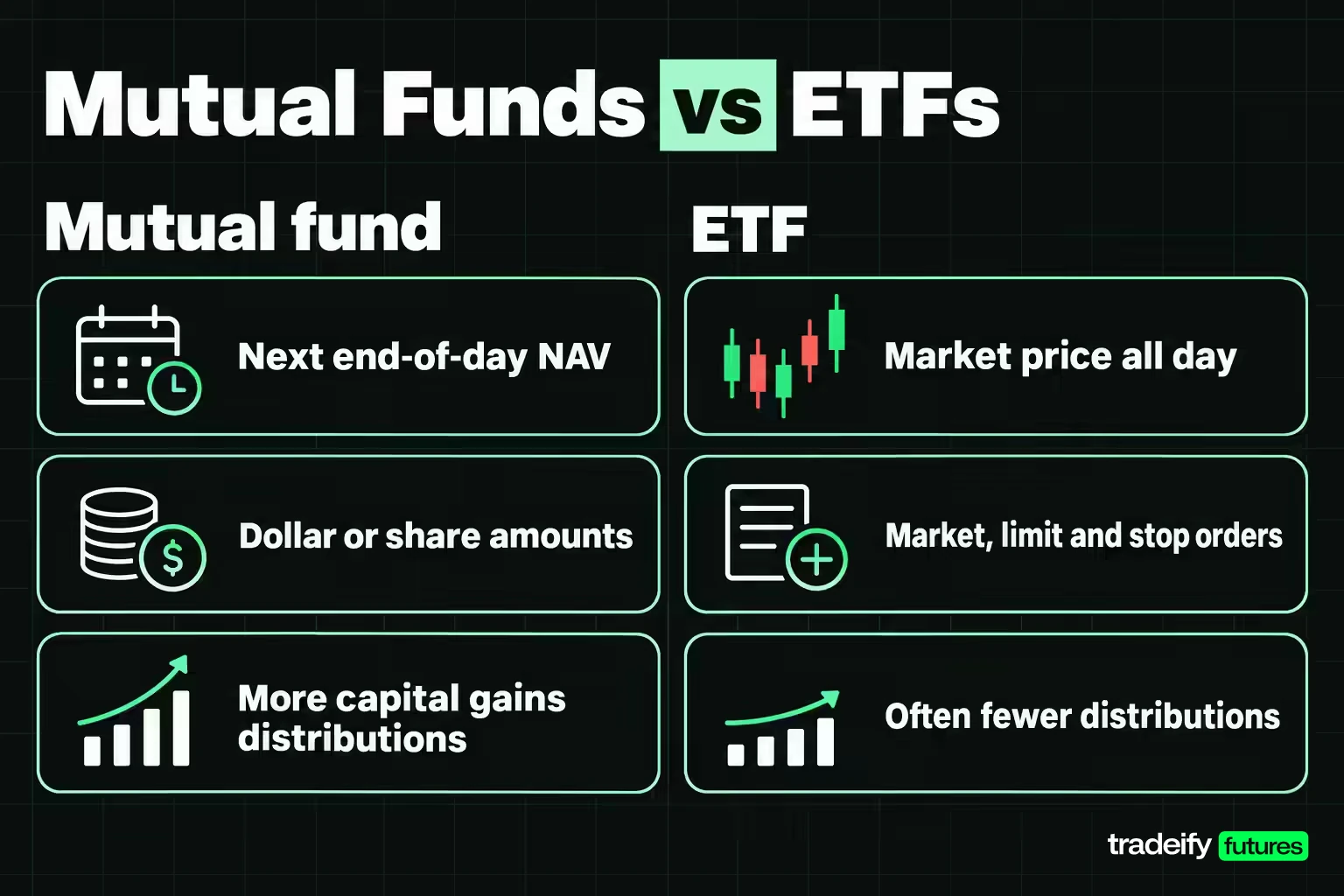
Mutual funds and exchange-traded funds (ETFs) are close cousins. Both are SEC-registered pooled funds, both can be active or index-based, and both are managed by registered advisers. The differences are in how you trade them, what you pay and how they are taxed.
| Feature | Mutual fund | ETF |
|---|---|---|
| Where you trade | With the fund company or through a broker | On a stock exchange through a brokerage account |
| Price you get | Next end-of-day NAV | Market price during the trading day, which can sit at a premium or discount to NAV |
| Order types | Dollar or share amount only | Market, limit and stop orders |
| Share classes and loads | Common, especially through brokers | Rare |
| Typical direct costs | Possible loads, 12b-1 and redemption fees | Possible broker commission and bid-ask spread |
| Capital gains distributions | More common | Often fewer, because many ETFs use in-kind redemptions |
| Automatic investing | Built in at most fund companies | Depends on the broker |
The tax gap disappears inside a 401(k) or IRA. In a taxable account, an ETF tracking the same index is often more tax-efficient.
Mutual funds tend to fit automatic monthly investing, retirement plan menus and investors who never want to think about intraday prices. ETFs tend to fit investors who want intraday trading, order control or the lowest possible tax drag in a taxable account.
Risks of Mutual Funds
Every mutual fund carries the risks of whatever it owns, plus a few that come from the fund structure itself.
- Market risk. Stock funds fall when stock markets fall. Broad diversification does not prevent this.
- Interest rate risk. When rates rise, bond prices fall, and so do bond funds. Longer-maturity funds move more.
- Credit risk. Bond funds holding lower-rated debt can lose value when issuers weaken or default.
- Inflation risk. Returns that trail inflation lose purchasing power, a particular issue for cash-like funds held for decades.
- Pricing and liquidity risk. You cannot exit at today's intraday price. An order placed in the morning of a sharp selloff gets that evening's NAV.
- Concentration risk. Sector, single-country and non-diversified funds can swing much harder than broad funds.
- Manager risk. An active manager can make poor calls, leave, or drift from the stated style.
- Cost risk. High fees are a guaranteed drag in a world where returns are not.
Past performance can show how volatile a fund has been, but it does not predict future returns. Look at the fund's worst calendar year and ask honestly whether you would have held through it.
Advantages and Disadvantages of Mutual Funds
Mutual funds solve real problems for investors, and they create a few of their own. The table pairs each strength with the tradeoff behind it.
| Advantage | Disadvantage |
|---|---|
| Instant diversification across many holdings | Diversification does not stop broad market losses |
| Professional management and research | You pay for management whether or not it adds value |
| Low minimums and fractional shares | Some funds and share classes carry loads and 12b-1 fees |
| Redeem any business day at NAV | Only one price per day, with no intraday control |
| Automatic investing and reinvestment | Autopilot makes it easy to stop reviewing the fund |
| Detailed SEC disclosure in the prospectus | Fees and holdings take effort to compare |
| Wide choice of strategies | Overlapping funds can duplicate exposure |
| Easy to hold in retirement accounts | Taxable distributions you did not choose |
When mutual funds make sense as an investment
A mutual fund is a container, not a verdict. A low-cost, broadly diversified mutual fund used for a long-term goal can be a sensible core holding for many investors. A high-cost, narrow fund bought because of last year's return is a different proposition, even under the same "mutual fund" label.
Compared with picking individual stocks, mutual funds trade control for diversification and less research work. Compared with ETFs, they trade intraday flexibility and some tax efficiency for simpler automatic investing.
How to Choose a Mutual Fund
Most people choose a mutual fund backwards: they open a list of last year's winners and work down it. Start instead with the job you need done, then test funds against that job.
Define the job the mutual fund has to do
Write one sentence: "This fund is my core US stock holding," or "This fund holds cash I need for next year's tuition." A clear job rules out most of the market before you look at a single return number.
Read the summary prospectus
The summary prospectus sets out the objective, principal strategies, principal risks, fee table, past performance against a benchmark, minimums and how to buy and sell. Prospectuses are free on the fund's website and on the SEC's EDGAR database. If you cannot explain the strategy after reading it, that is a signal on its own.
Check what the mutual fund actually owns
Look at the latest holdings report: top ten positions, sector weights, country exposure and, for bond funds, credit quality and average maturity. A fund's name only commits 80% of its assets to the named focus under SEC Rule 35d-1, so the holdings report, not the name, tells you what the remaining fifth is doing.
Compare costs on the same basis
Line up expense ratios, loads, 12b-1 fees, redemption fees and any brokerage transaction fee for the share class you would actually buy. FINRA's free Fund Analyzer compares up to three funds or share classes over your planned holding period.
Match mutual fund risk to your time horizon
A stock fund can be the right holding for money you will not touch for decades and the wrong one for a house down payment due next year. Check the fund's worst year and ask whether a loss that size would force you to sell.
Judge performance without chasing it
Compare returns with the fund's benchmark and similar funds over one, five and ten years, after fees. Note manager changes. Strong recent performance attracts money after the gain has already happened, which is the most common way investors buy high.
A mutual fund comparison worksheet
Putting two or three candidate mutual funds side by side on the same items keeps the comparison honest. Most of these sit in the summary prospectus or the latest shareholder report.
| What to compare | Where to find it | What to look for |
|---|---|---|
| Objective and strategy | Summary prospectus | A job that matches yours in plain words |
| Benchmark | Performance section | A fair index for what the fund holds |
| Top holdings and sectors | Holdings or shareholder report | Overlap with funds you already own |
| Expense ratio | Fee table | Lower is a smaller hurdle for the same job |
| Loads and 12b-1 fees | Fee table and share class details | The class you would actually buy |
| Turnover | Prospectus or shareholder report | High turnover means more trading costs and taxable gains |
| Worst year | Performance bar chart | A loss you could sit through without selling |
| Manager tenure | Management section | Whether today's manager built the record |
Mutual fund red flags before you buy
- A pricier share class of the same portfolio when you qualify for a cheaper one or a breakpoint.
- A record built by a manager who has since left.
- A "growth", "income" or sector name with holdings that do not match it.
- A large, high-turnover active fund held in a taxable account, where distributions can create tax bills you did not plan for.
- A recommendation you cannot explain back in one sentence.
Why there is no universal top five mutual funds
Lists of "top" mutual funds rank past returns, assets or ratings, and they change every year. A fund that topped a list because its sector boomed may be the worst choice for someone who needs a broad, steady core holding. The fund that fits your job, at a cost you can justify, is the top fund for you.
Mutual Fund Investing Strategies
Mutual funds lend themselves to a few simple, repeatable strategies. None of them guarantee a profit or protect against loss in a falling market. What they do is take timing guesswork and emotion out of the routine.
Dollar-cost averaging with mutual funds
Dollar-cost averaging means investing a fixed amount on a schedule regardless of price. Because mutual funds accept dollar amounts and fractional shares, they fit the method well.
Here is a round illustrative example: $500 a month for three months at NAVs of $25, $20 and $25 buys 20, 25 and 20 shares, or 65 shares for $1,500. Your average cost is $23.08 a share, below the $23.33 average NAV, because the fixed amount bought more shares when the price was low. The real benefit is behavioral: you keep investing through drops instead of waiting for a "better" entry.
Asset allocation and rebalancing with mutual funds
Asset allocation splits money among stocks, bonds and cash in proportions that match your goal and risk tolerance. Broad mutual funds make it easy to build that mix with two or three holdings. Over time the mix drifts as markets move, so investors rebalance, often once a year or when an allocation moves well off target, by trimming what grew and adding to what lagged.
Core and satellite mutual fund portfolios
A common structure puts most of the money in one or two broad, low-cost index funds (the core) and a smaller slice in specialized or active funds (satellites). The core does the heavy lifting; the satellites express a view without putting the whole plan at risk.
Mutual fund income and withdrawal math
Income goals need arithmetic, not hope. $3,000 a month is $36,000 a year. If you assume a portfolio can sustain a 4% annual withdrawal, that takes about $900,000; at 5% it takes $720,000, and at 6% it takes $600,000. Those rates are assumptions, not promises: a higher withdrawal rate raises the chance of running the money down, and returns, inflation and taxes all change the answer.
Mutual Funds Compared With Trading Futures
Many readers of a trading education library hold mutual funds in a retirement account while actively trading something else. The two activities use different tools for different jobs, and mixing up the mechanics causes problems.
Mutual funds are priced once a day, carry no intraday order control and are built for holding periods measured in years. Equity index futures such as the E-mini S&P 500 (ES) trade nearly around the clock on CME Globex, use leverage, and are built for short-term exposure and hedging. An S&P 500 index fund and an S&P 500 futures contract track the same index, but one is a long-term ownership vehicle and the other is a leveraged contract that can lose more than a small account can absorb in a single session.
The useful habit for a trader is separation. Long-term money in diversified, low-cost mutual funds should not become the backstop for short-term trading losses, and a trading account should be sized as risk capital on its own terms.
On our side, our evaluation and Sim Funded accounts trade only the futures on our supported products list, such as ES and MES, and those accounts are simulated; we do not offer cash stocks, options or forex. Every position on our accounts is closed by 4:45 PM ET each day, so nothing is held for the long-term horizon mutual funds are designed for.
Mutual Funds FAQ
What if I invest $10,000 in mutual funds for 5 years?
At illustrative steady returns of -2%, 4% and 8% a year, $10,000 in mutual funds becomes about $9,039, $12,167 or $14,693 after five years. The actual result depends on what the fund owns and what markets do. Real returns vary year to year, and fees and sales charges reduce the ending value.
What are the top 5 mutual funds?
There is no fixed top 5, because mutual fund rankings shift with recent returns and each fund does a different job. Start with your goal, then compare funds of that type on holdings, total cost, share class and long-term performance against their benchmark.
Is a mutual fund a good investment?
It can be, when the fund's objective, risk and costs match your goal and time horizon. Broad, low-cost funds are a common core holding for long-term investors. Mutual funds can still lose money, and they are not FDIC insured.
How much money do I need to invest to make $3,000 a month?
To draw $3,000 a month ($36,000 a year), you would need about $900,000 at an assumed 4% annual withdrawal rate, or about $720,000 at 5%. Those rates are illustrations, not guarantees, and taxes and inflation raise the real requirement.
How much money do you need to start investing in mutual funds?
Minimums vary widely by fund, share class and platform, and some funds have no minimum at all. Some funds lower or waive the minimum if you set up automatic monthly purchases. Check the current minimum in the prospectus or on your broker's order screen.
Can you withdraw money from a mutual fund at any time?
You can redeem shares on any business day at the next calculated NAV, minus any redemption fee or back-end sales charge. Funds generally must pay redemption proceeds within seven days. Selling in a taxable account can trigger capital gains tax.
Are mutual funds safe?
No mutual fund is risk-free. Funds can lose value from market moves, rising interest rates, credit problems or poor management decisions, and they are not insured by the FDIC. Money market funds aim for stability, but they are investments rather than bank deposits.
This article is educational and is not financial, tax or investment advice, or a recommendation to buy or sell any fund or security. Mutual funds can lose value, including principal, and past performance does not predict future results. Futures and other leveraged products can lose more than the cash committed, and results in simulated or funded trading accounts are simulated and do not guarantee any future result.


