



TL;DR: Option premiums are the price a buyer pays and a seller keeps, quoted per share, so $2.40 on a 100-share contract is $240. Premium equals intrinsic value plus time value, and time value decays to zero by expiration. Strike, time, implied volatility, rates and dividends move it, so a big premium is not automatically expensive.
An option chain can make a $0.35 contract look cheap and a $7.50 contract look expensive. That comparison tells you almost nothing. The two contracts can have different strikes, different expirations, different implied volatility and very different odds of being worth anything at the finish.
So before the dollar figure, ask two questions. What exactly am I paying for? And what has to happen, and by when, for that price to make sense?
Option premiums only make sense once you know what you are paying for. This guide breaks a premium into its parts, works the arithmetic from a chain quote to contract dollars, shows what moves the price and why it shrinks, and covers the parts beginners usually skip: margin, fees, taxes and the mistakes that come from reading the number at face value.
What Option Premiums Are
An option premium is the price of an option, and option premiums are what every quote on an option chain shows. The Options Clearing Corporation's disclosure document, "Characteristics and Risks of Standardized Options," defines it as the price the holder of an option pays and the writer of an option receives for the rights the option conveys. The price is set by buyers and sellers in the market, not by the exchange or the clearinghouse, and it changes continuously.
The same document makes a point that trips up new traders. The premium is not a down payment. It is a nonrefundable payment in full from the holder to the writer. If you buy a call for $3.00 and it expires worthless, that money does not come back.
Who pays and who receives the option premium
The buyer (the holder) pays the premium and gets a right. A call gives the right to buy the underlying at the strike price, and a put gives the right to sell it at the strike price.
The seller (the writer) receives the premium and takes on an obligation. If the holder exercises, the writer must sell (for a call) or buy (for a put) at the strike.
That asymmetry is the whole trade, and it is worth sitting with before you pick a side. The Options Industry Council puts it plainly: a long option holder's potential loss is limited to the amount paid for the contract, while a short call's potential loss is theoretically unlimited and a short put can still lose a large amount if the stock falls hard.
Premium can change hands again before expiration. Most option positions end in one of three ways:
- Closing transaction. The holder sells the option back into the market, or the writer buys it back. The realized result is the difference between the two premiums. The OCC disclosure document gives an example of an investor who buys a call for $500 and later sells it for $700, a $200 profit, or for $300, limiting the loss to $200.
- Exercise or assignment. The holder exercises, and the writer is assigned. An in-the-money option is often worth more sold than exercised, because selling captures any time value left in the premium, while exercising throws it away.
- Expiration. An out-of-the-money option expires worthless. The holder loses the whole premium, and the writer keeps it.
How option premiums are quoted per share
Equity option premiums are quoted per share, but a contract usually covers more than one share. The OCC document states that the unit of trading for most options on equity securities is 100 shares. A premium of $4 per share therefore means an aggregate premium of $400 for one contract.
So the cash math on a chain quote is short:
- Quoted premium × contract multiplier × number of contracts = total premium.
- A $2.40 quote on one standard contract is $2.40 × 100 = $240 before fees.
Not every contract uses 100 shares. Corporate actions can change the deliverable. In the OCC document's example, a 3-for-2 stock distribution turns an option on 100 shares into one covering 150 shares at an adjusted strike. Options on fund shares can cover 100 or 1,000 shares. Index options use a multiplier set by the listing exchange, and options on futures deliver a futures contract instead of shares. One option on E-mini S&P 500 futures, for example, covers one E-mini S&P 500 futures contract, and CME Rulebook Chapter 358A prices it in index points worth $50.00 each. A 20-point premium on that option is $1,000.
Before you trade a contract, check its multiplier and deliverable. A quote that looks familiar can be priced on a completely different unit.
The Option Premium Formula

Option premiums all have the same two parts:
Option premium = intrinsic value + time value
The Options Industry Council uses exactly this split, and calls time value "extrinsic value" as well. The formula is simple. Reading the two pieces correctly is where most of the work is.
Intrinsic value in the option premium
Intrinsic value is the amount an option is in the money right now. It is what the option would be worth if it had to be exercised immediately.
- Call intrinsic value = the larger of zero or (underlying price − strike price).
- Put intrinsic value = the larger of zero or (strike price − underlying price).
The OCC document's own example works well. With a stock at $46, a 40 call has $6 of intrinsic value per share. If the stock drops to $44, intrinsic value falls to $4. At $40 or below, it is zero. With the same stock at $46, a 50 put has $4 of intrinsic value.
Intrinsic value can never be negative. That is why moneyness matters:
| Moneyness | Call | Put | Intrinsic value |
|---|---|---|---|
| In the money | Strike below the underlying price | Strike above the underlying price | Positive |
| At the money | Strike equal to the underlying price | Strike equal to the underlying price | Zero |
| Out of the money | Strike above the underlying price | Strike below the underlying price | Zero |
An out-of-the-money option has no intrinsic value, but it still costs money. Everything you pay for it is time value.
Time value in the option premium
Time value is whatever the premium is above intrinsic value. The OCC describes it as the part of the premium that reflects the time remaining before expiration, and the Options Industry Council describes it as what a buyer is willing to pay above intrinsic value in the hope that the option gains value before it expires.
Think of time value as the price of possibility. A buyer pays it because the underlying might move further in their favor before expiration. A seller collects it as payment for carrying that risk. Same number, opposite bets.
The OCC gives two clean examples. With a stock at $40, a 40 call trading at $2 is entirely time value. With the stock at $45, a 40 call at $6 has $5 of intrinsic value and $1 of time value.
Time value has one hard property: it reaches zero at expiration. The Options Industry Council notes that an option that expires in the money is generally worth only its intrinsic value. That is why the buyer of time value is always racing the calendar.
Related lesson: Strike prices and moneyness
How to Calculate an Option Premium Step by Step
You do not need a pricing model to understand the option premiums you see on a chain. You need five steps. The numbers below are illustrative.
Imagine a stock trading at $54. The 50-strike call with about a month left is offered at $5.20.
- Convert the quote to contract dollars. $5.20 × 100 shares = $520 for one contract, before commissions and fees.
- Find intrinsic value. The call lets you buy at $50 when the stock is at $54, so intrinsic value is $54 − $50 = $4.00 per share, or $400 per contract.
- Find time value. $5.20 − $4.00 = $1.20 per share, or $120 per contract.
- Check the arithmetic. $400 + $120 = $520. If time value ever comes out negative, recheck the quote or the strike, because the OCC notes that an American-style option ordinarily trades at or above its intrinsic value.
- Find the expiration break-even. For a long call, it is the strike plus the premium: $50 + $5.20 = $55.20. The stock has to finish above $55.20 at expiration for the buyer to make money on a hold-to-expiry basis, before costs.
Calculating a put option premium
Option premiums on puts break down the same way. Take the same $54 stock and say the 50-strike put is offered at $0.90.
- $0.90 × 100 = $90 per contract.
- Intrinsic value is the larger of zero or $50 − $54, so zero.
- Time value is the full $0.90.
- $0 + $90 = $90.
- The long put's break-even is the strike minus the premium: $50 − $0.90 = $49.10.
The two contracts tell different stories. The call buyer is paying $1.20 for time and $4.00 for value that already exists. The put buyer is paying $0.90 entirely for the chance that the stock drops more than $4.90 before expiration.
| Step | 50 call | 50 put |
|---|---|---|
| Quote per share | $5.20 | $0.90 |
| Contract cost | $520 | $90 |
| Intrinsic value per share | $4.00 | $0 |
| Time value per share | $1.20 | $0.90 |
| Expiration break-even | $55.20 | $49.10 |
What Moves Option Premiums
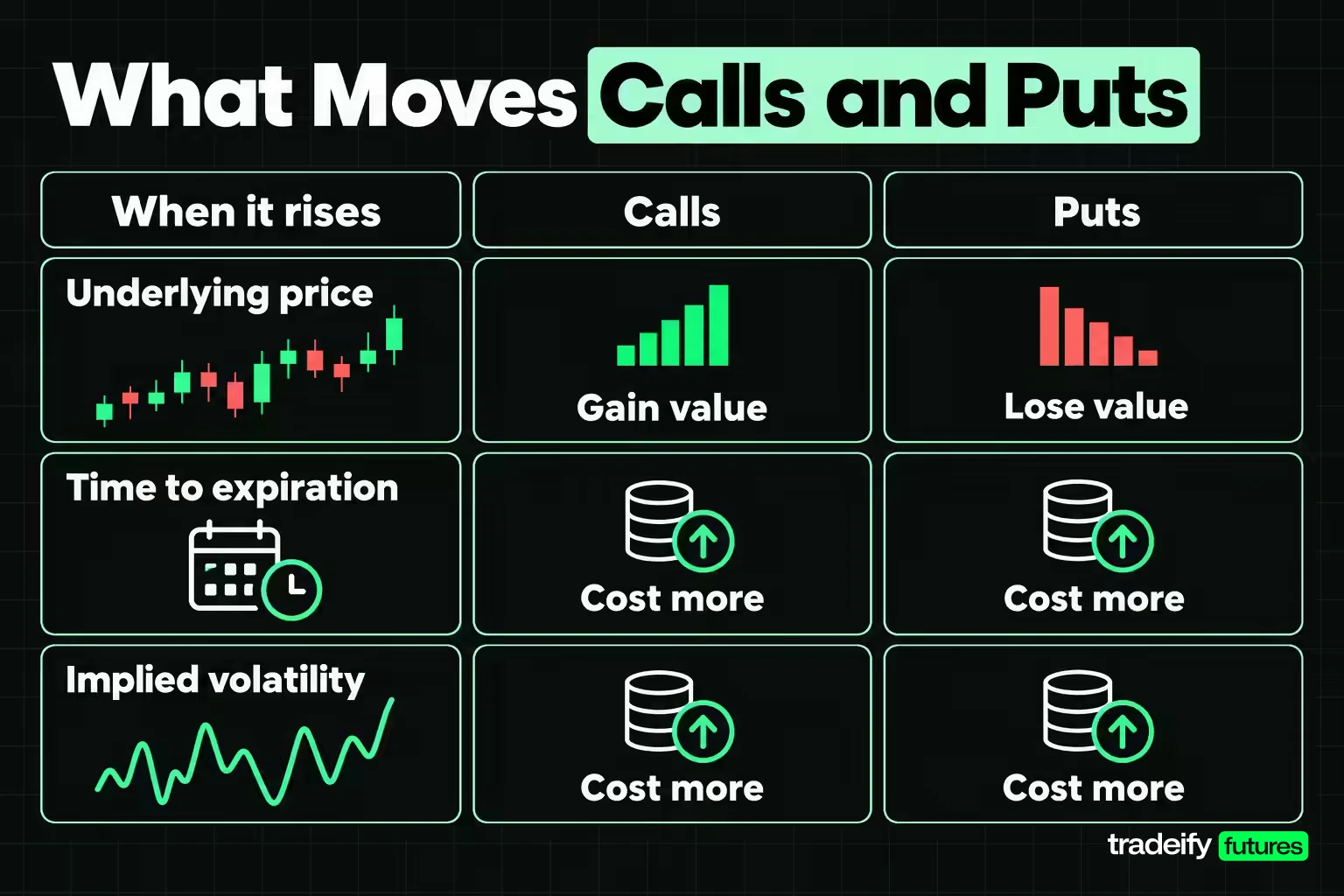
Option premiums respond to many inputs. The OCC document lists a long set of influences on price, from the underlying value to supply and demand in the options market. The Options Industry Council narrows the main ones to six: underlying price, strike, time until expiration, implied volatility, dividends and interest rates, and notes that dividends and rates have the smallest effect.
| Factor | When it rises, calls tend to | When it rises, puts tend to | Notes |
|---|---|---|---|
| Underlying price | Gain value | Lose value | Opposite effects on calls and puts |
| Strike price (comparing contracts) | Cost less | Cost more | Sets moneyness and intrinsic value |
| Time to expiration | Cost more | Cost more | More time means more time value |
| Implied volatility | Cost more | Cost more | Largest effect near the money |
| Interest rates | Cost more | Cost less | Small but measurable |
| Expected dividends | Cost less | Cost more | Small but measurable |
Underlying price and strike
Underlying price and strike work together through moneyness. As the underlying rises, a call moves further into the money and its premium generally rises, while a put moves the other way. The OCC adds a detail that matters for comparisons: an option deep in the money normally has very little time value, and an option far out of the money has only time value, but less of it than an at-the-money option on the same underlying and expiration.
The table below shows that pattern. The figures are illustrative Black-Scholes values computed for this guide: a $100 stock, 30 days to expiration, 25% implied volatility, a 4% interest rate and no dividends.
| Call strike | Premium | Intrinsic value | Time value |
|---|---|---|---|
| 90 | $10.49 | $10.00 | $0.49 |
| 95 | $6.21 | $5.00 | $1.21 |
| 100 | $3.02 | $0 | $3.02 |
| 105 | $1.17 | $0 | $1.17 |
| 110 | $0.35 | $0 | $0.35 |
Time value peaks at the money. The 100 call carries $3.02 of time value, while the 90 call, despite the biggest premium, carries only $0.49.
Interest rates and dividends in option premiums
In option premiums, rates and dividends reflect the cost of carrying the stock. According to the OCC, higher prevailing interest rates tend to raise call premiums and lower put premiums, and lower rates do the reverse. Expected cash dividends work in the other direction, because a dividend drops the share price on the ex-dividend date: calls tend to lose value and puts tend to gain. For a short-dated option the effect is small. For a long-dated option, or a stock with a large dividend coming, it is worth checking.
Which option has the highest premium
The highest premium on a chain usually belongs to a contract that is deep in the money, far from expiration, on a volatile underlying. Deep in-the-money options carry the most intrinsic value, and long-dated, high-volatility options carry the most time value. A higher-priced underlying also produces bigger dollar premiums than a cheaper one with the same percentage moves. None of that makes the contract a better trade. It only tells you how much of the price is already-earned value and how much is paid-for possibility.
Implied Volatility and Option Premiums
Implied volatility is the biggest swing factor in option premiums after the underlying itself. It is the volatility level the market is pricing into an option, backed out from the option's own premium. It is a measure of expected movement, not direction. The Options Industry Council explains that higher volatility estimates point to bigger expected moves in either direction, which generally raises premiums for puts and calls alike, with the biggest effect on at-the-money options.
Here is the size of that effect on the same illustrative 30-day, at-the-money contracts (a $100 stock and a 100 strike, 4% rate, Black-Scholes):
| Implied volatility | Call premium | Put premium |
|---|---|---|
| 15% | $1.88 | $1.55 |
| 25% | $3.02 | $2.69 |
| 40% | $4.73 | $4.40 |
Nothing about the stock changed between rows. Only the market's expectation of movement changed, and the call premium rose by more than half going from 15% to 25%.
The volatility crush after an event
Implied volatility often climbs before a scheduled event such as an earnings report and falls once the news is out, and option premiums climb and fall with it. That drop can swallow a correct directional call.
Imagine a $100 stock with an earnings report due. A 7-day, 100-strike call is priced with 60% implied volatility at $3.35 (illustrative Black-Scholes, 4% rate). The report comes out, the stock rises to $102, and implied volatility drops to 30%. With 6 days left, the same call is now worth about $2.80.
The trader read the direction correctly and still lost $0.55 per share, or $55 per contract. Two dollars of stock movement was not enough to offset the volatility that left the premium. Being right about direction and being paid for it are two different things.
Is high implied volatility good for buyers or sellers
High implied volatility means the buyer is paying more for the same strike and expiration, so the underlying has to move further for the trade to work. A seller collects more premium, but that premium is high because the market expects larger moves, and the seller carries those moves. Neither side gets a free edge from a high reading. What matters is whether the volatility you are paying for, or selling, turns out larger or smaller than the movement that actually happens.
Time Decay and the Shrinking Premium
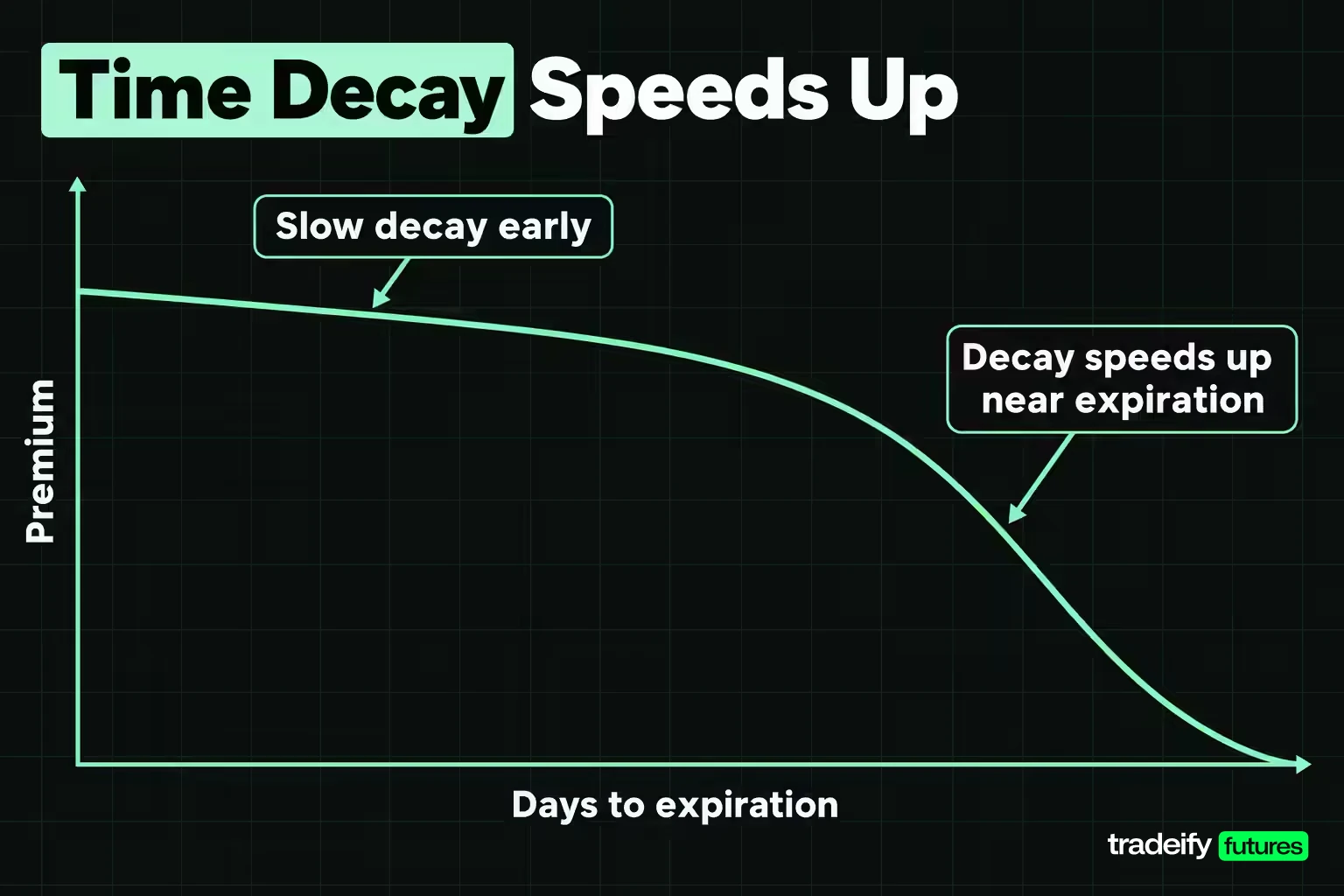
Time decay is the steady loss of option premiums as expiration approaches. The OCC calls an option a "wasting" asset: if it is not sold or exercised before expiration, it becomes worthless. All else equal, time value usually decreases as expiration approaches, and the OCC notes that the decrease accelerates as the time to expiration shortens. The Options Industry Council puts the fast part in the last several weeks of an option's life. In the option Greeks, this sensitivity is called theta.
The table shows how that plays out for an illustrative at-the-money call (a $100 stock, a 100 strike, 25% implied volatility, 4% rate, Black-Scholes) when nothing changes except the calendar:
| Days to expiration | Call premium |
|---|---|
| 90 | $5.43 |
| 60 | $4.36 |
| 30 | $3.02 |
| 14 | $2.03 |
| 7 | $1.42 |
| 1 | $0.53 |
From 90 to 60 days, the premium loses about 4 cents per share per day. From 30 to 14 days, about 6 cents. In the final week, about 15 cents per day. The same option, with the same stock price and the same volatility, bleeds faster the closer it gets to expiry. That is why a cheap weekly option can feel like a bargain on Monday and look very different by Thursday.
Why option premiums fall when the stock moves your way
Time decay is why option premiums can fall while the underlying moves in the buyer's favor. If the move is too small, or arrives too slowly, the decay outruns the gain in intrinsic value. Imagine buying a 10-day call and watching the stock creep up a little each day: the premium can still slide, because each day of decay takes more than each small move adds.
This is also where buyers and sellers stand on opposite sides. Time decay works against the holder and for the writer. A seller's edge from decay is real, but it is paid for with exposure to the large moves the premium was priced to cover.
Black-Scholes and Theoretical Option Premiums
A pricing model turns the factors that drive option premiums into a single theoretical number. The best known is the Black-Scholes formula. According to the Nobel committee, Fischer Black and Myron Scholes published it in 1973, Robert Merton derived and generalized it, and Merton and Scholes received the 1997 economics prize for the work (Black died in 1995).
The model's inputs are the same ones traders already watch: underlying price, strike, time to expiration, interest rates, dividends and volatility. Every input except volatility can be read from the contract or the market. That is why traders flip the model around: they plug in the market premium and solve for the volatility it implies.
Limits of the Black-Scholes option premium
Model values are reference points, not option premiums you can actually trade. The OCC document warns that premiums need not conform or correlate with any theoretical pricing formula at any particular time.
Warren Buffett made the same point in Berkshire Hathaway's 2008 shareholder letter. He wrote that the Black-Scholes formula "has approached the status of holy writ in finance," and that applied to extended time periods "it can produce absurd results." His example was a 100-year, $1 billion put on the S&P 500 that the formula priced at a $2.5 million premium. He argued the formula overstated the value of very long-dated puts, because past volatility says little about where American business will be a century later. He still used the formula to value Berkshire's own long-dated equity puts in its financial statements.
Estimating an option premium without a model
You can sanity-check a premium without solving any equation:
- Calculate intrinsic value exactly. That part is arithmetic, not opinion.
- Compare time value across nearby strikes and expirations on the same chain. A contract whose time value is far out of line with its neighbors deserves a second look.
- Compare the contract's implied volatility with its own recent range and with how much the underlying has actually been moving.
That will not prove a premium is wrong. It will show you which part of it you are paying for, and that is usually the part that decides the trade.
Call and Put Premiums at the Same Strike
Call and put option premiums at the same strike and expiration on the same underlying are rarely equal, even when the strike is exactly at the money. The relationship that ties them together is put-call parity. For European-style options on a stock with no dividends:
Call premium − put premium = stock price − present value of the strike
The present value of the strike is lower than the strike itself whenever interest rates are above zero, so at the money the call is usually worth a little more than the put. In the illustrative 30-day example (a $100 stock, a 100 strike, 4% rate), the call is $3.02, the put is $2.69, and the $0.33 gap matches the stock price minus the discounted strike to the cent.
Three things widen or flip that gap:
- Moneyness. If the stock sits above the strike, the call carries intrinsic value and the put does not. The call premium is bigger by roughly that intrinsic value.
- Interest rates. Higher rates raise calls and lower puts, which widens the at-the-money gap.
- Dividends. An expected dividend is subtracted from the stock side of the equation, so it pulls call premiums down relative to puts. Before a large dividend, an at-the-money put can be worth more than the call.
On American-style stock options the parity relationship holds only approximately, because early exercise is possible, but it is still the right first check when a call and put on the same strike look oddly priced.
Option Premium vs Margin
Premium and margin are different things. Premium is the price of the option. Margin is collateral your broker requires you to hold against a position. Under FINRA Rule 4210, the margin rule for US securities accounts:
- Long options that expire in nine months or less must be paid in full: at least 100% of the purchase price. You cannot borrow to buy a short-dated option.
- Long listed options with more than nine months left can be margined at 75% of their current market value.
- Short (uncovered) options require the option's full current market value plus a percentage of the underlying value: 20% for a stock option and 15% for a broad index option, reduced by any out-of-the-money amount but never below the option's value plus 10% (of the underlying value for calls, and of the exercise price for puts).
The rule is a floor. Rule 4210 also tells firms to consider higher requirements for volatile or illiquid positions, so many brokers set stricter house margin.
Worked example of option premium vs margin
Imagine a trader sells one uncovered 95-strike put for $2.00 on a stock trading at $100. The trader receives $200 in premium. The FINRA minimum margin works out like this:
- Option value: $2.00 × 100 = $200.
- 20% of the underlying value: 20% × $10,000 = $2,000.
- Out-of-the-money amount: ($100 − $95) × 100 = $500.
- Standard requirement: $200 + $2,000 − $500 = $1,700.
- Floor: $200 + 10% × $9,500 (the aggregate exercise price) = $1,150.
The requirement is the larger figure, $1,700. So the seller collects $200 but has to tie up $1,700, and that requirement rises if the stock falls toward the strike.
Risks of selling options for premium
Selling options looks attractive because option premiums arrive up front. The OCC document is blunt about the other side:
- The writer of an uncovered call is in an extremely risky position, and the potential loss is unlimited. In its example, a writer receives $4 for an uncovered 50 call, the stock jumps to $69, and buying the call back at $19 costs $1,900, a $1,500 loss after the $400 premium.
- The writer of a put bears the risk of the stock falling, potentially to zero. In the OCC example, a writer collects $3 on a 50 put, the stock drops to $40, and assignment means buying at $50, an effective cost of $47 against a $40 market price.
- American-style writers can be assigned at any time before expiration.
- Margin requirements can rise sharply as the position moves against the writer, forcing more cash in or a closing trade at a bad price.
Premium received is the most a seller can make on the trade. It is not a cushion against everything that can happen.
Fees, Taxes and the Total Option Premium Paid
Quoted option premiums are not the whole cost. The OCC document says option transaction costs consist mainly of commissions, charged on opening, closing, exercise and assignment, and can include margin and interest costs. It also warns that these costs tend to matter more for options than for stock, because they are larger relative to the premium. The bid-ask spread is an execution cost too, even though no one bills it.
So the real cost of a long option is the premium plus every charge to open it, plus every charge to close or exercise it. The real income from a short option is the premium minus those same charges. Fees vary by broker, so check the schedule before you place the order.
How option premiums are taxed in the US
The IRS covers option premiums in Publication 550 (2025 edition). In short, for exchange-traded equity options held by an individual (not a dealer):
- Buyer. The premium paid cannot be deducted. It is a capital expenditure. If the option is sold, the gain or loss is capital. If it expires, the premium is a capital loss. If a call is exercised, the premium is added to the cost basis of the stock bought.
- Writer. The premium received is not income when it arrives. It sits in a deferred account until the option expires, is exercised or is closed. If the option expires, the premium is a short-term capital gain. A closing purchase produces a short-term capital gain or loss.
- Section 1256 contracts. Nonequity options, which include broad-based stock index options (the publication names the S&P 500 index as an example) and options on commodity futures, are marked to market at year end and taxed 60% long-term and 40% short-term regardless of how long they were held.
Publication 550 also has separate rules for straddles, wash sales and dealers, so confirm how your own option premiums are treated with the publication or a tax professional.
Reading Option Premiums on an Option Chain
Option premiums change continuously while the market is open, so the place to track them is a live option chain from a broker or market data provider. Most chains show the same core columns:
- Bid. The best price a buyer is currently willing to pay. If you sell at market, you are likely selling here.
- Ask. The best price a seller is currently willing to accept. If you buy at market, you are likely buying here.
- Mark or midpoint. The average of bid and ask. It is a reference price, not a guaranteed fill.
- Last. The most recent trade. On a thinly traded contract, the last trade can be hours old and far from the current market.
- Volume and open interest. How many contracts traded today, and how many are still open. Low numbers usually mean wider spreads.
- Implied volatility and the Greeks. The volatility the premium implies, plus sensitivities such as delta and theta.
Measuring the option premium spread
The spread is part of what you pay. Measure it as a percentage of the midpoint.
A contract quoted $1.80 bid and $2.20 ask has a $2.00 midpoint and a $0.40 spread, which is 20% of the midpoint. Buying at $2.20 and immediately selling at $1.80 would cost $40 per contract before fees, with no market move at all. A similar contract quoted $1.95 bid and $2.05 ask has a $0.10 spread, 5% of the midpoint.
A wide spread does not rule a trade out. It tells you that a limit order matters, and that the premium you see on the screen is not the premium you will get.
Related lesson: Liquidity and bid-ask spreads in options
Common Option Premium Mistakes
Most mistakes with option premiums come from reading the number before splitting it into parts. Here are the ones that cost traders the most.
Treating a low option premium as a bargain
A $0.35 option is cheap in dollars, but it is usually cheap for a reason: little time left, a strike far from the market, or poor liquidity. The 110 call in the moneyness table costs $0.35 because the stock has to rise more than 10% in 30 days just to break even. Cheap options expire worthless all the time.
Treating a high option premium as a better trade
A $10.49 premium is not a stronger signal than a $3.02 one. In the moneyness table, most of the 90 call's premium is intrinsic value the stock already provides. A higher premium can mean more intrinsic value, more time or higher implied volatility. It does not mean higher quality or higher odds of profit. Split it before you judge it.
Forgetting the multiplier
A $3.00 quote on a standard equity option is $300, not $3. On an option on E-mini S&P 500 futures, a 3-point premium is $150. Check the contract unit every time you switch products.
Judging a position only by expiration break-even
Break-even at expiration is useful, but most options are closed before then. Before expiration, implied volatility and time decay move the premium as much as the underlying does. A trade can look fine on a hold-to-expiry chart and lose money in the week you actually hold it.
Assuming the seller keeps the whole option premium
The writer receives the premium up front, but a buyback, an assignment or fees can shrink it, and a large move can turn it into a loss many times bigger than the premium received.
Using option premiums as a futures trader
Options knowledge still earns its keep if you trade futures. Implied volatility on index options is the market's price for expected movement, so a jump in it ahead of a data release or an earnings-heavy week tells you the market expects bigger ranges in the underlying futures too. You can read that without trading a single option.
On our accounts, you trade futures only. Options of any kind are not on our supported products list, so you cannot buy or sell option premium on a Tradeify account. The ES futures you can trade are the contract CME's E-mini S&P 500 options are written on, which is why reading those options' implied volatility can still be useful context.
Option Premiums FAQ
What is the premium when trading options
The premium is the price of the option contract. The buyer pays it and the seller receives it in exchange for the rights the option conveys. It is quoted per share and, for a standard equity option, multiplied by 100 to get the cost of one contract.
What did Warren Buffett say about options
In his 2008 letter to Berkshire Hathaway shareholders, Buffett wrote that the Black-Scholes formula "has approached the status of holy writ in finance" but can produce absurd results for very long-dated options. Berkshire had sold long-term equity index puts and received $4.9 billion in premiums. In his 2002 letter he called derivatives "financial weapons of mass destruction."
What are the risks of selling options
A seller's maximum gain is the premium received, while losses can be far larger. An uncovered call has unlimited potential loss, and an uncovered put can lose most of the strike value if the stock collapses. Sellers can also be assigned early and face rising margin calls.
Which option has the highest premium
Deep in-the-money, long-dated options on volatile underlyings usually carry the highest premiums. A large premium reflects intrinsic value, time and volatility, not a better trade.
Is 1 option always 100 shares
No. Most standard equity options cover 100 shares, but corporate actions can adjust a contract to a different deliverable, such as 150 shares after a 3-for-2 distribution. Index options use an exchange-set multiplier, and options on futures deliver a futures contract instead of shares.
Can an option premium change if the stock does not move
Yes. Time decay lowers the premium every day, and changes in implied volatility, interest rates or expected dividends can raise or lower it with the stock price unchanged.
Putting Option Premiums to Work
The next time you open an option chain, pick one contract and run the full check before you look at any other number. Convert the quote to contract dollars. Split it into intrinsic value and time value. Note the days to expiration and the implied volatility, and measure the spread as a percentage of the midpoint. Then write down the move, and the date, that the trade needs in order to beat its break-even.
If you cannot say what you are paying for, a cheaper or pricier contract will not fix that. Reading option premiums this way will not tell you where the market goes next, but it will show you exactly where a position can fail.
Options and futures carry substantial risk. An option buyer can lose the entire premium, and an option seller can lose far more than the premium received. Leverage can magnify losses beyond what you expect. Evaluation and funded prop-firm accounts are simulated. The figures in this guide are illustrative, and nothing here is financial, investment or tax advice.


