



TL;DR: Strike prices are the fixed prices at which an option lets you buy (call) or sell (put), so your pick sets cost, odds and payoff. A call is in the money above its strike, a put below it. Break-even is strike plus premium for a call: a $70 call bought at $2.20 breaks even at $72.20. Pick the strike from your target, deadline and maximum loss, not from the cheapest premium.
An options chain shows a column of numbers down the middle, and every one of them is a different trade. Same stock, same expiration, but a $95 call and a $110 call behave like two different bets: one is expensive and moves almost like the stock, the other is cheap and needs a big move just to be worth anything.
That column is the list of strike prices. Picking from it is the first real decision in any options trade, and it is where most beginner mistakes start: the eye goes to the cheapest number, not the one that fits the move you expect. This guide explains what strike prices are, how they work for calls and puts, how they set intrinsic value and break-even, how exchanges decide which strikes exist, and how to choose one with a clear view of what the trade needs.
What Strike Prices Are
A strike price, also called the exercise price, is the fixed price written into an options contract. It is the price at which the holder may buy the underlying asset (with a call) or sell it (with a put) if the option is exercised.
The SEC's investor bulletin on options uses a simple quote to show where the strike sits: "ABC December 70 Call $2.20". ABC is the underlying stock, December is the expiration, 70 is the strike price, Call is the option type and $2.20 is the premium per share. A standard equity option generally covers 100 shares, so that $2.20 premium costs $220 per contract.
Three things about strike prices matter from day one:
- The strike does not move with the market. A $70 strike is $70 on the day you buy and $70 on expiration day. What changes is the distance between the strike and the stock price.
- You do not set it. Exchanges list a menu of strike prices for each expiration, and you choose from that menu.
- It is adjusted only for corporate events. Cboe's equity option specifications state that strikes are adjusted for splits and re-capitalizations, so a split changes the contract terms rather than wiping out the position.
When people ask what "strike" means in the share market, this is the answer: on a stock option, the strike is the per-share price at which the shares change hands if the option is exercised. It is not a target, a forecast or a fair value for the stock.
How Strike Prices Work for Calls and Puts
Strike prices work in opposite directions for calls and puts, because the two contracts carry opposite rights.
- Call option. The holder has the right to buy the underlying at the strike price on or before expiration. The call writer (the seller who opened the position) is obligated to sell at the strike if assigned.
- Put option. The holder has the right to sell the underlying at the strike price on or before expiration. The put writer is obligated to buy at the strike if assigned.
A call holder wants the stock to finish above the strike, because buying below the market price is valuable. A put holder wants the stock to finish below the strike, because selling above the market price is valuable.
The investor.gov bulletin gives a clean call example. With an ABC December 70 Call and ABC trading at $80, the position is in the money by $10, since the holder can buy at $70 shares worth $80. With ABC at $60, the same call is out of the money by $10, because nobody needs a right to pay $70 for a $60 stock.
Flip it for a put on the same $70 strike. With the stock at $60, the put is in the money by $10, because the holder can sell at $70 shares worth $60. With the stock at $80, the put is out of the money by $10.
Strike prices from the writer's side
Every strike has two sides. The buyer pays the premium and owns a right. The writer collects the premium and takes on an obligation at that same strike. A writer can close the position by buying the same option back before being assigned, but once assigned, the obligation has to be fulfilled at the strike price. That asymmetry is why the strike that looks attractive to a buyer is the one that creates the most exposure for a seller.
Strike Price Moneyness
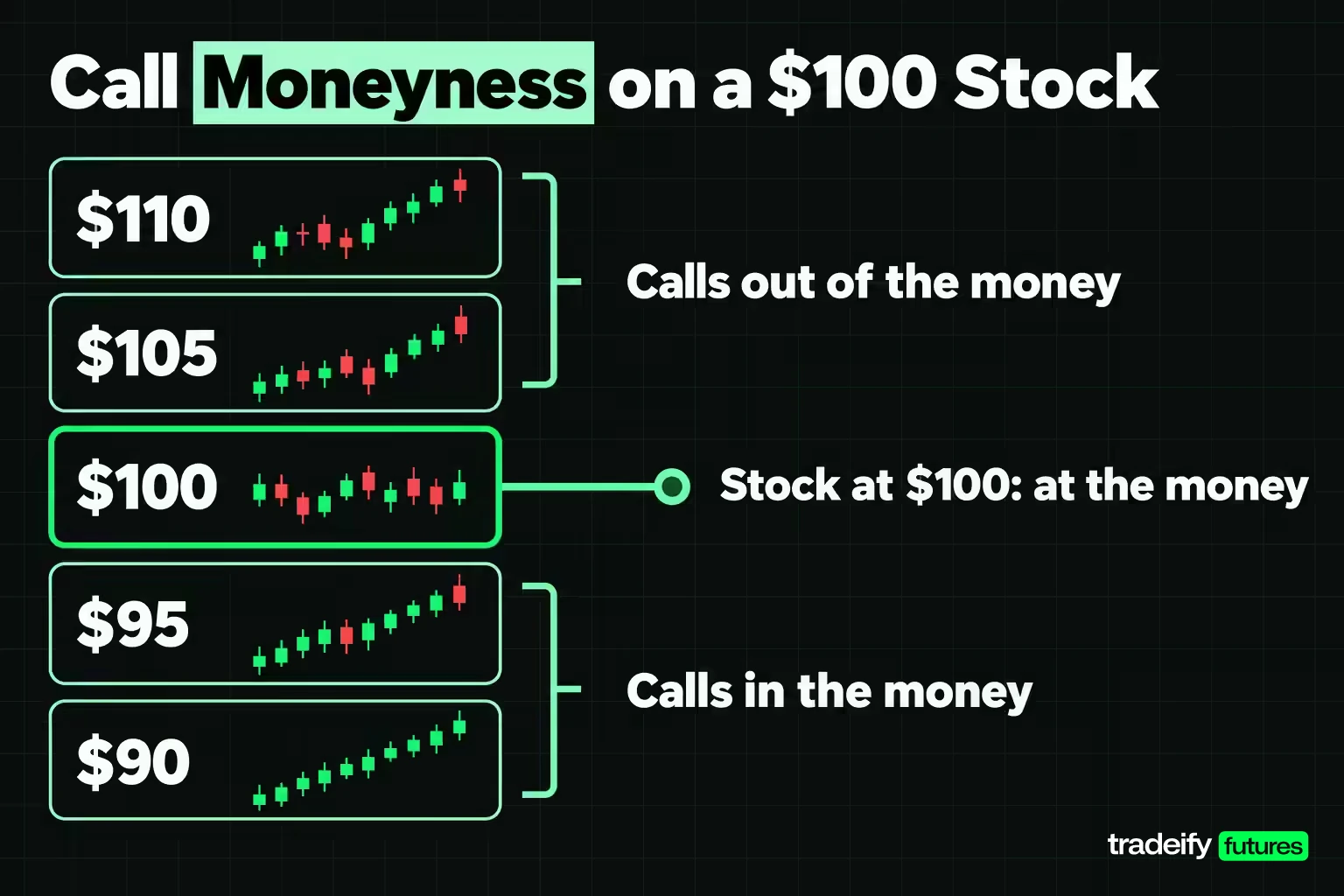
Moneyness describes where the strike sits relative to the current price of the underlying. It is the vocabulary traders use to talk about strike prices quickly.
| Moneyness | Call strike vs stock price | Put strike vs stock price | Intrinsic value |
|---|---|---|---|
| In the money (ITM) | Strike below the stock price | Strike above the stock price | Yes |
| At the money (ATM) | Strike equal to the stock price | Strike equal to the stock price | None |
| Out of the money (OTM) | Strike above the stock price | Strike below the stock price | None |
Take a stock at $100 with strike prices listed at $90, $95, $100, $105 and $110:
- The $90 and $95 calls are in the money. The $105 and $110 calls are out of the money.
- The $105 and $110 puts are in the money. The $90 and $95 puts are out of the money.
- The $100 call and the $100 put are both at the money.
In practice, "at the money" usually means the listed strike closest to the stock price, since the stock rarely sits exactly on a strike.
Why strike moneyness is only a snapshot
Moneyness changes every time the stock ticks. A $105 call that is out of the money at $100 becomes in the money at $106 and can slip back out by the close.
It also does not tell you whether a trade made money. Moneyness compares the stock with the strike. Profit compares what the option is worth with what you paid for it. A call can be in the money and still be a losing position if the premium you paid was larger than its intrinsic value. Keep those two questions separate and a lot of options confusion goes away.
Intrinsic and Extrinsic Value at Each Strike
An option's premium has two parts, and strike prices decide how much of each you are buying.
- Intrinsic value is the amount an option is in the money. For a call, it is the stock price minus the strike, if positive. For a put, it is the strike minus the stock price, if positive. Only in-the-money options have intrinsic value.
- Extrinsic value, also called time value, is everything in the premium above intrinsic value. It is what the market charges for the chance that the option gains value before expiration.
The table below uses an illustrative 30-day call chain on a $100 stock. The premiums come from a standard Black-Scholes model with 25% implied volatility, a 4% interest rate and no dividends. They are model values for teaching, not live quotes.
| Call strike | Premium | Intrinsic value | Time value |
|---|---|---|---|
| $90 | $10.49 | $10.00 | $0.49 |
| $95 | $6.21 | $5.00 | $1.21 |
| $100 | $3.02 | $0.00 | $3.02 |
| $105 | $1.17 | $0.00 | $1.17 |
| $110 | $0.35 | $0.00 | $0.35 |
Two patterns show up across strike prices, and they hold on real chains too:
- Time value is largest at the money. The $100 call is almost entirely time value, at $3.02. The Options Industry Council notes that time decay and volatility effects are most noticeable on at-the-money options.
- Deep in-the-money and far out-of-the-money strike prices carry little time value. The $90 call is mostly intrinsic value. The $110 call is all time value, but there is very little of it, because the market sees little chance it finishes in the money.
That split matters for decisions. When you buy an at-the-money strike, you are mostly paying for time and volatility, and that part of the premium shrinks toward zero by expiration. When you buy a deep in-the-money strike, most of what you pay is intrinsic value that moves with the stock.
Related lesson: Option premiums
Strike Price Examples on One Option Chain
The cleanest way to see what strike prices do is to hold everything else constant. The examples below use an illustrative $100 stock, a 30-day expiration and Black-Scholes model premiums (25% implied volatility, 4% interest rate, no dividends). Only the strike changes.
Call strike price example
| Call strike | Moneyness | Premium | Cost per contract | Break-even at expiration | Delta |
|---|---|---|---|---|---|
| $90 | ITM | $10.49 | $1,049 | $100.49 | 0.94 |
| $95 | ITM | $6.21 | $621 | $101.21 | 0.79 |
| $100 | ATM | $3.02 | $302 | $103.02 | 0.53 |
| $105 | OTM | $1.17 | $117 | $106.17 | 0.27 |
| $110 | OTM | $0.35 | $35 | $110.35 | 0.11 |
Now imagine a trader who thinks the stock can reach $108 within the month. Same view, five possible strikes. Here is the profit or loss per contract at expiration for each strike, before commissions and fees:
| Stock at expiration | $90 call | $95 call | $100 call | $105 call | $110 call |
|---|---|---|---|---|---|
| $100 | -$49 | -$121 | -$302 | -$117 | -$35 |
| $103 | $251 | $179 | -$2 | -$117 | -$35 |
| $106 | $551 | $479 | $298 | -$17 | -$35 |
| $108 | $751 | $679 | $498 | $183 | -$35 |
| $115 | $1,451 | $1,379 | $1,198 | $883 | $465 |
Read across a row and the same stock price gives five different results from five strike prices. Read down a column and you see each strike's personality.
- The $90 call costs the most, but it makes money on almost any rise. It also loses the most dollars if the stock collapses below $90.
- The $100 call is the middle ground. It needs about a 3% rise to break even and pays well if the thesis is right.
- The $105 call is cheap, but at a $106 finish it still loses money even though the trader was right about direction.
- The $110 call loses its whole premium at $108. The trader called the move almost exactly and still lost, because the strike asked for more than the move delivered. At $115 it returns $465 on $35, which is exactly why cheap strikes are tempting.
A trader who thinks the stock may test $108 has a real choice to make here. Pay more for a strike that only needs the direction to be right, or pay less for one that needs direction, size and timing all to line up.
Put strike price example
Here is an illustrative 30-day put chain on a $100 stock, priced with a Black-Scholes model (25% implied volatility, 4% interest rate, no dividends):
| Put strike | Moneyness | Premium | Break-even at expiration | P/L at $97 | P/L at $90 |
|---|---|---|---|---|---|
| $90 | OTM | $0.19 | $89.81 | -$19 | -$19 |
| $95 | OTM | $0.90 | $94.10 | -$90 | $410 |
| $100 | ATM | $2.69 | $97.31 | $31 | $731 |
| $105 | ITM | $5.82 | $99.18 | $218 | $918 |
Put strike prices follow the mirror image of call strike prices. Higher put strikes cost more and need a smaller decline to pay. The $90 put is cheap because the stock has to fall more than 10% before it is worth anything at expiration.
Strike Price and Break-Even
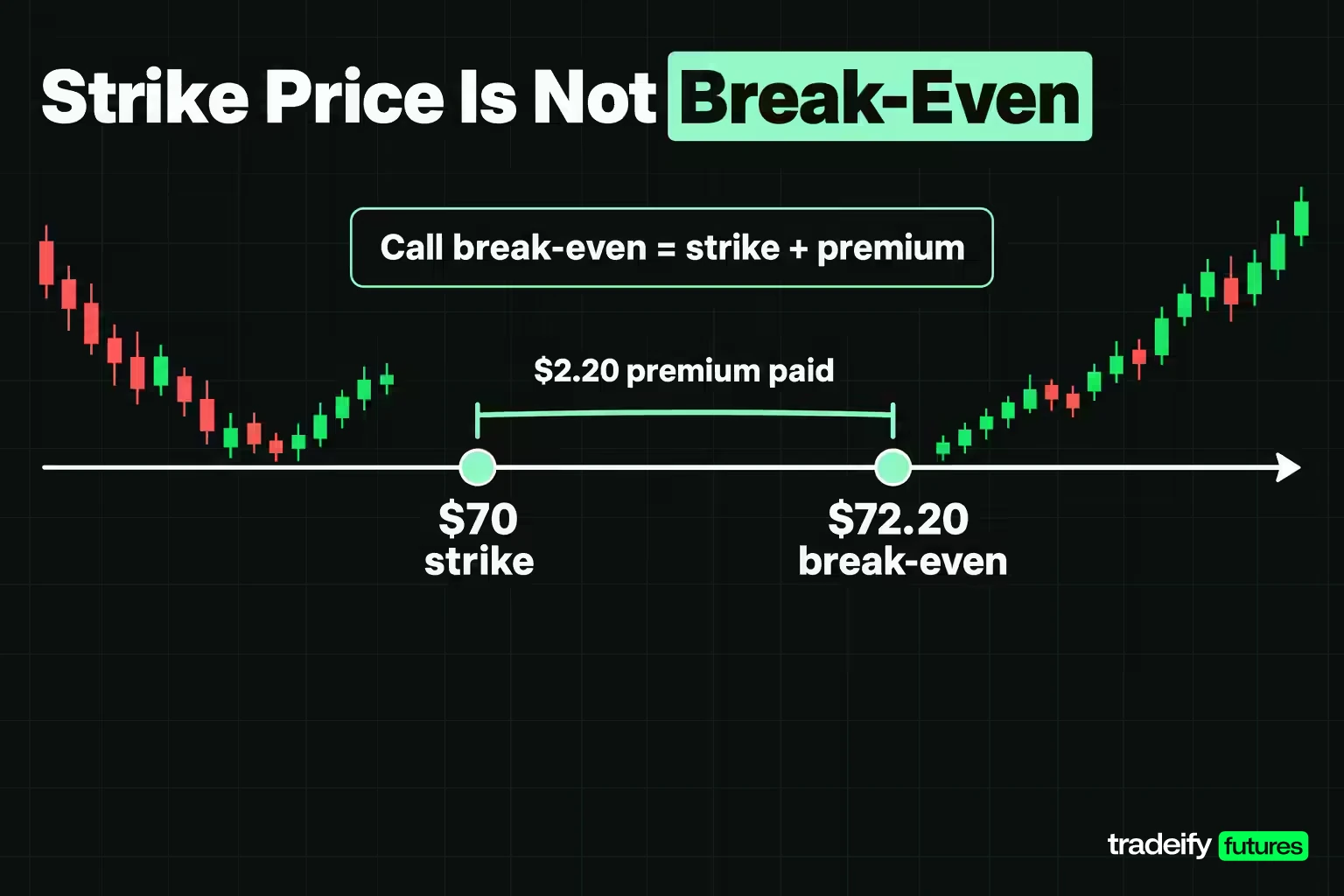
The strike price is not the break-even price. This is one of the most searched questions about strike prices, and the answer changes how you size every trade.
For a long option held to expiration:
- Call break-even = strike price + premium paid.
- Put break-even = strike price - premium paid.
The investor.gov example makes it concrete. A $70 call bought for $2.20 is in the money as soon as the stock is above $70, but the stock has to reach $72.20 for the buyer to break even. The OIC describes the same math from the exercise side: the net price paid for stock acquired by exercising a call is the strike plus the premium paid, and the net price received when exercising a put is the strike minus the premium paid. Commissions and fees push the real break-even a little further out.
How strike choice changes the required move
Break-even is where strike selection turns into a number you can test. Take illustrative 30-day calls on a $100 stock priced with a Black-Scholes model (25% implied volatility, 4% rate): $6.21 for the $95 strike, $3.02 for the $100, $1.17 for the $105 and $0.35 for the $110.
- The $95 call needs the stock above $101.21, a rise of about 1.2%.
- The $100 call needs $103.02, about 3%.
- The $105 call needs $106.17, about 6.2%.
- The $110 call needs $110.35, a rise of more than 10% in 30 days.
So the cheaper the call strike, in premium terms, the further the stock must travel before the trade pays. That is the trade-off hiding behind every "cheap" option, and it is easy to miss when the order ticket only shows a small dollar amount.
Percentage returns by strike
Percentage returns pull in the opposite direction. Using the same illustrative 30-day chain, where the $90 call costs $10.49, a $108 finish earns the $100 call $498 on $302 (about 165%) while the $90 call earns $751 on $1,049 (about 72%). More dollars, smaller percentage.
Out-of-the-money strike prices produce the eye-catching percentages when they work and a 100% loss when they do not. Neither figure is the right one to anchor on. The useful question is how much you lose if the thesis is wrong, and whether the required move is realistic for the time you have.
Before expiration, break-even math is only a guide. The option still carries time value, so a position can show a profit before the stock reaches break-even, or a loss after it passes, depending on time left and implied volatility.
How Exchanges Set Strike Prices
Strike prices are not chosen by traders or by the company whose stock underlies the option. Options exchanges list them under their listing rules, which set minimum intervals between strikes.
The standard tiers for options on individual stocks, as quoted from Nasdaq ISE's listing rules in an SEC notice published in the Federal Register on November 4, 2026, are:
| Strike price range | Minimum interval between strikes |
|---|---|
| $25 or less | $2.50 |
| Greater than $25 | $5 |
| Greater than $200 | $10 |
Cboe's equity option specifications describe the same standard pattern for strike prices. The same ISE rules allow tighter grids in several cases:
- ETF options can be listed at $1 intervals where the strike is $200 or less, and $5 above that.
- Short-term (weekly) series can use $0.50 intervals below $100, $1 between $100 and $150, and $2.50 above $150.
- Separate strike programs let exchanges list $1 or $2.50 intervals on selected stocks.
How New Strike Prices Get Added to a Chain
Cboe's specifications say in-, at- and out-of-the-money strikes are listed when a series opens, and new series are added after substantial market moves. So the strike prices on a chain cluster around wherever the stock has traded, and the menu widens if the stock runs.
Interval width has a practical cost. The ISE filing gives the example of an ETF at $50 where an investor wants a $47.50 put. On a $1 grid, the choice is a $47 put that leaves an extra 1% of downside unprotected or a $48 put that costs more than the protection requires. On a $10 grid for a high-priced stock, the gap between strikes can matter even more to your break-even.
Strike adjustments are the other factor. After a split or re-capitalization, the contract terms are adjusted so the position keeps its economic value. If you hold options through a corporate action, check the adjusted terms rather than assuming the old strike still applies on the same number of shares.
Exercising an Option at the Strike Price
Exercise is the moment the strike price stops being a reference number and becomes the actual transaction price.
To exercise, the holder tells the brokerage firm, which submits an exercise notice to the Options Clearing Corporation (OCC). OCC assigns the notice at random to a clearing member, and that firm assigns one of its customers who is short that option, either at random or first-in, first-out. The writer then has to buy or sell at the strike.
- Exercising a call. You pay the strike price for the shares. One $95 call exercised means paying $9,500 for 100 shares.
- Exercising a put. You sell shares at the strike price. You need the shares, or the exercise creates a short stock position.
American vs European Option Exercise Rules
The OIC states that all standardized equity options use American-style exercise, so they can be exercised on any day the market is open before expiration. Most index options are European-style and can be exercised only at expiration. Cboe's equity specifications state that a properly tendered exercise results in delivery of the stock on the third business day after exercise.
Timing has cut-offs. The OIC notes that options exchanges accept exercise notices until 4:30 PM CT, and most brokerage firms set an earlier cut-off for their customers.
Automatic exercise at expiration
At expiration, OCC uses a procedure called exercise by exception: options in the money by $0.01 or more are exercised automatically unless the clearing firm instructs otherwise. Your broker may use a different threshold, and you can always give your own instructions. This matters if you are holding a slightly in-the-money option and do not have the cash or shares to handle the resulting position.
Why most holders sell instead of exercising
Exercising throws away any time value left in the option. In an illustrative case, a stock trades at $108 with a week left, and a $95 call trades above its $13 intrinsic value. Exercising captures only the $13 and requires $9,500 in cash. Selling the call captures the intrinsic value plus the remaining time value and ends the position in one trade.
There are exceptions. The OIC notes that call holders sometimes exercise early to collect a dividend, and that most professional traders exercise deep in-the-money puts before expiration. If you are short an in-the-money option near a dividend date or near expiration, expect that assignment can come early.
How to Choose a Strike Price
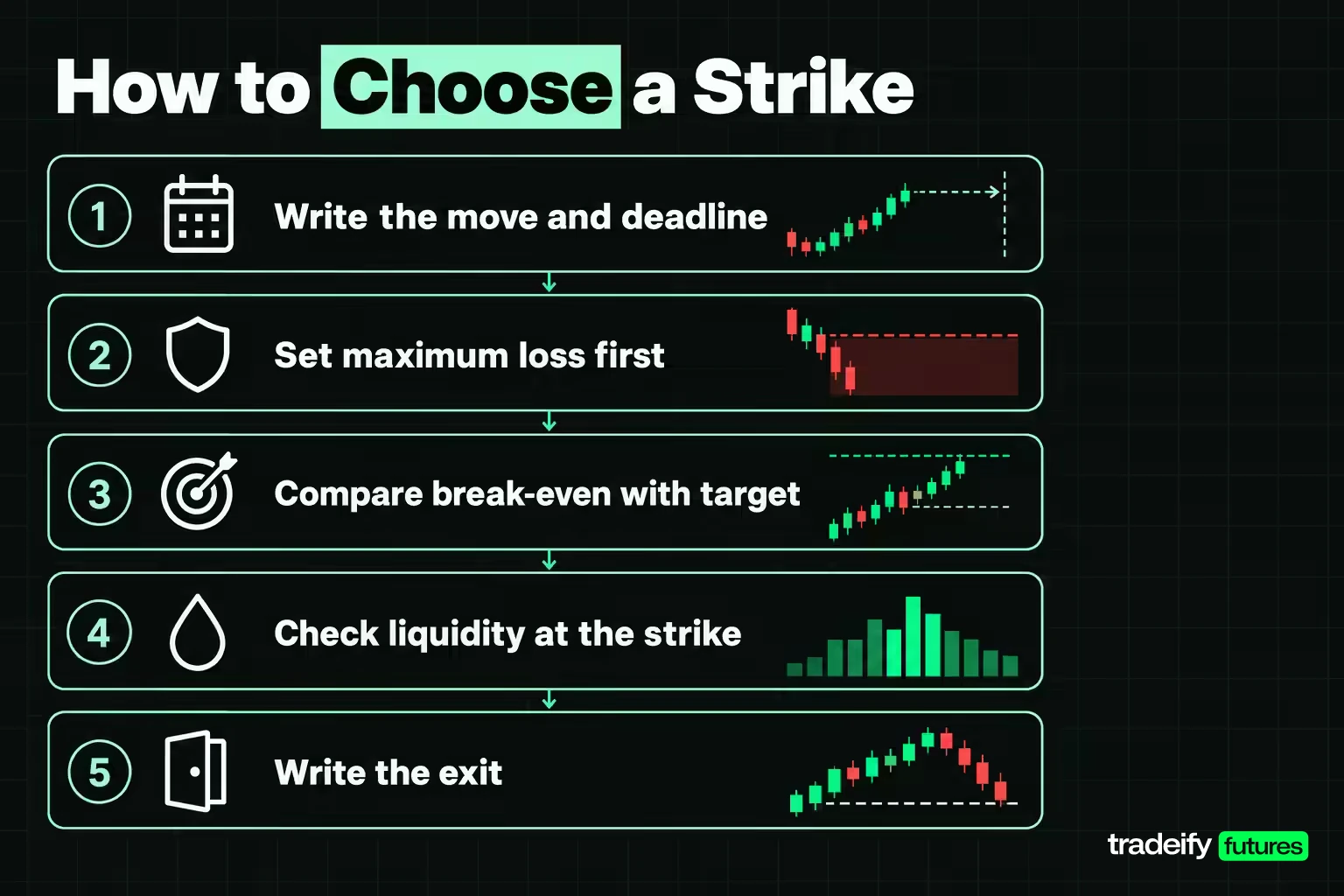
There is no best strike, only a strike that fits a specific thesis, deadline and loss limit. The chain will always offer something cheaper. Cheaper is not the question. Work through the decision in this order.
- Write down the move and the deadline. "Bullish" is not a plan. "The stock can reach $108 within three weeks" gives you a level and a clock you can compare with the chain. Also note what would prove the view wrong, such as a close back below the level that made you bullish.
- Set the maximum loss first. A long option can lose the full premium. If your limit is $300, a call quoted at $6.21 ($621 per contract) is already too big, before fees.
- Compare break-even with your target. If the target is $108 and a strike's break-even is $110.35, the trade can be right on direction and still lose everything.
- Check delta and the odds. Delta gives a rough sense of how likely a strike is to finish in the money and how much it moves with the stock.
- Match the strike to the expiration. Less time favors strikes closer to the money; far strikes need time to get there.
- Check liquidity at that strike. A wide bid-ask spread can eat a large share of a cheap option's value.
- Write the exit. Decide what you do if the stock moves against you, if the move takes too long, or if the target is hit early.
Here is how that plays out on an illustrative 30-day chain for a $100 stock. A trader who expects $108 in 30 days and can lose $300 might look at the $100 call ($302, break-even $103.02) or the $105 call ($117, break-even $106.17). The $110 call looks cheap at $35, but its break-even sits above the target, so it fails step 3 no matter how small the premium is.
Delta as a strike probability guide
The OIC defines delta as a theoretical estimate of how much an option's premium may change for a $1 move in the underlying. A call with a 0.50 delta may gain about $0.50 for a $1 rise in the stock, all else equal.
Some traders also read delta as a rough probability that the option finishes in the money. The OIC describes this shorthand and adds that an option with less than a 0.10 delta is not viewed as very likely to finish in the money. Delta changes constantly as the stock moves, time passes and implied volatility shifts.
An illustrative 30-day chain on a $100 stock (Black-Scholes, 25% implied volatility, 4% rate) shows that the shorthand is close but not exact. The model's own risk-neutral probability of finishing in the money is slightly lower than delta for each call:
| Call strike | Delta | Model probability of finishing ITM |
|---|---|---|
| $95 | 0.79 | 77% |
| $100 | 0.53 | 50% |
| $105 | 0.27 | 25% |
| $110 | 0.11 | 9% |
Use delta as a quick way to compare strike prices, not as a forecast. The model probability depends on the volatility you feed it, and real stocks gap, trend and react to news in ways a model does not.
Strike selection by time to expiration
Time to expiration changes which of the strike prices on a chain makes sense. Here is how two call strikes on an illustrative $100 stock price at 30 days and 90 days, using a Black-Scholes model with 25% implied volatility and a 4% rate:
| Call strike | 30-day premium | 30-day delta | 90-day premium | 90-day delta |
|---|---|---|---|---|
| $100 | $3.02 | 0.53 | $5.43 | 0.56 |
| $105 | $1.17 | 0.27 | $3.31 | 0.40 |
With 90 days, the $105 call has a 0.40 delta instead of 0.27, because there is more time for the stock to get there. The OIC notes the same pattern: an out-of-the-money call with more time to expiration has a higher delta than the same strike with less time. You pay for that time, though. The 90-day $105 call costs nearly three times the 30-day one.
A practical rule follows. If the move you expect is fast, a near-term strike closer to the money keeps the cost down without asking for too much distance. If you expect the move over months, a further strike can make sense, but only with an expiration that gives it room.
Strike price liquidity and bid-ask spreads
Liquidity varies by strike. Strike prices near the money and round numbers tend to trade more actively, while far strikes and odd intervals can have wide spreads and little volume.
Judge the spread as a percentage of the option's midpoint, not in cents. On an illustrative chain for a $100 stock, a $0.30 bid and $0.40 ask on the $110 call is a $0.10 spread on a $0.35 midpoint, about 29% of the option's value. A $10.40 bid and $10.60 ask on the $90 call is a $0.20 spread on a $10.50 midpoint, about 1.9%. The far strike looks cheap, but you may give up close to a third of its value just getting in and out.
Use limit orders on options, check the live bid and ask rather than the last trade, and decide beforehand what spread makes a strike unusable.
Strike Price vs Fair Market Value in Employee Stock Options
Strike price and fair market value (FMV) are not the same thing, though they meet at one moment on employee stock options.
On a listed option, the strike is simply one of the prices on the exchange's menu, and the stock's market price is set by trading. On an employee stock option, the company sets the strike when it grants the option, and tax rules tie that strike to the stock's FMV on the grant date.
- Carta explains that IRS rules require a private company's option strike to be equal to or greater than the stock's FMV on the grant date, which prevents companies from issuing discounted options.
- The Treasury regulations under section 409A (26 CFR 1.409A-1) say that if an option's exercise price is or could become less than the stock's FMV on the grant date, the grant generally counts as deferred compensation, which brings section 409A's tax rules into play.
- For incentive stock options, section 422 of the tax code requires an option price not less than the stock's FMV when the option is granted.
To set that FMV, private companies get what is commonly called a 409A valuation, an independent appraisal of the common stock. Carta notes that the 409A value of common stock is typically lower than the price investors pay for preferred stock in a funding round.
After the grant, the two numbers drift apart. The strike stays fixed, and FMV moves with the company's value. In an illustrative case, an employee holds 1,000 options with a $2.00 strike, and the latest FMV is $8.00. The spread is $6.00 per share, or $6,000 in total, before taxes. If FMV falls below $2.00, the options are underwater and have no exercise value, although the strike has not changed.
Related lesson: Stock options
Strike Prices on Futures Options
Strike prices work the same way on options on futures, with two differences: the underlying is a futures contract, and the price units come from the futures contract.
CME's rulebook chapter for options on E-mini S&P 500 futures shows how this works:
- Each option is on one E-mini S&P 500 futures contract.
- Option prices are quoted in index points, and each point is worth $50.00 per option contract.
- When a call is exercised, the seller takes on a short position in one futures contract at the option's exercise price, and the call buyer ends up long. Exercising a put works the other way.
- At expiration, a call is in the money only if the final settlement price of the futures is strictly above the strike, and a put only if it is strictly below. An expiring in-the-money option is exercised automatically unless contrary instructions are given (quarterly options), and the weekly and end-of-month European-style options are exercised or abandoned by the clearing house automatically.
An illustrative example: with E-mini S&P 500 futures at 6,000, a 6,000-strike call priced at 100 index points costs $5,000 (100 × $50). Its break-even at expiration is 6,100. If exercised, it becomes a long futures position at 6,000, with the full daily profit and loss of a futures contract from that point on.
That last step is where futures options differ most from stock options. Exercise does not hand you 100 shares. It hands you a leveraged futures position that is marked to market every day, so the risk profile changes the moment the option is exercised.
On our accounts, you trade futures only. Options of any kind are not on our supported products list, so you cannot buy or sell options at any strike price on a Tradeify account. The ES and MES futures you can trade are the same contracts these E-mini S&P 500 options exercise into.
Common Strike Price Mistakes
Most strike-selection errors come from looking at one number in isolation, usually the premium. These are the recurring ones, and each has a simple check.
- Treating a cheap premium as low risk. A $0.35 option is cheap per contract, but it can lose 100% of what you paid. Buying more contracts because each one is cheap only increases the dollars at risk.
- Confusing in the money with profitable. An in-the-money option can still be a losing trade if you paid more than its intrinsic value. Check break-even, not moneyness.
- Picking the strike before the plan. If you cannot state the target and deadline, you have no way to judge whether a strike's break-even is reasonable.
- Ignoring time. A strike that needs a 10% move in 30 days asks for a lot. Right on direction but wrong on timing still loses money as time value decays.
- Ignoring the spread. Far strike prices often carry the widest spreads relative to their price. The cost shows up when you exit.
- Forgetting about assignment and exercise. If you are short an option that moves in the money, the strike becomes your trade price whenever the holder decides to exercise.
- Assuming the strike is the price you will pay or receive overall. The premium and costs always sit on top of the strike.
If one rule covers most of these, it is this: decide what the trade has to do, then pick the strike whose break-even and maximum loss fit that plan. If no strike on the chain fits, passing on the trade is a valid answer.
Strike Prices FAQ
Is the strike price the break-even price?
No. For a long call held to expiration, break-even is the strike plus the premium paid. For a long put, it is the strike minus the premium paid. A $70 call bought for $2.20 breaks even at $72.20, before fees.
Is FMV the same as strike price?
No. Fair market value is what the stock is worth now, and it changes. The strike is fixed in the option contract. On employee stock options, the strike is usually set at or above FMV on the grant date, and the two numbers diverge from then on.
What is strike in the share market?
On a stock option, the strike is the per-share price at which the shares change hands if the option is exercised. A call holder can buy at the strike and a put holder can sell at it. It is not a price target or prediction for the stock.
How do you select a strike price?
Select a strike price by starting from your target price, deadline and maximum loss. Then compare each strike's premium, break-even, delta, time to expiration and bid-ask spread. Choose the strike whose break-even sits comfortably inside your target and whose cost fits your loss limit.
Are strike price and exercise price the same?
Yes. Strike price and exercise price are two names for the same contract term. Exchange rulebooks often use "exercise price", while most trading platforms label the chain column "strike".
Can a strike price change after you buy the option?
Not with normal market moves. The strike stays fixed for the life of the contract. It can be adjusted after corporate events such as stock splits or re-capitalizations, so the contract keeps its economic value.
What happens when the stock hits the strike price?
Nothing automatic. At that moment the option is roughly at the money and is mostly time value. It can move back in or out of the money before expiration, and only the price at expiration (or an exercise decision) settles the outcome.
Using Strike Prices in Your Next Trade Plan
The next time you open an options chain, use strike prices as a checklist rather than a menu. Write the target and deadline, then for two or three strikes note the premium in contract dollars, the break-even, the delta and the spread as a percentage of the midpoint. Cross out any strike whose break-even sits beyond your target or whose cost breaks your loss limit.
Whatever is left is a strike that fits the plan. If nothing is left, the chain has told you something useful too.
Options and futures carry substantial risk. An option buyer can lose the entire premium paid, and an option seller can lose far more than the premium received. Futures and options on futures use leverage, which can magnify losses beyond what you expect. Evaluation and funded prop-firm accounts are simulated. The figures in this guide are illustrative model values, and nothing here is financial, investment or tax advice.


