



TL;DR: Option rho estimates how much an option's price may change when interest rates move one percentage point. Long calls carry positive rho and long puts negative rho; selling flips the sign. A 30-day at-the-money call may show rho near 0.04, a 1-year call near 0.49 ($49 per contract). Convert rho to position dollars for a realistic rate move before deciding it matters.
Option rho is the Greek most traders skip, and on a two-week option that is usually fine. A one-point change in interest rates rarely happens in two weeks, and even if it did, the price of a short-dated option would barely notice.
The trouble starts when the same habit follows a trader into a one-year or two-year contract. There, rho can be as large as vega, and a string of rate decisions can quietly move the option's value while the underlying goes nowhere. This guide explains what option rho measures, why rates move option prices at all, how to calculate it, and how to tell when it is big enough to change a decision.
What Option Rho Measures
Option rho measures how much an option's theoretical value should change for a one-percentage-point change in the risk-free interest rate, with every other pricing input held constant. The Options Industry Council (OIC) gives a clean example: with rates at 3.00%, a $100 call with a rho of +.45 would gain $.45 in premium if rates jumped to 4%, while a put with a rho of -.45 would lose $.45 per share.
How to read a rho value
Rho is quoted in dollars per percentage point, per share. Platforms rarely print the units, the same way they rarely print them for delta or vega.
- A rho of 0.25 means about $0.25 per share for a one-point rate move.
- Standard equity options cover 100 shares, so that is about $25 per contract.
- A quarter-point move (0.25 percentage points) scales it down to about $0.0625 per share, or $6.25 per contract.
- The sign tells you direction. Positive rho gains when rates rise. Negative rho gains when rates fall.
So "the value of 1 rho" is simple: a rho of 1.00 means roughly $1.00 per share, or $100 per contract, for each one-point change in the rate.
Finding option rho on an option chain
On most option chains, option rho sits in an optional Greeks column next to delta, gamma, theta and vega. Many platforms hide it by default because it is small on near-term contracts.
Before multiplying it across a position, confirm how your platform scales it. Most show rho per one percentage point, but a model can also express it per 1.00 change in the decimal rate (100 percentage points), which makes the number 100 times larger. A quick check is to look at a one-year at-the-money call: if its rho is close to half a dollar on a $100 stock, the platform is quoting per point.
It also matters which rate the model uses. The OIC notes that interest rates are not the same industry wide and can vary between clearing firms, brokerages and even accounts. Two platforms can show slightly different rho for the same contract for that reason alone.
Why Interest Rates Affect Option Prices
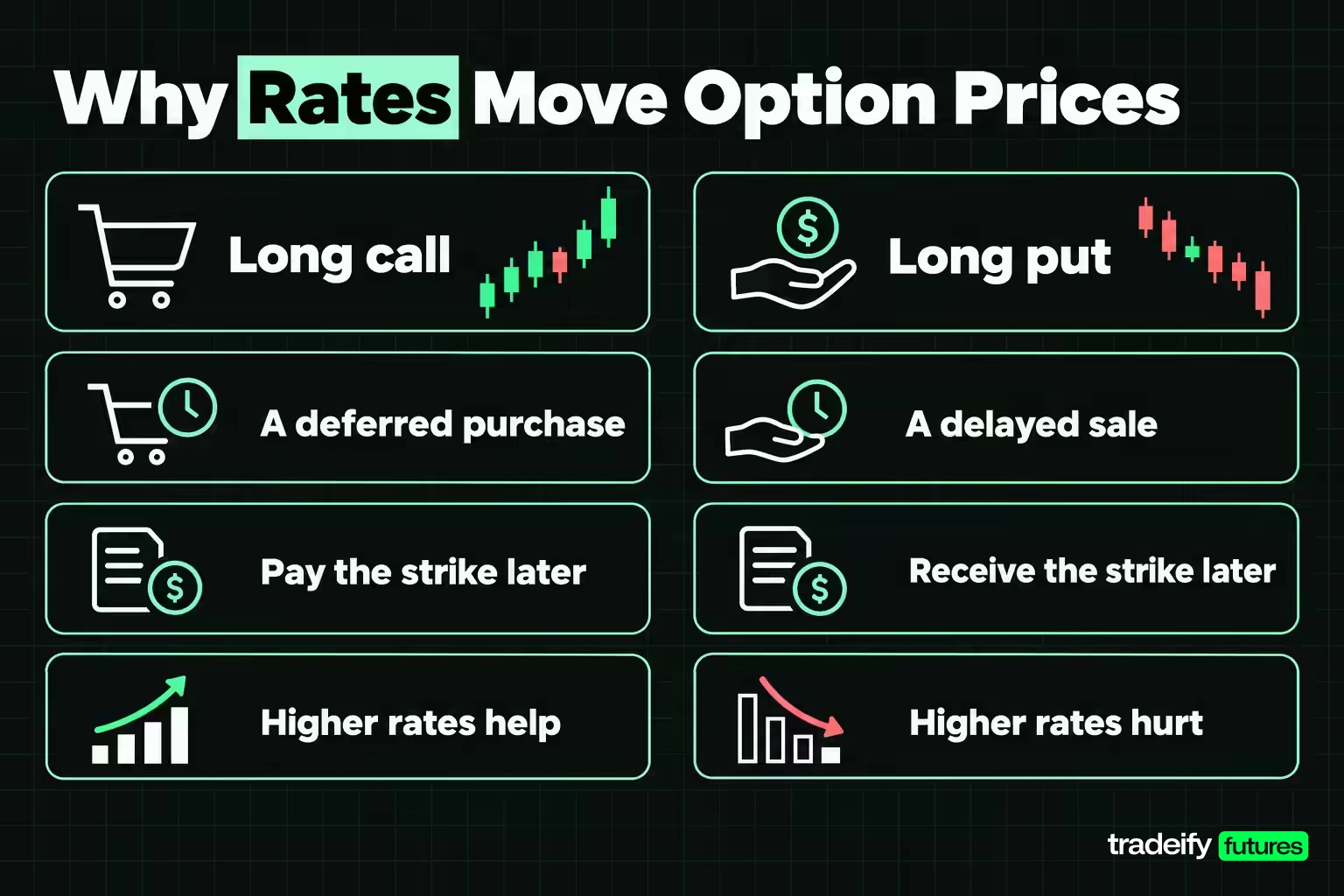
Interest rates affect option prices because an option changes when cash moves. Buying a call lets you control upside in a stock without paying for the stock today. Buying a put lets you lock in a sale price without selling today. Rates decide what that delay in cash is worth.
The call as a deferred purchase
Take a $50 stock. Buying 100 shares costs $5,000 now. A three-month $50 call might cost $2.00, or $200 for one contract, and you only pay the $5,000 strike later if you exercise. Macroption describes this as being like a three-month loan of $5,000.
The higher the interest rate, the more that loan is worth. Cash you did not spend on shares can sit in Treasury bills and earn interest. So a higher rate makes the call more valuable relative to owning the stock, and call rho is positive.
The put as a delayed sale
Now flip it. If you own the stock and want protection, you can sell the shares today for $5,000 and earn interest on the cash, or you can buy a $50 put and keep the right to receive $5,000 at expiration.
With the put, the cash arrives later. Higher rates make waiting for that money more expensive, so the put is worth less. Put rho is negative.
Discounting the strike and the hedging cost
Pricing models express the same idea by discounting the strike price back to today at the risk-free rate. A higher rate shrinks the present value of the strike. That helps a call holder, who pays the strike later, and hurts a put holder, who receives it later.
The OIC frames it from the market maker's side. Models price an option at its "hedged value." A dealer who buys a deep in-the-money put with a delta near -1.00 hedges by buying 100 shares, which means borrowing money or giving up interest on cash. When rates rise, that carrying cost rises, so the dealer pays less for the put. The OIC's options-pricing page lists the same cost of carry: interest paid for margin or received from alternatives such as a Treasury bill, plus dividends on shares held.
Call Rho vs Put Rho
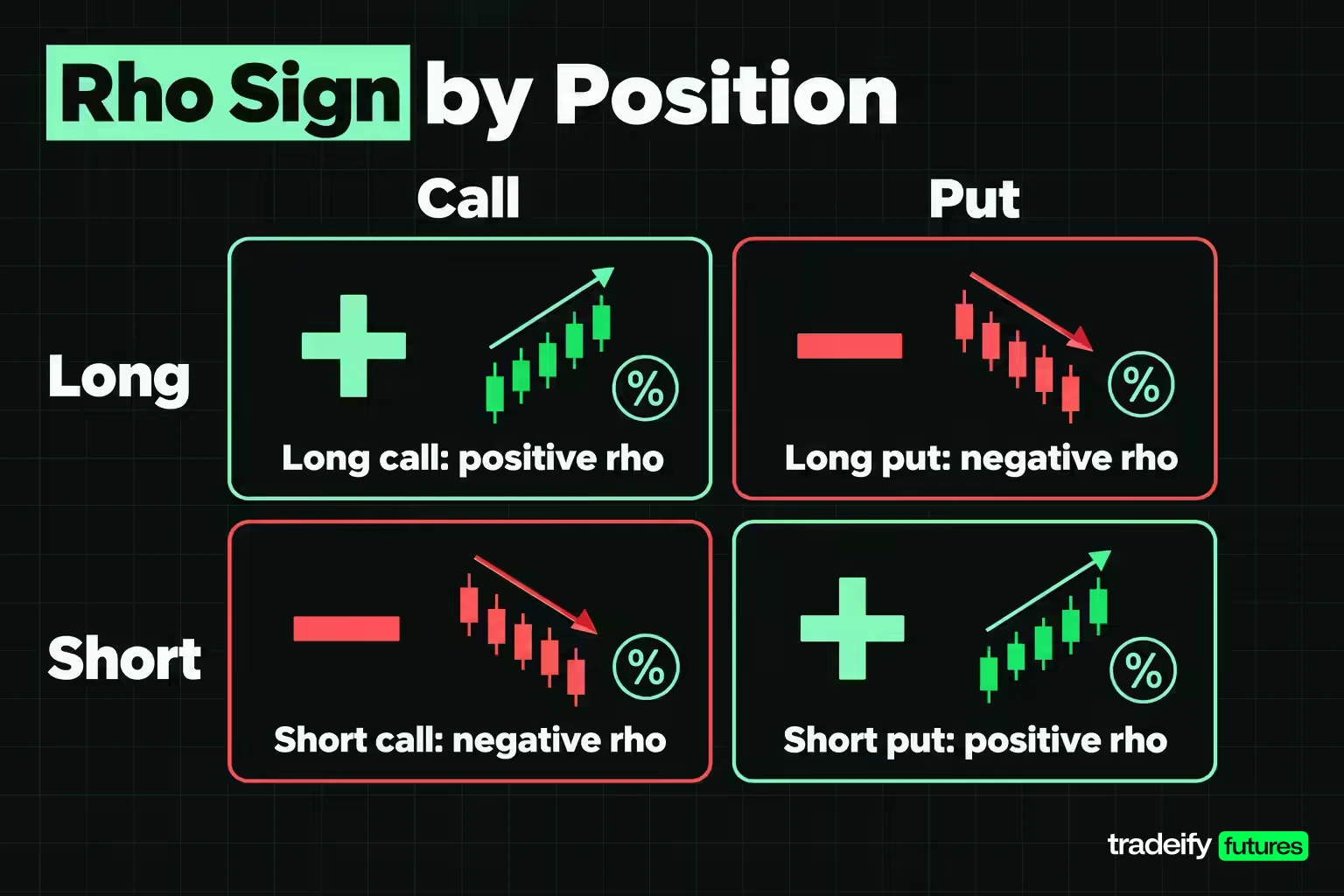
Call rho and put rho have opposite signs for the reasons in the cost-of-carry story. Purchased calls have positive rho because higher rates raise call premiums. Purchased puts have negative rho because higher rates lower put premiums, as the OIC puts it.
Selling the option reverses the sign. The OIC summary is useful here: any position that, hedged to delta neutral, requires buying the underlying shares (a short call or a long put) reacts negatively to rising rates. A position hedged by selling stock short is hurt when rates fall.
| Position | Rho sign | Helped by | Hurt by |
|---|---|---|---|
| Long call | Positive | Rising rates | Falling rates |
| Short call | Negative | Falling rates | Rising rates |
| Long put | Negative | Falling rates | Rising rates |
| Short put | Positive | Rising rates | Falling rates |
This table is a direction check only. A short call can still lose money in a rising-rate week if the stock rallies, because delta will swamp rho. The table tells you which way the rate input pushes, not how the trade ends.
Call rho and put rho also differ in size at the same strike. In a 1-year model with a $100 stock and a $100 strike, the call's rho is 0.494 and the put's rho is -0.467. The call is slightly more sensitive because, at the money, it has a higher chance of finishing in the money than the put once the forward price drifts above the spot price.
Rho and Put-Call Parity
Put-call parity explains why call rho and put rho move together, and it is the cleanest way to sanity-check option rho on a chain. For European options on a stock with no dividends, a call minus a put at the same strike and expiration equals the stock price minus the present value of the strike. Only the strike term depends on the rate.
That means the difference between call rho and put rho at the same strike must equal the rate sensitivity of the discounted strike: strike times time to expiration times the discount factor, divided by 100 to put it per percentage point. It does not depend on volatility or on where the stock trades.
| Strike (1-year, $100 stock) | Call rho | Put rho | Call rho minus put rho |
|---|---|---|---|
| $80 | 0.633 | -0.136 | 0.769 |
| $90 | 0.585 | -0.280 | 0.865 |
| $100 | 0.494 | -0.467 | 0.961 |
| $110 | 0.385 | -0.672 | 1.057 |
| $120 | 0.281 | -0.872 | 1.153 |
Model values: Black-Scholes, 25% implied volatility, 4% interest rate, no dividends. Each figure in the last column matches the strike times one year times the discount factor (for the $100 strike, 100 × 1 × e^(-0.04) ÷ 100 = 0.961).
The practical takeaway is that a call and a put at the same strike carry a fixed, known rate gap between them. If a chain shows call and put rho at one strike that do not roughly obey this, the model is using dividends, early-exercise adjustments or a different rate, and it is worth finding out which.
How to Calculate Option Rho
You can calculate option rho two ways: with the Black-Scholes formula, or by repricing the option at two rates. Platforms do it for you, but knowing the inputs explains why rho behaves the way it does. Rho is the first derivative of the option price with respect to the interest rate.
The Black-Scholes rho formula
For a non-dividend stock in the Black-Scholes model, per one percentage point:
- Call rho = K × T × e^(-rT) × N(d2) ÷ 100
- Put rho = -K × T × e^(-rT) × N(-d2) ÷ 100
In words:
- K is the strike price. A higher strike means more cash deferred, so more rate sensitivity.
- T is time to expiration in years. Rho grows roughly in line with it.
- e^(-rT) is the discount factor that turns the strike into today's dollars.
- N(d2) is, in the model, the risk-neutral probability the call finishes in the money. N(-d2) is the same for the put.
The ÷ 100 converts the result from "per 1.00 change in the decimal rate" to "per one percentage point." Leaving it out makes option rho look 100 times larger than the figure most platforms display.
If the stock pays a dividend, the model uses the rate net of the dividend yield to drive prices, so the rate and the dividend yield pull in opposite directions.
The bump-and-reprice method
The second way needs no calculus. Price the option at today's rate, price it again at a rate one point higher, and subtract. With a $100 stock, $100 strike, 1 year to expiration, 25% implied volatility and no dividends, the model call is worth $11.8370 at 4% and $12.3360 at 5%. The difference, $0.499, is the rho measured over a full one-point step.
The Black-Scholes rho formula gives 0.494 for the same call at 4%. The small gap is normal: rho itself changes as the rate changes, so a one-point bump picks up a little curvature that the instantaneous rho does not.
Rho and Time to Expiration
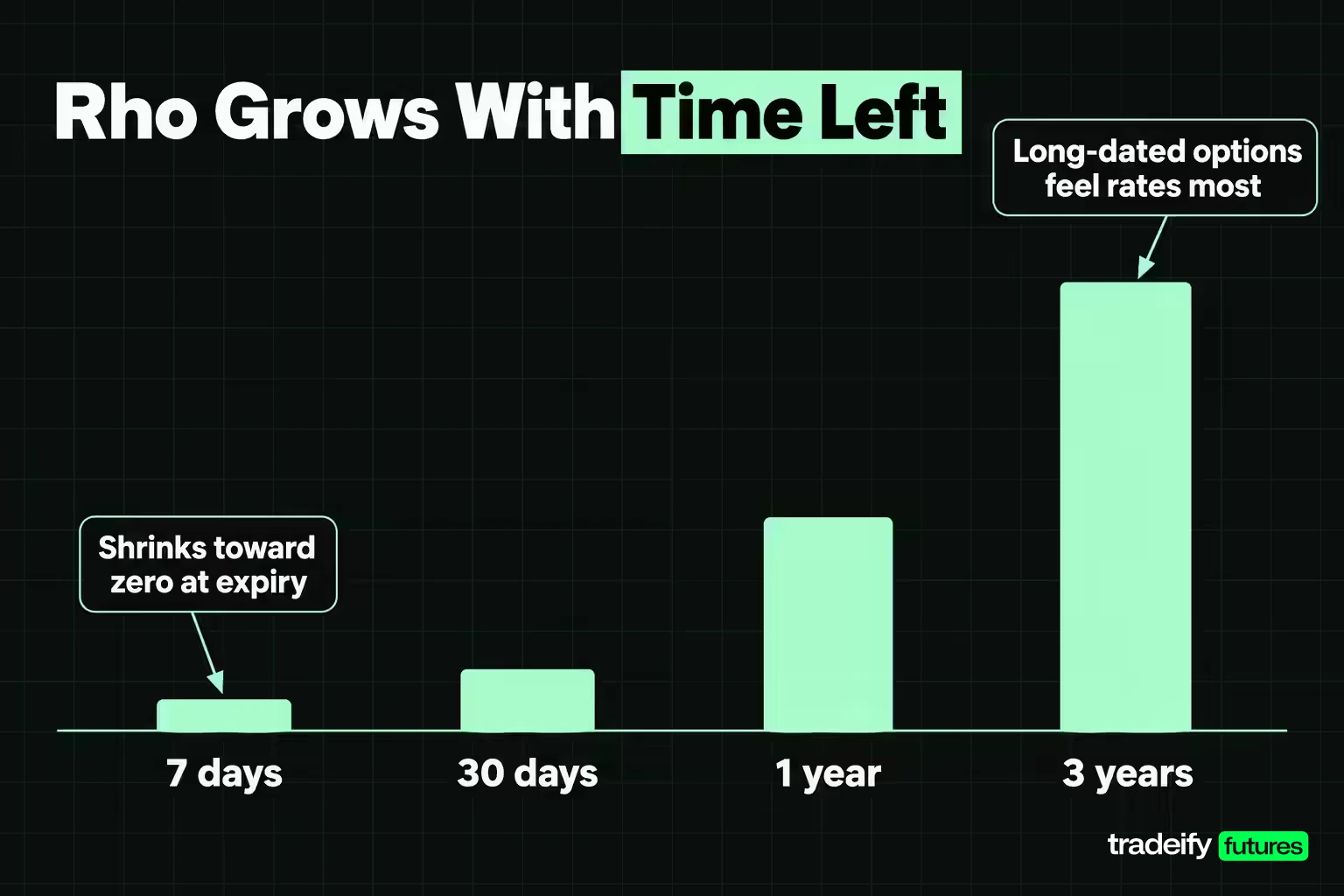
Option rho and time to expiration are tightly linked. Rho grows with the time remaining and shrinks toward zero as expiration approaches, which is why the OIC says rate changes affect longer-term options much more than near-term ones. The cash-deferral benefit of a call (or cost of a put) simply has more time to compound.
The model table below holds everything constant except time: $100 stock, $100 strike, 25% implied volatility, 4% rate, no dividends.
| Time to expiration | Call price | Call rho | Put price | Put rho |
|---|---|---|---|---|
| 7 days | $1.42 | 0.010 | $1.34 | -0.010 |
| 30 days | $3.02 | 0.041 | $2.69 | -0.041 |
| 90 days | $5.43 | 0.124 | $4.45 | -0.120 |
| 180 days | $7.95 | 0.246 | $5.99 | -0.237 |
| 1 year | $11.84 | 0.494 | $7.92 | -0.467 |
| 2 years | $17.68 | 0.960 | $9.99 | -0.887 |
| 3 years | $22.43 | 1.395 | $11.12 | -1.266 |
Two things stand out. First, rho roughly doubles each time the expiration doubles from 90 days onward. Second, the 3-year call's rho of 1.395 means about $139.50 per contract for a one-point move, against about $1 per contract for the 7-day call.
That is the whole case for watching rho on long-dated options and ignoring it on weeklies. Same strike, same stock, same Greek. Only the clock changed.
Rho and Moneyness
Option rho and moneyness interact because the strike only matters to the rate if the option is likely to be exercised. A deep in-the-money call is very likely to end with the holder paying the strike, so it carries nearly the full deferred-payment benefit. A far out-of-the-money call probably expires worthless, so the deferral barely counts.
Call rho across strikes
In a 1-year Black-Scholes model ($100 stock, 25% implied volatility, 4% rate, no dividends), call rho falls from 0.633 at the $80 strike (deep in the money, delta 0.88) to 0.494 at the money and 0.281 at the $120 strike (out of the money, delta 0.33). On the 30-day chain the same pattern holds at a much smaller scale: 0.069 for the $90 call, 0.041 at the money and 0.008 for the $110 call.
Rho does not keep rising forever as you go deeper in the money. It approaches the ceiling set by strike times time times the discount factor, because a deep in-the-money call is close to certain exercise and behaves like a forward purchase of the stock.
Put rho across strikes
Put rho across strikes mirrors call rho, with the sign reversed. In the same 1-year Black-Scholes model ($100 stock, 25% implied volatility, 4% rate), the $120 put, deep in the money with a delta of -0.67, has rho of -0.872, while the out-of-the-money $80 put has only -0.136. A deep in-the-money put is close to a forward sale of the stock, so it carries most of the "cash arrives later" cost.
Higher-priced underlyings carry more rho
Underlying price matters too. The OIC notes that carrying a $250 stock position costs more than carrying a $50 one. In the 1-year model, an at-the-money call on a $50 stock has rho of 0.247, while an at-the-money call on a $250 stock has rho of 1.235. Same percentages, five times the dollars.
Related lesson: How in-the-money, at-the-money and out-of-the-money options differ
Why Option Rho Is Usually the Smallest Greek
Option rho is usually the smallest Greek for two reasons: its values are small on the options most people trade, and the input it tracks moves slowly. The OIC's options-pricing page says dividends and the risk-free rate have a lesser effect on premium than the underlying price, strike, time and implied volatility.
Macroption makes the speed point well. A one-percentage-point change in the short-term risk-free rate is a huge event in markets, while the same change in implied volatility can happen in minutes on many underlyings. So even when rho and vega are similar in size per unit, vega gets exercised far more often.
Key characteristics of option rho
- Rho is first-order: it measures the response to a small rate change, and it changes as the rate, time and price change.
- It has no theoretical limit and can be positive or negative.
- Call rho is positive and put rho negative on stock options; options on futures behave differently.
- It grows with time to expiration, moneyness and the price of the underlying.
- It shrinks toward zero as expiration approaches.
- It ignores the indirect effect of rates on the underlying itself.
That last point is the one traders forget. Macroption notes that rate changes often move the underlying too: bank stocks, bonds and currencies can react hard to rate news. Rho only measures the direct effect on the option's pricing input. The indirect effect shows up through delta, and for rate-sensitive underlyings it is often much larger.
When the ranking flips
The "smallest Greek" label is a habit, not a law. On the 1-year at-the-money call, rho of 0.494 is larger than vega of 0.383 per volatility point. On a 3-year LEAPS-style contract, rho is larger still. The label holds for short-dated trading; it breaks for long-dated holdings.
Option Rho Worked Examples
These option rho examples use round illustrative numbers from a Black-Scholes model: $100 stock, 25% implied volatility, 4% interest rate, no dividends. They are not quotes for any real contract.
Example 1, a one-year call and put under a one-point rise
The 1-year $100 call is worth $11.84 with rho of 0.494. The 1-year $100 put is worth $7.92 with rho of -0.467.
If the rate rises from 4% to 5% and nothing else changes:
- Call estimate: $11.84 + $0.494 ≈ $12.33 per share, a gain of about $49.40 per contract.
- Put estimate: $7.92 - $0.467 ≈ $7.45 per share, a loss of about $46.70 per contract.
Full repricing at 5% gives a call change of +$0.499 and a put change of -$0.457. The rho estimate is within about a cent per share, which is as close as a first-order Greek gets.
Example 2, rho estimate vs full repricing on bigger rate moves
Rho is a local estimate. Stretch the move to two points, from 4% to 6%, and the rho estimate for the call is +$0.988 against a full-reprice change of +$1.008. For the put the estimate is -$0.934 against an actual -$0.8945. The error is still small, but it grows with the size of the move. In both cases the full reprice comes out slightly better for the holder than the straight-line estimate, because rho itself shifts as the rate moves.
At a more realistic quarter-point move (4% to 4.25%), the call estimate is +$0.1235 and full repricing gives +$0.1238. For decisions, a quarter-point step is the more useful scenario.
Example 3, a mixed position under a quarter-point rise
Suppose a hypothetical position holds 4 long 1-year $100 calls and 2 long 1-year $100 puts. Test a quarter-point rate rise:
- Calls: 0.494 × 0.25 × 100 × 4 = +$49.40.
- Puts: -0.467 × 0.25 × 100 × 2 = -$23.35.
- Net position rho effect: +$26.05.
That $26.05 is not a forecast of profit. It is the isolated effect of the rate input, and it is small next to everything else the position is exposed to. If the stock moved $1 on the same day, the position's delta would swamp it.
When Option Rho Really Matters
Option rho really matters when three things stack: a long time to expiration, a meaningful rate move, and a position big enough that the dollars count. Any one alone rarely changes a decision. All three together can.
Long-dated options and LEAPS
Cboe lists LEAPS, long-term options with the same characteristics as standard options but with expiration dates up to three years in the future. In the model table, a 3-year at-the-money call carries rho of 1.395, about 34 times the rho of the 30-day call. Anyone using LEAPS calls as a stock substitute is, in part, making a rate bet whether they intend to or not.
Rho during large or fast rate shifts
Rate regimes change. As of November 4, 2026, the Federal Reserve's federal funds target range is 3.75%-4.00%, after a quarter-point increase on September 16, 2026 and a hold on October 28, 2026. A run of quarter-point moves in the same direction adds up. Market rates can also move ahead of a Fed decision as expectations change, so the rate input on a long-dated option does not wait for the announcement.
A rate decision rarely moves an option by exactly its rho. Markets price expected decisions in advance, the yield the model uses may move by a different amount, and the underlying usually reacts on the same day.
High-priced underlyings and large positions
Because rho scales with the underlying's price, a long-dated option on a high-priced stock or index carries much more rho in dollars than one on a $50 stock. And because rho is per contract, a position of 50 or 100 long-dated contracts can turn a few cents of rho into hundreds of dollars per quarter point.
When rho is safe to ignore
On options with a few weeks or less to run, rho is usually noise. The 30-day at-the-money call moves about $1.03 per contract for a quarter-point rate change. Its theta costs more than that every single day, so time decay deserves the attention first.
Rho on Futures Options and Currency Options
Option rho on futures options and on currency options does not follow the stock-option rule of positive calls and negative puts. This matters for anyone who trades futures and reads about options on the same markets.
Options on futures
Buying a futures contract does not require paying the full contract value. You post a performance deposit, and gains and losses are settled daily. So the "call defers a big cash payment" logic that gives stock calls positive rho does not apply. Macroption notes that futures options tend to be less sensitive to interest rates than stock or currency options, and that general statements are hard because settlement details vary.
In the standard Black-76 model, where the option premium is paid upfront, rho is minus the time to expiration times the option price, so calls and puts both carry small negative rho. A 1-year at-the-money call on a $100 futures price, at 25% volatility and 4%, is worth about $9.56 with rho of -0.0956. The 30-day version has rho of -0.0023. The rate only discounts the premium; it does not change the forward.
Currency options
Currency options involve two rates. Rho tracks the domestic rate and behaves like stock-option rho: higher domestic rates help calls on the foreign currency and hurt puts. A second sensitivity, often called rho2 or phi, tracks the foreign rate and works like a dividend yield, so a higher foreign rate makes calls on that currency less valuable and puts more valuable. For currencies, the indirect effect of rates on the exchange rate itself is often much larger than either rho.
Rho Alongside Delta, Gamma, Theta and Vega
Option rho alongside the other Greeks makes sense only when every Greek is converted into dollars for a realistic move. Raw Greek values use different units, so adding them or ranking them directly is meaningless.
The OIC definitions give the units: delta per $1 move in the underlying, gamma as the change in delta per $1, theta per one day, vega per one point of implied volatility, rho per one percentage point of interest rate.
| Greek and scenario (per contract) | 30-day $100 call | 1-year $100 call |
|---|---|---|
| Delta, stock up $1 | +$53 | +$61 |
| Gamma, delta change per $1 | 0.0555 | 0.0153 |
| Theta, one day passes | -$5.30 | -$1.85 |
| Vega, implied volatility up 1 point | +$11.40 | +$38.30 |
| Rho, rates up 1 point | +$4.10 | +$49.40 |
| Rho, rates up 0.25 point | +$1.03 | +$12.35 |
Model values: $100 stock, 25% implied volatility, 4% rate, no dividends.
On the 30-day call, rho is the smallest line by a wide margin, and a quarter-point rate move is worth less than one day of theta. On the 1-year call, a full one-point rate move outweighs a one-point volatility move and is worth more than 26 days of theta.
The ranking that matters is the one for your own position and your own scenarios. A realistic day might be a $2 stock move, a 1-point volatility change and no rate change at all. Over six months, a half-point rate change is plausible too.
Related lesson: How the option Greeks work together
Using Option Rho in Trading Decisions
Using option rho well means knowing which decisions it should change and which it should not. It rarely decides whether to take a trade. It often helps decide how to structure one, and it is the Greek most likely to be missing from a long-dated trade plan.
Comparing rho across expirations
Two calls with similar deltas can carry very different rate exposure if one expires in 90 days and the other in two years. If the thesis is a three-month move, the longer contract adds rate exposure (and vega) the thesis does not need. If the plan is a long holding period, the longer contract's rho is part of the cost of holding it.
LEAPS calls instead of stock
A trader using a deep in-the-money LEAPS call as a stock substitute is effectively financing the stock at the option's implied rate. Higher rates make that financing more valuable, and the call already prices that in. If rates fall over the holding period, the call can lose some value even with the stock flat. Writing down the position's rho in dollars before buying turns that hidden assumption into a number.
Rho and rate expectations
Option rho does not tell you where rates are going. It tells you what a given rate move is worth to the position, which is a different question and a far more answerable one. A trader who expects rate changes should test a range of scenarios (for example, -0.50, -0.25, +0.25 and +0.50 points) rather than one guess.
A short rho materiality check
- Record the contract: underlying, strike, expiration, call or put, long or short.
- Confirm the platform quotes rho per percentage point and per share.
- Pick a plausible rate move for the holding period, usually a quarter or half point.
- Convert: rho × rate move × 100 × number of contracts, with the sign flipped for short positions.
- Compare that dollar figure with your delta, vega and theta scenarios and with your planned maximum loss.
- If rho is under a small fraction of the planned risk, note it and move on. If it is not, test more than one rate scenario.
The long-dated put example from Berkshire Hathaway
Long-dated options are where rate inputs carry the most weight, and the most famous example is Warren Buffett's. In Berkshire Hathaway's 2008 shareholder letter, Buffett described selling long-dated equity index put contracts on four major indices, totalling $37.1 billion, with $4.9 billion of premiums received and expirations running to January 24, 2028. He wrote that Berkshire used Black-Scholes to value them, with interest rates among the key inputs, and argued that the formula can produce absurd results over very long periods. Selling long-dated puts carries large risk, and that example is a disclosure from a very large company, not a template.
Managing Rho and Interest Rate Risk
Managing option rho starts with measuring net position rho, because a portfolio of calls and puts often offsets more of it than you expect. Add up each leg's rho × contracts × 100, with short legs carrying the opposite sign. The total is the position's dollar change for a one-point rate move.
Ways to reduce rho exposure
- Shorten the expiration. Moving from a 2-year to a 6-month contract cuts rho roughly fourfold in the model table, though it also changes theta, vega and the thesis.
- Pair opposite-sign positions. Long calls and long puts carry offsetting rho, so a long straddle has much less net rho than a long call alone. Long calls against short calls at another strike also offset.
- Use options on futures for rate-neutral exposure. In the standard model, their rho is small because the futures price already includes the financing cost.
- Hedge with rate instruments. Institutions with large long-dated books can offset rate exposure with interest rate futures or swaps. For most individual traders, that adds complexity and basis risk that outweighs the rho it removes.
Monitoring rho instead of hedging it
For most option positions under a year, option rho is a line item to check rather than a risk to hedge. The bigger interest-rate risk usually comes through the underlying: a rate surprise that moves the stock or index will show up in delta long before rho. Rho management makes sense when the measured dollars are material against your planned risk, not because the Greek exists.
We don't offer options of any kind, so rho never appears on one of our accounts. Our accounts trade listed futures such as ES, NQ and GC, and every position is closed by 4:45 PM ET, so there is no long-dated rate exposure to carry. Rate decisions still matter to futures traders, but through price moves in ES, NQ and GC rather than through rho.
Option Rho FAQ
How does rho work?
Option rho estimates how much an option's price changes when the risk-free rate moves one percentage point, holding everything else constant. Higher rates raise call values and lower put values on stock options. The effect grows with time to expiration.
What is the value of 1 rho?
A rho of 1.00 means the option's value changes by about $1.00 per share for a one-percentage-point rate change. On a standard 100-share equity option, that is about $100 per contract. A quarter-point move would be about $25 per contract.
What is rho in an option chain?
It is the column showing each contract's interest rate sensitivity, usually per share per percentage point. Many platforms hide it by default. Check the platform's scaling before multiplying it across a position.
Is rho positive or negative?
Long calls have positive rho and long puts have negative rho on stock options. Selling the option flips the sign. Options on futures are different: in the standard model, calls and puts both carry small negative rho.
What is Warren Buffett's favorite option strategy?
There is no official favorite, but the options trade Buffett wrote about most publicly was selling long-dated equity index puts. Berkshire Hathaway's 2008 letter describes $37.1 billion of such contracts. Selling puts carries large risk and is not a beginner strategy.
Does a Fed rate change move options by exactly rho?
No. Markets price expected decisions in advance, the rate in the model may move by a different amount, and the underlying usually reacts at the same time. Rho isolates one input; it does not predict the full market reaction.
Putting Option Rho to Work
The next time you look at a long-dated option, add option rho to the same line as delta, theta and vega. Multiply it by a quarter-point move, by 100 and by your contract count, and write the dollar figure next to your planned maximum loss.
If the number is tiny, you have confirmed you can ignore it. If it is not, you have found a rate bet inside the trade before the market found it for you.
Options and futures carry substantial risk. An option buyer can lose the entire premium paid, and an option seller can lose far more than the premium received. Futures and options on futures use leverage, which can magnify losses beyond what you expect. Evaluation and funded prop-firm accounts are simulated. The figures in this guide are illustrative model values, and nothing here is financial, investment or tax advice.


