



TL;DR: Share buybacks are a company buying back its own stock, and the key question is whether it paid a sensible price with spare cash. In a worked example, retiring 10% of shares lifts EPS from $5.00 to $5.33, not $5.56, once lost interest counts. Equity falls by every dollar spent, and US companies pay a 1% excise tax on net repurchases. Holders don't have to sell, so judge a program by its Item 703 filings, not the headline.
A company announces a multibillion-dollar buyback and the stock jumps before the open. If you hold the shares, trade them, or trade the index they sit in, you have to decide what that headline is worth.
Share buybacks are sometimes worth a lot. Sometimes the headline is a ceiling the company never reaches, funded with borrowed money, at a price that quietly costs the owners who stay. This guide covers how share buybacks work, what they do to earnings, equity and price, how they are taxed, and how to check whether a program delivered.
What Are Share Buybacks?
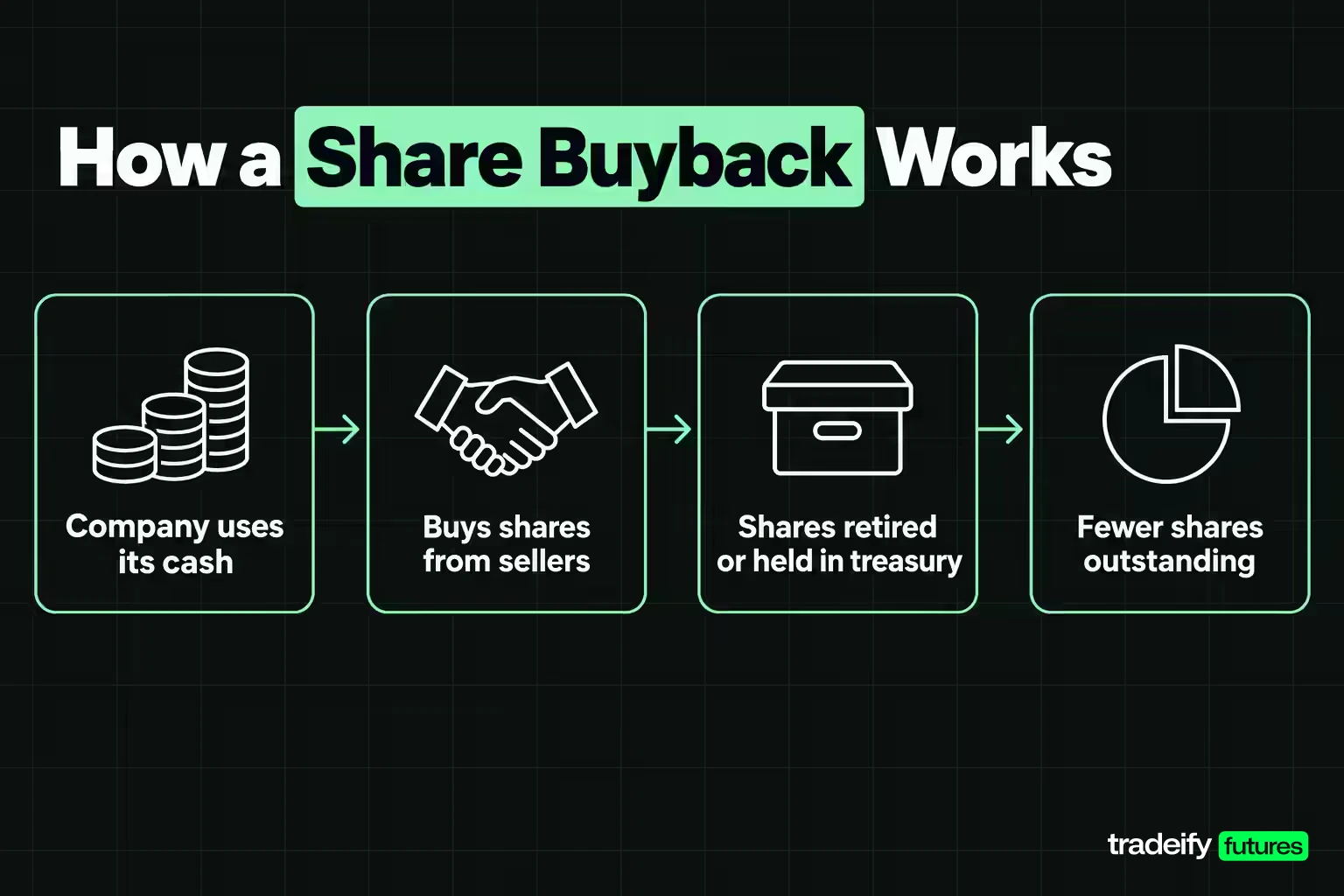
Share buybacks (also called share repurchases) happen when a company uses its own cash to buy back shares of its stock from investors. The shares it buys are either retired or held as treasury stock. Either way they stop counting as outstanding shares, so the company's profit and ownership are divided across fewer shares.
A buyback is one of two main ways a company returns cash to shareholders. The other is a dividend, which Investor.gov defines as a portion of a company's profit paid to shareholders. The difference is who gets the cash:
- A dividend pays every eligible holder, per share, whether they want the cash or not.
- A buyback pays only the holders who choose to sell. Everyone who keeps their shares ends up owning a slightly bigger slice of the company.
US public companies must report their repurchases every quarter under Item 703 of Regulation S-K, in a monthly table of shares bought, average price paid and how much of the announced program is left. That table, not the press release, is where a buyback becomes a fact.
Share Buyback Methods From Open Market to ASR
Share buybacks reach the market through a handful of routes. The route decides how fast the shares come off the market, who sells them, and how much a shareholder has to think about it.
Open-Market Share Repurchases
Most buybacks are open-market purchases. The company hires a broker to buy its stock in the normal market over weeks or months, alongside every other buyer.
In the US, the SEC's Rule 10b-18 offers a voluntary safe harbor from manipulation claims if the company meets four conditions every day:
- Manner. All purchases go through one broker or dealer per day.
- Timing. The company cannot make the opening trade of the day, and it cannot buy in the last 10 minutes before the scheduled close (the last 30 minutes for stocks below the rule's trading-value and public-float thresholds).
- Price. It cannot pay more than the highest independent bid or the last independent trade, whichever is higher.
- Volume. It cannot buy more than 25% of the stock's average daily trading volume over the prior four weeks, with one block purchase allowed per week instead.
Miss any one condition and that whole day's purchases lose the safe harbor. The rule does not force a company to buy anything, and it does not say how much.
Tender Offers for a Share Buyback
In a tender offer, the company offers to buy a set number of shares directly from holders, either at a fixed price or within a price range (a Dutch auction, where holders name the lowest price they will accept and the company sets one clearing price).
Issuer tender offers fall under the SEC's Rule 13e-4. The company files a Schedule TO, keeps the offer open for at least 20 business days, and must extend it by at least 10 business days if it changes the price or the number of shares sought. Holders can withdraw tendered shares while the offer is open.
Accelerated Share Repurchases
In an accelerated share repurchase (ASR), the company pays a bank a fixed dollar amount upfront and receives a large part of the shares right away. The final share count is settled at the end of the contract, based on the stock's average price over that period.
The tradeoff is speed against price certainty. The share count drops on day one, but the company won't know exactly how many shares its money bought until the contract settles.
Privately Negotiated Buybacks and 10b5-1 Plans
A company can also buy a block directly from one large holder, such as a founder or an exiting investor. Item 703 requires the company to footnote purchases made outside its announced program and say what kind of transaction they were.
Many companies run open-market buybacks through a Rule 10b5-1 plan, which sets the purchase instructions in advance. A plan adopted before the company has material nonpublic information gives it a defense if purchases later happen while insiders know something the market does not. That is one way a company keeps buying through periods when insiders know more than the market.
How Long a Buyback Program Takes
A buyback program usually starts with a board authorization, for example "up to $500 million of common stock." That figure is a ceiling, not a schedule. Item 703 asks companies to footnote each program's announcement date, approved amount and expiration date if there is one, and many programs have none.
The execution pace depends on the route:
- Open market. Volume rules stretch it out. Take a stock that trades an average of 2,000,000 shares a day. The 25% safe-harbor cap allows 500,000 shares a day, so retiring 10 million shares takes at least 20 trading days of buying at the maximum. Most programs buy far less than the cap and run for quarters or years.
- Tender offer. At least 20 business days from launch, plus extensions, then prompt payment. The company also cannot buy other shares for at least 10 business days after the offer ends.
- ASR. Most shares arrive on day one. Final settlement typically comes months later.
The reporting lags the buying. A company that buys in October may not show it until its next quarterly report, so the market often learns what was actually purchased weeks after it happened.
How Companies Pay for a Share Repurchase
A share repurchase is paid in cash. The question is where that cash comes from:
- Cash on hand. Money already sitting on the balance sheet. The cost is the interest it would have earned or the investment it could have funded.
- Free cash flow. Cash the business generates after operating costs and capital spending. Buybacks sized to free cash flow are the easiest to sustain.
- Debt. Borrowing to buy stock. If a company borrows $500 million at 6%, it takes on $30 million a year in interest to shrink its share count.
- Asset sales. Proceeds from selling a division or property, returned to shareholders.
The cash goes to sellers through the broker in open-market buying, directly to tendering holders after a tender offer closes, or to the bank upfront in an ASR. On the cash flow statement, all of it shows up under financing activities, next to borrowing and debt repayment. Comparing that line with operating cash flow and debt over several years tells you whether the program is paid for or borrowed.
Why Companies Buy Back Their Own Stock
Companies buy back their own stock for several reasons, and the honest ones are about capital allocation:
- Returning spare cash. The business generates more cash than it can reinvest at good returns.
- Perceived undervaluation. Management believes the stock trades below what the business is worth.
- Offsetting dilution. Employee stock awards and options add shares every year. Buybacks can soak them up.
- Capital structure. Some companies use buybacks to shift toward more debt and less equity.
- Flexibility. A buyback can be slowed or stopped without the market backlash that usually follows a dividend cut.
The dilution reason is the one most often misread. If a company repurchases 10 million shares in a year but issues 4 million to employees, the net reduction is 6 million. Its share count falls from 100 million to 94 million, not 90 million. The press release talks about the 10 million. The diluted share count shows the 6 million.
What Share Buybacks Do for Shareholders
Share buybacks can help shareholders in several ways, but only when the price paid is reasonable.
A larger ownership slice. If you hold 100,000 shares of a company with 100 million shares outstanding, you own 0.1%. After it retires 10 million shares, the same 100,000 shares are 0.111% of 90 million. You did nothing and own more of the business.
Higher earnings per share. The same profit spread over fewer shares produces higher EPS, if the profit holds up.
Optional cash. Holders who want cash can sell into the buyback. Holders who don't can stay put. A dividend gives that cash to everyone.
Tax deferral for holders who stay. Not selling means no taxable event, while a cash dividend is usually taxable in the year it is paid.
The benefit of share buybacks depends on the price. A company that buys below the business's value moves value toward the owners who stay. A company that overpays moves value to the sellers.
How Buybacks Change EPS and Shareholders' Equity
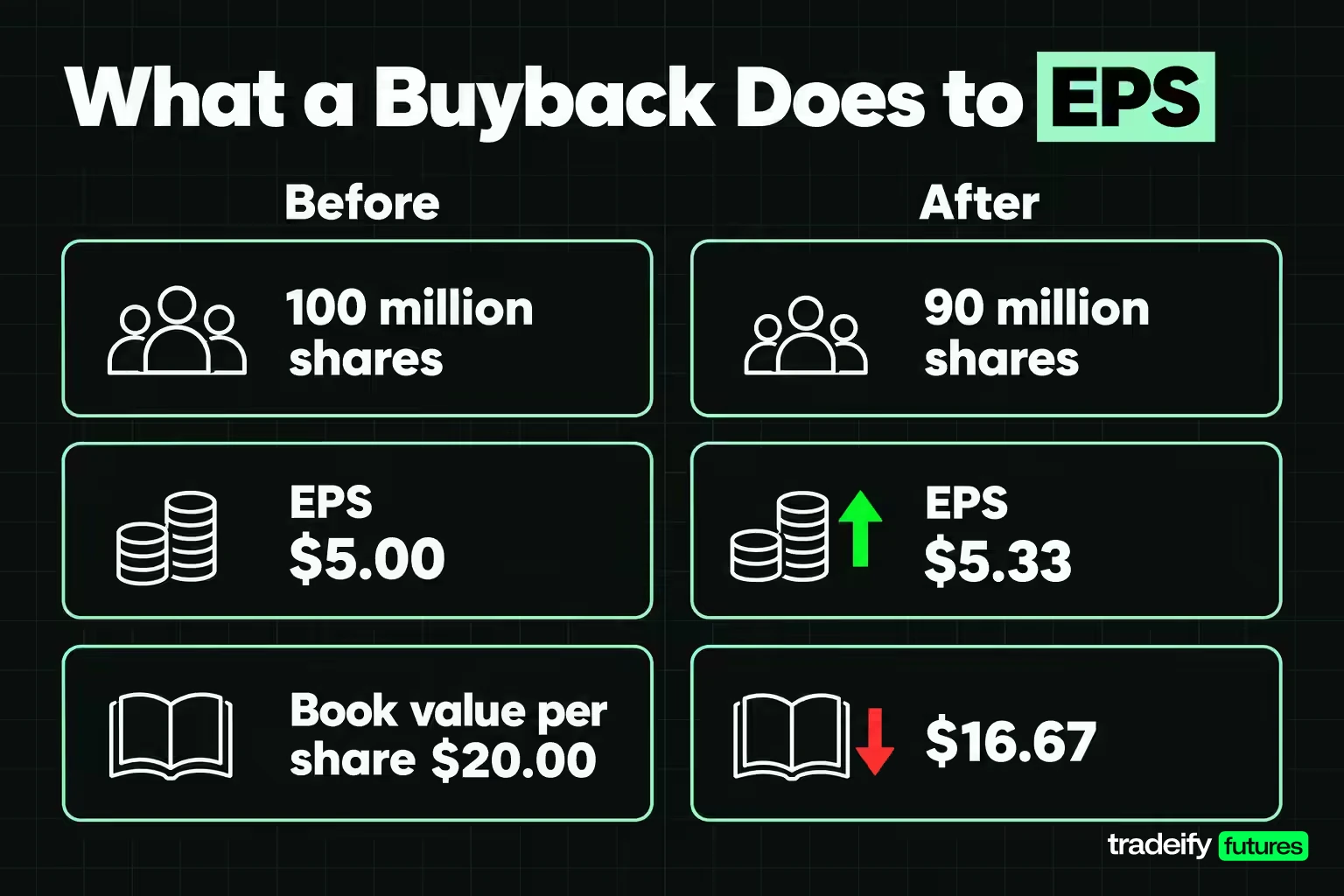
The math is easier to judge with numbers on the table. Here is a worked example with round illustrative numbers. A company has 100 million shares, a $50 share price (a $5 billion market cap), $500 million in annual net income and $2 billion of shareholders' equity. EPS is net income divided by outstanding shares, so it is $5.00.
It spends $500 million of cash to buy 10 million shares at $50.
| Measure | Before the buyback | After the buyback |
|---|---|---|
| Shares outstanding | 100 million | 90 million |
| Net income | $500 million | $480 million |
| EPS | $5.00 | $5.33 |
| Shareholders' equity | $2 billion | $1.5 billion |
| Book value per share | $20.00 | $16.67 |
The quick math says EPS jumps to $5.56, up 11.1%. But that $500 million of cash had been earning $20 million a year. Take that away and net income falls to $480 million, so EPS is $5.33, up 6.7%. The headline EPS gain overstates what the owners actually got, and the gap widens if the buyback was funded with debt.
Shareholders' equity falls by the amount spent. The SEC's balance sheet equation is assets = liabilities + shareholders' equity. Cash (an asset) drops by $500 million, liabilities don't change, so equity drops by $500 million too. Book value per share falls from $20.00 to $16.67, which is why heavy repurchasers can show very small or even negative book equity.
That is a normal accounting result, not a sign of distress on its own. It does mean price-to-book and return-on-equity figures need care for companies that buy back a lot of stock.
How Share Buybacks Affect the Stock Price
Share buybacks do not mechanically raise the stock price. If a company buys at fair value, the cash leaving and the shares retired cancel out. In the example above, the company is worth $5 billion with 100 million shares ($50 each). After spending $500 million, it is worth $4.5 billion with 90 million shares, still $50 each. Market cap falls; the per-share price does not have to move.
The price can move for other reasons:
- Signal. The market may read the announcement as management saying the stock is cheap or that cash flow is steady.
- Demand. A steady buyer for up to 25% of daily volume can soak up selling, especially in a quiet stock.
- EPS. Higher per-share earnings can support valuation multiples if the market believes them.
So the price paid decides who wins, and this is the part most headlines skip. Suppose that same company's business is truly worth $4 billion, plus its $500 million of cash, so $4.5 billion or $45.00 per share.
- Buying at $50, $500 million retires 10 million shares. The remaining $4 billion of value over 90 million shares is $44.44 per share. The owners who stayed lost value.
- Buying at $40, $500 million retires 12.5 million shares. The remaining value over 87.5 million shares is $45.71 per share. The owners who stayed gained.
A buyback also cannot hold a stock up when the business is getting worse. Companies keep buying through declines, and the price keeps falling because earnings expectations fall faster than the share count.
Across the market, the effect shows up in per-share numbers. S&P Dow Jones Indices reported that 17.1% of S&P 500 companies cut their share count by at least 4% year over year in the third quarter of 2025 (its December 18, 2025 release).
Share Buybacks vs Dividends
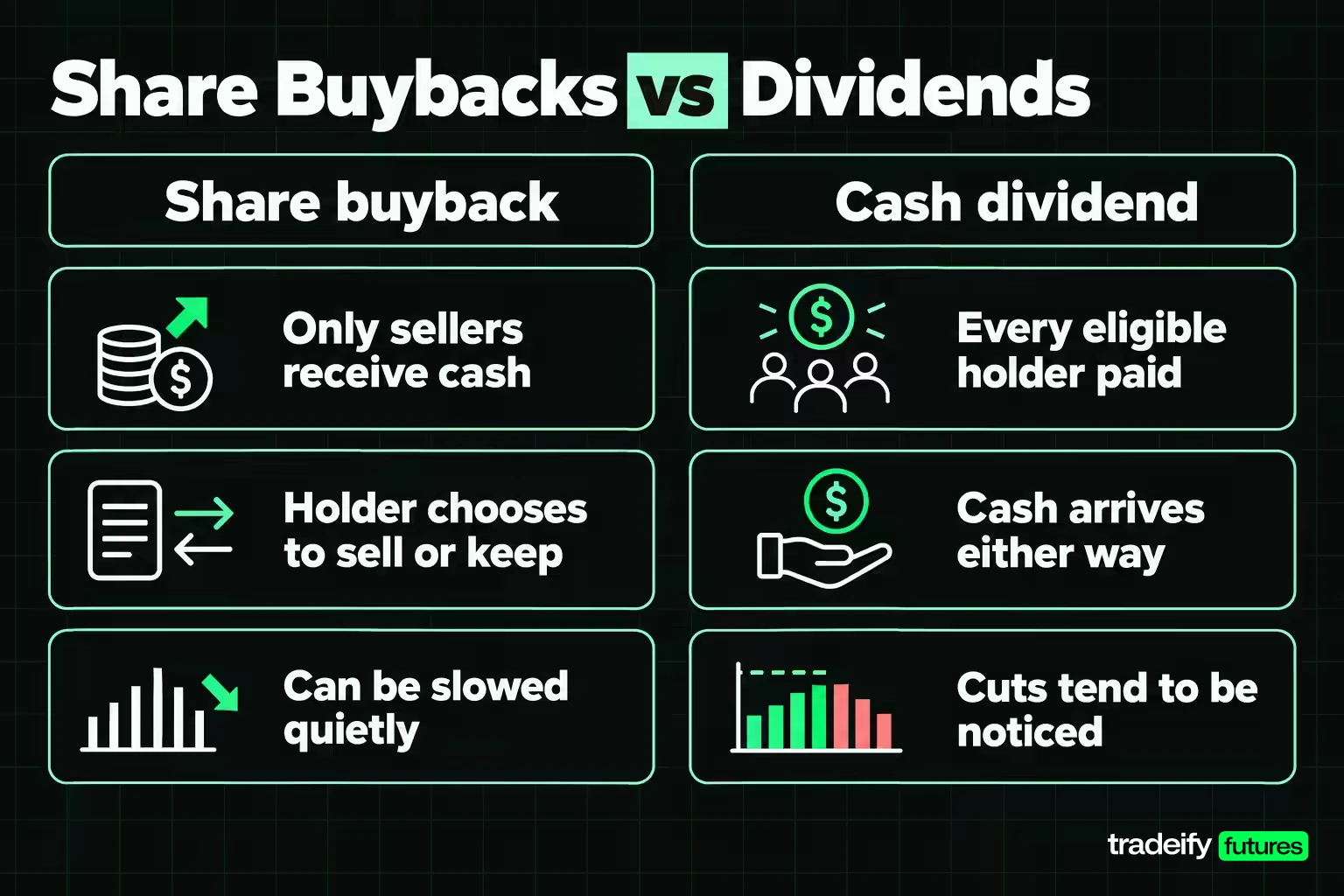
Share buybacks and dividends can return the same cash, with different results for each holder, so it helps to run the same money through both. Take the same $500 million and a holder of 1,000 shares at $50.
As a dividend, that is $5 per share. The holder gets $5,000 in cash, and in theory the stock drops to $45 when it goes ex-dividend. Shares worth $45,000 plus $5,000 cash is $50,000.
As a buyback at $50, the company is worth $4.5 billion over 90 million shares, still $50 a share. The holder keeps 1,000 shares worth $50,000 and owns a bigger slice. Before taxes, the result is the same. The differences are in choice, tax timing and commitment.
| Factor | Share buyback | Cash dividend |
|---|---|---|
| Who receives cash | Only holders who sell | Every eligible holder |
| Holder's choice | Sell or keep | Cash arrives either way |
| US tax for the holder | Only sellers, on any gain | Taxed when paid |
| Company commitment | Can be slowed or stopped quietly | Cuts tend to be noticed |
| Effect on share count | Falls if net of issuance | Unchanged |
| Price paid matters | Yes, overpaying hurts holders who stay | No purchase price involved |
| Company-level US tax | 1% excise tax on net repurchases | No excise tax |
In practice, large US companies lean on buybacks more. S&P Dow Jones Indices reported $1.020 trillion of S&P 500 buybacks in the 12 months to September 2025, against $664.9 billion of dividends.
Related lesson: How dividends are paid
Do Shareholders Have to Sell in a Buyback?
No. In US public company buybacks, selling is the holder's choice.
Open-market buybacks need nothing from you. The company's broker buys from whoever is selling in the market that day. You won't know whether the buyer on the other side of your sale was the company.
Tender offers are optional, but they are a decision. You can tender some, all or none of your shares, and you can withdraw tendered shares while the offer is open. If more shares are tendered than the company wants, it buys pro rata. For example, if a company seeks 10 million shares and 25 million are tendered, it takes 40% from each holder. Tender 1,000 shares and 400 are bought; 600 come back to you.
Rule 13e-4 lets the company accept odd lots first (holders of fewer than 100 shares who tender all of them), so small holders may avoid proration.
Two questions decide whether to tender. Is the offer price above what you think the shares are worth? And are you comfortable owning a larger share of the company if you don't sell? If you sell into the offer, the gain or loss is usually taxable.
How Share Buybacks Are Taxed
Share buybacks carry two separate tax questions: what the company pays and what the selling holder pays.
The Stock Buyback Excise Tax
Section 4501 of the Internal Revenue Code imposes a 1% excise tax on the fair market value of stock a covered corporation repurchases during the year. A covered corporation is a US company whose stock trades on an established securities market. The tax applies to repurchases after December 31, 2022, and the IRS published final regulations on November 24, 2025.
The tax is on net buybacks. The amount is reduced by stock the company issued during the year, including stock given to employees. Say a company repurchases $500 million of stock and issues $100 million. It pays 1% on $400 million, or $4 million. Exceptions include companies that repurchase $1 million or less in a year, stock contributed to employee retirement plans, and repurchases by RICs and REITs.
S&P Dow Jones Indices estimated the tax cut S&P 500 operating earnings by 0.40% over the 12 months to September 2025.
Is the Stock Buyback Tax 1%, 2%, 5% or 10%?
The US stock buyback tax is 1%. People search for 2%, 5% or 10% rates because higher rates keep being proposed, but as of November 2026 Section 4501 of the Internal Revenue Code still says 1%. The Stock Buyback Accountability Act of 2026 (S. 4796), introduced in the Senate on June 16, 2026, would raise the rate to 4%. It was referred to the Senate Finance Committee and has not become law.
The difference is real money. A company with $400 million of net repurchases in a year owes $4 million at 1%; at 4% it would owe $16 million.
Taxes for Shareholders Who Sell
For a holder who sells into an open-market buyback, it is an ordinary sale. Under IRS rules, the difference between your adjusted basis and what you receive is a capital gain or loss: long-term if you held more than one year, short-term if one year or less.
A tender offer is a redemption, governed by Section 302. It is treated as a sale if it meaningfully reduces your ownership, for example if it ends your interest in the company or cuts your ownership ratio below 80% of where it was. Otherwise it can be taxed as a dividend. For most small holders in a pro rata public tender, the offer documents explain the expected treatment.
Holders who keep their shares owe nothing because of the buyback. These are US federal rules; other countries tax buybacks differently, and none of this is tax advice.
Buyback Risks and Red Flags
Share buybacks can make weak decisions look good for a while. Watch for these red flags:
- Buying at the top. A company flush with cash at a profit peak may buy most heavily when its stock is most expensive, then stop when the stock is cheap and cash is tight.
- Borrowing to buy. Debt-funded buybacks add interest and reduce the cushion if business weakens.
- Masking dilution. Large gross repurchases that barely move the diluted share count usually mean stock compensation is eating them.
- Crowding out investment. Cash spent on stock is not spent on research, equipment, acquisitions or paying down debt.
- Engineered EPS. A shrinking share count can produce EPS growth while revenue and total earnings stand still.
- Incentives. Executive pay tied to EPS targets can reward buybacks for reasons that have little to do with value.
- Announced but not executed. A big authorization with little actual buying is a headline, not a buyback.
None of these makes a buyback bad on its own. Each is a reason to check the numbers before taking the announcement at face value.
How to Read a Buyback Announcement
Treat a buyback announcement as the start of the work, not the conclusion. The announcement tells you what management is allowed to do. The filings tell you what it did. Check these points:
- Authorization vs execution. Find the new authorization, any amount left from earlier programs, and what the company actually bought in recent Item 703 tables.
- Scale. Divide the authorization by market cap. A $500 million program at a $5 billion company is 10%. A $10 billion program at a $3 trillion company is 0.33%. The second sounds bigger and matters far less.
- Funding. Compare buyback spending with free cash flow and the change in debt.
- Net share change. Compare shares repurchased with the change in diluted shares over the same quarters.
- Price paid. Check the average price paid in the Item 703 table against your own view of value.
- Concentration. Index-level buyback totals are dominated by a few companies. S&P Dow Jones Indices reported that the top 20 accounted for 49.5% of S&P 500 buybacks in the third quarter of 2025.
Then decide what would change your read. Rising debt, weaker free cash flow, or repurchases at prices far above your valuation would weaken the case. Steady buying at sensible prices, with the diluted share count falling, strengthens it.
Finding Upcoming Share Buybacks and Tender Offers
There is no official calendar of upcoming share buybacks, so the question of which company is going to buy back shares is answered company by company. New programs are announced in press releases and earnings reports, usually with a dollar amount and sometimes an expiration date. For upcoming buyback offers in 2026 that holders can actually respond to, look for issuer tender offers: they are filed with the SEC on Schedule TO, searchable on EDGAR, and must stay open for at least 20 business days, which gives holders time to read the terms.
Completed purchases show up later, in each company's quarterly Item 703 table. In December 2023, a federal appeals court vacated the SEC's newer share repurchase disclosure rule, which would have required daily repurchase data, so the quarterly table is still the main public record of share buybacks.
Share Buybacks and Index Futures Traders
Share buybacks are company decisions, but in aggregate they touch the indexes behind equity index futures. Buybacks lift per-share earnings for the index, and they are concentrated in the largest companies, which carry the most weight in a market-cap-weighted index.
That makes buyback trends useful background, not a trade signal. It is tempting to read a big buyback headline as support for the whole market, but one company's program is a rounding error next to the index. One company's buyback headline can move that stock at the open. It rarely tells you anything about where an index future will trade by the afternoon. The decision for an index trader is whether the news changes the session's structure, and usually it doesn't.
On our accounts, you can't trade single stocks or options; the equity products are index futures such as ES, MES, NQ, MNQ, YM and RTY, and every position is closed by 4:45 PM ET. A buyback headline is session context on our accounts, never a reason to hold overnight.
Share Buybacks FAQ
Do share buybacks reduce shareholders' equity?
Yes. The cash spent leaves the balance sheet while liabilities stay the same, so shareholders' equity falls by the amount spent. Book value per share falls too whenever the company pays more per share than its book value per share.
How much is the stock buyback tax?
The US federal excise tax is 1% of net repurchases for publicly traded US companies, in effect since 2023. A Senate bill introduced in June 2026 would raise it to 4%, but it has not become law.
Which companies are buying back shares?
The companies buying back shares are the ones that say so in their own announcements and filings, since there is no single official list. New programs appear in company press releases and earnings reports, completed purchases appear in each company's quarterly Item 703 table, and tender offers are filed on Schedule TO on EDGAR.
Are share buybacks good for investors?
They can be. A buyback helps the owners who stay when the company buys below the business's value with spare cash. It hurts them when management overpays or borrows heavily to buy.
Do share buybacks always raise the stock price?
No. At a fair price, the cash spent and the shares retired cancel out. The stock can still fall during a buyback if earnings expectations drop.
The Bottom Line on Share Buybacks
Share buybacks are a capital-allocation decision, not an automatic buy signal. They add value for the owners who stay when a healthy company buys below what the business is worth with cash it doesn't need. They cost those owners when the company overpays, borrows to buy, or uses repurchases to hide dilution.
For your next buyback headline, open the company's last two quarterly reports. Compare the Item 703 purchases with the change in diluted shares and with free cash flow, and write down what result would change your first read. That check takes a few minutes and tells you more than the announcement did.
Trading involves substantial risk. Stocks can fall sharply, and futures are leveraged products where losses can exceed what you expect and move fast. Funded and evaluation accounts at prop firms are simulated. This article is educational and is not investment, tax or financial advice.


