




TL;DR: Dividends are payments a company makes to its shareholders, and the real question is whether the business can keep funding them. You qualify by buying before the ex-dividend date, and the share price usually drops by about the dividend that morning. A $1.60 annual dividend on a $50 stock is a 3.2% yield, and a yield that rises because the price fell is a warning. Check the payout ratio and free cash flow coverage before trusting the yield. US qualified dividends are taxed at 0%, 15% or 20%, ordinary dividends at regular income rates.
Dividends are the part of stock ownership that feels most like getting paid. You hold shares, a date passes, and cash lands in your account. The catch is everything around that payment: the date that decides who gets paid, the price drop that comes with it, the high yield that turns out to be a warning, and the tax bill that trims what you keep.
This guide covers how dividends work, the four dates, the math behind yield and payout ratio, tax rules in the US with notes on the UK and Australia, reinvestment, and a practical way to compare dividend stocks. Every example uses round, illustrative numbers, so you can rerun the math on any stock you are looking at.
What Are Dividends
A dividend is a payment a company makes to its shareholders out of its profits. The SEC's Investor.gov defines it as a portion of a company's profit paid to shareholders, and notes that public companies that pay dividends usually do so on a fixed schedule, although they can pay at any time. An unscheduled payment is called a special or extra dividend.
The IRS describes dividends as distributions of a corporation's earnings and profits. Most are paid in cash, but a company can also pay in additional stock, stock rights or other property.
Three basics shape everything else about dividends:
- It is a board decision. A company's board of directors declares each common-stock dividend. Nothing in owning a common share entitles you to a payment until the board declares one.
- It is quoted per share. A dividend of $0.40 per share means you receive $0.40 for every share you own on the cutoff date.
- It follows a schedule, not a promise. Many US companies pay quarterly. Some pay monthly, and some companies outside the US pay a small interim dividend plus a larger annual one. Any of them can raise, cut, suspend or end the payment.
Funds pay dividends too. Mutual funds, exchange-traded funds and real estate investment trusts (REITs) collect income from what they hold and pass it through to their own shareholders as dividends.
The useful way to think about a dividend is as a transfer. Cash moves from the company's balance sheet to yours. The company is worth a little less afterward, and you hold the cash. Whether that helps you depends on what the company would have done with the money, which is why experienced dividend investors spend more time on the business than on the payment.
Related lesson: What owning a share actually gives you
How Dividends Work From Board Vote to Your Account
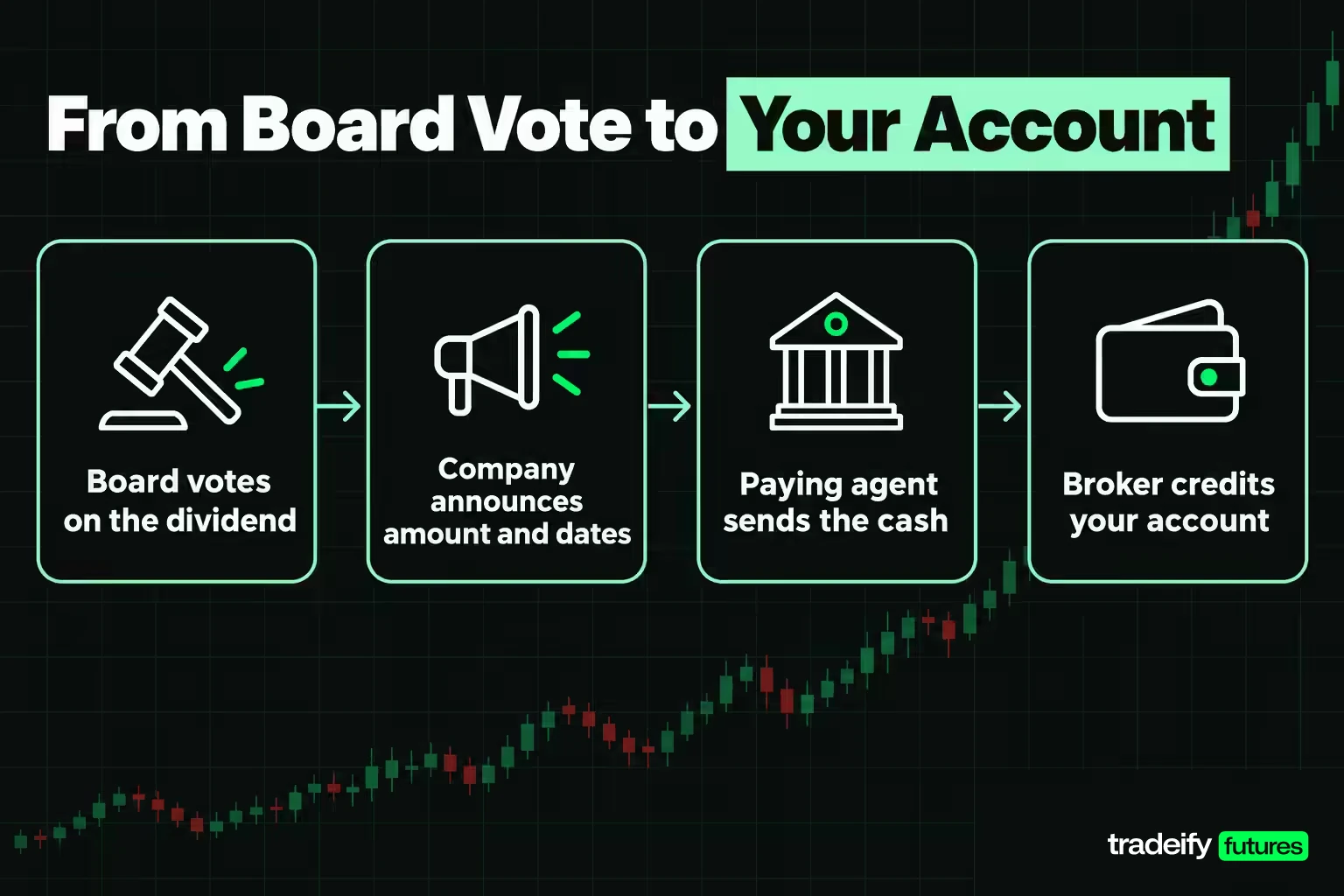
Dividends work through a short chain of decisions and handoffs. The company's board reviews earnings, cash, debt and plans, then votes on whether to pay a dividend and how much. The company announces the amount per share and the key dates. On the payment date the company's paying agent sends the cash through the settlement system to brokers, and your broker credits your account.
Most investors never touch the company directly. Your shares usually sit in your broker's name on the company's books (street name), so the broker receives the payment for all its clients and allocates it. That is why a dividend can show up as "pending" for a short time before it becomes cash you can use.
A worked dividend cash example
Suppose a company declares a regular quarterly dividend of $0.40 per share and you own 120 shares.
- Cash per payment: 120 x $0.40 = $48
- Annual dividend per share if all four payments stay the same: $0.40 x 4 = $1.60
- Annual cash on 120 shares: 120 x $1.60 = $192
The $192 figure is an estimate. It assumes the board declares the same amount four times, which it is not obliged to do. Treat forward dividend income as a projection that the next announcement can change.
What the board considers before declaring dividends
The board's decision is a capital-allocation call. Cash paid out cannot also fund a new factory, an acquisition, a debt repayment or a buyback. A board that raises the dividend is saying it expects enough cash to cover the higher payment and its other needs. A board that cuts it is usually protecting liquidity or funding something it thinks matters more.
That is why the announcement itself carries information. A raise, a hold, a cut or a suspension each tells you something about how management sees the next few quarters.
Key Dividend Dates and Who Gets Paid
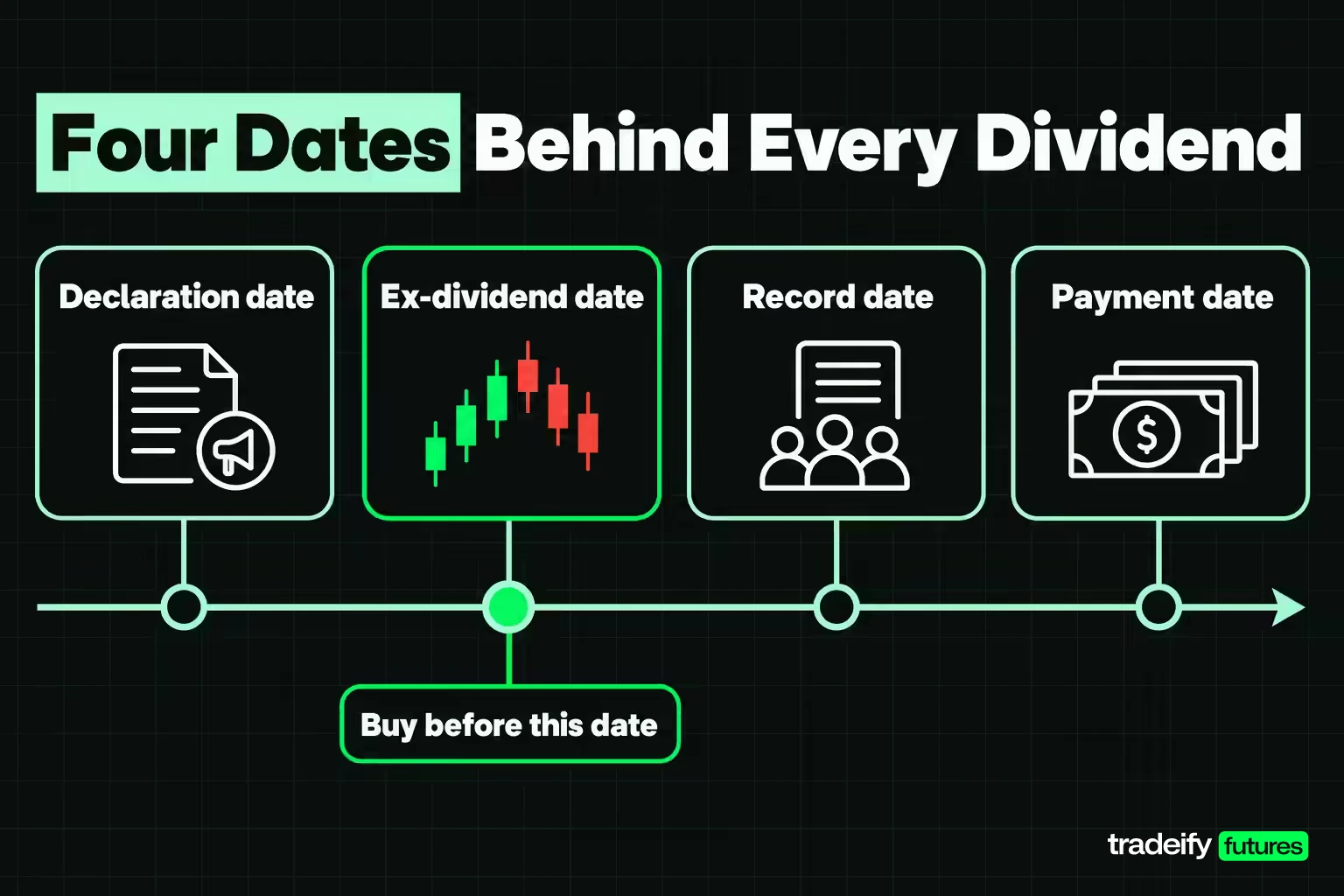
Four dates control every dividend. Mixing them up is the most common reason an investor expects a payment that never arrives.
| Date | What happens | Why it matters to you |
|---|---|---|
| Declaration date | The board announces the amount, record date and payment date | The first point when the payment is official |
| Ex-dividend date | Shares start trading without the right to the upcoming dividend | Buy before this date to receive the payment |
| Record date | The company checks its books for eligible shareholders | Mostly an administrative cutoff for investors |
| Payment date | Cash or shares are sent to eligible holders | When the money reaches your broker |
Record date vs ex-dividend date
The record date is when you must be on the company's books as a shareholder. The ex-dividend date is set from that record date under exchange rules. Investor.gov explains that the ex-dividend date for stocks is usually the same day as the record date, or one business day earlier if the record date is not a business day.
The practical rule is simple. If you buy on or after the ex-dividend date, you do not get the next dividend; the seller does. If you buy before the ex-dividend date, you get it.
Investor.gov's own example: a company declares a dividend on Monday, March 2, 2026, with a record date of Monday, March 16, 2026, and a payable date of Tuesday, March 17, 2026. The ex-dividend date is also March 16, 2026, so anyone who buys that day or later misses the payment. If the record date had fallen on a Sunday, the ex-date would move back to the Friday before.
Special rules for large and stock dividends
Two exceptions catch people out. When a dividend is 25% or more of the stock's value, the ex-dividend date is deferred until one business day after the dividend is paid. For stock dividends, the ex-date is the first business day after the new shares are paid. If you sell before that ex-date, you also sell away the right to the extra shares and owe them to the buyer through a "due bill".
For any unusual payment, read the company's announcement and your broker's corporate-action notice rather than applying a memorized rule.
Related lesson: A full walkthrough of ex-dividend timing
Why Companies Pay Dividends
Companies pay dividends mainly because they generate more cash than they can reinvest at attractive returns. A mature business with steady demand and limited room to grow often cannot put all its profit to good use internally. Returning part of it to owners is one answer.
Other reasons sit on top of that:
- Shareholder demand. Some investors, such as retirees and income funds, want regular cash and favor companies that provide it.
- Discipline. A committed dividend limits how much cash management can spend on empire-building deals. Every dollar paid out has to be earned first.
- Signaling. Managers know more about the company than outside shareholders do. Economist Michael Spence's work on signaling, recognized in the 2001 Nobel prize in economics, used dividends as one example of how insiders communicate information. A company that raises its dividend is putting cash behind a statement about its future.
Signaling cuts both ways. Because companies are reluctant to cut dividends, a cut tends to be read as bad news and can hit the share price hard. That reluctance is also why boards often keep dividends lower than they could afford: they would rather raise slowly than reverse later.
The alternative to a dividend is not "nothing". A company can retain the cash, pay down debt or buy back its own shares. Buybacks return cash to the investors who choose to sell, while dividends pay every holder. Neither is automatically better for dividends' recipients; the question is always whether the company has a better use for the money than you do.
Related lesson: How buybacks compare with dividends
Which Companies Pay Dividends and Which Do Not
Dividend-paying companies tend to be mature businesses with steady cash flow. Young, fast-growing companies usually pay little or nothing because they need the cash to hire, build and expand. A startup with a zero payout ratio is not being stingy; it is betting that reinvested profit earns more than shareholders could earn elsewhere.
The line moves over time. Apple is a well-known example: it began paying a dividend in 2012 after about 17 years without one, once its cash flow made a zero payout hard to justify.
Some structures pay high dividends by design:
- REITs. Investor.gov notes that most REITs pay out at least 100 percent of their taxable income to shareholders. Their yields are often high, but those dividends are generally taxed as ordinary income.
- Pass-through structures. Master limited partnerships and business development companies also tend to have high yields because their structure requires them to pass most of their income to owners.
- Funds and ETFs. These collect dividends from the stocks they hold and pass them on, which spreads single-company risk across many payers.
What shares pay the best dividends
There is no single answer, and the honest version of the question is "which dividends are most likely to keep coming?" The highest yield on a screener is often the riskiest, because a falling share price pushes yield up. The more useful candidates are companies whose earnings and free cash flow comfortably cover the payment, whose debt is manageable, and whose business does not depend on one good year. A broad dividend-focused fund is another route if you want income without betting on a few companies.
Types of Dividends
Most dividends are regular cash payments, but the label on a distribution changes how it affects your position and your taxes.
| Dividend type | How it is paid | What to watch |
|---|---|---|
| Regular cash dividend | Cash per share on a set schedule | The board can change it at any declaration |
| Special or extra dividend | One-time cash payment | Do not count it as recurring income |
| Stock dividend | Additional shares instead of cash | More shares, each worth proportionally less |
| Preferred dividend | Fixed or set rate under the preferred terms | Paid before common dividends |
| Return of capital | Cash that is not from earnings and profits | Not a dividend for US tax; it lowers your cost basis |
| Franked dividend (Australia) | Cash with a franking credit for company tax already paid | The credit can reduce the holder's own tax |
A stock dividend does not make you richer on its own. If you own 100 shares and the company pays a 5% stock dividend, you get 5 more shares, but the company is still worth the same, so each share is worth a little less.
Return of capital deserves extra care. The IRS treats it as a return of part of your investment, not income. It reduces your cost basis, and once basis reaches zero, further distributions of that kind count as capital gains. A high "yield" made up of return of capital is not the same as a high yield paid from profits.
Dividend Yield and How to Calculate It
Dividend yield measures annual dividends as a percentage of the current share price. It is the most quoted dividend number and the most misread one.
The formula: dividend yield = annual dividends per share ÷ price per share x 100.
Using the earlier example of a $0.40 quarterly dividend and a $50 stock:
- Annual dividends per share: $0.40 x 4 = $1.60
- Yield at $50: $1.60 ÷ $50 = 3.2%
- Yield if the price falls to $40: $1.60 ÷ $40 = 4%
- Yield if the price falls to $32: $1.60 ÷ $32 = 5%
Nothing about the company's payment changed in those three lines. The yield rose only because the price fell. That is the core trap with dividend yield: a rising yield often reflects falling confidence, not a more generous company. When a yield looks unusually high, the first question is what the market is worried about, and the second is whether you have a reason to disagree.
Trailing, forward and yield on cost
Screeners calculate yield in different ways, so check which one you are looking at:
- Trailing yield adds up the last 12 months of dividends. It can be stale if the company just raised or cut.
- Forward yield annualizes the latest declared payment, such as the last quarterly dividend x 4. It reflects recent changes but misleads when payments are uneven, such as a small interim plus a large final dividend.
- Yield on cost divides today's dividend by the price you originally paid. If you bought at $40 and the dividend is $1.60, your yield on cost is 4%.
Yield on cost describes your history. A new buyer at $50 still gets 3.2%. When you decide whether to keep holding, compare the current yield and the business outlook with your other options, not with the price you happened to pay.
Related lesson: Yield and payout ratio in more depth
Payout Ratio and Other Dividend Health Metrics
Dividend health metrics ask one question: can the company afford its dividend? Yield tells you what you are being paid. These ratios tell you whether it can last.
- Payout ratio = dividends ÷ net income, or dividends per share ÷ earnings per share (EPS).
- Retention ratio = 1 minus the payout ratio, the share of profit the company keeps.
- Dividend coverage = EPS ÷ dividends per share, the number of times earnings cover the payment.
- Cash payout ratio = dividends ÷ free cash flow, because dividends are paid in cash, not accounting earnings.
Worked payout ratio example
Take the same company paying $1.60 a year, with EPS of $2.50 and free cash flow of $2.00 per share.
- Payout ratio: $1.60 ÷ $2.50 = 64%, so the company retains 36% of earnings.
- Coverage: $2.50 ÷ $1.60 = about 1.56 times.
- Cash payout ratio: $1.60 ÷ $2.00 = 80%.
Now suppose EPS drops to $1.40 in a bad year. The payout ratio jumps to about 114%. The company is paying out more than it earns, which it can only do from cash reserves or borrowing. One year above 100% can be a blip; several in a row usually ends in a cut.
Investopedia describes a payout ratio of 30% to 50% as generally stable, but norms vary by industry. REITs and utilities run high payout ratios by design, while a growing technology company may pay nothing. Compare a company with its own history and its peers, and read the cash payout ratio alongside the earnings-based one.
What Happens to the Share Price When Dividends Are Paid
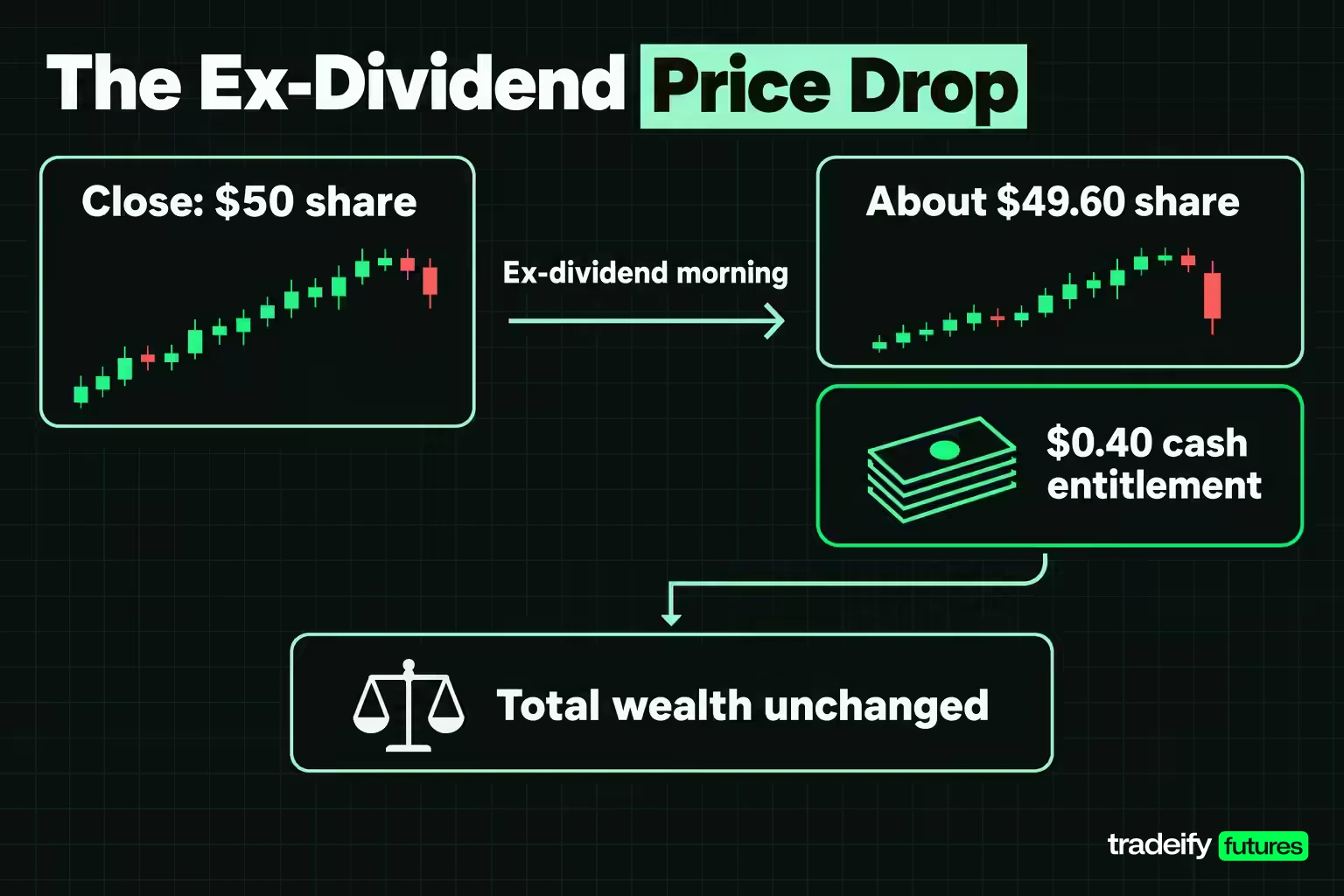
On the ex-dividend date, a stock's price tends to fall by roughly the dividend amount, because new buyers no longer get the payment. Investor.gov notes that with a significant dividend the price may fall by that amount on the ex-date.
Suppose a stock closes at $50 and goes ex-dividend for $0.40 the next morning. All else equal, the reference value at the open is about $49.60. You now hold $0.40 of cash entitlement plus a share worth about $49.60, so your total wealth did not change. Market news still moves the price, so the actual open can be higher or lower.
Brokers build this into open orders. Under FINRA Rule 5330, a broker holding an open buy limit order reduces its price by the cash dividend on the ex-date unless the order is marked "Do Not Reduce". A good-'til-canceled buy limit at $48.00 would become $47.60 after a $0.40 dividend. Dividends under one cent are not adjusted.
Why dividend capture rarely works
The price adjustment is why buying just before the ex-date to "collect" the dividend is not free money. It is a tempting idea because the payment date looks like a sure thing. You receive $0.40, but the share you bought for $50 opens near $49.60. After trading costs, tax on a dividend that likely fails the qualified holding period, and the market's normal noise, the net result is often no better than doing nothing, and sometimes worse.
How dividends add to total return
Total return combines price change and dividends. If a $50 stock rises to $54 and pays $1.60 over the year, your total return is $5.60, or 11.2% (an 8% price gain plus 3.2% from dividends). If it falls to $44 instead, the same $1.60 leaves you with a loss of $4.40, or -8.8%. The dividend softens the $6 price drop but does not erase it.
Announcements move prices too. A larger-than-expected raise can lift a stock, and a cut or suspension often sends it sharply lower, because of the signal it carries about future earnings.
Related lesson: How total return is measured
How Dividends Are Taxed
How dividends are taxed depends on where you live, the type of dividend, the account it lands in and how long you held the shares. The rules below are general; check current rules or a tax adviser for your own situation.
US dividend tax rules
In the US, all taxable dividends are ordinary dividends, and some of them are also qualified dividends taxed at the lower long-term capital gain rates of 0%, 15% or 20%, depending on taxable income. The company or broker marks which dividends are qualified on Form 1099-DIV.
To count as qualified, you generally must hold the stock for more than 60 days during the 121-day period that begins 60 days before the ex-dividend date. Buying just before the ex-date and selling soon after usually fails this test, so that dividend is taxed at ordinary income rates.
Other US points worth knowing:
- You should receive Form 1099-DIV from each payer for distributions of at least $10, but you must report dividends even without the form.
- If taxable ordinary dividends exceed $1,500, you file Schedule B.
- The 3.8% net investment income tax can apply when modified AGI exceeds $200,000 (single or head of household) or $250,000 (married filing jointly).
- REIT dividends are generally taxed as ordinary income and do not get the qualified rate.
- Reinvested dividends are still taxable in the year paid.
- Dividends inside tax-advantaged retirement accounts follow that account's rules instead.
As a simple illustration, $192 of qualified dividends taxed at 15% costs $28.80, while the same $192 at the 0% rate costs nothing.
Dividend tax for international investors
Non-US investors in US stocks usually face 30% US withholding on dividends unless a tax treaty lowers it. On $192, that is $57.60 withheld before the cash arrives. US investors who own foreign stocks may see foreign tax withheld and can often claim a foreign tax credit on Form 1116.
In the UK, the dividend allowance is £500 a year, and dividends in an ISA are not taxed. For the 2026 to 2027 tax year, GOV.UK lists dividend rates above the allowance of 10.75% (basic), 35.75% (higher) and 39.35% (additional). A basic-rate taxpayer with £3,000 of dividends pays 10.75% on £2,500, or £268.75.
Australia uses an imputation system. Company tax already paid is attached to the dividend as a franking credit. A $70 fully franked dividend from a company taxed at 30% carries a $30 franking credit, so the resident shareholder declares $100 of income and receives a $30 tax offset. If the shareholder's own rate is lower, eligible residents can get the excess refunded. A holding period rule of 45 days applies once total franking credits reach $5,000 or more in a year.
Dividend Reinvestment Plans and Compounding
A dividend reinvestment plan (DRIP) uses your cash dividends to buy more shares of the same company or fund instead of paying you cash. Many plans allow fractional shares, so every dollar goes back to work, and some company-run plans charge no commission or offer a small discount. Most brokers offer a similar automatic reinvestment setting.
How DRIP compounding adds up
Using the running example of 120 shares, a $0.40 quarterly dividend and, for simplicity, a share price that stays at $50:
| Quarter | Shares after reinvestment |
|---|---|
| 1 | 120.96 |
| 2 | 121.93 |
| 3 | 122.90 |
| 4 | 123.89 |
After a year, the next annual dividend on 123.89 shares at $1.60 is about $198.22, versus $192 without reinvestment. Carry the same assumptions forward 40 quarters and the position grows to about 165.05 shares paying about $264.07 a year. Real results will differ, because prices and dividends move, but the mechanism is the point: dividends buy shares that earn their own dividends.
When not to reinvest dividends
Reinvestment is not a quality filter. A DRIP keeps buying the same stock whether it is cheap or expensive, improving or deteriorating. Before switching it on, ask:
- Would you buy this stock today with new cash at its current price?
- Is the position already too large a share of your portfolio?
- Do you need the income for spending or for another investment?
- Would a diversified fund be a better home for the cash?
Tax still applies. In a taxable account, reinvested dividends are income in the year paid, even though you never saw the cash. Keep records, because each reinvested purchase adds to your cost basis.
Benefits and Limits of Dividends for Investors
Dividends give investors four real benefits, and each one has a limit that shows up when the business or the market turns.
- Income without selling. Dividends give you cash without having to sell shares, which suits investors who live off a portfolio. The limit: the company decides the amount, and it can fall exactly when you need it.
- Compounding. Reinvested dividends buy more shares, which pay more dividends. The limit: compounding works in your favor only if the underlying business holds up.
- A check on management. A company that must fund a dividend has less room for careless spending. The limit: a board can also defend a dividend it cannot afford, starving the business of investment.
- Behavioral anchor. Regular cash can make it easier to hold through volatility rather than selling in a panic. The limit: it can also make investors hold a declining company for the income.
The biggest limit is that dividends are not extra return on top of price. The ex-date price adjustment takes the payment out of the share value. What matters is total return after tax, and a company that reinvests well without paying a dividend can deliver just as much or more.
Concentration is the quieter risk. Several high-yield stocks can all depend on the same thing, such as interest rates, a commodity or one sector. Count the risks you own, not just the tickers.
How to Compare Dividend Stocks
Comparing dividend stocks starts with the business and ends with the yield, not the other way around. A short checklist:
- Confirm the current declared dividend and dates from the company's announcement.
- Calculate the forward yield and compare it with the company's own history and its peers.
- Check the payout ratio and the cash payout ratio over several years, not one quarter.
- Read the balance sheet for debt coming due and interest costs that compete with the dividend.
- Look at the dividend record through a bad year: raises, freezes, cuts or suspensions.
- Judge what could weaken revenue or free cash flow over the next few years.
A two-stock dividend comparison
The table below compares two illustrative stocks. Stock B looks better on yield and worse on everything that supports it.
| Metric | Stock A | Stock B |
|---|---|---|
| Share price | $50 | $25 |
| Annual dividend per share | $1.60 | $2.00 |
| Dividend yield | 3.2% | 8% |
| Earnings per share | $2.50 | $2.10 |
| Payout ratio | 64% | About 95% |
| Free cash flow per share | $2.00 | $1.60 |
| Cash payout ratio | 80% | 125% |
Stock B pays more cash than its free cash flow produces, so it is funding part of the dividend from reserves or borrowing. Its 8% yield may last, but the numbers say the burden of proof is on the company. Stock A's 3.2% has room to absorb a weak year. Neither number decides the trade on its own; together they tell you which dividend is more exposed to a cut.
Dividends and Stock Index Futures
Dividends also shape prices in markets where nobody receives them. Stock index futures, such as E-mini S&P 500 futures, track an index of dividend-paying companies, but a futures holder does not collect those dividends. CME Group explains that the expected dividends are built into the futures price through the basis, the gap between the futures price and the cash index.
Two forces set that gap. Holding the stocks costs financing, which pushes the futures price up. Holding the stocks also earns dividends, which pushes it down. As an illustration, with an index at 7,000, a 1.20% dividend yield and 90 days to expiration, the expected dividends are worth about 20.7 index points. With financing at 4.00%, the cost of carry is about 69.0 points, so the net carry is about 48.3 points and the future would trade above the index by roughly that much. At expiration the basis shrinks to zero as futures and cash converge.
For futures traders, that means a big dividend season or a change in expected dividends shows up in the spread between futures and the cash index, not as a payment in the account.
Our accounts don't offer cash stocks, so dividend income never lands on a Tradeify account. We list equity index futures such as ES, NQ, YM, RTY, MES and MNQ, and every position is closed by 4:45 PM ET each trading day, with no overnight holds. Dividends reach those contracts only through how the futures are priced against the cash index.
Related lesson: How basis works in futures
Dividends FAQ
Are dividends free money?
No. The company moves cash out of the business to you, and the share price usually drops by about the dividend on the ex-date. Your total wealth is roughly unchanged at that moment, and tax may apply to the cash.
Can a company stop paying dividends?
Yes. A common-stock dividend is a board decision each time, and the board can reduce, suspend or end it. A long payment record shows the company's priorities but is not a guarantee.
How often are dividends paid?
Many US companies pay quarterly, while others pay monthly, twice a year or once a year. Special dividends are one-time payments outside the regular schedule.
Do ETFs pay dividends?
Yes. ETFs and mutual funds pass through the dividends from the stocks they hold, usually on their own schedule. The fund's distributions can mix qualified dividends, ordinary dividends and capital gains.
What is the difference between a dividend and a buyback?
A dividend sends cash to every eligible shareholder. A buyback uses company cash to repurchase shares, which pays only the investors who sell and can raise each remaining owner's share of the company.
This article is educational and is not financial, tax or investment advice, or a recommendation to buy or sell any security. Stocks can lose value, dividends can be cut or suspended, and past dividend records do not predict future payments. Futures and other leveraged products can lose more than the cash committed, and results in simulated or funded trading accounts are simulated and do not guarantee any future result.


