.svg)

.svg)
.svg)

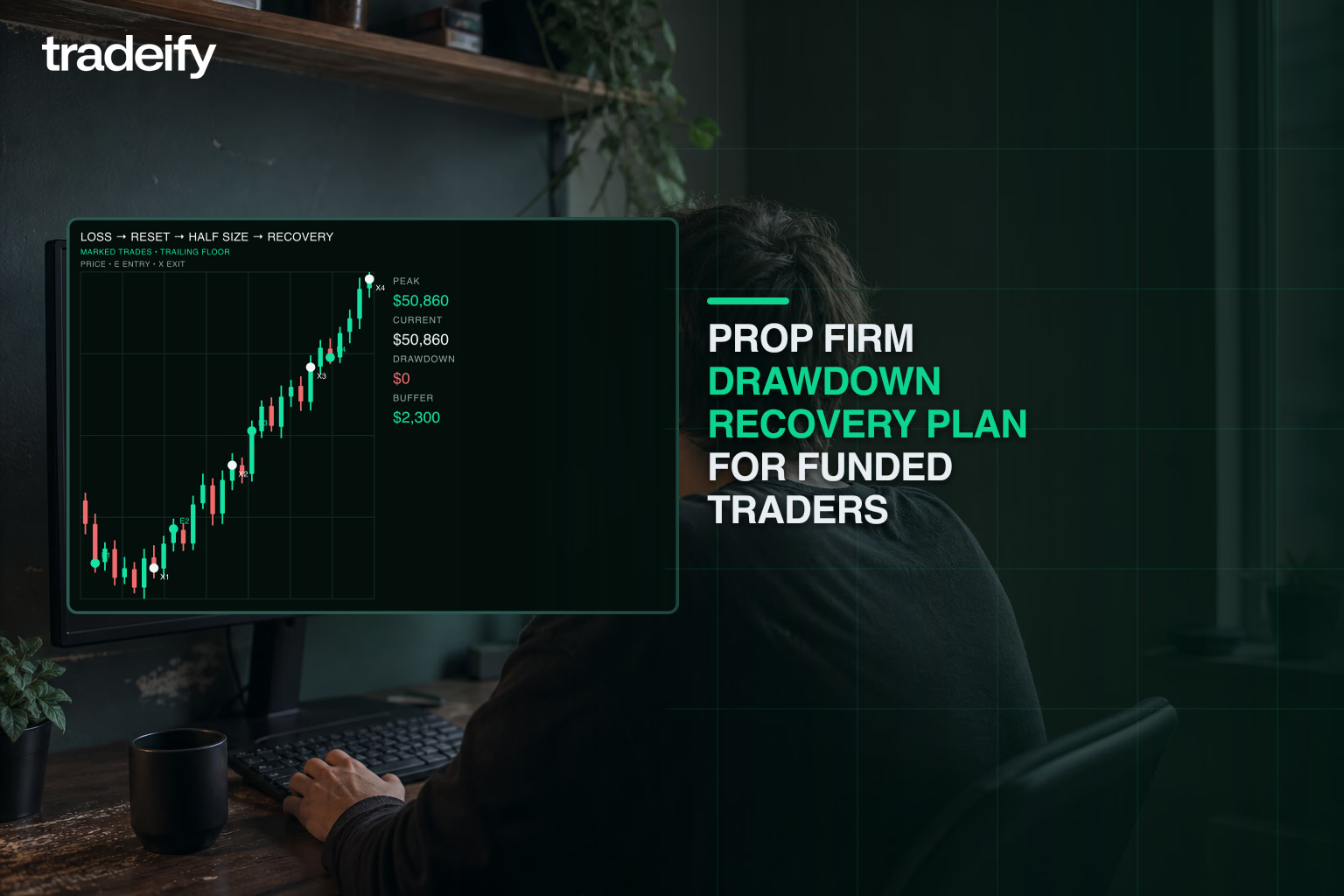


TL;DR: Tradeify is a futures prop firm offering Growth, Select, and Lightning accounts at multiple sizes ($25K through $150K) with End-of-Day (EOD) trailing drawdowns. Growth evaluations have no consistency rule and can be passed in a single day; Growth funded accounts carry a 35% consistency rule, a Daily Loss Limit (DLL) as a soft breach, and max trailing drawdown as a hard breach. Select evaluations require a 40% consistency rule and have no DLL, but the consistency rule is removed entirely once funded — and traders choose between Flex (no DLL) or Daily (lower DLL) payout paths after passing. Lightning skips the evaluation entirely with instant funding, uses a progressive consistency rule starting at 20%, and has different drawdown limits at larger account sizes. EOD trailing means the drawdown floor only trails upward at session close, but it is enforced in real time — if your balance hits the current limit during trading, the account fails immediately. All positions must be closed by 4:59 PM ET daily — no overnight or swing trading. Drawdown recovery follows a three-phase protocol: psychological reset (15-min, 24-hr, or 48-hr cooling periods based on severity), forensic audit of profit factor, win rate, MAE, and R:R ratio, then tactical scaling at 0.25R–0.5R with a 3-trade daily cap and A-setup-only filter. Instruments include NQ (Nasdaq-100), ES (S&P 500), YM (Dow), and RTY (Russell), with MES/MNQ micros recommended during recovery for granular sizing at 1:10 scaling — but traders must close all mini positions before entering micros, as holding minis and micros simultaneously is a hedging violation. The drawdown locks at $100 above starting balance once specific EOD profit thresholds are hit — those thresholds vary by account type and size. After five successful payouts across all plan types, traders become eligible for Tradeify Elite Live with no DLL, EOD trailing drawdowns, daily payouts at a 90/10 profit split, and up to five live accounts.
A long prop trading career rests less on how often you win and more on how you protect capital when you lose. Futures trading uses margin, which makes both gains and losses larger. Drawdowns are not a risk to manage someday — they are a certainty. For Tradeify traders, knowing how End-of-Day trailing drawdowns, Daily Loss Limits, and the mental side of recovery work is the difference between long-term funding and a permanent prop firm account failure. This guide gives futures day traders a clear framework for diagnosing, managing, and recovering from drawdowns inside Tradeify — from the evaluation through the funded stage.
Tradeify Drawdown Rules Every Prop Firm Trader Must Know
To implement a recovery plan, one must first achieve a granular understanding of the specific guardrails established by the firm. Tradeify offers three main account types — Growth, Select, and Lightning — each governed by different rules designed to protect the firm's capital while providing the trader with varying degrees of flexibility. The primary mechanism of risk control is the distinction between a "soft breach" and a "hard breach," a dichotomy that determines whether a trader is merely paused for the session or terminated from the program.
Evaluation Account Rules
Growth and Select evaluations share the same account sizes ($50K, $100K, $150K) but differ in key ways. Growth evaluations have a Daily Loss Limit and no consistency requirement, meaning you can pass the evaluation in as little as one trading day. Select evaluations have no Daily Loss Limit during the evaluation phase but require a 40% consistency rule, meaning no single day's profit can exceed 40% of total profits — which means you need a minimum of three trading days to pass.
| Account Type | Account Size | Daily Loss Limit (DLL) | Max Trailing Drawdown | Consistency | Profit Target |
|---|---|---|---|---|---|
| Growth Eval | $50,000 | $1,250 | $2,000 | None | $3,000 |
| Growth Eval | $100,000 | $2,500 | $3,500 | None | $6,000 |
| Growth Eval | $150,000 | $3,750 | $5,000 | None | $9,000 |
| Select Eval | $50,000 | None | $2,000 | 40% | $2,500 |
| Select Eval | $100,000 | None | $3,000 | 40% | $6,000 |
| Select Eval | $150,000 | None | $4,500 | 40% | $9,000 |
Funded Account Rules
Once funded, the rules shift depending on your account type and — for Select — which payout path you chose after passing. Lightning accounts skip the evaluation with instant prop firm funding and go straight to funded status.
| Account Type | Account Size | Daily Loss Limit (DLL) | Max Trailing Drawdown | Consistency |
|---|---|---|---|---|
| Growth Funded | $50,000 | $1,250 | $2,000 | 35% |
| Growth Funded | $100,000 | $2,500 | $3,500 | 35% |
| Growth Funded | $150,000 | $3,750 | $5,000 | 35% |
| Select Flex (5-Day) | $50,000 | None | $2,000 | None |
| Select Flex (5-Day) | $100,000 | None | $3,000 | None |
| Select Flex (5-Day) | $150,000 | None | $4,500 | None |
| Select Daily | $50,000 | $1,000 | $2,000 | None |
| Select Daily | $100,000 | $1,250 | $3,000 | None |
| Select Daily | $150,000 | $1,750 | $4,500 | None |
| Lightning | $25,000 | None | $1,000 | 20%* |
| Lightning | $50,000 | $1,250 | $2,000 | 20%* |
| Lightning | $100,000 | $2,500 | $4,000 | 20%* |
| Lightning | $150,000 | $3,750 | $6,000 | 20%* |
*Lightning accounts use a progressive consistency rule: 20% for the first payout, 25% for the second, and 30% for all subsequent payouts.
A few things to notice here. Growth and Lightning share the same DLL values at matching account sizes, but Lightning has larger max trailing drawdowns at $100K ($4,000 vs. $3,500) and $150K ($6,000 vs. $5,000). Lightning also offers a $25K size that Growth and Select don't. Select Daily funded accounts have a lower DLL than Growth at every size, while Select Flex has no DLL at all. And the consistency rule disappears entirely on funded Select accounts — a significant advantage during recovery, since you don't have to worry about one big green day throwing off your payout eligibility.
Soft Breach vs. Hard Breach
The Daily Loss Limit operates as a portfolio-level monitor, tracking both realized and unrealized losses alongside fees and commissions throughout the active trading session. When the cumulative loss reaches this threshold, the system triggers a trading pause. This is a soft breach — the trader cannot open new positions until the start of the next trading session at 6:00 PM ET, but the account remains active and eligible for funding.
One important caveat: the DLL is not a hard stop. In volatile market conditions, losses may exceed the DLL before the system triggers the pause. Never rely on the DLL as your stop loss — always use your own stop orders. If slippage pushes your loss past the max trailing drawdown before the DLL kicks in, the account fails permanently.
The Max Trailing Drawdown is the hard breach. This limit tracks the account's peak balance (the "high-water mark") and adjusts dynamically. If the account balance touches or drops below this threshold, the account is permanently failed. There is no recovery from a hard breach.
How End-of-Day Trailing Drawdown Works at Tradeify
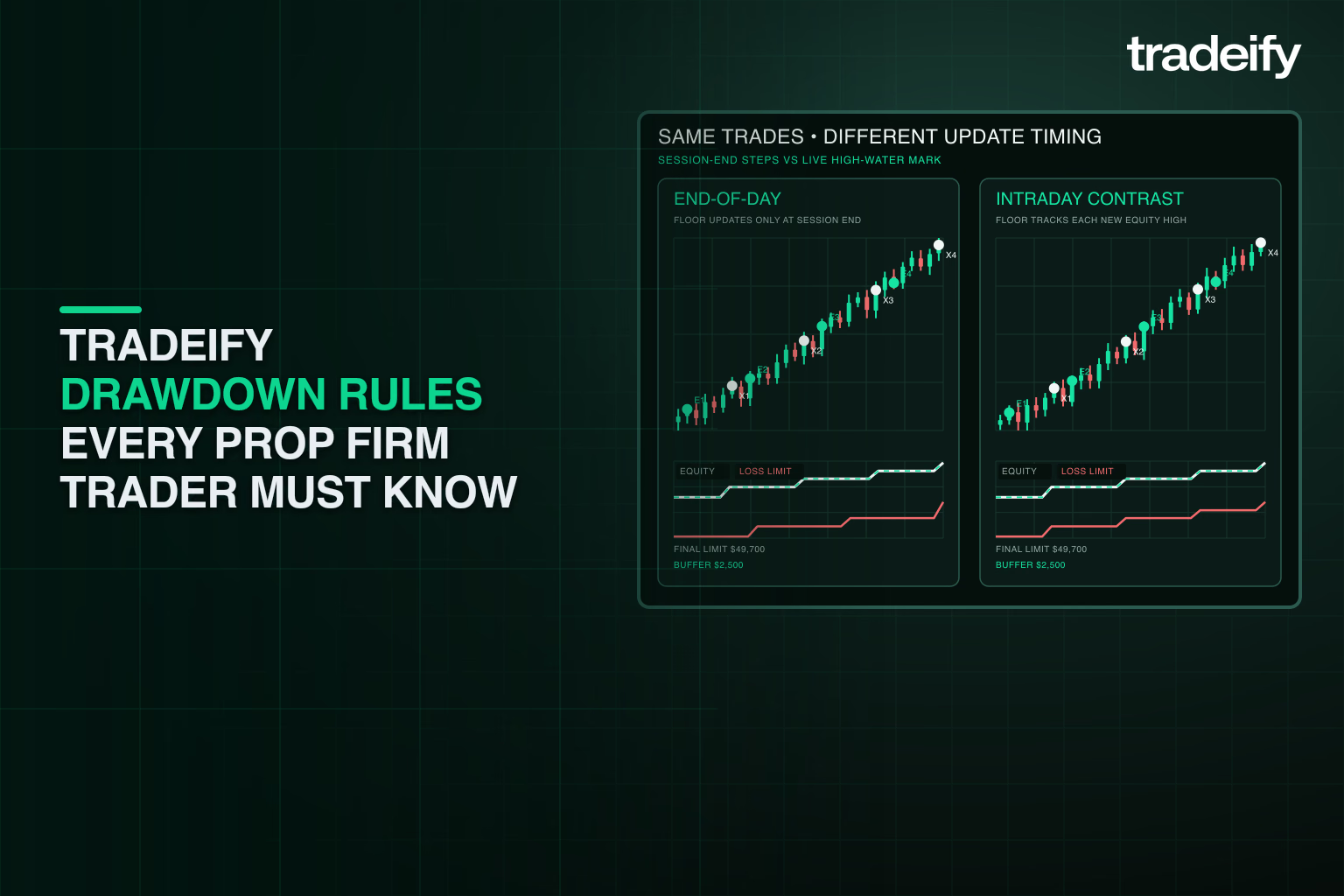
A fundamental advantage of the Tradeify system is the utilization of an End-of-Day (EOD) trailing drawdown for Growth, Select, and Lightning accounts. Many proprietary firms utilize an intraday trailing drawdown, which moves the failure threshold upward in real time as unrealized profits increase. This often "traps" traders during normal market pullbacks — if a trader is up $2,000 and the market retraces $1,500, an intraday drawdown would have already moved the floor up $2,000, potentially causing an account breach despite the trader still being in a profitable position.
Tradeify's EOD model only updates the drawdown threshold based on the account's highest-ever end-of-day balance. The drawdown limit trails this high-water mark — it only moves up, never down. If the day ends in a loss, the drawdown floor remains static at its previous high-water mark.
What EOD Drawdown Does and Does Not Mean for Intraday Trading
This is a critical distinction that every Tradeify trader needs to understand: while the EOD drawdown only updates at the end of each trading day, it is enforced in real time. If your account balance hits the current drawdown limit at any point during the trading session, your account fails immediately — even if you might have recovered by end of day.
What EOD drawdown does give you is protection from the floor chasing your open equity during the session. If you enter a trade that goes $1,500 in your favor and then pulls back $1,000, the drawdown floor won't have moved during that sequence. It only recalculates based on where you close the day. This gives you more room to manage positions through normal intraday volatility compared to firms that trail drawdown in real time.
For example, on a $100,000 Growth account with a $3,500 drawdown: if your starting limit is $96,500 and you end Day 1 at $103,000, the limit moves up to $99,500. If Day 2 ends at $101,000, the limit stays at $99,500 — it never moves down. But during Day 3, if your balance drops to $99,500 at any point, even intraday, the account fails.
One additional rule that ties directly into EOD drawdown management: all Tradeify accounts require positions to be closed by 4:59 PM ET each trading day. There is no overnight or swing trading. If you are in a recovery phase and managing a position late in the session, make sure you are flat before this cutoff — holding through it will result in a violation regardless of whether the trade is profitable.
The Math Behind Drawdown Recovery in Prop Firm Trading
A recovery plan must be grounded in the harsh mathematical reality of percentage-based recovery. As an account balance falls, the percentage gain needed to climb back grows fast — and not in a straight line. This is the asymmetry of loss. For instance, a 10% loss requires an 11.1% gain to recover, but a 50% loss requires a 100% gain.
In the context of a proprietary challenge, where the "actual" tradable capital is only the distance between the starting balance and the maximum drawdown, the math is even more compressed. On a $50,000 account with a $2,000 drawdown, a $1,000 loss represents a 50% loss of the trader's usable risk capital, even if it is only a 2% drop in the total account balance.
R = (1 / (1 − L)) − 1
Where L is the percentage of the loss relative to the maximum allowable drawdown. If a trader has $2,000 of drawdown and loses $1,000, they have lost 50% of their risk capital, meaning they now need to achieve a 100% return on their remaining risk capital just to reach the break-even point. This mathematical reality dictates that recovery cannot be achieved through increased aggression — it can only be achieved through a reduction in risk and an extension of the time horizon.
The Drawdown Recovery Math Table
The recovery formula above produces a non-linear curve. Every extra percent of drawdown demands a disproportionately larger return to break even. The table below shows the percentage gain required to fully recover from each level of drawdown.
| Drawdown (%) | Gain Required to Recover (%) |
|---|---|
| 5% | 5.3% |
| 10% | 11.1% |
| 15% | 17.6% |
| 20% | 25.0% |
| 25% | 33.3% |
| 30% | 42.9% |
| 40% | 66.7% |
| 50% | 100.0% |
| 70% | 233.3% |
The takeaway is simple. A small loss is cheap to recover. A large loss is not. Once a drawdown reaches 25–30%, the required gain starts to outrun what a consistent edge can deliver in a reasonable time. That is why prop firm risk caps exist below those levels — and why the only realistic recovery path is to keep losses small.
How Long Recovery Actually Takes
The other half of recovery math is time. A required gain is one thing; the number of trades needed to earn it at a normal edge is another. Using the formula above and a baseline expectancy of about 0.5% per trade (a 50% win rate at 1:1 R:R with a small positive bias), here is what recovery looks like in trade count:
| Drawdown | Required Gain | Approx. Trades to Recover at 0.5% Expectancy |
|---|---|---|
| 10% | 11.1% | ~22 trades |
| 20% | 25.0% | ~50 trades |
| 30% | 42.9% | ~86 trades |
If a trader takes three quality setups per day, a 10% drawdown is roughly one to two weeks of disciplined trading. A 30% drawdown is closer to six weeks. The numbers shift with expectancy, but the relationship does not — bigger drawdowns demand exponentially more sessions to climb out of. Trying to compress that timeline with larger size is the most reliable way to convert a recoverable drawdown into a hard breach.
Phase I: The Psychological Reset After a Drawdown Hit
The hour right after a big loss is the most dangerous window for a prop account. The brain is wired to treat a financial loss like a threat — fight or flight kicks in, often as revenge trading or a pull to "get back to even." This state — often called tilt that derails funded trader recovery — pushes traders to drop a proven plan and take impulsive, high-risk bets. Account failure usually follows.
The Cooling-Off Protocol
A professional recovery plan mandates an immediate cessation of trading activity following a DLL hit or a loss exceeding 1% of the total account balance. The soft-breach nature of Tradeify's Daily Loss Limit is specifically designed to enforce this discipline — when you hit the DLL, the system stops you from trading until the next session, which serves as a built-in cooling-off mechanism.
Professional traders utilize structured reset windows to regain cognitive control:
The 15-Minute Reset: For a single losing trade that followed the plan, a brief walk away from the screens is sufficient to clear the immediate emotional residue.
The 24-Hour Reset: Following a DLL hit, the trader must remain out of the market until the next 6:00 PM ET reset. This period should be spent entirely away from charts to allow the nervous system to return to a baseline state.
The 48-Hour Hiatus: If a trader has reached 50% of their maximum drawdown, a multi-day break is required. This time is used to conduct a forensic audit of the trading journal and re-verify the strategy against current market conditions.
The 2–5 Day Stand-Down: After a max drawdown event or repeated DLL hits in the same week, take two to five full trading days off. The goal is not screen time — it is to reset routine, sleep, and review before risking capital again.
Confidence does not return with a single winning trade — it returns through the consistent application of a structured process. Attempting to recover capital while in a state of emotional distress is a failure of risk management, not a failure of strategy.
The Three-Tier Response Protocol
Not every red day deserves the same response. A small dip in normal variance should not trigger the same plan as a serious drawdown. Use a tiered protocol so the size of the response matches the size of the damage. The percentage bands below are measured against remaining max trailing drawdown, which is the only risk number that actually ends an account.
| Tier | Drawdown Consumed | Response |
|---|---|---|
| Tier 1 | 0–35% of max drawdown | Normal variance. Keep size and process. Log the trades and move on. |
| Tier 2 | 35–70% of max drawdown | Cut size to 0.5R. Tighten setup filter to A-grade only. Cap trades at three per day. |
| Tier 3 | 70%+ of max drawdown | Full stop. Close the platform. Begin the forensic audit before any new exposure. |
Tradeify's Daily Loss Limit makes Tier 3 enforcement automatic — once the DLL is hit, the system blocks new positions until the next 6:00 PM ET reset. The tiered table above guides decisions during the session, before the DLL ever triggers, when the trader still has full control over how the account ends the day.
Naming the Drawdown Traps
Generic warnings about "tilt" do not stick. Naming the specific traps does. Watch for these patterns the moment they appear:
The One Good Trade Trap: The belief that a single winning trade will fix the drawdown. It usually arrives with oversized risk and a low-quality setup.
The I Deserve to Win Trap: A sense that the market owes a recovery after recent losses. The market owes nothing. Setups owe nothing. Time at the screen owes nothing.
The Change Everything Trap: Switching strategy, instrument, and timeframe at once after a losing week. It destroys the only baseline a trader has to learn from.
The I Cannot Afford to Stop Trap: The fear that stepping away will mean failure. In a hard-breach environment, the opposite is true — pushing through fatigue is the fastest path to a breach.
Phase II: The Forensic Audit of Your Trading Performance
Once psychological stability is restored, the trader must determine if the drawdown was a result of standard market variance or a fundamental process failure. This is achieved through a forensic audit of the trading journal, focusing on key performance metrics rather than just the bottom-line P&L.
Three Root Causes Behind Most Drawdowns
Before chasing metrics, name the failure mode. Most prop firm drawdowns trace back to one of three root causes, and each demands a different response.
Execution Breakdown: The strategy still works, but the trader stopped following it. Stops moved, sizing crept up, setups got fuzzy. Fix: tighten process — no plan, no trade.
Strategy Degradation: The strategy itself stopped producing. Win rate and profit factor have drifted below baseline for 50+ trades. Fix: pause live trading, backtest the strategy on the most recent month, and decide whether to adjust or replace it.
Market Regime Change: The strategy is fine; the market is not the one it was built for. Volatility, trend, or session character has shifted. Fix: stand down or switch to setups suited to the new regime until conditions revert.
The forensic audit below tells you which of the three is happening. Without that label, every fix is a guess.
Key Metrics to Audit During Recovery
Traders should analyze their last 20–50 trades using the following framework to identify structural leaks in their performance.
| Metric | Definition | Red Flag in Drawdown | Recovery Target |
|---|---|---|---|
| Profit Factor | Ratio of gross profit to gross loss. | Below 1.0 — strategy is no longer profitable. | 1.25 or higher. |
| Win Rate | Percentage of trades ending in profit. | Drastic drop below historical baseline. | Stability within 1 standard deviation of mean. |
| Average Trade Duration | Time spent in active positions. | Significant deviation — either "panic selling" or "hope-holding." | Alignment with original strategy parameters. |
| Max Adverse Excursion | Maximum drawdown experienced during a single trade. | Consistently hitting stops before targets are reached. | Adjusting stops based on ATR or market structure. |
| Risk-Reward Ratio | Average win size vs. average loss size. | Wins are smaller than losses — often due to "cutting winners" out of fear. | Minimum 1.5:1 or 2:1. |
Process failures typically fall into three categories: overleveraging, overtrading during drawdown recovery, and failing to adapt to market regimes. If the audit reveals that the trader was following the plan but the market was simply not providing the necessary setups, the recovery strategy is "patience." If the audit reveals rule violations, the recovery strategy is "restraint."
The Rules Followed vs. Rules Broken Trade Tag
Run every trade in the audit through a single binary check: was every rule in the plan followed, or was at least one broken? Tag each trade in the journal as Rules Followed or Rules Broken, then split the P&L by tag.
If the Rules Followed bucket is profitable and the Rules Broken bucket is the source of the drawdown, the strategy is intact and the fix is discipline. If both buckets are losing, the strategy itself has slipped and needs a backtest before any return to live exposure. This one tag separates a process problem from a strategy problem faster than any other metric.
Phase III: Tactical Scaling and the Comeback Protocol
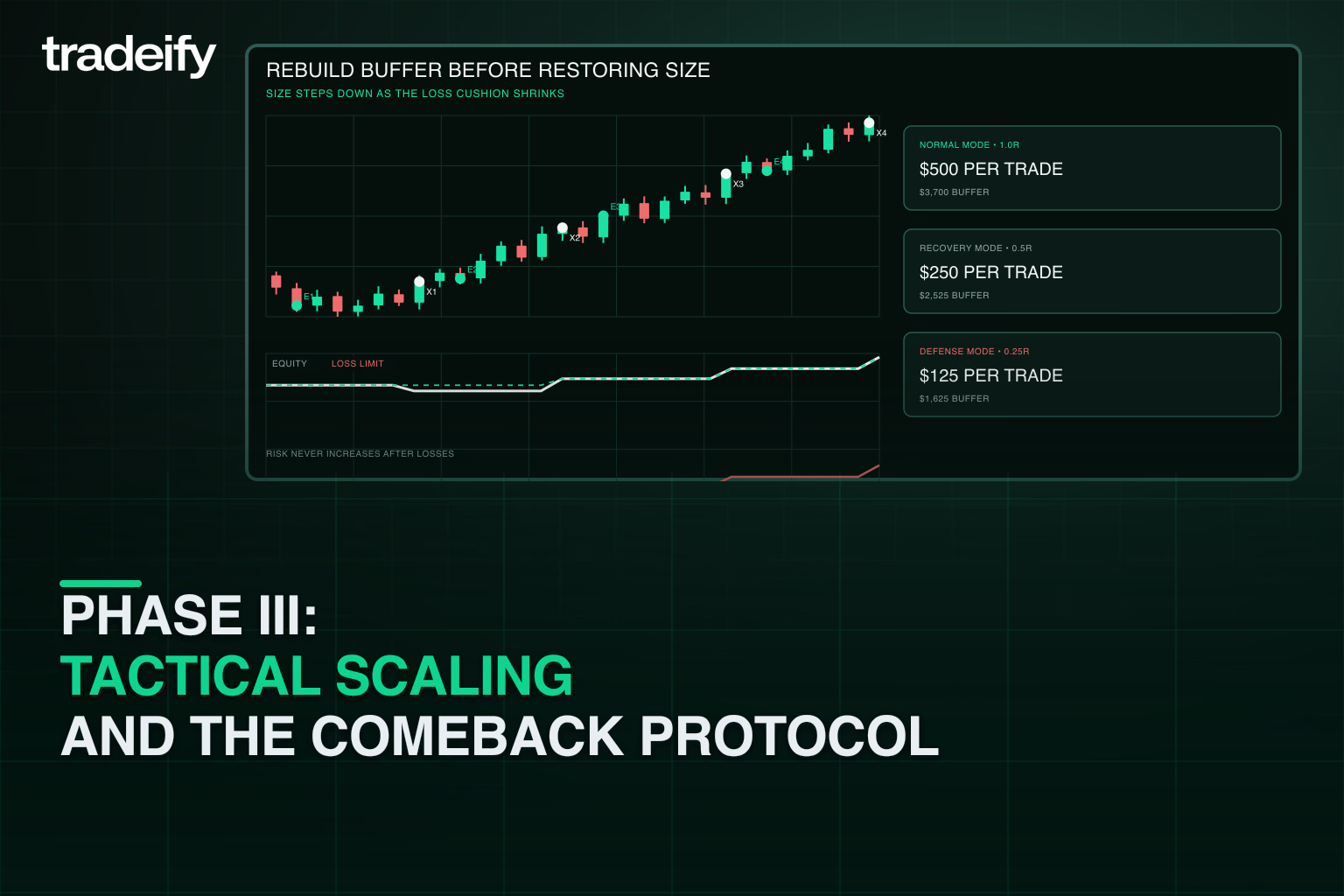
The tactical phase of recovery is defined by a systematic reduction in risk and an increase in the quality of trade selection. The goal is to stop the equity hemorrhage and rebuild confidence through a series of "base hits" rather than "home runs."
Resetting Risk Units and Sizing for Recovery
The trader must redefine their Risk Unit (R) based on the remaining distance to the hard breach drawdown limit. If a trader has a $100,000 Growth account with a $3,500 drawdown and they have already lost $1,500, they have $2,000 of risk capital remaining.
Professional recovery sizing guidelines include:
Size Reduction: Cut the position size to 0.5R or even 0.25R. On a $100K account where a standard risk might be $500 per trade, the recovery risk should be lowered to $125–$250.
The 3-Trade Daily Cap: Limit the number of trades to three per session. This prevents the "death by a thousand cuts" that occurs when a frustrated trader takes marginal setups to "stay busy."
A-Setup Filter: Only execute setups that have a documented positive expectancy in the trader's historical data. If a setup is not in the "A" category, it is considered "entertainment" and must be skipped.
The "Quit on Green" Rule: If the first or second trade of the day results in a net profit of 1R, the trader should close the platform. This creates a psychological win and prevents the common mistake of "giving it all back" later in the session.
Recovery is a sequence of controlled, positive-expectancy exposures, not a single winning trade. Traders who graduate from this protocol typically do so after 5–7 consecutive days of adhering to these rules, regardless of the specific dollar amount recovered.
The 9-Week Size Scale-Up Roadmap
Returning to full size in one step undoes the recovery. Scale back up in clear phases, each tied to a specific size and minimum streak of disciplined sessions before the next step.
| Phase | Window | Position Size | Gate to Advance |
|---|---|---|---|
| Phase 1 | Weeks 1–2 | 25% of normal size | 5+ consecutive sessions with no rule violations. |
| Phase 2 | Weeks 3–4 | 50% of normal size | Profit factor at or above 1.25 across the window. |
| Phase 3 | Weeks 5–8 | 75% of normal size | Account back above pre-drawdown high-water mark. |
| Phase 4 | Week 9+ | 100% of normal size | Maintained for as long as edge holds. |
If any phase produces a rule violation or a return below the previous phase's results, step back down one phase before stepping forward again. Time spent at a lower size is cheap. A second hard breach is not.
NQ vs. ES for Prop Firm Drawdown Recovery
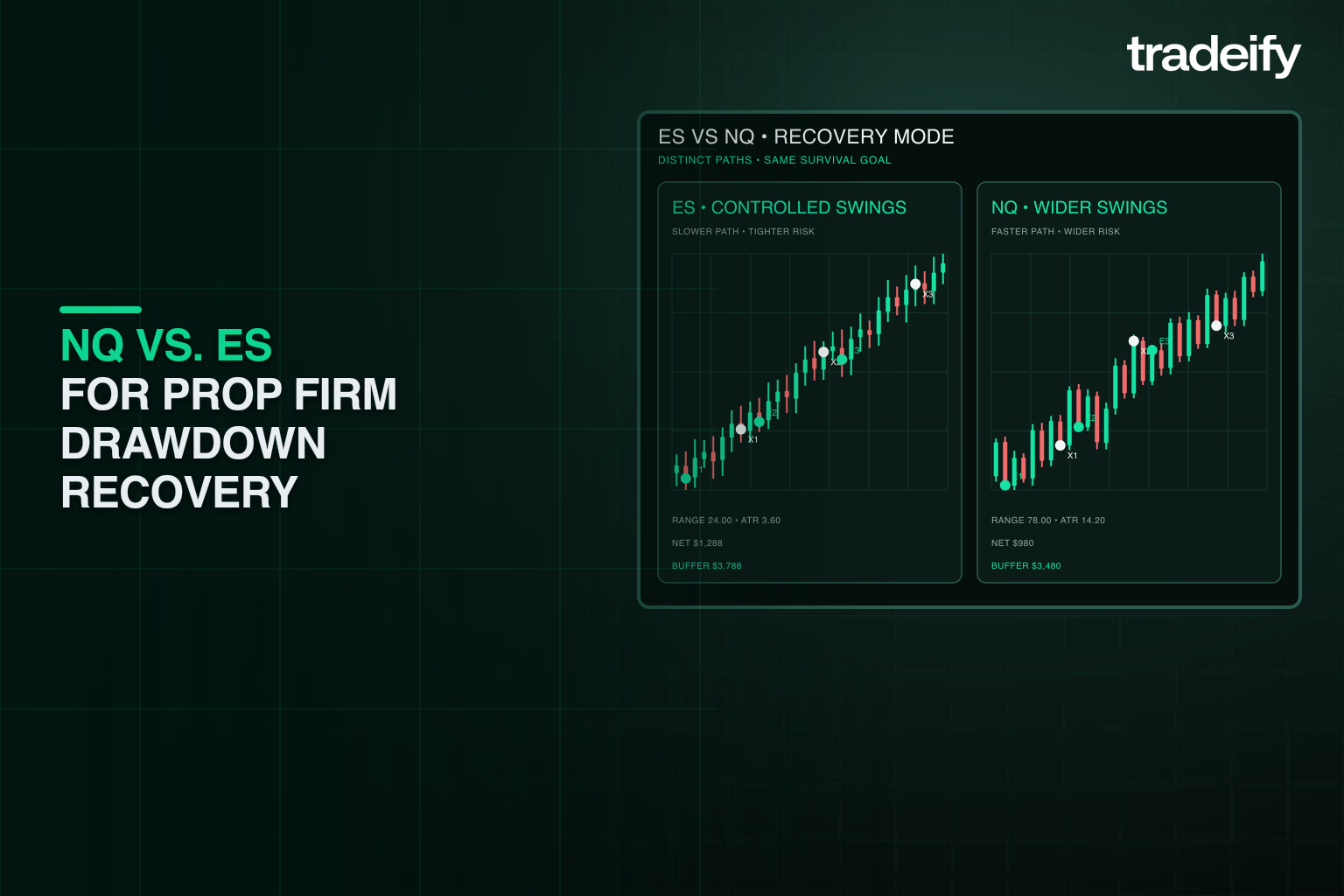
During a recovery phase, the choice of instrument is as important as the entry criteria. For futures traders, the Nasdaq-100 (NQ) and the S&P 500 (ES) are the primary vehicles for challenge accounts. However, their volatility profiles differ significantly. NQ is known for high-velocity moves and larger ranges, which can lead to rapid account growth but also rapid drawdown breaches if sizing is not perfectly calibrated.
Using Index Correlation to Find Recovery Setups
Traders can use inter-market correlation to find high-probability setups while reducing risk. By observing the percentage changes of the four major indices (ES, NQ, YM, and RTY) the trader can identify which market is leading the trend and which is lagging.
Read the Con: ES is considered the "boss." If the ES is not confirming a move in NQ, the move is often a "fakeout."
RTY as the "Snitch": Small caps (RTY) are the ultimate indicator of risk appetite. If NQ and ES are rallying but RTY is flat or red, the rally is likely unsupported by broad market participation and is prone to reversal.
SMT Divergence: During recovery, traders should look for SMT (Smart Money Technique) divergence for prop firm recovery setups. If ES makes a lower low but NQ fails to make a lower low, it indicates technical strength in NQ and a high-probability long opportunity with a tight stop.
Using micro contracts (MES or MNQ) for prop firm drawdown recovery instead of minis is highly recommended during recovery. The 1:10 scaling between minis and micros allows for granular risk control, enabling a trader to risk much smaller amounts per trade while still participating in the same market moves. One critical rule to be aware of: Tradeify prohibits holding mini and micro contracts simultaneously, regardless of direction. If you normally trade minis and want to switch to micros during recovery, make sure all mini positions are fully closed before entering any micro contract — otherwise you will trigger a hedging violation.
How High-Impact News Can Wreck a Prop Firm Drawdown Recovery
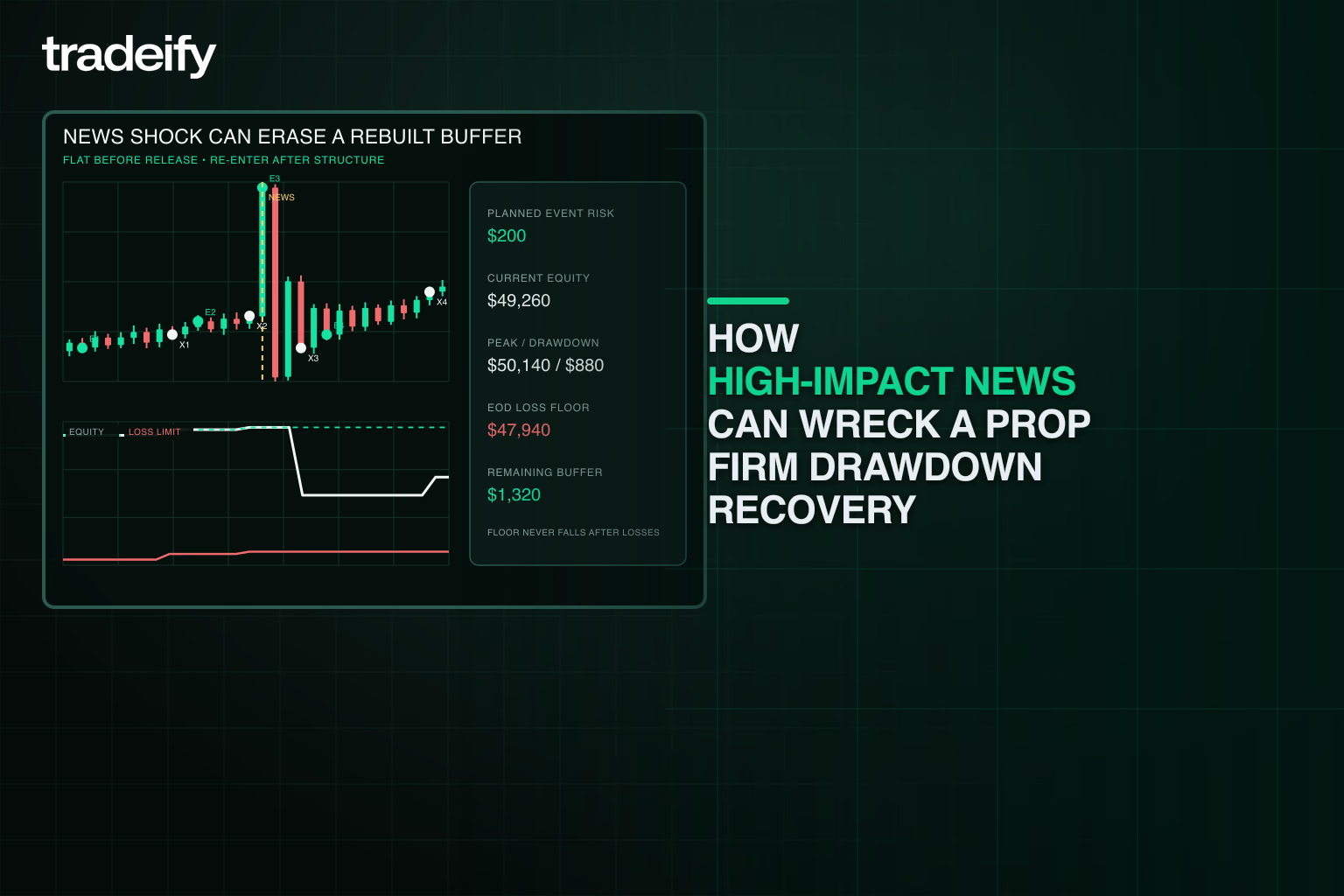
One of the most common causes of failed accounts is being caught on the wrong side of high-impact economic news. Volatility during events like the Consumer Price Index (CPI) or Federal Open Market Committee (FOMC) meetings can cause market "gaps" and significant slippage, meaning a trader's stop-loss may be filled at a price far worse than intended — potentially breaching the Max Trailing Drawdown instantly.
News Events to Avoid During Recovery
A recovery plan must include a strict "No-Trade" policy around the following events to prevent accidental account termination.
| Event | Market Mechanism | Risk to Trader | Protocol |
|---|---|---|---|
| CPI / PPI | Inflation data drives interest rate expectations. | Rapid, two-sided "whipsaws" of 100+ points in NQ. | Go flat 30 mins prior; wait 15 mins post-release. |
| Non-Farm Payrolls | Key labor market health indicator. | Extreme slippage; bracket orders may not fill. | Avoid pre-market sessions; trade the 10:00 AM ET reaction. |
| FOMC Rate Decision | Direct central bank policy shifts. | "Trend-less" chop during the meeting, followed by 40 mins of volatility. | Sit out the entire afternoon session. |
| Treasury Auctions | Global demand for US debt. | Liquidity pockets can vanish, leading to erratic price spikes. | Watch for liquidity to shrink; reduce size to micros. |
The most professional "edge" in trading is knowing when to stay out of the market. If a trader is in a drawdown, their mental capital is already low — attempting to trade news-driven volatility often leads to overtrading and emotional decision-making.
Managing the Consistency Rule During Drawdown Recovery
As a trader successfully works through the tactical recovery and begins to build a profit cushion, they must manage Tradeify's consistency rules that affect funded trader payouts to remain eligible for payouts. The consistency rule ensures that no single day's profit accounts for more than a specific percentage of the total gains. But the rules vary significantly by account type, so understanding which consistency threshold applies to your account is essential during recovery.
Consistency Rules by Account Type
| Account Type | Consistency Rule | Key Detail |
|---|---|---|
| Growth Evaluation | None | Can pass the evaluation in a single trading day. |
| Growth Funded | 35% | No single day's profit can exceed 35% of total profits. |
| Select Evaluation | 40% | Requires a minimum of 3 trading days to pass. |
| Select Funded (Flex or Daily) | None | Consistency rule is removed after passing the evaluation. |
| Lightning | 20% → 25% → 30% | Progressive: 20% for first payout, 25% for second, 30% for third and beyond. |
Traders in recovery often make the mistake of having one "monster" winning day that brings the account back to break-even or into profit. While this is positive for the account balance, it can push the consistency percentage into the red on accounts where the rule applies. If a trader has $10,000 in total profit on a Growth funded account and $4,000 of that came from one day (40%), they are ineligible for a payout — a common reason prop firm payouts get denied — until they earn enough additional, smaller profits to bring that single day down to 35% or less of the total.
Losing days are particularly detrimental during the recovery phase because they reduce the total profits denominator, which causes the biggest day's percentage to rise. For example, if a $1,000 win was 30% of a $3,333 total profit, a $500 loss drops the total to $2,833, pushing the consistency of the $1,000 win up to 35.3% — potentially delaying the payout.
One advantage for Select funded traders: since the consistency rule is removed entirely on both Flex and Daily funded accounts, this math doesn't apply to them at all. This can make Select a more forgiving path during recovery if consistency management is a concern.
The Drawdown Lock as the Final Recovery Milestone
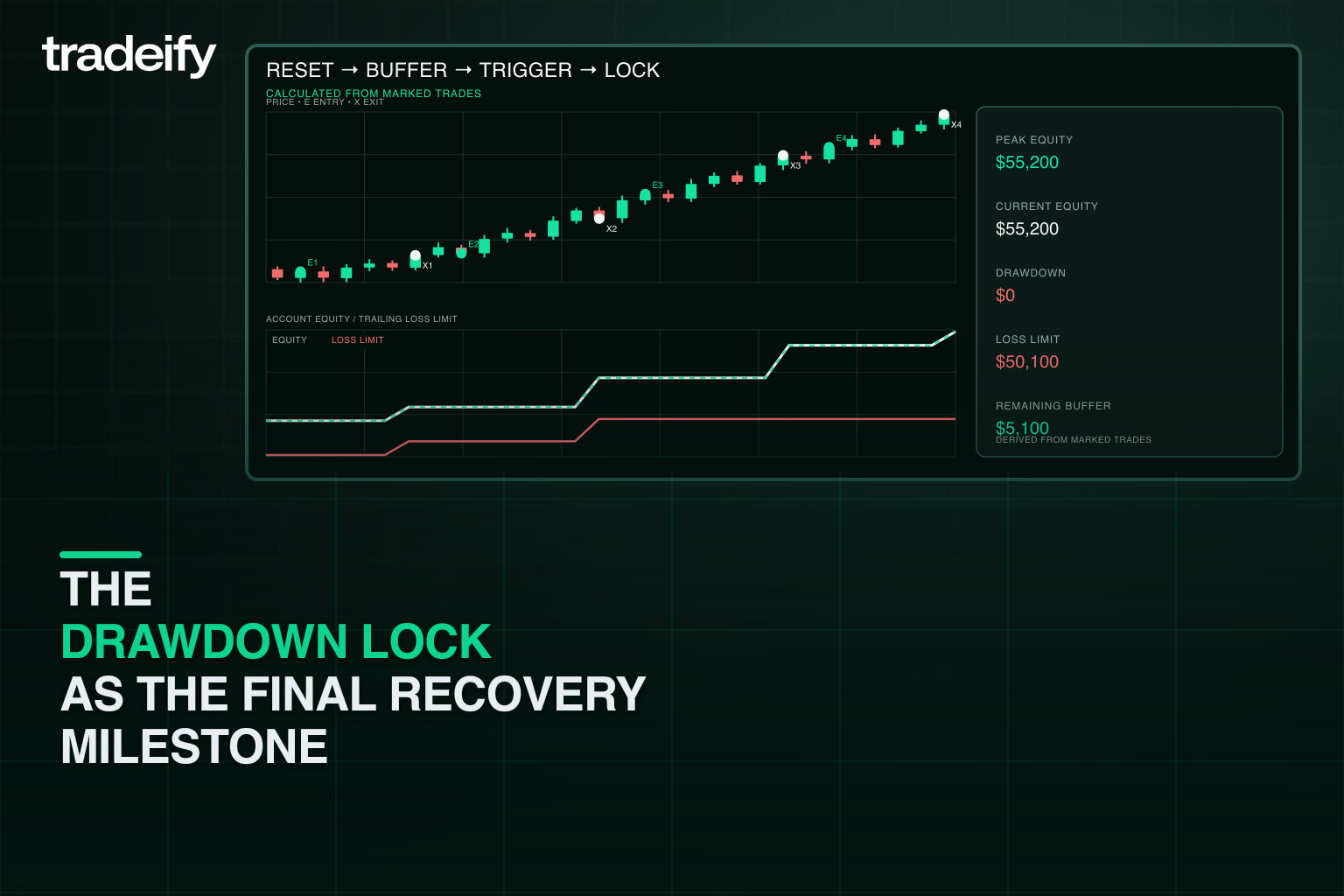
For funded traders in the Growth, Lightning, or Select paths, the ultimate goal of a recovery strategy is to reach the drawdown lock. This is a unique Tradeify mechanism where the trailing drawdown becomes a fixed floor that never moves up again, regardless of how much profit is made subsequently.
How the Drawdown Lock Works
The drawdown locks at $100 above the starting balance once the account's end-of-day balance hits a specific profit threshold. The lock trigger varies by account type and size because it depends on the max drawdown amount — and different account types have different drawdowns.
For Growth funded accounts:
| Account Size | Lock Trigger (EOD Balance) | Locked Drawdown Floor |
|---|---|---|
| $50K | $52,100 | $50,100 |
| $100K | $103,600 | $100,100 |
| $150K | $155,100 | $150,100 |
For Select funded accounts:
| Account Size | Lock Trigger: Flex | Lock Trigger: Daily | Locked Drawdown Floor |
|---|---|---|---|
| $50K | $52,100 | $52,100 | $50,100 |
| $100K | $103,100 | $102,600 | $100,100 |
| $150K | $154,600 | $153,600 | $150,100 |
For Lightning funded accounts:
| Account Size | Lock Trigger (EOD Balance) | Locked Drawdown Floor |
|---|---|---|
| $25K | $26,100 | $25,100 |
| $50K | $52,100 | $50,100 |
| $100K | $104,100 | $100,100 |
| $150K | $156,100 | $150,100 |
Reaching the drawdown lock is a game-changing moment for recovery. Once the floor is fixed at $50,100 (for a 50K account), any profit earned above that level becomes a permanent equity cushion. A trader who grows their account to $55,000 now has a $4,900 buffer before they risk failing the account. This eliminates the anxiety of a trailing ceiling that keeps rising with your balance. However, traders must be careful with withdrawals — requesting a payout reduces the balance but does not move the locked floor, meaning a large withdrawal can bring you dangerously close to the locked failure point.
Note: The drawdown lock applies only to sim funded accounts. Evaluation accounts do not have drawdown locking.
From Drawdown Recovery to Tradeify Elite
The final objective for any Tradeify trader is to graduate from the simulated funded environment to the Tradeify Elite Live program. A trader becomes eligible for Elite Live after achieving five total payouts across all their funded accounts (any plan type — Growth, Select, or Lightning). Meeting the five-payout threshold makes you eligible to be considered for the transition; Tradeify will reach out when you are selected.
When a trader transitions to Elite Live, every funded account that received at least one payout becomes its own Elite Live account. A trader can hold up to five live accounts simultaneously.
The Elite program represents the most stable environment for a professional trader:
No Daily Loss Limit: Elite accounts remove the system-enforced DLL, giving the trader full control over their daily risk management.
EOD Trailing Drawdown: Elite accounts use the same End-of-Day trailing drawdown mechanism as sim funded accounts. The drawdown trails the high-water mark at EOD and locks once the account reaches the appropriate profit threshold. These are not "fixed" from the start — they trail and lock just like the sim funded stage.
Daily Payouts: Elite traders can request payouts daily at a 90/10 profit split (90% to the trader, 10% to Tradeify). Elite Live accounts start at a $0 balance — everything earned is profit.
Multi-Account Scalability: Each funded account that received a payout transitions to its own Elite Live account, allowing a trader to scale across up to five live accounts.
Traders who fail an Elite account enter a cool-off period of up to four weeks, depending on their live performance, before they can begin new evaluations. After transitioning to Elite Live, the payout counter resets to zero — a trader must earn five more payouts across new funded accounts to become eligible for additional Elite Live transitions.
Prop Firm Drawdown Recovery FAQ
How long does it take to recover from a prop firm drawdown?
At a baseline expectancy of about 0.5% per trade, a 10% drawdown takes around 22 trades to recover, a 20% drawdown around 50, and a 30% drawdown around 86. At three quality setups per day, that is roughly one to two weeks for a small drawdown and up to six weeks for a deeper one.
Should I increase position size to recover faster?
No. Increasing size after a drawdown is the single most common path to a hard breach. The math of asymmetric loss already works against you — adding size only widens the failure cone. Cut size to 0.25–0.5R during recovery and let consistency rebuild the account.
What is the difference between a soft breach and a hard breach at Tradeify?
A soft breach is hitting the Daily Loss Limit. The account pauses until the next 6:00 PM ET session reset and resumes the next day. A hard breach is touching or breaking the Max Trailing Drawdown — the account is failed permanently and cannot be recovered.
Does EOD trailing drawdown protect me from intraday losses?
Partly. The drawdown floor only moves up at the end of each session, so normal intraday pullbacks do not push it higher. But the floor itself is enforced in real time — if your account balance touches the current limit during the session, the account fails immediately.
How many days should I take off after a serious drawdown?
Two to five trading days. A 15-minute reset is enough after one losing trade that followed the plan, and a 24-hour break is enough after a DLL hit. After a max drawdown event or repeated DLL hits in the same week, take two to five full sessions off to reset routine and review before risking capital again.
Should I switch to micro contracts during recovery?
Yes, in most cases. Micros (MES, MNQ) scale at 1:10 versus minis, which gives much finer risk control during recovery. Close any open mini positions first — holding minis and micros at the same time is a hedging violation on Tradeify accounts.
How does the consistency rule affect recovery on a funded account?
It depends on the account. Growth funded uses 35%, Lightning uses 20% / 25% / 30% progressively, and Select funded (Flex or Daily) removes the consistency rule entirely. On accounts where it applies, one oversized green day during recovery can delay payout eligibility until additional smaller wins bring the biggest day back under the threshold.
The Prop Firm Drawdown Recovery Framework
Recovering a proprietary challenge or funded account is not a matter of "winning back" lost capital, but of rebuilding a broken process. By using the EOD trailing drawdown and the structural protections of the Daily Loss Limit, Tradeify traders have a significant edge over those at firms with real-time trailing rules — as long as they understand that EOD drawdown is still enforced in real time.
A professional recovery plan is summarized by the following core principles:
Acknowledge the asymmetry of loss: Recovery requires a longer time horizon than the loss that created the drawdown.
Enforce the psychological reset: Use the DLL pause as a built-in cooling period to prevent emotional spirals and revenge trading.
Conduct forensic audits: Use trade journaling to distinguish between strategy variance and process failure.
Scale down risk: Reset the R-unit to 0.5R or 0.25R and limit daily trade count until confidence returns.
Optimize asset selection: Use micro contracts and inter-market correlation to find high-probability, low-risk entries.
Avoid news-driven chaos: Respect high-impact economic events and step away from the market to avoid account-ending slippage.
Manage the consistency rule: Focus on steady, similar-sized wins to maintain payout eligibility — and know which consistency threshold applies to your specific account type.
The path to a lasting partnership with Tradeify is paved with discipline, risk management, and the ability to operate calmly within the constraints of the challenge environment. By mastering the recovery plan, a trader transforms the drawdown from a threat of failure into a catalyst for professional growth and eventual Elite Live progression.
.svg)
.svg)
.svg)
.svg)








.webp)