How to Win a Trading Competition Based on What Actually Works
TL;DR: Trading competitions need competition strategy, not normal account-growth advice: identify the format, estimate target-to-place and target-to-win, calculate drawdown cushion, track time remaining, and choose base, defend, and chase plans before Day 1. Highest-balance leaderboards need enough variance to outrank the field, broad Top-N prize contests reward protecting the cutoff, head-to-head brackets reward opponent-relative decisions, and challenge-style contests should be treated like evaluations first. A $50,000 account with a $2,500 max drawdown is functionally a $2,500 risk account, and with a 52% win rate plus 3:2 reward-to-risk, risking 100 bps per trade against a 5% cushion can produce an 82% breach probability over 50 trades, while 200 bps takes that risk to 100%. Winning means trading the tournament: read scoring, prize curve, drawdown type, position limits, automation rules, KYC, tie-breakers, and prize fulfillment before chasing rank.
Most traders enter trading competitions trying to prove they are good traders. Winners enter trying to become the right kind of outlier.
A competition is not normal trading. It is a constrained outlier game with a deadline. You are trying to produce a result large enough to matter on a leaderboard, inside a fixed window, without breaching the rules that make the result count. The best strategy is not always the safest one, and it is not always the most aggressive one. It is the one that fits the scoring system, prize curve, drawdown rules, and time remaining. You do not win by trading the chart alone. You win by trading the tournament.
There is a secondary thesis worth introducing now because it shapes the rest of this article: amateurs chase rank, professionals chase prize equity. A trader who fights to climb from 87th to 50th in a competition that pays the top 100 the same amount has accomplished nothing. A trader who protects 95th place when the prize value is real has accomplished what the competition rewards.
Why Most Trading Competition Advice Is Wrong
Most articles on this topic repeat the same generic advice: risk one to two percent per trade, stay disciplined, journal your trades, control your emotions. This advice optimizes for longevity in a personal trading account. It does not optimize for ranking in a tournament with thousands of participants and a prize curve. The opposite advice, "go big or take maximum leverage," is equally wrong. It ignores prize curves, disqualification rules, drawdown floors, and the fact that most competitions pay more than just first place.
Both pieces of advice fail for the same reason: they assume one strategy fits every competition. Competition strategy depends entirely on what the competition rewards.
A second common mistake is conflating evaluation challenges with leaderboard competitions. They are different objective functions. An evaluation is binary: hit the target without hitting the floor and you pass. A competition is relative: your target moves based on what other traders do. You can post a great month and finish 800th if the field is hot.
The longest-running data set in the industry illustrates this. The Robbins World Cup Trading Championships, run annually since 1983, has been won with returns as high as 11,376% and as low as 53%, in the same year-long format with the same rules. The variance is not because some years are easier to trade than others. It is because the winning number is whatever the field produces, and the field changes. A trader who showed up in 2001 with the strategy that won in 1987 would have ended deep in the standings, and vice versa. Strategy that wins a competition is strategy that fits the field, not strategy that performs in absolute terms.
The third mistake is treating leaderboard position as static. A trader in 5th place with three days left should not behave the same way as a trader in 5th place with three weeks left. A trader in 200th place should not behave the same way as a trader in 12th place. Generic advice ignores all of this.
The prop trading community has a phrase that captures the real skill: trading the risk engine, not the market. The traders who place in competitions understand the rule structure as well as they understand price action. The traders who fail can read a chart but did not read the fine print.
Trading Competitions Are Different Games
Before you can decide on strategy, you have to identify which game you are actually playing. The category determines almost everything.
| Competition type | Winner determined by | Strategic implication |
|---|---|---|
| Highest balance / net P&L leaderboard | Final account balance or percentage return | Variance has to be high enough to outrank the field. Conservative trading guarantees mid-pack. |
| Risk-adjusted / consistency contest | Profit divided by drawdown, win rate, or smoothness | Big single-day gains can hurt your score. Steadiness matters more than peak P&L. |
| Top-N prize contest with broad payout | Finishing in top 10, 100, 1,000, etc. | Optimize for the cutoff, not first place. Survival often beats aggression. |
| Winner-take-most contest | Top 1-3 receive most prize value | Late-stage aggression becomes more rational the further from the top you sit. |
| Head-to-head bracket / knockout | Beating one opponent each round | The goal is opponent-relative, not absolute. Do not trade to look good. Trade to advance. |
| Multi-stage qualifier feeding into bracket | Cumulative score in stage one, then daily head-to-head pairings until one trader remains | Stage one is a balance leaderboard with a drawdown floor and a cut line at a fixed rank. Stage two is a fresh account each day with no drawdown, where you only have to beat one specific opponent. The qualifier rewards not blowing up; the bracket rewards reading the matchup. Treating both stages as the same game is the most common way traders waste their qualifier position. |
| Challenge-style prop contest with leaderboard | Meet target, avoid drawdown, optionally rank | Treat it like an evaluation first, leaderboard second. Compliance dominates. |
| Broker demo contest | Often profit, volume, or churn | Read the rules carefully. Some demo contests reward behavior you would never want in a real account. |
| Live audited championship | Real-money return with audited standings | Higher credibility, real risk, smaller field. Different game entirely. The Robbins World Cup Trading Championships, running since 1983, is the canonical example: year-long, real-money, audited standings, no prize pool but career-defining recognition for top finishers. |
"Trading competition" is not one search term that should produce one strategy. Same keyword, different game types, different correct answers. Before you enter any competition, you should be able to identify which row above describes it. If you cannot, you are not ready to compete.
Trading Competition Numbers You Need Before Day One
Once you know which game you are playing, you need four numbers. These govern every risk decision you will make for the duration of the contest.
Target-to-place. The estimated return needed to finish in the lowest paying tier. If the prize ladder pays the top 1,000 and historical data suggests the 1,000th place finisher needed a 4% return, your target-to-place is 4%.
Target-to-win. The estimated return needed to compete for first place. Often three to ten times higher than target-to-place, depending on prize curve and field size.
Drawdown cushion. The room you have between current balance and the floor that ends your competition. This is the only real capital you are trading. A $50,000 account with a $2,500 max drawdown is functionally a $2,500 account.
Time remaining. The temporal constraint. As time decreases, the rational case for variance increases, but only for traders who are behind their target. For traders ahead of pace, time decreasing should mean variance decreasing.
A trader without a target return is not competing. They are just taking trades while a leaderboard happens nearby.
These four numbers should produce three plans before you have placed a single trade:
- A base plan for trading at expected pace.
- A defend plan for protecting position once you are inside the prize tier.
- A chase plan for the situation where you are behind and need rank movement.
The worst decisions in a competition come from improvising after you have checked the leaderboard for the third time and you do not like what you see. Build the plans before the contest starts.
What Changes in a Trading Competition
Most competent traders do not need to change what setups they trade. They need to change how they manage the trades around the format. Six things look different in a tournament than they do in a normal funded account:
Trade fewer instruments. A trader who normally rotates between five futures contracts should pick one or two for the duration of the contest. The cognitive cost of context-switching is high and the expected value of each "extra" instrument is low when you are already operating with a tight cushion.
Cut losers faster. Normal account math gives you room to let a trade work. Competition cushions do not. A trade that goes 20% into your daily risk allocation in the first minute is a different decision than the same trade in your funded account. Take the small loss and look for the next setup.
Do not add to losers. DCA works in normal trading because you have time. Competition formats almost never give you time. Adding to a losing position in a tournament is the fastest way to turn a manageable loss into a disqualification.
Set a daily stop at 25-30% of cushion. If you have $2,500 of drawdown to work with over a 5-day contest, you should not lose more than about $625-$750 on any single day. Most traders do not set this stop in advance and end up burning through 60% of cushion on Day 1 because the market moved against them.
Size up only on your top-tier setups. "Trade your edge" in a tournament means filtering aggressively. The B-grade setups that produce small profits in a normal account are noise in a competition. They tie up cushion and slow you down without moving rank.
Treat the leaderboard as data, not a scoreboard. Refresh it once per session, not once per trade. The leaderboard tells you where the field is forming. It does not tell you how to trade. Traders who refresh constantly end up trading the leaderboard instead of the chart.
The common thread across all six: a tournament rewards traders who tighten their normal process, not traders who reach for a different one. The temptation in a competition is to swing harder than you do in your funded account because the prize is bigger. The math says do the opposite. The standard process executed cleanly under tournament conditions outperforms the same process executed loosely.
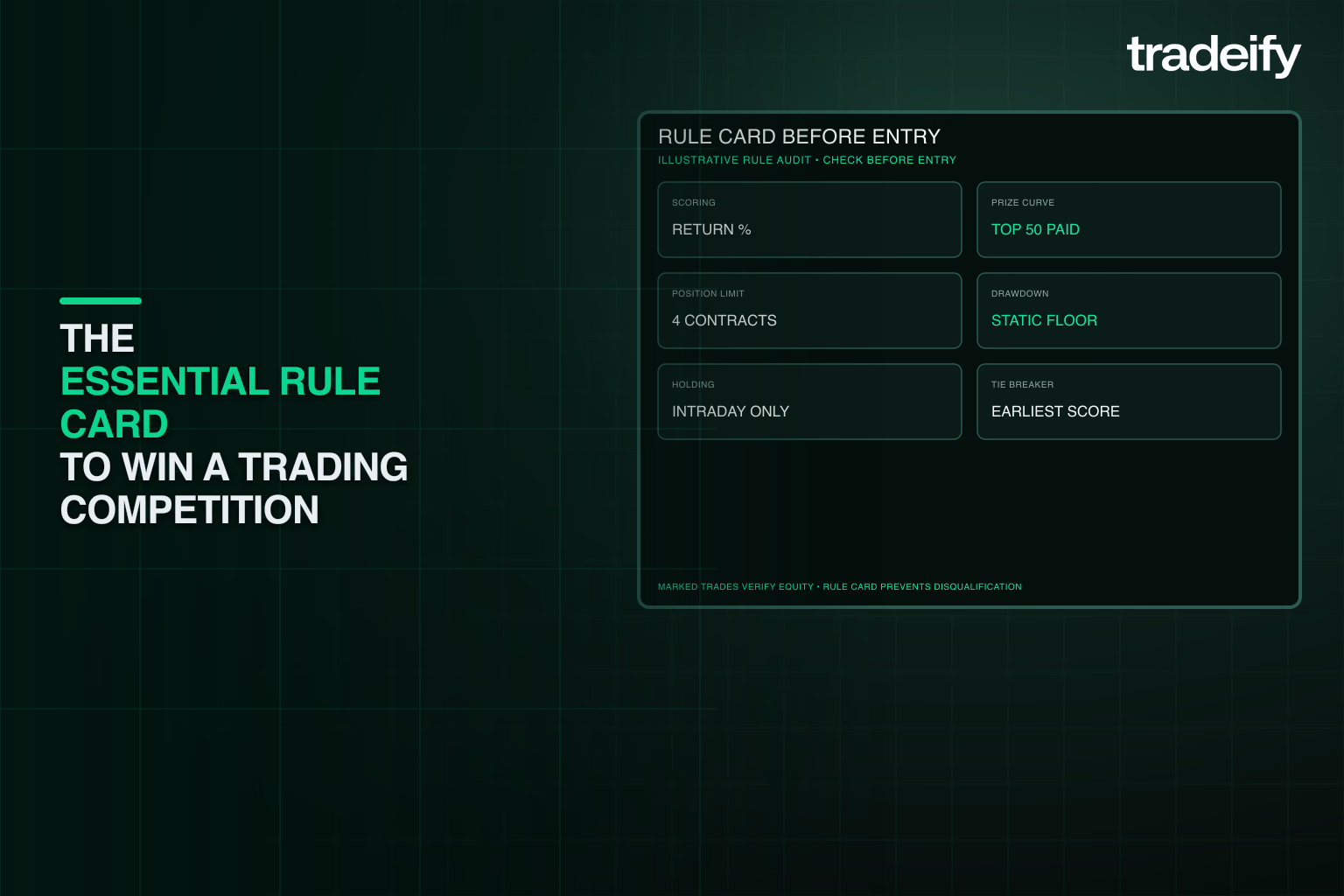
Trading Competition Rule Card
The fastest way to lose a trading competition is not a bad trade. It is a rule violation. Most disqualifications come from things traders never read in the fine print.
Before entering any competition, audit it against this checklist:
- Scoring metric. Is the rank based on ending balance, equity, net profit, percentage return, volume, win rate, or a composite risk score?
- Prize curve. Winner-take-all, top three, top ten, top hundred, top thousand, lottery, or funded accounts?
- Starting balance and leverage. What buying power is simulated, and how does it compare to typical funded accounts?
- Drawdown type. Static floor, end-of-day trailing, intraday trailing, daily loss limit, max loss limit?
- Position limits. Maximum lots, contracts, open positions, scaling rules?
- Trade frequency limits. Minimum trading days, maximum trades per day, minimum trade duration?
- Holding rules. Overnight positions allowed? Weekend? News events? Required to be flat at close?
- Instrument list. Futures only? Specific tickers? Are micros treated differently from minis?
- Automation rules. Are EAs, bots, trade copiers, or specific indicators allowed or prohibited?
- Identity and compliance. KYC required? Country restrictions? IP/device limits? One account per person?
- Tie-breakers. Win rate, drawdown, earliest to target, sponsor discretion?
- Prize fulfillment. Cash, funded account, profit split, withdrawal requirements, tax forms, forfeiture conditions?
Two notes on this list.
First, every item on it has been the cause of at least one trader losing a verified placement. None of these are theoretical. Audit them before you trade, not after the leaderboard freezes.
Second, this rule card is more useful than any single firm's specific rules because firms change rules. The categories do not.
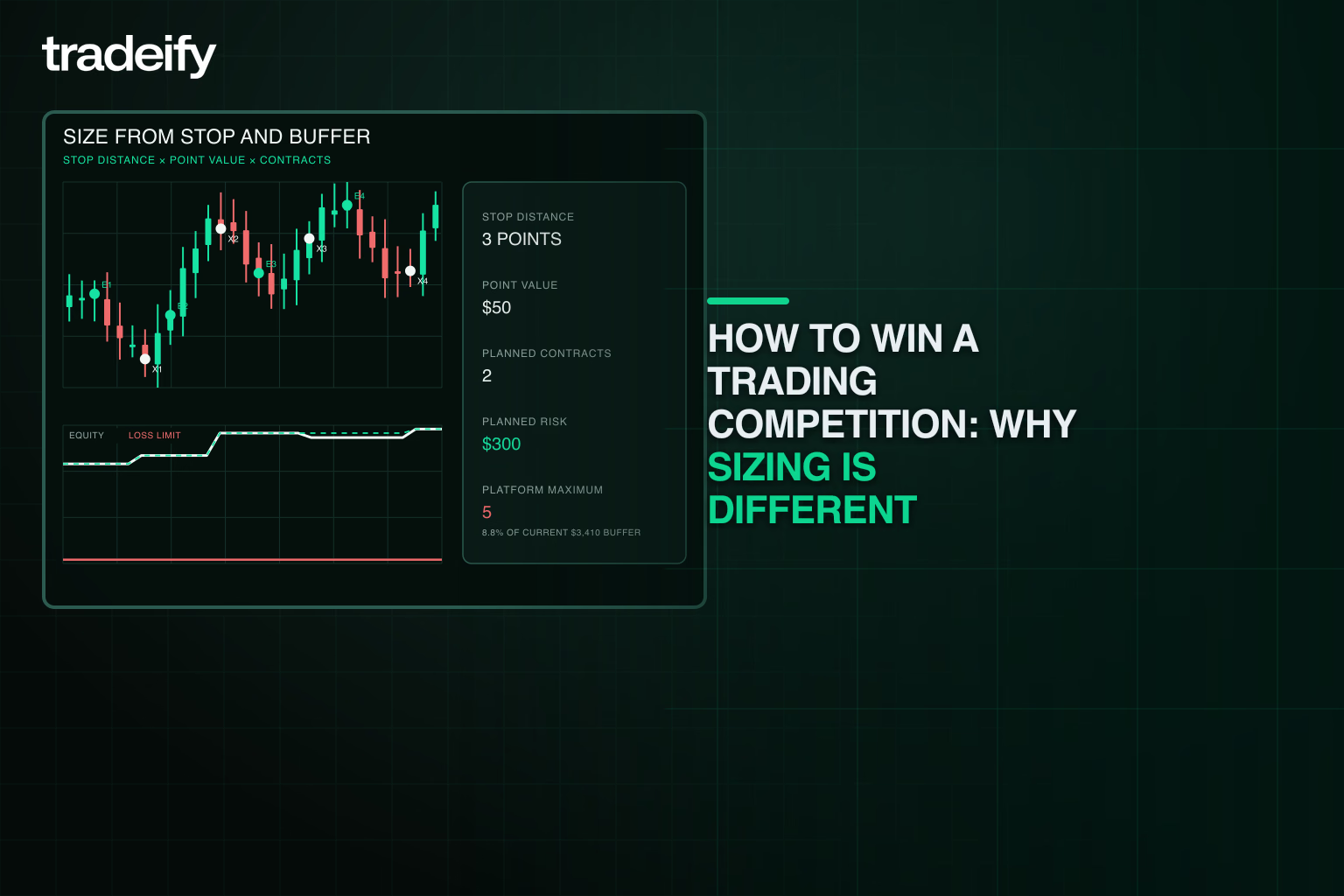
Why Trading Competition Sizing Is Different
Most trading content tells you to risk one to two percent per trade. That advice optimizes for surviving a long career in a personal account. In a competition with a tight drawdown cushion and a fixed deadline, the same risk percentage produces different outcomes.
The table below shows the probability of breaching trailing drawdown over fifty trades, assuming a 52% win rate and 3:2 reward-to-risk ratio. That edge structure is realistic for an above-average discretionary trader.
| Per-trade risk | 4% cushion | 5% cushion | 8% cushion | 10% cushion |
|---|---|---|---|---|
| 50 bps | 13% | 5% | 0% | 0% |
| 100 bps | 82% | 62% | 16% | 7% |
| 150 bps | 98% | 87% | 48% | 26% |
| 200 bps | 100% | 99% | 82% | 61% |
| 300 bps | 100% | 100% | 97% | 87% |
| 500 bps | 100% | 100% | 100% | 100% |
The cliff between 100 bps and 200 bps on a 4% cushion is the part most traders miss. At 100 bps per trade, breach probability is 82%. Doubling the risk to 200 bps sends it to 100%. Trailing drawdown ratchets, so a single bad sequence after a winning streak can breach an account that was up significantly.
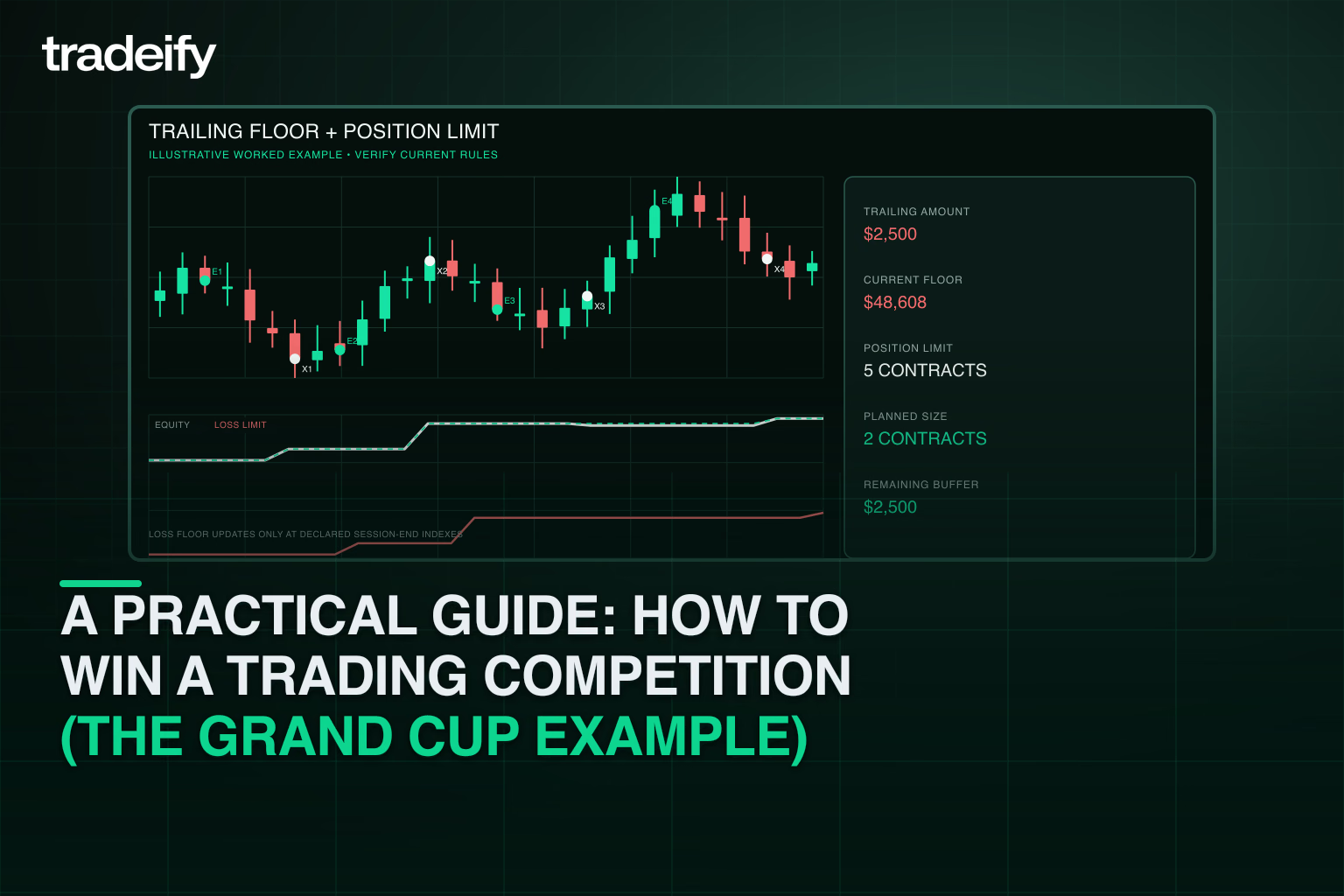
In the Grand Cup qualifier, the $50,000 simulated account runs with a 5% cushion ($2,500 trailing drawdown on a $50,000 starting balance). The implication: the standard "risk 1-2%" advice produces breach probabilities between 82% and 100% over a contest's worth of trading. That is not risk management. That is a coin flip on whether you survive, weighted against you.
Two corollaries follow. First, if your target return requires risking more than 150 bps per trade on a typical competition cushion, the target is probably unreachable on that horizon without taking variance that breaches you first. Second, when you are already inside the prize tier, the math says stop. The expected value of one more trade is dwarfed by the expected loss of falling out of a tier you have already secured. "Stop trading once you are in the money" is not discipline advice. It is an EV calculation.
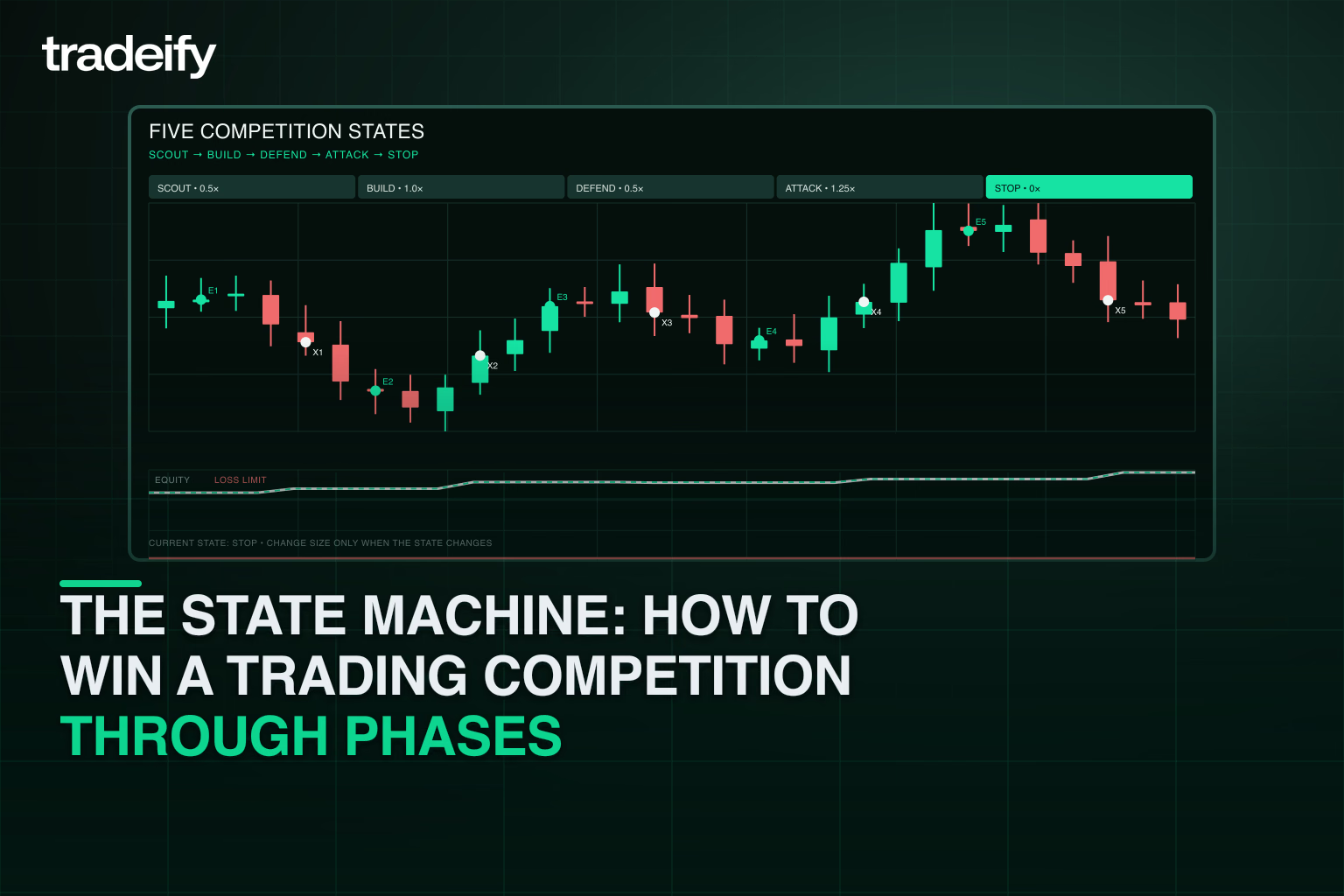
Trading Competition State Machine
A trader in a competition is always in one of five states: Scout, Build, Defend, Attack, or Stop. Scout means gathering information without burning drawdown. Build means accumulating enough P&L to become a contender. Defend means protecting prize equity and eligibility. Attack means using controlled variance to move rank. Stop means preserving prize, eligibility, or future learning. The phases below map roughly to contest time, but the states matter more than the calendar. A trader who reaches Defend at 15% of contest time and stays there should not move back to Build because they are still early in the calendar.
The phases use percentages of total contest time rather than days. A 30-day Robbins-style championship runs them at one pace; a 5-day prop firm qualifier runs them at another; a 24-hour broker contest compresses them to hours. Same logic, different wall-clock.
Before the competition opens, complete the rule card audit, calculate the four numbers, and build the three plans: base, defend, chase. Most traders skip this. That is why most traders lose. Without a map, every leaderboard refresh becomes an emotional event.
Trading Competition Calibration
Goal: read the field. Do not try to win the competition early. Try to learn what kind of competition this is becoming. The first leaderboard is not a verdict, it is a volatility sample. Some early leaders are skilled. Many are running maximum variance and will disappear within the first quarter of the contest.
Confirm platform and execution. Satisfy any minimum trade requirements safely. Trade only your strongest setups. Note where the prize cutoff is forming and how aggressive the field is willing to be. Do not revenge-trade because the leaderboard moved without you. Do not change instruments because someone else is winning with NQ. Do not burn drawdown trying to match early leaders.
By the end of calibration, you should be able to classify the contest. Is the field aggressive or measured? Is the cutoff rising fast or slow? Is your base plan enough, or does this competition require more variance?
Trading Competition Positioning
Goal: become a live contender. By the time the contest is one-third over, you should know whether you are ahead of target pace, near it, behind but recoverable, or functionally out unless you take a major shot.
This phase is about controlled variance, which is the difference between professional competition trading and the reckless aggression generic articles describe. Controlled variance means larger size only on your strongest setups, only when drawdown cushion is healthy, only during your strongest session, only when the math says you need it. Random aggression is larger size because you fell behind, because you are frustrated, with no stop condition, designed to feel better instead of move rank.
By the end of positioning, your plan has to start responding to the scoreboard. "I am just going to trade my plan" is not enough.
Trading Competition Separation
Goal: create distance from the crowd or change gear. The middle of a competition is dangerous because there is still enough time to recover and enough leaderboard information to trigger bad decisions.
Most traders overtrade here. They take B-grade setups, switch instruments, copy whoever is winning, hold losers longer than usual, and try to manufacture a breakout day. The result is usually drawdown without rank movement. The trap is what traders call strategy hopping: abandoning the edge that got you into the contest because someone else's edge is running hotter today. Strategy hopping mid-contest almost always loses. The leaders you would be copying are usually running variance that will catch up with them, and you would be adopting their approach right before it stops working.
Not every trader should keep trying to win. Sometimes the best decision in this phase is to stop because the remaining upside no longer justifies the rule, drawdown, or emotional cost.
Trading Competition Conversion
Goal: convert rank into prize equity. By this point, the question stops being "can I trade well?" and becomes "what is the right tournament decision?"
The prize curve matters most here. A trader in 420th place in a competition that pays the top 1,000 should not necessarily trade aggressively to climb. The marginal prize improvement may not justify the risk of dropping out of the money entirely. A trader in 40th place in a competition that only pays the top three has the opposite problem. Conservative trading there is not survival. It is slow elimination.
If you are already in the money, your biggest enemy is unnecessary upside. Pushing for a slightly better rank when the prize improvement is small and the risk of dropping out is real is irrational. Most traders push anyway. That is why most do not win.
Trading Competition Final Stretch
The end has three modes, not "just trade." If you are locked into a strong prize position, reduce size, trade only if rules require it, avoid news events, and stop refreshing the leaderboard every five minutes. Do not turn a won contest into an open trade. If you are outside a meaningful prize tier but still have drawdown and time for a rational shot, take best setups only, with size used intentionally, and know the exact level where the chase is over. Do not bleed out across twenty small trades trying to manufacture a big result. If you are too far behind, too close to a breach, or too emotionally compromised to trade well, stop. A competition you cannot win can still become research you can use.
The competition does not end when the leaderboard freezes. It ends when the prize is confirmed. Export your trade history, save screenshots of standings, confirm KYC requirements are complete, and watch for email deadlines on prize claims. A leaderboard win is provisional until the rules team says it is real.
Trading Competition Strategy by Leaderboard Position
Most articles give one strategy. A real competitor needs conditional play. The right move depends on where you are on the leaderboard and how much time is left.
| Your position | Bad instinct | Better tournament move |
|---|---|---|
| Leading on Day 1 of a long contest | Press the advantage | Reduce immediately. Day 1 leaders almost never finish on top. The variance that put you there will take you out. Bank the position and trade your normal plan, not your hot one. |
| Top 1-5% early | Keep pressing because it is working | Reduce variance unless the prize curve demands first place only. |
| Just inside prize cutoff | Chase the leaders | Defend the cutoff. Avoid disqualification. |
| Just outside prize cutoff | Trade normally and hope | Increase size selectively on best setups. You need rank movement, not "good trading." |
| Second-to-last day, just below cutoff | Spread your shot across many trades | Pick one A-grade setup. If it works, climb. If it does not, stop. Most traders try to manufacture the move with five mediocre trades and bleed instead. |
| Just outside the daily cut in an elimination-format contest | Trade hard to climb | Survive the day first. The cut horizon is hours, not days. Do not blow up trying to escape the bottom. |
| Head-to-head with daily reset and no drawdown floor | Trade your normal style and hope your edge wins out | Trade your opponent, not the chart. Late in the day, if you are up by any margin, the correct move is usually to stop. If you are down, you need a single high-quality setup that can flip the day, not a sequence of small trades that eat your remaining time. With no drawdown to manage, sizing decisions hinge entirely on what your opponent has done and how much session is left. |
| Far behind late | Revenge trade on whatever is moving | Decide whether the prize curve justifies a high-variance attempt. If not, stop. |
| Head-to-head and ahead intraday | Keep trading to "run it up" | Stop giving your opponent a path back unless rules require more trades. |
| Head-to-head and behind late | Take random trades | Use one or two asymmetric setups where the upside can flip the matchup. |
The honest version of this advice: the correct move in a competition can look like bad trading in a funded account. That does not mean reckless behavior is always smart. It means competition strategy and account-growth strategy optimize for different outcomes.
Trading Competition Disqualification Mistakes
For many competitions, the fastest way to lose is not a bad trade. It is a rule violation. The mistakes below cause disqualifications across most major prop firms and broker contests.
Misunderstanding the drawdown structure is the most common one. EOD trailing drawdowns measure once at close, but they are often enforced in real time during the day. Intraday trailing drawdowns measure at every equity peak, including unrealized profit. A trade that goes $1,000 in your favor and then comes back to breakeven can fail an intraday account even though you ended flat. The difference between these two structures is the single biggest variable in how you size positions in a competition. Read which type your contest uses before you place a trade.
Some firms add rules on top of the standard drawdown structure that catch traders by surprise. Apex Trader Funding, for example, historically enforced a 30% Negative P&L rule that limited the loss a trader could take on any single open trade as a percentage of their accumulated profit balance. A trade that ultimately closed profitable could still fail the account if it dipped too far against the trader at any point. Apex restructured its ruleset in March 2026. New accounts now operate under a simplified 50% Consistency Rule, while pre-March 2026 accounts continue under the legacy 30% structure. The specifics matter less than the general lesson: prop firms change rules, sometimes mid-season, and the rule that applies to your account is the rule that was active when you bought it. Read the version that applies to you, not the version someone else describes from memory.
Other common disqualifications:
- Rushing the contest. The fastest way to fail is to treat the profit target as a hurdle to clear in two days. Traders who push hard early to "get it over with" tend to over-leverage, then revenge trade after the first loss, then breach a daily limit before they have had time to settle into the contest. Take more time than you think you need.
- Failing to meet minimum trading day requirements. Many competitions require trades on a minimum number of days. Missing this disqualifies even the leader.
- Using ineligible tools, platforms, or strategies. Some contests prohibit EAs, copy trading, or specific automation. Others restrict trading during news events.
- Failing KYC or prize paperwork. Verified placements have been forfeited because winners did not complete identity verification by the deadline.
- Breaking position or contract limits. Even briefly exceeding maximum lot sizes can void results. This applies across instruments: being in two minis on NQ and one mini on ES can violate a "two contract maximum" rule even if neither position alone would. It also applies across contract classes: contests that prohibit hedging often define hedging as holding any minis and any micros simultaneously, regardless of direction or whether either position is individually within limits.
- Holding positions when the rules require flat. Some contests require closing all positions before market close or before weekends.
- Treating simulated profits like withdrawable cash. Simulated P&L emotionally feels like real money. It is not, until the rules team confirms it.
- Sharing accounts, IPs, or devices in violation of one-account rules.
Reading the rules before entering takes thirty minutes. Losing a placement to a rule violation takes a month of trading and the prize money with it.
A Tradeify-Specific Example: The Grand Cup Challenge
To make the framework concrete, consider a contest run on Tradeify's own platform: the Grand Cup Challenge.
The Grand Cup Challenge qualifier is a $50,000 simulated account with a $2,500 trailing drawdown, no daily loss limit, a max position size of 1 mini or 10 micros that cannot be combined, and no hedging between mini and micro classes. The position limit does not scale during the qualifier. Resets are available only during Stage 1, and traders can reset up to three times at $29 per reset. Once the head-to-head bracket begins, resets are gone.
Run that through the rule card:
- Scoring metric: Account balance and rank movement, with eliminations layered on top.
- Prize curve: Top finishers advance through stages and compete for prize money and live capital, with a meaningful curve rather than a winner-take-all.
- Starting balance: $50,000 simulated. Cushion is a $2,500 trailing drawdown, or 5% of starting balance.
- Drawdown type: EOD trailing — measured at close, but enforced in real time during the day.
- Position limits: 1 mini or 10 micros, not combined, with no scaling. Per account, not per asset.
- Holding rules: Standard futures session rules. No hedging across mini and micro classes at any point.
- Reset policy: Up to three resets during Stage 1 only.
A trader who treats Grand Cup like a normal Tradeify funded account will get the sizing wrong in two directions. They will under-trade in Week 1 because they are used to managing drawdown over months instead of weeks, and they will accidentally hedge — long an ES mini while still holding an MES from earlier in the session — because that is a non-event in normal trading. Both mistakes are common. Both are avoidable by reading the rule card before Day 1.
The framework works for any competition, on Tradeify or anywhere else. The discipline is reading the contest, not memorizing one set of rules.
Trading Competition FAQ
What is the best strategy to win a trading competition? There is not one. The best strategy depends on the scoring system, prize curve, drawdown rules, and time remaining. Identify which type of competition you are entering, calculate your four numbers (target-to-place, target-to-win, drawdown cushion, time remaining), and adjust your variance based on your position relative to the prize cutoff.
How much risk should I take in a prop firm competition? Risk should depend on your distance from the prize cutoff and time remaining. Standard "risk 1-2% per trade" advice optimizes for longevity in a funded account, not ranking in a tournament. Far behind and late, higher variance may be the only rational path. Already in the money with time left, the lower your risk, the better.
Are trading competitions the same as prop firm challenges? No. A challenge is binary: meet the target without hitting the floor and you pass. A competition is relative: your target moves based on what other traders do. They reward different objective functions and require different strategies.
What is the biggest mistake traders make in tournaments? Treating the competition as if it were a funded account. The objective function is different, which means the strategy should be different. Most traders apply funded-account discipline to a tournament and finish in the middle of the pack.
What happens if I win but break a rule? You forfeit. Rule violations void placements at every major prop firm. Verified leaderboard wins have been disqualified for things as small as a missing KYC submission or a single trade held a few seconds too long. Win the leaderboard and the audit, or you have not actually won.
Trading Competition Strategy Comes Down to Prize Equity
The trader who wins is not always the best trader. It is the trader whose strategy best fits the contest's scoring system, payout curve, drawdown rules, and time remaining.
Most generic competition advice optimizes for the wrong thing. It assumes one strategy fits every contest, treats leaderboard position as static, and conflates evaluations with tournaments. The article that gets you to the prize tier does not give you tips. It gives you a framework: identify the game, calculate the four numbers, build the plans, switch states as conditions change, and win the audit when it is over.
Amateurs chase rank. Professionals chase prize equity. The difference between them is not skill. It is whether they understood what game they were actually playing.
Get up to $750k instant sim funding
- Start earning payouts instantly
- Super fast automated payouts
- Free journal to improve


.webp)