.svg)

.svg)
.svg)

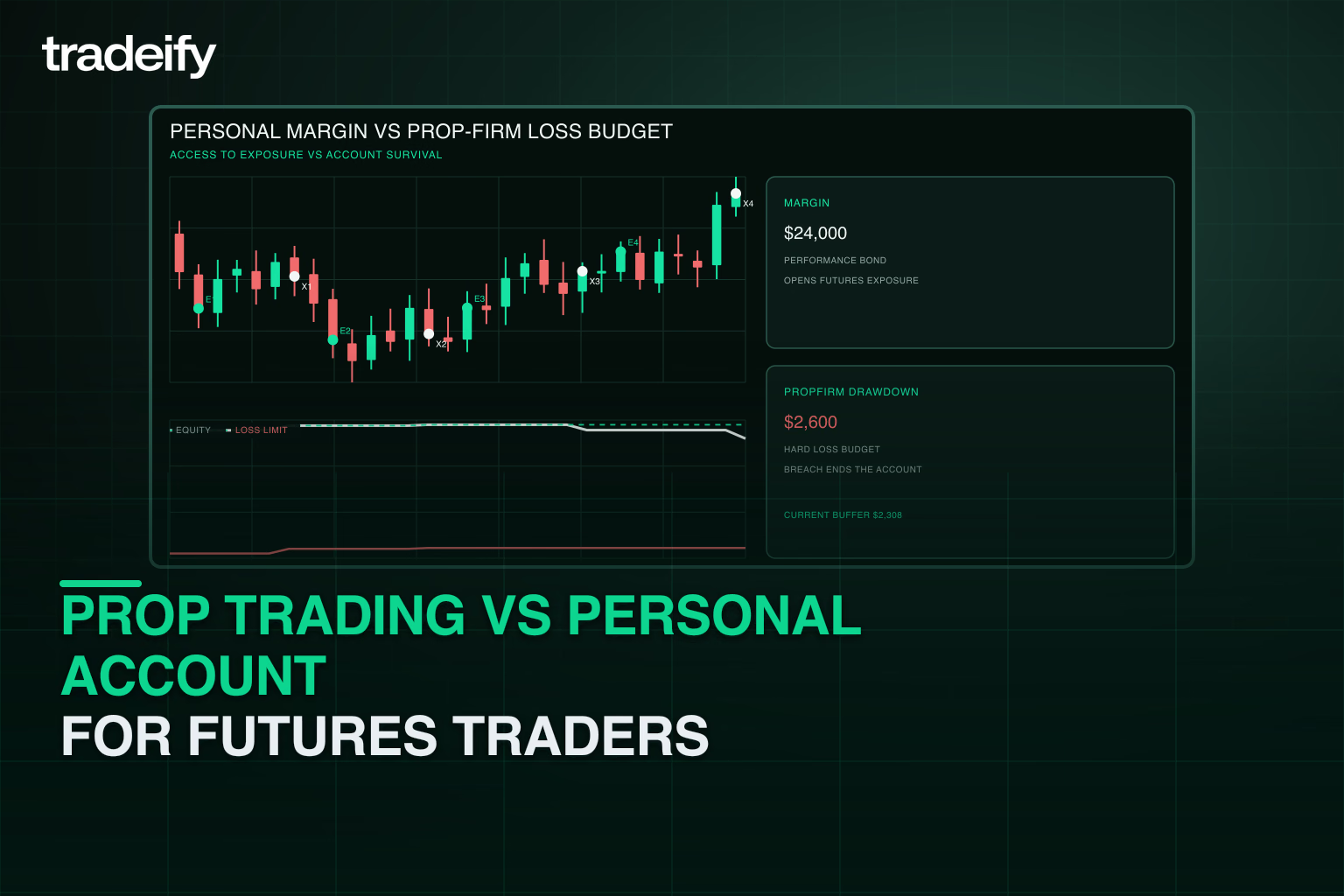


TL;DR: Prop trading firms like Tradeify give futures traders access to $50K–$150K in simulated buying power for one-time fees starting under $100 (Growth from $97, Select from $111) or a one-time Lightning purchase, compared to $24,000+ overnight margin per ES contract in a personal account. Tradeify offers a 90/10 profit split on all sim funded payouts, EOD trailing drawdown, and multiple payout frequencies depending on account type. Three paths include Growth (EOD trailing drawdown, no consistency rule during evaluation, 35% consistency on funded payouts), Select (choose between Flex 5-day or Daily payout after passing, 40% consistency during evaluation, none once funded), and Lightning Funded (one-time fee, no evaluation, progressive consistency rule starting at 20% and relaxing to 25% then 30% over subsequent payouts). Personal accounts offer 100% profit retention, full autonomy, and no rule-based restrictions but require significant capital and carry total loss liability.
The traditional model of self-funded brokerage accounts is being challenged by the rapid rise of capital allocation programs, commonly known as proprietary trading firms. For the modern futures trader, the decision to risk personal savings or work through the structured evaluation of a firm like Tradeify is no longer a simple question of preference but a complex calculation of capital efficiency, risk mitigation, and psychological endurance. This guide provides a thorough analysis of the cost-benefit trade-offs between proprietary trading and personal live accounts, designed for the serious market participant weighing their options.

Why Futures Traders Choose Prop Trading Over a Personal Account
The fundamental dilemma facing any developing trader is the scarcity of capital. In the traditional self-funded model, a trader's growth is strictly limited by the size of their initial deposit and the slow, arithmetic progress of compounding a small balance. Proprietary trading offers a solution to that capital barrier by providing access to institutional-grade buying power. This access isn't a loan, though. It's a performance-based partnership. The trader executes strategies using the firm's capital (often starting in a simulated environment to prove consistency) and shares the resulting profits.
The central question remains: why risk personal capital when a prop firm can provide the same market exposure for a fraction of the cost? While the answer involves a close look at rules and profit splits, the initial appeal is clear. A trader can pay a relatively small evaluation fee to access the intraday leverage of a $50,000 to $150,000 account. In a personal account, achieving similar exposure while maintaining safe risk parameters would require tens of thousands of dollars in liquid savings.

How Prop Trading and Personal Accounts Actually Work
To evaluate these two paths, you need to understand the structural mechanics of a personal live account versus a capital allocation program. A personal account is a direct relationship between you and a broker (e.g., Tradovate, Rithmic, TradeSea, Interactive Brokers). You own 100% of the funds, retain 100% of the profits, and assume 100% of the liability for losses. There are no external "rules" regarding how much you can lose in a day or how many contracts you can trade, provided the account meets the broker's margin requirements.
A prop trading firm, such as Tradeify, acts as a secondary layer. The firm provides the capital and the trading environment, often partnering with specific brokers to manage platform access and execution. The trader is essentially an independent contractor whose financial risk is limited to the evaluation fee and the time invested.
| Feature | Personal Live Account | Prop Firm (Tradeify) |
|---|---|---|
| Capital Source | Personal Savings | Firm Allocation |
| Profit Retention | 100% | 90% (sim funded split) |
| Financial Risk | Total Balance | Fee Only |
| Autonomy | Total Control | Rule-Based |
| Scaling | Slow (Compounding) | Rapid (Milestones) |
| Regulation | NFA/CFTC (US) | Contract Law / Simulated |

The Real Math Behind Prop Trading Capital
A frequent point of confusion for those entering the prop firm space is the actual amount of capital being "provided." Marketing materials often highlight "$100,000 Accounts," leading traders to believe they have six figures of liquidity. The reality of the capital allocation model is defined by the maximum loss limit, not the starting balance.
If a firm provides a $100,000 account but mandates that the account fails if the balance drops below a certain floor, the firm hasn't loaned the trader $100,000. They've provided a defined risk buffer with leverage on the nominal account size. In the context of Tradeify's $100K Select Evaluation, the maximum trailing drawdown is $3,000. This means the "true" risk capital is $3,000. If the trader uses the maximum evaluation contract limit of 8 minis, they're managing a notional value of roughly $2,000,000 (assuming an S&P 500 price of 5,000) against a $3,000 risk buffer.
Prop Trading Profit Sharing Realities
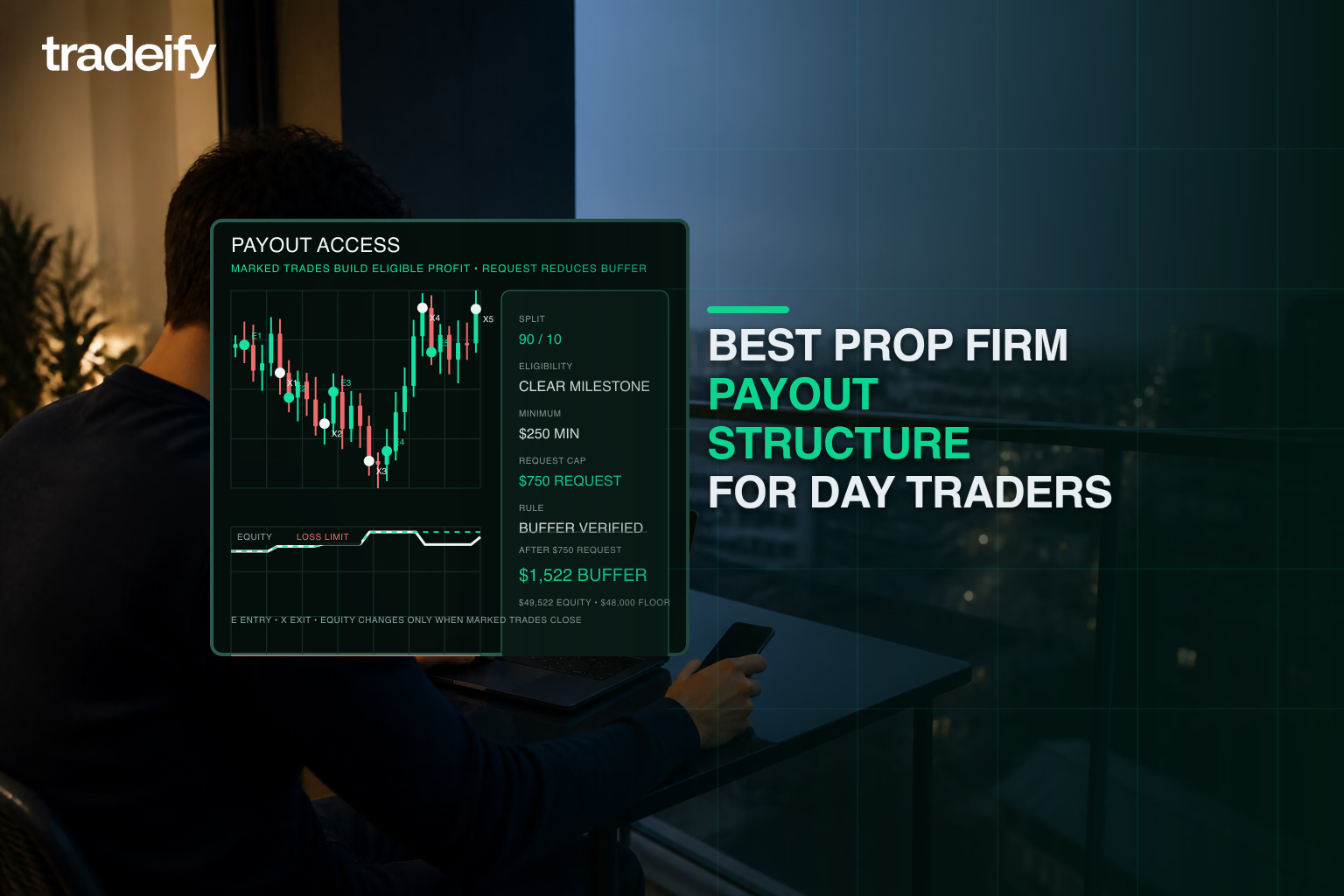
The second "catch" is the profit split. While a personal account allows for 100% profit retention, prop firms take a cut. Tradeify operates a 90/10 profit split on all sim funded account payouts, meaning the trader keeps 90% and the firm retains 10%. For traders generating consistent returns, this is a favorable arrangement given that the firm provides the capital, the infrastructure, and absorbs the financial risk beyond the evaluation fee.

Prop Trading vs Personal Account Side-by-Side Comparison
When deciding between these two models, traders need to analyze the cost of entry, the speed of scaling, and the flexibility of the trading environment.
Cost of Entry for Prop Trading vs a Personal Account
For a futures trader, the cost of entry in a personal account is governed by CME margin requirements. To trade a single E-mini S&P 500 (ES) contract, the exchange requires a maintenance margin of over $24,000 to hold a position overnight. Even with day-trading margins as low as $500 per contract offered by some brokers, a trader would need a significant buffer to survive even a minor losing streak.
| Contract | Nominal Value (Approx) | Personal Margin (Day) | Prop Fee (Tradeify) |
|---|---|---|---|
| E-mini S&P 500 (ES) | $250,000 | $500 - $1,000 | From $97 (Growth 50K) |
| Micro E-mini (MES) | $25,000 | $50 - $100 | From $97 (Growth 50K) |
| Nasdaq 100 (NQ) | $400,000 | $1,000 | From $174 (Growth 100K) |
The prop firm model allows a trader to control the same notional value for the cost of a one-time evaluation fee, effectively providing outsized leverage relative to the trader's actual out-of-pocket cost.
Scaling Through Prop Trading vs a Personal Account
Scaling a personal account from $5,000 to $100,000 through trading alone can take years of consistent performance, even for highly skilled traders. In contrast, prop firms offer immediate access to large balances. If a trader demonstrates the skill to pass a $150,000 evaluation, they can be managing that capital within days. Tradeify also offers a path from simulated funded accounts to Elite Live accounts, where traders can be considered for real capital after meeting minimum payout thresholds.

Psychological Differences Between Prop Trading and Personal Accounts
The psychological environment of trading is fundamentally different when risking personal savings versus firm capital. In a personal account, every loss is felt as a direct threat to the trader's financial security, which can lead to destructive behaviors like "revenge trading" or "the disposition effect" (holding losers too long).
Prop firms introduce a different type of stress: evaluation pressure. Because the trader is working within a framework of trailing drawdowns (and daily loss limits on certain account types), there is a constant awareness of rule boundaries. However, this "artificial" pressure often forces better habits. The strict risk management rules of a prop firm act as an external discipline mechanism that many retail traders lack when left to their own devices.
How Prop Trading Firms Manage Risk for Traders
Prop firms use automated risk management tools, such as trailing drawdowns and daily loss limits (DLL), that protect both the firm and the trader. At Tradeify, most account types use an End-of-Day (EOD) trailing drawdown. The drawdown floor only moves upward based on your closing balance at the end of each trading day, giving you more intraday flexibility than firms that use real-time trailing drawdowns. This means a trader can experience temporary intraday pullbacks without the drawdown floor ratcheting up against them. It's worth noting that while the drawdown only trails upward at EOD, it is still enforced in real time. If your account balance touches the current drawdown floor at any point during the session, the account fails.

Common Prop Trading Questions and Industry Realities
Is the profit-sharing model fair?
Tradeify operates a 90/10 split on sim funded payouts, meaning the trader keeps 90%. Given that the firm provides the capital, the infrastructure, and assumes the financial risk beyond the evaluation fee, this is widely considered a favorable arrangement for the trader.
How do prop firms make money if traders are successful?
Prop firms generate revenue through several channels. Evaluation fees form the base of operating capital, since many traders don't pass their evaluations on the first attempt. The firm's share of profit splits from successful traders is another revenue source. Some firms also leverage the trading data and patterns from their most successful participants to inform their own market strategies.
Are prop firms legitimate?
The industry has a range of participants. Legitimacy is defined by a firm's history of payouts and its transparency regarding rules. Firms that provide clear drawdown rules, offer reliable payout processing (like Rise or Plane), and have verified payout histories are generally considered trustworthy. Tradeify has a track record of verified payouts and a clear transition path to live capital through the Elite Live program.
Prop Trading Compliance and Global Restrictions
Traders should be aware that prop firms must comply with international financial regulations and sanctions. This results in "Restricted Countries" lists. Due to OFAC (Office of Foreign Assets Control) regulations and other international sanctions, residents of certain countries are typically prohibited from joining these programs.
| Region | Status | Reason |
|---|---|---|
| United States | Accepted (Tradeify) | Compliance with US Futures regulations |
| North Korea | Restricted | OFAC Sanctions |
| Iran/Syria | Restricted | International Sanctions |
| EU/UK | Varies | Local CFD/Futures regulations |
Choosing Between Prop Trading and a Personal Account

Choosing between a prop firm and a personal account depends on your experience level and financial situation.
When Prop Trading Makes Sense
You have a proven strategy but lack the capital to make meaningful profits.
You want to develop discipline through structured risk management rules.
You want to trade large futures contracts without risking your personal savings.
When a Personal Account Is the Better Fit
You are an experienced trader with sufficient capital to manage your own risk.
You require complete control over your positions, including holding over weekends or through news events.
You want to build long-term wealth without sharing any portion of your profits.
Tradeify's Prop Trading Paths

Tradeify offers three distinct paths designed for different trading styles and experience levels:
Growth Evaluation
Best for traders who want flexibility and the fastest route to funding. Growth uses an EOD trailing drawdown and has no consistency rule during evaluation, meaning you can pass in as few as one trading day. Once funded, a 35% consistency rule applies to payout eligibility (no single day's profit can exceed 35% of your total profits). Growth funded accounts have a 5 winning day payout frequency, and a daily loss limit that is removed once the account reaches the 6% profit threshold ($53,000 for 50K, $106,000 for 100K, $159,000 for 150K). One-time pricing starts at $97 for a 50K account.
Select Evaluation
Designed for traders who want to choose their payout strategy. Select also uses EOD trailing drawdown with a 40% consistency rule during evaluation (requiring a minimum of 3 trading days to pass). After passing, you choose between two funded paths: Select Flex (5 winning day payouts, no daily loss limit) or Select Daily (daily payouts with a daily loss limit). Neither funded path has a consistency rule. One-time pricing starts at $111 for a 50K account.
Lightning Funded
A one-time payment option that skips the evaluation phase entirely, ideal for proven traders who want immediate market access. Lightning accounts are funded instantly with EOD trailing drawdown, a daily loss limit, and a progressive consistency rule that starts at 20% for the first payout and gradually relaxes to 25% and then 30% for subsequent payouts. While there is no formal minimum trading day requirement, the 20% consistency rule practically means you'll need at least 5 profitable days before your first payout, since no single day can exceed 20% of your total profits. One-time pricing starts at $328 for a 50K account.
All three paths lead to Tradeify's Elite Live program, where traders transition from simulated accounts to trading real capital. Traders become eligible for consideration once they reach either 3 payouts on a single account or 10 total payouts across all plan types. Meeting these thresholds does not guarantee an immediate transition — Tradeify evaluates traders holistically based on consistency, risk management, and overall trading behavior, and will reach out directly when a trader is selected. There are no activation fees on any account type.
Technical Analysis and Discipline in Prop Trading

Regardless of the account type, success in futures trading comes down to a sound understanding of technical analysis and rigorous discipline. Technical analysis (the study of price action, volume, and market structure) provides the "edge," while risk management (the core of the prop firm model) provides the "survival."
Community stories and social proof highlight the importance of persistence. In the context of a prop firm, every failed evaluation is a step toward refining a strategy and mastering the psychological challenges of the market. The traders who succeed are the ones who treat the evaluation as a proving ground rather than a lottery ticket.

The Professional Path Forward for Futures Traders
The "prop trading vs personal account" debate isn't a matter of which is objectively better, but which serves your current goals. For the undercapitalized but skilled trader, a firm like Tradeify offers a real opportunity to scale and generate professional income with limited personal risk. For the established veteran, the personal account remains the ultimate vehicle for autonomy and long-term wealth.
Key Prop Trading Formulas for Trader Success

Successful participants often monitor their performance using key metrics that align with prop firm requirements.
The Prop Trading Consistency Ratio
The ratio of your largest winning day to your total profit:
CR = P_max / P_total
For a Tradeify Growth funded account, CR must be ≤ 0.35 to be eligible for a payout. For Lightning accounts, it must be ≤ 0.20 for the first payout, relaxing to 0.25 for the second and 0.30 for subsequent payouts.
Effective Leverage on Prop Trading Risk Capital
To understand the true risk of a prop account, calculate the leverage on the drawdown (D_max) rather than the nominal balance:
L_risk = Notional Value / D_max
For a $100K Select account with a $3,000 drawdown trading 1 ES contract (notional ~$250,000):
L_risk = 250,000 / 3,000 ≈ 83.3 : 1
This highlights the intensity of the prop firm environment compared to a personal account, where leverage is typically closer to 10:1 or 20:1.
Proprietary trading through Tradeify provides the bridge between retail potential and professional execution. By understanding the math behind risk capital, mastering the psychological pressure, and utilizing a hybrid reinvestment strategy, traders can build a professional approach to the futures markets that serves their long-term goals.
How Tradeify Compares in the Prop Trading Industry
When evaluating any prop firm, the key factors to consider are drawdown mechanics, payout reliability, profit split, and the path to live capital. Some firms use multi-step evaluations, others offer instant funding. Profit splits across the industry typically range from 80% to 95%, with most top-tier firms settling around 80/20 or 90/10.
Tradeify's 90/10 split on sim funded payouts, combined with EOD trailing drawdown across all account types, positions it competitively in the futures prop trading space. The transition path through the Elite Live program, where traders move from simulated accounts to trading real capital after meeting minimum payout thresholds, provides a clear professional progression that not every firm offers. For traders evaluating their options, the most important step is to read the fine print on drawdown rules, understand exactly how payouts work, and verify the firm's track record through independent reviews and payout proof.
.svg)
.svg)
.svg)
.svg)






.webp)