.svg)

.svg)
.svg)



TL;DR: Prop firm statistics in 2026 are useful only when the source is clear. The cited third-party sources report three directional patterns: search demand for "prop firm" grew from about 880 monthly global searches in January 2020 to a Q2 2025 high near 49,500, futures-related prop firm searches overtook forex-related searches in late 2025, and the cited third-party pass-rate estimates cluster around roughly 5% to 15%. Payout trackers can show payout counts, largest payouts, average payout size, and median payout time, but they are not audited industry totals. Treat every pass-rate, payout, market-size, and trader-success number as directional unless it comes from a primary firm disclosure, an official account document, or a transparent third-party dataset. The common 97% day-trader-loss statistic comes from a specific academic study of Brazilian equity futures day traders and should not be used as a universal prop-firm pass-rate claim. Also separate retail funded-account statistics from institutional proprietary-trading statistics because challenge pass rates, payout trackers, firm revenue, and employee trading-desk results measure different models.
- Prop firm statistics worth trusting
- Search demand and futures interest
- Capital efficiency and account access
- Pass rates, failures, and risk limits
- Success-rate questions to read carefully
- Retail vs institutional statistics
- Source-quality checklist
- Account models behind the numbers
- Payout statistics and what they mean
- Futures trading hours and platforms
- Tax records and payout reporting
- Prop firm statistics takeaway
Prop firm statistics worth trusting
Prop firm statistics attract big claims because the topic is competitive. Some numbers are useful. Others are recycled without a clear source.
The safest way to read 2026 prop firm data is to separate four kinds of evidence:
- Search-demand data: useful for measuring interest in funded trading, but not proof that traders are profitable.
- Pass-rate data: usually based on private datasets, firm disclosures, or third-party estimates. It should be treated as directional unless the sample is explained.
- Payout data: useful when the tracker explains whether it measures total dollars, payout count, largest payout, average payout, or median payout time.
- Official rule data: the best source for profit splits, payout eligibility, account size, risk limits, drawdown rules, and platform access.
That matters. A narrow verified number beats a dramatic number with no method behind it.
Search demand and futures interest

Search interest is one of the clearer public signals. PropFirmApp's December 2025 statistics page reports that global monthly search volume for "prop firm" was about 880 in January 2020 and reached a Q2 2025 high near 49,500. The same page says futures-related prop firm queries totaled about 19,100 global searches in December 2025, ahead of the forex-related terms it tracked.
That does not prove the industry is safer, better, more profitable, or larger by revenue. It does show that search demand for funded-account topics rose sharply across the period tracked by that source.
What the search trend does and does not prove
Higher search demand means the tracked terms received more searches for funded accounts, payout rules, drawdown limits, and firm comparisons. It does not identify unique searchers, validate any one firm's claims, guarantee payout access, or prove a trader will pass an evaluation.
Capital efficiency and account access
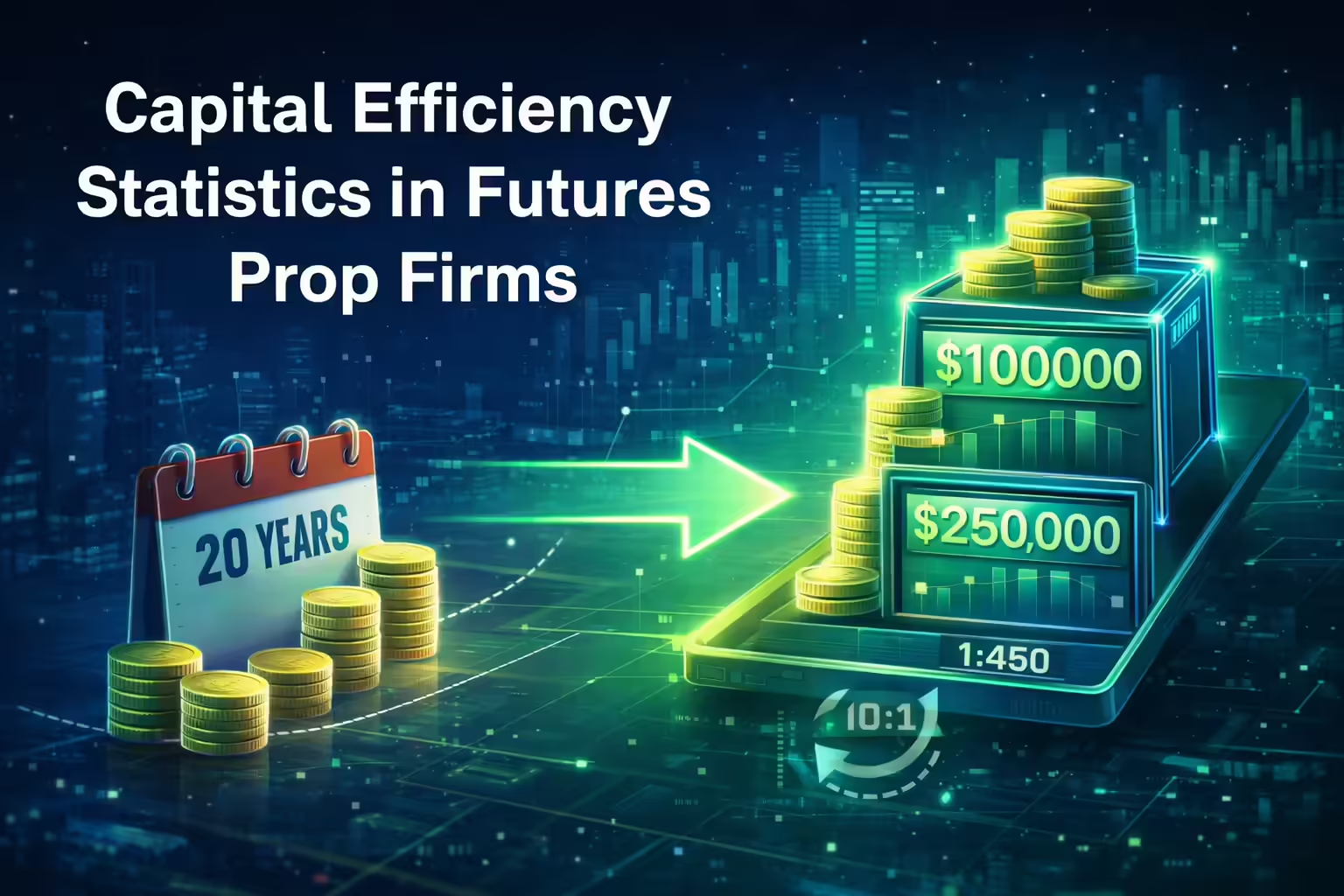
The clearest appeal of a funded-account model is capital efficiency. A trader pays an evaluation or account fee, then trades inside rules set by the firm.
That can create a large notional-account-to-fee ratio. It is not the same as personal buying power, guaranteed capital, or a guaranteed payout.
Use your total planned spend as the real budget: evaluation or account fees, resets, subscriptions, data costs, platform costs, and any other required charges. A funded trading account only works if the trader can stay inside drawdown limits, trading-day requirements, consistency rules, payout caps, and allowed-product rules.
Pass rates, failures, and risk limits
What public pass-rate claims say
- QuantVPS summarizes typical evaluation pass rates around 5% to 10% and says only a small share of funded accounts receive payouts.
- Damn Prop Firms cites a broader first-attempt pass-rate range of about 5% to 15%.
How to use those numbers
- Do not average every claim together. Pass rates change by firm, account type, reset behavior, trader experience, and rule design.
- Look for the sample. A statistic from 300,000 accounts means something different than a forum comment or marketing claim.
- Review account constraints. Drawdown limits, daily loss limits, consistency rules, overtrading risk, and payout-rule requirements are practical risk points to check before using any headline pass-rate estimate.
Futures trading itself still carries real market risk. The CFTC's futures education material says futures customers receive risk disclosures and that futures accounts are adjusted to reflect each trading day's current market value at close. A prop account does not remove execution risk, rule risk, payout-eligibility risk, or the budgeting risk of repeated fees, resets, subscriptions, data costs, or platform costs.
Success-rate questions to read carefully
Search results around prop firm statistics often pull in broad day-trading success questions. Those questions are useful because they show what readers worry about, but they should not be mixed into prop firm statistics without context.
Does the 97% day-trader-loss statistic apply to prop firms?
Not directly. The commonly cited 97% figure comes from the SSRN paper Day Trading for a Living?, which studied Brazilian equity futures day traders who began trading from 2013 to 2015 and persisted for more than 300 days. It is a warning about day-trading difficulty, not a published pass rate for every prop firm, futures evaluation, or funded account.
Can a $100K account size predict average daily income?
No. A headline account size does not tell you the trader's allowed contracts, drawdown room, risk per trade, payout eligibility, fees, or consistency rule. As a separate securities-market risk reference, FINRA's frequent intraday trading guidance warns retail brokerage-account traders that frequent trading, especially on margin, can lead to losing some or all of an investment. That FINRA guidance is not evidence of futures prop-account income. Account size alone is not an income statistic.
Is a prop firm a profitable business?
Some firms may be profitable businesses, but public search results rarely provide audited firm-level revenue, expense, payout, or reserve data. Treat business-model claims as incomplete unless the source explains whether it is measuring challenge fees, reset fees, subscriptions, payout liabilities, broker costs, technology costs, or actual net income.
Retail vs institutional statistics
Some ranking pages mix retail funded-account numbers with institutional proprietary-trading numbers. That can confuse the reader because the business models are not measuring the same thing.
A retail funded-account article usually tracks evaluation fees, pass rates, resets, payout eligibility, profit splits, account rules, and simulated or funded-account payouts. Institutional proprietary-trading references usually describe firms trading their own capital, employee or contractor trading desks, broker-dealer activity, or banking-entity proprietary trading. FINRA describes a proprietary trading firm in its fee-rule context as a member that trades exclusively its own capital and does not have customers, while the SEC's Volcker Rule release discusses banking entities trading for their own account.
Do not compare these statistics directly
- Challenge pass rates: useful for evaluation-style funded accounts, but not a salary or career-success statistic.
- Payout tracker totals: useful for a tracker sample, but not an audited industry revenue number.
- Firm revenue or market-size claims: useful only when the source explains whether it includes fees, subscriptions, resets, payout liabilities, broker costs, and technology costs.
- Institutional trading desk results: useful for understanding traditional proprietary trading, but not evidence that a retail funded-account trader will pass, get paid, or keep an account.
Clean prop firm statistics label the model first. If the source does not say whether it is measuring retail challenges, live funded accounts, payout-tracker submissions, institutional desks, or broker-dealer proprietary trading, treat the number as directional context instead of a decision rule.
Source-quality checklist
Before relying on a prop firm statistic, ask what the number actually measures.
Strong source
Official firm rule pages, account agreements, payout policies, platform documentation, and tax forms.
Useful but limited
Third-party articles, comparison tools, and payout trackers. These can show patterns and can be strong evidence for their own explicitly defined samples, but not for audited industry totals.
Weak source
Unsourced social posts, isolated trader screenshots, vague market-size claims, and statistics that do not explain the sample.
Account models behind the numbers
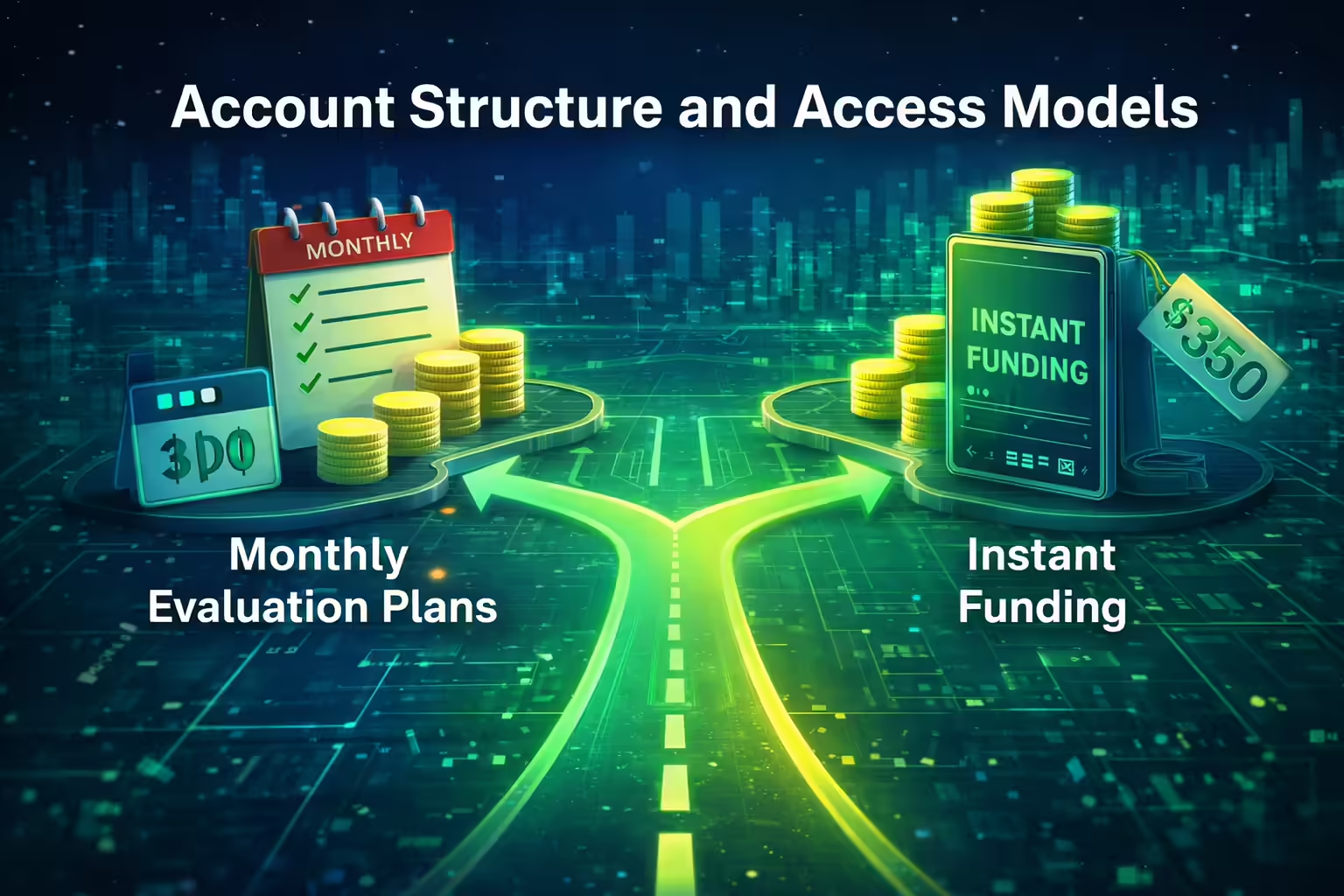
Pass rates and payout rates look different across account types. A one-step evaluation, a two-step evaluation, and a straight-to-funded account do not test traders in the same way. Current futures prop firms also differ by account rules, payout policy, platform connection, and reset structure.
Evaluation accounts
Growth Accounts
- Tradeify's Help Center lists Growth Evaluation account sizes of $25K, $50K, $100K, and $150K.
- Growth can be passed in as few as 1 trading day because the evaluation has no consistency requirement.
- End-of-Day (EOD) drawdown tracking
- Daily Loss Limit applies as a soft breach during evaluation.
Select Accounts
- Tradeify's Help Center lists Select Evaluation account sizes of $25K, $50K, $100K, and $150K.
- Select requires a minimum of 3 trading days because of the 40% consistency rule.
- There is no Daily Loss Limit during the Select evaluation, according to the current Help Center page.
- After passing, traders choose either a Flex 5-Day or Daily payout policy for that account.
Straight-to-funded accounts
Lightning Accounts
- Tradeify's Help Center describes Lightning Funded as a straight-to-sim-funded account path with no evaluation phase.
- Account sizes are listed as $25K, $50K, $100K, and $150K.
- End-of-Day (EOD) drawdown tracking
- Payout eligibility depends on the payout policy, profit objective, and consistency rule.
- Lightning payout policy pages state that traders receive 90% of the payout amount requested.
- Official rule pages should be checked before buying or resetting any account.
Payout statistics and what they mean
How many payout records the tracker includes.
Average, largest, or firm-level payout amounts.
Median payout timing or payout-window rules.
The Prop Firm Match payout tracker, verified on July 23, 2026, is useful because it separates payout-related metrics such as total payouts, payout count, largest single payout, average payout size, and median payout timing. Do not rewrite those figures as total industry payouts unless the tracker explicitly defines the sample and date range.
Reading payout claims cleanly
A payout statistic can mean several different things. Before comparing firms, identify whether the page is reporting:
- Total payout dollars tracked
- Number of payout records
- Largest single payout
- Average payout size
- Median payout time
- Minimum payout threshold, payout cap, or withdrawal frequency
Futures trading hours and platforms
Many futures products trade outside regular U.S. stock-market hours, but that does not mean every hour is equally liquid or appropriate for every strategy. High-volume trading windows around the U.S. cash open can matter for execution, spreads, and discipline.
Platform rules also matter. Tradeify's current Supported Platforms Help Center page lists platform access by broker connection rather than treating every platform as interchangeable. Check the current account connection before assuming a platform, data feed, or mobile workflow is available.
Tax records and payout reporting
Do not treat tax handling as a universal prop firm statistic. Payout reporting can depend on the firm, payout processor, trader location, entity setup, and tax year.
The IRS describes Form 1099-NEC as the form used to report nonemployee compensation. That does not automatically answer how every prop firm payout or account fee applies to your situation. Keep records of fees, resets, subscriptions, payouts, processor statements, and account agreements, then ask a qualified tax professional how they apply to your return.
Prop firm statistics takeaway
The best 2026 prop firm statistics point to sharply higher search demand and stronger futures-related interest in the tracked query set. They also point to a harder truth: the cited third-party estimates suggest most evaluation attempts or sampled accounts do not pass.
Use statistics as a filter, not a promise. Start with source quality, check current official rules, compare payout definitions, and treat drawdown, consistency, overtrading, and payout requirements as risk points to evaluate before trading under pressure. For more context on the futures side of the market, read this guide to the proprietary trading industry.
.svg)
.svg)
.svg)
.svg)









.webp)