



TL;DR: Long vs short options comes down to one choice: buy a right and pay a premium, or sell an obligation and collect one. A long option's loss is capped at the premium, but time decay works against it. A short option earns the premium if little happens, but its loss can be far larger and it can be assigned. Long calls and short puts lean bullish; long puts and short calls lean bearish. On a $50 strike at a $3 premium, the buyer risks $300, while an uncovered call seller's loss has no ceiling.
Most traders meet long vs short options at the order ticket, with a view on a stock and two ways to act on it. You can pay for a call and hope the move comes fast, or sell a put and get paid while you wait. Both are bullish. They are not the same trade.
The first question is not direction. It is whether you bought the option to open or sold it to open. That answer decides whether you own a right or owe an obligation, whether each passing day helps or hurts you, and how large the worst case can get.
This guide explains long vs short options from the ground up: what each side means, how each position is opened and closed, how the profit and loss looks at expiration, where the risks sit, and how the same logic applies to stocks and futures.
What Long and Short Mean in Options
In options, long and short describe which side of the contract you hold. They do not describe how long you plan to keep the trade, and they do not, on their own, tell you whether the position is bullish or bearish.
You are long an option after you buy it to open. You pay the premium and become the holder. A long call gives you the right to buy the underlying at the strike price; a long put gives you the right to sell it at the strike price. You can use that right, sell it to someone else, or let it expire.
You are short an option after you sell it to open. You receive the premium and become the writer. A short call obliges you to sell the underlying at the strike price if you are assigned; a short put obliges you to buy it at the strike price if you are assigned. FINRA puts it plainly: buying to open is buying a right, while selling to open is accepting an obligation.
That gives four basic option positions, and every listed options trade is built from them.
| Position | How it is opened | What you hold | Typical market view |
|---|---|---|---|
| Long call | Buy to open a call | Right to buy at the strike | Bullish |
| Short call | Sell to open a call | Obligation to sell at the strike if assigned | Neutral to bearish |
| Long put | Buy to open a put | Right to sell at the strike | Bearish |
| Short put | Sell to open a put | Obligation to buy at the strike if assigned | Neutral to bullish |
So long does not automatically mean bullish. A long put is a bearish position, and a short put is a bullish one. To label an option trade, answer two questions in order: did you buy or sell, and is it a call or a put?
Long vs Short Options Compared Side by Side
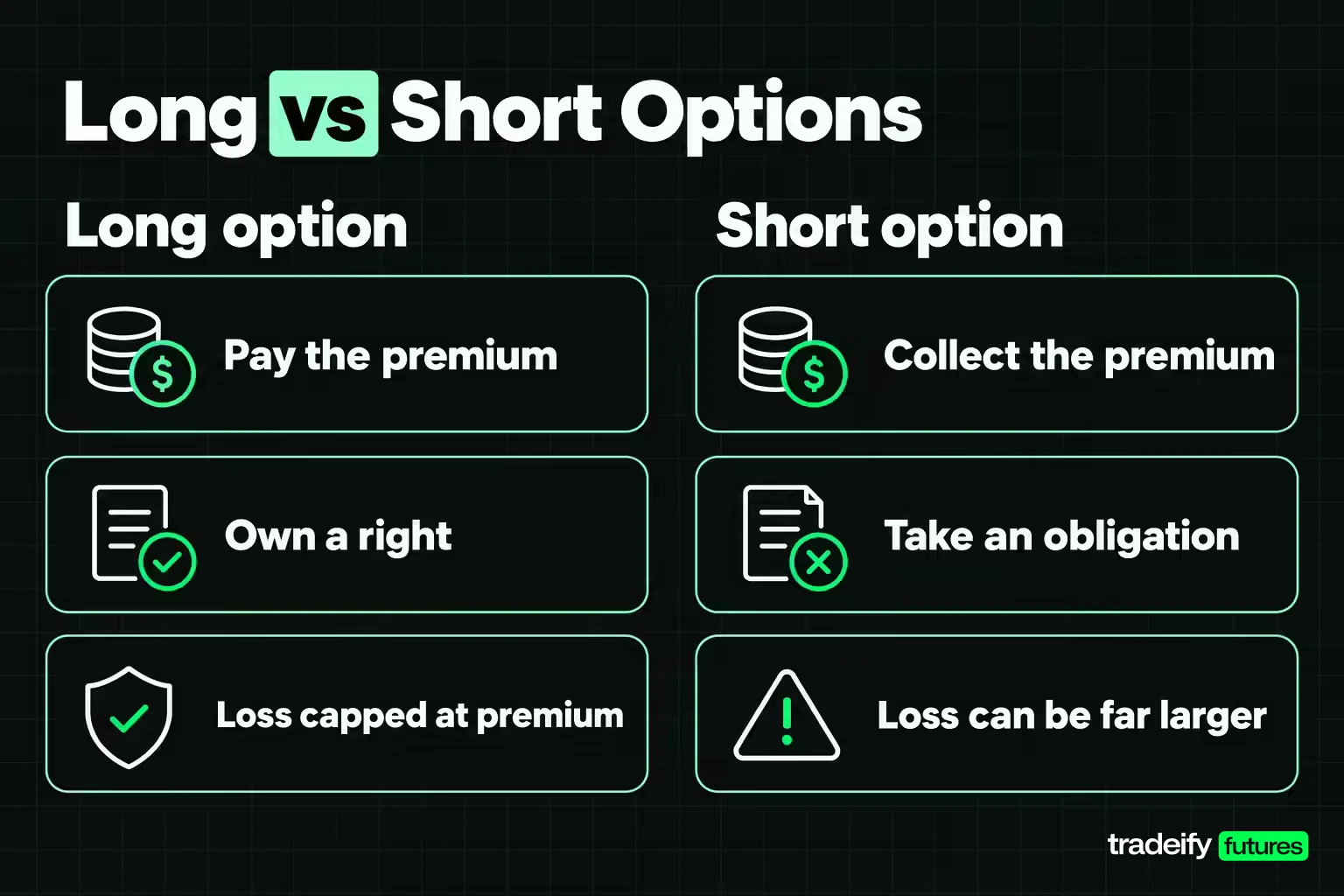
The cleanest way to compare long vs short options is to put all four single-option positions next to each other and read across. The figures assume one standard equity option contract covering 100 shares, held to expiration, with an uncovered short position and no other holdings.
| Feature | Long call | Short call | Long put | Short put |
|---|---|---|---|---|
| Premium | Paid | Received | Paid | Received |
| Right or obligation | Right to buy | Obligation to sell | Right to sell | Obligation to buy |
| Market view | Up | Flat or down | Down | Flat or up |
| Maximum profit | Unlimited in theory | Premium received | Strike minus premium | Premium received |
| Maximum loss | Premium paid | Unlimited in theory | Premium paid | Strike minus premium |
| Breakeven at expiration | Strike plus premium | Strike plus premium | Strike minus premium | Strike minus premium |
| Effect of time passing | Hurts | Helps | Hurts | Helps |
| Effect of rising implied volatility | Helps | Hurts | Helps | Hurts |
| Assignment risk | None | Yes | None | Yes |
Three differences matter more than the rest.
The cash flow is reversed. The buyer pays the premium up front and the seller keeps it whatever happens next. That premium is the buyer's whole risk and the seller's whole reward.
The loss boundaries are not mirror images in size. The buyer's worst case is known before the trade. The seller's worst case is either open-ended (short call) or large but bounded (short put, if the stock goes to zero).
Time and volatility pull in opposite directions. All else equal, the long side loses value as expiration approaches and gains when implied volatility rises. The short side wants the reverse.
How a Long Option Position Works
A long option position starts with a buy-to-open order. The premium you pay is quoted per share, so the cost of one standard equity contract is the quoted premium times 100. That premium goes to the seller and is not refunded.
From there, the position can end in three ways. You can sell the option to close at whatever the market pays for it. You can exercise it and buy (call) or sell (put) the shares at the strike. Or you can let it expire, which for an out-of-the-money option means losing the premium.
The SEC's investor bulletin on options uses a simple call example. With a stock at $68, a buyer pays $2.20 for a December 70 call, or $220 for the contract. The stock has to rise above $72.20 by expiration for the trade to break even if held that long. Two weeks later the stock is at $80 and the call trades at $10.20, so the contract is worth $1,020. Selling to close collects the difference, $1,020 minus $220, an $800 gain before commissions.
Notice what the buyer skipped. They did not exercise and buy 100 shares at $70, which would have needed $7,000 of cash. Most long option holders close the contract rather than exercise it, because selling the option captures both its intrinsic value and any time value left.
A long put works the same way in the other direction. It gains as the underlying falls, and it can be sold to close or exercised to sell shares at the strike.
How a Short Option Position Works
A short option position starts with a sell-to-open order. The premium lands in your account straight away, and in exchange you take on an obligation that lasts until you buy the option back, it expires, or you are assigned.
Because the seller can owe far more than the premium, brokers require options approval and margin for uncovered short options. The margin is a deposit against the obligation, not a cap on the loss.
How assignment works on a short option
Assignment is the moment the obligation becomes real. When a holder exercises, the Options Clearing Corporation (OCC) randomly assigns the exercise notice to a clearing firm with a matching short position, and that firm assigns it to one of its customers short the same series. A short call writer then has to deliver shares at the strike; a short put writer has to buy shares at the strike.
FINRA gives a worked example of how fast that can turn. A trader sells 10 contracts of XYZ July 50 calls at $1.00 while the stock is at $40, collecting $1,000. The stock climbs to $60 and the calls are assigned. Without owning the stock, the trader must deliver 1,000 shares at $50 that are worth $60, a $10,000 hit, or a $9,000 loss after the $1,000 premium.
That is the core trade-off of a short option in one line. The best case was fixed at $1,000 on day one. The worst case grew with every dollar the stock rose, and nothing in the trade told the seller when it would stop.
How a short option is closed
A short option is closed with a buy-to-close order in the same series: same underlying, same call or put, same strike and same expiration. Buying a different option does not close the short one; it opens a second position. If the option expires out of the money, the obligation ends and the seller keeps the full premium.
How a short option compares with short selling stock
A short option and a short sale of stock both start with a sale and both can lose more than the trader takes in. The mechanics differ. A short seller borrows shares, sells them, and profits only if the price falls before buying them back. An option seller borrows nothing; the sale creates a new contract, and the profit comes from the premium shrinking, which can happen whether the stock falls, holds still, or moves less than the market expected.
Related lesson: Options assignment risk
Long and Short Positions in Stocks, Futures and Derivatives
The words long and short carry across markets, but the mechanics behind them change. Knowing which version you are dealing with avoids a lot of confusion.
Long and short stock positions
Being long a stock means you own it and expect it to rise. Being short a stock generally means selling shares you do not own, using shares borrowed through your broker, and buying them back later to return them. Investor.gov notes that short sellers are subject to margin rules, may pay interest on the stock loan, and must pay the lender any dividend the stock pays while it is borrowed.
Federal Reserve Regulation T sets the initial requirement for a short sale of a standard listed stock at 150% of its current market value. Shorting 100 shares at $50 ($5,000) therefore ties up $7,500, which includes the $5,000 of sale proceeds. Brokers can and often do ask for more.
Long and short in futures
Futures are symmetric. The CFTC defines a long as one who has bought a futures contract to establish a position and a short as the selling side of an open futures contract. There is nothing to borrow: going short is simply selling a contract to open, and every open contract has one long and one short behind it. Gains and losses move roughly one-for-one with the price in both directions.
Long and short in options
Options add a second layer. Because there are calls and puts, a trader can be long or short each one, which creates four positions instead of two. The long side holds a right and pays for it. The short side sells that right and takes on the obligation. Other derivatives, such as contracts for difference, follow the stock-and-futures logic of buying or selling the underlying exposure; options are the one place where long can mean bearish.
| Market | How to go long | How to go short | Worst case for the short side |
|---|---|---|---|
| Stocks | Buy shares | Borrow and sell shares | Unlimited in theory as the price rises |
| Futures | Buy a contract to open | Sell a contract to open | Unlimited in theory as the price rises |
| Options | Buy a call or put to open | Sell a call or put to open | Unlimited for a short call, strike minus premium for a short put |
Related lesson: Short selling mechanics
Option Profit and Loss Profiles for Long and Short Positions
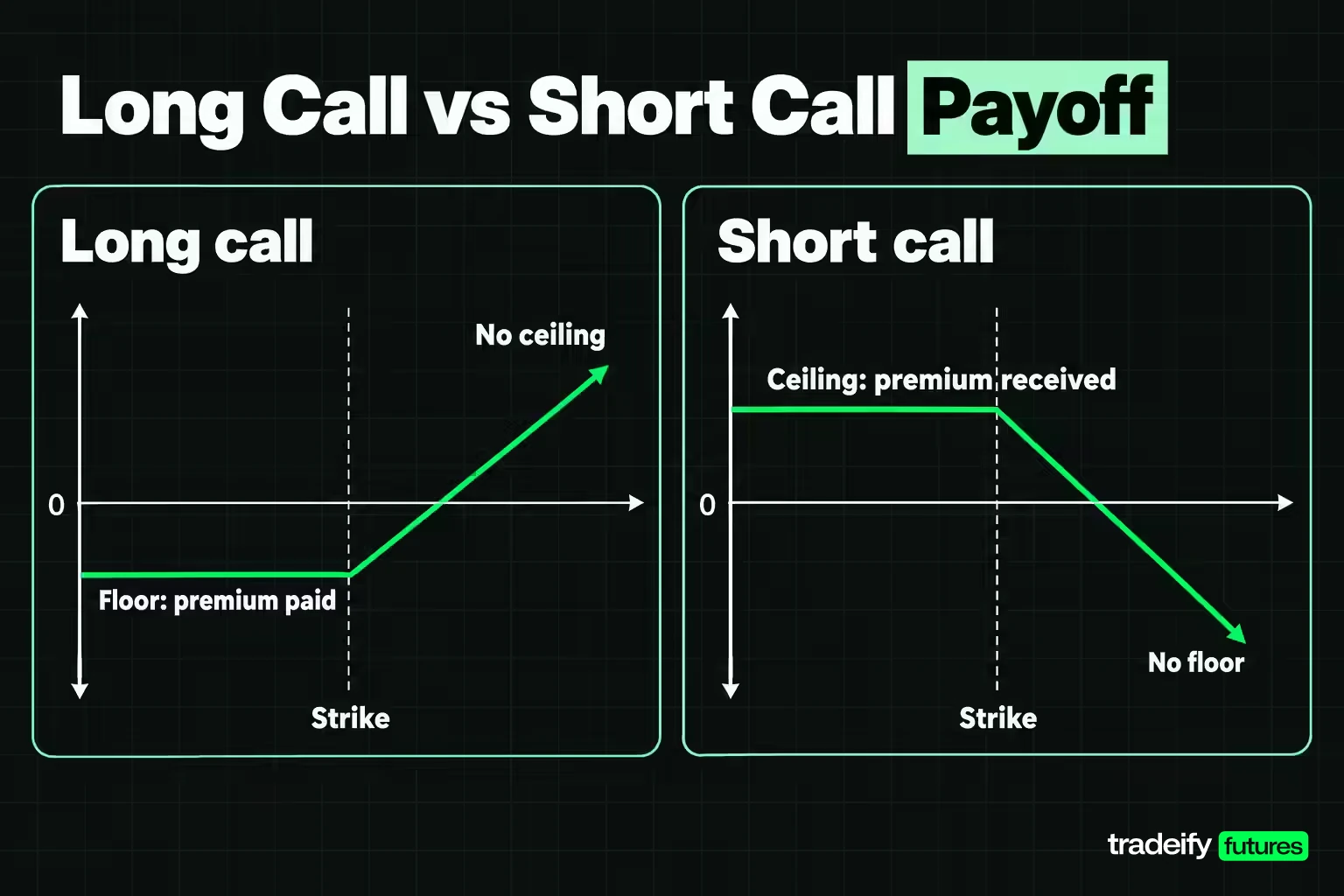
The profit and loss profile of each option position can be written as a short formula at expiration. K is the strike, S is the underlying price at expiration, and P is the premium per share. Multiply the result by 100 for one standard equity contract.
- Long call: the larger of S minus K or zero, minus P.
- Short call: P, minus the larger of S minus K or zero.
- Long put: the larger of K minus S or zero, minus P.
- Short put: P, minus the larger of K minus S or zero.
Each short profile is the exact opposite of the matching long profile, before costs. The option itself is a zero-sum contract between the two sides.
The shape is what separates them. A long call has a floor (the premium) and no ceiling. A short call has a ceiling (the premium) and no floor. A long put's gain is capped at the strike minus the premium because a stock cannot fall below zero, and a short put's loss is capped at the same amount for the same reason. That is why the Options Industry Council describes a short call's risk as theoretically unlimited and a short put's risk as substantial rather than unlimited.
Breakeven follows the same logic. For both sides of a call, it is the strike plus the premium. For both sides of a put, it is the strike minus the premium. The buyer needs the stock beyond breakeven to profit at expiration; the seller profits as long as it stays short of it.
Worked Example of Long and Short Options on One Contract
A single illustrative contract shows how the four profiles behave. Assume XYZ options with a $50 strike, a $3 premium, a 100-share multiplier, held to expiration, with fees left out. Each contract costs the buyer $300 and pays the seller $300. The call breaks even at $53 and the put at $47.
| XYZ at expiration | Long call | Short call | Long put | Short put |
|---|---|---|---|---|
| $40 | -$300 | $300 | $700 | -$700 |
| $45 | -$300 | $300 | $200 | -$200 |
| $47 | -$300 | $300 | $0 | $0 |
| $50 | -$300 | $300 | -$300 | $300 |
| $53 | $0 | $0 | -$300 | $300 |
| $55 | $200 | -$200 | -$300 | $300 |
| $60 | $700 | -$700 | -$300 | $300 |
The table makes one point hard to miss: every dollar one side makes, the other side loses. At $60, the call has $10 of intrinsic value, so the long call makes $7 a share ($700) and the short call loses the same. At $40, the put is $10 in the money, so the long put makes $700 and the short put loses $700. At $50, both options expire worthless and both sellers keep $300.
Now push the example to the extremes. If XYZ went to zero, the short put would lose ($50 minus $3) times 100, or $4,700, and the long put would make the same. If XYZ went to $100, the short call would lose $4,700, and at $150 it would lose $9,700. There is no price at which the short call's loss stops growing.
Real results differ from the clean table. Bid-ask spreads, commissions, early exercise, and closing before expiration at a price that still includes time value all change the numbers.
Advantages and Drawbacks of Long Options
Buying options is where most traders start, and the appeal is real. So is the cost of getting the timing wrong.
Advantages of a long option
- Defined risk. The most a buyer can lose is the premium paid plus costs, and that number is known before the order is sent.
- Large upside. A long call's potential gain is unlimited in theory, and a long put's is large, so a correct and timely view can return many times the premium.
- Small outlay. In the worked example, the $50 call costs $300, while 100 shares at $50 cost $5,000. That gap is why the Options Industry Council calls calls a way to participate without the up-front capital of owning stock.
- No assignment. The holder controls exercise and never receives an assignment notice.
- Rising volatility helps. All else equal, a jump in implied volatility lifts the value of a long option.
Drawbacks of a long option
- Time decay works against you every day. The part of the premium that is time value tends to shrink as expiration approaches.
- Timing matters as much as direction. A move that arrives after expiration earns nothing, and a move that is too small may not clear breakeven.
- A defined loss can still be a total loss. An out-of-the-money option at expiration is worth zero, which is 100% of what was paid.
- Falling volatility hurts. A long option can lose value after an event even if the stock moves in the expected direction, because implied volatility often drops once the uncertainty is gone.
- No shareholder rights. A call holder gets no dividends or votes without exercising.
- Repeated premium is a running cost. A trader who keeps buying options that expire worthless pays the full premium each time, and that cost adds up even when each single loss looked small.
Advantages and Risks of Short Options
Selling options turns the buyer's trade-offs around. The steady income is what draws traders in, and the occasional large loss is what the income is paying for.
Advantages of a short option
- Premium up front. The seller is paid at the start, and that payment is kept in full if the option expires out of the money.
- Time works for you. All else equal, the passage of time has a strongly positive effect on a short option.
- You can be right without a big move. A short put profits if the stock rises, holds still or falls a little; a short call profits if the stock falls, holds still or rises a little.
- A way to buy lower. A cash-secured put can be used to buy a stock below its current price, with the premium lowering the effective cost.
- Falling volatility helps. A drop in implied volatility tends to reduce the value of the option you sold.
Risks of a short option
- Loss far larger than the premium. A short call has no maximum loss, and a short put can lose the strike minus the premium, many times what was collected.
- Assignment at any time. Short American-style options can be assigned on any day the market is open, not only at expiration.
- Margin calls. The Options Industry Council warns that an adverse move can force a seller to add margin on very short notice or close at a large loss.
- Gap risk. News between sessions can move a stock past the strike before there is any chance to buy the option back.
- An unfavorable risk-reward shape. The Options Industry Council describes a naked call as the riskiest option strategy there is and a naked put as second only to it.
Time Decay, Volatility and Assignment in Long and Short Options
Three option-specific forces shape a long or short position even when the stock barely moves.
Time decay
An option's premium has two parts: intrinsic value (how far it is in the money) and time value. Time value tends to shrink as expiration approaches. A long option generally has negative theta, so each day costs something if nothing else changes. A short option generally has positive theta. That daily gain for the seller is small and steady, while an adverse move can wipe out weeks of it in one session.
Implied volatility
Implied volatility is the market's price for expected movement. When it rises, calls and puts both tend to gain value, which helps long positions and hurts short ones. When it falls, the reverse happens. This is why a trader can buy a call before earnings, see the stock rise, and still lose money if implied volatility collapses after the report.
Exercise, expiration and early assignment
Equity options are American-style, so the holder can exercise on any business day before expiration, and the seller can be assigned on any of those days. FINRA notes that only about 7% of options positions are typically exercised, but that does not mean a seller is assigned on only 7% of short positions. Early assignment is more likely when an option is deep in the money, when a dividend is approaching on a short call, or around a corporate action.
At expiration, OCC's exercise-by-exception procedure exercises equity options that are $0.01 or more in the money unless instructions say otherwise, and brokers can use their own thresholds. Options exchanges stop accepting exercise notices at 4:30 PM CT on the last trading day, and most brokers set an earlier cutoff. A seller cannot know for certain whether they were assigned until the Monday after expiration, which leaves a weekend of price risk on any stock position that assignment creates.
How to Open and Close Long or Short Options
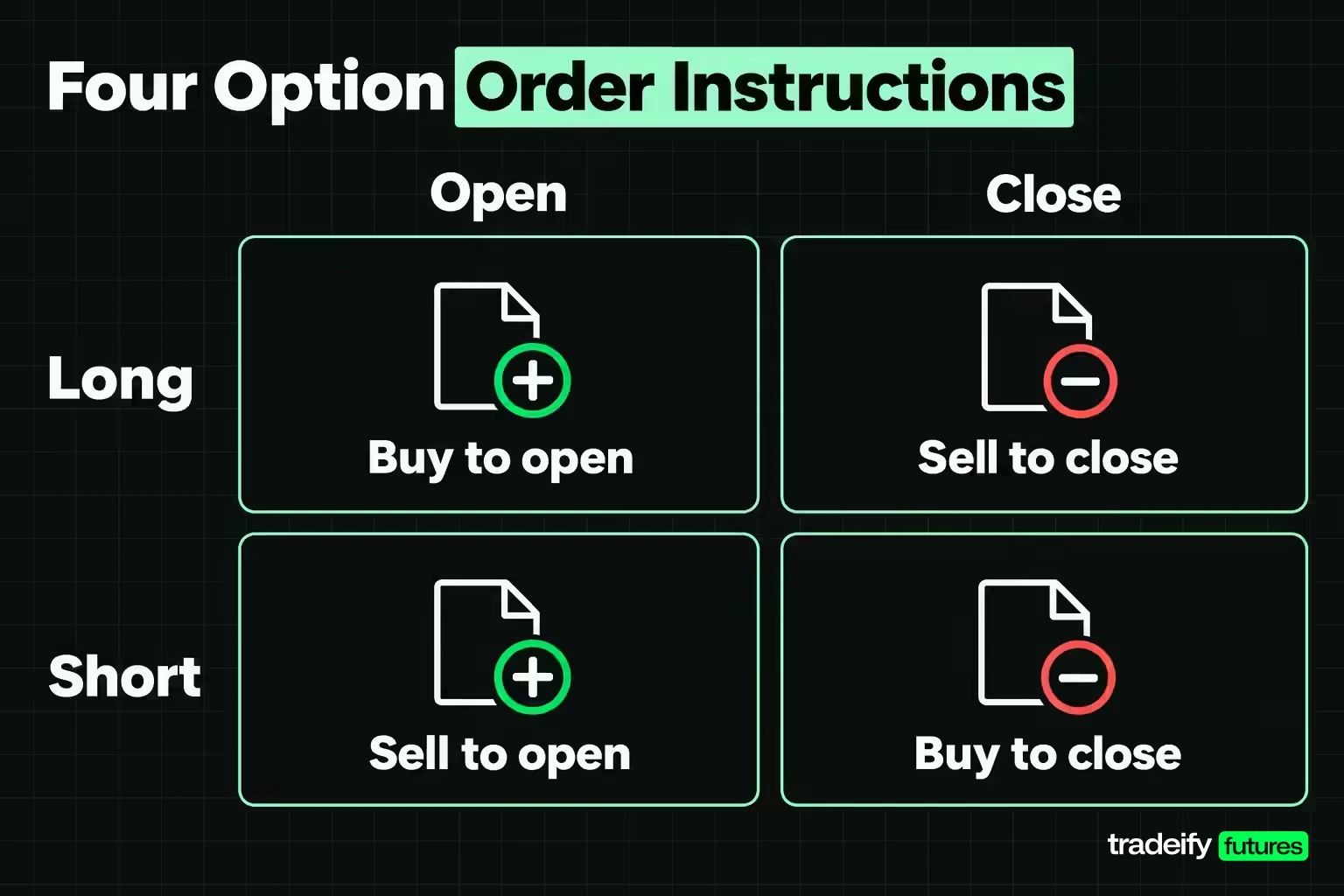
Opening and closing an option takes four distinct order instructions, and confusing them is one of the costliest errors in options trading.
| Order | What it does | Position afterward |
|---|---|---|
| Buy to open | Creates or adds to a long option | Long |
| Sell to close | Reduces or exits a long option | Smaller long or flat |
| Sell to open | Creates or adds to a short option | Short |
| Buy to close | Reduces or exits a short option | Smaller short or flat |
The practical sequence looks like this.
- Get the right approval. Brokers require options approval, and selling uncovered options usually needs the highest level.
- Pick the exact contract. Confirm the underlying, call or put, strike and expiration date, and check that the contract is liquid enough to exit.
- Choose the side. Buy to open for a long position, sell to open for a short one.
- Use a limit order. Options spreads can be wide, and a limit order sets the worst price you will accept.
- Check the order effect before sending. Make sure the ticket says open or close as intended and the quantity matches.
- Plan the exit at entry. Write down the price, date or condition that will make you close, and know your broker's exercise and assignment cutoffs.
A small slip at step 5 can double a position instead of closing it. A trader who means to buy back a short call and enters sell to open instead now has twice the obligation.
When to Choose Long or Short
Choosing between a long and a short option is less about being bullish or bearish and more about what you expect, how soon, and what you can afford to be wrong about.
Questions that point toward a long option
- Do you expect a large move, soon? Long options need the move to beat the premium before time runs out.
- Do you want the worst case fixed in advance? A long position cannot lose more than what you paid.
- Is implied volatility low relative to the move you expect? Buying is cheaper when the market prices in little movement.
Questions that point toward a short option
- Do you expect the price to stay in a range or move only modestly? Short options earn their premium when little happens.
- Is implied volatility high? Sellers collect more when the market prices in a big move.
- Can you meet the obligation? A short put needs the cash or margin to buy the stock; a short call needs a plan for a sharp rally.
Choosing between a long call and a short put
Imagine a trader who expects XYZ, now at $50, to rise over the next two months but not dramatically. A long call needs the stock above breakeven by expiration, so a modest rise may not be enough to cover the premium and time decay. A short put pays the premium up front and profits if XYZ stays above the strike less the premium, but it leaves the trader owning shares at the strike if the stock falls. Same bullish view, two very different bets: the long call bets on size and speed, the short put bets on the price not falling far.
What would change the choice? If an earnings report is due and implied volatility is elevated, the short put collects more premium but also faces a larger gap. If the trader cannot afford to own 100 shares at $50, the short put is the wrong tool regardless of the view.
Long Stock vs Short Puts and Synthetic Option Positions
Options let you express the same view in several ways, and comparing them shows what each one actually trades away.
Long stock vs a short put
Buying 100 shares at $50 costs $5,000, earns any dividends, and has unlimited upside and a loss down to zero. Selling a cash-secured $50 put with a $3 premium sets aside $5,000 to buy the shares if assigned. If XYZ stays above $50, the seller keeps $300 and never owns the stock. If XYZ falls below $50 and the put is assigned, the seller buys at $50 with an effective cost of $47.
| Feature | Long 100 shares at $50 | Short $50 cash-secured put at $3 |
|---|---|---|
| Cash committed | $5,000 | $5,000 set aside |
| Profit if XYZ rises to $60 | $1,000 | $300 |
| Result if XYZ stays at $50 | $0 | $300 |
| Result if XYZ falls to $40 | -$1,000 | -$700 |
| Dividends | Received | Not received |
| Upside | Unlimited | Capped at the premium |
The short put does better in a flat or slightly falling market and worse in a strong rally. The Options Industry Council notes that a cash-secured put has the same risk profile as a covered call, which is why it is treated as a stock-acquisition strategy rather than a bet on a crash never coming.
Synthetic long and short positions
Calls and puts can be combined to copy a stock position. A synthetic long stock is a long call plus a short put at the same strike and expiration. It behaves much like owning the shares for the life of the options, with a smaller cash outlay, no voting rights or dividends, and the time decay of the two options roughly offsetting. A synthetic short stock is the reverse, a short call plus a long put, and carries unlimited risk if the stock rallies.
The Options Industry Council describes each of these as essentially a futures position on the stock. That relationship between calls, puts and the underlying is known as put-call parity, and it is why a long call and a short put can never be priced far apart for long.
Long Short Ratios, Put Call Ratios and Short Interest
Traders also read long and short positioning across the whole market as a sentiment gauge. Three public data sets are used most.
- Put/call ratios. Cboe publishes daily put/call ratios, including total, equity, index and SPX ratios. A high ratio means more puts traded relative to calls, which some traders read as fear and, at extremes, as a contrarian signal.
- Short interest. Under FINRA Rule 4560, broker-dealers report short positions in every equity security twice a month, for the 15th and for month-end, and FINRA publishes the data on the 7th business day after each settlement date. FINRA says it publishes the data to help investors gauge market sentiment.
- Futures positioning. The CFTC's Commitments of Traders reports split futures open interest into long and short positions by trader category.
None of these is a timing tool by itself, and that is where traders get caught: a crowded short can stay crowded for months. A put/call ratio mixes buyers and sellers of puts, so a jump in put volume can come from sellers collecting premium as easily as from buyers hedging. Short interest is published days after the settlement date it measures. Treat any of them as context for a view, not a trigger.
Common Mistakes With Long and Short Options
The same handful of errors cause most long vs short options confusion, and most of them happen at the order ticket rather than in the analysis.
Assuming long means bullish
A long put is bearish and a short put is bullish. Name the position fully (long call, short call, long put, short put) before deciding what it needs.
Mixing up position side and time
A "long option" is a bought option. A "long-dated option" is one with a lot of time left. They are unrelated.
Treating a defined loss as a small loss
The premium on a long option is the maximum loss, and an option that expires out of the money loses all of it. Sizing a long position as if the premium were a stop that rarely triggers is how buyers drain an account.
Comparing only the premium
A $300 debit and a $300 credit look symmetrical. In rights, obligations, margin and worst case, they are not.
Ignoring assignment until expiration day
A short American-style option can be assigned any business day. A seller who has no plan for assignment, including the cash or margin to carry the resulting shares, does not yet have a plan for the trade.
Selling options because they win often
A short option can expire worthless many times in a row and give back all of it, and more, in one move. A high win rate says nothing about the size of the loss. Check the worst trade in the sample before trusting the average.
Going Long or Short With Futures Instead
Many traders who want simple long or short exposure use futures rather than options. A futures contract has no premium, no time decay and no assignment of an option obligation. Buying a contract is a long position, selling one is a short position, and the profit or loss moves with the price in a nearly straight line in both directions. That simplicity cuts both ways: the loss on a futures position is not capped by a premium, so stops and position size do the job a premium does for an option buyer.
We don't offer options on our accounts, of any kind. On our funded accounts, which are simulated, traders can go long or short supported futures such as ES, NQ, MES and MNQ, all positions are closed by 4:45 PM ET, and opposing positions in the same product group (for example long ES and short NQ) count as prohibited hedging.
Frequently Asked Questions About Long and Short Options
Are long options safer than short options?
Not automatically, but their worst case is smaller and known in advance. Long options have a defined maximum loss equal to the premium paid plus costs. That makes the worst case clearer, but the whole premium can still be lost. Short options can lose much more than the premium and carry assignment risk, so they generally demand more capital, approval and planning.
Can a put be a long position?
Yes. Buying a put to open creates a long put, which gains as the underlying falls. The holder has the right to sell at the strike price before expiration.
Can I lose more than the premium on an option?
A buyer cannot lose more than the premium paid plus costs. A seller can lose far more than the premium received. A short call has no fixed maximum loss, and a short put can lose the strike minus the premium if the stock goes to zero.
What is Warren Buffett's favorite option strategy?
Selling puts is the options strategy Buffett has documented most clearly in his own writing. Berkshire Hathaway's 2008 shareholder letter describes the company selling long-dated, European-style puts on four stock indexes, totalling $37.1 billion of exposure for $4.9 billion in premiums. The same letter reported a $5.1 billion mark-to-market loss on them at the time, a reminder that short option risk shows up before expiration.
How do you short the stock market?
Traders take a short view on the broad market by short selling index ETFs, selling stock index futures, buying puts on an index or ETF, or selling calls. Each carries different risks: short sales and short futures have no cap on losses, while buying puts limits the loss to the premium.
Can a normal person short sell?
Yes, an individual can short sell through a margin account if the broker approves it and can borrow the shares. Regulation T requires 150% of the short position's value at the start, which includes the sale proceeds, and the short seller pays stock-loan fees and any dividends.
How does a short work?
A short profits when price falls. In stocks, you sell borrowed shares and buy them back later. In futures, you sell a contract to open. In options, you sell a call or put to open, collect the premium and accept the obligation that comes with it.
What are the most shorted stocks right now?
There is no fixed answer, because the most shorted list changes twice a month. FINRA publishes short interest for every listed and over-the-counter stock on the 7th business day after each mid-month and month-end settlement date. Any ranked list of the most shorted names is a snapshot from that data and goes stale within two weeks.
Do I need to exercise a long option to make money?
No. Most long option holders sell to close before expiration. Selling captures the option's remaining time value, while exercising gives it up and requires the cash or margin to take the shares.
Options involve risk and are not suitable for every investor. An option buyer can lose the full premium in a short time, and uncovered option sellers can lose far more than the premium received and may be assigned at any time. The examples here are illustrative and exclude fees, spreads, margin changes and early assignment. Futures and other leveraged products can also lose more than expected, and funded or evaluation accounts are simulated. This article is educational and is not investment advice.


