



TL;DR: Options assignment risk is the chance a short option is exercised against you, forcing a buy or sale of 100 shares a contract at the strike. American-style options can be assigned any business day, not only at expiration. Risk rises when the option is deep in the money, has little time value left, or a call faces an ex-dividend date. At expiration, OCC exercises options $0.01 or more in the money unless told otherwise. Buying to close before the bell is the only sure exit.
When you sell an option, you collect a premium and accept an obligation. The buyer holds the right, and the buyer decides when to use it. That is the whole of options assignment risk: someone else controls the timing of an obligation you already agreed to.
Most of the time nothing happens. The Options Industry Council (OIC) puts exercises at about 7% of options, and most short options are bought back or expire. But "most of the time" is not a plan. A short put that drifts in the money can turn into 100 shares per contract, bought with cash you may have planned to use elsewhere. A short call can turn into a short stock position over a weekend.
The fix is not predicting assignment. Nobody can. The fix is knowing what each short option can turn into, what that would cost your account, and what you will do about it, before the cut-off instead of after the notice lands.
What Is Options Assignment
Options assignment is the step that makes an option seller perform. When the holder of an option exercises, a seller of that same option series is assigned and must fulfill the contract at the strike price.
FINRA describes it plainly. Buying an option to open buys a right. Selling an option to open accepts an obligation:
- A short call obliges you to sell the underlying at the strike price if assigned.
- A short put obliges you to buy the underlying at the strike price if assigned.
- In exchange, you received the premium up front.
For standard US equity options, one contract covers 100 shares. So an assigned $50 put means paying $5,000 for 100 shares, and an assigned $50 call means delivering 100 shares and receiving $5,000.
Related lesson: Long and short option positions
How the OCC sits between buyers and sellers
Listed options are not private deals between you and the person who bought from you. The Options Clearing Corporation (OCC) stands between buyers and sellers. When a holder exercises, OCC assigns the exercise to a clearing firm that carries a short position in that series, and the firm then picks one of its customers who is short that option.
That structure has one consequence traders often miss. Your assignment risk does not depend on what the original buyer of your contract does. OIC points out that the other side of your sale may have been someone closing a short, and that anyone short the series is exposed whenever any holder exercises.
How the Assignment Process Works
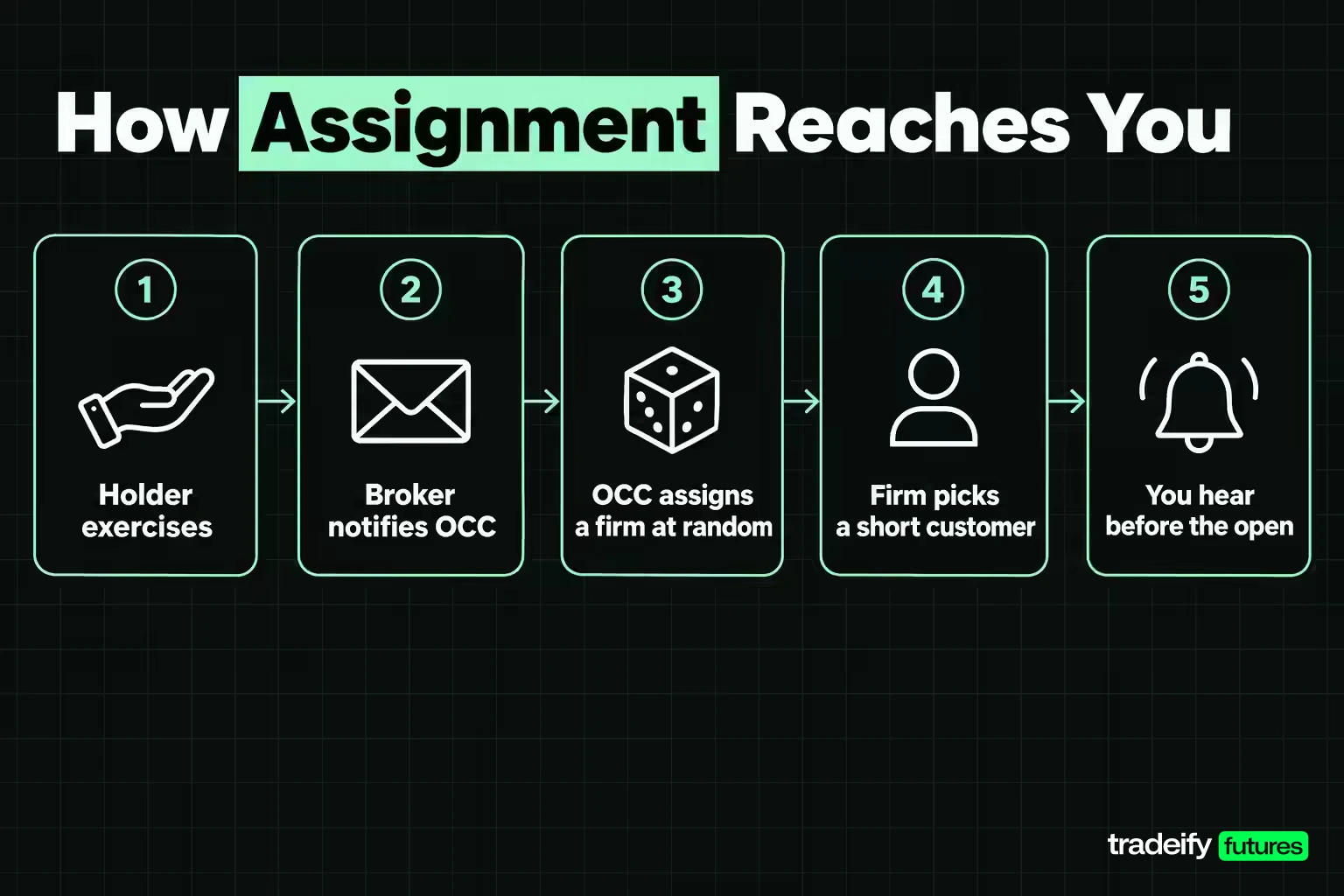
The assignment process runs overnight and follows the same chain every time. Knowing the order of events explains why closing a position during the session protects you and why reacting after a notice often comes too late.
- A holder tells their broker to exercise before the broker's cut-off time.
- The broker submits the exercise notice to OCC, directly or through a clearing member.
- OCC randomly assigns the notice to a clearing member with customer or firm accounts short that series.
- That firm allocates the assignment to one of its short customers, at random or on a first-in, first-out basis, using a method the exchange has approved.
- The assigned customer learns about it from the broker, usually before the next session opens.
Why closing during the session prevents assignment
OIC states that assignments are based on net positions after the market closes each day. If you buy back a short call during the session, you are no longer short at the close and cannot be assigned on it that night. OCC also processes closing purchases before exercises.
The OIC's October 2026 Office Hours recap adds two practical details. Exercise and assignment notices are processed only after the close, so nothing is assigned during trading hours. And OCC assigns without knowing anything about the member's price, contract or days remaining, so there is no way to predict whose position gets picked.
Partial assignment is normal
An option holder can exercise some contracts and keep others. OIC gives the example of a trader short 10 contracts who was assigned one contract at a time on different days. Each day, some, all or none of a short position can be assigned.
When Assignment Happens at Expiration or Before
Assignment can happen at two different points: on expiration, which is when most exercises occur, and before expiration on American-style options. They carry different risks, so it helps to treat them separately.
Assignment at expiration
At expiration, OCC uses a procedure called exercise by exception. Options that finish in the money by $0.01 or more are exercised unless the holder's firm submits contrary instructions. Brokers can use different thresholds, and OIC stresses that this is not truly automatic, because a holder can always choose otherwise.
For the seller, that means a short option that expires in the money should be treated as likely to be assigned. Likely is not certain. OIC notes that some holders let in-the-money options lapse, and some sellers are assigned on options that expire exactly at the money or even out of the money.
After-hours news is the usual cause. The options exchanges accept exercise notices until 4:30 PM Central Time on the last trading day, and most brokers set an earlier cut-off. A stock that closes $0.20 below your put strike and then drops on an after-hours headline can still produce an exercise notice.
Assignment before expiration
FINRA explains that American-style options can be exercised any time during the life of the contract, so a short American-style option can be assigned on any day equity markets are open. European-style options can be exercised only during a set period just before expiration.
All standardized US equity options are American-style, according to OIC. Most, but not all, index options are European-style. That single fact decides whether early assignment is even possible on your position.
How often exercise actually happens
OIC says holders exercise only about 7% of options, and its historical figures show more than 72% of contracts are closed before expiration, 22% expire worthless and 6% are exercised. FINRA adds the warning that matters: 7% does not mean only 7% of your short positions can be assigned. You can be assigned on some, all or none of them.
The base rate is low. The cost when it lands on you is not. OIC's 6% historical exercise rate says nothing about the deep in-the-money call sitting in your account the night before an ex-date, so judge the position by its conditions, not the average.
Related lesson: American-style and European-style options
Early Assignment Risk on American-Style Options
Early assignment risk is the chance an American-style short option is exercised before its expiration day. It is uncommon because exercising early usually costs the holder money.
An option's price has two parts: intrinsic value (how far it is in the money) and time value (everything above that). Exercising captures only the intrinsic value and throws the time value away. OIC's example uses a stock at $32.80 and a two-week $32.50 call trading at $1.10. The call is $0.30 in the money and carries $0.80 of time value. Exercising and selling the stock nets $0.30. Selling the call nets $1.10. A rational holder sells.
So the question to ask is not "Is my short option in the money?" It is "What would the holder gain by exercising today that beats selling the option?" When the answer is "nothing," early assignment stays unlikely. When the answer is "something," the risk is real.
Situations that make early exercise rational
OIC, FINRA and Fidelity identify a short list of situations where exercising early can beat selling:
- A dividend worth more than the remaining time value. A call holder who exercises before the ex-dividend date gets the dividend.
- Deep in-the-money puts. OIC notes that most professional option traders exercise deep in-the-money puts before expiration, because exercising turns the position into cash now.
- Interest on short stock. OIC's Office Hours recap describes put holders exercising to create a short stock position that earns interest, when that interest exceeds the put's extrinsic value.
- Hard-to-borrow shares. FINRA lists shares becoming difficult to borrow around a pending buyout or takeover as a reason for early exercise.
- Corporate actions. OIC warns that mergers, takeovers, spin-offs and special dividends can upset normal early-exercise expectations entirely.
Notice what is missing from that list: a stock simply moving against you. A sharp move raises the odds because it pushes the option deeper in the money and squeezes time value, but the move alone does not force anyone's hand.
Related lesson: Early exercise from the holder's side
Factors That Raise Options Assignment Risk
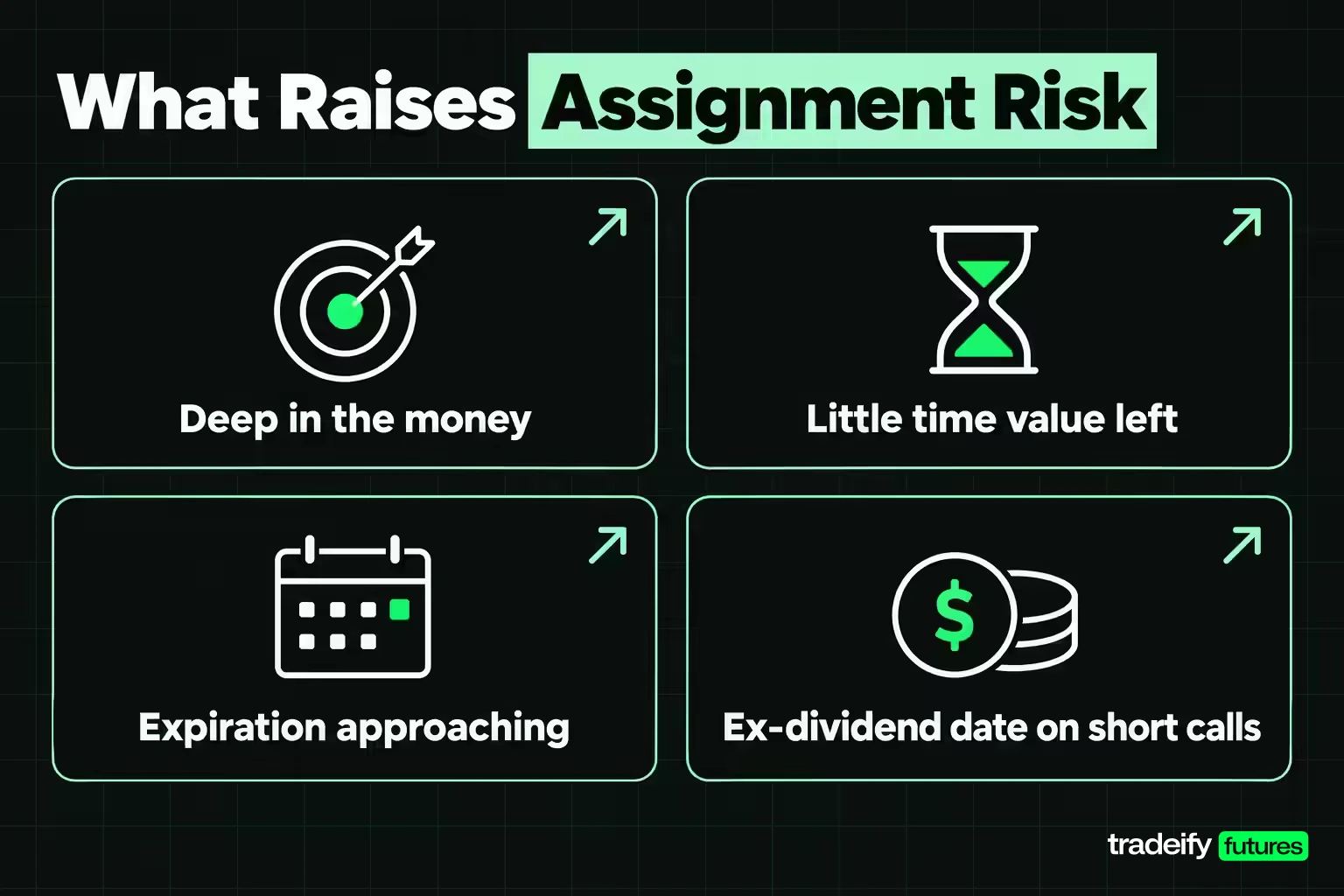
Options assignment risk cannot be forecast contract by contract, but the conditions that raise it are well known. OIC summarizes them in one line: assignment risk increases as the option goes deeper in the money, as expiration approaches, just before the ex-dividend date for short calls and just after the ex-dividend date for short puts.
| Factor | Why it matters | What to check |
|---|---|---|
| Moneyness | Deeper in the money means more intrinsic value and usually less time value | How far the stock sits past your strike |
| Extrinsic value | Exercise forfeits it, so a small amount removes the holder's reason to wait | Option price minus intrinsic value |
| Time to expiration | Time value shrinks as expiration nears | Days left and the last trading day |
| Dividends | Call holders exercise to own shares before the ex-date | Ex-dividend date and dividend size |
| Interest rates | Put holders can earn interest on a short stock position | Deep in-the-money short puts |
| Borrow and corporate events | Hard-to-borrow stock or a pending deal changes the math | Takeover news, special dividends |
| Exercise style | European-style options cannot be exercised early | Contract specifications |
Reading extrinsic value quickly
Extrinsic value is the single best warning light. OIC's Office Hours recap offers a shortcut for calls: the price of the put at the same strike tends to be close to the call's extrinsic value. If that matching put is trading for a few cents and a dividend of 40 cents is coming, the holder's choice is easy.
Two cautions keep this honest. A wide bid-ask spread can make extrinsic value look bigger or smaller than it is, so use the midpoint and check both sides. And moneyness is not a switch: a contract one cent in the money is not guaranteed to be exercised, and a narrow out-of-the-money close is not a promise that it won't be.
Related lesson: Intrinsic and extrinsic value
Dividend Risk and Early Call Assignment
Dividend risk is the most predictable form of early call assignment, because the date is published in advance. OIC, quoting the options disclosure document, says a call holder becomes entitled to the dividend by exercising before the ex-dividend date, and an assigned call writer, covered or not, must deliver the stock plus the dividend.
Fidelity explains why the timing matters. Stock prices drop by roughly the dividend on the ex-dividend date, but option prices are not adjusted for it. So when an in-the-money call's remaining time value is smaller than the dividend, there is a good chance a holder will exercise the day before the ex-date.
Dividend assignment worked example
The following numbers are illustrative, not a quote.
- Stock price: $54
- Short call strike: $50
- Call price: $4.10, so intrinsic value is $4.00 and extrinsic value is $0.10
- Dividend: $0.40, with the ex-dividend date tomorrow
A holder who exercises today gives up $0.10 of time value, which is $10 per contract, and captures $0.40 of dividend, which is $40 per contract. That is $30 better per contract than holding the call. The math is public and takes seconds, so assume some holder will act on it.
For the seller, assignment means delivering 100 shares at $50 and receiving $5,000. If the call was uncovered, the assignment creates a short stock position dated before the ex-date, and the short seller owes the $40 dividend to the lender of the shares. Fidelity's own example puts it at scale: a trader short five uncovered calls on a stock paying $0.50 would owe $250 in dividends on assignment, on top of delivering 500 shares.
Why the ex-dividend date can beat the expiration date
The trap is looking at the expiration date and thinking you have time. The dividend creates a second deadline that can arrive weeks earlier. Fidelity adds that buying back the call must happen before the ex-dividend date to keep the shares and the dividend, and that even this is not foolproof, because assignment can come earlier still.
Related lesson: How ex-dividend dates work
Call Option Assignment for Covered and Uncovered Calls
Call option assignment obliges the call seller to deliver shares at the strike price and receive the strike in cash. What that means for your account depends on whether you already own the shares.
Covered call assignment
With a covered call, you own the shares the contract may require. Assignment sells them at the strike. OIC frames the net result per share as the strike price plus the premium you collected when you sold the call.
The position is structurally covered, so the main costs are the upside you gave up and, near an ex-date, the dividend you lose. The real question belongs at the start of the trade: are you willing to sell these shares at this strike? If the honest answer is no, the covered call was carrying a conflict from day one.
Uncovered call assignment
An uncovered (naked) call has no shares behind it. If assigned, you must deliver shares you do not own, which usually means your broker creates a short stock position you then have to buy back. OIC lists the maximum loss on a naked call as unlimited, because there is no ceiling on how far a stock can rise.
FINRA's example shows the scale. A trader sells 10 XYZ July 50 calls at $1.00 with the stock at $40, collecting $1,000. The stock rises to $60 and the calls are assigned. The trader must deliver 1,000 shares at $50, receiving $50,000, while buying them at market would cost $60,000. The result is a $9,000 loss: $10,000 on the delivery minus the $1,000 premium.
FINRA adds a point that changes how to think about it. The account was already showing that loss before assignment, because the short calls were marked at market. Assignment did not create the $9,000. It turned an open risk into a short stock position you now have to manage.
Put Option Assignment and the Cash It Requires
Put option assignment obliges the put seller to buy shares at the strike price. One assigned contract on a $50 strike means paying $5,000 for 100 shares, whatever the stock trades at when the notice arrives. OIC frames the net cost per share as the strike minus the premium received.
Cash-secured puts versus naked puts
A cash-secured put sets aside the full purchase amount. Assignment is an expected outcome: you end up owning shares at a price you chose in advance, and the premium lowers your cost basis.
A naked put is the same trade without the cash reserved. OIC calls it a highly risky strategy, second only to naked calls, and notes that the naked put writer has "neither the ready cash for this purpose nor a desire to own the underlying stock." If assigned, the writer has to find the cash by settlement and then sell the shares, and the maximum loss is the strike minus the premium if the stock goes to zero.
Size is where naked puts surprise people. Five short $50 puts look like a small premium trade. On assignment they become $25,000 of stock (5 contracts x 100 shares x $50).
Settlement timing on an assigned put
Stock trades in the US now settle one business day after the trade date (T+1), a cycle the SEC moved to from T+2 with a compliance date of May 28, 2024. An assignment settles like a stock purchase, so the cash has to be there quickly.
OIC adds a weekend wrinkle for expiration Friday: a put writer may not know whether assignment occurred until the Monday after expiration, and the stock can gap over the weekend in the meantime.
What Assignment Means for Option Sellers
Assignment means an option seller's obligation stops being theoretical. OIC is blunt about it: once an assignment is received, the writer has no alternative but to fulfill it. You cannot decline it, reverse it or ask for a different contract.
That makes the seller's real decision the one made before the close, not after the notice. This table maps each common short position to what assignment creates.
| Short position | Assignment creates | Worst case to plan for |
|---|---|---|
| Covered call | Shares sold at the strike | Upside above the strike given up, dividend lost near an ex-date |
| Uncovered call | Short stock at the strike | Unlimited loss as the stock rises, plus dividends owed |
| Cash-secured put | Shares bought at the strike with reserved cash | Stock keeps falling after you own it |
| Naked put | Shares bought at the strike without reserved cash | Strike minus premium if the stock goes to zero, plus forced selling |
| Short leg of a spread | Stock or short stock while the long leg stays open | One-day financing gap and a long leg you must act on |
| Short cash-settled index option | Cash debit for the in-the-money amount | Full intrinsic value at settlement |
The seller's three exposures
Option sellers face three separate exposures, and assignment touches all of them:
- Price risk. Assignment turns an option position into a stock position with full price exposure, 100 shares per contract.
- Cash and margin risk. The account must carry the new stock or short stock position, which can need far more capital than the original option.
- Timing risk. The holder picks the day, and you find out after the close, sometimes after a weekend.
How Option Holders Decide to Exercise
Assignment only happens because a holder exercises, so the holder's side explains a lot about when sellers get assigned. A holder has three basic choices: sell the option in the market, exercise it, or let it expire.
OIC reports that in about 70% of options trades, holders sell to close rather than exercise. Selling captures intrinsic value and whatever time value remains. Exercising captures intrinsic value only and requires the capital to complete the trade. To exercise a call, OIC notes you need the cash or the margin equivalent to buy the shares.
Exercise instructions at expiration
Holders should tell their broker explicitly whether to exercise each expiring contract. OIC is emphatic on this point, because exercise by exception will otherwise exercise anything in the money by $0.01 or more, and a broker's threshold may differ. A holder who does not want 100 shares per contract can submit a do-not-exercise instruction before the broker's cut-off, or sell the option before the close.
How holder incentives predict assignment
OIC suggests sellers think from the holder's side: the holder usually picks the most profitable outcome. If selling the option pays more than exercising it, early exercise is unlikely. If exercising captures a dividend, interest or a borrow benefit worth more than the time value, expect it.
How Assignment Affects Your Account and Margin
Assignment changes your account overnight. A short option that tied up some margin becomes a stock or short stock position worth 100 times the strike per contract, and the account has to support it the next morning.
Buying power and margin calls
Cboe's strategy-based margin summary notes that a stock margin customer pays half (50%) of the cost of a stock purchase and borrows the rest. Brokers can require more. Cboe also warns that uncovered writers may face calls for substantial additional margin after adverse moves.
Here is the illustrative math on one assigned $50 put. You now own 100 shares worth up to $5,000 at the strike. In a margin account under the half-cost rule, that position needs about $2,500 of equity before any higher house requirement. In a cash account, you need the full $5,000. If the account cannot carry it, a margin call follows.
What happens if you cannot meet the call
FINRA's margin disclosure language is direct about what follows:
- Your firm can sell securities in your account to meet a margin call.
- It can sell without contacting you first.
- You do not get to choose what is sold.
- You can lose more than you deposited.
- Open short stock positions keep costing interest.
An uncovered short call assigned on a stock that keeps rising can leave the account with a negative balance after forced buy-ins. That deficit is a debt to the broker, not just a paper loss.
Assigned short stock carries its own costs
A short stock position from call assignment carries borrow costs, owes any dividend paid while you are short, and keeps full upside risk. FINRA notes that an assigned trader who did not own the shares must acquire and deliver them. Until you buy them back, the account carries a short sale with all of those costs.
Related lesson: Margin calls and forced liquidation
Assignment in Spreads and Multi-Leg Positions
Assignment in spreads and multi-leg positions is where traders who thought their risk was capped get surprised. The long option still limits the theoretical loss, but assignment on the short leg breaks the package apart, and FINRA is clear that you must perform on the assigned leg regardless of the other legs. Exercising the long option to offset it is your job, not the broker's.
The one-day financing gap
OIC's bull put spread page shows the mechanics. Suppose a spread is short a $60 put and long a $55 put on the same expiration. If the short $60 put is assigned early, you buy 100 shares at $60 and must then exercise the long $55 put to sell them. OIC notes that covering the assignment this way requires financing a long stock position for one business day.
The OIC Office Hours recap explains why the gap exists. Exercise notices are processed before assignment notices each night, so by the time you learn of an assignment, the window to exercise your paired long option for that session has usually closed.
After-hours moves at expiration
FINRA's first example shows how after-hours trading creates spread risk. A trader is short March 50 puts and long March 55 puts. XYZ closes at $56 on expiration day, so both puts look out of the money. An unexpected announcement sends XYZ to $40 after hours.
The short 50 puts may now be exercised and assigned. If the trader also exercises the long 55 puts before the cut-off, they buy at $50 and sell at $55, a $5 per share gain, or $500 per contract. If they do not, they own stock bought at $50 that now trades at $40, a $1,000 loss per contract, with the long puts gone.
Pin risk near the short strike
OIC calls this expiration risk and says it is most acute when the stock trades just below, at or just above the short strike at the close. You cannot know until Monday whether you were assigned. Guess one way and hedge, and you may wake up with an unintended short stock position. Guess the other way, and you may own shares that fell over the weekend. OIC's two remedies are simple: close the spread before expiration, or be ready for either outcome.
Physical vs Cash Settlement on Exercise
Physical vs cash settlement decides what an assignment actually delivers. Standard equity and ETF options settle physically in shares. Many index options settle in cash. Options on futures settle into a futures position. The obligation is real in all three cases, but the account looks very different the next day.
Cash-settled index options
Cboe's SPX options are European-style and cash-settled, with a $100 multiplier and cash delivered the business day after expiration. An illustrative short SPX 7,000 call that settles at 7,050 means a cash debit of 50 points x $100 = $5,000. No shares change hands. Cboe's XSP, one-tenth the size of the S&P 500 index, works the same way: an illustrative 700 call settling at 705 costs 5 x $100 = $500.
Because these are European-style, there is no early assignment. The risk sits entirely at settlement, which for standard SPX uses a settlement value calculated from opening prices on expiration day.
Options on futures
Options on futures assign into futures. CME's rulebook describes the E-mini S&P 500 option as an option on one E-mini S&P 500 futures contract, and its quarterly options are American-style, so early exercise is possible. An assigned short call writer ends up short one futures contract at the strike.
With illustrative numbers, a short 7,000 call assigned with the futures at 7,100 leaves you short one E-mini at 7,000 while the market sits 100 points higher. At $50 per point, that is $5,000 against the new futures position at once, and the futures keep moving after that.
| Settlement type | Typical products | What assignment delivers |
|---|---|---|
| Physical shares | US equity and ETF options | 100 shares per contract bought or sold at the strike |
| Cash | SPX, XSP and other cash-settled index options | Cash for the in-the-money amount times the multiplier |
| Futures position | CME options on futures | A long or short futures contract at the strike |
Related lesson: Cash vs physical settlement
Options Assignment Examples With the Math
These three options assignment examples use round, illustrative prices. Each one starts with the trade, shows what assignment creates, and ends with the number you should have known before the notice arrived.
Short put held through expiration
- Sell one $50 put for $2.00, collecting $200.
- The stock closes at $44 on expiration day, so the put is $6 in the money.
- Assignment: you pay $5,000 for 100 shares.
- Net cost: $50 minus $2.00 premium = $48 per share, or $4,800.
- Market value: 100 x $44 = $4,400.
- Open loss on the shares: $400.
The $400 loss existed before assignment, as the put's mark. What assignment adds is the $5,000 cash need and full exposure to the stock from Monday's open onward.
Covered call called away
- Own 100 shares bought at $46.
- Sell one $50 call for $1.50, collecting $150.
- The stock rallies to $58 and the call is assigned.
- You receive $5,000 for the shares, so your net sale price is $51.50 per share.
- Gain versus your $46 cost: $5.50 per share, or $550.
- Had you held the shares without the call, they would be worth $5,800, against the $5,150 you received. You gave up $650 of upside.
Nothing went wrong here. The trade did what it was built to do. The mistake would have been selling the call while privately hoping to keep the shares.
Credit spread assigned early
- Sell a $60 put and buy a $55 put, same expiration, for a $1.50 credit, $150 per spread.
- Maximum loss: $5 strike width minus $1.50 = $3.50, or $350.
- The stock falls to $50 and the short $60 put is assigned early.
- You pay $6,000 for 100 shares overnight.
- You exercise the $55 put the next session and receive $5,500.
The spread's math still caps the loss at $350. The surprise is the $6,000 the account had to carry for a day, which can trigger a margin call in a small account even though the defined risk never changed.
How to Avoid or Manage Assignment
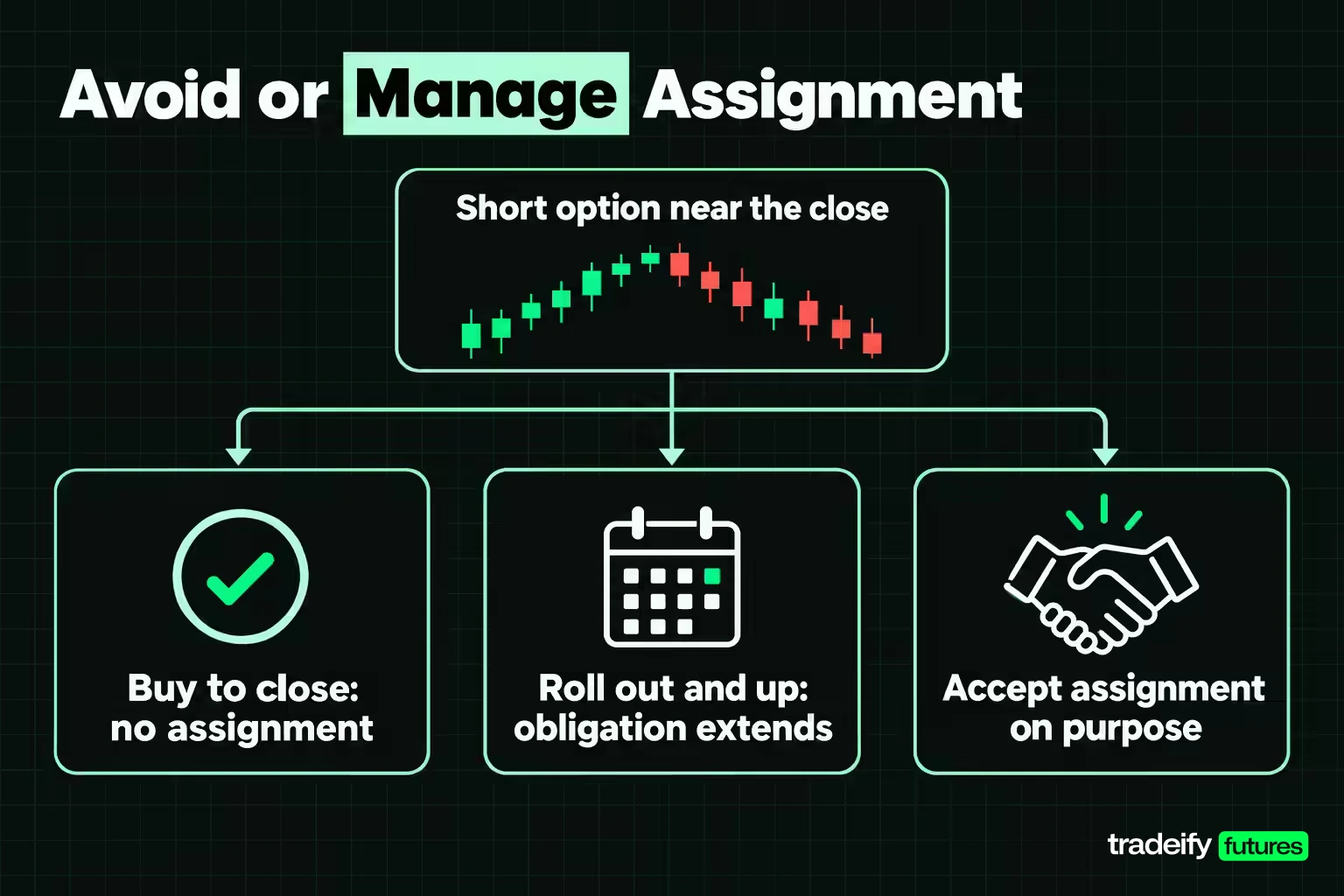
The only way to remove assignment risk completely is to close the short option before the market close. OIC's phrase for it is "when in doubt, close them out." Everything else in this section reduces, delays or prepares for assignment rather than eliminating it.
Buy to close before the close
Because OCC processes closing purchases before exercises and assignments are based on net positions after the close, a short option bought back during the session cannot be assigned that night. Check first that you have not already been assigned from a prior night, as OIC advises.
Closing can sting. A short call deep in the money costs close to its intrinsic value to buy back, and paying it feels like taking a loss on purpose. It isn't a new loss, though. It is the loss the position already had, paid on your schedule instead of the holder's.
Roll out and up
OIC describes rolling out and up for a covered call: buy back the current call and sell a higher strike in a later month. A roll can add time and room, but it also extends the obligation. A roll that only postpones a losing position, without improving its logic, is not automatically better than closing.
Related lesson: Managing and rolling options
Accepting assignment on purpose
If you are willing to be assigned, make it deliberate. Calculate the share position, the cash or margin it needs, your effective price and your next step before the close. A cash-secured put seller who wants the shares and a covered call seller happy to sell at the strike are both managing assignment, just by accepting it.
Pre-close assignment checklist
Run this assignment checklist before the close on any short option that is in the money, close to the money, near expiration or facing an ex-dividend date. The first four questions cover the contract and the clock:
- Is the option American-style or European-style?
- Is it physically settled, cash-settled or settled into futures?
- How much extrinsic value remains, using the midpoint?
- Is an ex-dividend date coming before expiration on a short call?
Account checks before assignment
Before the close on a short option at risk of assignment, these account checks decide whether you close, roll or accept:
- What position would assignment create, in shares and dollars?
- Can the account carry that position at the broker's margin terms?
- What is your broker's exercise cut-off, and does it differ from the exchange's?
- For spreads, have you decided whether you will exercise the long leg?
- Close, roll or accept? Decide now, not after the notice.
Managing the Fear of Assignment
The fear of assignment is common among new option sellers, and it usually shows up as a behavior: holding a losing short option too long because closing it "locks in" the loss, or closing every short option at the first sign of trouble because the idea of owning shares feels like a disaster.
Both reactions treat assignment as the problem. It usually is not. FINRA notes that a short option is already marked at market, so an account shows the unrealized loss on an in-the-money short option before anyone exercises. Assignment converts that open option loss into a stock position. It does not create the loss, and avoiding it does not erase the loss.
Rules that replace assignment anxiety
The useful move is to replace the vague worry with decisions you make before the trade:
- Size for the assignment, not the premium. If you could not carry 100 shares per contract at the strike, the position is too big.
- Decide your assignment answer at entry. Write down whether you would accept, roll or close if the option goes in the money.
- Set calendar alerts. Mark the ex-dividend date and the last trading day for every short option.
- Pick a close-out trigger. For example, close or roll when extrinsic value falls below a level you choose, or before any ex-date on an in-the-money short call.
- Know your broker's cut-off. The exchange deadline is 4:30 PM Central Time; your broker's is often earlier.
A trader who knows the answer in advance does not have to make it up at 3:55 PM on a Friday. That is the real cure for the fear: not certainty about whether assignment comes, but certainty about what you will do if it does.
Assignment Risk for Futures Traders
Assignment is an options concept, so a trader who only trades futures never receives an assignment notice. Futures contracts carry their own expiration and settlement rules, but there is no holder on the other side choosing when to exercise.
Futures traders meet assignment through options on futures. A short option on E-mini S&P 500 futures can be assigned into a short or long futures position, and the quarterly contracts are American-style. That converts a defined option trade into an open futures position with full point value, which is a very different risk overnight.
On our accounts, assignment does not come up at all. We don't offer options of any kind, so a Tradeify account trades futures only, and every position is closed by 4:45 PM ET on regular trading days with no overnight holds. The habit from this guide still carries over: know what each open position can turn into before the close, and decide before the deadline rather than after it.
Options Assignment Risk FAQ
Can an out-of-the-money option be assigned?
Yes. A holder of an American-style option can exercise at any time regardless of moneyness, and OIC notes that some writers are assigned on options that expire at or out of the money. After-hours price moves are the usual reason.
Can I be assigned on only part of my position?
Yes. Holders can exercise some contracts and keep the rest. OIC describes a trader short 10 contracts who was assigned one at a time on different days.
Does buying to close the same day prevent assignment that night?
Yes. Assignments are based on net positions after the close, and OCC processes closing purchases before exercises. It does not undo an assignment already made on an earlier night.
Can I be assigned while the stock is halted?
Yes. OIC says put writers must still buy at the strike if assigned during a halt, and holders can usually still exercise. Halts can also change how expiring options are processed.
How will I know I was assigned?
Your broker notifies you, usually before the next session opens. On expiration Friday, OIC notes you may not know until the following Monday.
Short Option Risk Note
Options involve risk and are not suitable for every investor. Selling options can create stock purchase or delivery obligations, sudden margin calls and, for uncovered calls, losses with no theoretical limit. Options on futures and futures themselves use leverage, so losses can exceed the amount you expected to risk. Simulated and funded prop accounts are simulated. This article is education only, not investment, tax or legal advice; check the contract specifications and your broker's exercise and assignment procedures before trading.


