



TL;DR: Short selling mechanics: borrow shares, sell them, then buy them back to return them, usually inside a margin account. Regulation T requires 150% of the short's value up front, and FINRA maintenance is at least 30%. Because that requirement grows as price rises, a short with a 40% house rule can face a call after a 7% move. Borrow fees, dividends owed, recalls and squeezes all sit between entry and exit. Futures shorts skip the borrow but still carry unlimited risk.
Short selling mechanics are the plumbing behind a bearish trade: where the shares come from, what the broker checks before your order goes in, how the account is margined while the position is open, and what can force you out before you choose to leave.
Most explanations stop at "sell high, buy back low." That's the idea, not the trade. A trader can be right about a stock falling and still lose money on the short because the borrow got recalled, the fee reset higher, or the margin requirement climbed faster than the account could carry it.
This guide walks a short sale from the locate to the buy to cover, prices the margin and carrying costs on one worked position, and then compares stock shorting with selling a futures contract, where the mechanics are completely different.
Related lesson: What a short position is compared with a long one
What Short Selling Is and How a Short Sale Works
A short sale is the sale of a stock you do not own, delivered with shares you borrow. The SEC's own summary puts it plainly: short sellers profit if the price drops and they buy back cheaper, and lose if the price rises.
The sequence has three parts:
- Borrow. Your broker lends you shares from its own inventory, from other clients' margin accounts, or from another lender.
- Sell. You sell those borrowed shares at today's price. The cash lands in your account, but it is not yours to spend.
- Buy to cover. Later, you buy the same number of shares in the market and they go back to the lender. The difference between your sale price and your buyback price, minus costs, is your result.
The proceeds stay in the account as collateral against the borrowed shares. That one detail explains most of what follows. A long position uses your cash to buy an asset. A short position creates a liability: you owe shares, and the dollar value of that debt moves with the stock price.
Why Short Selling Is Structurally Different From Buying
Three differences exist before the price moves at all:
- The sale has to be sourced. If no shares can be borrowed, you cannot short, no matter how strong your view is.
- The position costs money to hold. The lender charges for the loan, and any dividend the company pays is owed by you to the lender.
- The loss has no ceiling. A stock you buy can only fall to zero. A stock you short can keep rising, and the SEC describes the potential loss as unlimited for that reason.
Short selling is legal, and the SEC notes that the vast majority of short sales are. What's prohibited is abusive or manipulative shorting, such as selling to push a price down and induce others to sell. Short sellers also provide liquidity and let investors hedge long positions they already hold.
Short Selling Mechanics Step by Step
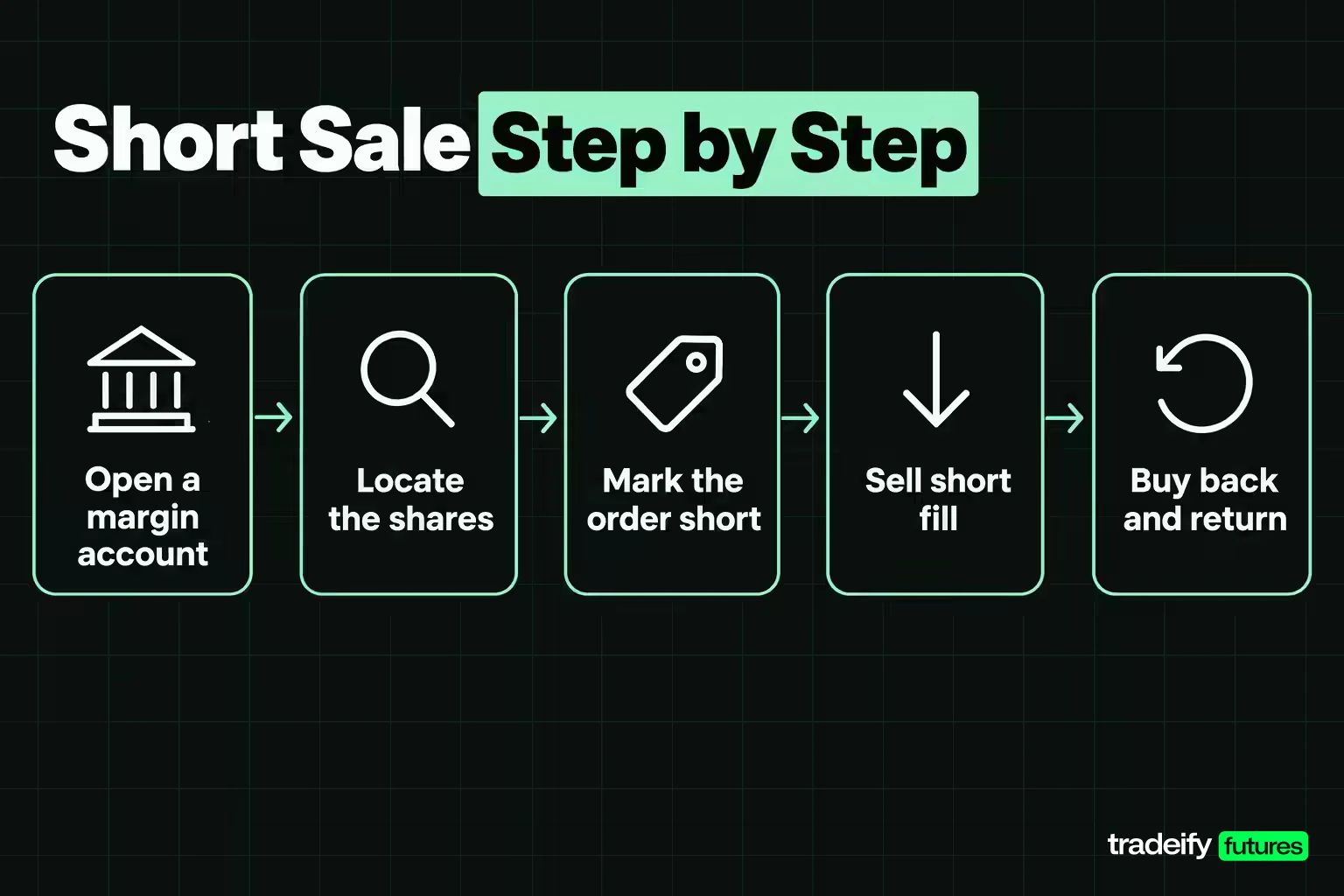
A short sale moves through the same stages in the same order every time. Retail traders usually see only the order ticket, but the steps around it decide whether the trade can happen and whether it can stay open.
Open a Margin Account Before Short Selling
Shorting requires a margin account, not a cash account, because the broker is extending you credit in the form of borrowed shares. FINRA Rule 4210 requires at least $2,000 of equity in a margin account, and brokers can require more for short selling privileges. Approval usually comes with a margin agreement that spells out the house requirements, interest rate and the broker's right to close positions.
The Locate, the Order Mark and the Fill
- The locate. Under Regulation SHO Rule 203(b)(1), a broker cannot accept a short sale order unless it has borrowed the shares, arranged to borrow them, or has reasonable grounds to believe they can be borrowed for delivery on time, and it must document that. This is why a stock can be shortable one morning and unavailable the next.
- The order mark. Rule 200(g) requires every sell order in a stock to be marked "long," "short" or "short exempt." You count as owning shares only to the extent of a net long position, so if you hold 300 shares and sell 500, at least the 200 you don't own are a short sale.
- The fill. You place a sell short order like any other, as a market or a limit order. On days when the stock has already fallen 10% or more, Regulation SHO's price test can stop a short from hitting the bid, so a limit on the offer may be the only way in.
- Delivery. US stock trades now settle one business day after the trade date (T+1, since May 28, 2024). Your broker's securities lending desk delivers the borrowed shares to settle the sale.
Monitoring the Short and Buying to Cover
- Monitoring. While the short is open, the broker recalculates your margin requirement against the current price, charges the borrow fee and interest, and debits any dividend owed to the lender.
- Buy to cover. You close the short by buying the shares back. The lender's loan is repaid with those shares, and the collateral is released.
One step can go wrong outside your control. A stock that looked borrowable on the trade date can stop being available before settlement. When delivery fails, Rule 204 requires the clearing firm to close out a short-sale fail by the start of regular trading hours on the settlement day after the settlement date, by borrowing or buying shares. Brokers typically pass that forced buy-in through to the customer's account, reducing or eliminating the short at whatever price the market offers.
Related lesson: How the broker borrows and delivers shares
Margin Requirements on a Short Position
Margin on a short position works in reverse from margin on a long. On a long, a falling price shrinks both your equity and the requirement. On a short, a rising price increases the value of the shares you owe, and the requirement is a percentage of that larger number.
The Rules Behind Short Margin
- Initial requirement. Regulation T requires 150% of the market value of a short sale. The sale proceeds supply 100%, and you deposit the other 50%.
- Maintenance requirement. FINRA Rule 4210 requires the greater of $5.00 per share or 30% of current market value for a stock shorted at $5.00 or above. The $5.00 per share amount governs below roughly $16.67, and the 30% figure governs above it.
- Low-priced stocks. For a short stock trading under $5.00, the requirement is the greater of $2.50 per share or 100% of market value.
- House requirements. Brokers can and often do set higher maintenance levels, especially on volatile or hard-to-borrow names.
Worked Example of a Short Margin Ladder
Imagine a trader shorts 500 shares at $40 (round, illustrative prices). The sale brings in $20,000. Regulation T requires a $30,000 credit balance, so the trader deposits $10,000. Account equity is the $30,000 credit minus the current value of the 500 shares owed.
The price at which equity falls to the requirement is the credit balance divided by the share count divided by one plus the requirement:
- At the 30% FINRA minimum: $30,000 / 500 / 1.30 = $46.15, a 15.38% rise.
- At an illustrative 40% house requirement: $30,000 / 500 / 1.40 = $42.86, a 7.14% rise.
- Zero equity: $30,000 / 500 = $60.00, a 50% rise.
| Share price | Value of shares owed | Account equity | 30% requirement | Room vs 30% | 40% requirement | Room vs 40% |
|---|---|---|---|---|---|---|
| $40.00 | $20,000.00 | $10,000.00 | $6,000.00 | $4,000.00 | $8,000.00 | $2,000.00 |
| $42.86 | $21,428.57 | $8,571.43 | $6,428.57 | $2,142.86 | $8,571.43 | $0.00 |
| $44.00 | $22,000.00 | $8,000.00 | $6,600.00 | $1,400.00 | $8,800.00 | -$800.00 |
| $46.15 | $23,076.92 | $6,923.08 | $6,923.08 | $0.00 | $9,230.77 | -$2,307.69 |
| $50.00 | $25,000.00 | $5,000.00 | $7,500.00 | -$2,500.00 | $10,000.00 | -$5,000.00 |
| $60.00 | $30,000.00 | $0.00 | $9,000.00 | -$9,000.00 | $12,000.00 | -$12,000.00 |
Read the two "room" columns side by side. At $44.00 this short still clears the regulatory floor with $1,400.00 to spare, yet it is already $800.00 short of the house number. In most accounts, the broker's own requirement triggers the margin call first, not the regulation.
A 50% rise wipes out the entire deposit. A long position bought with the same $10,000 would need the stock to go to zero to do that.
Related lesson: The deposit a short requires at entry
Short Selling Profit and Loss Limits

The profit and loss on a short sale are lopsided by construction. The best possible outcome is the stock going to zero, so the maximum gross gain equals the original sale proceeds. The worst outcome has no cap, because a share price has no ceiling.
Take an illustrative short of 500 shares at $40, with $20,000 of proceeds and a $10,000 deposit:
- Maximum gain: the stock falls to $0, and the gross gain is $20,000, or 100% of the proceeds.
- Loss at $60: 500 x $20 = $10,000, the whole deposit.
- Loss at $80: 500 x $40 = $20,000, twice the deposit. The account would owe money.
A Worked Short Sale Net of Costs
Imagine the trader covers at $34 after 60 days, with an assumed 3% annualized borrow fee and one $0.40 dividend paid while the position was open:
| Line item | Calculation | Amount |
|---|---|---|
| Gross gain | 500 x ($40 - $34) | $3,000 |
| Borrow fee | $20,000 x 3% x 60/365 | -$98.63 |
| Payment in lieu of dividend | 500 x $0.40 | -$200 |
| Net before commissions and interest | $3,000 - $98.63 - $200 | $2,701.37 |
| Return on the $10,000 deposit | $2,701.37 / $10,000 | 27.01% |
Notice the scale. The gain needed a $6 drop. A $20 rise would have erased the deposit. That asymmetry is why short sellers obsess over exits: there's a natural limit to how much a short can make and no natural limit to how much it can lose.
The Costs of Holding a Short Position
A short position pays rent every day it stays open. Three charges apply to a short that do not apply to the same stock held long.
- Borrow fees. The lender is paid for the loan. Easy-to-borrow stocks are cheap to short. On hard-to-borrow names the fee can exceed the interest the broker earns on your collateral, which means you pay out of pocket just to keep the position.
- Margin interest. Your broker charges interest under the terms of your margin agreement. The rate is set by the broker, not by regulation.
- Payments in lieu of dividends. You don't own the shares, so you don't receive dividends. If the company pays one while you're short, you owe the lender an equal cash amount.
How Holding Time Changes a Short Sale
Carrying costs scale with time. On an illustrative short of 500 shares at $40 ($20,000 of proceeds, $10,000 deposited), a 3% borrow fee costs $600 a year, and four $0.40 quarterly dividends add $800. Together that's $1,400, or 14% of the $10,000 deposit, before the stock moves a cent.
That changes the math between a short held for a session and one held for months. An intraday short barely touches the dividend calendar and accrues little fee. A multi-month short has to fall far enough to pay its rent first. If the thesis needs eight weeks to play out, price eight weeks of carry into the plan, plus every ex-dividend date in that window.
Recalls End a Short on Someone Else's Schedule
Borrowed shares can be called back. A lender that wants to sell its shares can recall them, and if your broker can't find a replacement borrow, your short gets bought in. A recall doesn't care whether your thesis is working, and it rarely comes at a convenient price. Names with unstable borrow availability carry this risk most, and they tend to be the same crowded names where buy-ins hurt most.
Short Squeeze Risk and Forced Buy-Ins

A short squeeze happens when a rising price forces short sellers to cover, and covering means buying. That buying pushes the price higher, which forces more shorts to cover. The SEC staff described this loop directly: buy-to-cover volume that raises prices and forces further buying "is often referred to as a 'short squeeze.'"
The GameStop Case in Numbers
GameStop in January 2021 is the reference case. According to the SEC staff report on early 2021 market conditions, GME short interest reached 122.97% of float, which is possible when the same shares are lent more than once. The stock closed at $347.51 on January 27, 2021, more than 1,600% above its January 11 close (pre-split prices).
The same report adds a caveat worth keeping. Staff concluded that buying to cover started the run but that positive sentiment, not short covering, sustained the weeks-long rise. A squeeze can trigger a move that other buyers then carry much further.
Three Mechanical Sources of Short Squeeze Risk
Squeeze risk comes from three mechanical sources, and all of them force you to buy at a time you didn't choose:
- Margin calls. As the price rises, the requirement rises with it. Accounts that can't meet the call get covered by the broker.
- Recalls and fails. When lenders want their shares back or borrow dries up, Rule 204 close-outs turn into forced purchases.
- Crowding. When a large share of the float is short, the exit door is narrow. Everyone covering at once is the squeeze.
Short interest is the standard crowding gauge. FINRA Rule 4560 requires member firms to report short positions in every equity twice a month, and the reports are due by 6 PM ET on the second business day after the reporting settlement date. That means the figure you read is always days old, and a crowd can form between reports. Lists of the "most shorted stocks" are built from this data, change every reporting cycle, and say nothing about timing on their own.
Related lesson: How slippage behaves when a forced cover has to buy
Market Conditions and Timing for Short Selling
Short selling works best when the market context, the stock's own story and the mechanics all agree. A good bearish thesis in the wrong conditions is still a bad short.
Trend, Catalyst and Dividend Checks Before Shorting
- Trend context. Shorting a stock in a broad downtrend means the market's drift helps you. Shorting into a strong uptrend means fighting it, and the margin math punishes you faster when you're wrong.
- Scheduled catalysts. Earnings reports, guidance updates and major economic releases can gap a stock overnight. A short held through one is a bet on the event, so size it like one.
- Ex-dividend dates. Holding a short through an ex-dividend date means you owe the payment. Check the calendar before you choose a holding period.
How the Short Sale Price Test Affects Timing
Regulation SHO Rule 201 changes the mechanics on days a stock falls hard. Once a stock drops 10% or more from the prior close (from a $40 close, that's $36.00 in round numbers), short sales can't execute at or below the national best bid for the rest of that day and the next. You can still short, but you have to rest on the offer and wait for a buyer. Chasing a stock that has already collapsed is exactly when the rule slows you down.
Identifying Short Selling Candidates
Traders who short individual stocks usually screen for a combination of:
- Weak fundamentals. Deteriorating revenue, shrinking margins, rising debt or a valuation the business can't support.
- Broken price structure. Failed rallies, lower highs, and a loss of key support on rising volume.
- Manageable crowding. Enough short interest to confirm others see the problem, but not so much that a squeeze becomes the main risk.
- Borrow you can actually get. A stable, affordable borrow matters as much as the thesis. If the fee is high and availability is thin, the market is telling you the trade is crowded.
Stop Losses and Sizing for a Short Sale
A short sale's stop sits above the entry, and it has to sit inside the price where the margin requirement breaks. If the stop is beyond the breach price, the broker may reduce the position before your plan ever executes.
Applying the 7% Sell Rule to a Short
The "7% sell rule" comes from Investor's Business Daily's guidance for stock buyers: sell a stock if it falls 7%-8% below what you paid, with tighter cuts of 3%-5% in weak markets. It was written for long positions, but traders sometimes mirror it for shorts by cutting a loss 7% above the entry.
Take an illustrative short of 500 shares at $40 with a $10,000 deposit. A 7% stop sits at $42.80. That risks 500 x $2.80 = $1,400. It also sits just below $42.86, the price where a 40% house requirement on that position would trigger a margin call ($30,000 credit / 500 / 1.40). A high house requirement leaves almost no room between a sensible stop and a forced cover.
Sizing a Short Sale From the Stop
Work backward from what you can afford to lose, not forward from how sure you feel. With a $1,000 risk budget and a $2.80 stop distance, $1,000 / $2.80 = 357 shares, which risks $999.60.
Two cautions apply to every short stop:
- Stops don't cap gaps. A stock that opens far above your stop fills you at the open, not at your level. Earnings gaps and squeezes are exactly when this happens.
- A buy stop adds to buying pressure. In a squeeze, your stop is one more forced buyer. Many traders use smaller size on crowded names rather than relying on the stop alone.
Related lesson: Sizing a position so the breach price stays outside the stop
Naked Short Selling and the Delivery Rules
Naked short selling means selling short without borrowing or arranging to borrow the shares in time for delivery, which produces a "failure to deliver." The SEC is careful here: naked shorting is not automatically illegal. Bona fide market makers are excepted from the locate requirement because they sometimes have to sell into sudden demand, though they are still subject to the close-out rules.
For everyone else, the rules tighten in layers:
- Locate first. Shorting without a locate violates Regulation SHO for anyone outside bona fide market making.
- Rule 10b-21. Adopted in 2008, the "naked" short selling antifraud rule makes it fraud to deceive a broker or buyer about your ability to deliver and then fail to deliver.
- Threshold securities. A stock goes on a threshold list after five consecutive settlement days of aggregate fails of 10,000 shares or more that also equal at least 0.5% of shares outstanding.
- Mandatory close-out. Fails in a threshold security that persist for 13 consecutive settlement days must be closed out by purchase, and firms that miss close-outs face a pre-borrow requirement before any new shorts in that stock.
For a retail trader, the practical effect is simple. You can't naked short through a normal broker, and a stock with heavy fails can become harder or more expensive to short overnight.
Alternatives to Short Selling Stock
Selling borrowed stock is only one way to profit from a decline. Each alternative changes the mechanics, the cost and the shape of the risk.
Inverse ETFs and the Daily Reset
Inverse ETFs, sometimes called "short" funds, aim to deliver the opposite of an index's daily return using swaps, futures and other derivatives. The SEC's investor bulletin warns that most reset daily, so returns over longer periods can differ sharply from the daily target.
Here's how that plays out with round, illustrative numbers. An index rises from 100 to 110, then falls back to 100.00. A -1x daily fund drops from 100 to 90, then rises 9.09% to 98.18. The index is flat, but the inverse fund is down 1.82% before fees. You can't lose more than you invest in an inverse ETF, but holding one for weeks is not the same as being short.
Put Options and Short Puts
A long put gives you the right, not the obligation, to sell at the strike price. The most you can lose is the premium, which makes it a defined-risk bearish position.
A short put is the opposite trade and is not bearish at all. The put writer collects a premium and stands ready to buy the stock at the strike if assigned. A short put profits if the stock stays above the strike and loses if it falls well below it, so people searching for "short put" often mean something very different from "shorting."
Futures Shorts and Pairs Trades
Selling a futures contract is a short with no borrow, no locate and no dividend owed, though losses remain unlimited and the account is marked to market daily. Advanced traders also use pairs trades, shorting a weak stock while holding a stronger one in the same sector, which reduces exposure to the broad market but introduces two sets of borrow and execution risk.
| Method | Borrow needed | Maximum loss | Main cost or drag |
|---|---|---|---|
| Short stock | Yes | Unlimited | Borrow fee, interest, dividends owed |
| Inverse ETF | No | Amount invested | Daily reset drift, fund expenses |
| Long put | No | Premium paid | Time decay of the premium |
| Short futures contract | No | Unlimited | Daily mark to market, commissions |
Related lesson: How a put option works
Short Selling Mechanics in Futures Compared With Stocks
Shorting in futures uses the same word but different plumbing. You don't borrow anything. Selling a futures contract simply opens the short side of a new contract, and every open futures contract has one long and one short. The CFTC defines futures short selling as selling a contract with the idea of offsetting it, or delivering on it, later.
That removes most of the stock-shorting machinery:
- No borrow, no locate, no recall. There is no lender, so there is no borrow fee and nobody can call the position back.
- No dividend obligation. A futures contract is not a share.
- Margin is a performance bond. The CFTC states that futures margin "is not partial payment on a purchase." It's a good-faith deposit against losses.
- Daily mark to market. Gains and losses are settled in cash at the end of each session, rather than building into a rising requirement on a borrowed asset.
A Worked Futures Short
Imagine a trader sells one Micro E-mini S&P 500 (MES) contract at 6,900, a round illustrative level. MES is worth $5 per index point, so the position controls $34,500 of notional value. If the index falls to 6,870, the 30-point drop is worth $150. A 12-point stop above entry risks $60. The same 30 points on the full-size E-mini (ES, $50 per point) is $1,500, and the same 12-point stop risks $600.
The risk is still unlimited in direction. An index or commodity can rally hard, and a short futures position loses the full dollar value of every point. Leverage makes that loss large relative to the deposit.
| Mechanic | Short stock | Short futures contract |
|---|---|---|
| What you sell | Borrowed shares | A new contract you never held |
| Borrow and locate | Required | Not applicable |
| Dividends | Owed to the lender | None |
| Margin | 150% initial, 30% minimum maintenance | Performance bond per contract |
| Holding cost | Borrow fee and interest | Commissions, no borrow fee |
| Forced exit risk | Margin call, recall, buy-in | Margin call, liquidation |
On our accounts, futures are the only way to go short. We don't offer cash stocks, options or single stock futures, so there's no borrowing, locating or dividend tracking. You simply sell a supported contract such as ES, NQ, CL or GC. All positions close by 4:45 PM ET, so every short is intraday. A short in one product against a long in a correlated product from the same group, such as long ES and short NQ, counts as prohibited hedging, even across accounts. Funded accounts are simulated.
Short Selling FAQ
How do you short sell stocks as a beginner?
Open a margin account, confirm the broker can locate shares, and check the current borrow fee. Place a sell short order with a stop above the entry that sits inside your margin breach price. Size the position from the stop, not from conviction.
What are the 5 most shorted stocks?
There is no fixed top five, because the most shorted stocks change every time firms report short interest to FINRA, twice a month. Exchanges and data providers rank stocks by short interest as a percent of float, and any list goes stale quickly. A heavily shorted stock is a squeeze candidate as much as a bearish signal.
What is the 7% sell rule?
The 7% sell rule is Investor's Business Daily guidance to sell a stock that falls 7%-8% below your purchase price. It is a loss-cutting rule for long positions. Some traders mirror it on shorts by covering 7% above the entry.
What is a short put option and how does it work?
A short put means selling a put option and collecting the premium. The seller must buy the stock at the strike price if assigned. It profits if the stock stays above the strike and loses if the stock falls, so it is a bullish or neutral trade, not a bearish one.
Is short selling legal?
Yes. Most short selling is legal and regulated under Regulation SHO. Manipulative shorting and deceiving a broker about delivery are illegal.
Can you lose more than you invest when short selling?
Yes. A short stock or short futures position can lose more than the deposit, because there is no ceiling on how far a price can rise. Brokers can close positions without notice when the account falls short.
Before Your Next Short Sale
A short sale is ready when you can answer five questions with numbers rather than hopes:
- Can the shares be borrowed today, and at what fee?
- At what exact price does your broker's requirement break?
- Does your stop sit inside that breach price?
- What will borrow fees, interest and dividends cost over your planned holding period?
- How crowded is the short, and what happens to your exit if everyone covers at once?
If any answer is a guess, the mechanics are still deciding the trade for you.
Short selling, margin trading and futures involve substantial risk, and losses on a short position can exceed the money deposited. All prices, fees and requirements in this guide are illustrative examples built from published rules, not live quotes or recommendations. Borrow availability, house requirements and fees vary by broker and can change at any time. Simulated and funded accounts are simulated and differ from live markets. This article is education, not individual advice.


