



TL;DR: Rolling options means closing one contract and opening another on the same underlying, with a later date, a new strike, or both. Judge a roll by the new position's risk and purpose, not by whether the ticket shows a credit. Closing the old leg locks in its result, and the new leg starts its own clock, assignment risk and cost. In a model covered call, a $0.40 debit roll lifts the assignment price from $106.65 to $111.25.
You sold a covered call, the stock ran straight through your strike, and expiration is a week away. Or you bought a call, your view still looks right, and the clock is about to beat you to it. Either way the same idea shows up on the order ticket: roll it.
Rolling options can buy more time, move the strike, or both. What it cannot do is rewrite the first trade. It closes one contract and opens another, and the new contract deserves the same scrutiny you would give any fresh position.
The sections below cover the mechanics, each type of roll, worked examples on covered calls, cash-secured puts and long calls, and the costs, risks and tax questions that come with rolling.
What Rolling Options Means
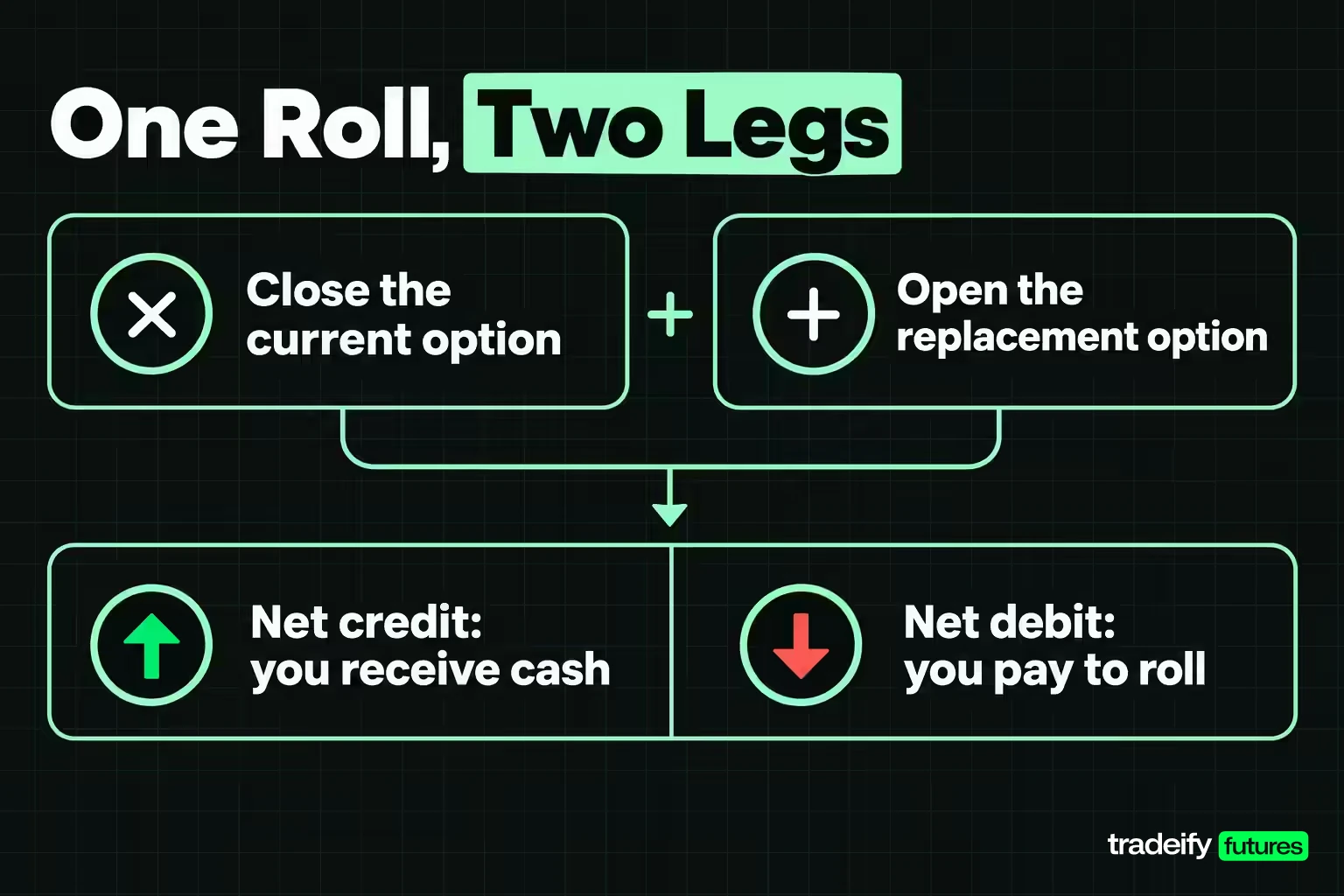
Rolling options means closing an open option and opening a new option on the same underlying asset, usually in one order. The new contract normally has a later expiration, a different strike price, or both.
Most broker platforms let you send the two legs as a single "roll" or spread order. Economically you are still making two trades:
- Buy or sell to close the current option.
- Buy or sell to open the replacement option.
The first trade realizes the gain or loss on the old contract. The second trade starts a new position with its own premium, strike, expiration, Greeks, liquidity and assignment exposure.
Contract size and the roll ticket
Equity option contracts usually represent 100 shares of the underlying stock, so every $0.10 of option price is $10 per contract. Corporate actions such as splits or mergers can produce adjusted contracts with a different deliverable, so check the contract terms before doing share math on an older position.
Most monthly equity options stop trading on the third Friday of the expiration month, and many stocks also list weekly expirations. A roll ticket shows both legs, the expiration of each, and one net price for the package.
Reading the net credit or debit on a roll
The net price of an options roll is the premium from the new option minus the cost to close the old one.
For a short option (a covered call or cash-secured put):
- A positive result is a net credit: you receive cash on the roll.
- A negative result is a net debit: you pay to roll.
For a long option the directions flip. You sell the old contract and buy the new one, so a roll to a cheaper contract brings in a credit and a roll to a more expensive one costs a debit.
One habit keeps the math honest. Track the old trade's realized result and the new position's risk as two separate lines. A $0.40 credit on a roll does not mean the trade made $0.40. It means the package of "close this, open that" brought in $0.40 per share before fees, on top of whatever the first trade already won or lost.
Rolling Options Strategies by Direction
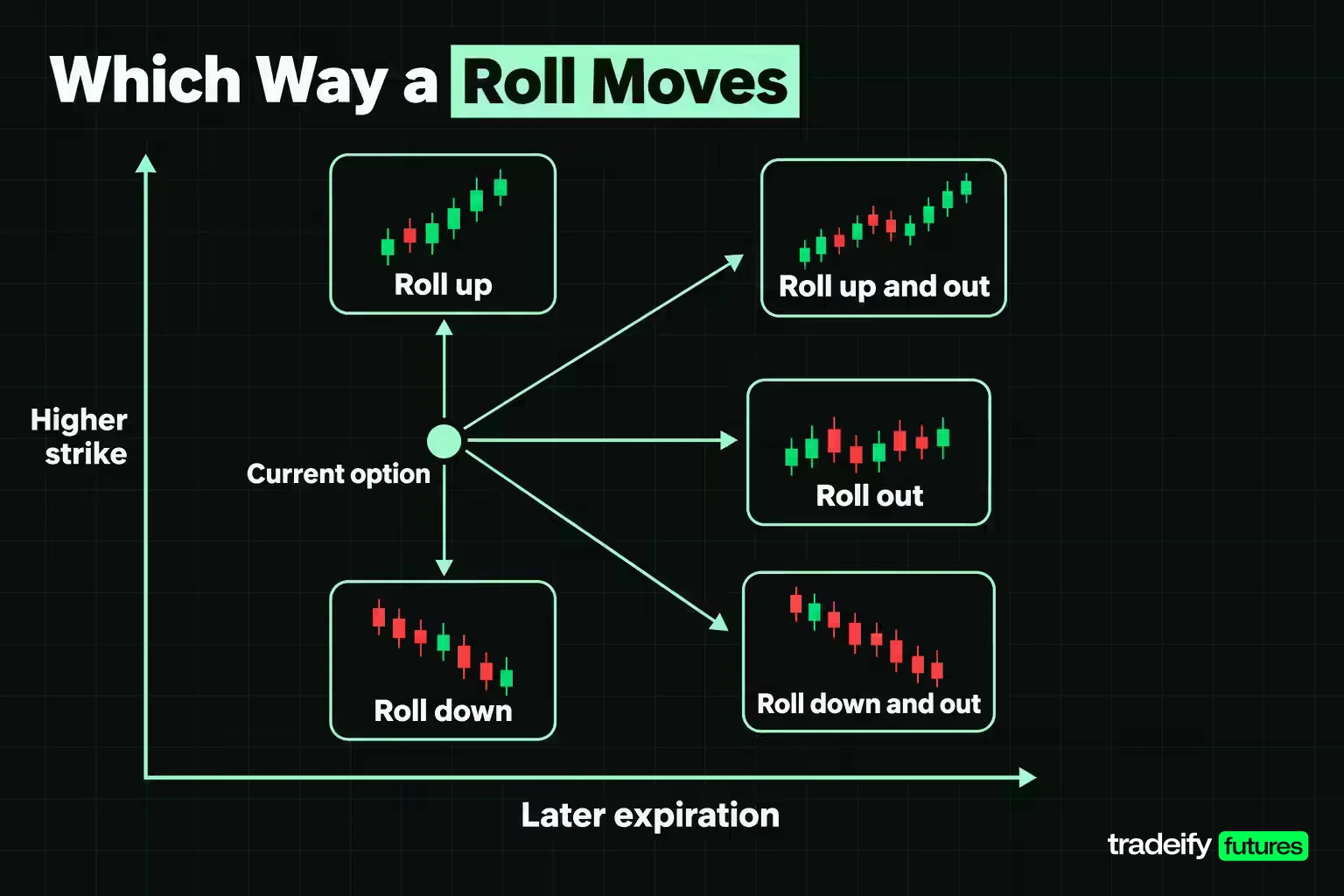
Every options roll changes time, strike, or both. The names describe the mechanics. They do not tell you whether the adjustment is smart.
| Roll type | What changes | Typical reason |
|---|---|---|
| Roll out | Same strike, later expiration | Keep the position and its strike, add time |
| Roll up | Higher strike, same expiration | Raise a covered call's cap or bank part of a long call gain |
| Roll down | Lower strike, same expiration | Lower a cash-secured put's purchase price or reset a long put |
| Roll up and out | Higher strike, later expiration | Defend a covered call after a rally, often for a small debit or credit |
| Roll down and out | Lower strike, later expiration | Defend a cash-secured put after a drop |
| Diagonal roll | Different strike and expiration on the long or short leg of a spread | Re-center a spread around the current price |
A calendar-style roll keeps the strike and only moves the expiration, which is the same as rolling out. Traders running calendar spreads use it to replace the short near-term leg once it decays, while the longer-dated leg stays in place.
Direction matters differently for calls and puts. Rolling a short call up moves the strike away from the stock after a rally, which lowers assignment odds. Rolling a short put down does the same after a drop. Rolling a long call up does the opposite: it reduces exposure and usually pulls cash out of the trade.
When you write down a roll, name the exact old and new contracts (for example, "buy to close the 7-day $105 call, sell to open the 35-day $110 call"). A label like "rolled up and out" is too vague to review later.
Offensive vs Defensive Rolling Options
Rolling options falls into two broad camps, and mixing them up is how traders end up rolling for the wrong reason.
Defensive options rolls
A defensive roll responds to a threat. A covered call is deep in the money and you would rather keep the shares. A cash-secured put is under water and you are no longer comfortable buying at that strike yet. A short option sits near the money a few days before an ex-dividend date.
The goal of a defensive roll is to change the obligation: push it later, move it further from the stock, or both. The cost usually shows up as a smaller credit, a debit, or more time with your capital tied up.
Offensive options rolls
An offensive roll acts on a trade that is working. The classic case is a long call that has gained a lot of value. Rolling it up to a higher strike sells the expensive contract, buys a cheaper one, and moves part of the gain into cash while keeping some upside.
Using round illustrative numbers from a Black-Scholes model: a 60-day $100 call bought for $5.15 is worth $12.85 after the stock rallies to $112. Selling it and buying a $115 call with the same 35 days left at $3.05 brings in a $9.80 credit, and the amount still at risk falls to $305 per contract.
How to tell an offensive roll from a defensive one
Ask what problem the roll solves. If the answer is "the trade is working and I want to bank some of it while staying in," it is offensive. If the answer is "I don't want to be assigned" or "I'm not ready to take this loss," it is defensive, and the second version of that answer deserves a hard look.
When to Roll Options
There is no single right day to roll an option. There are signals that make the question worth asking, and one test that should decide it.
Signals that prompt an options roll
- Little time left with the thesis intact. In the last few weeks before expiration, time value on a near-the-money option changes fastest. If your view still needs time to play out, a later contract may express it better than the one about to expire.
- The strike no longer fits. A covered call written at a strike the stock has blown through, or a long call so deep in the money that it behaves almost like stock, may call for a new strike.
- Assignment odds are rising. Short in-the-money options get assigned more often as expiration nears. Before an ex-dividend date, call holders may exercise early to capture the dividend, which raises the odds for in-the-money short calls.
- An event sits inside or just past expiration. Earnings or a known announcement may make you want the option to expire before the event, or after it.
- A profit target is hit early. A short option that has lost most of its value can be closed and re-opened further out to collect fresh premium, if you still want the exposure.
Related lesson: How the option Greeks work together
The "would I open this today" test
Before rolling, ask one question: if you had no position at all, would you open the new contract at this price today?
That question catches the most common rolling mistake. Closing a losing trade feels like admitting defeat, so a trader accepts a weak new setup to avoid the feeling. The market does not care what the first contract cost. The replacement has to stand on its own.
When not to roll
Skip the roll when its only job is to postpone a loss, when the bid-ask spread on either leg is wide, when the new contract trades thinly, when the debit pushes total risk past the limit you set at entry, or when you cannot state the exit rule for the new position. Closing and staying flat is a valid choice, and waiting for a cleaner setup is often the better trade.
Benefits of Rolling Options
Rolling options earns its place when it serves a plan written before the trade. Each benefit below has a matching cost, and both belong in the decision.
- More time for a thesis. A later expiration gives a slow-developing view room to work. The cost is more time value paid on long options, or a longer obligation on short ones.
- Control over assignment. Rolling a short call or put away from the money can lower the chance of being assigned before you are ready. The cost is usually a smaller credit or a debit.
- A strike that matches the current price. A roll can reset a covered call's cap after a rally or a cash-secured put's purchase price after a drop.
- Banking gains without leaving. An offensive roll on a long option turns part of a paper gain into cash while keeping some upside.
- Repeat premium on income strategies. Covered call and cash-secured put writers often roll to collect new premium instead of letting an option expire and starting over. The primary motive of a covered call, as the Options Industry Council describes it, is premium income.
- Fewer moving parts. A single multi-leg order can reduce legging risk compared with two separate orders, because both legs are priced as one package.
None of these benefits make a losing idea a winning one. A roll that adds time to a broken thesis simply buys more of the same problem.
Rolling Covered Calls
Rolling covered calls is the most common roll in practice. The OIC frames a covered call as a stock position with a chosen exit price (strike plus premium), and assignment at that price can be seen as success. Rolling only makes sense when you would genuinely rather keep the shares or move that exit price.
Covered call roll example with four choices
Every number here is illustrative, from a Black-Scholes model with 30% implied volatility and a 4% rate, rounded to $0.05.
Imagine a trader who owns 100 shares bought at $95. With the stock at $100, they sell a 30-day $105 call for $1.65 ($165). The stock then rallies to $108. With 7 days left, buying the call back costs $3.70. Closing it realizes a loss of $2.05 per share ($205) on the option, while the shares have gained $13 per share.
| Covered call choice | Net roll cash per share | Cumulative premium | Effective sale price if assigned | Gain vs $95 basis |
|---|---|---|---|---|
| Let assignment happen at $105 | None | $1.65 | $106.65 | $11.65 |
| Roll out to the 35-day $105 call at $5.85 | $2.15 credit | $3.80 | $108.80 | $13.80 |
| Roll up and out to the 35-day $110 call at $3.30 | $0.40 debit | $1.25 | $111.25 | $16.25 |
| Roll up and out to the 35-day $112 call at $2.55 | $1.15 debit | $0.50 | $112.50 | $17.50 |
The gain column assumes assignment at expiration of the new contract and ignores fees. It is a ledger result under one path, not a forecast.
Trade-offs in each covered call roll
In this covered call example (shares bought at $95, a 7-day $105 call, stock at $108), each roll keeps the shares exposed for 28 more days. If the stock falls back to $95, the higher cap means nothing and the extra premium is the only cushion.
The same-strike roll collects the biggest credit, but the $105 call stays in the money with a delta of about 0.76, so early assignment can still happen, especially before an ex-dividend date. The $110 roll costs $0.40 to raise the cap by $4.60 per share (from $106.65 to $111.25), and its delta of about 0.46 means assignment is roughly a coin flip on the model's numbers.
The trade-off is easy to miss. The credit roll looks best on the ticket and worst on upside. The debit rolls look worse on the ticket and keep more of the rally. Which one fits depends on whether you want to keep the shares, not on which number is green.
Rolling Cash-Secured Puts
Rolling cash-secured puts is the mirror image of the covered call roll. The OIC describes the cash-secured put as primarily a stock acquisition strategy: you sell a put, set aside the cash to buy the shares, and accept assignment as a valid outcome. Rolling is the choice to delay or reprice that purchase.
Cash-secured put roll example with four choices
Illustrative model numbers again (30% implied volatility, 4% rate, rounded to $0.05).
With a stock at $100, a trader sells a 30-day $95 put for $1.35 ($135) and sets aside $9,500. Twenty days later the stock is at $91, the put has 10 days left, and buying it back costs $4.40. Closing it realizes a $3.05 per share ($305) loss on the put.
| Cash-secured put choice | Net roll cash per share | Cumulative premium | Effective purchase price if assigned | Cash set aside |
|---|---|---|---|---|
| Accept assignment at $95 | None | $1.35 | $93.65 | $9,500 |
| Roll out to the 45-day $95 put at $5.90 | $1.50 credit | $2.85 | $92.15 | $9,500 |
| Roll down and out to the 45-day $92.50 put at $4.40 | Even | $1.35 | $91.15 | $9,250 |
| Roll down and out to the 45-day $90 put at $3.10 | $1.30 debit | $0.05 | $89.95 | $9,000 |
Accepting assignment means owning the stock at an effective $93.65 while it trades at $91, an unrealized loss of $2.65 per share ($265). Every roll adds 35 days of exposure to a stock that has just dropped 9%.
Reading the cash-secured put choices
The same-strike roll lowers the effective price the most per dollar collected, but it keeps you committed to buying at $95 after the market has already said $91. The $90 roll moves the purchase price below today's price, but it costs a debit and wipes out nearly all the premium collected.
The honest question is the one the OIC raises about cash-secured puts in general: is the strike still a price you are comfortable owning the stock at, no matter how low it goes? If yes, assignment may be the cleanest outcome. If no, a roll does not fix that, and closing the put may be the better decision.
Rolling Options Examples With a Long Call
Long options are rolled less often than short ones, but the math is the same: track the old result and the new risk separately. These examples use the same illustrative Black-Scholes inputs (30% implied volatility, 4% rate, rounded to $0.05).
Offensive roll up on a winning call
A trader buys a 60-day $100 call for $5.15 ($515) with the stock at $100. After 25 days the stock is at $112, the call is worth $12.85 ($1,285) and its delta is about 0.90, so it now moves almost like 90 shares.
| Long call choice | Net cash in per contract | New contract cost | Remaining delta | Cash banked vs $515 paid |
|---|---|---|---|---|
| Hold the $100 call | $0 | None | 0.90 | $0 |
| Roll up to the 35-day $110 call at $5.45 | $740 | $545 | 0.61 | $225 |
| Roll up to the 35-day $115 call at $3.05 | $980 | $305 | 0.42 | $465 |
| Close and walk away | $1,285 | None | 0 | $770 |
The $115 roll realizes a $770 gain on the first call and spends $305 on the new one, so $465 is banked even if the new call expires worthless. The trade-off is upside: the position now carries less than half the delta it had, so a further rally earns much less.
Why the long call roll is not "free money"
The credit from a roll up is your own gain coming back to you, minus the price of the new contract. It is not a bonus. If the stock keeps climbing, holding the original call or closing it outright may both beat the roll. The roll is a middle choice: bank some, keep some, and accept a defined smaller stake.
Rolling a Losing Options Position
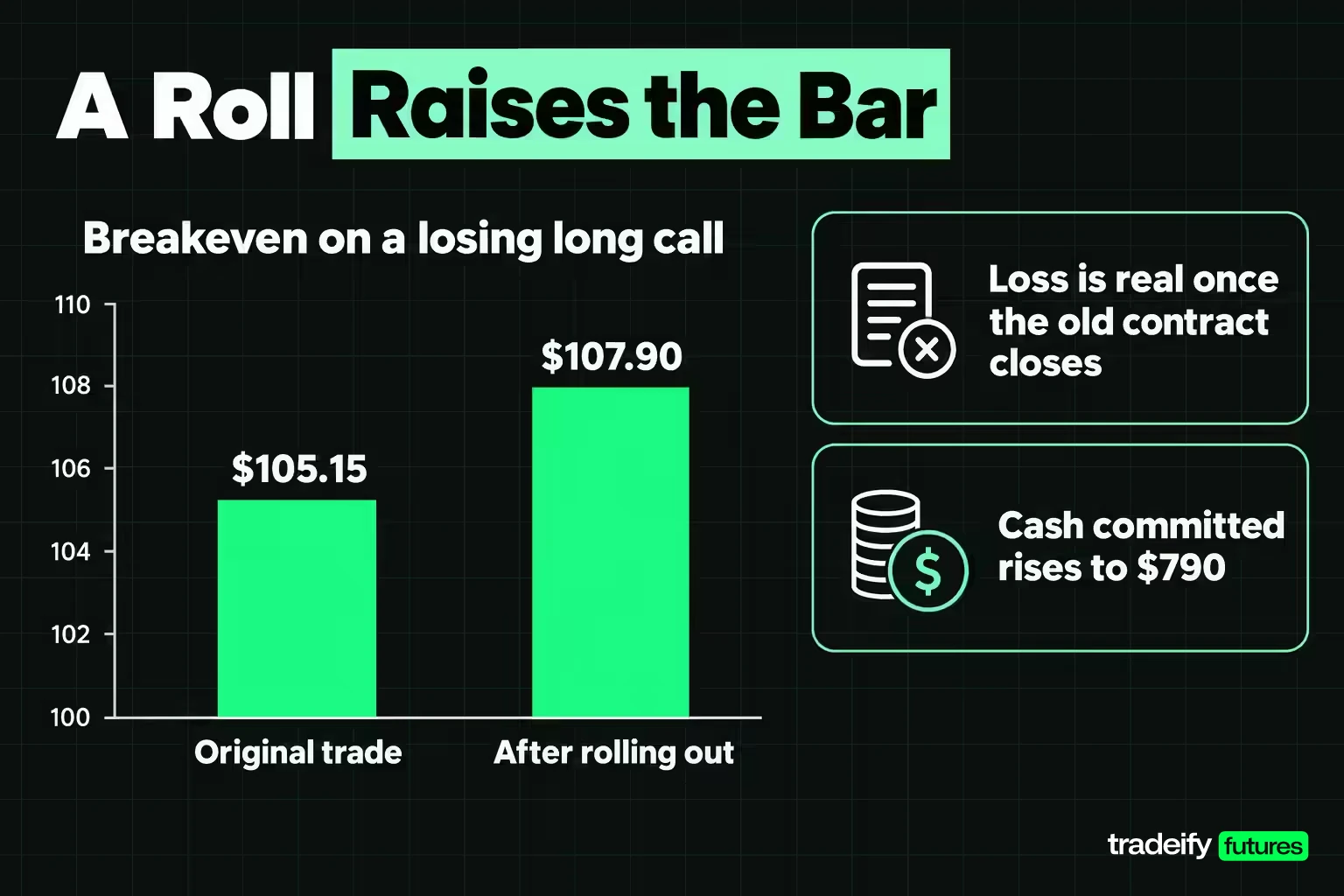
Rolling a losing options position is where rolling does the most damage, because a roll can make a realized loss feel like a "work in progress." The loss is real the moment the old contract closes.
Losing long call example
Same starting trade (illustrative model numbers): a 60-day $100 call bought for $5.15. This time the stock falls to $95 and, with 14 days left, the call is worth $0.65.
- Closing now realizes a $4.50 loss per share ($450).
- Rolling out to the 74-day $100 call costs $3.40, a $2.75 net debit ($275).
- Total cash committed to the idea becomes $7.90 ($790): $5.15 + $3.40 - $0.65.
- The combined breakeven at the new expiration rises to $107.90, versus $105.15 on the original trade.
The roll added 60 days. It also added $340 at risk on the new contract and moved the bar the stock has to clear higher. If the original thesis was "this stock rallies in two months," the roll quietly changes it to "this stock rallies further, over four months."
A roll budget for losing options trades
Set a roll budget before the first trade: the maximum total capital you will commit to one idea, including every later roll. Once rolls would push past it, close. Count each roll's debit against your per-trade risk limit, exactly as if it were a new trade, because it is one.
A defensive roll of a short option works the same way. Rolling a losing covered call or cash-secured put for a credit can still increase the total obligation if the new strike is worse or the time is longer.
Risks of Rolling Options
Rolling options changes a position. It does not remove options risk, and it adds a few risks of its own. The main downsides of rolling options, in short:
- Costs compound, because every roll pays commissions and the bid-ask spread on two legs.
- The old result is final, so a roll cannot reverse a realized loss.
- The market can keep moving against the new contract, now for longer and sometimes at a worse strike.
- Short options stay open to assignment until the close leg fills.
- A chain of rolls can turn a defined-risk idea into an open-ended commitment.
Assignment can arrive while a roll is pending
As long as a short American-style option stays open, it can be assigned on any day the market is open, FINRA notes. The Options Clearing Corporation assigns exercise notices randomly to firms with short positions, and each firm passes them to customers at random or by its own procedure. If the close leg of your roll has not filled, the old short option is still live.
Expiration adds a trap. The OIC notes that a covered call that expired slightly out of the money may still have been assigned, with notification arriving the following Monday. Confirm the old contract's status before trading the shares.
Related lesson: Options assignment risk
Legging risk on a two-step roll
Entering the close and the open as separate orders exposes you to the price moving between fills. You can end up closed with no new position, or holding both. A single multi-leg order prices the package together, though fills still depend on the market and order terms.
More time means more exposure
A later expiration gives a thesis more room. It also keeps the position open to adverse moves, implied-volatility shifts and events for longer. For short options, the obligation and the cash or margin set aside stay tied up.
A credit can hide a worse trade
A small credit can come with much more time, a less favorable strike or a larger tail risk. Judge the full package: the realized result on the old contract, the new maximum loss or obligation, the added time, the capital commitment, liquidity and fees.
Costs that compound with every roll
Each roll pays commissions on two contracts and gives up part of the bid-ask spread on both legs. On a single roll that may be a few dollars per contract. On a covered call rolled every month for a year, it is 24 contract trades and 24 spreads, and that friction comes straight out of the premium the strategy exists to collect.
The endless roll
The quietest risk is behavioral. Each roll feels like a small, reasonable step, but a chain of rolls can turn a defined-risk trade into an open-ended commitment. Writing down the roll budget and exit rule before the first roll is the defense.
Costs and Implied Volatility in an Options Roll
The price of an options roll has three parts: commissions, the bid-ask spread on both legs, and the implied volatility baked into both contracts.
Commissions and slippage on two legs
A roll trades two contracts for every contract you hold. Schwab, for example, charges a standard $0.65 per contract on online options trades as of November 2026, so a one-contract roll costs $1.30 in commissions before regulatory and exchange fees.
On most rolls the spread costs more than the commission. Suppose each leg is quoted $0.10 wide. Filling at the natural price (paying the ask, selling the bid) instead of the midpoint gives up about $0.05 per leg, or $0.10 per share across the roll. That is $10 per contract.
On the $110 covered call roll from a $108 stock (illustrative), a $0.40 debit at the midpoint becomes $0.50 at the natural price. Add $1.30 in commissions and the roll costs $51.30 per contract instead of $40. Working a limit order near the midpoint is usually worth the patience on liquid contracts.
Related lesson: Liquidity and bid-ask spreads in options
How implied volatility changes a roll
Implied volatility raises or lowers both legs at once, but not equally. Rerun the same $110 covered call roll (stock $108, buy back a 7-day $105 call, sell a 35-day $110 call) at two volatility levels in the model:
| Implied volatility | Buy back 7-day $105 call | Sell 35-day $110 call | Net roll result |
|---|---|---|---|
| 30% | $3.70 | $3.30 | $0.40 debit |
| 45% | $4.45 | $5.30 | $0.85 credit |
The longer-dated option carries more time value, so it gains more from higher implied volatility. That is why short-option sellers often find better roll credits when volatility is high. The catch is that higher implied volatility means the market expects bigger moves, so the extra credit pays you for extra risk. It is compensation, not a gift.
Taxes and Wash Sale Rules When Rolling Options
Rolling options creates taxable events, because the close leg is a real sale. US rules below come from IRS Publication 550 (2025 edition); this is general education, not tax advice.
How a closed option is taxed
- If you wrote (sold) an option and close it by buying it back, the difference between what you received and what you paid is a short-term capital gain or loss.
- If you bought an option and sell it before exercise, the gain or loss is long-term or short-term depending on how long you held it.
So each roll can realize a gain or loss on the old leg in that tax year, even though the trade "continues" in your mind.
Wash sale rules and rolled options
The wash sale rule disallows a loss if you buy substantially identical stock or securities within 30 days before or after the sale. Publication 550 states the rules apply to losses from sales of contracts and options to acquire or sell stock or securities. A disallowed loss is generally added to the basis of the new position.
Here is the gray area. Publication 550 says "substantially identical" depends on all the facts and circumstances, and it does not set a bright line for options with a different strike or expiration. Rolling a losing option into a very similar contract on the same stock is exactly the case to raise with a tax professional.
Covered call rolls and qualified covered call status
Covered calls get special treatment under the straddle rules only if they are "qualified covered calls." Among the conditions in Publication 550: the option is exchange-traded, granted more than 30 days before expiration, not deep in the money, and (for options entered into after July 28, 2002) granted not more than 12 months before expiration, unless it meets separate benchmark rules. Rolling into a short-dated or deep-in-the-money call can fall outside those conditions, which can change how losses and the stock's holding period are treated.
Rolling Options for Beginners
Rolling options is an intermediate skill. It makes sense once you are comfortable with how a single option is priced, how assignment works, and how you would exit without rolling. Options trading also requires specific approval from your brokerage firm, and the approval level determines which rolls you can place.
A sensible first rule for beginners: never roll a position you could not explain in one sentence before you opened it. If the original plan had no exit, the roll will not create one.
How to roll an option step by step
- Write down the current position: contract, cost or credit, today's close price and the realized result if closed now.
- Write the reason for the roll in one line (defend, extend, bank gains, reprice) and the thesis for the new contract.
- Pick the new contract on the option chain and check its bid-ask spread, volume and open interest.
- Calculate the net credit or debit, the new maximum loss or obligation, and the added days.
- Apply the "would I open this today" test and your roll budget.
- Enter the roll as one multi-leg order with a limit price near the midpoint.
- Confirm both legs filled, then record the new position, exit rule and next review date.
Brokers often set exercise and order cut-off times earlier than the exchanges, the OIC notes, so leave margin on expiration day rather than rolling in the final minutes.
Tools for planning an options roll
The tools that help most are simple: the option chain with Greeks and open interest, the broker's multi-leg roll ticket, an option pricing calculator to test "what if the stock moves" scenarios, and a running ledger that keeps the old result and new risk on separate lines.
Rolling Futures Contracts Compared With Rolling Options
Rolling in futures means something related but different. CME Group describes rollover as moving a position from the front-month contract to a contract further out, by offsetting the current position and opening the new one at the same time. Its example: a trader long four September S&P 500 futures sells four September contracts and buys four December (or later) contracts.
The differences from an options roll:
- A futures roll keeps the same exposure in the next contract month; there is no strike to change.
- Futures traders usually time the roll by watching volume shift from the expiring contract to the next one.
- If a futures position is neither offset nor rolled before expiration, it goes to settlement, which can be physical delivery or cash settlement depending on the market.
Related lesson: Futures expiration dates
On our accounts at Tradeify you trade futures only. We don't offer options of any kind, so none of the option rolls in this guide can be placed on a Tradeify account. Rolling works differently for us too: every position is closed by 4:45 PM ET and nothing is held overnight, so a roll simply means switching which contract month you trade next session. Our Help Center suggests making that switch 1-2 weeks before expiration or when volume shifts to the next month.
Rolling Options FAQ
How do you roll a stock option?
You close the current option and open a new one on the same stock, usually as one multi-leg order. Pick the new strike and expiration, check the net credit or debit and the new risk, and enter it with a limit price. Then confirm both legs filled.
What is Warren Buffett's favorite option strategy?
Selling puts is the option strategy Buffett is best known for, though he has not named a favorite. In his 2008 letter he described Berkshire's long-dated equity index put contracts, which had brought in $4.9 billion of premiums. Those contracts ran 15 or 20 years and could not be settled early, so they were built to avoid rolling altogether.
What is the 3 5 7 rule in trading?
The 3 5 7 rule is an informal risk guideline that caps risk at 3% of the account per trade and 5% across all open trades, and aims for winners at least 7% larger than losers. It is not an industry standard, and versions differ. Applied to rolling, every roll debit counts toward those limits.
What does rollover mean in trading?
In futures, rollover means closing the expiring contract month and opening a later one to keep the same exposure. In options, the similar term is rolling: closing one option and opening another with a different expiration, strike or both.
Can you roll an option after it expires?
No. Once the contract has expired there is nothing left to close. Any exercise or assignment follows its own process, and new exposure would be a new trade, not a roll.
Is rolling options always done for a credit?
No. A roll can produce a credit, a debit or roughly even cash flow, depending on the prices of both contracts. A credit alone does not prove the new position is better.
Making Your Next Rolling Options Decision
Rolling options works best as a planned adjustment, not a reflex. Before the next roll, write three things on the ticket or in your journal: the reason for the roll, the net price including fees, and the price or date that would prove the new position wrong.
Then compare the roll with two alternatives: close and stay flat, or close and wait for a cleaner setup. If the new contract still earns its place after that check, the roll is a deliberate decision. If it doesn't, closing the trade is usually the cleaner choice.
Options and futures involve substantial risk and are not suitable for every investor; short options can lose far more than the premium collected, and leveraged futures can lose more than expected. All examples here use illustrative prices, not forecasts. Funded and evaluation accounts at prop firms are simulated. This is educational material, not investment or tax advice; read the Characteristics and Risks of Standardized Options before trading listed options.


