



TL;DR: Futures expiration dates are set product by product, so the date that matters depends on the contract you hold. Index futures stop on the third Friday, crude oil stops in the month before delivery, and gold stops near month-end. On physically delivered contracts, first notice day can arrive weeks before the last trading day. Read both dates for your exact contract, and plan to roll or exit before the earlier one.
Every futures contract has an end date written into its rules. Miss it on a cash-settled contract and your position settles at a price you were not watching. Miss it on a physically delivered contract and you can end up on the hook for 1,000 barrels of crude oil or 100 troy ounces of gold.
Most traders who get caught did look at a date. They looked at the wrong one.
The catch is that there is no single expiration calendar. Each exchange writes a separate rule for each product, and those rules land on very different days even inside the same month. This guide explains how the dates are set, which date actually forces a decision, and how to check it before you enter a trade.
What Futures Expiration Dates Are and Why They Matter
A futures expiration date is the point at which a contract stops trading and its obligations are settled, either in cash or by delivery of the underlying. The exchange that lists the contract sets that date as one of the standardized terms, alongside contract size, delivery months, delivery locations and acceptable grades. The CFTC lists the last trading day among those exchange-set terms.
Most traders never reach it. According to the CFTC, most futures contracts by volume are liquidated by offsetting, meaning the holder takes the opposite trade before the end, and do not result in delivery. The delivery provision still matters, because it is what keeps the futures price tied to the cash market price as the contract approaches its end.
So why should a day trader care about futures expiration dates? Three reasons:
- Liquidity moves before the date does. Volume shifts to the next contract month ahead of expiration, and the old month gets thinner and harder to trade.
- The contract you see on your chart changes. A platform or data feed can switch months while your saved workspace still points at the old one.
- Some contracts carry obligations before they stop trading. On physically delivered products, a long holder can be assigned delivery from first notice day onward, and that day can come weeks before the last trading day.
A futures position does not drift past its end date quietly. If you still hold it, the exchange rule decides what happens next, not you.
Related lesson: Why the month furthest out is rarely the one you should trade
Last Trading Day, First Notice Day and Final Settlement
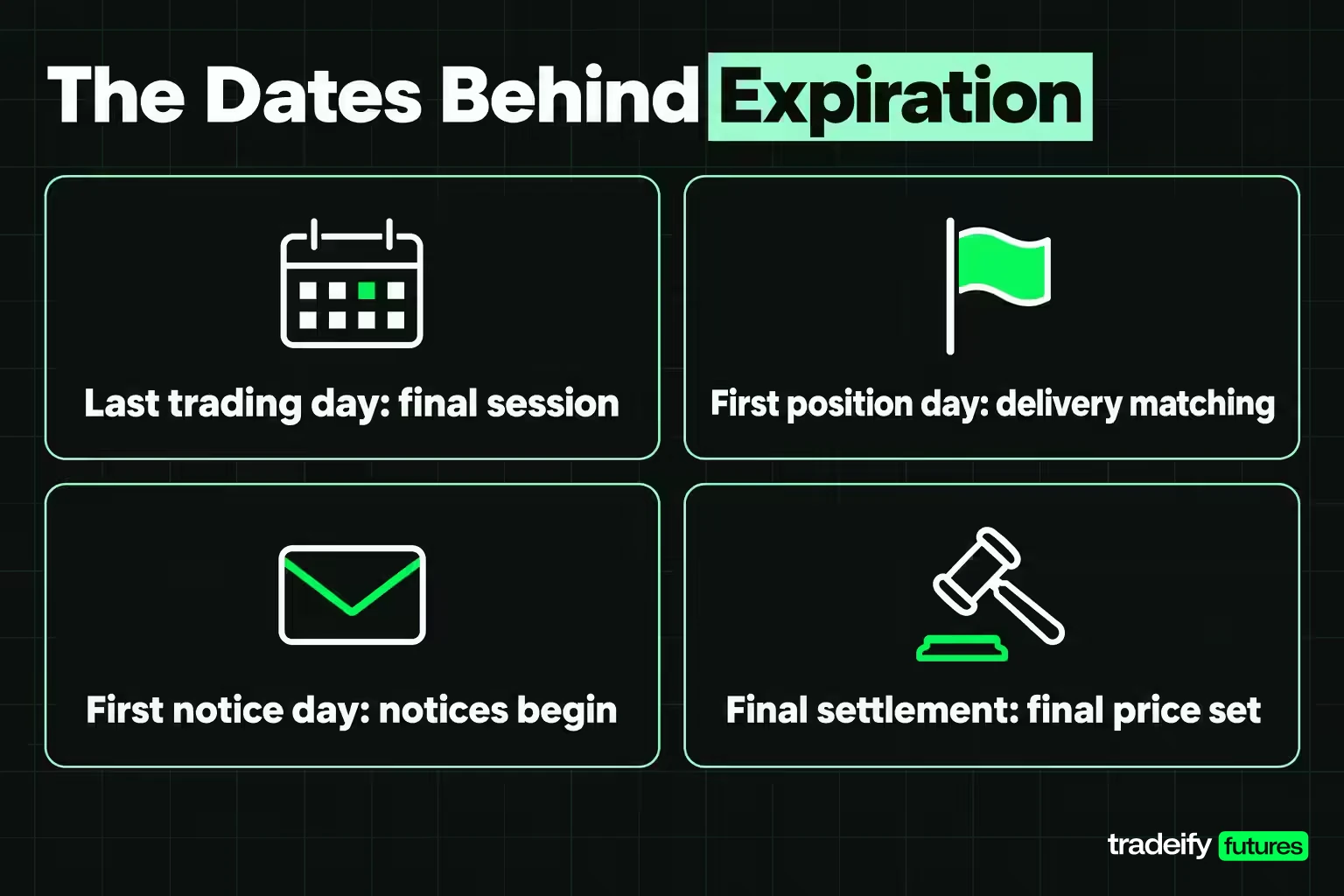
"Expiration" gets used loosely for several different events. CME Group's product calendar lists them as separate fields, and on a physically delivered contract they can fall weeks apart.
- Last trading day. The final session in which the contract can be bought or sold. After it, there is no order book to exit through.
- First position day. On physically delivered contracts, the first day a short can tell the clearing house it intends to deliver. CME Group's delivery guides say any long still holding after the close on first position day is eligible to be matched for delivery. On the December 2026 contracts in this guide it falls one business day before first notice day.
- First notice day. The first day on which notices of intent to deliver can be received. The CFTC notes that it varies by commodity and exchange. From this day, a long holder can be assigned delivery.
- Final settlement date. The day the exchange fixes the final settlement price and the last mark-to-market happens. On cash-settled contracts it usually matches the last trading day.
- Delivery period. The window in which the physical commodity or security changes hands, for example any business day of the delivery month for gold.
Cash-settled contracts such as the E-mini S&P 500 have no notice days and no delivery period. Their calendar is simple: one last trading day, one final settlement.
Physically delivered contracts are where traders get caught. Most free calendars headline the last trading day, so that is the date people remember. The first notice day, the one that can actually put a delivery in your account, is easy to miss.
Related lesson: Why the notice date and the last trading date are not the same event
How Exchanges Write Each Contract's Expiration Rule
Exchanges do not publish a date and hope it sticks. They publish a rule, and the date falls out of it each month. The rules come in a few families.
Weekday expiration rules for index, currency and crypto futures
Equity index futures anchor to a weekday. The E-mini S&P 500 stops trading at 9:30 AM ET on the third Friday of the contract month, and the E-mini Nasdaq-100 and Micro E-mini contracts follow the same third-Friday pattern.
Euro FX futures (6E) anchor to a different weekday. Trading terminates at 9:16 AM CT, two business days before the third Wednesday of the contract month.
Bitcoin futures at CME stop at 4:00 PM London time on the last Friday of the contract month. If that Friday is not both a London and a U.S. business day, trading ends on the prior business day.
Business-day counts from the end of the month
Some rules count backward from the end of the delivery month. Gold futures (GC) stop trading at 12:30 PM CT on the third last business day of the contract month. The 10-Year T-Note (ZN) stops at 12:01 PM CT, seven business days before the last business day of the contract month.
The count of business days is fixed. The calendar date it lands on is not, because weekends and exchange holidays change which days count. That is why last year's date is a guess, not a reference.
Crude oil and corn expiration rules anchored to a calendar day
Crude oil uses a calendar anchor in the month before delivery. Light Sweet Crude Oil (CL) trading terminates three business days before the 25th calendar day of the month prior to the contract month. If the 25th is not a business day, trading terminates four business days before the 25th.
Corn (ZC) terminates on the business day prior to the 15th calendar day of the contract month.
Smaller contracts sometimes anchor to their larger sibling instead. Micro WTI Crude Oil (MCL) stops trading one business day before the corresponding CL contract.
How a holiday moves an expiration date
The January 2027 crude oil contract shows why you count rather than guess. Its anchor is December 25, 2026, which is Christmas Day and an exchange holiday. The fallback clause applies, so trading terminates four business days before the 25th. Counting back over Thursday, December 24, Wednesday, December 23 and Tuesday, December 22 lands on Monday, December 21, 2026, which is the last trading day CME Group's calendar shows for that contract.
Thanksgiving (November 26, 2026) and Christmas (December 25, 2026) are both exchange holidays on CME Group's 2026 schedule, so any business-day rule counted through late November or December has to skip them.
Expiration Cycles by Asset Class
The listing cycle tells you which months exist. The expiration rule tells you when each one stops. Both vary by asset class, and generalising one market's habit to another is the most common mistake in this topic.
| Asset class | Example contract | Months listed | Expiration rule | Settlement |
|---|---|---|---|---|
| Equity index | E-mini S&P 500 (ES) | Quarterly Mar, Jun, Sep, Dec | 9:30 AM ET, third Friday of the contract month | Cash |
| Treasury | 10-Year T-Note (ZN) | Quarterly Mar, Jun, Sep, Dec | 12:01 PM CT, seven business days before the last business day of the month | Physical delivery of notes |
| Energy | Light Sweet Crude Oil (CL) | Every month | Three business days before the 25th calendar day of the prior month | Physical delivery |
| Metals | Gold (GC) | Every month for the nearest 26 | 12:30 PM CT, third last business day of the contract month | Physical delivery |
| Grains | Corn (ZC) | Mar, May, Jul, Sep, Dec | Business day before the 15th of the contract month | Physical delivery |
| Currency | Euro FX (6E) | Quarterly plus serial months | 9:16 AM CT, two business days before the third Wednesday | Physical delivery |
| Crypto | Bitcoin (BTC) | Monthly plus quarterly | 4:00 PM London time, last Friday of the month | Cash |
Common mistakes about futures expiration cycles
A few points about expiration cycles that generic expiry guides often get wrong:
- "Futures expire on the third Friday" is an equity index rule, not a futures rule. Gold, crude, Treasuries, corn and euro futures all use different anchors.
- Gold expires in its own contract month. The December gold contract trades until late December. It is the notice day that arrives at the end of November.
- Crude oil expires in the month before its name. The December crude contract stops trading in November.
- CME's euro futures are physically delivered. Holding 6E through expiration means a currency exchange at delivery, not a cash adjustment.
How far out each product lists also differs. CME Group lists E-mini S&P 500 futures for 21 consecutive quarters, 10-Year T-Note futures for 3 consecutive quarters, gold for 26 consecutive months, and crude oil for the current year plus the next 10 calendar years. Trading volume, though, concentrates in the nearest month or quarter, which is why the expiration of that one contract matters most.
December 2026 Futures Expiration Dates for Common Contracts
The table below shows how far apart futures expiration dates fall inside a single contract month. All dates come from CME Group's product calendar, as of November 4, 2026. Each one also matches the contract's published termination rule when counted on CME's 2026 holiday schedule.
| Contract | Code | Last trading day | First notice day | Settlement |
|---|---|---|---|---|
| Micro WTI Crude Oil | MCLZ26 | Thursday, November 19, 2026 | None | Cash |
| Light Sweet Crude Oil | CLZ26 | Friday, November 20, 2026 | Tuesday, November 24, 2026 | Physical |
| Corn | ZCZ26 | Monday, December 14, 2026 | Monday, November 30, 2026 | Physical |
| Euro FX | 6EZ26 | Monday, December 14, 2026 | None (delivery Wednesday, December 16, 2026) | Physical |
| E-mini S&P 500, E-mini Nasdaq-100, Micro E-mini S&P 500 | ESZ26, NQZ26, MESZ26 | Friday, December 18, 2026 | None | Cash |
| 10-Year T-Note | ZNZ26 | Monday, December 21, 2026 | Monday, November 30, 2026 | Physical |
| Bitcoin | BTCZ26 | Thursday, December 24, 2026 | None | Cash |
| Gold | GCZ26 | Tuesday, December 29, 2026 | Monday, November 30, 2026 | Physical |
Reading the December 2026 expiration table
Read the December 2026 table in two directions.
Across the rows, the last trading days for "December" contracts span 39 days, from November 20 to December 29. A trader holding several of these would have separate deadlines spread across six weeks.
Within each physical row, compare the two date columns. For gold, first notice day comes 29 days before the last trading day. For the 10-Year T-Note the gap is 21 days, and for corn it is 14 days. Crude oil runs the other way: trading stops on November 20, four days before the notice day. On every physical contract, the date that binds a long holder is the earlier of the two, and in practice the close of first position day, one business day before first notice day.
The Bitcoin row shows the holiday fallback at work. The last Friday of December 2026 is Christmas Day, so trading ends on the prior business day, Thursday, December 24.
These dates are a snapshot for one cycle. The next cycle has its own dates, so recheck the exchange calendar rather than reusing this table.
Reading Month Codes to Find a Contract's Expiration
A futures symbol tells you which contract month you hold, and the month tells you which expiration rule to apply. Symbols follow the pattern root + month code + year.
| Month | Code | Month | Code |
|---|---|---|---|
| January | F | July | N |
| February | G | August | Q |
| March | H | September | U |
| April | J | October | V |
| May | K | November | X |
| June | M | December | Z |
So ESZ26 is the December 2026 E-mini S&P 500, and GCG27 is February 2027 gold. Platforms shorten the year differently. Some use the last digit (ESZ6), while others print the full year (ESZ2026). It is the same contract either way.
Two traps sit in symbols:
- The month in the symbol is the delivery month, not the expiry month. CLZ26 is December crude, yet it stops trading on November 20, 2026.
- Continuous chart symbols are not contracts. A symbol such as ES1! on TradingView stitches several months together for charting. It has no expiration date of its own and cannot be traded. The order still goes to a dated contract.
Related lesson: Reading the month code that identifies the contract you are actually holding
Cash Settlement vs Physical Delivery at Expiration
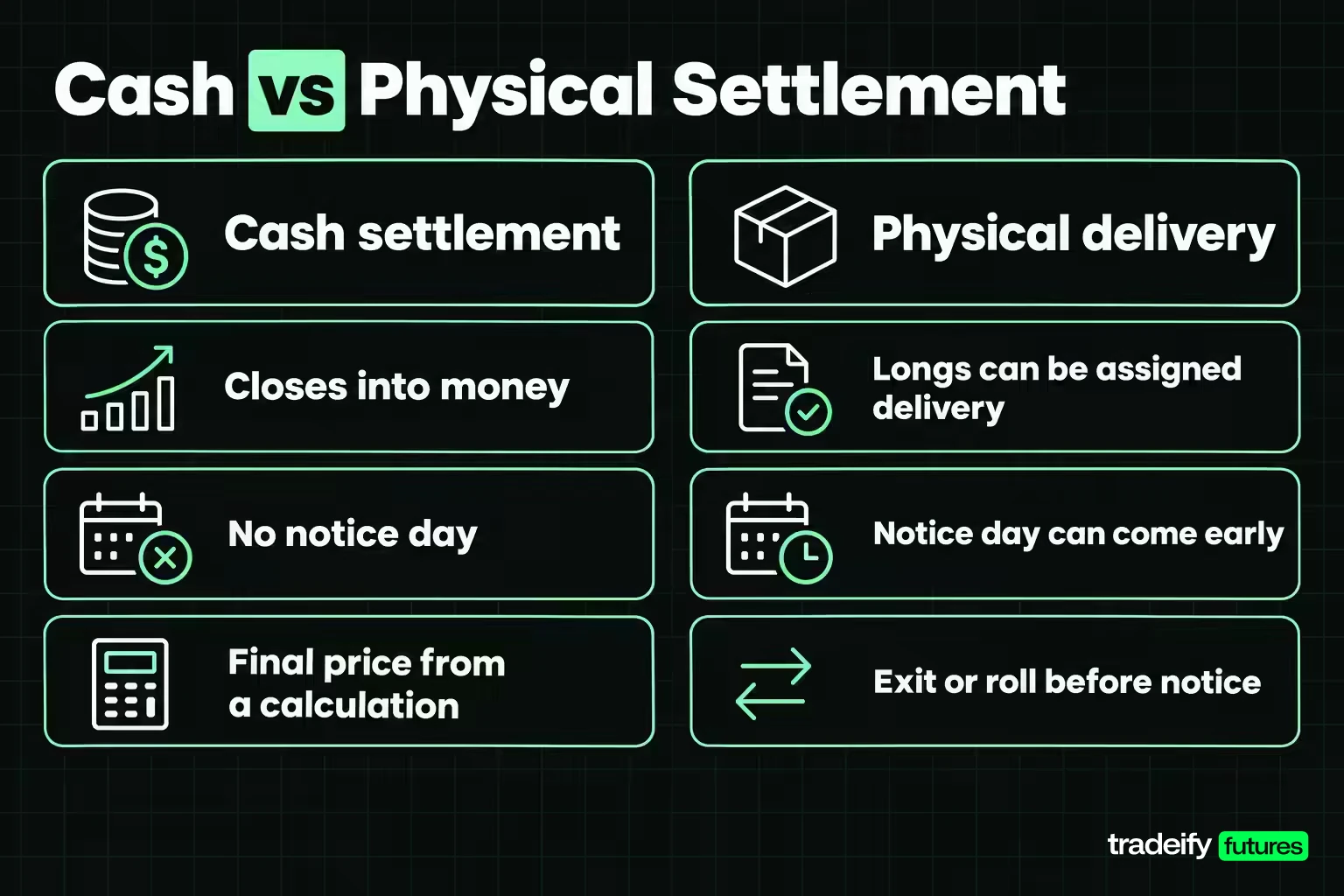
What happens at expiration depends on one field in the contract specification: settlement method. CME Group labels it "Financially Settled" or "Deliverable."
What happens to a cash-settled contract at expiration
A cash-settled futures contract closes into money. At expiration, the exchange sets a final settlement price, and every open position is marked to it one last time. The gain or loss since the previous day's settlement is paid or collected, and the position disappears.
The E-mini S&P 500, E-mini Nasdaq-100, Micro E-mini S&P 500, Micro WTI Crude Oil and CME Bitcoin futures all settle this way. Nobody receives a basket of stocks or a bitcoin.
Cash settlement is not the same as "nothing happens." Your final price comes from a separate calculation, not from the last trade you watched. On the E-mini S&P 500 it comes from the next morning's opening prices of the index stocks. A position held into that print can settle well away from the prior close.
What physical delivery involves at expiration
A deliverable contract ends with a transfer of the underlying. The specification spells out where and how.
- Crude oil (CL). Delivery is free-on-board at a pipeline or storage facility in Cushing, Oklahoma, and the short must have the crude ready to flow ratably from the first day of the delivery month. One contract is 1,000 barrels.
- Gold (GC). Delivery can occur on any business day of the delivery month. One contract is 100 troy ounces.
- 10-Year T-Note (ZN). The short delivers eligible Treasury notes through the Federal Reserve book-entry wire-transfer system, at an invoice price based on the futures settlement price and a conversion factor.
- Euro FX (6E). The contract settles by physical delivery of currency.
Scale is the reason retail traders avoid delivery. At an illustrative gold price of $4,000 per ounce, taking delivery on one GC contract means paying about $400,000 for 100 ounces. At an illustrative $60 per barrel, one CL contract is a $60,000 crude oil purchase that needs a pipeline slot in Cushing.
Can you hold a futures contract until it expires
On the exchange, yes. Nothing stops a holder from keeping a position to the final bell. Brokers are another matter. Some retail brokers do not allow physical delivery at all (Charles Schwab's futures education page says its clients cannot take delivery), and those brokers expect deliverable positions to be rolled or closed before first notice day. Cash-settled contracts can usually be held to the final settlement, but you take the final settlement price as it comes.
If a long position in a deliverable contract is still open after the close on first position day, it can be matched for delivery. Getting out at that stage usually means paying for the delivery and then selling the commodity on, with fees and logistics along the way.
Related lesson: What actually happens at the end of a contract, cash settlement against physical delivery
How the Final Settlement Price Is Set at Expiration
Every futures position is marked to market daily at the exchange's settlement price. The final settlement price is the last of those marks, and each product uses its own method.
| Contract | Normal daily settlement | Final settlement at expiration |
|---|---|---|
| E-mini S&P 500 (ES) | VWAP of trades 2:59:30 PM to 3:00 PM CT | Special Opening Quotation of the S&P 500, from component stocks' opening prices on the third Friday |
| Light Sweet Crude Oil (CL) | VWAP of trades 2:28 PM to 2:30 PM ET in the active month | VWAP of outright trades 2:00 PM to 2:30 PM ET on the last trading day |
| Gold (GC) | VWAP of trades 1:29 PM to 1:30 PM ET in the active month | Settled through calendar spread relationships, as a non-active month |
The equity index method is the one that surprises people. The final price for the E-mini S&P 500 is a special quotation built from the opening prices of the stocks in the index, so it is not a futures trade at all. Futures trading in the expiring contract stops at 9:30 AM ET, and the final number reflects how each stock opens that morning.
Mark-to-market on the final day, a worked example
Imagine a trader long one E-mini S&P 500 contract from an illustrative 6,800.00 on Wednesday of expiration week. Each index point is worth $50.
- Thursday's daily settlement is an illustrative 6,820.00. The account is credited 20 points, or $1,000.
- On Friday the Special Opening Quotation prints at an illustrative 6,790.00. The final mark is 30 points below Thursday's settlement, so the account is debited $1,500.
- Net result: 10 points against the entry, a $500 loss. The same trade on one Micro E-mini S&P 500 ($5 per point) would lose $50.
Thursday's credit was real money in the account, and the final mark took it back. Nothing went wrong with the contract. The trader simply held into a price they could not trade against, only accept.
Why Expiration Week Changes How Futures Trade
Expiration risk starts well before the last trading day. Here is where traders usually get caught.
- The exchange moves its own attention. In CME's crude oil settlement procedure, the expiring month stops being the "active month" two business days before it expires. For gold, the active month becomes non-active on its first position date. Volume and tight spreads follow the active month.
- Spreads widen in the old month. As participants roll, the expiring contract's order book thins. Market orders can slip further, and stops can fill worse than expected.
- Settlement windows add their own flows. Index futures expire into an opening auction. Physically settled contracts carry traders who are closing out to avoid delivery, which can make the last sessions jumpy.
- Options expire alongside futures. Quarterly equity index options on futures share the futures expiration, and the hedging flows around that day can move the underlying.
- Broker cut-offs come first. A broker's own liquidation deadline for deliverable contracts can arrive before any exchange date.
None of these make expiration week untradeable. They do mean the contract you trade on Tuesday may behave differently by Thursday, even if the chart looks the same. If fills start to feel worse than your usual size should get, check which month you are in before you blame the setup.
Rolling a Futures Position Before Expiration
A roll closes the expiring contract and opens the same position in a later month. If you are long December, you sell December and buy March. The exposure continues; the contract changes.
There are two ways to do it:
- Two separate orders. Exit the old month, then enter the new one. Simple, but you carry price risk between the fills and pay the spread twice.
- A calendar spread order. Many platforms let you trade the spread between the two months as a single instrument. The E-mini S&P 500 calendar spread trades in 0.05-point increments, worth $2.50, which is finer than the outright's 0.25-point tick.
What a futures roll costs
The new month usually trades at a different price from the old one. On index futures that gap mostly reflects interest and expected dividends. On commodities it reflects storage, financing and supply.
Take an illustrative roll on the E-mini S&P 500. December trades at 6,800.00 and March at 6,860.00, a 60-point difference. Rolling a long position means selling December at 6,800.00 and buying March at 6,860.00. You have not lost 60 points, because March is a different contract with its own price path. Your open position simply carries the new level, so move any stop or target levels by the same 60 points or they will sit in the wrong place.
The real costs of a roll are the two commissions, the bid-ask spread on each leg, and any slippage in a thinning expiring month.
Related lesson: Moving a position from the expiring month to the next one
When to Roll Futures Contracts Before Expiration
Roll timing comes down to one rule: roll while both contracts are liquid, and before the date that binds you.
- For cash-settled index futures, volume moves to the next quarter ahead of expiration. Rolling once the new month's daily volume overtakes the old one keeps you in the deeper book.
- For physically delivered contracts, the binding date is first position day (the day before first notice day), not the last trading day. Roll or exit before its close, and before your broker's own cut-off.
- For crude oil, trading stops before the notice day, so the last trading day binds. The active-month switch two business days before expiration is a natural signal.
The roll that hurts is the one forced on you in the final hours, when the old month is thin and the clock is running. Decide the roll date when you open the trade, and the deadline stops being a surprise.
Related lesson: How the contract you pick off a list changes with the expiry date
Options on Futures Expiration, AM and PM
Options on futures carry their own expiration date and a specific expiration time. CME Group splits them into two styles.
- PM expiration. The option expires at the close of the market on its last trading day and is valued against the underlying future at that close. CME notes that the vast majority of options on futures expire this way.
- AM expiration. The option expires the morning of its last trading day. These are usually written on a future with the same expiration date and time, and financially settled futures often use them. AM-style options on S&P 500 futures, for example, use the Special Opening Quotation as their fixing price.
Micro E-mini S&P 500 and Micro E-mini Nasdaq-100 options are a useful contrast. CME describes them as European-style and financially settled, with Monday through Friday daily expiries, weeklies and end-of-month contracts. Their fixing price is the volume-weighted average price of the underlying E-mini futures during the final 30 seconds before the cash equity market closes. In-the-money options are exercised automatically into cash, so a short option holder receives a cash debit rather than a futures position.
The lesson for futures traders: an option's expiration date and time do not have to match the futures contract's. If you trade around options expiry, check which time and price the option uses.
Futures Expiration Calendars and Tracking Tools
Expiration dates are public. The work is in checking the right source and keeping it next to your plan.
- The exchange product calendar. CME Group publishes a calendar for every product with first trade, last trade, settlement, first and last notice, and first and last delivery dates. This is the reference to trust.
- The contract specification and rulebook. The "Termination of Trading" field gives the rule behind the date. Use it to check a date or work out a contract that is not listed yet.
- Your trading platform. Most platforms show the expiration date in the contract details. Check that your chart, DOM and order ticket all point to the same contract month.
- Broker notices. Brokers publish their own liquidation and delivery deadlines. These can be earlier than the exchange's dates and are the ones your account will follow.
- Third-party calendars. Useful for a quick scan, but some show only the last trading day or omit the year. Confirm anything that matters against the exchange.
A simple habit works: keep a short list of the contracts you trade, with each one's last trading day, first notice day where it has one, and your own planned roll date.
A Five-Step Expiration Check Before Each Trade
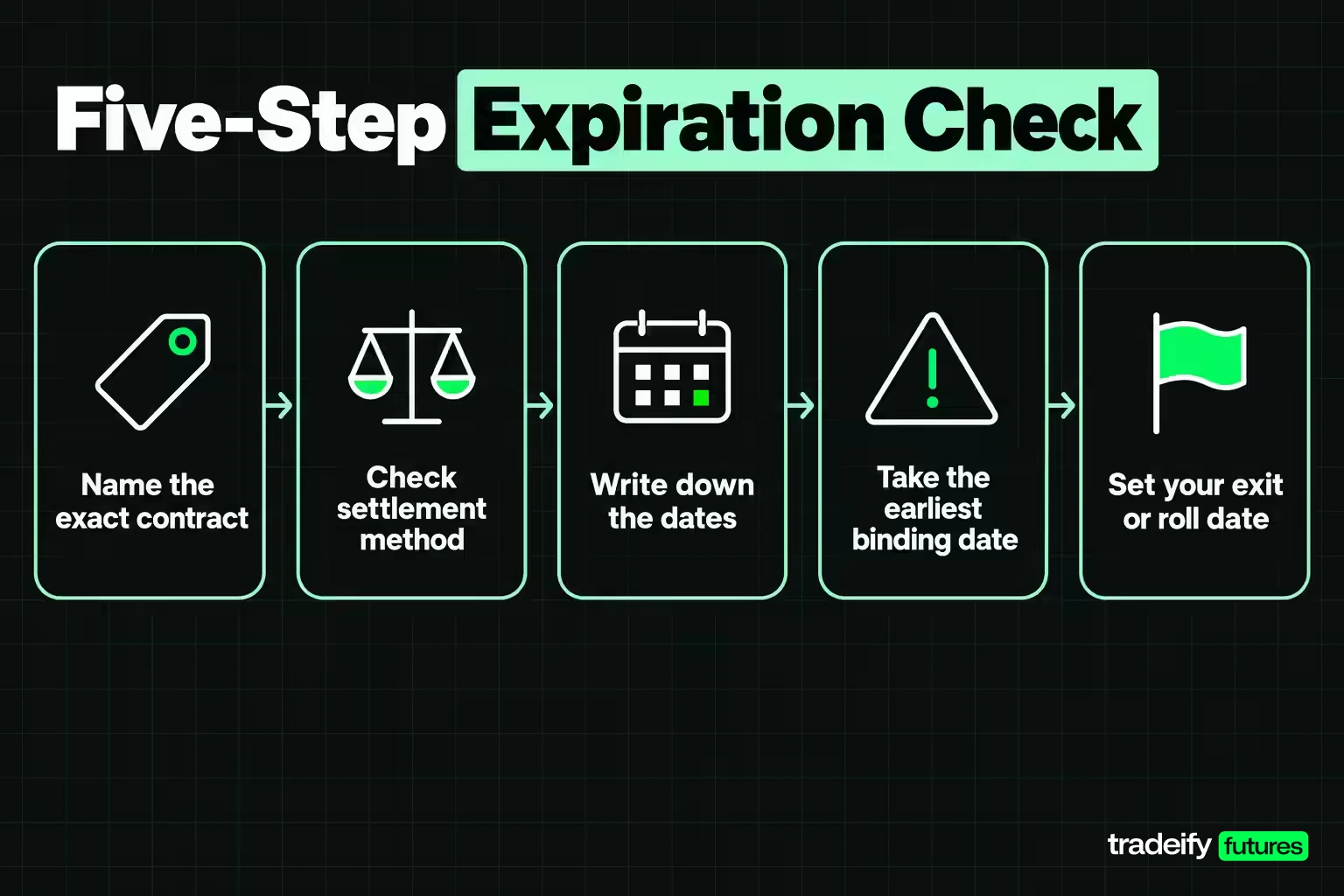
Run this when you open a position, not when the date is close. It takes a minute.
- Name the exact contract. "Long crude" is not a position. CLZ26 is, and it has its own dates.
- Check the settlement method. Cash or physical decides whether a notice day exists and what happens if you do nothing.
- Write down the dates. Last trading day, plus first position and first notice day for physical contracts, from the exchange calendar.
- Take the earliest date that binds you. For a long in a physical contract that is the close of first position day, unless the last trading day comes first. Use your broker's cut-off if it is earlier still.
- Set your own exit or roll date before it. Leave room for both legs of a roll to trade in a liquid market.
If you cannot find a notice day for a contract that delivers a physical commodity, the check is not finished.
How Futures Expiration Affects Day-Trading and Funded Accounts
A trader who is flat at the end of every session never carries a position into a notice day or a final settlement price. For that trader, expiration is mostly a contract-selection problem: making sure each new session starts in the liquid month, and that charts and order tickets are not still pointing at the expiring one. The risk to watch is on the final day of an index contract, when a position in the expiring month would settle at the Special Opening Quotation.
On our accounts, every position must be closed by 4:45 PM ET each day, and overnight holds are not allowed, so there is never a position to carry through expiration. A "roll" here simply means switching which contract month you trade in the next session. Our Help Center suggests trading the contract shown as the current Globex code on the CME calendar, rolling forward rather than backward, and avoiding contracts within one to two weeks of expiration. Funded accounts are simulated.
Futures Expiration Dates FAQ
What happens if your futures contract expires?
It settles under the contract's rules. A cash-settled contract is marked to the final settlement price and closed in cash. A physically delivered contract leads to delivery: the long pays for and receives the commodity or security, and the short delivers it. Brokers that do not support delivery expect those positions closed or rolled well before that point.
Can you hold futures until the expiry date?
On the exchange, yes. Cash-settled futures can usually be held to final settlement. Deliverable futures are different, because some retail brokers do not allow delivery and expect positions closed or rolled before first notice day.
What is the monthly expiry date for F&O contracts?
On India's NSE, monthly equity F&O contracts expiring from September 1, 2025 expire on the last Tuesday of the month, under a June 2025 exchange circular that moved expiry from Thursday. "F&O" is an Indian-market term, and these days are set under SEBI's rules, which have changed before, so check the exchange's current circular. U.S. futures have no single monthly expiry day.
What are Nasdaq futures, and when do they expire?
Nasdaq futures usually means the E-mini Nasdaq-100 (NQ) and Micro E-mini Nasdaq-100 (MNQ). NQ is worth $20 times the Nasdaq-100 Index, and MNQ is worth $2 times the index. Both are cash-settled, list quarterly in March, June, September and December, and stop trading at 9:30 AM ET on the third Friday of the contract month.
What's the difference between Nasdaq and Nasdaq futures?
The Nasdaq-100 is an index, a calculated number that cannot be bought directly. Nasdaq futures are exchange-traded contracts on that index. They trade nearly around the clock, use a multiplier, are marked to market every day, and expire on a set date.
Do futures expire worthless?
No. A futures contract is not an option, so it does not lapse with zero value. At expiration it settles at the final price, and the full gain or loss is credited or debited. What it can do is expire into a delivery obligation you did not plan for.
Which futures expire on the third Friday?
Quarterly equity index futures such as the E-mini S&P 500, E-mini Nasdaq-100 and their micro versions expire on the third Friday of March, June, September and December. Most commodity, Treasury and currency futures use other rules.
Futures trading involves substantial risk, and leverage means losses can exceed what you expect or the money you set aside. Expiration dates, settlement methods and holiday schedules are set by the exchange and can change, so confirm current terms with the exchange and your broker before trading. Results on simulated or funded evaluation accounts are simulated. This article is education, not individual investment advice.


