



TL;DR: Put options give the buyer the right to sell an asset at a set strike by expiration, so the choice is defined cost versus obligation. One equity put covers 100 shares, so a $50 put bought for $2.50 costs $250 and breaks even at $47.50. A put buyer can lose only that premium, and profit grows as price falls below break-even. A put seller collects the premium but may have to buy the asset at the strike, which can mean large losses in a sharp decline.
Put options are the standard way to bet on a decline, or protect against one, without shorting the asset itself. The idea is simple. The execution is where traders get caught. You can call the drop correctly and still lose money on the put, because the stock fell too little, fell too late, or fell while the option's price was deflating anyway.
So the real question is never just "will it go down?" It is "will it go down far enough, soon enough, to beat what I paid?" This guide works through that question: what a put is, how the contract behaves from purchase to expiration, the payoff math for buyers and sellers, the real risks of writing puts, and the practical steps for buying one.
What Put Options Are
A put option is a contract that gives its buyer the right, but not the obligation, to sell an underlying asset at a fixed price (the strike price) on or before a set expiration date. The buyer pays a premium for that right. The seller, also called the writer, collects the premium and takes on the obligation to buy the underlying at the strike if the buyer exercises.
Options come in two types. A call gives the holder the right to buy. A put gives the holder the right to sell. Either one can be bought or sold, which creates four basic positions: long call, short call, long put and short put.
For standard U.S. equity options, one contract generally covers 100 shares, and Cboe's specifications state that one point of premium equals $100. A put quoted at $2.50 therefore costs $250 per contract before fees. Contracts can be adjusted after splits or other corporate actions, so check the deliverable on the option chain rather than assuming 100 shares every time.
The core terms of every put contract are:
- Underlying: the stock, ETF or index the option is based on.
- Strike price: the price at which the put holder can sell.
- Premium: the market price of the option, paid by the buyer and received by the seller.
- Expiration: the date after which the contract no longer exists.
- Multiplier: the number of units one contract controls, generally 100 for equity options.
Put option moneyness and premium parts
A put is in the money when the underlying trades below the strike, at the money when the two are equal, and out of the money when the underlying sits above the strike. The Options Industry Council (OIC) splits a put's premium into two parts. Intrinsic value is the amount the option is in the money. Time value is everything else in the premium, the price of the chance that the trade improves before expiration.
A $50 put with the stock at $46 has $4 of intrinsic value. If that put trades at $5.20, the remaining $1.20 is time value, and time value shrinks as expiration approaches.
How Put Options Work From Purchase to Expiration
Put options pass through a predictable life cycle, and each stage brings a different decision for the buyer and the writer.
The buyer opens the position by paying the premium. From that point the put's price moves with the underlying, time remaining and implied volatility. Most holders of put options never exercise. They close the trade by selling the put back into the market. OIC notes that option holders exercise only about 7% of options, and that most exercises happen close to expiration, because exercising early throws away any remaining time value.
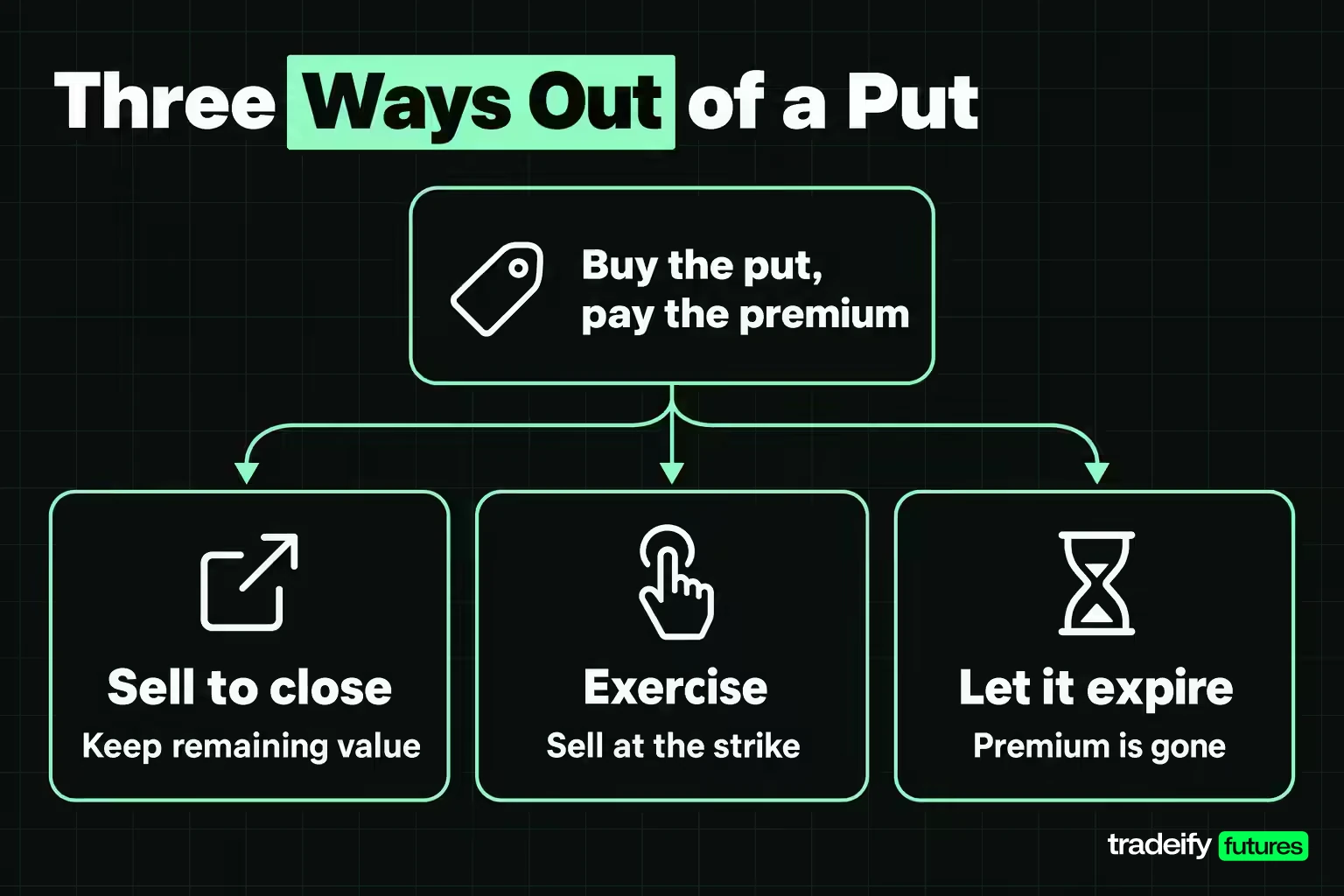
A put holder has three ways out:
- Sell to close: sell the put in the market and keep whatever value is left, including time value.
- Exercise: tell the broker to use the right and sell the underlying at the strike.
- Let it expire: an out-of-the-money put usually expires worthless and the premium is gone.
Put option exercise and assignment
When a holder exercises, the broker sends an exercise notice to the Options Clearing Corporation (OCC). OCC randomly assigns that notice to a clearing firm that carries a short position in the same series, and the firm then picks one of its customers who wrote that put, either at random or first in, first out. The assigned writer must buy the shares at the strike price.
At expiration, OCC automatically exercises equity options that are in the money by $0.01 or more unless the holder instructs the broker otherwise. Brokers can apply their own thresholds and deadlines, so an expiring put needs an instruction or a closing trade before the final session ends.
Put option exercise styles and settlement
The exercise style decides when a put can be used:
- American style: can be exercised on any business day up to and including expiration. Cboe's equity option specifications list standard equity options as American style, expiring on the third Friday of the expiration month.
- European style: can be exercised only at expiration. Cboe lists S&P 500 Index (SPX) options as European style.
Settlement decides what changes hands. Exercising a stock or ETF put delivers shares, so the holder sells 100 shares at the strike and the writer buys them. Index puts such as SPX are cash settled, and Cboe states that exercise results in delivery of cash on the business day following expiration, equal to the strike minus the settlement value multiplied by $100.
Put Option Payoff and Break-Even Math
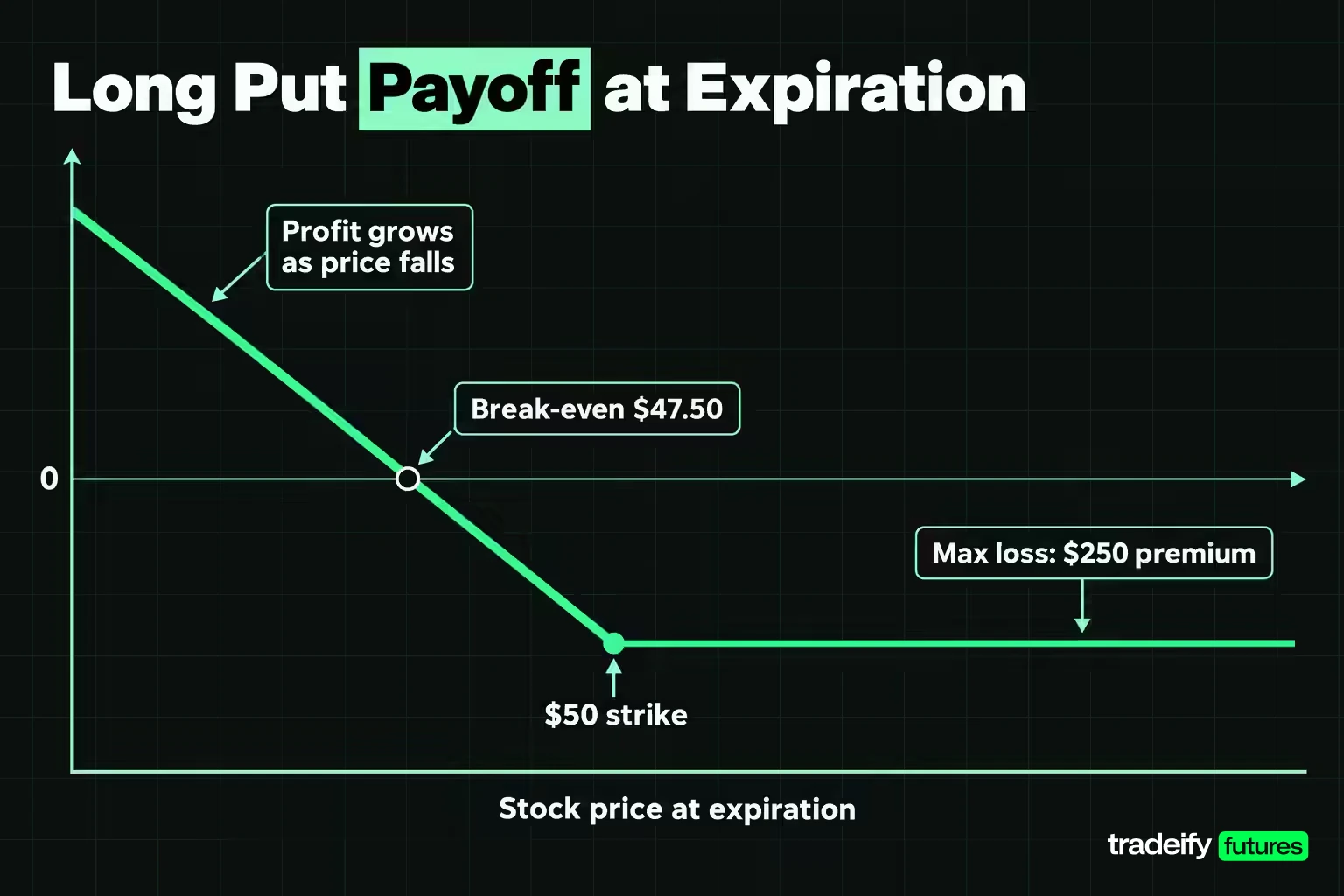
The payoff of a put option at expiration takes two lines of arithmetic. Intrinsic value per share equals the strike minus the underlying price, floored at zero. Profit or loss equals intrinsic value minus the premium paid, multiplied by 100.
Take an illustrative trade with round numbers. The stock trades at $52. A trader buys one $50 put for $2.50, a total cost of $250. The expiration break-even is the strike minus the premium, $50 minus $2.50, which is $47.50 before commissions.
| Stock price at expiration | Put intrinsic value per share | Long put profit or loss |
|---|---|---|
| $55 | $0 | -$250 |
| $50 | $0 | -$250 |
| $49 | $1 | -$150 |
| $47.50 | $2.50 | $0 |
| $45 | $5 | $250 |
| $40 | $10 | $750 |
| $35 | $15 | $1,250 |
| $0 | $50 | $4,750 |
The $49 row is the one that catches people. The put finished in the money, yet the position still lost $150 because the premium cost more than the intrinsic value it earned. Being below the strike is not the same as being profitable. The strike tells you where the put starts to have value. The break-even tells you where the trade starts to pay.
Maximum loss and maximum profit on a long put
For buyers of put options, the maximum loss is the premium paid plus fees. In the example that is $250, reached anywhere at or above $50 at expiration. OIC describes it the same way: the worst case is the stock above the strike at expiration with the put still held.
The maximum profit is large but finite, because a stock cannot fall below zero. It equals the strike minus the premium, multiplied by 100. Here that is $4,750 if the stock goes to $0. The put writer's numbers are the mirror image: a maximum gain of the $250 premium and a maximum loss of $4,750 in the same worst case.
Before expiration, the payoff table is only part of the story. The put still carries time value, so its market price can sit above intrinsic value, and a drop in implied volatility can cut the price even if the stock has barely moved.
Risk and Reward of Buying vs Selling Put Options
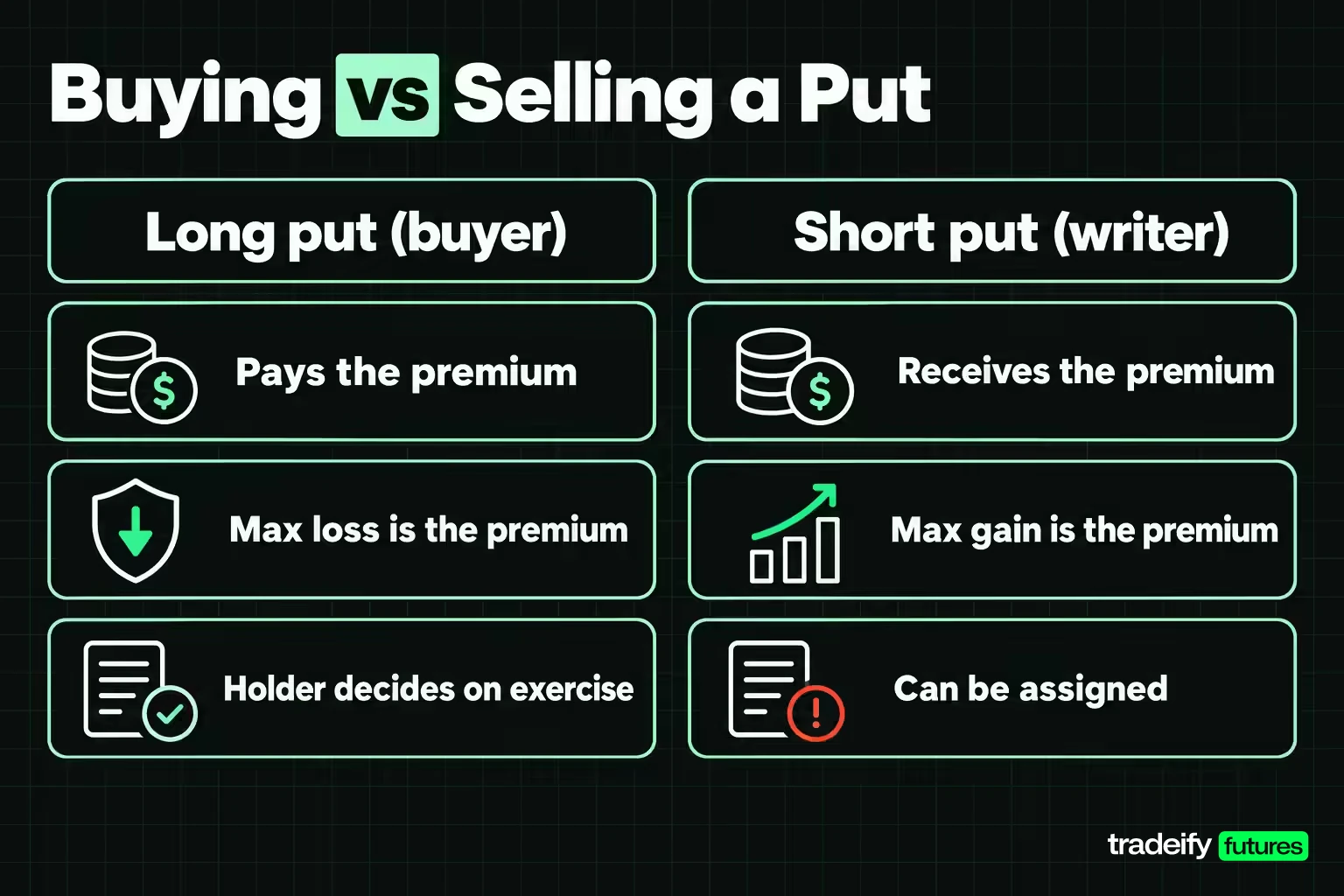
Put options give the buyer and the seller opposite exposures, and the risk is not symmetrical. One side pays a small known amount for a large possible gain. The other side collects a small known amount and accepts a large possible loss.
| Feature | Long put (buyer) | Short put (writer) |
|---|---|---|
| Market view | Bearish or protective | Neutral to bullish |
| Cash at the start | Pays the premium | Receives the premium |
| Maximum gain | Strike minus premium, x 100 | Premium received |
| Maximum loss | Premium paid | Strike minus premium, x 100 |
| Break-even at expiration | Strike minus premium | Strike minus premium |
| Effect of time passing | Hurts | Helps |
| Effect of rising implied volatility | Helps | Hurts |
| Assignment risk | None, the holder decides | Can be assigned on any business day for American-style puts |
Both sides share the same break-even, $47.50 in the $50 strike example. What differs is the shape of the outcome. The buyer loses a little often and wins big occasionally. The writer wins a little often and can lose big when the market breaks.
That asymmetry is the decision. A long put fits a trader who expects a meaningful move within a specific window and is willing to lose the full premium if it does not come. A short put fits someone who is comfortable owning the stock at the strike and can absorb the loss if the price keeps falling.
Neither side is the "safe" one. The buyer's risk is small per trade but shows up often. The writer's risk is rare but large, and a run of small wins can make it easy to forget it exists.
Related lesson: Long vs short options
Selling Put Options
Selling put options, also called writing puts, means collecting a premium in exchange for a promise to buy the underlying at the strike if assigned. The writer earns the most when the put expires worthless and does not control whether or when assignment happens.
OIC separates two versions of this trade.
A cash-secured put sets aside enough cash to buy the shares if assigned. The writer usually wants to own the stock and treats the strike minus the premium as an acceptable purchase price. In the illustrative example, writing one $50 put for $2.50 means reserving $5,000 to cover a possible purchase of 100 shares. If assigned, the effective cost is $47.50 per share, the strike less the premium already received.
A naked, or uncovered, put is written without that reserved cash. OIC describes the only motive as premium income, and the writer has no plan to keep the stock. If assignment arrives, the writer has to find the cash quickly or sell the shares, often into the same decline that caused the assignment.
Short put outcomes at expiration
Using the same $50 strike and $2.50 premium:
- Stock at $50 or higher: the put expires worthless and the writer keeps $250.
- Stock at $47.50: the writer breaks even before fees.
- Stock at $45: the writer loses $250.
- Stock at $40: the writer loses $750.
- Stock at $0: the writer loses $4,750, the strike minus the premium.
The premium is the best case. Everything below the break-even is loss, and the loss grows dollar for dollar as the stock falls. Ten months of collecting $250 can be erased by one bad month, which is why the size of a short put should be set by the worst case, not the premium.
Risks of Selling Put Options
The biggest risk of selling put options is a sharp decline. The reward is capped at the premium while the loss can reach the full strike value minus that premium. A put sold for $250 can turn into a loss of several thousand dollars on a single contract.
Other risks are specific to the short side:
- Early assignment. American-style puts can be exercised any business day. OIC notes that when puts go deep in the money, most professional option traders exercise before expiration, so writers of deep in-the-money puts should be ready for early assignment.
- Weekend gap after expiration. OIC points out that a naked put writer may not know until the Monday after expiration whether assignment happened, which leaves the position exposed to price moves in between.
- Trading halts. OIC states that put writers remain obligated to buy at the strike even when the stock's trading is halted. Exercise and assignment can still occur while the market for the stock is closed.
- Exit liquidity. Closing a short put costs the most exactly when the stock is falling fast and the put's premium is rising.
Margin on uncovered put options
Brokers require collateral for naked put options, and the exchange minimum grows as the trade goes against the writer. Cboe's strategy-based margin rule for an uncovered equity put is 100% of the option proceeds plus 20% of the underlying value, less any out-of-the-money amount, with a minimum of the proceeds plus 10% of the put's strike value.
Run the illustrative trade through it. Stock at $52, $50 put sold for $2.50:
- Proceeds: $250.
- 20% of the underlying value: 20% of $5,200 is $1,040.
- Out-of-the-money amount: $2 per share, or $200.
- Requirement: $250 plus $1,040 minus $200 = $1,090.
- Minimum check: $250 plus 10% of $5,000 = $750, so $1,090 applies.
Now suppose the stock drops to $40 and the put trades at $10.50. The maintenance requirement becomes $1,050 plus 20% of $4,000, or $1,850, and the position shows an $800 loss. The collateral demand rose while the account was losing money, which is how margin calls happen. These are exchange minimums; brokers can and often do require more.
Related lesson: Options assignment risk
Common Uses for Put Options
Put options serve several different jobs, and the right structure depends on which job the trader is doing.
- Bearish speculation. A trader expecting a decline buys a put to profit from it with risk capped at the premium. OIC frames the motivation as profiting from a fall without risking an unlimited amount of capital, as a short seller does.
- Hedging. An investor who owns shares buys a put to set a floor under them for a period of time.
- Premium income. A writer sells puts to collect premium, accepting the obligation to buy if assigned.
- Stock acquisition. A cash-secured put writer sells puts at a strike where they would be happy to own the stock, effectively getting paid while waiting for a lower entry.
- Spreads. A bear put spread buys one put and sells another with the same expiration and a lower strike. OIC notes that the sold put lowers the cost and also sets a ceiling on profit.
Put option leverage in numbers
The percentage math explains why speculators use put options. In the illustrative trade, the stock falls from $52 to $45 at expiration. A short seller of 100 shares gains $700. The put buyer gains $250 on a $250 outlay, a 100% return, while risking only $250 instead of facing open-ended losses if the stock had risen.
The same math works in reverse. If the stock had stayed at $52, the short seller would have broken even before costs while the put buyer lost 100% of the premium. Puts trade capped risk for a deadline. That trade-off is fine when the timing thesis is real and expensive when it is a guess.
A bear put spread example
An illustrative bear put spread buys the $50 put for $2.50 and sells a $45 put for $0.90. The net debit is $1.60, or $160 per spread. The maximum gain is the $5 gap between strikes minus the debit, $340, reached at or below $45. The break-even is $48.40. Compared with the single put, the spread costs less and breaks even closer to the current price, but it stops gaining below $45.
Protective Puts for Hedging a Stock Position
A protective put, sometimes called a married put, is one of the oldest uses of put options. It adds a long put to shares the investor already owns. OIC describes it as insurance on the stock's value: the strike sets the minimum exit price for as long as the put lasts, while the investor keeps the upside.
An illustrative example: an investor owns 100 shares bought at $52 and buys a $50 put for $2.50.
- Maximum loss: $52 minus $50 plus $2.50 = $4.50 per share, or $450, no matter how far the stock falls before expiration.
- Upside break-even: the stock must rise to $54.50 to cover the premium.
- Without the put, a drop to $35 would cost $1,700. With the put, the loss stops at $450.
The cost is the drag. Every protective put raises the bar for profit by the premium paid, and repeated hedges add up over a year. A hedge that quietly expires worthless was not a mistake, any more than an unused insurance policy was. It only becomes a mistake when the ongoing cost was never budgeted. Strike choice is the main tradeoff. A strike closer to the stock price gives tighter protection at a higher premium. A lower strike is cheaper and works more like catastrophe cover.
OIC also flags two non-market issues. Employment-related restrictions on selling stock may forbid hedging it with puts, and depending on the facts the IRS may treat a particular protective put as equivalent to selling the stock. Check both before hedging a large or restricted position.
Why Put Options Matter for Portfolios and Risk Management
Put options are the market's price for downside protection, which makes them useful well beyond one trader's bearish idea.
For portfolio managers and risk teams, put options turn an open-ended downside into a known cost. A fund that buys index puts knows in advance what the hedge costs and roughly where losses stop. That makes puts a budgeting tool as much as a trading tool: the premium is the insurance bill.
For market watchers, put activity carries information. Cboe publishes daily put/call ratios split by category, including total, index and equity options. A rising share of put volume can reflect hedging demand or bearish positioning, though the same number can mean different things in different markets, so it works as context rather than a signal on its own.
Put pricing also shows how worried the market is. OIC notes that higher volatility tends to raise the value of long options. When fear rises, put premiums usually rise with it, which is why protection is often cheapest when nobody seems to want it and most expensive in the middle of a selloff.
For anyone who trades stocks, futures or indexes without ever buying an option, put prices still matter. They show what the market charges to insure against a fall, and that cost feeds into implied volatility measures that many traders watch.
How to Buy Put Options Step by Step
Buying put options starts with account permissions and ends with an exit plan, and the order of the steps matters.
- Get approval to trade put options. The SEC's investor bulletin explains that brokers must approve an account for options trading through an options agreement covering objectives, experience and finances. Brokers generally offer five trading levels, and FINRA lists buying puts and calls as a separate approval category from writing uncovered options. The broker must also provide the OCC booklet Characteristics and Risks of Standardized Options. Read it.
- Define the thesis. Write down what should fall, by how much and by when. A put needs a price target and a time window.
- Choose the expiration. Pick a date that leaves room for the move to happen, not just the minimum. Time value erodes as expiration approaches, so the cheapest short-dated put is often cheap for a reason.
- Choose the strike. In-the-money puts cost more but move more closely with the stock. Out-of-the-money puts cost less but need a bigger drop to pay.
- Check the quote. Look at the bid, the ask, volume and open interest. A wide spread is a cost paid on the way in and again on the way out.
- Size by premium at risk. The premium can go to zero, so the position size should be an amount the trader can lose in full. Cboe rules require puts with nine months or less to expiration to be paid for in full.
- Use a limit order. Set the price at or near the midpoint rather than paying whatever the ask shows.
- Plan the exit. Decide in advance the profit level to sell at, the date to re-evaluate and what happens before expiration, including whether to sell to close or exercise.
A first put option trade for beginners
For a first trade, a small position in a liquid underlying keeps the learning cost low. Paper trading the same steps first helps a trader see how premiums move with time and volatility before money is at stake. The goal of the first few trades is to learn how the contract behaves, not to make a big call on the market.
Expect the first lesson to be a put that loses value while the stock goes nowhere. That is time decay doing its job, and it is cheaper to learn it on one small contract than on a full-size position.
Related lesson: Liquidity and bid-ask spreads in options
Put Option Mistakes to Avoid
Most losses on put options come from a short list of repeat errors.
- Confusing intrinsic value with profit. A put that finishes in the money can still lose money. In the $50 strike example, an expiration price of $49 still loses $150.
- Ignoring the deadline. A bearish idea without a time frame is incomplete. A decline that arrives after expiration pays nothing.
- Overpaying for volatility. Put premiums climb when fear is high. If implied volatility falls after entry, the put can lose value even when the stock drifts lower.
- Trading illiquid strikes. A profit on the screen is not an exit. Wide spreads and thin open interest can eat a large share of the gain.
- Treating short-put premium as free income. The premium is payment for an obligation. A writer must be ready to buy at the strike when the stock is far lower.
- Reaching expiration without a plan. OCC exercises equity options that are $0.01 in the money unless told otherwise, which can create a short stock position a put buyer never wanted.
Put option pre-trade checklist
Before placing a put trade, have a written answer for each item:
- The bearish or protective thesis, and the price and date that would prove it wrong.
- Strike, expiration, premium, multiplier and total cash at risk.
- The expiration break-even after fees.
- What happens if the stock barely moves while time passes and volatility falls.
- The bid-ask spread and a reasonable limit price.
- The plan to close, exercise or handle assignment.
- For a short put, the cash or margin needed if the stock drops 20% or more.
If any answer is vague, the trade is not ready yet. Direction is one input. The checklist covers the others.
Put Options vs Calls and Short Selling
Put options are one of several ways to express a view on price, and the right choice depends on the risk shape a trader wants.
A call gives the right to buy at the strike and gains when the underlying rises. A put gives the right to sell at the strike and gains when the underlying falls. Both buyers risk only the premium. Both writers take on an obligation: the call writer to sell, the put writer to buy.
Put options compared with short selling and short futures
Short selling stock is a different bearish tool from put options. Investor.gov explains that a short seller borrows shares, sells them, and later buys them back to return to the lender, paying margin costs, interest on the stock loan and any dividends along the way. OIC notes that a short stock position risks an unlimited amount of capital if the price rises, while a long put caps the loss at the premium.
| Bearish approach | Upfront cost | Maximum loss | Time limit | Main risk |
|---|---|---|---|---|
| Buy a put | Premium paid | Premium paid | Expires on a set date | Move comes too late or too small |
| Sell a call | Receives premium | Unlimited for an uncovered call | Expires on a set date | Sharp rally |
| Short sell the stock | Margin plus borrowing costs | Unlimited | None, while the borrow lasts | Sharp rally and recall of the borrowed shares |
| Sell a futures contract | Margin | Grows with every tick higher | Contract expiration, can be rolled | Sharp rally and margin calls |
The useful question is not which tool is best but which risk the trader can live with. A put suits a defined budget and a defined window. A short position suits a trader who expects a slower decline and can manage open-ended risk with stops and margin.
On our accounts, options are not offered at all, including options on futures, so a bearish view is expressed by selling a supported futures contract such as ES or MES. Our accounts are sized by contract limits, and every position must be closed by 4:45 PM ET on regular trading days. There are no overnight or weekend holds.
Put Options FAQ
What is the difference between a put and a call?
A put gives the holder the right to sell the underlying at the strike price, and it gains value when the price falls. A call gives the right to buy at the strike and gains when the price rises. Buyers of either risk only the premium paid.
What is the difference between a short and a put?
A short seller borrows and sells shares, so losses have no ceiling if the price rises and there is no expiration date. A put buyer pays a premium, and that premium is the maximum loss. The tradeoff is that the put expires and loses time value as the clock runs.
How do you calculate the payoff of a put option?
At expiration, subtract the stock price from the strike to get intrinsic value, with a floor of zero. Subtract the premium paid, then multiply by 100 for a standard equity contract. A $50 put bought for $2.50 breaks even at $47.50 before fees.
Can you lose more than you paid for a put option?
A put buyer cannot lose more than the premium paid plus fees. A put writer can lose far more than the premium received, up to the strike minus the premium, multiplied by 100, if the stock goes to zero.
What happens if a put option expires in the money?
OCC automatically exercises equity options that are $0.01 or more in the money unless the holder tells the broker not to. For a put, exercise sells 100 shares at the strike, which creates a short stock position if the holder did not own the shares.
Options carry substantial risk and are not suitable for every investor. A long put can lose its entire premium, and a short put can lose many times the premium received and lead to assignment and margin calls. Futures and other leveraged products can also lose more than expected. Simulated or funded trading accounts are simulated and do not reflect live brokerage execution. This article is education only and not investment, tax or trading advice.


