



TL;DR: Stock options give the right, not the obligation, to buy or sell shares at a fixed strike price before expiration. Listed calls and puts usually cover 100 shares, so a $2.20 premium costs $220 per contract. Employee ISOs and NSOs vest over time, most often on a four-year schedule with a one-year cliff. NSO spreads are taxed as income at exercise, while ISOs face AMT and 2-year and 1-year holding periods. Buyers can lose the full premium, sellers can lose far more, and private shares may be unsellable for years.
Stock options mean two different things depending on who is asking. A trader means listed calls and puts on an exchange. An employee means a grant from an employer that lets them buy company shares at a set price once they vest.
Both versions share one idea: a right to buy (or sell) stock at a fixed price, for a limited time. After that, almost everything differs. The trader is deciding whether a $200 premium is worth the bet. The employee is deciding whether to put $5,000 of savings into shares they may not be able to sell for years. This guide covers both and keeps them apart, because confusing the two is where the expensive mistakes start.
What Stock Options Are
Stock options are contracts that give the owner the right to buy or sell a stock at a fixed price on or before a set date. The owner is not obliged to use that right. If using it makes no sense, the owner can let it lapse or, with listed options, sell it to someone else.
That right has a price. On an exchange, the buyer pays a premium to the seller. In an employment grant, the "price" is the time you have to stay with the company before the options vest, plus the strike price you pay to buy the shares later.
Every stock option has the same building blocks:
- An underlying stock.
- A strike price, also called the exercise price.
- An expiration date.
- A type: the right to buy (a call) or, for listed options, the right to sell (a put).
The SEC's investor education office describes options as derivatives, because their value comes from the underlying asset. That one word explains most of what surprises new holders. When the stock moves, the option moves, but not one for one, and the clock keeps running against the holder the whole time.
Listed options and employee options also differ in who sits on the other side. A listed option has a seller who took on an obligation for a fee. An employee option has the company on the other side, which issues new shares or uses existing ones when the employee exercises.
Employee Stock Options vs Listed Stock Options
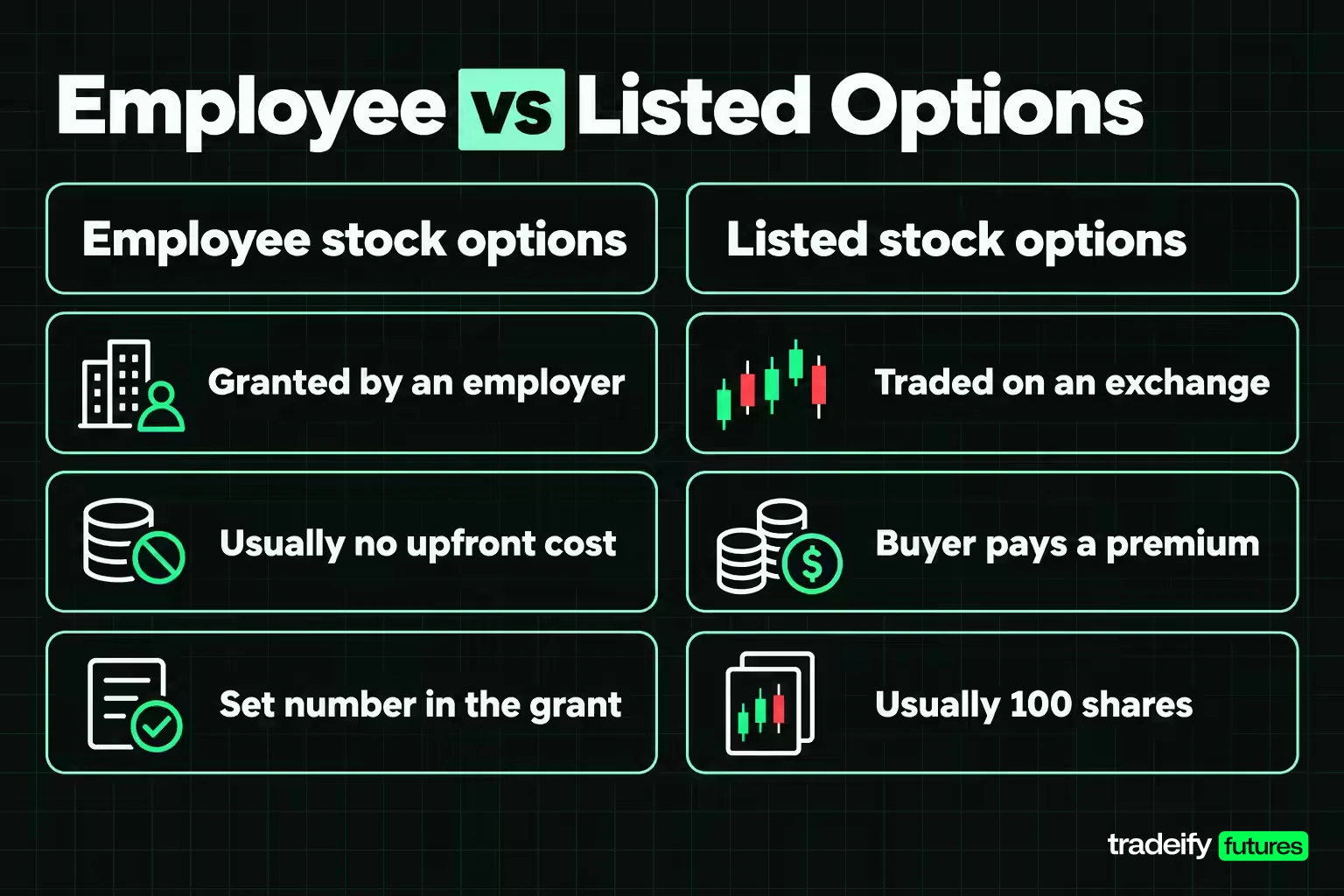
Employee stock options and listed stock options share a name and very little else. Mixing them up leads to bad decisions, such as treating a grant like a trade or assuming a listed call has tax treatment like an incentive stock option.
| Feature | Employee stock options | Listed stock options |
|---|---|---|
| Where they come from | Granted by an employer under a written plan | Bought or sold on an options exchange through a broker |
| Upfront cost | Usually none at grant | Premium paid by the buyer |
| Typical underlying amount | Set number of shares in the grant | Generally 100 shares per contract |
| Types | ISOs, NSOs and ESPP purchase rights | Calls and puts |
| Can you sell the option itself | No, generally not transferable | Yes, close it in the market before expiration |
| Typical lifespan | Often years; ISOs max 10 years from grant | Days to months for most contracts |
| Main tax trigger | Exercise (NSO) or sale of shares (ISO) | Sale, expiration or exercise of the contract |
| Main risk | Shares never worth more than the strike, or no way to sell | Losing the premium as a buyer, assignment as a seller |
The table misses one behavioral difference that matters more than any row. A listed option is something you choose to buy, so you control the size of the bet. An employee grant arrives as part of your pay, so it can quietly grow into a large share of your net worth without you ever deciding it should.
Types of Stock Options
Stock options come in a handful of types. On the listed side there are two. On the employee side there are three common forms, and the tax code defines most of the differences.
Calls and puts
A call option gives the buyer the right to buy 100 shares at the strike price before expiration. A put option gives the buyer the right to sell 100 shares at the strike price. The seller of each takes the opposite obligation: a call seller may have to sell shares, and a put seller may have to buy them.
That creates four basic positions: buying calls, selling calls, buying puts and selling puts. A call buyer wants the stock to rise. A put buyer wants it to fall, or wants protection against a fall in shares already owned.
Incentive stock options (ISOs)
ISOs are statutory options defined in section 422 of the Internal Revenue Code. They can only go to employees, their strike price cannot be below the stock's fair market value on the grant date, and they cannot be exercised more than 10 years after grant. Their appeal is tax treatment: no regular income tax at grant or exercise if the rules are met, though the alternative minimum tax can apply.
Nonqualified stock options (NSOs)
NSOs, also called nonstatutory options, are any employer options that do not qualify as ISOs or ESPP rights. Companies can grant them to employees, contractors, advisers and directors. The IRS treats the spread at exercise as ordinary income for most NSOs, which makes them simpler but usually less tax-friendly.
Employee stock purchase plans (ESPPs)
An ESPP under section 423 lets employees buy company stock through payroll deductions, often at a discount. The purchase price can be as low as 85% of the stock's fair market value at the start or end of the offering period, whichever is lower. Each employee's purchase rights are capped at $25,000 of stock value (measured at grant) per calendar year.
Strike Price on Stock Options
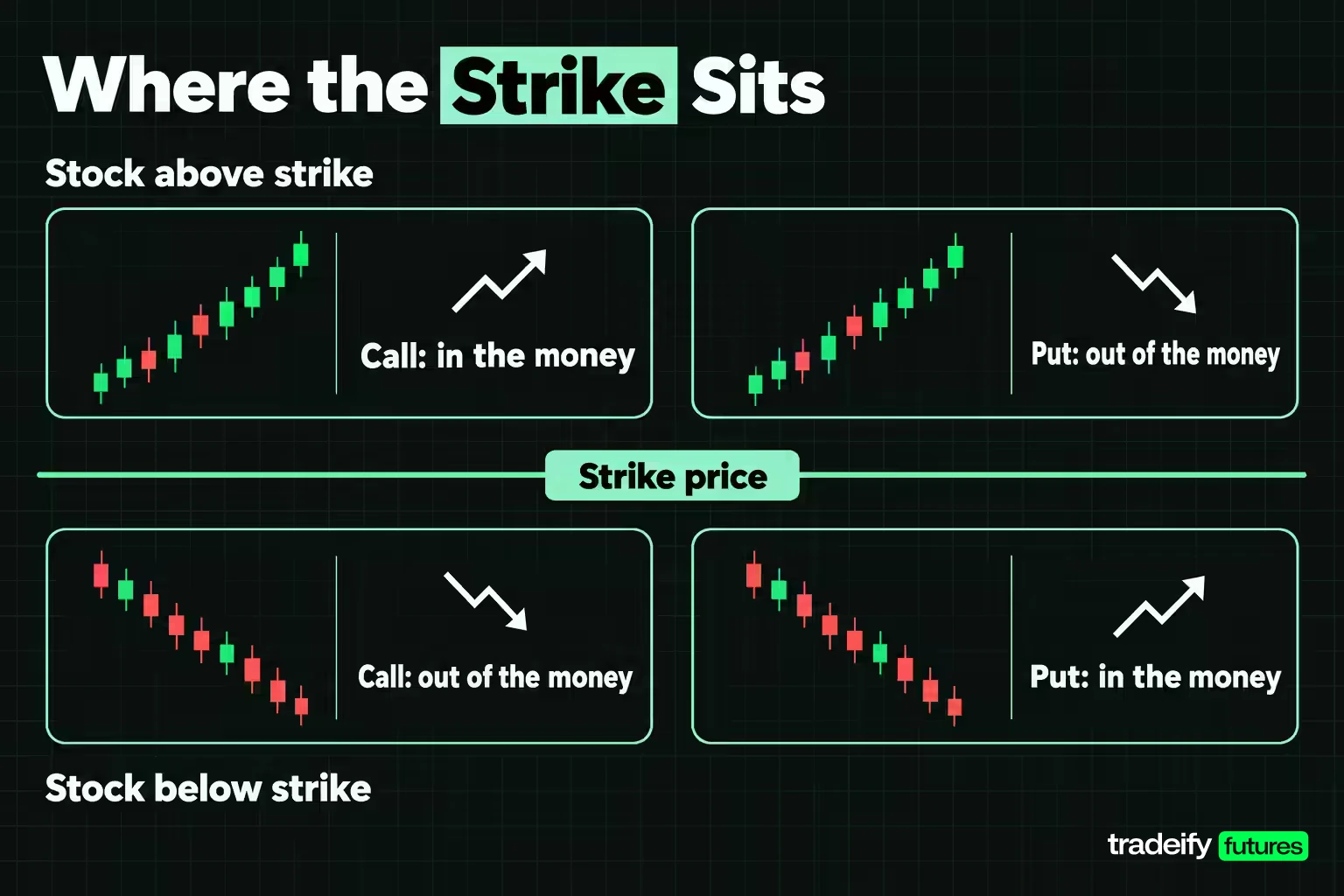
The strike price, or exercise price, is the fixed price at which the option holder can buy (call) or sell (put) the stock. Where the stock trades compared with that strike decides whether exercising the option makes sense right now.
For calls and puts the labels work in opposite directions:
- A call is in the money when the stock is above the strike, at the money when the two are equal, and out of the money when the stock is below the strike.
- A put is in the money when the stock is below the strike, and out of the money when the stock is above it.
Here is how that looks in illustrative numbers. With the stock at $40, a $45 put is in the money by $5.00, worth $500 in intrinsic value on one 100-share contract. A $35 put on the same stock is out of the money and has no intrinsic value.
Choosing a listed strike is a trade-off, and the cheap end of the chain is where beginners get caught. Lower call strikes cost more but need a smaller move to pay off. Higher call strikes look like a bargain because the stock has further to travel, and that distance is exactly why many of them expire worthless.
For employee options, you do not choose the strike. ISO rules require the strike to be at least the fair market value on the grant date. Private companies set that value with an independent 409A valuation, which is usually below the price investors paid for preferred shares in the last funding round. A low strike is only good news if the stock later trades well above it and you can actually sell.
Listed Stock Option Contract Specifications
Listed stock option contracts are standardized, so every contract in the same series has the same terms. Reading the quote correctly is the first piece of risk control.
The SEC's example quote is "ABC December 70 Call $2.20". It breaks down like this:
- ABC is the underlying stock.
- December is the expiration month.
- 70 is the strike price, $70 per share.
- Call is the type.
- $2.20 is the premium per share.
An option contract generally represents 100 shares, so a $2.20 premium costs $220 per contract before commissions and fees. That multiplier is easy to forget when you are staring at a price that looks like pocket change. A quote that reads two dollars is a $220 decision, and ten contracts is $2,200.
Other specifications that matter:
- Expiration cycle. Standard monthly stock options generally expire around the third Friday of the month. Many stocks also list weekly and quarterly expirations.
- Adjusted contracts. Splits, mergers and special dividends can change the deliverable so a contract no longer covers 100 plain shares. Check the contract details before trading an unusual series.
- Opening and closing. Buying to open creates a long position and selling to open creates a short one. You exit by doing the opposite in the same contract.
- Account approval. Options trading needs specific approval from your brokerage firm, and every customer is expected to read the Characteristics and Risks of Standardized Options disclosure document.
American and European option styles
American-style options can be exercised at any time before expiration. European-style options can be exercised only during a set period just before expiration. FINRA notes that options on individual stocks and ETFs in U.S. markets are American-style, so SPY options are American-style while S&P 500 index (SPX) options are European-style.
The style matters most to sellers. A short American-style option can be assigned on any day the equity market is open, not only at expiration.
Related lesson: Compare the two exercise styles
How Stock Options Are Valued
Stock option value has two parts. Intrinsic value is what the option would be worth if exercised right now. Time value is everything above that, the price of the chance that the stock moves further before expiration.
Take an illustrative example. A stock trades at $53 and a $50 call with 20 days left is priced at $4.10. Intrinsic value is $3.00 (the $53 stock minus the $50 strike). Time value is $1.10, or $110 per contract. The full contract costs $410.
The main inputs that move a listed premium are:
- The stock price compared with the strike.
- Time until expiration.
- The stock's expected volatility, called implied volatility in the option price.
- Interest rates and expected dividends, which matter less for short-dated contracts.
Time value shrinks as expiration approaches, and the decay tends to speed up in the last weeks for at-the-money contracts. That is why a holder can be right on direction and still lose. The stock moved, just not far enough or fast enough to cover the time value that disappeared. Reading the direction correctly and owning a profitable option are two separate things.
The standard pricing framework comes from Fischer Black, Myron Scholes and Robert Merton. Merton and Scholes received the 1997 Nobel prize in economics for the method, which the prize committee described as a formula for valuing stock options.
Valuing employee stock options
Employee stock options at a private company have no market price. Their paper value is the spread between the latest fair market value (usually the 409A number) and your strike, multiplied by vested options. That number ignores the real questions: when you can sell, what the company will be worth then, and how much tax you owe along the way. Treat it as an upper bound, not a balance.
A Worked Stock Option Payoff Example
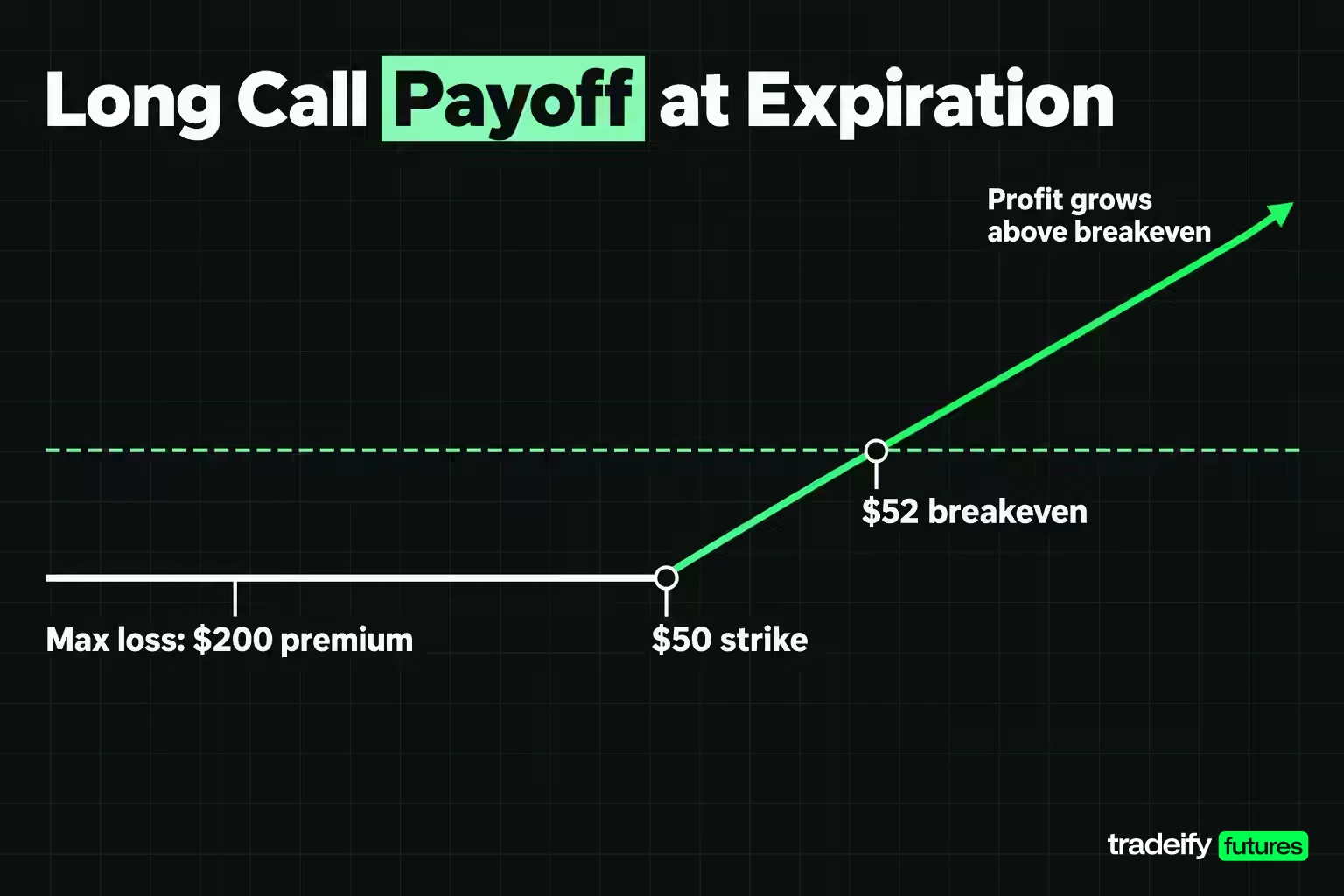
A worked stock option example makes the trade-offs concrete. All prices here are illustrative.
ABC stock trades at $48. You buy one 30-day $50 call for a $2.00 premium. With the 100-share multiplier, the cost is $200 before fees. The breakeven at expiration is $52, the strike plus the premium.
| ABC price at expiration | Call intrinsic value | Profit or loss per contract |
|---|---|---|
| $45 | $0 | -$200 |
| $50 | $0 | -$200 |
| $52 | $2.00 | $0 |
| $55 | $5.00 | +$300 |
| $60 | $10.00 | +$800 |
The table shows the shape of a long call. The loss is capped at the $200 premium, and the gain grows with the stock above $52.
It also hides the most common disappointment. Suppose ABC climbs from $48 to $49.50 in the first week. The direction was right, but the call is still out of the money and a week of time value has gone. The option can be worth less than you paid even though the stock rose. "The stock went up" is not a complete options thesis; the move also needs a size and a deadline.
You also do not have to wait for expiration. If ABC jumps to $55 in ten days, the call will trade above its $5.00 intrinsic value because time remains, and you can sell it to close. Most listed option traders exit this way rather than exercising.
Vesting Schedules for Employee Stock Options
A vesting schedule decides when employee stock options become yours to exercise. Until options vest, they are a promise that depends on you staying with the company.
Carta reports that the most common structure is four years with a one-year cliff. The cliff means nothing vests for the first 12 months, then a block vests at once.
Here is an illustrative grant of 4,000 options:
- Months 1 to 11: nothing vested.
- Month 12 (the cliff): 1,000 options vest.
- After that: the remaining 3,000 options vest at 250 per quarter for 12 quarters.
- After two years: 2,000 options vested.
- After four years: all 4,000 options vested.
Some plans vest monthly after the cliff, some use performance milestones, and some accelerate vesting if the company is acquired. Read your grant agreement rather than assuming the common pattern.
Leaving a company before options vest
If you leave, vesting stops on your last day. Unvested options go back to the company's option pool. Vested options usually stay exercisable for a limited post-termination exercise period, and Carta notes that the company is not obliged to remind you of that deadline. Miss it and the options are gone.
Exercising Stock Options
Exercising stock options means using the right in the contract: paying the strike price to buy shares (a call or employee option) or delivering shares at the strike (a put). The decision differs sharply between listed and employee options.
Exercising listed stock options
Most listed option holders never exercise. FINRA says only about 7% of options positions are typically exercised, because selling the contract usually captures its time value as well as its intrinsic value. Exercising a call early throws that time value away and ties up the full share cost, $5,000 for 100 shares at a $50 strike. Early exercise can make sense in narrow cases, such as just before a dividend on a deep in-the-money call.
Exercising employee stock options
Employee options can only be exercised, not sold, so the question is how and when. Common methods:
- Cash exercise. You pay the strike and any tax withholding out of pocket and keep all the shares.
- Cashless exercise (same-day sale). A broker sells all the shares right away and you keep the proceeds minus the cost. At private companies this usually happens only during a liquidity event such as a tender offer.
- Sell-to-cover. You sell just enough shares to pay the exercise cost and taxes and keep the rest.
- Stock swap. You pay with company shares you already own, which section 422 allows for ISOs if the plan permits it.
An illustrative case shows the numbers. You hold 1,000 vested options with a $5 strike and the stock is worth $12. Exercising costs $5,000 and gives you shares worth $12,000, a $7,000 spread. With sell-to-cover and ignoring taxes and fees, you would sell about 417 shares to fund the $5,000 and keep 583.
That spread is where the tax bill sits. For an NSO, the $7,000 is ordinary income in the year you exercise. For an ISO, there is no regular income tax at exercise, but the $7,000 counts for the alternative minimum tax.
Timing is the hard part, and both choices have a real cost. Exercising early can start the holding clock and lock in a smaller taxable spread, but you put cash into shares you may never be able to sell. Waiting keeps your cash free but can mean a bigger tax bill, or a rushed decision when a deadline arrives. Carta found that in Q4 2024, employees at startups on its platform exercised only 32.2% of grants that were fully vested and in the money, which shows how often people hesitate on that cost.
Stock Option Expiration
Stock option expiration is the deadline after which the right disappears. What happens at that moment depends on the type of option.
When listed stock options expire
Standard monthly listed stock options generally expire around the third Friday of the month. At expiration, an out-of-the-money option expires worthless. An in-the-money option is usually exercised: the Options Clearing Corporation exercises expiring equity options that are $0.01 or more in the money unless the broker submits contrary instructions, and brokers can apply their own thresholds and cutoff times.
That one-cent rule catches traders who stop watching a position on the last day. A long call that closes a few cents in the money turns into 100 shares per contract, and the account needs cash or margin to hold them over the weekend. A short option can be assigned the same way. Close it, or give your broker explicit instructions before the cutoff, rather than leaving the outcome to a default.
When employee stock options expire
Employee stock options have much longer lives. An ISO cannot be exercisable more than 10 years after grant (5 years for someone owning over 10% of the voting stock). Leaving the company usually cuts that short to the post-termination exercise period in the plan.
There is also a tax deadline inside that window. To keep ISO treatment, you must exercise within 3 months after your employment ends (1 year if you are disabled). A plan may let you exercise later, but the option is then taxed as an NSO.
How Stock Options Are Taxed
Stock option taxes depend on the type of option. This section summarises the U.S. federal rules from the IRS and the Internal Revenue Code. It is general education, not tax advice, and state rules and your situation can change the answer.
Taxes on nonqualified stock options
For most NSOs, there is no tax at grant. At exercise, the spread between the stock's fair market value and the strike is ordinary income, usually reported on your W-2 if you are an employee. When you later sell the shares, any further gain or loss is a capital gain or loss, long-term if you held the shares more than one year after exercise.
Taxes on incentive stock options
ISOs get statutory treatment. There is no regular income tax at grant or exercise, but the spread at exercise is an adjustment for the alternative minimum tax, which can create a large bill in the exercise year. Your employer reports the exercise on Form 3921.
The full benefit needs two holding periods. You must not sell the shares within 2 years of the grant date or within 1 year of exercise. Meet both and the whole gain over the strike is a long-term capital gain. Sell earlier and it is a disqualifying disposition, and part of the gain becomes ordinary income.
The $100,000 rule for incentive stock options
The $100,000 rule caps how many ISOs can first become exercisable in one calendar year. If the stock covered by ISOs that first vest in a year is worth more than $100,000, valued at the grant-date price, the excess is treated as NSOs. Options count in the order they were granted.
An illustrative grant shows how it works. A grant covers 30,000 shares at a $10 grant-date value, $300,000 in total. If it vests 10,000 shares a year, each year is exactly $100,000 and all of it can be ISOs. If 20,000 shares ($200,000) first vest in one year, $100,000 stays ISO and the other $100,000 is treated as NSOs.
Taxes on ESPP shares
ESPP shares follow similar holding periods: 2 years from the start of the offering and 1 year from purchase. An illustrative case shows the discount. If the stock is $40 at the start of the offering and $50 on the purchase date, a plan with the full 15% discount on the lower price charges $34 a share. Your employer reports the transfer on Form 3922.
Taxes on listed stock options
Listed stock options bought and sold in a brokerage account follow IRS Publication 550. You cannot deduct the premium when you buy. If you sell the option before exercising it, the difference is a short-term or long-term capital gain or loss depending on how long you held it. If it expires, the premium becomes a capital loss.
Selling Shares From Exercised Stock Options
Selling shares from exercised stock options is often the step people plan for least. A share price on a dashboard is not money until you can actually sell, and the rules on when you can sell are usually tighter than people expect.
At a public company, shares from exercised options can usually be sold through the plan broker, subject to company trading windows. Many companies close trading for employees around earnings and other sensitive periods. After an IPO, a lock-up agreement typically blocks insiders and employees from selling for a set period.
At a private company, there is often no market at all. Shares may only become sellable in an acquisition, an IPO or a company-arranged tender offer. The classic trap is exercising early, paying tax on the spread, and then watching the value fall before any sale is possible.
Before selling, connect three decisions:
- Taxes. Selling ISO shares early creates a disqualifying disposition. Holding past one year after exercise can turn short-term gains into long-term ones.
- Concentration. Your salary already depends on the company. Holding a large share of your net worth in the same stock doubles that exposure.
- A rule set in advance. Decide what you will sell, and at what point, before the window opens, so the share price on the day does not make the choice for you.
How Corporate Events and Dilution Affect Stock Options
Corporate events can change stock options without the holder doing anything. Employee holders and listed option traders face different versions of the same problem.
Acquisitions and IPOs for employee stock options
When a private company is acquired, employee stock options may be assumed by the buyer, converted into the buyer's options, cashed out, or in some cases canceled, depending on the deal and the plan. Some plans accelerate vesting on a sale. An IPO usually creates a market for the shares but adds a lock-up and trading windows.
Dilution and option pools
A stock option pool is a block of shares set aside for current and future employees. Creating or enlarging the pool dilutes existing shareholders, and so does each funding round that issues new shares. Your number of options stays the same, but your percentage of the company falls. Dilution does not have to mean a lower value per share, because new money can grow the company, but it is why "0.1% of the company" at hiring rarely stays 0.1%.
Corporate actions on listed stock options
Listed stock options are adjusted for events such as stock splits, mergers and special dividends. After an adjustment, one contract may deliver a different number of shares or a mix of shares and cash. Pricing tools can misread these series, so check the deliverable before trading one.
Common Stock Option Strategies
Stock option strategies are ways to combine options with each other or with shares for a specific job. The list here sticks to the basic single-option structures, with illustrative numbers.
| Strategy | Position | What it is for | Main risk |
|---|---|---|---|
| Long call | Buy a call | Upside exposure with a capped cost | Losing the full premium |
| Long put | Buy a put | Downside exposure with a capped cost | Losing the full premium |
| Covered call | Own 100 shares, sell a call | Collect premium against shares you own | Shares called away, upside capped |
| Protective put | Own 100 shares, buy a put | Set a floor under a stock position | Premium cost if no fall comes |
| Cash-secured put | Sell a put, hold cash for the shares | Get paid to wait for a lower entry | Buying shares as they keep falling |
Stock option strategy examples in numbers
A few illustrative numbers make each stock option strategy concrete:
- Covered call. You own 100 shares bought at $48 and sell a $55 call for $1.00, collecting $100. If the stock rises above $55, the shares are likely called away at $55, so you give up any gain beyond that.
- Protective put. You own shares at $50 and buy a $45 put for $1.50 ($150). Your worst exit is $45 a share until expiration, plus the premium you paid.
- Cash-secured put. You sell a $45 put for $1.20 ($120) and set aside $4,500 in case of assignment. If assigned, your effective purchase price is $43.80. If the stock falls to $30, you still buy at $45.
- Stock replacement. Instead of $4,800 for 100 shares at $48, you buy one call for $200. Less cash is at risk, but the call can expire worthless while the shares would still be worth something.
Stock option strategies for employees
Employee option holders have a different strategy menu: exercise and hold, exercise and sell, or wait. A common middle path is to exercise and sell enough to cover the cost and taxes, then hold the rest under a written selling plan.
So are stock options a good thing? They are a tool, not a verdict. For an employee, options can be valuable if the company grows and the shares become sellable. For a trader, options can define risk precisely, but precision in the contract does not replace discipline in the plan, and many contracts bought out of the money expire worthless.
Related lesson: How premiums work for buyers and sellers
Stock Option Risks
Stock option risks depend on which side you are on. Listed buyers, listed sellers and employee holders each face a different main risk.
Risks for listed option buyers
- Losing the full premium. An out-of-the-money option at expiration is worth nothing.
- Time decay. The option loses time value every day the stock does not move enough.
- Volatility drops. A fall in implied volatility, common after earnings, can cut the premium even when the stock moves your way.
- Wide spreads. Thinly traded contracts can cost a lot to enter and exit.
- Size creep. A cheap premium invites too many contracts. Ten contracts at $2.00 is $2,000 at risk, not $2.
Risks for listed option sellers
Selling options collects premium but takes on an obligation. A short American-style option can be assigned on any trading day. FINRA gives an example: sell 10 XYZ $50 calls at $1.00 with the stock at $40 and collect $1,000. If XYZ rises to $60 and you are assigned without owning the shares, you must deliver 1,000 shares at $50, an unrealized loss of $9,000. An uncovered call has no fixed ceiling on that loss.
Risks for employee option holders
- Underwater options. If the stock never rises above the strike, the options have no value.
- No market. Private company shares may not be sellable for years.
- Tax surprises. An ISO exercise can trigger the alternative minimum tax on gains you cannot yet sell.
- Concentration. Your job and a large share of your savings ride on one company.
- Deadlines. Missing a post-termination exercise window forfeits vested options.
A stock option pre-trade check
Before opening a listed stock option position, answer these questions in writing:
- What job does this position do: direction, protection or income?
- What stock move does it need, and by when?
- What are the strike, expiration, premium, bid-ask spread and open interest?
- How much of the premium is intrinsic value and how much is time value?
- What happens if implied volatility falls while the stock moves as expected?
- What is the most you will lose in dollars, and what event closes the trade?
- What happens at expiration or assignment if you do nothing?
A vague answer such as "it should go up" fails the check. If the position only works with a fast, precise move on a precise schedule, size it for that fragility or skip it. Doing nothing is a valid answer when the contract needs everything to go right.
On our accounts you trade CME futures such as ES, NQ, YM and RTY and their micros. We do not offer options of any kind, cash stocks or single stock futures, so nothing here describes a product you can trade with us. Our funded accounts are simulated.
Related lesson: How assignment works for option sellers
Stock Options FAQ
How does a stock option work?
A stock option gives its holder the right to buy or sell a stock at a fixed strike price before an expiration date. Listed options cost a premium and usually cover 100 shares per contract. Employee options are granted by an employer and must vest before they can be exercised.
What is the $100,000 rule for stock options?
The $100,000 rule limits incentive stock options to $100,000 of stock value, measured at the grant-date price, that can first become exercisable in a calendar year. Anything above that is treated as nonqualified stock options. It comes from section 422(d) of the Internal Revenue Code.
What are examples of stock options?
An exchange-traded example is one "ABC December 70 Call" priced at $2.20, which costs $220 and gives the right to buy 100 shares at $70. An employee example is a grant of 4,000 options at a $5 strike vesting over four years with a one-year cliff. ESPP purchase rights are a third kind.
Are stock options a good thing?
Stock options can be a good thing, but only when the terms fit your goals and you understand the costs. Employee options can add real value if the company grows and you can sell, but they can also end up worthless. Listed options can define risk, but buyers lose the whole premium when the move does not come in time.
Can you lose more than you pay for stock options?
A buyer of a listed call or put can lose only the premium plus fees. A seller can lose much more, and an uncovered call has no fixed limit. Employees cannot lose more than they paid to exercise, but they can owe tax on gains that later disappear.
Do stock options always cover 100 shares?
Standard listed stock option contracts generally cover 100 shares. Splits, mergers and special dividends can produce adjusted contracts with a different deliverable. Employee grants cover whatever number of shares the grant states.
This article is general education, not investment, tax or legal advice. Options involve substantial risk and are not suitable for everyone: buyers can lose the full premium, and sellers can lose more than the premium received. Futures and leveraged products can also lose more than expected, and simulated or funded accounts are simulated. Read the options disclosure document and your plan documents, and speak with a qualified tax professional before exercising employee options.


