



TL;DR: 0DTE options are options traded on expiration day, so direction, timing and move size must all work before the close. SPX, XSP, SPY, QQQ, IWM and ES options expire every weekday, and SPXW, XSP and ES weeklies stop at 4:00 PM ET. Time value falls fastest in the final hour, and delta swings hard near the strike. Buyers can lose the full premium, and sellers many times the credit. Size from maximum loss and know whether you get cash, shares or futures.
0DTE options are calls and puts that expire on the same day you trade them. Buy one at 10:00 AM and it is settled that afternoon. Any option series becomes a 0DTE contract on its final trading day, even if it was listed months earlier.
That short clock is the whole story. A futures trader needs price to reach the target before the stop. A 0DTE option trader needs that too, plus a move that arrives early enough and runs far enough to beat the premium. You can read the direction correctly and still lose money. Those are two different decisions, and this guide treats them separately.
What Are 0DTE Options
0DTE stands for zero days to expiration. Cboe describes 0DTE options as contracts that expire at the end of the current trading day, and FINRA defines a 0DTE strategy as opening a position on the option's expiration day. They are not a separate product. They are ordinary listed options in their last session.
A call gives the holder the right to buy the underlying at the strike price. A put gives the holder the right to sell at the strike. The buyer pays a premium for that right. The seller collects the premium and takes on the obligation.
On expiration day, the premium has two parts. Intrinsic value is the amount the option is in the money. Time value is everything else, and on the last day it can only go one way by the close: to zero.
How 0DTE options trading works in practice
Most 0DTE options traders never hold to settlement. They open and close within hours, trading the change in premium. The premium moves with the underlying, with time and with implied volatility.
A buyer is paying for a move that has to arrive today. A seller is betting the move stays smaller than the market expects. Both sides are trading the same thing: how far the underlying travels before the bell compared with what the premium already priced in.
Which Symbols Offer 0DTE Options
0DTE options exist every weekday only on underlyings with daily expirations. Most single stocks list weekly options that expire on Fridays, so they become 0DTE once a week.
Products with an expiration every weekday include:
- SPX Weeklys (SPXW) on the S&P 500 Index, which settle Monday through Friday.
- XSP options on the Mini-SPX Index, which is 1/10th the value of SPX and also expires Monday through Friday.
- SPY, QQQ and IWM options, where exchange rules allow Monday, Tuesday, Wednesday and Thursday expirations on top of the Friday weekly.
- E-mini S&P 500 options at CME, which list Monday, Tuesday, Wednesday, Thursday and Friday weekly options on the futures contract.
Some ETFs have partial schedules. Cboe's rules allow Monday and Wednesday expirations in GLD, SLV and TLT, and Wednesday expirations in USO and UNG. In January 2026 the SEC approved a Nasdaq ISE rule allowing Monday and Wednesday expirations on some qualifying individual stocks and ETFs, and Cboe filed a matching rule. Check the live option chain before assuming a symbol has a same-day contract.
Volume is concentrated in index options. Cboe's 0DTE page, checked on November 4, 2026, listed 59% of SPX volume and 48% of XSP volume as 0DTE.
| Product | Underlying | Size per point | Settlement | Exercise style |
|---|---|---|---|---|
| SPXW | S&P 500 Index | $100 | Cash, PM-settled | European |
| XSP | Mini-SPX, 1/10th of SPX | $100 on a 1/10th index | Cash, PM-settled | European |
| SPY | S&P 500 ETF | 100 shares | Shares of the ETF | American |
| E-mini S&P 500 weekly options | ES futures | $50 | One ES futures contract | European |
At an illustrative S&P 500 level of 6,000, one SPX contract controls $600,000 of notional value, one XSP contract $60,000 and one ES option's underlying future $300,000. The same idea can carry very different dollar risk depending on which product you pick.
How 0DTE Options Expire and Settle
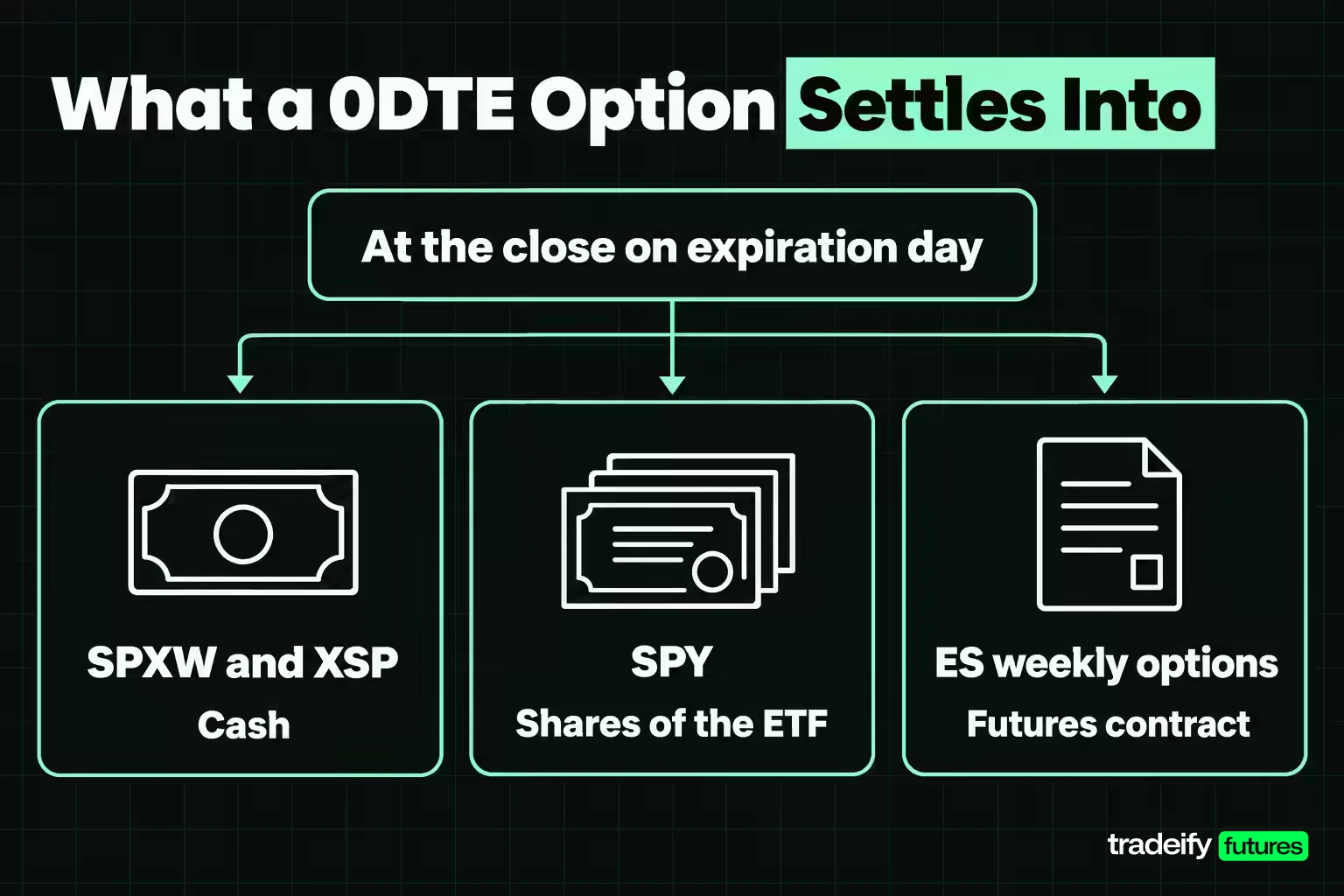
0DTE options expiration rules vary by product, and the differences decide what lands in your account at the close.
On Cboe, expiring SPXW options stop trading at 4:00 PM ET on expiration day, or 1:00 PM ET on a half-day holiday. Expiring XSP Weeklys close at 3:00 PM Chicago time, which is 4:00 PM ET. Both are PM-settled from the index close and paid in cash on the next business day. Because they are European style, they can only be exercised at expiration.
0DTE options on ETFs settle in shares
SPY options are American style and settle in shares of the ETF. Equity options that finish in the money by $0.01 or more are exercised automatically under the clearing house's exercise-by-exception procedure unless an instruction says otherwise. A long call that closes a few cents in the money can become 100 shares per contract overnight, with the gap risk that comes with it.
FINRA warns that brokers may evaluate positions before the close. If an account cannot cover the shares or cash an exercise would require, the firm may liquidate the option position before the end of the session, at a price that limits profit or adds to a loss. Cash-settled index options are less likely to trigger this, but it is still the broker's call.
0DTE options on futures settle into futures
E-mini S&P 500 weekly options are options on one ES futures contract, with each index point worth $50.00. CME Rule 358A says trading in an expiring weekly stops at 3:00 PM Chicago time (4:00 PM ET). The fixing price is the volume-weighted average of ES futures trades in the final 30 seconds, from 2:59:30 PM to 3:00:00 PM Chicago time. In-the-money weeklies are exercised automatically, and out-of-the-money ones are abandoned.
Exercise does not pay cash. A long call becomes a long ES futures position at the strike, and a long put becomes a short position. ES keeps trading until 5:00 PM ET and reopens at 6:00 PM ET, so an exercised position is live market exposure the moment it appears.
Theta Decay in 0DTE Options
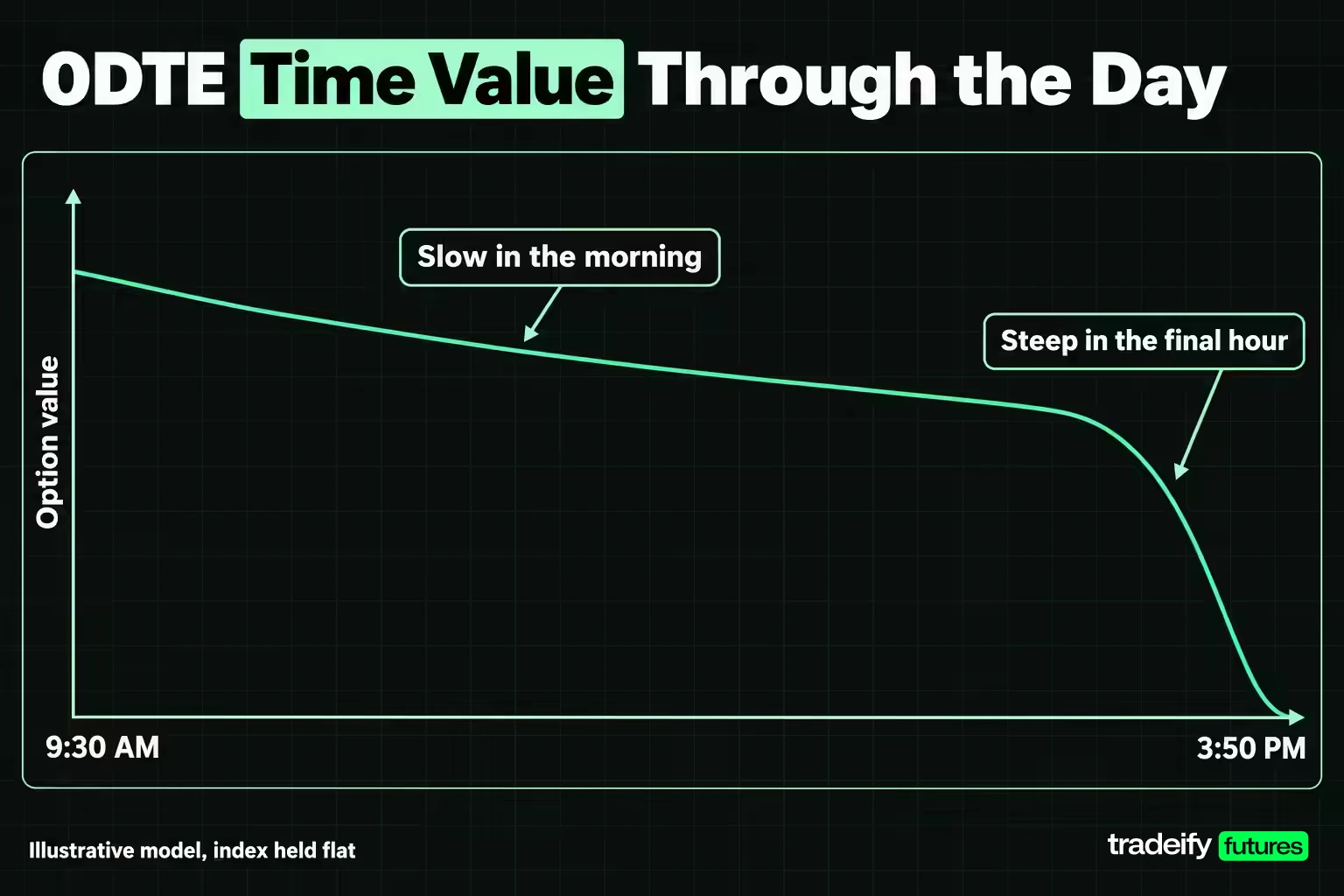
Theta decay is the loss of an option's time value as expiration approaches. With 0DTE options, the decay is not spread evenly across the day. It is slow in the morning and steep in the final hour.
The table shows a simple Black-Scholes model of two S&P 500 calls with the index held flat at 6,000 and implied volatility at 15%. The figures are illustrative model output, not market quotes, and they assume volatility is spread evenly through a 6.5-hour session.
| Time (ET) | 6,000 call (at the money) | 6,020 call (out of the money) |
|---|---|---|
| 9:30 AM | 22.62 ($2,262) | 14.05 ($1,405) |
| 11:00 AM | 19.84 ($1,984) | 11.45 ($1,145) |
| 1:00 PM | 15.37 ($1,537) | 7.41 ($741) |
| 2:30 PM | 10.87 ($1,087) | 3.68 ($368) |
| 3:00 PM | 8.87 ($887) | 2.25 ($225) |
| 3:30 PM | 6.27 ($627) | 0.76 ($76) |
| 3:50 PM | 3.62 ($362) | 0.04 ($4) |
In this model the at-the-money call loses 1.81 points ($181) in the first hour of trading and 8.87 points ($887) in the last hour. By 1:00 PM it has lost 32% of its opening value, while the out-of-the-money call has lost 47%.
What the 0DTE decay curve means for a trade
The out-of-the-money option decays faster in percentage terms because it is made entirely of time value. If the index is still flat at 3:30 PM, the 6,020 call holds only 0.76 points. It needs a 20-point move in half an hour just to have intrinsic value.
For a buyer, that means the setup has to work early. Waiting for the afternoon is paying rent on a position that has stopped earning. For a seller, the steep afternoon decay is the appeal, but that same window is when a move does the most damage. Real markets are not flat, and the open and close usually carry more movement than the model assumes.
Gamma and the Greeks in 0DTE Options
Delta estimates how much an option's price changes for a one-point move in the underlying. Gamma measures how fast delta changes. On expiration day, gamma near the strike becomes very large, and that is what makes 0DTE options feel unstable.
In the same 15% volatility model, the 6,000 call's gamma is 0.0070 at the open and 0.0179 with one hour left. A similar option with 21 trading days left, about one month, has a gamma of 0.00154. One hour before expiration, the at-the-money gamma is about 12 times the one-month figure.
You can see it in delta. At the open, a move from 5,995 to 6,005 takes the 6,000 call's delta from 0.47 to 0.54. With 30 minutes left, the same 10-point move takes it from 0.38 to 0.63. The option is acting less like a smooth position and more like an on-off switch at the strike.
Pin risk and dealer hedging on 0DTE expiration days
When the underlying finishes near a strike, a small move in the last minutes can flip an option from worthless to in the money. That is pin risk. It matters most for sellers and for anyone holding a physically settled product into the close.
Market makers who sell 0DTE options often hedge with the underlying or futures, and their hedges change as delta changes. Some analysts track estimated dealer gamma exposure to judge whether that hedging may dampen or amplify intraday moves. Treat those estimates as context, not a signal on their own, because the positions behind them are not fully public.
Related lesson: Option gamma
Why Traders Use 0DTE Options
The appeal of 0DTE options is real, which is why it pays to be precise about what each benefit does and does not give you.
- Small premium. Same-day options cost less than further-dated options at the same strike, because little time value is left. FINRA notes the lower premiums. A smaller premium is not a smaller risk if you simply buy more contracts.
- Defined buyer risk. A long call or put cannot lose more than the premium paid. That cap is clean, but the full premium can disappear in hours.
- No overnight hold. The outcome is known the same day, as Cboe puts it. There is no overnight gap on a cash-settled index option that expires. Physically settled and futures options can still turn into overnight positions through exercise.
- Event targeting. A trader can express a view on one data release or one afternoon without paying for weeks of time value.
- Liquidity. Cboe describes index 0DTE options as highly liquid with tight spreads. That applies to active strikes in liquid products, not to every strike.
Why traders buy 0DTE options instead of the underlying
Options give a capped loss on the long side and a nonlinear payoff. A put can cap downside on a portfolio for a day, and a call can express a sharp upside view with a known maximum loss. The price for that is time value, and on expiration day the price of time is paid fastest.
Who Trades 0DTE Options
Several kinds of traders meet in the same 0DTE options market, and they want different things.
- Premium sellers sell credit spreads and iron condors, aiming to collect the afternoon decay. Their risk is the occasional large move.
- Directional day traders buy calls, puts or debit spreads to trade a breakout, a reversal or a news release, with the premium as their maximum loss.
- Hedgers use same-day puts or calls to protect a stock portfolio or futures position through a specific event, such as an inflation report or a Fed decision.
- Market makers quote both sides and hedge the resulting exposure in the underlying or in futures.
Knowing who is on the other side helps. If you buy a cheap out-of-the-money call at 2:00 PM, the seller is usually someone betting that time runs out before price gets there. That seller only needs the afternoon to stay ordinary. You need it to be unusual.
The Main Risks of 0DTE Options
Every risk in options gets compressed into one session with 0DTE options. FINRA's summary is blunt: any strategy that can earn profits quickly can bring losses quickly.
Losing the full 0DTE premium
An option that finishes out of the money expires with no value. For a buyer, the premium is gone, and there is no next week for the idea to work. Your market view can turn out to be right on Friday after the Wednesday option already expired.
Short 0DTE options can lose far more than the credit
FINRA points out that uncovered call writers face unlimited potential loss if the underlying rises sharply. A short put can lose many times its credit in a sell-off. A defined-risk spread caps the loss at the strike width minus the credit, but that cap can still be four or five times the money collected.
Liquidity, fills and settlement on 0DTE options
A heavily traded product can still have wide spreads on a specific strike, especially in fast markets and near the close. On a low-priced option, a few cents of slippage is a large share of the position. The quote on screen is a price someone showed, not a price you are guaranteed to get.
Settlement adds a separate layer. A physically settled option can turn into shares, a futures option into a futures position, and a broker can close a position for you before the close. None of those are market moves, but all of them can cost money.
Whipsaw and binary outcomes in 0DTE options
Near the strike late in the day, a 0DTE option behaves almost like a yes-or-no bet. In a Black-Scholes model with the S&P 500 at 6,000 and implied volatility at 15%, a 6,000 call's delta moves from 0.38 to 0.63 on a 10-point move with 30 minutes left. A choppy final half hour can push the same position from a gain to a loss and back several times.
That whipsaw tempts traders to tighten stops, which then get hit by noise, or to widen them, which raises the loss. Decide in advance whether you will hold through the final minutes or exit at a fixed time. Both choices can work. Changing the choice mid-trade usually does not.
Overtrading 0DTE options
A fresh expiration every weekday makes it easy to trade every day. A string of small premiums lost on low-quality setups can add up to a large weekly loss. The daily expiration is a feature of the product, not a reason to trade.
Related lesson: Options liquidity and bid-ask spreads
Common 0DTE Options Strategies
No 0DTE options strategy creates an edge by itself. Each structure shapes the payoff around a specific view, and each has a specific way of failing.
Long 0DTE calls and puts
A long call expresses a bullish view and a long put a bearish one. The premium is the maximum loss. These suit a momentum or breakout setup where you expect a fast, large move. The failure mode is a move that is too small or too late, so the plan needs a time exit, not just a price stop.
0DTE debit spreads
A call debit spread buys one call and sells a higher strike call. A put debit spread buys one put and sells a lower strike put. The short leg cuts the cost and the time decay, and it also caps the profit. Debit spreads suit a directional view with a realistic target, such as a move back to the prior day's high.
0DTE credit spreads
A credit spread sells one option and buys a further out-of-the-money option for protection. Cboe sets out the payoff: maximum profit is the premium received, and maximum loss is the width of the strikes minus that premium. A put credit spread expresses "the index will not fall below this level today". A call credit spread expresses the opposite.
0DTE iron condors
An iron condor sells a put spread and a call spread together, betting the index stays inside a range. Using Cboe's example, a 5-wide iron condor on SPX risks $500 minus the credit received. The failure mode is a late breakout, so the plan should define the price that ends the range idea.
0DTE options trades around scheduled news events
Some traders buy straddles or strangles before a scheduled release, such as a CPI report or a Fed decision, when they expect a bigger move than the options price in. Others sell premium after the release, once implied volatility has dropped. Both depend on comparing the realized move with the implied one, and both can lose if the move lands exactly where the market expected.
Matching a 0DTE options strategy to the setup
The structure should follow the setup, not the other way round.
- Directional momentum. Price breaks a level with volume and keeps going. A long call or put, or a debit spread, fits because you need the move to continue quickly. The exit triggers are a failed follow-through or a time cutoff.
- Opening range breakout. Price closes outside the first 15 to 30 minutes' range. A debit spread with the short strike near a realistic target keeps cost and decay lower than a single long option. If price returns inside the range, the idea is wrong.
- Mean reversion. Price stretches away from VWAP or a prior-day level and stalls. A credit spread on the far side of the stretch, or a small debit spread back toward the mean, fits a slower move. A new high or low beyond the stall point ends the trade.
- Range day. The index chops between clear levels with falling volatility. An iron condor with strikes outside those levels fits. A break of either level ends the range idea, even if the condor still shows a profit.
Strike choice matters as much as structure. An at-the-money option costs more but responds to the first point of movement. An out-of-the-money option is cheap because it needs a large move to pay. Picking strikes by price instead of by the move the setup actually projects is how a good read turns into a losing trade.
Timing 0DTE Options Trades With Technical Analysis
Because 0DTE options punish late entries, timing matters as much as direction. Technical levels help decide when a setup is valid and when doing nothing is the better trade.
Chart levels that time 0DTE options entries
- Opening range. The high and low of the first 15 to 30 minutes give a reference. A decisive break with volume can support a directional option buy. A return inside the range can support a fade or a range trade.
- VWAP. The volume-weighted average price shows where most volume traded during the session. Price holding above VWAP after a pullback supports a bullish view. Repeated failures at VWAP support a range or bearish view.
- Prior day high, low and close. These levels often attract reactions and give clear invalidation points.
- Round numbers and large-open-interest strikes. Price may stall or pin near them late in the day.
Using the 0DTE straddle to size the expected move
The at-the-money straddle price is a quick read of the move the market is pricing. In the 15% volatility model, the straddle at the open is 45.24 points, about 0.75% of 6,000. With the index flat it shrinks to 30.73 points at 1:00 PM and 17.74 points at 3:00 PM.
Compare your target with that number. If your setup needs a 60-point move by 2:00 PM and the straddle is pricing 45 points for the whole day, the trade asks for more than the market expects. That is a reason to use a spread, reduce size or skip.
The plan should state what invalidates the setup. A breakout that falls back inside the opening range, a loss of VWAP or a time cutoff are all valid exits. A chart level gives you the location. The option's price and time left decide whether the trade is worth taking there.
Related lesson: Opening range breakout
0DTE Options Trade Examples
The three examples use round, illustrative prices. They show the mechanics, not a recommended trade.
Example 1, a long 0DTE call that is right on direction and still loses
A trader buys an S&P 500 index 6,020 call at 10:00 AM with the index at 6,000. In a Black-Scholes model with implied volatility at 15% and a $100 multiplier, the call costs 13.21 points, or $1,321 per contract.
- At 11:00 AM the index is at 6,025. The call is worth 22.51 points, a $930 gain.
- At 1:00 PM the index is at 6,020. The call is worth 15.42 points, a $220 gain.
- At 3:30 PM the index is still at 6,020. The call is worth 6.29 points, a $692 loss.
- At the close the index is at 6,030. The call is worth 10.00 points ($1,000), a $321 loss.
The break-even at expiration is 6,033.21. The index went up 30 points, the view was correct, and the trade still lost money because the move was not big enough. The best exit came in the morning, when the move arrived fast. That is why a 0DTE plan needs profit and time rules, not just a stop. Without them, the trader's choice at 11:00 AM is improvised, and improvised exits tend to favor hope.
Example 2, a 0DTE put credit spread and the win rate it needs
A trader sells the 5,950 put and buys the 5,945 put on SPX for a $1.00 credit. That is $100 collected on a spread 5 points wide, or $500. Maximum loss is $400.
The break-even win rate is 80%, because $400 of risk divided by $500 of total range is 0.80. One maximum loss erases four maximum wins.
This is where the question "what trading strategy has a 90% win rate" leads. Short premium can win often. With full wins and full losses only, a 90% win rate gives 9 x $100 minus 1 x $400, a $500 gain per 10 trades before costs. At a 75% win rate, the same spread loses $250 per 10 trades. A high win rate tells you little until you know the size of the losses.
Example 3, an ES 0DTE option that becomes a futures position
A trader buys an ES weekly 6,000 call for 8.00 points, which is $400 at $50 per point. At 3:00 PM Chicago time, the fixing price is 6,006.00. The call is in the money by 6.00 points ($300), so the trade is down $100 before fees.
The call is exercised automatically into one long ES futures contract at 6,000. If ES drops 10 points before the trader exits, that is another $500 lost. A futures trader who assumed the option simply expired could find a live position after the option market closed.
Position Sizing and Risk Management for 0DTE Options
0DTE options risk management starts with the most the position can lose, not the premium, the credit or the buying power shown on screen.
Sizing 0DTE options from maximum loss
Take an illustrative $10,000 account. Risking 1% per trade is $100. An XSP put spread 1 point wide ($100 width) sold for $0.20 ($20) has an $80 maximum loss, so 1% allows one spread.
At 3% per trade, the same account can sell three spreads. Three maximum losses in a row then cost $720, or 7.2% of the account. Ten straight losses at 3% each leave 73.7% of the account. At 1% each they leave 90.4%.
A written 0DTE options risk plan
Write these down before sending the order:
- Maximum dollar loss for the trade, based on the structure's worst case.
- The underlying level or event that triggers the entry.
- The time window when the setup is valid, and the time you stop opening new positions.
- The exits in priority order: loss, profit, time and invalidation.
- The bid-ask spread and size on the exact strike or combination.
- The settlement method and the broker's expiration-day policy.
- A session cap on the number of attempts and the daily loss.
Stop when the session cap is reached. The pull after two quick losses is to buy one more cheap contract to get it back. That trade has the same odds as the last two, with a worse decision-maker behind it. The cap exists for that exact moment.
Common 0DTE Options Mistakes
Most 0DTE options mistakes come from treating a contract with hours to live as if it had weeks.
- Trading the first minutes on impulse. The opening minutes have wide spreads and fast reversals. Many traders wait for the opening range to form before committing.
- Holding a long option into the last half hour hoping for a move. In the model, the 6,020 call's delta falls to 0.10 by 3:30 PM with the index flat. A late rescue needs a large, fast move, and hope is not an exit rule.
- Buying far out-of-the-money options because they are cheap. A low price usually reflects a low chance of finishing in the money. Cheap and good value are not the same thing.
- Ignoring time decay. A position can lose value while the underlying moves your way.
- Using market orders on thin strikes. A limit order controls the price you accept.
- Sizing a credit trade from the credit. The maximum loss, not the premium, is the risk.
- Forgetting settlement. Shares, futures or a broker liquidation can turn up after a trade you thought was finished.
Where to Trade 0DTE Options
0DTE options trade through brokers that offer listed options or futures options, and access depends on your account approvals.
FINRA notes that options trading requires specific approval from your brokerage firm, and brokers grant different levels for buying options, spreads and uncovered selling. Spreads and short options generally need a margin account. FINRA also points out that intraday margin requirements apply to margin accounts during the trading day, including on expiration dates.
The stock-account day-trading rules are changing. FINRA Regulatory Notice 26-10 replaces the pattern day trader rules, including the $25,000 minimum equity, with new intraday margin standards. It took effect June 4, 2026, and the phase-in ends October 20, 2027, so your firm may still be on the old rules.
Options on ES are traded through a futures account with options permission. Before trading 0DTE options anywhere, ask the broker three things: when it starts closing expiring positions, how it handles in-the-money options it thinks you cannot afford to exercise, and what fees apply to exercise and assignment.
0DTE Options Versus Futures Day Trading

0DTE options and intraday futures can both express a view on the S&P 500 within one session, but the payoffs are different.
An ES futures contract gains or loses $50 per index point from your entry, with no time decay. An at-the-money 0DTE option starts with a delta near 0.50, loses time value all day and swings toward a delta of 0 or 1 as the close approaches. The futures trade needs price to move past your costs. The option trade needs price to move past the premium, in time.
| Factor | 0DTE options | Intraday futures |
|---|---|---|
| Payoff | Nonlinear, changes with strike, time and volatility | Linear, fixed dollar value per point |
| Time decay | Works against buyers, for sellers | None |
| Maximum loss | Premium for buyers, strike width minus credit for spreads, open-ended for uncovered sellers | Set by your stop and sizing, with slippage risk |
| End of session | Expires, settles or is exercised | Stays open until you close it |
Do not swap an option premium in for a futures stop distance. A $500 premium and a $500 stop are not the same risk, because the option can lose all $500 with no price move at all.
Our accounts at Tradeify trade futures, not options. We don't offer options of any kind, including 0DTE. On our accounts you trade products like ES and MES, positions are closed by 4:45 PM ET each day, and funded accounts are simulated. If you study 0DTE flows, use them as context for how ES behaves into the close.
0DTE Options FAQ
Are 0DTE options the same as day trading
No. 0DTE options are often used for day trading because they expire the same day, but day trading covers any position opened and closed in one session, including stocks, futures and longer-dated options.
Can you lose more than the premium on 0DTE options
A buyer of a call or put can lose only the premium paid. A seller can lose much more than the credit. Spreads cap the loss at the strike width minus the credit, while uncovered short calls carry unlimited risk.
What time do 0DTE options stop trading
Expiring SPXW and XSP options stop trading at 4:00 PM ET, or earlier on half-day holidays. E-mini S&P 500 weekly options stop at 3:00 PM Chicago time, also 4:00 PM ET. Your broker may close positions earlier.
What is the 3 5 7 rule in trading
The 3 5 7 rule is an informal risk heuristic, not an exchange or regulatory rule. A common version says risk no more than 3% per trade, keep total open risk under 5%, and make winners at least 7% larger than losers. For 0DTE options, 3% per trade is aggressive because full losses are frequent.
What trading strategy has a 90% win rate
No strategy reliably wins 90% of the time without trade-offs. Far out-of-the-money credit spreads can win often, but one maximum loss can wipe out several wins. Judge any strategy by the win rate and the size of the average loss together.
What is theta decay in options trading
Theta decay is the daily loss of an option's time value as expiration nears. It speeds up close to expiration. For 0DTE options, most of the at-the-money time value disappears in the final hours of the session.
Treat the 0DTE Options Clock as a Constraint
The defining feature of 0DTE options is not cheap premium or fast profit. It is the lack of time. The thesis, entry, invalidation and exit all have to work inside one session.
Before your next 0DTE options trade, write down the move you need, the time it must arrive by, the maximum loss and what happens if the position is still open at the close. If any answer is blank, the trade is not ready, and passing on it is a valid decision.
Options and futures trading involve substantial risk of loss and are not suitable for every investor. 0DTE options can expire worthless within hours, and short options can lose far more than the premium received. Futures are leveraged and losses can exceed what you expect. Simulated or funded accounts are simulated and do not reproduce every live fill. This article is education, not individual advice or a recommendation to trade any product or strategy.


