.svg)

.svg)
.svg)




TL;DR: The best futures prop firm accounts for small account traders are usually 25K or 50K evaluations with a $1,000 to $2,000 drawdown, micro-contract access, clear payout rules, and a cost structure you can afford for more than one attempt. Compare the full cost of the evaluation, resets, activation, data, and commissions rather than choosing the lowest advertised fee. Then match the drawdown model, daily loss rule, consistency target, and payout conditions to how you actually trade. A smaller account with clear rules is often a better fit than a larger account that encourages oversized positions.
Table of contents
- What makes a futures prop firm account good for small traders
- Best futures prop firm accounts compared
- Why 25K and 50K futures accounts make sense
- Compare the full futures prop firm cost
- Use drawdown to compare futures accounts
- Trade micro futures in a small prop account
- Check futures prop firm payout rules
- Choose a futures prop firm account by trader type
- Avoid small futures account mistakes
- Small futures prop firm account questions
A larger account number can look like the obvious choice. More buying power. More contracts. More room to trade.
That is not always how futures prop firm accounts work.
The number on the dashboard is not the amount you can lose. A 25K or 50K account may give a small account trader everything needed to prove a strategy, while keeping the fee, profit target, and position limits easier to manage.
The best account is not the one with the biggest headline balance. It is the one whose rules give your strategy enough room without pushing you to trade larger than you should.
What makes a futures prop firm account good for small traders

Small account traders usually need control more than size.
A useful futures prop firm account should let you trade micros, calculate risk in small increments, and survive a normal losing streak without approaching the maximum loss limit. The fee structure also needs to fit your real budget, including the possibility that the first attempt does not pass.
Start with six factors:
- Usable drawdown: How much can the account lose before it fails?
- Drawdown method: Does the floor trail intraday, at the end of the day, or remain static?
- Micro-contract access: Can you trade MES, MNQ, MCL, MGC, or other micros without being forced into mini contracts?
- Total account cost: Is the fee monthly or one-time? Are resets and activation extra?
- Evaluation rules: What profit target, consistency rule, daily loss limit, and minimum-day requirement apply?
- Payout conditions: What buffer, winning-day requirement, profit split, and withdrawal cap apply after passing?
Do not score an account on one number. A low evaluation fee can become expensive when monthly renewals, resets, activation, and repeated attempts are added. A generous contract limit can be dangerous when the usable drawdown is small.
Best futures prop firm accounts compared

The accounts below represent five current structures that can fit traders starting with a limited account budget. Pricing and rules were checked in July 2026. Promotions change, so confirm the official checkout and rule pages before purchasing.
Futures prop firm account | Entry structure | Evaluation target and drawdown | Key rules | Best fit |
|---|---|---|---|---|
Growth 25K (Tradeify) | $99 one-time list price; eligible first-purchase promotions may reduce the checkout price; $60 reset; no activation fee | $1,500 target and $1,000 end-of-day trailing drawdown | $600 soft daily loss limit, no evaluation consistency rule, 1 mini or 10 micros | Traders who want a one-time fee and a fast evaluation path |
Flex 25K (MyFundedFutures) | $95 one-time evaluation, no activation fee (official page) | $1,500 target and $1,000 EOD trailing drawdown (official page) | No daily loss limit, 50% evaluation consistency, 2 minis or 20 micros (official page) | Traders who want a 25K account without a daily loss limit |
25K Test (TakeProfit Trader) | $150 regular monthly test price, promotions may reduce it (official page) | $1,500 target and $1,500 EOD trailing drawdown (official page) | Up to 3 contracts, no evaluation daily loss limit currently shown (official page) | Traders who value a larger drawdown cushion on a 25K account |
50K Trading Combine (Topstep) | $49 monthly plus $149 activation, or $95 monthly with no activation fee (official page) | $3,000 target, $2,000 EOD trailing maximum loss limit (official page) | 50% consistency target, up to 5 minis or 50 micros (official page) | Traders who prefer a lower first-month cost and an established monthly model |
Flex 50K (FundedNext) | About $134 as a standard one-time fee, promotions may reduce it (official page) | $3,000 target, $2,000 EOD maximum loss limit (official page) | No daily loss limit, 40% evaluation consistency, no funded buffer (official page) | Traders who want a one-time 50K account without a daily loss limit |
None of these accounts is automatically best for every trader. The right fit depends on whether you care most about one-time cost, drawdown room, daily risk controls, payout access, or the ability to trade very small.
Why 25K and 50K futures accounts make sense

Small account sizes can reduce the financial pressure around an evaluation.
A 25K account commonly pairs a $1,500 profit target with a $1,000 to $1,500 drawdown. A 50K account often increases the target to $3,000 and the drawdown to about $2,000. The exact rules vary, but the relationship is easy to understand.
The smaller tier may work well when you:
- Trade one or two micro contracts
- Take a limited number of setups each session
- Want the lowest one-time or monthly entry point
- Are testing whether your strategy fits prop firm rules
- Do not need a high maximum position size
A 50K account may make more sense when you:
- Need more than one micro contract to scale out
- Trade a wider stop that requires more dollar risk
- Want a $2,000 drawdown instead of a $1,000 cushion
- Can absorb the higher reset or recurring cost
- Have already tested the strategy over a meaningful sample
Do not choose 50K because $50,000 sounds more professional. Choose it when the additional drawdown or position flexibility solves a specific problem in your plan.
Compare the full futures prop firm cost

The advertised evaluation fee is only the first line of the budget.
Calculate the likely cost over the number of attempts you can realistically afford:
Total planned cost = evaluation fees + renewals + resets + activation + data or platform fees
Then add trading commissions separately. Commissions are not usually paid at checkout, but they affect the account balance and your distance from the drawdown floor.
One-time futures account fees
A one-time evaluation can be easier to budget because the account does not renew every month. The tradeoff is that the initial fee may be higher than a discounted first month elsewhere.
Check whether the account remains active until you pass or fail. Also check the reset price and whether a separate activation charge appears after passing.
One-time does not mean unlimited. A hard drawdown breach can still end the account, and a reset or new purchase may be required.
Monthly futures account fees
A monthly model can reduce the first payment, but time becomes part of the cost. If the evaluation takes three billing cycles, compare all three payments against a one-time alternative.
Some firms offer a lower monthly fee with an activation charge after passing and a higher monthly fee without activation. Estimate both paths based on your pass rate and normal evaluation length.
Futures account promotions
Discount codes can lower the first attempt, but they should not decide which rules you trade.
Check whether the discount applies to renewals, resets, activation, or only the original purchase. If the normal price does not fit your budget, the account may become difficult to maintain after the promotion ends.
Use drawdown to compare futures accounts

Account size is marketing. Drawdown is risk capital.
Use this calculation:
Drawdown ratio = maximum loss limit ÷ advertised account size
A 25K account with a $1,000 drawdown has a 4% drawdown ratio. A 25K account with a $1,500 drawdown has a 6% ratio. A 50K account with a $2,000 drawdown has a 4% ratio.
That does not make the higher ratio automatically better. You still need to understand how the floor moves.
End-of-day trailing drawdown
An end-of-day trailing drawdown generally updates after the session based on the highest closing balance. It may still be enforced against real-time equity, depending on the firm's rules.
This model can give intraday trades more room than a drawdown that rises with open profits. It also means a strong closing day can pull the floor higher for the next session.
Intraday trailing drawdown
An intraday trailing drawdown can move upward as open or realized profits increase. Giving back an open gain may reduce the remaining cushion quickly.
Small account traders should know whether unrealized gains move the floor. If they do, a trade that moves strongly in your favor and then reverses can create more account risk than expected.
Static drawdown
A static floor stays at a fixed level. It is often easier to calculate, but it may apply only after a milestone, payout, or transition to a different account stage.
Read the evaluation rules and funded rules separately. The drawdown method can change after passing or after the first payout.
Trade micro futures in a small prop account

Micro futures make small position adjustments possible.
One E-mini S&P 500 contract represents ten Micro E-mini S&P 500 contracts. The same 10-to-1 relationship commonly applies when firms convert mini limits to micro limits. That lets a trader reduce risk, scale out gradually, or test an entry without jumping directly to a mini contract.
Micros can help small account traders:
- Keep dollar risk under a fixed per-trade limit
- Use a stop based on market structure instead of account pressure
- Split one setup into two exits
- Reduce size after a losing streak
- Trade more than one setup without using the full account limit
A high contract limit is not a recommendation. If an account permits 10 or 20 micros, you can still trade one.
Position size should come from the stop:
Contracts = maximum dollar risk ÷ risk per contract at the stop
Round down and leave room for commissions and slippage. If one micro contract still risks too much at the required stop, skip the trade or choose a market with a smaller dollar value per tick.
Check futures prop firm payout rules

Passing is only the first half of the account decision.
Read the funded or simulated funded payout policy before buying the evaluation. The rules that matter after passing may include:
- A profit buffer before the first withdrawal
- A minimum number of winning days
- A minimum profit amount per qualifying day
- A consistency calculation
- A maximum payout per request
- A percentage of profits that must remain in the account
- A reduced drawdown after the first payout
- A change in the trader profit split
- A review or transition to a live account
A small account with a $1,000 drawdown can become much tighter after a payout if the maximum loss limit moves close to breakeven. That can change how much you can safely risk on the next trade.
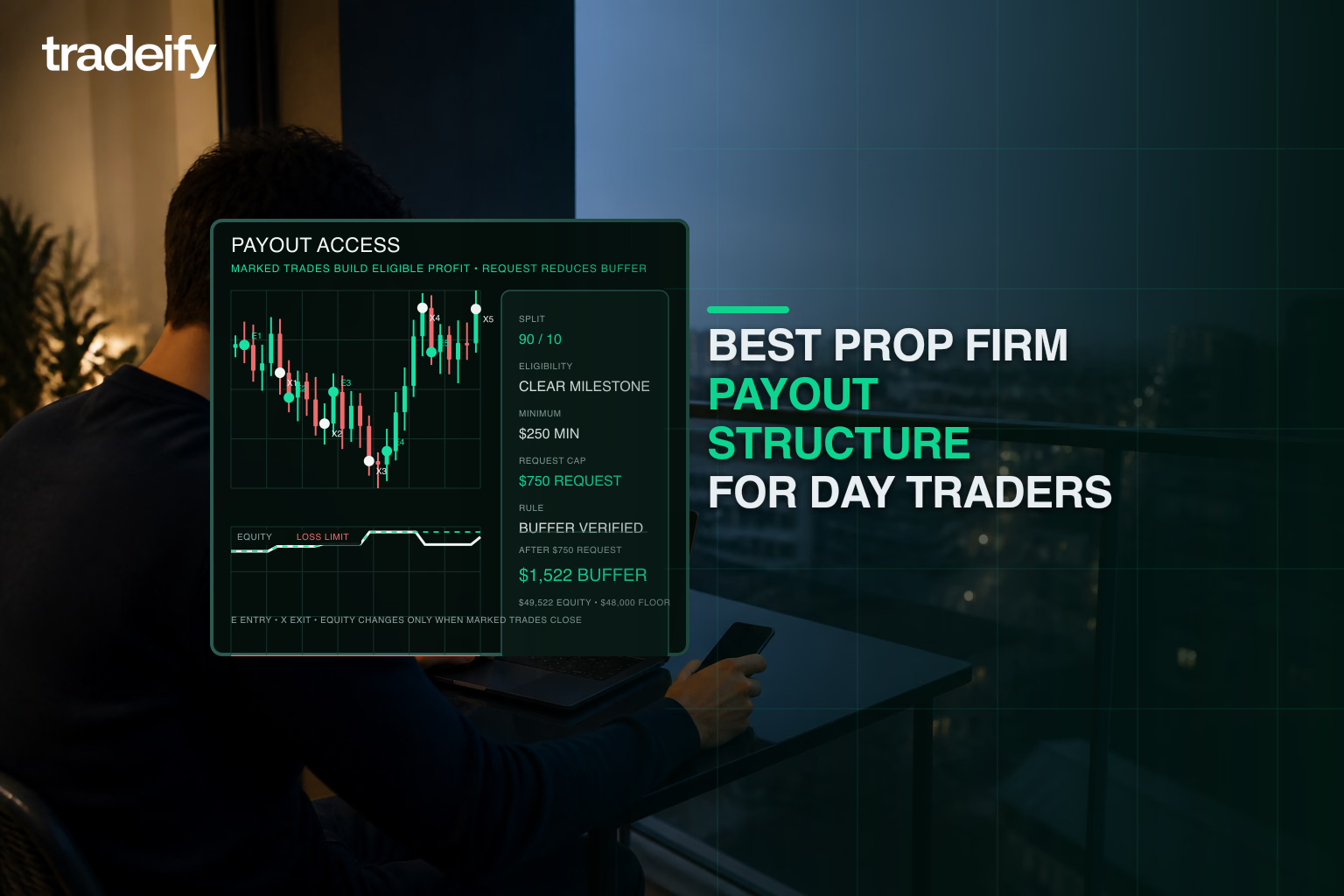
Do not compare firms using profit split alone. Keeping 90% of a payout is not useful if the account rules make you ineligible to request it. Start with the buffer, qualifying days, drawdown after payout, and withdrawal cap. Look at the split after those rules make sense.
Choose a futures prop firm account by trader type

The best fit becomes clearer when you start with behavior instead of price.
Futures traders with the smallest fixed budget
Look for a one-time 25K evaluation with no activation fee. This keeps the account cost known at purchase and avoids pressure from a monthly renewal date.
Compare reset prices before choosing. A slightly higher original fee may still cost less across two or three attempts.
For example, our Growth 25K account has a $99 one-time list price with no activation fee. An eligible first-purchase promotion may lower the checkout price and is limited to one promotional purchase per customer, so confirm the live offer before buying. It uses a $1,500 target, $1,000 end-of-day trailing drawdown, and $600 soft daily loss limit. There is no consistency rule during the evaluation, so it can be passed in as little as one trading day by hitting the profit target within the limits. Once funded, payouts follow a consistency requirement, so plan for steady daily profits rather than a single outsized day. This structure can fit a trader who wants a defined cost and an account-level daily brake, while still using a smaller personal stop.
Futures traders who need a daily stop
A soft daily loss limit can act as a final account-level brake. It can pause trading for the session without ending the account, provided the hard drawdown is not breached first.
Your personal daily stop should be smaller. Do not use the firm's liquidation threshold as the planned exit.
Futures traders who dislike daily loss limits
Some 25K and 50K evaluations have no daily loss limit. These accounts can fit strategies with wider intraday swings, but the freedom cuts both ways.
Without a firm-level pause, your personal daily stop becomes even more important. A trader can reach the maximum drawdown in one session if size is not controlled.
Futures traders who need more drawdown room
Compare the actual maximum loss amount, not only the account tier. A 25K account with a $1,500 drawdown provides more initial room than a 25K account with a $1,000 drawdown.
The larger cushion may justify a higher fee for a strategy with wider stops or longer normal losing streaks. It should not be used as permission to increase size.
Futures traders testing a prop firm for the first time
Start with one account and one or two micros. Learn how the dashboard calculates drawdown, when the session resets, and how commissions affect the balance.
Buying several discounted accounts before understanding the rules multiplies mistakes. Prove that the process works on one account first.
Avoid small futures account mistakes

Choosing the cheapest futures account
Cheap is not the same as affordable. A recurring fee, activation charge, or expensive reset can change the total cost.
Build a three-attempt budget before buying the first account.
Trading the maximum futures contracts
Maximum position size is an account rule, not a sizing recommendation. Using the full limit on a small drawdown can end the account in one move.
Size from your stop and dollar risk.
Ignoring futures payout rules
Traders often study the evaluation target and barely read the funded rules. The payout buffer, qualifying days, and post-payout drawdown may matter more over time.
Read both stages before paying.
Buying a larger futures account for status
A 100K or 150K label does not improve execution. If your strategy works with one micro contract, a smaller account may reduce cost and pressure.
Move up only when the extra drawdown or contract capacity has a defined purpose.
Treating a futures prop account like personal capital
Many futures prop firm evaluations and funded stages use simulated accounts. The firm's rules, payout policy, and risk controls determine what the account can do.
Do not assume the dashboard balance functions like cash in a personal brokerage account.
Small futures prop firm account questions
What futures account size is best for a small trader?
A 25K account can fit traders using one or two micros and seeking the lowest entry cost. A 50K account may be better when the strategy needs a $2,000 drawdown, wider stops, or more scaling flexibility. Compare usable drawdown and total cost rather than the account label.
Can you trade futures with a small account?
Yes, micro futures allow smaller position sizes than standard E-mini or full-size contracts. A prop firm evaluation can provide a rule-based simulated account path, but trading still involves risk and the evaluation fee can be lost.
Are 25K futures prop firm accounts worth it?
They can be when the drawdown, contract limits, and payout rules fit your strategy. A 25K account may be a poor fit if one normal stop requires too much of the $1,000 to $1,500 drawdown.
Should a beginner choose a 25K or 50K futures account?
Choose the smallest tier that gives the strategy enough drawdown room. Beginners often benefit from one account, micro contracts, and a low personal daily stop. The ability to trade more contracts is not a beginner benefit by itself.
Is a one-time futures prop account better than monthly billing?
It depends on how long you usually take to pass. One-time pricing gives a known upfront cost. Monthly pricing may start lower but becomes more expensive across several billing cycles. Include activation and reset charges in the comparison.
What should small futures traders check before buying?
Confirm the profit target, drawdown method, daily loss rule, consistency requirement, minimum trading days, contract conversion, renewal terms, reset fee, activation fee, and payout policy. Save the current rules because firms can update their programs.
Pick the futures account that fits your risk
The best futures prop firm account is not the biggest account or the cheapest promotion.
It is the account that lets you trade your normal setup at a controlled size, absorb a normal losing streak, understand every rule, and afford another attempt without forcing trades.
Start with the drawdown. Check the full cost. Read the payout rules. Trade micros until the results justify more size.
Small account. Clear plan. Clean execution.
.svg)
.svg)
.svg)
.svg)






.webp)