.svg)

.svg)
.svg)



TL;DR: Types of prop firms include institutional prop desks, principal trading and market making firms, retail funded trader firms, futures prop firms, forex prop firms, crypto prop firms, options and equities prop firms, remote firms, in house firms, and hybrid firms or programs that offer more than one account path. Traditional proprietary trading means a firm trades for its own account, while retail funded trader firms usually offer rules-based accounts with profit targets, drawdown limits, payout terms, and simulated or live-account stages. A prop firm directory lists individual companies, but a prop firm type guide helps you sort the business model before comparing accounts. Retail funded traders should shortlist by asset class, evaluation versus instant-funded path, country eligibility, platform access, maximum allocation, fees, payout terms, and published risk rules, then verify whether each relevant stage is simulated or live and whether live progression exists. Institutional candidates should check official company or careers pages for roles, location, trading focus, qualifications, compensation structure, and hiring requirements. Futures traders should compare contract limits, commissions, data fees, daily loss rules, trailing drawdown, payout caps, platform access, and reset terms.
Prop firm is a broad term. It can describe a Wall Street trading desk using firm capital, a quantitative market maker, a broker-dealer trading for its own account, or a retail funded trader program where a trader pays for access to a simulated or funded account path.
That matters because each type of prop firm has a different business model, risk rule set, account structure, and trader fit. A futures trader comparing firms needs more than a list of logos. The better question is what kind of prop firm you are actually looking at.
This guide breaks the market into practical categories, explains how each type works, and shows what to check before choosing a firm.
Table of Contents
- What a prop firm means
- The main types of prop firms
- Prop firm lists vs prop firm types
- Turn prop firm types into a shortlist
- Institutional prop firms
- Market making and high-frequency prop firms
- Retail funded trader prop firms
- Evaluation prop firms
- Instant funded prop firms
- Futures prop firms
- Forex prop firms
- Crypto prop firms
- Options, equities, and asset specific prop firms
- Remote prop firms
- In house prop firms
- Hybrid prop firms
- How to choose the right prop firm type
- Common prop firm red flags
- Prop firm types compared by trader goal
- Frequently asked questions
What a prop firm means
In traditional finance, proprietary trading means trading for the firm's own account rather than trading on behalf of a customer. The Volcker Rule regulations define proprietary trading for banking entities as engaging as principal for a trading account in purchases or sales of financial instruments, subject to exceptions and exclusions in the rule text (eCFR). The FDIC summarizes the Volcker Rule as a restriction on banking entities engaging in proprietary trading and certain covered fund relationships (FDIC).
Retail traders usually use prop firm differently. They often mean a funded trader company that offers evaluations, simulated funded accounts, profit splits, drawdown rules, and payout policies. Some firms focus on futures, some on forex CFDs, some on crypto, and some offer several markets.
Those two meanings overlap in language, but they are not the same operating model. A bank trading desk, a high-frequency market maker, and a futures funded trader program all use firm capital concepts, but the trader's day-to-day experience is completely different.
The main types of prop firms

Prop firm types are easier to compare by dimension. One firm can fit more than one row, such as a remote retail funded futures firm with both evaluation and instant funded account paths.
|
Dimension |
Prop firm type |
Core model |
Typical trader fit |
|
Business model |
Institutional prop desks |
The firm hires traders or allocates internal capital |
Professional traders with finance or trading experience |
|
Business model |
Principal trading and market making firms |
The firm trades its own strategies, often with technology and quantitative research |
Quant, developer, and market microstructure specialists |
|
Business model |
Retail funded trader firms |
Traders pay for an evaluation or account path and trade within firm rules |
Skilled independent traders who want larger account exposure |
|
Asset focus |
Futures prop firms |
Firms or programs focused on futures contracts, futures market data, and futures-specific rules |
Traders focused on indices, rates, metals, energy, agriculture, or currency futures |
|
Asset focus |
Forex prop firms |
Firms or programs focused on currency pairs, forex platforms, or CFDs |
Currency and CFD traders |
|
Asset focus |
Crypto prop firms |
Firms or programs focused on crypto pairs, crypto derivatives, or digital-asset market access |
Traders who need 24/7 crypto market access |
|
Asset focus |
Options and equities prop firms |
Firms or programs built around stocks, stock CFDs, equity options, or futures options |
Traders who understand shorting, margin, assignment, and strategy-permission risk |
|
Work arrangement |
Remote prop firms |
The trader works outside a physical desk, usually through online platforms, dashboards, or remote access |
Traders who need location flexibility, whether the role is self-directed retail access or a remote institutional seat |
|
Work arrangement |
In house prop firms |
The trader works from a firm office, trading floor, or physical desk |
Traders who want a structured firm setting, desk support, and a hiring path |
|
Account path |
Evaluation prop firms |
The trader must pass a rules-based test before reaching payout eligibility or a funded stage |
Traders who want a staged process and can follow written rules |
|
Account path |
Instant funded prop firms |
The trader starts at a funded-labeled stage sooner, subject to that firm's price, risk, and payout rules |
Experienced traders comparing speed, cost, and rule pressure |
|
Program/provider structure |
Hybrid funded-trader programs |
Firms or programs that offer multiple distinct retail account paths or program models |
Traders comparing speed, cost, and rule flexibility |
The rest of the article explains the useful differences inside those categories.
Prop firm lists vs prop firm types
A prop firm list and a prop firm type guide solve different problems. A list helps you compare individual companies, reviews, prices, offers, and account names. A type guide helps you decide which category belongs on your shortlist before those details matter.
Use the type first. If you want a trading-desk career, start with institutional, market making, or in house firms. If you want an online funded trader account, compare retail funded trader firms. If you already know your market, narrow the list by futures, forex, crypto, options, equities, or multi-asset access.
That order keeps the comparison cleaner. It is hard to compare a quantitative trading firm, a forex CFD challenge, a futures evaluation account, and an instant funded crypto program as if they were the same product.
Turn prop firm types into a shortlist
Once you know the prop firm type, compare individual firms with filters that match that category. Retail funded-trader directories may combine account sizes, assets, platforms, prices, offers, reviews, and maximum allocation fields in one view. An institutional shortlist may be organized by location, firm size, trading focus, and instruments. Verify role requirements and hiring processes on each firm's official careers or company pages.
Use this order:
- Pick the market first, such as futures, forex, crypto, equities, options, or multi-asset.
- Choose the core business model, such as institutional desk, market making, or retail funded trader program.
- Choose the work arrangement when it matters, such as in house, remote, or hybrid office/remote work.
- For retail funded programs, choose the account path, such as evaluation or instant funded. If the provider is a hybrid funded-trader program, compare each path separately. Treat simulated funded and live as account stages unless the firm clearly sells them as separate paths.
- Check eligibility and restrictions, including country availability, trader verification, account documentation, and any role or licensing requirements when the firm is employment-style.
- Compare the real trading setup. For retail accounts, that means platform access, instruments, contract or position limits, data, commissions, spreads, and execution rules. For institutional firms, that means role expectations, desk structure, trading focus, technology, location, compensation model, and hiring process.
- Compare the rules that decide whether the path works. Retail funded programs need drawdown, daily loss, consistency, payout, reset, and allocation checks. Institutional paths need risk limits, supervision, capital allocation, compliance, and desk-level performance expectations.
That keeps the shortlist practical. A low advertised price does not help if the account type, tradable market, platform, payout process, or risk rule does not match how you trade.
Institutional prop firms

Institutional prop firms are closest to the classic definition of proprietary trading. The firm trades its own money, manages risk centrally, and may hire traders as employees, contractors, or desk members. The trader is usually not buying a public challenge account. They are joining a trading business.
These firms may trade equities, options, futures, fixed income, currencies, commodities, and derivatives. Some are discretionary, where humans make trading decisions. Others are heavily quantitative, with strategies built around pricing models, data, execution, and risk controls.
The upside is access to infrastructure, research, risk systems, and potentially meaningful capital. The tradeoff is that entry is much harder. The firm may expect a track record, technical skill, licensing where applicable, an interview process, or relocation.
This type is best for traders who want a career seat inside a trading firm, not a quick online account.
Market making and high-frequency prop firms

Market makers and high-frequency trading firms are a separate type of prop trading business. They often trade their own capital across exchanges, quote bids and offers, manage inventory, and compete on execution speed, models, and market structure knowledge.
These firms are not usually built for retail traders who want to pass a funded account challenge. They hire quantitative researchers, software engineers, traders, and operations staff. The work can involve order book modeling, latency, statistical signals, exchange connectivity, and risk automation.
This type is best for people with quantitative, programming, math, or exchange-market experience. It is not the same as paying for a futures account evaluation.
Retail funded trader prop firms

Retail funded trader firms are what most online searches mean by prop firms. Instead of applying for a trading desk job, traders buy an evaluation or account, follow rules, and may qualify for payouts if they meet the firm's requirements.
The trader experience usually centers on:
|
Feature |
What to check |
|
Account size |
The headline balance and the actual drawdown room |
|
Evaluation rules |
Profit target, minimum days, consistency rules, and prohibited trading |
|
Risk limits |
Daily loss limit, max loss, trailing drawdown, position limits, and contract limits |
|
Payout rules |
First payout timing, payout frequency, caps, split, and documentation |
|
Fees |
Evaluation cost, reset fees, activation fees, data fees, commissions, and platform fees |
|
Market access |
Futures, forex, crypto, stocks, options, or CFDs |
|
Account stage and progression |
Whether evaluation or funded trading is simulated or live, and whether the provider offers progression to a live stage |
Retail funded trader firms can be useful for traders who already have a defined process and want a rules-based account path with possible payout eligibility. They can also be a poor fit for traders who are still inconsistent, because rules can end an account even when the trader's broader idea is not invalid.
Evaluation prop firms

Evaluation prop firms require the trader to pass a test before reaching a funded stage. The test usually includes a profit target, loss limits, and behavior rules. Some firms use one-step challenges. Others use two-step or multi-step models.
The common appeal is a staged process. Evaluation accounts may have a lower upfront price than instant funded paths at some firms, but the real comparison depends on reset terms, activation costs, commissions, payout rules, and how many attempts a trader needs. The downside is friction. You may need to pass before receiving payout eligibility, and a rule breach can force a reset or new account purchase.
Evaluation firms are usually best for traders who:
- Can follow a written trading plan.
- Understand drawdown math.
- Do not need immediate payout access.
- Want a staged test before payout eligibility.
- Can trade consistently inside daily or trailing limits.
For futures traders, the most important detail is not the headline account size. It is the distance between the starting balance and the relevant loss limit.
Instant funded prop firms

Instant funded prop firms let traders skip a traditional evaluation and start at a funded-labeled stage sooner. The tradeoff is firm-specific: upfront price, payout caps, consistency rules, reset availability, and first-payout requirements can all differ by plan.
This model can make sense for experienced traders who already know they can trade inside firm rules and want a shorter path to payout eligibility. It can be a bad fit for traders who are trying to learn under pressure, because a failed account can still mean another fee, reset decision, or fresh plan comparison.
Tradeify's Futures Prop pricing reference, for example, lists Growth and Select evaluation account types plus Lightning Funded accounts that skip the evaluation. The same help article says these account types are available in 25K, 50K, 100K, and 150K sizes, with different pricing and rule structures (Tradeify Help Center).
Before choosing instant funding, compare:
- The upfront price against the actual drawdown room.
- Whether resets are available.
- Payout frequency and payout caps.
- Consistency rules.
- Contract limits.
- Any restrictions around news, copy trading, holding positions, or scaling.
Fast access is only useful if the rules fit how you actually trade.
Futures prop firms
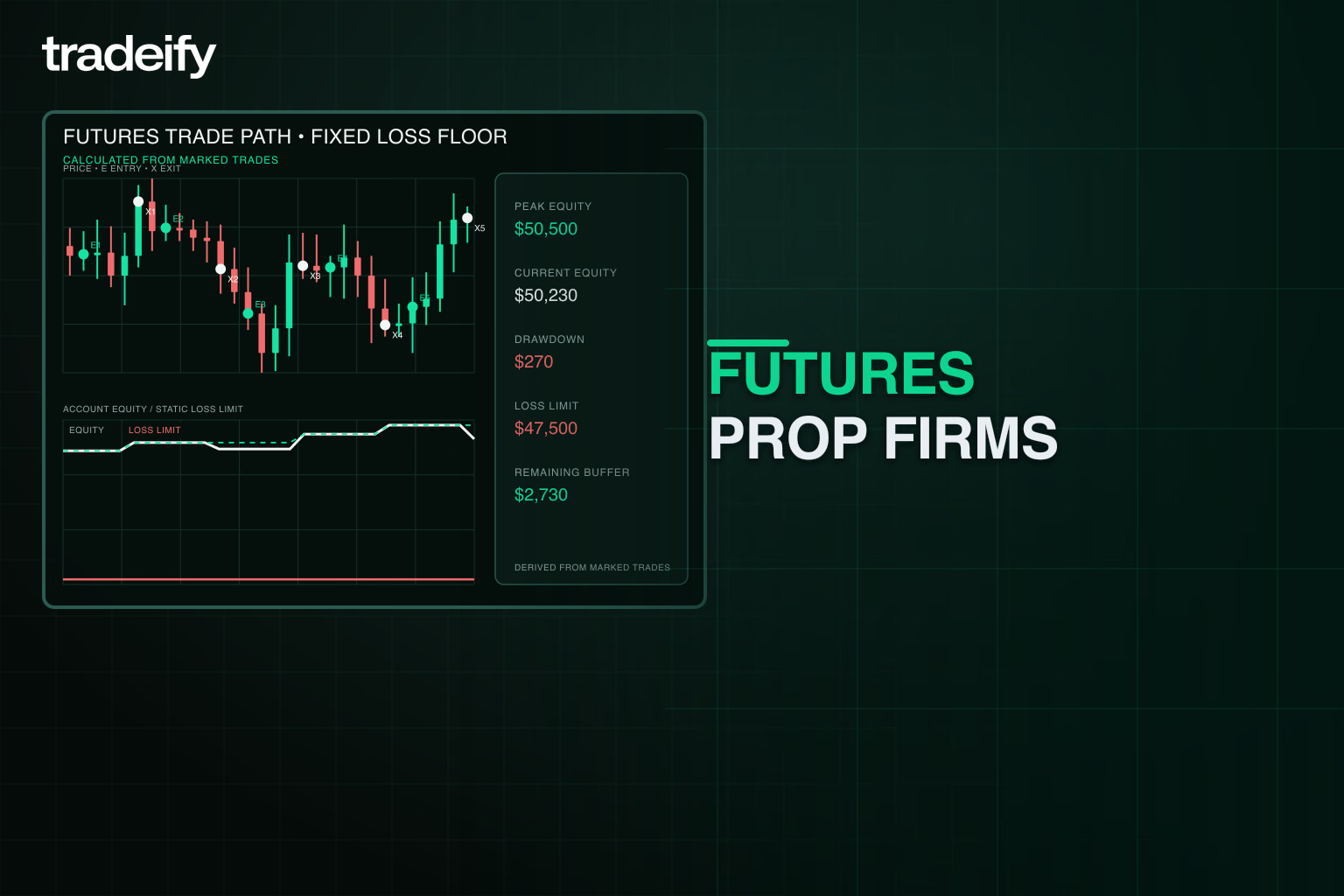
Futures prop firms focus on futures contracts, such as equity index futures, interest rate futures, energy, metals, currencies, and agricultural products. CME Group's futures education materials cover core mechanics such as contract specifications, trading codes, expiration, settlement, tick movement, price limits, notional value, transparency, margin, and the roles of speculators and hedgers (CME Group).
Futures margin is different from securities margin. CME explains that futures margin is money that must be kept on hand with a broker when opening a futures position, and it is not a down payment on the underlying asset (CME Group).
That structure makes futures prop firms attractive for traders who want clear contract specs, defined tick values, and platform ecosystems built around futures markets. In retail prop accounts, confirm whether your current stage is simulated or live before assuming orders are submitted to or cleared by an exchange. Tradeify's Help Center, for example, says Simulated Funded Accounts replicate live-market conditions without using actual capital, and its NinjaTrader setup guide tells Evaluation and Sim Funded users to choose simulation mode (Tradeify Help Center; Tradeify Help Center).
It also means risk can move quickly. A futures account can look large in headline balance while having a much smaller practical loss limit.
Tradeify can serve as a futures-focused worked example. Its pricing reference lists current Futures Prop account types as Growth Evaluation, Select Evaluation, and Lightning Funded across 25K, 50K, 100K, and 150K sizes. The same pricing reference says Sim Funded accounts use a 90% trader and 10% Tradeify split, and Elite Live accounts use an 80% trader and 20% Tradeify split. Tradeify's Common FAQs distinguish Sim Funded trading from Live Funded trading, and the Elite Program page separately documents the Elite Live split (Tradeify Help Center; Tradeify Help Center; Tradeify Help Center).
In this category framework, Tradeify's Futures Prop product is an online retail funded-trader offering focused on futures, with documented evaluation and instant funded account paths plus platform setup through supported trading platforms. For crypto comparison, treat Futures Prop and crypto as separate categories and verify the current product rules before assuming one account can trade both.
Futures prop firms are usually best for traders who:
- Trade index futures like ES, NQ, MES, or MNQ.
- Understand tick values and contract sizing.
- Want strategies built around exchange-listed futures specifications and market data rather than OTC forex or CFD exposure.
- Can manage intraday risk tightly.
- Prefer defined sessions, economic calendars, and exchange product specs.
Forex prop firms
Forex prop firms focus on currency trading, often through CFD or retail forex platforms. These firms may offer major, minor, and exotic currency pairs, plus commodities, indices, and crypto CFDs depending on the platform and jurisdiction.
The key questions are different from futures. Instead of futures contract specs, data fees, and contract-based rule checks, the trader needs to check spread, commission, swap, execution rules, weekend holding, news trading, broker relationships, platform type, and whether the account is simulated or live.
Forex prop firms may fit traders who specialize in currency pairs and are used to forex-style position sizing. They may not fit futures traders who prefer futures contract specs, tick-value math, and platform ecosystems built around futures order flow.
Crypto prop firms
Crypto prop firms focus on cryptocurrency markets, sometimes through spot-like pairs, perpetual-style products, or crypto CFDs. The appeal is often 24/7 market access and a wider set of crypto symbols.
Crypto prop rules can differ sharply from futures rules. Around-the-clock trading can create weekend risk, liquidity gaps, exchange outages, and different volatility patterns. Traders should check product type, leverage limits, weekend rules, exchange or liquidity venue, payout terms, and whether crypto access is part of the same account or a separate product.
Tradeify's Common FAQs currently describe Tradeify Crypto as separate from Futures Prop, with separate dashboards, accounts, platforms, and support teams. Tradeify's supported-products article also says Futures Prop does not support cryptocurrency derivatives, including Bitcoin futures (Tradeify Help Center; Tradeify Help Center).
Crypto prop firms are usually best for traders who already understand crypto volatility and want a ruleset built for that market rather than a futures-only account.
Options, equities, and asset specific prop firms
Some prop firms are best understood by what they allow traders to trade. This matters because two firms can both call themselves prop firms while offering completely different instruments, platforms, and risk controls.
|
Asset focus |
Common instruments |
Main issue to review |
|
Futures |
ES, NQ, MES, MNQ, CL, GC, rates, currencies, agriculture |
Contract limits, data fees, commissions, any exchange or clearing charges listed by the firm, trailing drawdown, payout caps |
|
Forex |
EUR/USD, GBP/USD, USD/JPY, minors, exotics |
Spread, swap, news rules, broker model, platform execution |
|
Crypto |
BTC, ETH, SOL, altcoin pairs |
24/7 rules, liquidity, weekend risk, leverage, platform stability |
|
Stocks |
Listed equities or stock CFDs |
Shorting rules, buying power, locates, commissions |
|
Options |
Equity or futures options |
Strategy permissions, assignment risk, spreads, margin treatment |
Equities prop firms can mean a traditional desk trading listed stocks, a retail program that supports stock CFDs, or a technology-heavy firm focused on execution and short-term strategies. The key checks are buying power, shorting rules, locate access, data costs, commissions, and whether the firm expects desk-style employment or a self-directed online account.
Options prop firms need a different review. Check whether the firm allows single-leg options, spreads, futures options, overnight holds, assignment exposure, and defined-risk structures. Options add option-specific mechanics such as Greeks, exercise rights, assignment obligations for short options, and strategy-permission rules. Volatility, expiration, and liquidity also matter in futures, but options traders have to evaluate how those risks affect premium, time decay, and exercise or assignment outcomes.
Many traders start by comparing account size, but asset fit matters more. A trader who scalps NQ futures needs a different firm from a trader who swing trades EUR/USD, trades equity options around earnings, or trades BTC over the weekend.
Remote prop firms

Remote prop firms let traders participate online rather than on a physical desk. Online retail funded trader programs are accessed remotely through account dashboards and trading platforms. Institutional trading firms may offer office-based, hybrid office/remote, or remote roles depending on the firm, team, training model, oversight needs, and infrastructure.
Remote access is convenient, but it puts more responsibility on the trader. Self-directed retail funded-trader programs generally leave trading-process management to the trader. Remote institutional roles may still include direct management, monitoring, and risk oversight.
Remote prop firms are best for traders who can work away from a physical desk. Employment status, independence, supervision, and capital model still depend on the firm's core business model.
In house prop firms

In house prop firms bring traders into a firm office or trading floor. This may include training, desk mentoring, shared tools, risk managers, and direct oversight. The model is less common for casual retail traders but still exists in institutional trading, market making, and some regional trading groups.
The advantage is feedback and infrastructure. The tradeoff is access. In house roles may require interviews, location flexibility, a demonstrated skill set, or employment terms that look nothing like a public funded account.
This type is best for traders who want a career path inside a trading company rather than a self-directed online account.
Hybrid prop firms
Hybrid prop firms combine multiple distinct retail funded-trader account paths or program models, such as evaluation and instant funded paths. Payout schedules, scaling terms, simulated or live stages, and live progression are features inside those paths, not separate reasons to call a provider hybrid.
Hybrid models can be useful because traders do not all need the same path. A newer funded trader may prefer a staged evaluation. An experienced trader with a validated process may compare an instant-funded path if the cost, drawdown, payout, and rule structure fit. A trader who wants fewer daily restrictions may choose a plan with different loss-limit rules.
The downside is complexity. The more plan types a firm offers, the more carefully you need to compare:
- Evaluation versus instant funded cost.
- Daily loss limit rules.
- End-of-day versus intraday trailing drawdown.
- First payout timing.
- Max payout caps.
- Consistency rules.
- Whether the account can progress to live trading.
- Platform and data costs.
Do not assume two account types inside the same firm work the same way.
How to choose the right prop firm type
Start with your market, then your process, then the firm model.
If you trade futures, focus on futures prop firms first. Confirm supported platforms, tradable contracts, contract limits, data fees, commissions, drawdown rules, payout rules, and whether the account is simulated or has a live progression path.
If you trade forex, compare forex-specific execution, spread, swaps, account currency, broker relationship, and news rules.
If you trade crypto, confirm that the product is actually built for crypto rather than a futures or forex account with limited crypto exposure.
Then check fit:
|
Trader profile |
Better fit |
Why |
|
Newer trader still building consistency |
Demo or practice account first; paid evaluation only after checking total costs and rules |
Practice helps you learn without reset or account-loss pressure; evaluations are still rule-bound paid accounts |
|
Experienced rule-based futures scalper |
Futures evaluation or instant funded account |
Clear contract rules and fast feedback |
|
Trader who wants no evaluation |
Instant funded model |
Faster start, firm-specific total cost |
|
Trader who needs 24/7 markets |
Crypto prop account that explicitly permits 24/7 trading |
Crypto markets trade around the clock, but weekend access and maintenance restrictions remain account-specific |
|
Trader seeking a trading career |
Institutional or in house prop firm |
More structure, hiring process, and desk support |
|
Quant or developer |
Market making or HFT prop firm |
Technical skill matters more than challenge passing |
The best prop firm type is the one whose rules match the way you already trade. If you have to change your entire strategy to fit the account, the account may be the wrong product.
Common prop firm red flags
No prop firm type removes trading risk. Before paying for any account, read the rules and look for warning signs:
- Vague payout terms.
- Hidden activation or platform fees.
- Rules that are hard to find before purchase.
- Account sizes promoted without clear drawdown limits.
- Promises that imply trading income is easy or likely.
- No clear explanation of simulated versus live trading.
- Sudden rule changes without clear notice.
- Poor support around account breaches or payout reviews.
For futures accounts, also check commissions and data terms. Tradeify's pricing reference, for example, separates account prices from trading commissions and lists per-contract round-trip commission fees for common futures instruments (Tradeify Help Center).
Prop firm types compared by trader goal
If your goal is speed, compare instant funded firms. If your goal is a staged test before payout eligibility, compare evaluation firms. If your goal is market fit, choose by asset class first. If your goal is a trading career, look at institutional or in house firms.
For many retail futures traders, the most practical choice is between:
- A futures evaluation account with a required pass and its own reset, activation, commission, and payout terms.
- A futures instant funded account with faster access and its own payout, consistency, reset, and fee terms.
- A hybrid funded-trader program that lets you compare more than one path inside the same provider.
That is where Tradeify fits the conversation. It offers futures prop account paths across evaluation and instant funded models, while separating Futures Prop from its crypto product line. Traders should still verify the current rules, fees, payout terms, and platform requirements before buying, because prop firm details change often.
Frequently asked questions
What are the types of prop firms
The main types can be grouped by core business model, asset focus, work arrangement, account path, and provider structure. Core models include institutional prop desks, principal trading or market making firms, and retail funded trader firms. Asset-focused firms include futures, forex, crypto, options, and equities prop firms. Work arrangements include remote and in house firms. Common retail account paths include evaluation and instant funded models. Simulated funded and live are usually account stages unless a firm clearly sells them as separate paths. Hybrid firms or programs may offer more than one path.
What is the difference between futures and forex prop firms
Futures prop firms focus on products, market data, contract specs, tick values, fees, and rule sets based on exchange-listed futures. In a retail prop account, the evaluation or funded stage may still be simulated, so verify whether orders are simulated or actually routed and cleared. Forex prop firms focus on currency pairs or CFDs, where spread, swap, platform execution, broker model, and jurisdiction matter more.
Are instant funded prop firms better than evaluation firms
Not automatically. Instant funded and evaluation paths can have different payout, consistency, drawdown, reset, commission, data, and activation terms. The better choice depends on your experience, strategy, listed price, expected attempts, and the exact account rules.
What type of prop firm is best for beginners
Beginners usually need practice, clear rules, and lower pressure before choosing a funded path. A demo, practice account, or clearly priced evaluation can make more sense than buying the fastest available account. A trader who cannot follow daily loss and drawdown rules is usually not ready for a higher-pressure account.
Do prop firms use real money or simulated accounts
It depends on the firm and account stage. Some firms use simulated evaluations, some use simulated funded accounts, and some have live-account progression. Always read the firm's agreement and account rules so you understand whether you are trading simulated capital, live capital, or a path that can lead from one to the other.
What should futures traders check before choosing a prop firm
Futures traders should check supported platforms, allowed contracts, contract limits, daily loss rules, trailing drawdown, commissions, data fees, payout frequency, payout caps, consistency rules, reset terms, and whether the account can progress to a live stage.
.svg)
.svg)
.svg)
.svg)







.webp)