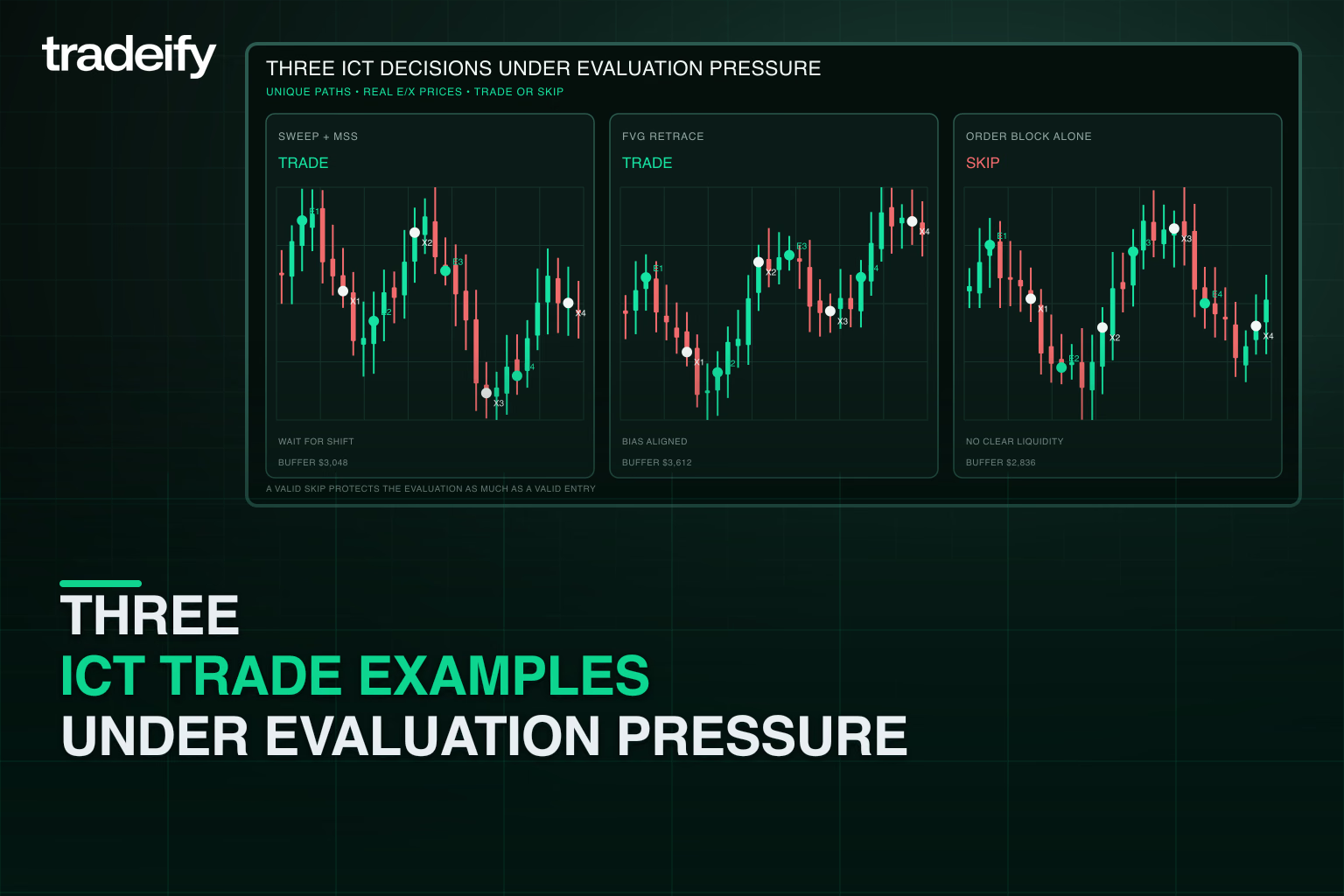
TL;DR: Inner Circle Trader (ICT) concepts — including Fair Value Gaps (FVGs), Order Blocks, Market Structure Shifts (MSS), and the Silver Bullet strategy (10:00–11:00 AM EST window) — can be applied to prop firm evaluations on platforms like Tradeify, which offers Growth, Select, and Lightning accounts in 50K, 100K, and 150K sizes (Lightning also includes a 25K). Tradeify accounts use End-of-Day trailing drawdowns (the floor only moves up based on your highest end-of-day balance), but the limit is enforced in real time, meaning your account fails immediately if your balance touches it intraday. Profit targets and consistency rules vary by account type: Growth funded carries a 35% consistency rule, Select evaluations follow 40% (no consistency rule once funded), and Lightning Funded accounts purchased after September 12, 2025 use a progressive 20% → 25% → 30% structure across payouts. The ICT 2022 Mentorship Model provides a mechanical workflow (Daily Bias, Liquidity Sweep, MSS, FVG entry, 1:3+ R:R target) designed for Kill Zone sessions (London Open 2–5 AM EST, NY Open 8:30–11 AM EST, London Close 10 AM–12 PM EST, NY PM 1:30–4 PM EST). Silver Bullet backtests on NQ and XAU/USD show 70–80% win rates when executed correctly. Industry-wide prop firm pass rates sit at 5–10% for challenges and 1–2% for actual payouts, with most failures caused by drawdown breaches rather than strategy gaps. Recommended risk per trade is 0.25–0.5% of total account balance. ICT terminology (Order Blocks, FVGs, Liquidity Sweeps) maps directly to classical equivalents (Supply/Demand zones, gaps, false breakouts), and the framework's primary value for prop firm traders is its time-based selectivity and high R:R structure rather than conceptual originality. Traders also need to be aware of Tradeify's microscalping rule — over 50% of trades and over 50% of profit must come from positions held longer than 10 seconds — which directly affects how aggressively ICT scalpers can execute the Silver Bullet on lower timeframes.
The evolution of retail day trading over the past decade has culminated in a significant shift away from lagging technical indicators toward more complex, price-action-centric frameworks. Central to this transition is the Inner Circle Trader (ICT) methodology, a comprehensive trading system developed by Michael J. Huddleston, which posits that financial markets are governed by a central bank-driven algorithm designed to manipulate price and seek liquidity. This methodology has gained immense popularity within the proprietary trading firm (prop firm) community, where companies like Tradeify offer traders access to substantial simulated capital. For the beginning day trader, the intersection of ICT concepts and prop firm requirements presents a unique environment that demands both technical precision and rigorous risk management. The central inquiry of this analysis is whether the ICT framework provides a genuine edge in passing prop firm evaluations and sustaining funded accounts, or if its complexity masks a rebranding of classical price action principles.
How ICT Algorithmic Price Delivery Concepts Work
The foundational premise of the ICT methodology is the Interbank Price Delivery Algorithm (IPDA). This theory suggests that price movement in liquid markets (specifically forex, futures, and major indices) is not a result of random walk or the collective sentiment of retail participants, but rather a scripted process managed by institutional entities. The IPDA is said to move price through four distinct stages: consolidation, expansion, retracement, and reversal. By understanding these stages, the trader attempts to align their entries with the "smart money" footprint, thereby avoiding the common traps that liquidate retail accounts.
This institutional narrative serves a critical psychological function. It provides a structured worldview that allows beginning traders to interpret market volatility not as chaotic noise, but as a series of calculated maneuvers aimed at specific price levels. In the context of a prop firm like Tradeify, where traders must work within strict drawdown limits, this narrative-driven approach can foster the patience necessary to wait for high-probability setups rather than chasing impulsive moves.
ICT Liquidity Concepts and Draw on Liquidity
At the heart of the ICT framework is the concept of liquidity. Liquidity is defined as the resting orders (buy-stops and sell-stops) located at specific price points on a chart, usually above recent highs or below recent lows. The algorithm is theorized to seek these "liquidity pools" to facilitate the filling of large institutional orders that would otherwise cause excessive slippage.
Identifying the "Draw on Liquidity" (DOL) is perhaps the most important skill for an ICT practitioner. The DOL is the most likely destination for price based on higher-timeframe analysis. If the higher-timeframe bias is bullish, the price will likely be drawn to buy-side liquidity (BSL) above old highs or into an imbalance like a Fair Value Gap (FVG). Conversely, in a bearish regime, price is drawn to sell-side liquidity (SSL) below old lows. For a Tradeify trader, correctly identifying the DOL on a daily or four-hour chart is the prerequisite for all lower-timeframe execution.
| Liquidity Category | Chart Location | Theoretical Institutional Function |
|---|---|---|
| Buy-Side Liquidity (BSL) | Above swing highs, equal highs, or session highs. | Used to provide liquidity for institutional sell orders (distribution). |
| Sell-Side Liquidity (SSL) | Below swing lows, equal lows, or session lows. | Used to provide liquidity for institutional buy orders (accumulation). |
| Internal Range Liquidity | FVGs or imbalances located within a price range. | Areas where the market rebalances before reaching external targets. |
| External Range Liquidity | Major swing highs or lows on daily or weekly charts. | The ultimate targets for major algorithmic price runs. |
Core ICT Concepts Every Prop Firm Trader Should Know
The ICT methodology utilizes a specific vocabulary to describe price action, often referred to as Smart Money Concepts (SMC). For a beginner, mastering these concepts is the first step toward building a viable trading plan.
ICT Market Structure Concepts BOS, CHOCH, and MSS
Traditional technical analysis often defines a trend as a series of higher highs and higher lows. ICT refines this by distinguishing between trend continuation and trend shifts.
- Break of Structure (BOS): This occurs when the price breaks a previous swing high in an uptrend or a swing low in a downtrend, signaling that the current trend remains intact.
- Change of Character (CHOCH): Often the first signal of a potential reversal, a CHOCH occurs when price fails to make a new high and instead breaks a recent internal low (in an uptrend).
- Market Structure Shift (MSS): The MSS is a confirmed structural break accompanied by "displacement" (a forceful move characterized by large-range candles and a visible increase in momentum). An MSS is only considered valid if it creates an imbalance, such as a Fair Value Gap, in its wake.
The ICT PD Array Matrix for Finding Entry Points
The ICT methodology organizes entry points through a hierarchy known as the Premium/Discount (PD) Array Matrix. Traders use the Fibonacci tool to divide a price range into a "Premium" half (above the 50% level) and a "Discount" half (below the 50% level). According to the framework, one should only look for buy setups in the Discount zone and sell setups in the Premium zone. Within these zones, specific "arrays" act as magnets or triggers:
- Order Blocks (OB): A bullish order block is the last down-candle before a strong move up that breaks structure. It represents institutional accumulation. A bearish order block is the last up-candle before a strong move down.
- Fair Value Gaps (FVG): These are three-candle patterns where a large middle candle leaves a gap between the first candle's wick and the third candle's wick. They represent inefficiencies where the price was delivered too quickly, and the algorithm is expected to return to "rebalance" the price.
- Breaker Blocks: A breaker is essentially a "failed" order block. If a bearish order block is broken with displacement, it becomes a bullish breaker, providing support for future price action.
The Prop Firm World and Tradeify as a Strategic Partner
The emergence of prop firms like Tradeify has altered the risk-reward profile for retail traders. Instead of risking personal savings, traders pay a relatively small fee to access large amounts of simulated capital. Tradeify offers $50,000, $100,000, and $150,000 accounts across its Growth, Select, and Lightning programs, with Lightning also offering a $25,000 size for traders who want a smaller starting point. If a trader hits a profit target while following strict risk rules, they receive a payout based on their performance.
What Prop Firm Traders Should Know About Tradeify
Tradeify offers three main paths to a funded account: Growth Evaluation (one-time purchase, has a Daily Loss Limit, 35% consistency rule once funded), Select Evaluation (one-time purchase, no DLL during evaluation, 40% consistency rule that's removed once funded), and Lightning Funded (instant funding, no evaluation required, progressive consistency rule). Beyond these, traders who build a strong payout history can be invited into Elite Live, where performance is rewarded from a dedicated pool. For beginning traders, Tradeify is often preferred due to its straightforward rules and reliable payout process.
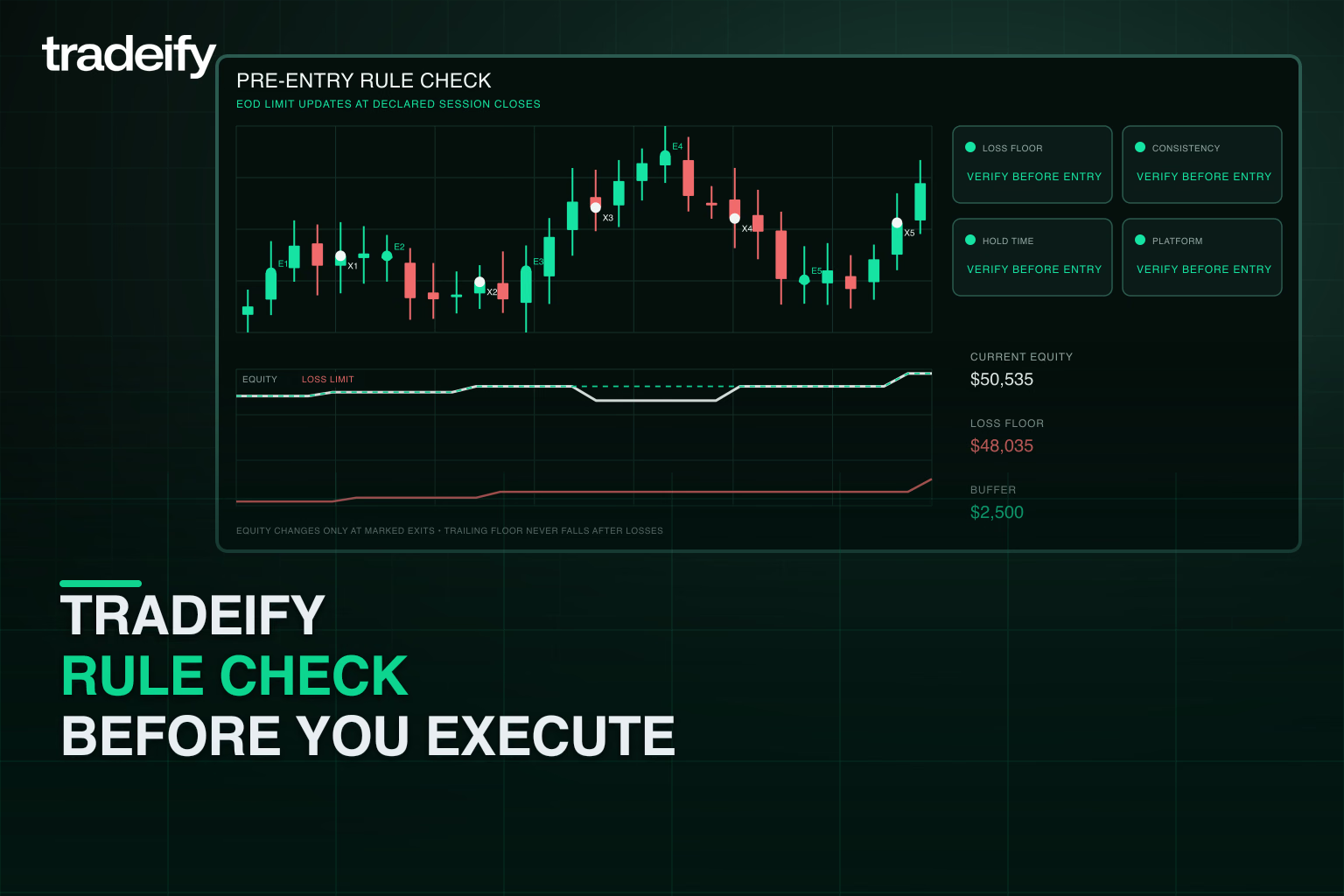
All current Tradeify account types use End-of-Day trailing drawdowns. The drawdown floor only moves up based on your highest end-of-day balance — not on intraday unrealized profit. This means a profitable spike at 10:30 AM that gives back to breakeven by close will not permanently ratchet your drawdown floor tighter. There is, however, a critical caveat: while the floor only moves up at end of day, the limit is enforced in real time. If your account balance touches the current drawdown limit at any point during the session, your account fails immediately. Treating the EOD recalculation as a free pass to swing close to the limit intraday is one of the most common ways traders blow accounts that should have survived.
The Consistency Rule is another primary challenge. It ensures that a trader's success is the result of a repeatable process rather than a single lucky trade during a news event. The specific threshold varies by account type. Growth funded accounts follow a 35% rule. Select evaluations follow 40%, and that rule is removed entirely once the account is funded. Lightning Funded accounts purchased after September 12, 2025 use a progressive structure: 20% for the first payout, 25% for the second, and 30% for all subsequent payouts. If a trader generates more than 35% of their total profit in a single day on a Growth account, for example, they must continue trading to dilute that outlier day before a payout is approved.
Prop Firm Failure Rates and the ICT Strategy Paradox
Industry data indicates that the vast majority of prop firm candidates fail. Estimates suggest that while 5–10% may pass a challenge, only about 1–2% of all traders who start an evaluation actually receive a payout. This failure rate remains consistent across all trading strategies, including ICT, classical price action, and indicator-based systems.
The paradox lies in the fact that while ICT is highly technical and precise, its complexity can be a liability for beginners. The "test" in a prop firm is not just about having a profitable strategy; it is about risk discipline. Most traders fail because they breach drawdown limits, not because they don't know how to identify a Fair Value Gap.
Using the ICT 2022 Mentorship Model in Prop Firm Trading

For a beginner looking to trade ICT concepts within Tradeify, the "2022 Mentorship Model" is widely considered the gold standard for intraday index futures trading. This model was specifically designed to be mechanical, reducing the subjectivity that often plagues other ICT strategies.
The ICT 2022 Model Execution Workflow
The 2022 model follows a specific sequence of events that must occur during institutional "Kill Zones" (the periods of highest liquidity and volatility).
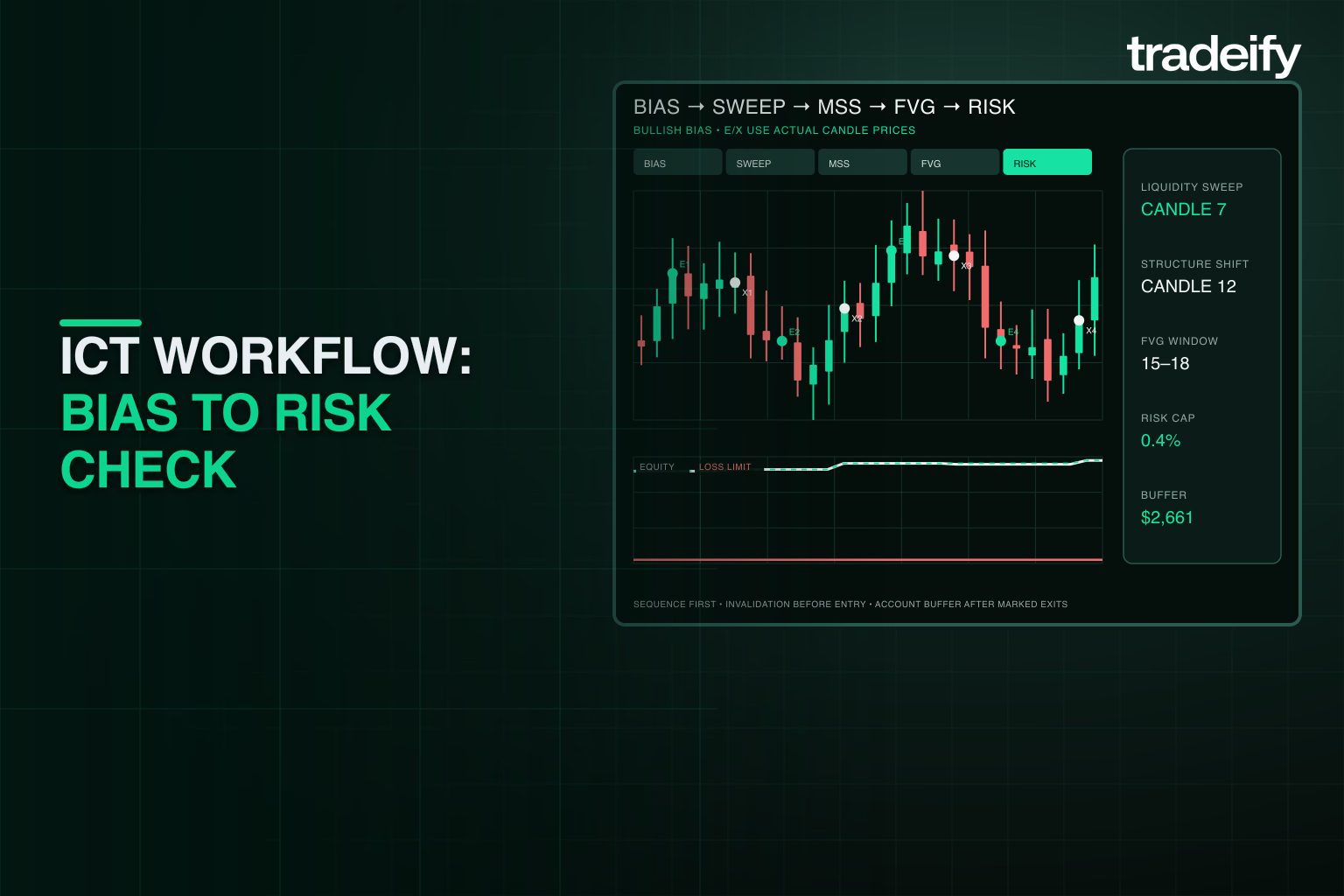
- Define Daily Bias: The trader examines the daily and 1-hour charts to determine the Draw on Liquidity. If the market is clearly trending higher, the focus is exclusively on buy setups.
- Wait for the Sweep: During the New York AM session (starting around 8:30 AM EST), the trader waits for the price to sweep a short-term high or low. This sweep is interpreted as the "smart money" triggering retail stops.
- Monitor for the MSS: On a 1-minute or 5-minute chart, the trader looks for a sharp displacement move in the opposite direction of the sweep. This move must break a recent swing high (for longs) or swing low (for shorts).
- Identify the FVG: Within the displacement move, there must be a clear Fair Value Gap. This FVG becomes the entry zone.
- Set the Entry and Exit: A limit order is placed at the edge of the FVG. The stop loss is placed above the high (for shorts) or below the low (for longs) of the candle that swept the liquidity. The target is the "opposite" liquidity pool, typically aiming for a minimum 1:3 risk-to-reward ratio.
Why ICT Concepts Prioritize Time over Price
In ICT trading, time is as important as price. The "Kill Zones" represent windows where the algorithm is expected to move the market.
| Session | Time (EST) | Strategic Importance |
|---|---|---|
| London Open | 2:00 AM – 5:00 AM | Sets the initial direction or the daily low/high. |
| New York Open | 8:30 AM – 11:00 AM | Highest volume; often provides the most significant "Silver Bullet" moves. |
| London Close | 10:00 AM – 12:00 PM | Often sees a retracement or reversal of the morning move. |
| New York PM | 1:30 PM – 4:00 PM | Can provide trend continuation or a secondary move toward liquidity. |
The ICT Silver Bullet Strategy for Prop Firm Evaluations
The "Silver Bullet" is a highly condensed version of ICT concepts, designed for traders who want a more "set-and-forget" style within specific time windows. It is particularly effective for futures traders on platforms like Tradeify who are looking for consistent, high-probability setups without spending all day in front of charts.
ICT Silver Bullet Trading Rules
The Silver Bullet focuses on the 10:00 AM to 11:00 AM EST window, known as the New York AM session. The rules are deceptively simple:
- Identify the Higher Timeframe Bias (e.g., is the 15-minute trend up or down?).
- Identify a Liquidity Target (e.g., the previous session's high or low).
- Wait for a Fair Value Gap (FVG) to form on a 1-minute to 5-minute chart within the 10:00–11:00 AM window.
- Enter on the retracement to that FVG, targeting the identified liquidity.
- Risk management typically involves a 1:2 risk-to-reward ratio or targeting the next major liquidity pool.
Backtesting results for the Silver Bullet strategy on Gold (XAU/USD) and the NASDAQ (NQ) have shown win rates as high as 70–80% when executed correctly. For a Tradeify evaluation, where the goal is to hit a profit target like $6,000 on a $100K Growth account while staying within a $3,500 trailing drawdown, the high win rate and mechanical nature of the Silver Bullet can be a significant asset.
Does ICT Work for Prop Firm Trading
The question of ICT's efficacy is fraught with controversy. Critics argue that Michael Huddleston, the founder, has a history of failing to prove his own profitability in live accounts and has been accused of "cherry-picking" winning trades in hindsight. Furthermore, many experienced traders point out that ICT is essentially a rebranding of existing concepts, such as Wyckoff Theory, Supply and Demand, and classical Price Action.
The ICT Rebranding Argument
The following table compares ICT terminology with its classical technical analysis counterparts:
| ICT Term | Classical Equivalent | Concept Description |
|---|---|---|
| Order Block | Supply / Demand Zone | A specific candle where institutional orders are clustered. |
| Liquidity Sweep | False Breakout / Stop Hunt | Price briefly moves past a level to trigger stops before reversing. |
| Market Structure Shift | Trend Reversal (Lower High/Higher Low) | A change in the sequence of highs and lows signaling a new trend. |
| Fair Value Gap | Gap / Inefficiency | A price range where only one side of the market was delivered. |
| Optimal Trade Entry | Fibonacci Retracement | Using the 62–79% levels for entry in a trending market. |
ICT Community Controversy vs. Practical Trading Results
While the controversy surrounding the founder is real, many traders have found success by ignoring the "drama" and focusing on the concepts themselves. The strength of the ICT framework lies not in its originality, but in its ability to synthesize multiple elements of price action into a cohesive, narrative-driven system. For a beginner, having a "story" for why the market is moving can be more helpful than staring at a confusing array of oscillators.
However, one must avoid the trap of "hindsight bias." It is easy to look at a chart after the fact and find an Order Block that worked. The challenge is identifying the correct Order Block in real-time while the candles are forming. This requires extensive backtesting and forward-testing, which most beginners are unwilling to do.
Prop Firm Risk Management Math for ICT Traders

In the Tradeify environment, risk management is not just a suggestion; it is the fundamental requirement for survival. The most common mistake beginners make is treating a $100,000 prop firm account like they actually have $100,000 to lose.
Understanding the Prop Firm Drawdown Constraint
A $100,000 Tradeify Growth account has a $3,500 maximum trailing drawdown, while a $100,000 Lightning account has a $4,000 trailing drawdown. In practical terms, the trader essentially has a $3,500 (or $4,000) account, not a $100,000 one. Risking 1% of the $100,000 ($1,000) means the trader can only be wrong three or four times before the account is closed. Professional prop firm traders typically risk between 0.25% and 0.5% of the total account balance per trade.
ICT Position Sizing and R to R Ratios for Prop Firms
The primary advantage of ICT concepts in a prop firm is the ability to achieve high risk-to-reward (R:R) ratios. By entering on a 1-minute FVG with a tight stop loss based on the candle's structure, a trader can often achieve an R:R of 1:3 or 1:5.
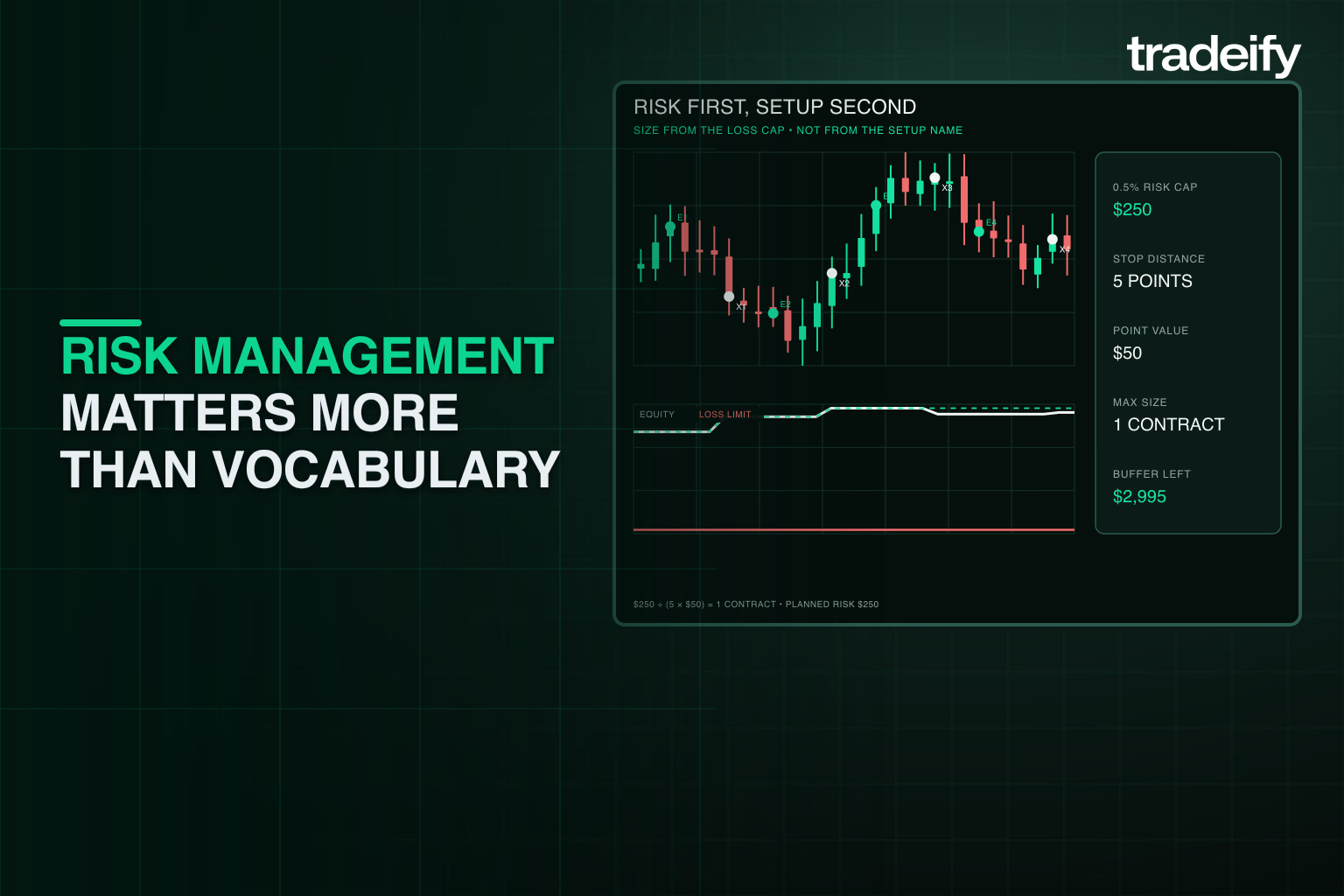
To calculate the proper position size for a Tradeify account, the following math applies:
For example, if a trader is risking $250 (0.25% of a $100k account) on the NQ (where 1 tick = $5) and the stop loss is 50 ticks:
By strictly adhering to this math, the trader ensures that they can withstand a series of losses without hitting the maximum drawdown limit.
The Psychological Shift From Demo to Funded Prop Firm Trading
Transitioning from a demo account to a Tradeify evaluation, and eventually to a funded account, is a significant psychological obstacle. When "real" money (or the prospect of real money) is on the line, the human brain often reverts to impulsive behaviors like revenge trading or over-leveraging.
The Trap of Over-Leveraging in Prop Firm Trading
Seeing a $150,000 account balance creates a false sense of security. Beginning traders often use the maximum allowed leverage to hit their profit targets quickly, but this volatility usually leads to a breach of the daily drawdown limit within minutes. Success in Tradeify is about hitting "base hits" (consistent, small wins) rather than "home runs."
The Prop Firm Consistency Requirement
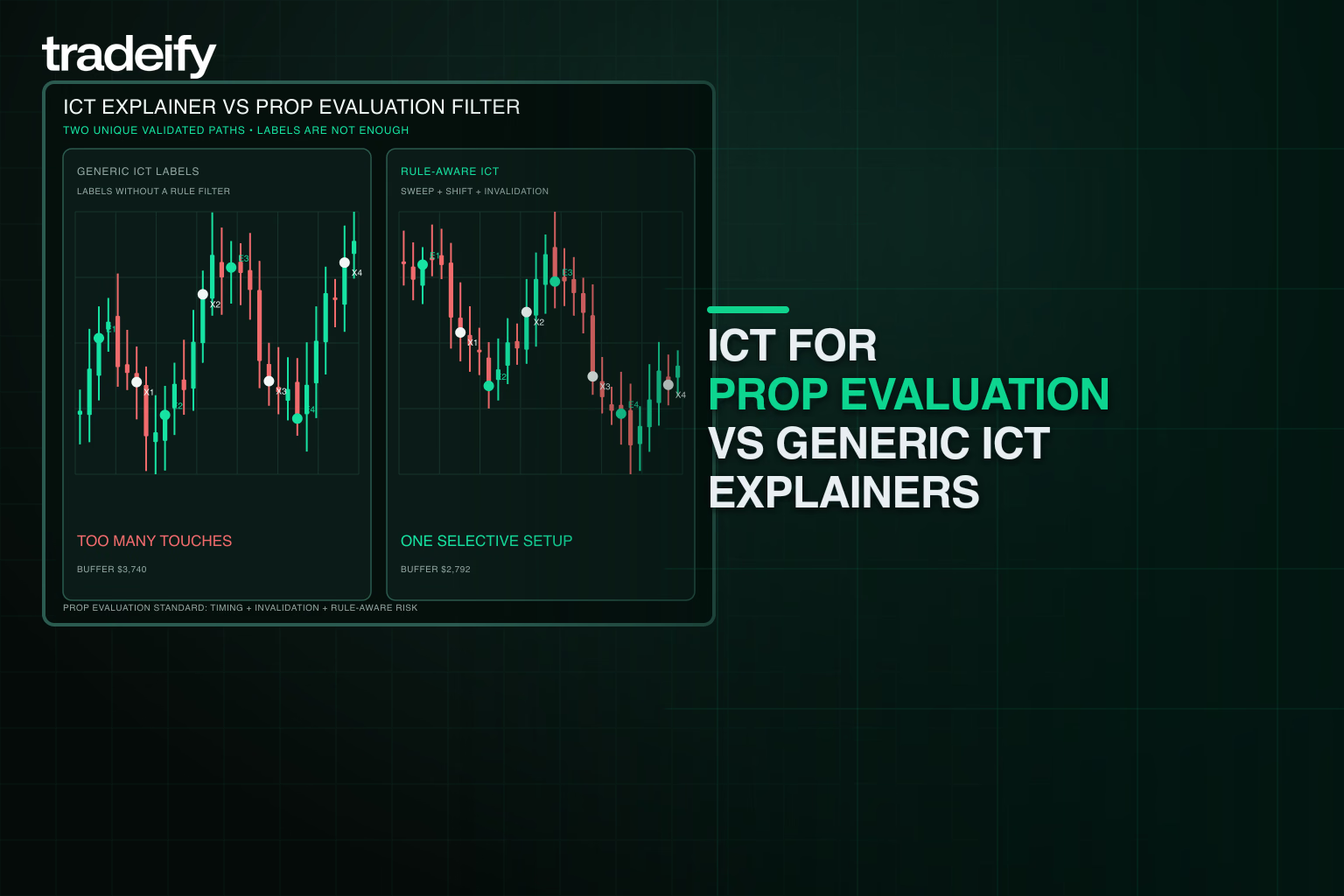
Tradeify's consistency rules mean that a trader must demonstrate a repeatable process. This is where the ICT framework is most beneficial. Because it focuses on specific times (Kill Zones) and specific patterns (Silver Bullet), it naturally limits the number of trades a trader takes. This selectivity is the hallmark of a professional trader and is exactly what prop firms are looking for in their funded participants.
Understanding Tradeify-Specific Rules and Platforms
Beginning traders must be intimately familiar with the Tradeify "Funded Trader Agreement" and the specific rules of their chosen account.
- News Trading: Tradeify does not restrict news trading on any account type, but you trade news at your own risk. High-impact events like CPI or FOMC produce wide spreads, slippage, and unpredictable fills, so tight ICT stops during these windows are generally a recipe for failure.
- Trailing Drawdown: All current Tradeify accounts use End-of-Day trailing drawdown. The floor only moves up based on your highest end-of-day balance, not intraday unrealized profit. If you are up $2,000 mid-session but close the day at breakeven, the floor stays where it was. However, the limit is enforced in real time. If your balance touches the current drawdown limit at any point during the session, your account fails immediately. The EOD recalculation is not a free pass to breach the limit intraday.
- Microscalping Rule: Tradeify enforces a microscalping rule that directly affects how aggressively ICT scalpers can execute on lower timeframes. To activate a passed evaluation or request a payout, you must meet both of these criteria: over 50% of your trades must be held longer than 10 seconds, and over 50% of your profit must come from trades held longer than 10 seconds. This is worth understanding before adopting a 1-minute Silver Bullet approach where you might be in and out of trades in seconds — if too much of your profit comes from sub-10-second trades, you will not be able to take a payout. Holding positions for longer (which most ICT setups naturally encourage when targeting the "opposite" liquidity pool) keeps you compliant.
- Platforms: Tradeify supports three broker connections that you select at checkout: Tradovate, Rithmic, and WealthCharts. Tradovate credentials give you access to the Tradovate web/desktop platform, NinjaTrader, and TradingView. Rithmic credentials give you access to Tradesea, Quantower, Sierra Chart, and R|Trader. WealthCharts is its own broker and platform with separate credentials. For ICT traders, TradingView (via Tradovate) is often preferred due to its advanced drawing tools for marking FVGs and Liquidity zones, though WealthCharts and Sierra Chart also offer strong charting for traders who prefer them.
ICT Strategies for Passing the Prop Firm Evaluation

To pass a Tradeify evaluation using ICT concepts, a beginning trader should follow a structured "blueprints" approach.
- Phase 1: Foundation Building. Spend 1–2 months paper trading the concepts. Learn to identify structure and liquidity without the pressure of a live challenge.
- Phase 2: Concept Integration. Focus on one model, such as the Silver Bullet or the 2022 Mentorship. Do not try to combine every ICT concept at once.
- Phase 3: Risk Calibration. Use a "Setup Validation" checklist. Only take trades that score highly across multiple criteria (e.g., HTF Bias + Session Time + Liquidity Sweep + MSS + FVG).
- Phase 4: Scaling. Once funded, do not increase your risk. The goal is to reach the first payout, which requires the same discipline that passed the evaluation.
The Reality of ICT Concepts in Prop Firm Trading
The analysis indicates that Inner Circle Trader (ICT) concepts can be highly effective for passing prop firm evaluations, provided the trader understands the limitations and risks involved. The methodology's emphasis on time-based windows and high R:R setups is well suited for the strict drawdown environments of firms like Tradeify. However, the complexity of the system and the controversy surrounding its origin mean that it is not a "get-rich-quick" scheme.
For the beginning trader, the key takeaway is that the "edge" does not come from the strategy alone, but from the combination of a logical framework and professional risk management. Whether one calls it "Order Blocks" or "Supply and Demand," the underlying mechanics of market liquidity remain constant. Successful Tradeify traders are those who treat their trading as a business, focusing on repeatable processes, emotional discipline, and the mathematical protection of their capital. By aligning ICT's institutional narrative with Tradeify's operational rules — including the EOD trailing drawdown, the consistency requirements, and the microscalping rule — a trader can significantly increase their probability of achieving long-term, consistent payouts in the proprietary trading industry.
Get up to $750k instant sim funding
- Start earning payouts instantly
- Super fast automated payouts
- Free journal to improve


.webp)