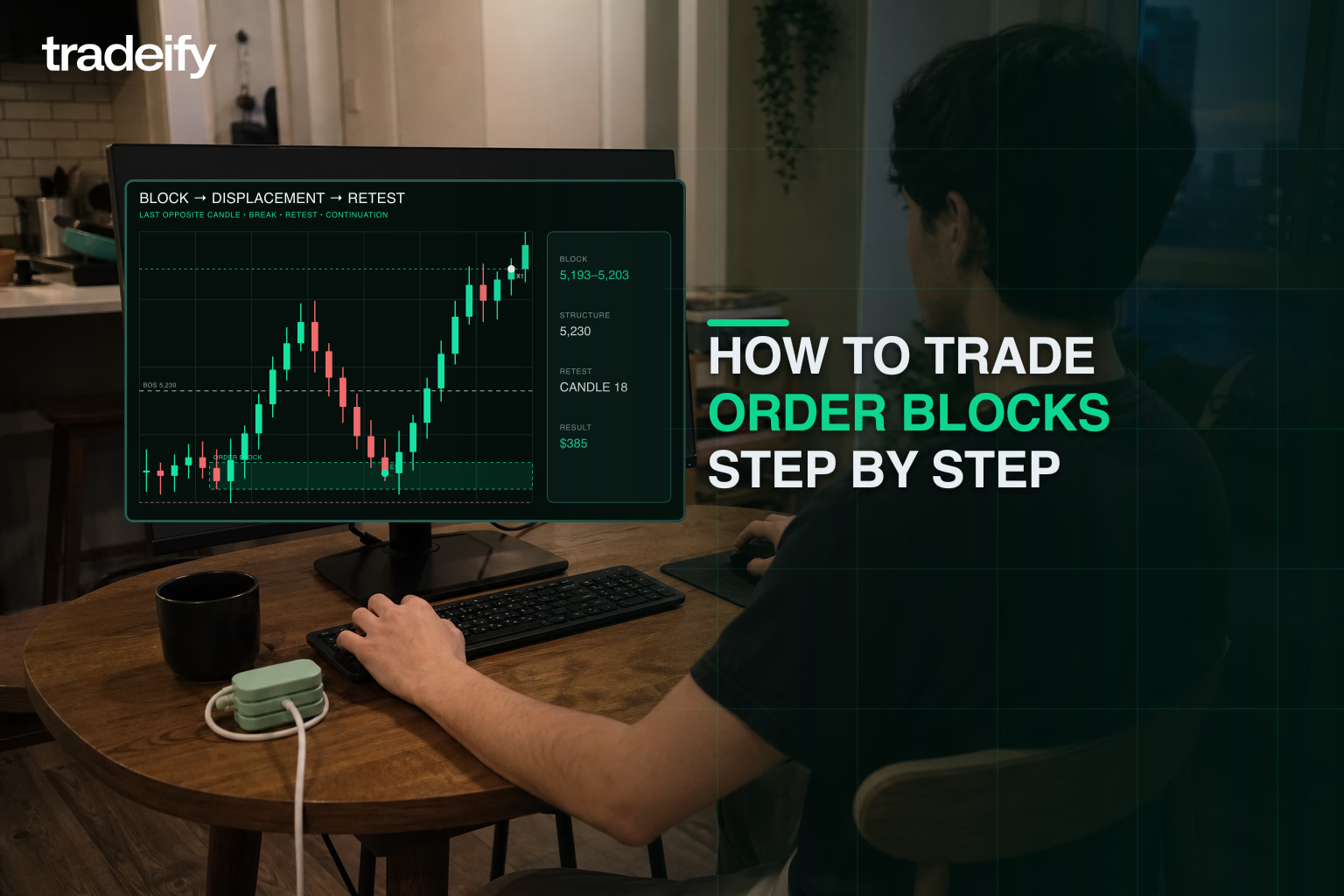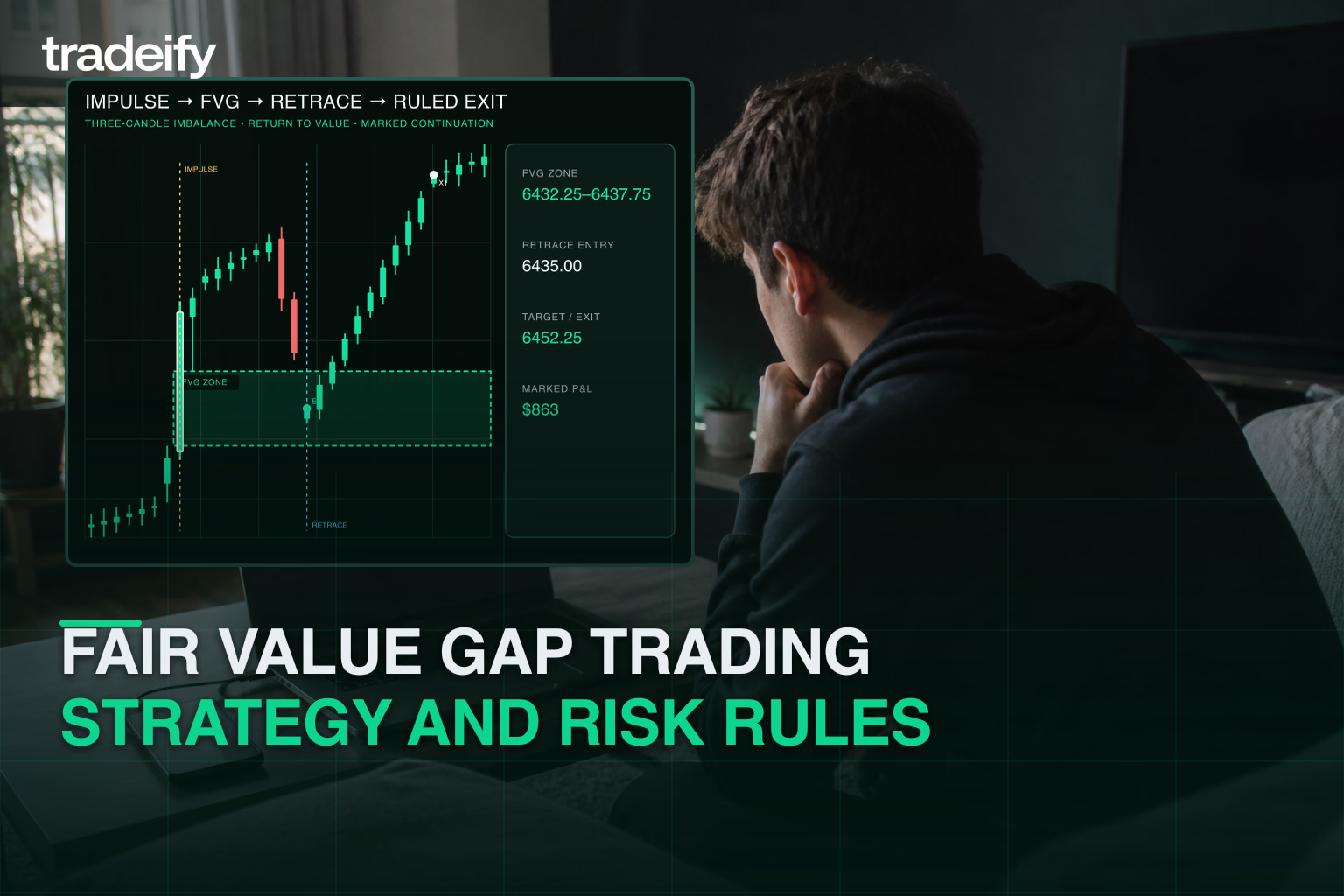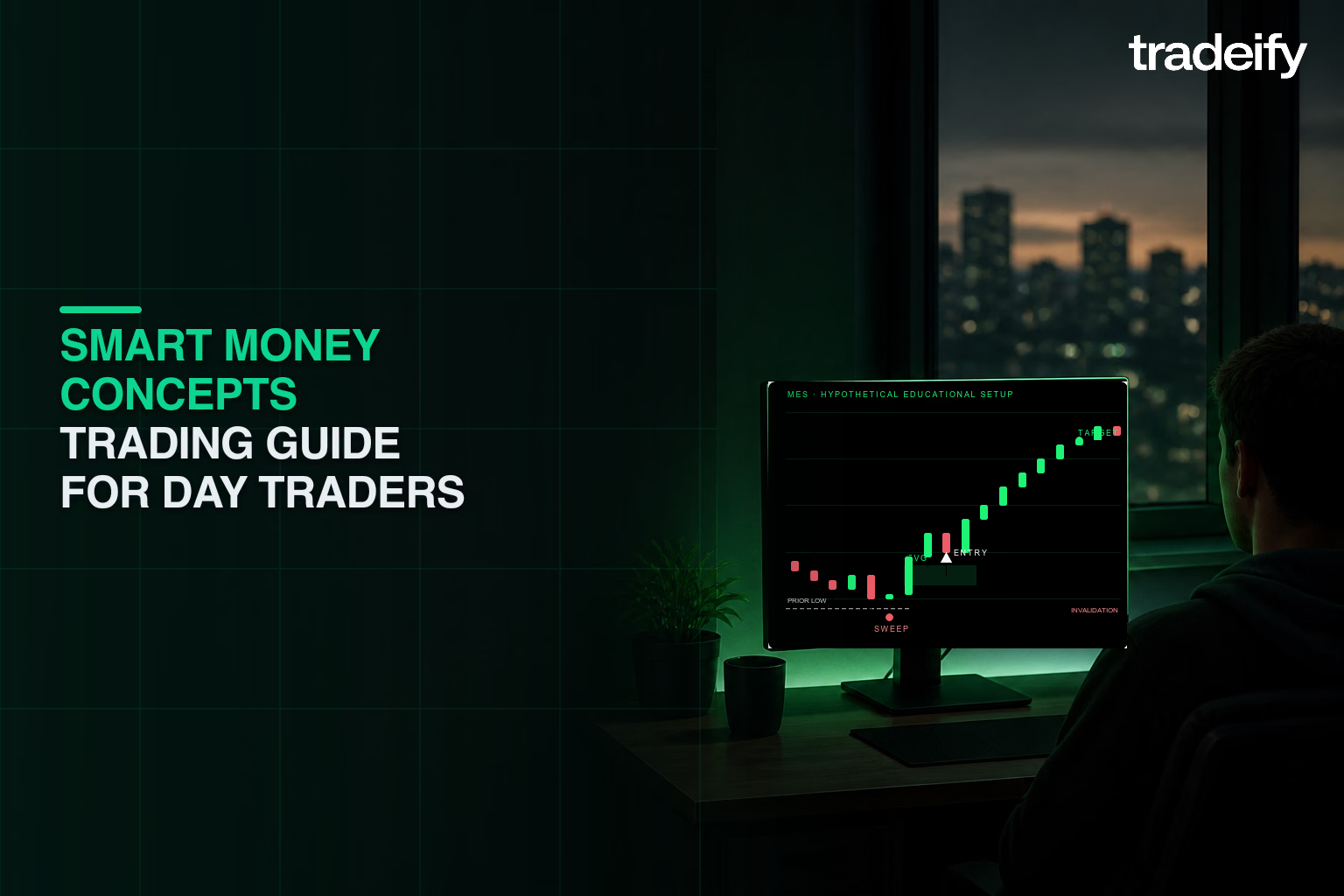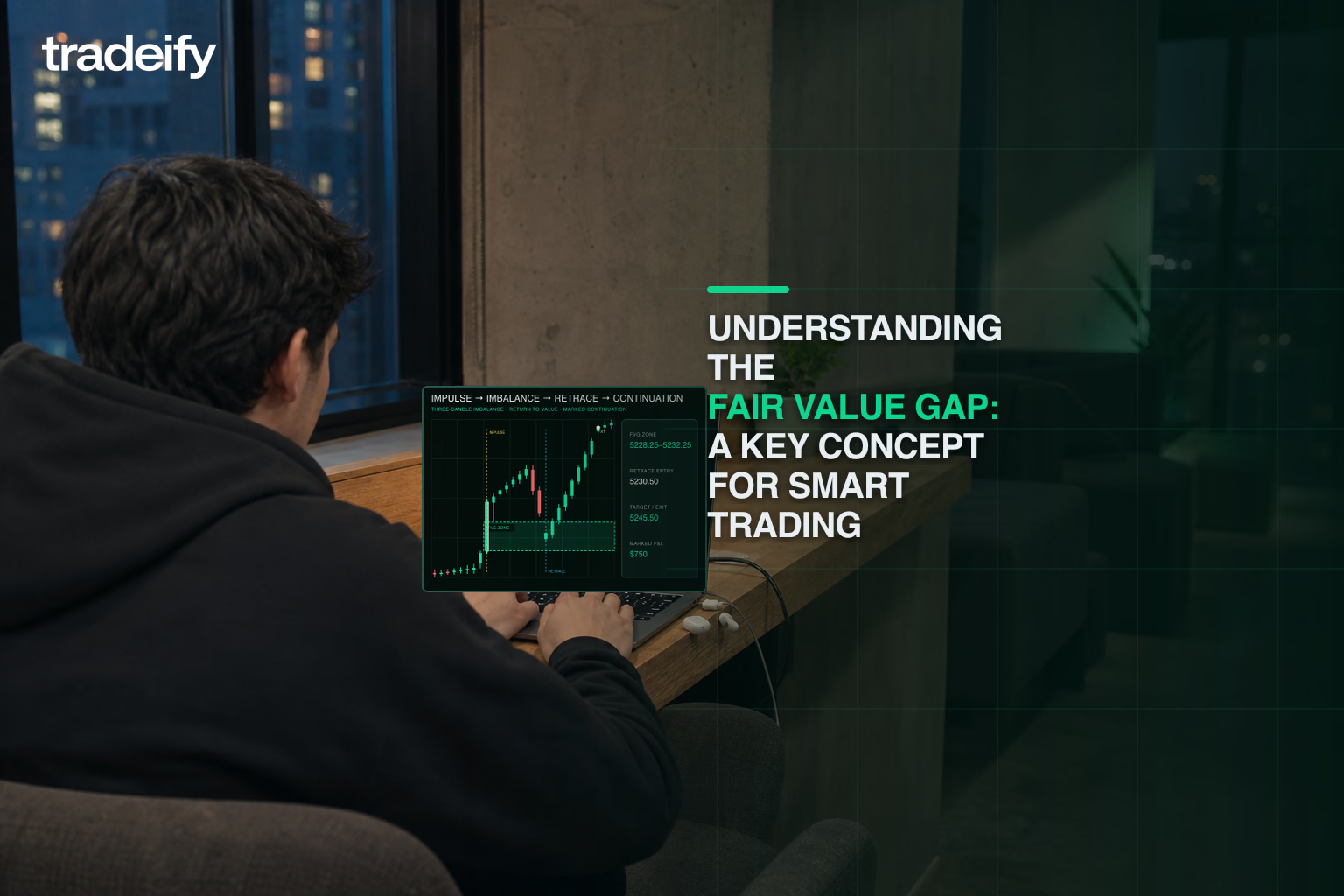
Order Blocks (OB) are specific candlestick clusters representing institutional accumulation or distribution footprints, technically defined as the final opposing candle prior to an impulsive price move that generates displacement, breaks market structure (BOS/MSS), and leaves a Fair Value Gap (FVG). High-probability OBs must be unmitigated, aligned with Higher Timeframe (HTF) flow, and ideally formed after a liquidity sweep; the optimal entry occurs upon the first "mitigation" touch to clear institutional drawdown. Validation requires analyzing fractal structures (H4/Daily for identification, M1/M5 for execution via Change of Character), with invalidation occurring if price closes beyond the OB's 50% Mean Threshold or distal line. Statistical backtesting suggests optimized setups (Displacement + FVG + Sweep) yield 60–65% win rates with 1:3 to 1:10 Risk-to-Reward ratios, particularly during the New York Session (09:30–11:00 EST). Common failure points include trading against dominant order flow, ignoring Premium/Discount pricing arrays, or mistaking "inducement" liquidity pools for valid zones.
Table of Contents
- Executive Summary on Order Blocks in Trading
- Key Findings Regarding Institutional Footprints
- Conceptual Foundation and the Physics of Institutional Order Flow
- Definition and Theoretical Underpinnings of Smart Money Concepts
- The Mechanics of Mitigation in Order Blocks
- Order Blocks vs Supply and Demand vs Support and Resistance
- Anatomy and Identification within the High Probability Order Block Checklist
- Displacement and Momentum Analysis
- Fair Value Gaps and Imbalance in Trading
- Break of Structure and Market Structure Shift for Smart Money Concepts
- Liquidity Sweep and Institutional Footprints
- Unmitigated Status of Order Blocks
- Technical Execution for Refining and Drawing Order Blocks
- The Drawing Convention Comparing Body vs Wick in Trading
- The Refining Process and Fractal Analysis of Order Blocks
- Timeframe Selection Matrix for Institutional Footprints
- Strategic Implementation and Risk Management in Smart Money Concepts
- Entry Models for Order Blocks
- Stop Loss and Take Profit Placement in Trading
- Why Order Blocks Fail (Common Pitfalls)
- Advanced Concepts and Terminology in Smart Money Concepts
- Data Driven Insights and Backtesting Results for Order Blocks
- Concluding the Comprehensive Analysis of Institutional Footprints
Executive Summary on Order Blocks in Trading
Order Blocks (OB) represent a cornerstone of modern technical analysis within the context of Smart Money Concepts (SMC). Unlike traditional support and resistance, which often rely on retail sentiment, Order Blocks are theorized to be the specific price footprints of institutional accumulation and distribution. This report provides an examination of Order Block theory, identification methodologies, and execution strategies optimized for the futures markets.
Key Findings Regarding Institutional Footprints
- Institutional Nature: Order Blocks are specific candles representing the "last line of defense" where institutions (banks, hedge funds) initiated a move that broke market structure.
- Validation is Critical: A raw candle is insufficient. High-probability Order Blocks must be validated by displacement (violent price movement), Fair Value Gaps (FVG), and liquidity sweeps.
- Precision over Frequency: While Supply and Demand zones offer broad areas of interest, Order Blocks, specifically when refined from Higher Timeframes (H4) to Lower Timeframes (M15/M5), offer superior Risk-to-Reward (R:R) ratios, essential for passing prop firm evaluations like those at Tradeify.
- Strategic Failure: Order Blocks primarily fail when traders ignore the "Premium/Discount" pricing models or attempt to trade them against the dominant institutional order flow.
Conceptual Foundation and the Physics of Institutional Order Flow
Definition and Theoretical Underpinnings of Smart Money Concepts
In the lexicon of Smart Money Concepts (SMC), an Order Block (OB) is the specific candlestick cluster where large market participants (institutions) placed their final orders prior to a significant, impulsive price movement that alters the market structure.
Institutions deal in volumes too large to be filled at a single price level without causing massive slippage. Therefore, they must "build" positions by manipulating price in the opposite direction of their intended move to generate liquidity (matching orders).
- Bullish Order Block: Technically defined as the last bearish candle (down-close) prior to a strong impulsive upward move that breaks a structural high. This candle represents the institutional "sell" orders used to drive price down into a liquidity pool to facilitate a massive "buy" entry.
- Bearish Order Block: Defined as the last bullish candle (up-close) prior to a strong impulsive downward move that breaks a structural low. This represents the institutional "buy" orders used to induce retail longs before a massive "sell" campaign.
The Mechanics of Mitigation in Order Blocks
The efficacy of Order Blocks lies in the concept of mitigation. When institutions manipulate price (e.g., selling to buy), they are left with open drawdown positions on the manipulation leg once the price rockets away in the intended direction.
To close these drawdown positions at breakeven or a small loss, institutions must drive the price back to the origin of the move, the Order Block. This return to the zone allows them to "mitigate" their losses and add to their winning positions, causing the price to react and resume the trend.
Order Blocks vs Supply and Demand vs Support and Resistance
A critical distinction exists between Order Blocks and traditional zones to avoid "retail traps."
| Feature | Support & Resistance (S/R) | Supply & Demand (S/D) | Order Blocks (OB) |
|---|---|---|---|
| Origin | Retail reaction points (touches) | Aggressive buying/selling zones | Institutional manipulation footprints |
| Precision | Low (Lines/Zones) | Medium (Broad Zones) | High (Specific Candles) |
| Logic | "Price reacted here before" | "Imbalance of buyers/sellers" | "Mitigation of institutional orders" |
| SMC View | Often viewed as Liquidity (targets) | Contextual background | Entry triggers |
| Validation | Multiple touches | Rally-Base-Rally structures | Displacement + FVG + Structure Break |
Source Analysis: Research indicates that while Supply and Demand zones focus on broader imbalances, Order Blocks are precise candles tied to specific institutional intent. Support and Resistance levels are frequently used by institutions as "liquidity pools," areas to target and destroy, rather than safe entry points.
Anatomy and Identification within the High Probability Order Block Checklist
Identifying a candle as an Order Block is straightforward; identifying a tradable Order Block requires a rigorous qualification process. A valid Order Block must exhibit specific characteristics that confirm institutional presence.
Displacement and Momentum Analysis
Displacement is the single most important factor in validating an Order Block. It refers to a violent, high-momentum move away from the specific candle identified as the Order Block.
- Criteria: The move must be energetic, creating large candles with small wicks.
- Significance: If price drifts away from a level slowly, it indicates a lack of institutional urgency. A true Order Block is followed by a "leaving" leg that suggests heavy capital commitment.
Fair Value Gaps and Imbalance in Trading
A valid Order Block should be immediately followed by a Fair Value Gap (FVG). An FVG occurs when price moves so quickly that it skips levels, leaving an inefficiency where only buyers or sellers were able to participate.
- The Magnet Effect: Price is drawn back to these gaps to rebalance the auction. The FVG serves as the "vacuum" that pulls price back into the Order Block for mitigation.
- Rule: If there is no FVG between the Order Block and the current price action, the probability of the zone holding diminishes significantly.
Break of Structure and Market Structure Shift for Smart Money Concepts
The displacement caused by the Order Block must achieve a structural objective.
- BOS (Continuation): In an uptrend, the move from the Order Block must break the previous swing high.
- MSS (Reversal): In a reversal scenario, the move must break the most recent significant swing point that controlled the trend.
- Validation: An Order Block that fails to break structure is merely a pause in price, not a point of origin for a new trend.
Liquidity Sweep and Institutional Footprints
The strongest Order Blocks are those that formed after sweeping liquidity.
- Mechanism: Before the true move, price often spikes above a previous high or below a previous low to trigger stop-losses (liquidity).
- Institutional Logic: This sweep provides the necessary volume for institutions to fill their large orders. An Order Block that creates a move without first sweeping liquidity is prone to becoming liquidity itself (i.e., price will smash through it to find liquidity lower/higher).
Unmitigated Status of Order Blocks
Order Blocks are "one-time use" zones.
- Freshness: The highest probability setup occurs on the first touch (mitigation).
- Degradation: Once price has tapped the Order Block and reacted, the institutional orders are considered mitigated. Subsequent returns to the level are likely to break through, as the defensive orders are no longer present.
Technical Execution for Refining and Drawing Order Blocks
The Drawing Convention Comparing Body vs Wick in Trading
There is significant debate and nuance regarding how to draw the Order Block zone on a chart.
- The Body-Centric Approach: Many SMC traders draw the box from the open to the close of the candle body. This is considered the "volume" area where the bulk of positions were transacted.
- The Wick-Inclusive Approach: Including the wicks (high to low of the candle) is safer as it covers the entire range of price delivery.
- Strategy Modifications:
- If the candle has a small body and long wicks, use the entire wick range.
- If the candle is a large momentum candle, focus on the body or the "Mean Threshold" (50% of the body).
- Rejection Blocks: In cases of extremely long wicks, the wick itself can be treated as a "Rejection Block," where entries are taken at the start of the wick or its midpoint.
The Refining Process and Fractal Analysis of Order Blocks
To achieve the high Risk-to-Reward (R:R) ratios required for prop firm profitability (e.g., Tradeify's evaluation criteria), traders must refine large zones into precise entry points.
Step-by-Step Refinement Protocol:
- Macro View (H4/Daily): Identify the master Order Block that aligns with the overall trend. This zone may be 20-50 points wide in futures (e.g., ES or NQ).
- Intermediate View (H1/M15): Zoom into the H4 zone. Within that large candle, identify the specific M15 candle that initiated the displacement. This narrows the zone significantly.
- Micro View (M5/M1): Wait for price to arrive at the M15 zone. Do not enter blindly. Look for a "Change of Character" (ChoCH) or micro-BOS on the M1 chart to confirm the reversal inside the higher timeframe zone.
Timeframe Selection Matrix for Institutional Footprints
Different timeframes serve different functions in the Order Block hierarchy:
| Timeframe | Function | Application |
|---|---|---|
| Daily / Weekly | Bias & Direction | Identify major liquidity pools and long-term OBs. Do not trade directly off these without wide stops. |
| H4 / H1 | Zone Identification | The "Golden Timeframes" for spotting valid OBs. These levels carry significant institutional weight. |
| M15 | Intraday Structure | Used to validate the H4 zones and identify intraday swings. |
| M5 / M1 | Execution (Sniper) | Used solely for entry triggers to minimize Stop Loss distance. |
Strategic Implementation and Risk Management in Smart Money Concepts
Entry Models for Order Blocks
There are two primary methods for entering trades at Order Blocks:
A. The Limit Entry (Aggressive)
- Method: Place a Limit Order at the proximal line (front edge) or the 50% equilibrium (Mean Threshold) of the Order Block.
- Pros: Guarantees entry if price touches the level; captures the absolute wick tip.
- Cons: High risk of being stopped out if the market ignores the Order Block (catching a falling knife).
- Best For: Fresh, high-probability Order Blocks that align with the H4/Daily trend and have clear displacement.
B. The Confirmation Entry (Conservative)
- Method: Allow price to tap into the Order Block. Wait for a lower timeframe (LTF) Market Structure Shift (MSS) or a new FVG to form in the intended direction before entering.
- Pros: Significantly higher win rate; filters out invalid zones.
- Cons: Worse R:R ratio; risk of missing the trade if price moves too fast (V-shape recovery).
- Best For: Counter-trend trades or zones that are slightly ambiguous.
Stop Loss and Take Profit Placement in Trading
- Stop Loss (SL):
- Standard: Just beyond the distal line (the far edge) of the Order Block.
- Conservative: Below the swing low/high that created the Order Block.
- Institutional Insight: If price closes more than 50% through a valid Order Block (breaching the Mean Threshold), the setup is often considered invalidated, and the trade should be manually closed or the SL triggered.
- Take Profit (TP):
- TP1: The nearest opposing liquidity pool (recent swing high/low).
- TP2: The next opposing unmitigated Order Block.
- TP3: Equilibrium of the higher timeframe range.
Why Order Blocks Fail (Common Pitfalls)
Even valid-looking Order Blocks fail. Understanding why is crucial for capital preservation.
- Trading Against Flow: An Order Block formed against a massive higher-timeframe trend is likely to be smashed.
- Inducement: If an Order Block has "clean" lows/highs resting just before it, price will often run through the zone to sweep that liquidity before reversing. This is known as "Inducement."
- Premium/Discount Pricing: Buying at a Bullish Order Block that is located in a "Premium" (expensive) area of the leg is low probability. Institutions buy in "Discount" (lower 50% of the dealing range) and sell in "Premium" (upper 50% of the dealing range).
Advanced Concepts and Terminology in Smart Money Concepts
To trade Order Blocks at an expert level, one must master the surrounding vocabulary of the Smart Money Concepts (SMC) ecosystem.
The overarching philosophy that price is engineered by a central algorithm/entity to seek liquidity and balance efficiency.
A failed Order Block. If a Bullish Order Block is broken with strong momentum, it flips into a resistance zone (Breaker). Price often retests the Breaker from the other side.
Similar to a Breaker but occurs without a liquidity sweep. It is a support-turned-resistance level used for re-entry.
A rapid price move that lacks trading on one side (similar to a Fair Value Gap). Price returns here to "fill" the void.
The 50% level of an Order Block's body. This is a critical sensitivity point; institutions often defend this specific level.
Data Driven Insights and Backtesting Results for Order Blocks
While Smart Money Concepts (SMC) is often theoretical, backtesting provides empirical evidence of its efficacy when rules are strictly applied.
- Win Rate vs. R:R: Backtesting data suggests that raw Order Block strategies may have win rates around 50-55%, but the edge comes from the Risk-to-Reward Ratio. A typical Order Block trade targets 1:3 to 1:10 R:R. A 50% win rate with a 1:3 R:R generates significant alpha.
- Optimization: Strategies that filter for Displacement + Fair Value Gap (FVG) + Liquidity Sweep (the "Holy Trinity" of SMC) show significantly higher strike rates (up to 60-65% in trending markets) compared to trading raw Order Blocks.
- Futures Context (ES/NQ): In indices like the S&P 500 (ES) and Nasdaq (NQ), Order Blocks formed during the New York Session (9:30 AM - 11:00 AM EST) have a higher probability of holding due to the volume injection during the "Silver Bullet" window.
Concluding the Comprehensive Analysis of Institutional Footprints
For traders utilizing Tradeify's funded accounts, Order Blocks offer a structured mechanism to manage risk and secure high-payout setups. The "instant funding" and "trailing drawdown" rules of futures prop firms necessitate a strategy that avoids deep drawdowns.
Strategic Recommendations:
- Adopt the "Sniper" Mindset: Do not trade every Order Block. Wait for the "A+" setups that align with H4 structure and have clear displacement.
- Use Limit Orders Cautiously: In high-volatility futures markets, confirmation entries on the M1/M5 reduce the risk of slippage and instant stop-outs.
- Focus on R:R: Use the precision of Order Blocks to keep stops tight (e.g., 2-4 points on ES, 10-20 points on NQ) while targeting larger structural runs. This aligns perfectly with passing evaluations and maintaining funded status.
By shifting focus from "predicting" price to "reacting" to institutional footprints, traders can align themselves with the Smart Money, turning the chart from a chaotic battlefield into a structured map of institutional intent.
Get up to $750k instant sim funding
- Start earning payouts instantly
- Super fast automated payouts
- Free journal to improve


.webp)