.svg)

.svg)
.svg)

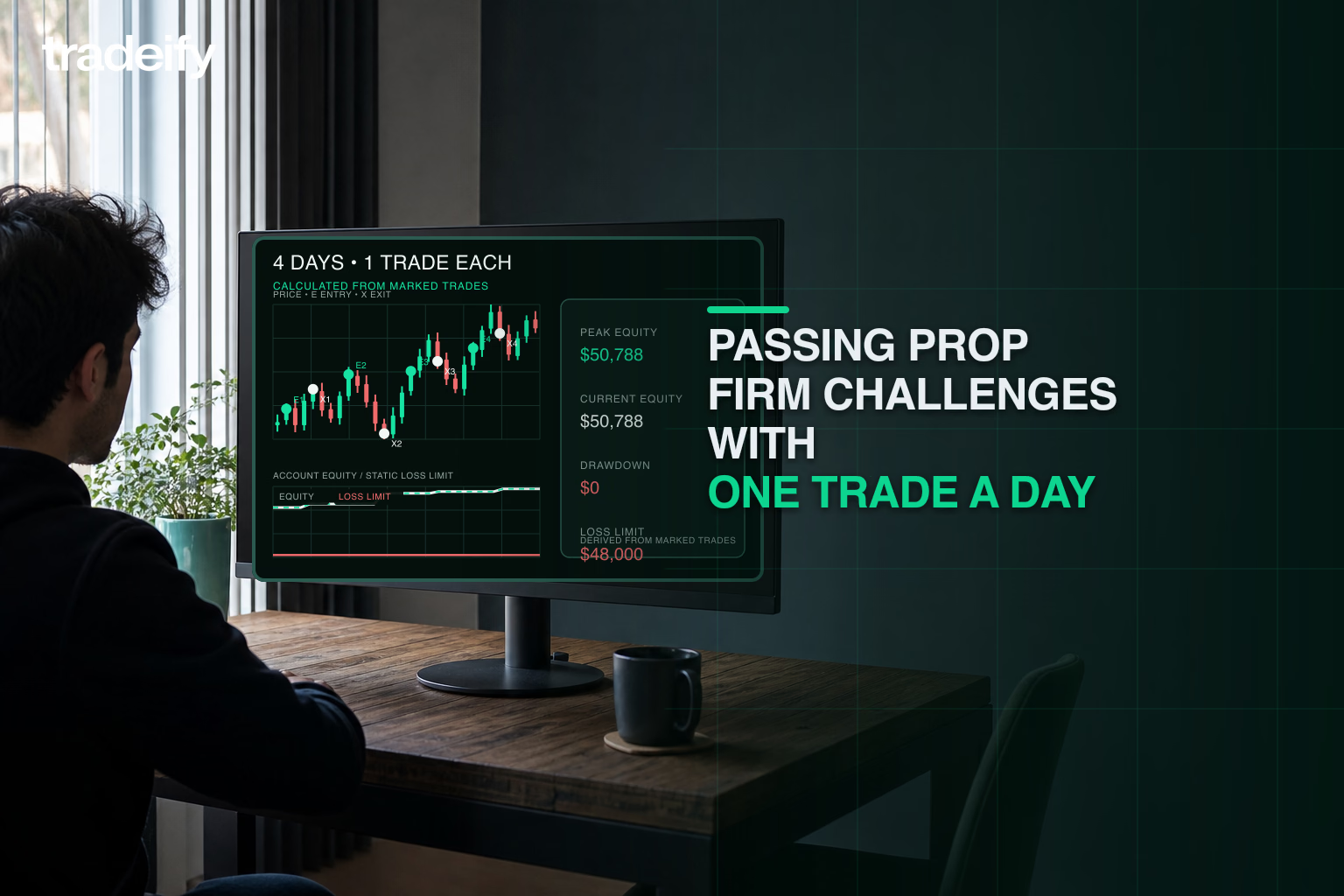


Fast answer: Yes, some prop firm evaluations can be passed in a single day—but only if the rules allow it and your strategy fits the constraints. Here’s how to decide and execute safely.
TL;DR: The One Trade a Day strategy restricts traders to a single daily execution—defined by a hard Take Profit or Stop Loss—to eliminate revenge trading and overtrading, the primary causes of prop firm failure. This approach is specifically optimized for Tradeify evaluations, ensuring adherence to the Consistency Rule (capping single-day profits at 20% to 40% depending on account type) and preventing Daily Loss Limit breaches. Implementation requires executing high-probability setups such as the Opening Range Breakout (ORB) on ES/NQ (using the 9:30–9:45 AM EST range) or trend-following candlestick patterns like Hammersticks and Bearish Engulfing at support/resistance levels. To succeed, traders must maintain a minimum 1:1.5 risk-to-reward ratio, strictly observe the 6:00 PM–5:00 PM EST trading day cycle, and enforce an immediate platform shutdown ritual post-trade to preserve capital and psychological control.
Key Points
In the high-stakes sector of futures trading, a common misconception exists that "more is better." New traders often believe that increased screen time and high click rates equate to higher returns. The reality is usually the opposite. In the prop firm environment, where risk management is king, overtrading is the fastest way to fail an evaluation.
The One Trade a Day Strategy addresses this specific point of failure.
It appears simple, perhaps even too slow for market participants seeking an adrenaline rush. However, for traders looking to secure funding with a firm like Tradeify, this strategy serves as a survival mechanism. By committing to a single trade every 24 hours, a trader removes the noise, the chaos, and the emotional instability that lead to ruin.
This guide explains what the One Trade a Day strategy entails, why it functions effectively on a psychological level, and how to execute it using technical concepts like the Opening Range Breakout (ORB) and Candlestick Trading. It also examines how this specific discipline helps satisfy Tradeify's rules, such as the Consistency Rule and Trailing Drawdown.
What is the One Trade a Day Strategy for Prop Firm Challenges?
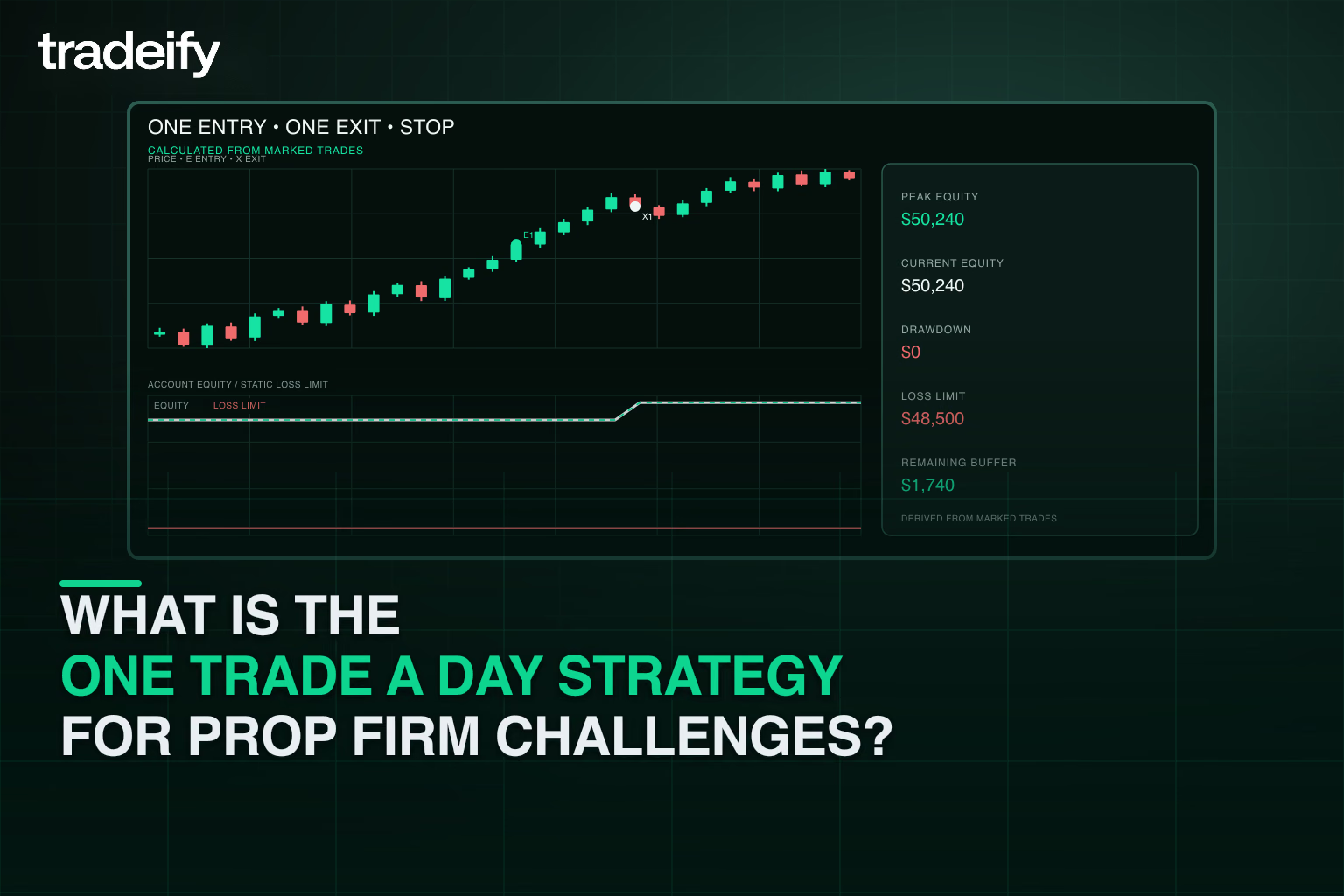
The One Trade a Day Strategy is literal: a trader is permitted to open exactly one position per trading day. If that trade hits the Take Profit (TP), the session is over. If it hits the Stop Loss (SL), the session is over. There are no secondary attempts, no recovery trades, and absolutely no scalping before the session closes.
The Sniper vs The Machine Gunner Approach to Prop Firm Challenges
The efficacy of the One Trade a Day method is best understood by comparing two distinct trading styles: the sniper and the machine gunner.
The Machine Gunner (Scalper/High Frequency) sprays trades everywhere, hoping to hit the target. They rely on volume and speed. In trading, this often looks like algorithmic trading or high-frequency scalping. While effective for computers, it is mentally exhausting for humans and leads to high commission costs.
The Sniper (One Trade a Day) waits for hours, observing the environment, checking market sentiment, and waits for the perfect target presentation. They take one shot. Whether they hit or miss, they leave the session to avoid giving profits back.
For a retail trader or a prop firm candidate, acting as a sniper is often the only sustainable edge. You cannot compete with institutional algorithms on speed, but you can compete on patience and selectivity.
Defining the Trading Day for Your One Trade Discipline
Successfully implementing a daily trade limit requires understanding the definition of a "day" in the futures market, especially on platforms like Tradeify. A trading day does not begin when a trader wakes up. According to Tradeify's rules, a trading day runs from 6:00 PM EST to 5:00 PM EST the next calendar day.
If a trader places a position at 8:00 PM EST on Tuesday and another at 8:00 AM EST on Wednesday, Tradeify considers that two trades in the same trading day—potentially violating the One Trade per Day framework if you are applying it for discipline.
Why One Trade a Day Works (and Why Most Traders Fail Without It)
The prop firm ecosystem is built to eliminate chaotic risk takers. While traders believe they are being evaluated on profitability, they are actually being evaluated on consistency and risk management.
Most traders fail because they cannot stop trading.
A trade goes negative, and they revenge trade. A trade goes positive, and they get greedy. A trader hits a daily profit goal, and then gives it all back in a late-session impulse trade.
One Trade a Day solves this by cutting the behavioral feedback loop off at the root. When you only take one trade, you eliminate the possibility of emotional spirals.
How One Trade a Day Helps You Pass Prop Firm Rules
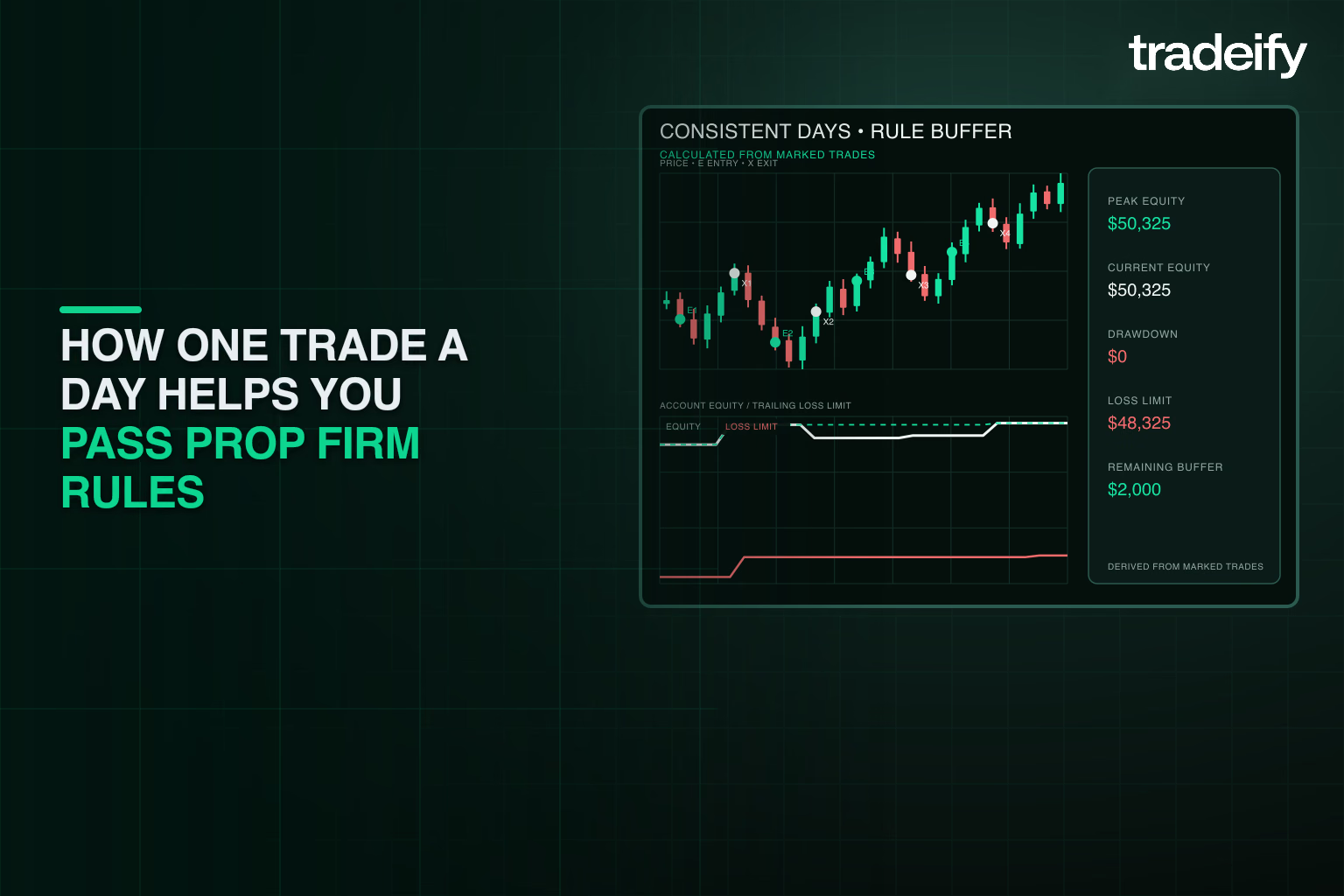
Most proprietary trading firms enforce a combination of rules:
- Maximum trailing drawdown
- Daily loss limit (DLL)
- Consistency rules (limits on best day profit)
- Minimum trading days
By limiting trade frequency, you reduce volatility and naturally conform to these restrictions.
Passing the Consistency Rule with One Trade a Day
The consistency rule is designed to ensure that traders pass through steady, repeatable performance rather than gambling on a few lucky trades. The exact threshold depends on account type:
- Growth funded accounts follow a 35% consistency rule, meaning no single trading day's profit can exceed 35% of total accumulated profit when requesting a payout.
- Lightning funded accounts start with a 20% consistency rule for the first payout, scaling to 25% on the second payout and 30% on subsequent payouts for accounts purchased after September 12, 2025. Legacy Lightning accounts maintain 20% for all payouts.
- Select accounts have a 40% consistency rule during evaluation (requiring a minimum of 3 trading days to pass), though funded Select accounts do not enforce a consistency rule for payouts.
How "One Trade a Day" Helps: If a trader scalps 50 times a day, they might experience one massive "lucky" day making $5,000, followed by 10 days of breaking even. That $5,000 day would breach the consistency percentage, making it difficult to withdraw funds. By trading once a day with a consistent position size (e.g., 2 contracts) and consistent targets (e.g., 20 points), the daily P&L will naturally appear smooth. This avoids massive outliers that flag the account for review or block the payout.
Protecting Your Account From the Daily Loss Limit
Tradeify has Daily Loss Limits on Growth, Lightning, and Select Daily funded accounts that pause trading if a trader loses a specific amount in a single day. Importantly, hitting the DLL is a soft breach — it pauses your trading until the next session (6:00 PM ET), but it does not fail or terminate your account. Only the Max Trailing Drawdown is a hard breach that permanently ends an account.
That said, overtrading is still the primary reason traders get dangerously close to both limits. A trader loses one trade, becomes frustrated, increases their position size to "make it back," and suddenly starts sliding toward the trailing drawdown threshold. If a trader takes one calculated trade with a defined stop loss (e.g., risking $250 on a $50,000 account), they will stay far from both the DLL and the drawdown limit. This ensures survival to trade another day.
It's also worth noting that Select Flex funded accounts do not have a Daily Loss Limit at all, meaning traders on that path are relying entirely on the Max Trailing Drawdown as their risk boundary — making personal discipline even more important.
How One Trade a Day Aligns With Payout Requirements
Tradeify requires consistent trading activity to qualify for payouts. For Growth funded accounts, traders need at least 5 profitable trading days (with minimum profit thresholds per day based on account size) between each payout request. For Lightning accounts, there must be a minimum of 5 trading days between each payout request. All funded accounts also require at least 1 trade per week to remain active.
Using the One Trade a Day strategy naturally fulfills these requirements. The trader engages in the market consistently, hitting the activity requirement without putting the funded account at unnecessary risk. Over the course of a week, five solid trading days with defined entries and exits build the kind of track record that satisfies payout criteria.
One Trade a Day: The Discipline Strategy That Wins Prop Firm Challenges

Adopting a "One Trade a Day" strategy transforms the decision-making process. It shifts a trader from a frenzied state of reaction to a calm state of anticipation. It forces the trader to become a specialist in a chosen setup, whether that is the ORB, Trend Trading, or News Breakouts.
For Tradeify traders, this discipline is the key to longevity. It aligns perfectly with the payout consistency rules, protects the drawdown, and prevents the emotional burnout that ends many careers.
Action Plan for Tomorrow
- Open the charts and identify one specific setup (e.g., the Hammerstick on a pullback).
- Wait for the New York Open.
- If the setup appears, execute with a Stop Loss.
- If it doesn't appear, do not trade.
- Close the computer.
This is how trading turns from a chaotic gamble into a professional business.
Quick comparison: “pass in one day” eligibility
If your goal is to pass a prop firm evaluation in one trading day, you need a ruleset that makes a one-day pass possible (not just theoretically allowed) and a strategy that fits those constraints.
Credibility checklist (no invented stats)
If you’re evaluating any prop firm’s “pass in one day” claim, look for objective proof points. Use this checklist to verify before committing time or money.
- Rules in writing: minimum days, drawdown type, DLL behavior, consistency caps, trade hold-time filters.
- Clear definitions: what counts as a “trading day,” what counts as a “pass,” and what triggers a “soft” vs “hard” breach.
- Payout policy clarity: minimum days between payouts, processing windows, and any caps.
- Audit trail: publicly documented policies + user dashboard screenshots (where applicable).
FAQ: passing a prop firm challenge in one day
Is it actually realistic to pass a prop firm challenge in one day?
It depends on the ruleset. If the evaluation requires 3+ trading days or enforces a strict best-day cap, a one-day pass may be impossible regardless of skill.
What’s the biggest reason traders fail when trying to pass in one day?
Oversizing relative to the drawdown buffer. One forced loss can end the attempt before the edge has time to play out.
Does “one trade a day” mean one entry or one position?
Use the strict definition: one position that resolves via either stop-loss or take-profit. If you scale out or scale in, document it as the same position.
Do daily loss limits help or hurt one-day pass attempts?
A soft DLL can prevent tilt and protect the account. A very tight DLL can also limit normal variance and reduce your ability to complete the profit target.
Why do hold-time / microscalping rules matter?
If a firm requires a minimum hold time (for example, >10 seconds), then very fast scalps may not qualify—even if they’re profitable.
Does passing in one day mean you can withdraw immediately?
No. Passing is an evaluation milestone; payouts typically have separate requirements and timelines.
.svg)
.svg)
.svg)
.svg)







.webp)