.svg)

.svg)
.svg)



Table of Contents
- How Prop Firm Payout Rules Work
- What Prop Firm Payout Terms Mean
- How the Prop Firm Payout Process Works Step by Step
- How Prop Firm Profit Splits Work
- How the Consistency Rule Works
- How Prop Firm Drawdown Rules Protect Trader Capital
- Prop Firm Evaluation Paths Growth vs Select
- Funded Account Payout Choice Select Flex vs Select Daily
- Growth and Lightning Payout Rules
- Prop Firm Payout Methods and Timelines
- How Daily Prop Firm Payouts Really Work
- Withdrawal Process and Payout Timelines
- How Scaling Plans Affect Prop Firm Payout Size
- Common Mistakes That Block Prop Firm Payouts
- Prop Firm Payout Red Flags and Legitimacy Checks
- Prop Firm Payout Rules Compared Across the Industry
- Building a Sustainable Career as a Funded Trader
- Frequently Asked Questions About Prop Firm Payouts
TL;DR
TL;DR: Prop firm payout rules set when, how, and under what conditions a funded trader can withdraw profit, built around core terms like profit split (the trader's share of profit), payout cycle (the window each withdrawal is measured against, which resets after payout), consistency rule (a cap on how much of total profit can come from one day), high-water mark, drawdown limit (intraday vs End-of-Day trailing,...
TL;DR:Prop firm payout rules set when, how, and under what conditions a funded trader can withdraw profit, built around core terms like profit split (the trader's share of profit), payout cycle (the window each withdrawal is measured against, which resets after payout), consistency rule (a cap on how much of total profit can come from one day), high-water mark, drawdown limit (intraday vs End-of-Day trailing, where an EOD limit only adjusts at market close but is still enforced in real time during the day), safety buffer (a required profit cushion before any payout), activation fee, virtual/simulated capital, evaluation phase, KYC identity verification, and scaling plan. The standard payout process runs eligibility check, close open trades, request in dashboard, complete KYC, select method, compliance review, funds received, then cycle reset. Industry-wide, profit splits run 50% to 95%, consistency rules 20% to 50% (some none), minimum trading days 0 to 15, minimum payouts $50 to $1,500, payout frequency daily to monthly, and processing 1 hour to 5 business days. Payments move via Rise, Plane, Deel, Wise, ACH/wire, PayPal, or crypto stablecoins (USDT/USDC), where crypto is fastest and runs around the clock but adds conversion risk. Profit above a payout cap stays in the account as equity and becomes withdrawable over later cycles. Red flags include vague or shifting rules, hidden deductions, delayed-payout excuses, and no public proof of payouts.
How Prop Firm Payout Rules Work
For aspiring day traders, the move from trading personal capital to securing institutional funding through a proprietary (prop) trading firm is a sought-after milestone. Reaching funded status is only the first step. The real test of a trader's viability is working through the firm's payout rules and actually getting paid. A payout policy is the structured set of conditions a firm uses to distribute profits. In prop trading, these rules dictate when, how, and under what conditions a trader can withdraw simulated or live profits.
Proprietary trading firms are businesses managing risk across thousands of independent traders. The payout structure is built to separate disciplined, consistent traders from gamblers who rely on high-risk, outsized trades. Through mechanisms like consistency rules, end-of-day drawdowns, and minimum profitable days, firms such as Tradeify make sure the traders they fund can produce steady, repeatable performance. This guide breaks down every critical payout rule, profit split, and risk parameter you need to understand, using Tradeify's ecosystem as a working example and comparing it against the wider industry.
What Prop Firm Payout Terms Mean
Before working through the rules, it helps to define the vocabulary. These are the terms that appear in almost every prop firm payout policy.
- Profit split: The percentage of withdrawn profit the trader keeps versus the firm. A 90/10 split means the trader keeps 90% and the firm keeps 10%.
- Payout cycle: The window of trading activity that a single withdrawal is measured against. After a payout, the cycle usually resets, and counters such as profitable days start again from zero.
- Consistency rule: A limit on how much of a trader's total profit can come from a single day. It stops a trader from passing or withdrawing on the back of one oversized trade.
- High-water mark: The highest account balance reached. Many firms only pay on new profit generated above this mark, so losses must be recovered before new payouts are possible.
- Drawdown limit: The lowest balance an account can reach before it fails. It can be calculated intraday or at end of day, and it may trail upward as the account grows.
- Safety buffer: A required cushion of profit above the starting balance that must be built before any withdrawal is allowed. It protects the firm from immediate payout requests on day one.
- Activation fee: A one-time charge some firms apply when a trader passes an evaluation and moves to a funded account, separate from the evaluation cost.
- Virtual capital: Simulated funds. Most modern prop firms fund traders on demo or simulated accounts first, and payouts come from the firm's own capital based on simulated performance.
- Evaluation phase: The test a trader completes to prove skill before funding. It typically sets a profit target, a drawdown limit, and sometimes a minimum number of trading days.
- KYC (Know Your Customer): The identity verification step required before a firm releases money, usually a government ID and proof of address.
- Scaling plan: A structured path that increases account size or buying power as a trader hits profit and consistency milestones, which in turn raises payout potential.
How the Prop Firm Payout Process Works Step by Step

Most reputable firms follow a similar sequence from "I am eligible" to "the money is in my account." Knowing the order prevents the common mistake of requesting too early.
- Complete KYC first. You must be KYC verified before you can request a payout at all, so a valid government ID and proof of address should be verified in advance.
- Eligibility check. Confirm you have met every requirement for your plan, including the profit goal, minimum profitable or winning days, the consistency rule, and the safety buffer. These are checked automatically, so if you miss any one of them you will not have the option to request a payout yet.
- Request the payout in your dashboard. Withdrawal requests are submitted through the Tradeify trader portal, where you enter the amount and confirm the cycle. Once submitted, the request lands in the admin dashboard as pending.
- Open positions are allowed. Tradeify does not enforce a flat-account rule, so after submitting you can keep trading or stop, whichever you prefer. Just note that if you keep trading and fail the account before the request is approved, the payout may not be approved, since approval deducts the requested amount from your sim account balance.
- Select a payout method. With Tradeify, the default method is RISE. If you cannot use RISE, you need to contact support to have it changed to Plane after a review.
- Fraud and compliance review. Consistency rules, drawdown limits, and trade activity are verified automatically before you can request, which is what makes a request available in the first place. After you submit, Tradeify runs additional fraud checks before the payout is approved.
- Funds received. Once approved, funds are sent within 24 hours, often almost instantly, and arrive in your RISE wallet. From there you can withdraw to your preferred payment method.
- Account reset and new payout cycle. All payout objectives reset once the payout is approved. From there you can resume trading and work toward future payouts.
How Prop Firm Profit Splits Work
The most immediate concern for any day trader evaluating a prop firm is the compensation structure. How much of the generated profit does the trader actually keep? Tradeify uses a competitive profit-sharing model built to attract and retain profitable day traders.
When a trader moves from the evaluation phase into a simulated funded account (Growth, Select, or Lightning Sim Funded), the initial profits are entirely their own. Tradeify uses a 90/10 profit split that applies from the very first payout, so traders keep 90% of all withdrawn profits.
This 90/10 split applies universally to all Simulated Funded stages, including Select, Growth, and Lightning accounts. There is no grace amount or initial zero-split threshold to clear first.
Elite Live Account Profit Split Rules
Tradeify offers a third stage of progression known as "Tradeify Elite," which involves trading live CME capital rather than simulated funds. After a trader meets the qualification threshold (3 payouts on a single account, or 10 total payouts since the last Live transition across all plan types), they may be considered for the Elite program. These thresholds are the minimum for consideration, not an automatic upgrade, and Tradeify selects traders at its discretion based on overall consistency and risk management.
The payout rules shift slightly in the Elite Live setup:
- Starting balance. Elite Live accounts start with a $0 balance. All funds present in the account are considered pure profit.
- Profit split. The split shifts to an 80/20 ratio, meaning the trader keeps 80% of the profits and Tradeify keeps 20%.
- Withdrawal mechanics. Because the account starts at $0, traders can withdraw any amount they have earned. However, if a payout request brings the account balance back to exactly $0, the Live Account is permanently closed.
How the Consistency Rule Works

The consistency rule is one of the most critical and frequently misunderstood payout parameters in the prop trading industry. It is a risk management guideline that makes sure a trader's total profit is the result of steady, repeatable trading rather than a single high-risk home-run trade.
The rule enforces a mathematical limit on the percentage of total profit that can come from any single trading day. If a trader's best day exceeds the allowed percentage, they are not breached or failed. Instead, they simply do not meet payout eligibility yet and cannot request a withdrawal until they generate more profit on later days, which dilutes the percentage of their best day until it falls back within the compliance threshold.
How to Calculate Your Consistency Rule
The formula for determining consistency is standard across the industry:
Consistency Percentage = (Highest Profit Day / Total Accumulated Profit) x 100
If a trader is subject to a 40% consistency rule, they can pre-calculate the most they are allowed to make on any given day without pushing back their payout timeline. For example, if the total profit target is $2,500, the calculation is $2,500 x 0.40 = $1,000. So no single day should exceed $1,000 in profit.
If a trader accidentally earns $1,500 in one day, they can calculate their new required total profit target by dividing the highest day by the consistency percentage limit:
New Profit Target = $1,500 / 0.40 = $3,750
Consistency Rules by Tradeify Account Type
Tradeify applies different consistency percentages depending on the specific account and phase the trader is in:
- Select Evaluation Phase. Enforces a 40% consistency rule. This mathematically requires a trader to trade for a minimum of three profitable days to pass the evaluation (for example, 33.3% + 33.3% + 33.3% = 100%).
- Growth Evaluation Phase. Enforces no consistency rule. A trader can make 100% of their profit target in a single day and pass instantly.
- Growth Funded Accounts. Enforces a 35% consistency rule once funded. No single day can account for more than 35% of the total profit generated between payout requests.
- Select Funded Accounts. Enforces no consistency rule once the trader is funded, whether they choose the Flex or Daily path.
- Lightning Funded Accounts. Enforces an escalating consistency rule. For accounts purchased after September 12, 2025, the rule is 20% for the first payout, 25% for the second, and 30% for the third payout and beyond. This rewards disciplined, lower-risk scalping or swing trading.
What Happens to Profits Above the Payout Cap
A common question on trading forums is what happens to profit that sits above a payout cap. The short answer is that it does not disappear. Excess profit stays in the account as equity and acts as an additional buffer against drawdown.
On a capped plan such as Select Flex, where a single cycle is limited to 50% of profit above the starting balance (with raw dollar caps per cycle), any profit beyond the cap remains in the account. It becomes withdrawable across later payout cycles, provided the trader keeps satisfying the consistency rule, the cap, and the safety-buffer requirement for each cycle. In practice, a strong run does not force a trader to leave money behind permanently. It spreads larger withdrawals across multiple cycles, which is exactly the steady, repeatable behavior the rules are designed to encourage. The capital that stays in the account also widens the gap between the balance and the drawdown floor, which lowers the risk of breaching while waiting for the next eligible cycle.
How Prop Firm Drawdown Rules Protect Trader Capital
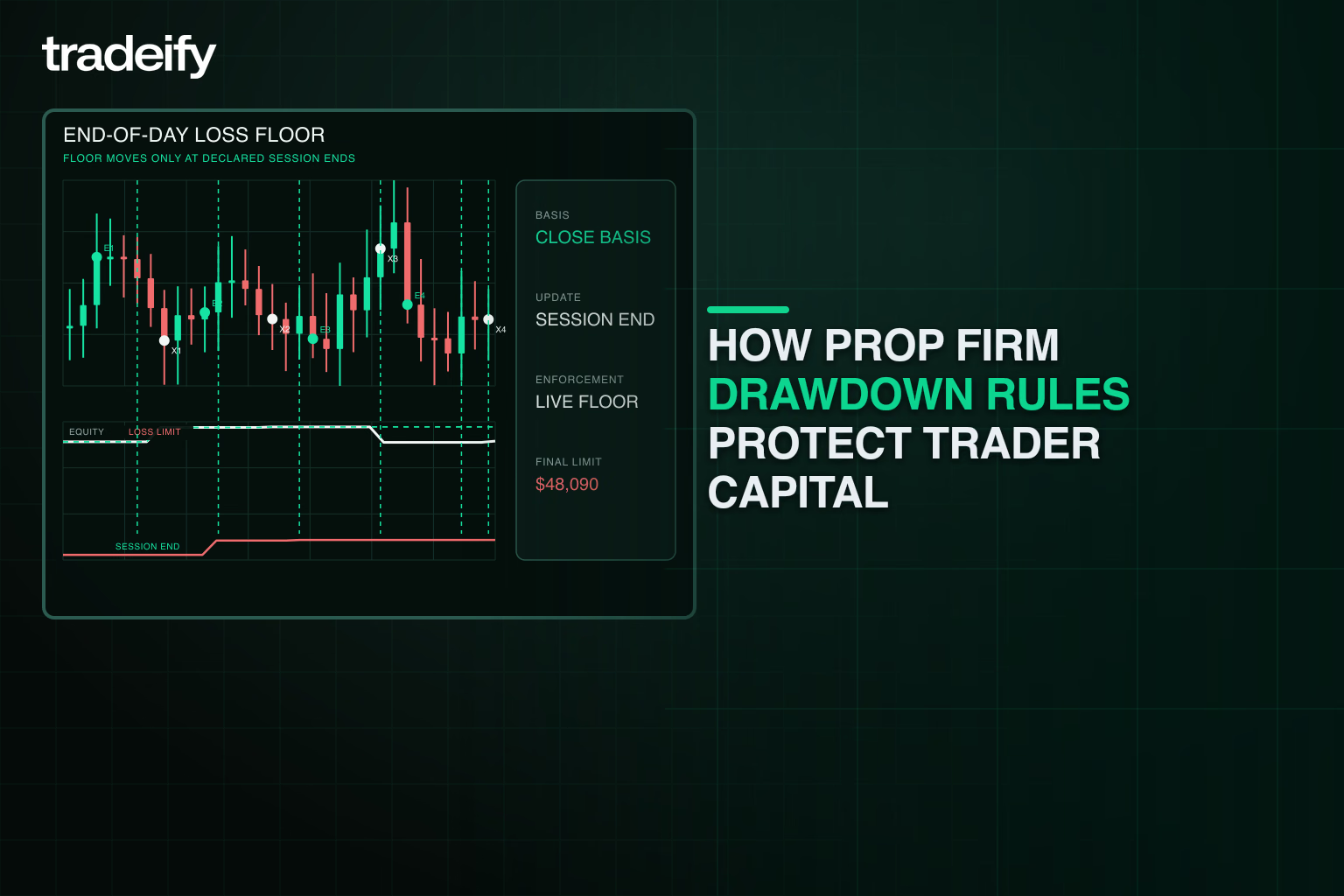
A critical part of payout rules is understanding how drawdowns are calculated, because hitting a drawdown limit fails the account and forfeits any pending payout. Tradeify is well regarded by retail traders because all of its current plans (Growth, Select, and Lightning) use an End-of-Day (EOD) trailing drawdown rather than an intraday trailing drawdown.
Intraday vs End-of-Day Drawdown Rules
In an intraday trailing drawdown model, the risk limit trails the highest unrealized tick of profit during an active trade. If a trade goes up by $1,000 but the trader closes it at breakeven, their drawdown floor still moves up by $1,000.
Tradeify's End-of-Day drawdown works differently in one important way: the floor only adjusts at market close (typically between 5:00 PM and 6:00 PM EST/EDT), and it only locks in gains when the day finishes profitable. That gives day traders more room than an intraday model, because the floor does not ratchet upward on every unrealized tick during the session, and there is no separate intraday loss cap on the Select and Flex paths.
What the End-of-Day label does not mean is that only the closing balance matters for a breach. The drawdown floor is enforced in real time. If your balance, including the unrealized profit and loss on an open position, reaches your current drawdown limit at any point during the day, the account fails immediately. The "End-of-Day" part governs how the limit trails and updates; it does not pause enforcement during the session. So a trader has room to manage normal intraday swings, but riding a position down into the floor and hoping to recover before the close will still fail the account.
How Drawdown Locking Rules Work
A trailing drawdown cannot trail forever. In Tradeify's system, the trailing drawdown locks and becomes a static minimum balance once the End-of-Day balance exceeds the starting capital plus the drawdown amount, plus $100.
For example, on a $50,000 Select account with a $2,000 drawdown:
- Starting balance $50,000. Drawdown floor $48,000.
- Trader closes the day at $51,500. New drawdown floor $49,500.
- Trader's End-of-Day balance reaches $52,100. The floor reaches its maximum limit of $50,100 (starting balance + $100) and locks. From this point forward, the drawdown floor never rises above $50,100, no matter how much profit the trader accumulates.
Prop Firm Evaluation Paths Growth vs Select
Traders buying a Tradeify evaluation first choose their evaluation vehicle. The choice between the Growth and Select evaluation plans directly affects the risk rules during the test and the payout policies available after passing.
Growth Evaluation Path for Traders
The Growth path is built for experienced, fast-paced traders who want funded capital as quickly as possible.
- Minimum days to pass. 1 day.
- Consistency rule. None during the evaluation.
- Daily Loss Limit (DLL). Yes. The Growth evaluation uses a soft-breach DLL (for example, $1,250 on a $50K account). If the trader hits this limit, trading is paused for the day, but the account is not failed.
- Payout policy choice. Fixed. Once funded, Growth traders follow the standard Growth payout rules.
Select Evaluation Path for Traders
The Select path is Tradeify's premier evaluation, built for traders who want maximum intraday flexibility and the power to choose their own payout rhythm once funded.
- Minimum days to pass. 3 days (enforced by the math of the consistency rule).
- Consistency rule. 40% during the evaluation.
- Daily Loss Limit (DLL). None. Traders can take large intraday drawdowns without a separate daily cap, as long as their balance stays above the trailing drawdown floor at every point in the day.
- Payout policy choice. After passing, Select traders make a permanent, irreversible choice between two funded payout models, Select Flex or Select Daily.
Funded Account Payout Choice Select Flex vs Select Daily
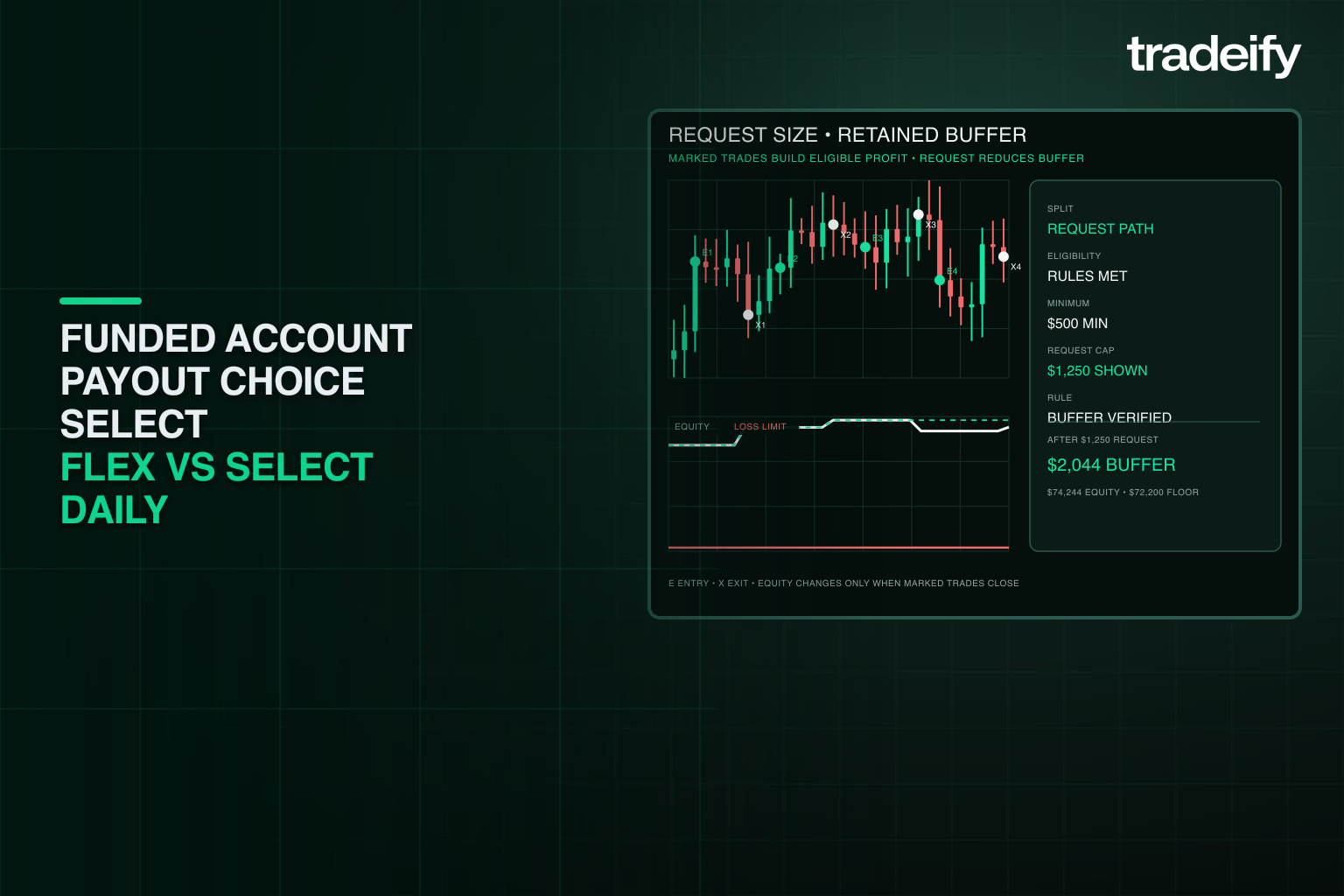
One of the most distinctive features of Tradeify's ecosystem is the post-evaluation fork for Select traders. The choice between Select Flex and Select Daily sets the frequency, size, and rules of all future payouts. The wrong choice can work against a trader's strategy, while the right choice optimizes cash flow.
Select Flex Payout Rules
Select Flex is favored by swing traders, momentum traders, and anyone who prioritizes account longevity and large, infrequent payouts.
- Payout frequency. Payouts can be requested after 5 winning trading days. A winning day is any day that clears the minimum profit threshold for the account size: $100 for 25K, $150 for 50K, $200 for 100K, and $250 for 150K.
- Daily loss limit. None. Flex funded accounts have no hard or soft daily loss limit, which gives traders room to hold through intraday volatility.
- Buffer requirement. None. Unlike most prop firm accounts, there is no minimum balance requirement before a payout. Once a trader has 5 winning days and is in profit, they can withdraw regardless of account balance.
- Payout caps. Withdrawals are capped at 50% of the total profit generated above the starting balance. The raw dollar caps per cycle are large, with $1,250 for 25K, $3,000 for 50K, $4,000 for 100K, and $5,000 for 150K accounts.
- Consistency rule. None.
Select Daily Payout Rules
Select Daily is built for high-frequency scalpers and algorithmic traders who want to treat their prop firm account like a daily income stream.
- Payout frequency. Eligibility occurs every single day, as long as the account is above the required buffer.
- Daily loss limit. Active. The Daily plan enforces a soft DLL ($1,000 for 50K, $1,250 for 100K, $1,750 for 150K) to control intraday risk.
- Buffer requirement. Required. Before any payout, the trader must build a static profit buffer above the starting balance ($2,100 for 50K, $2,600 for 100K, $3,600 for 150K).
- Payout caps. Withdrawals are smaller but more frequent. A trader can withdraw up to 2x their current cycle profit, capped at $1,000 per day for 50K, $1,500 for 100K, and $2,500 for 150K. The minimum payout request is $250.
- Consistency rule. None.
The universal continuity rule. Whether a trader picks Flex or Daily, Tradeify enforces a positive net profit rule for all payouts after the first. A trader must be net positive during the current payout cycle to request a withdrawal. If a trader takes losses after a payout, they cannot simply withdraw leftover capital. They must trade back to a net positive state for that specific cycle.
Select Flex vs Select Daily Payout Comparison
| Feature | Select Flex | Select Daily |
| Ideal trader profile | Swing / Momentum | Scalper / High-Frequency |
| Payout frequency | Every 5 winning days | Daily (once buffer met) |
| Buffer requirement | None | Required (e.g., $2,100 for 50K) |
| Daily loss limit | None | Yes (e.g., $1,000 for 50K) |
| Max payout (50K account) | $3,000 per cycle (50% of profit) | $1,000 per day |
| Funded consistency rule | None | None |
Growth and Lightning Payout Rules
For traders who do not choose the Select evaluation, Tradeify offers standard payout rules through the Growth Funded and Lightning Funded accounts.
Growth Funded Payout Rules
Once a trader passes the 1-day Growth evaluation, they enter the Growth Sim Funded stage. The payout rules here are traditional and milestone-based:
- Buffer zones. Traders must build a profit buffer. For a $50K account, the minimum balance to request a payout is $53,000 (a $3,000 profit buffer).
- Consistency rule. A 35% consistency rule applies to the total profit generated.
- Minimum profitable days. To qualify for a payout, the trader must execute at least 5 profitable trading days. A profitable day is any day with net profit greater than $150 for a 50K account, $200 for 100K, and $250 for 150K. The count resets to zero after every successful payout.
- Payout tiers. The amount a trader can withdraw scales up. The maximum payout per request is initially capped (for example, $1,500 on the first payout for a 50K account) and scales up to higher amounts by later payouts.
Lightning Funded Payout Rules
The Lightning account lets traders bypass the evaluation phase and immediately begin trading simulated funded capital through a one-time purchase. Because there is no evaluation to prove the trader's skills, the payout rules are stricter to protect the firm's capital.
- Payout cadence. Lightning Funded accounts are eligible for payouts on a 5-day cadence, not daily. On top of that timing, a trader must hit the cycle's profit goal and satisfy the consistency rule before a payout can be requested.
- Payout profit goals. Instead of profitable-day counts, traders must hit specific dollar goals. For a $50K account, the first payout requires generating $3,000 in new profit, and the second payout and beyond require $2,000 in fresh profit. Leftover profit from a previous cycle does not carry over.
- Consistency rule. This is the tightest parameter. The consistency rule starts at 20% for the first payout, loosens to 25% for the second, and settles at 30% for all later payouts (for accounts purchased after September 12, 2025).
- Minimum payout. The absolute minimum a trader can withdraw from a Lightning account is $1,000.
Prop Firm Payout Methods and Timelines

How fast a payout reaches your bank depends heavily on the payment rail the firm uses. Most modern prop firms route payments through specialized processors rather than traditional banking alone, because those processors settle far faster than standard ACH or wire transfers.
| Method | Type | Typical speed | Notes |
| Rise | Payout processor | Minutes to hours | Common in prop trading, supports many countries |
| Plane | Payout processor | Minutes to hours | Built for global contractor payouts |
| Deel | Payout / contractor platform | Same day to a few days | Often used for international traders |
| Wise / bank transfer | Bank rail | 1 to 3 business days | Lower fees on cross-border than legacy wires |
| ACH / wire | Bank rail | 1 to 5 business days | Domestic ACH is cheap; international wires can carry fees |
| PayPal | Digital wallet | Minutes to a day | Convenient, but watch for receiving fees |
| Crypto (USDT / USDC) | Stablecoin transfer | Minutes | Fastest option, available around the clock |
Domestic payments generally clear faster and cheaper than international ones, where intermediary banks and currency conversion add time and cost. Crypto stablecoins are usually the quickest route and are not bound by banking hours, which is why many firms promote them. The trade-off is conversion risk. Moving between fiat and stablecoins, and later cashing out, can introduce exchange-rate spreads and network fees. Always confirm whether the firm or the processor charges a fee per withdrawal, since a small flat fee matters more on frequent, smaller payouts than on large infrequent ones.
Tradeify uses platforms like Rise and Plane to handle distributions, which is how it can advertise fast turnaround on approved requests.
How Daily Prop Firm Payouts Really Work
Daily payouts are one of the most heavily marketed features in prop trading, and also one of the most misunderstood. A true daily payout means you can request a withdrawal on any trading day, not that money lands in your account every single day automatically.
Several conditions usually sit between a trader and a genuine daily withdrawal:
- Minimum payout thresholds. Many daily plans set a floor (for example, a $250 minimum on Tradeify's Select Daily) so traders cannot request tiny amounts repeatedly.
- Same-day approval versus settlement. A firm may approve a request the same day, but the money still has to settle through the chosen payment rail. Crypto can land in minutes, while a bank transfer can still take days even if approval was instant.
- Buffer requirements. Most daily plans require a profit buffer above the starting balance before any payout is allowed, so daily access does not begin on day one.
- Hidden barriers. Marketing rarely highlights the supporting rules. Some firms attach minimum trading days, consistency rules, or net-positive-cycle requirements that quietly limit how often a daily payout can actually happen.
The cash-flow benefit of a real daily plan is significant for full-time scalpers who want to treat trading like income. The key is to read the fine print and separate "eligible to request daily" from "paid daily without conditions."
Withdrawal Process and Payout Timelines
When a trader has cleared the profit goals, consistency rules, and drawdowns, they are ready to request a payout. Tradeify is known for efficient payout logistics that emphasize speed and reliability.
Prop Firm Payout Windows
For Sim Funded accounts (Growth, Select, and Lightning), payout requests can be submitted directly from the Tradeify dashboard once all eligibility criteria are met (consistency rule, profit goal, and minimum profitable trading days where applicable). One timing detail matters: requests can only be submitted after the end-of-day process runs. So if you hit the profits that make you eligible during today's session, you can request the payout later that same day, after 6:00 PM EST. There are no fixed monthly submission windows, and eligibility timing varies by plan.
Select Daily funded traders can request daily payouts once their balance exceeds the buffer amount. Select Flex and Growth Funded traders submit a request whenever they have completed the required winning or profitable days for the cycle and met the minimum balance requirement. Lightning Funded traders are eligible for payouts on a 5-day cadence, once the consistency rule and profit objective for the cycle are met.
Payout Processing Times
In the broader financial system, payment settlement can take 1 to 5 business days for standard ACH or international wire transfers. Modern prop firms rely on specialized processors instead. Tradeify uses platforms like Rise and Plane to handle distributions.
Once a payout request is submitted, it goes through a compliance review to verify that consistency rules and EOD drawdowns were respected. On approval, the funds are deducted from the trader's simulated account. Tradeify's published policy is that approved requests are typically paid within 24 hours during business hours. Requests submitted outside normal business hours (Monday toFriday, 8:00 AM to 5:00 PM EST) or on federal holidays may take up to 72 hours.
Fast settlement is a major advantage for retail day traders. It provides immediate liquidity and reinforces the psychological reward of disciplined trading.
Payout Request Finality and Independent Accounts
Two final administrative rules govern Tradeify payouts:
- Request finality. Once a trader clicks submit on a payout request, the action is final. The request cannot be edited, modified, or canceled.
- Independent accounts. Tradeify allows users to hold up to 5 simultaneous funded accounts totaling up to $1,000,000 in capital. For payout purposes, each account is a completely independent entity. A trader must independently satisfy the trading days, buffer requirements, and consistency rules for each account to withdraw from it.
How Scaling Plans Affect Prop Firm Payout Size
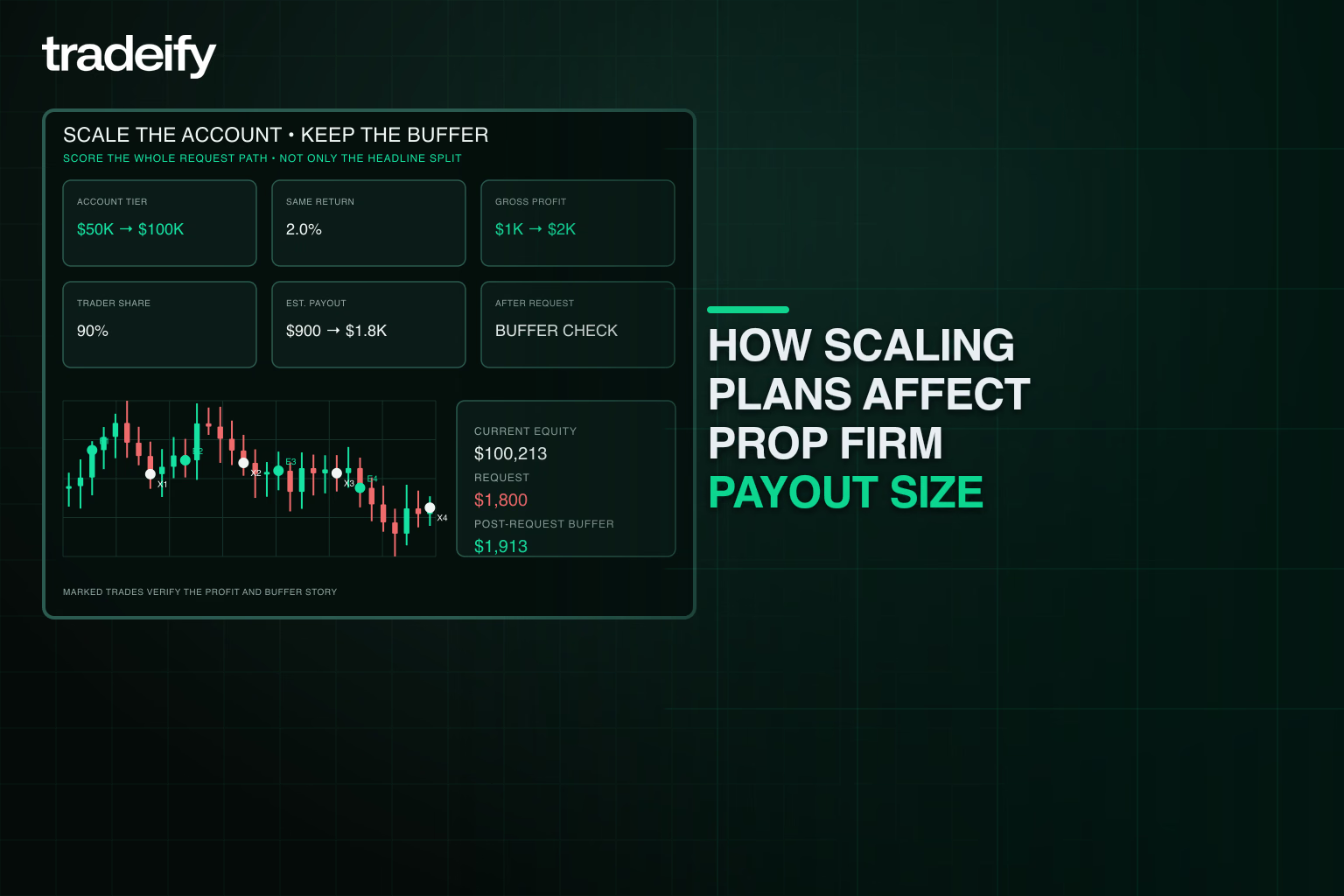
Payout potential is not fixed. As account size grows, the dollar value behind every percentage point of profit grows with it, which directly raises how much a trader can withdraw per cycle.
Three factors drive larger payouts over time:
- Bigger account sizes. A 150K account produces larger raw profit on the same percentage move than a 50K account, and its payout caps are set higher to match (for example, Select Daily caps of $1,000 for 50K, $1,500 for 100K, and $2,500 for 150K).
- Scaling plans. Some firms increase buying power or account size as a trader hits profit and consistency milestones. Each step up raises the ceiling on future withdrawals.
- Bonus and progression tiers. Programs that reward consistent performance, such as a path toward a live capital stage, can change the split or the cap in the trader's favor. With Tradeify, reaching the Elite Live stage moves a trader onto a live CME account where all funds are treated as profit.
The practical takeaway is that the fastest way to grow payouts is rarely a single large win. It is compounding consistent results, clearing the milestones that open up larger accounts, and letting the higher caps that come with size do the heavy lifting.
Common Mistakes That Block Prop Firm Payouts
Most rejected payouts trace back to a small set of avoidable errors. Knowing them in advance protects both the payout and the account.
- Revenge trading. Chasing losses with oversized positions after a bad trade is the fastest way to breach a drawdown limit and forfeit a pending payout.
- Overtrading. Excessive trading inflates a single day's results and can trip the consistency rule, pausing eligibility even when the account is profitable.
- Poor position sizing. Risking too much per trade pushes the account toward the drawdown floor and leaves no room to recover within the cycle.
- Holding through restricted news. Some firms restrict trading around high-impact news. Holding a position through a restricted window can void results or breach the account.
- Breaching drawdown. Dropping to the EOD floor at any point fails the account outright, which cancels any unrequested profit.
- Misunderstanding payout cycles. Forgetting that counters reset after a payout, or that the current cycle must be net positive, leads to requests that get rejected.
- Requesting before requirements are satisfied. Submitting a request before completing KYC, closing open trades, or meeting the minimum profitable days is one of the most common reasons a payout stalls.
Prop Firm Payout Red Flags and Legitimacy Checks

Not every firm honors its payout promises. Before committing capital to an evaluation, run a few legitimacy checks and watch for warning signs.
- Unclear or shifting rules. Payout terms that are vague, hard to find, or change without notice make it difficult to ever satisfy them. Reputable firms publish detailed, stable rules.
- Delayed payout excuses. A pattern of moving goalposts, repeated verification requests, or sudden new conditions at withdrawal time is a serious warning sign.
- Hidden deductions. Fees or split changes that only appear at payout, and were never disclosed up front, suggest a firm engineering reasons not to pay in full.
- Weak community sentiment. Low or falling Trustpilot scores, and consistent complaints across trading communities about getting paid, are worth taking seriously.
- No payout proof. Established firms can point to verifiable payout records. A complete absence of public proof of payouts is a gap worth questioning.
- Overly generous claims. Profit splits or guarantees that sit far outside normal industry ranges can signal a model that is not sustainable, which puts future payouts at risk.
- Weak firm stability. A firm with no track record, no clear ownership, or signs of financial trouble may not be around to honor payouts over the long term.
The strongest signal is simple. A firm that pays consistently, documents it, and keeps its rules clear and unchanged is far more likely to pay you.
Prop Firm Payout Rules Compared Across the Industry
Payout rules vary widely between firms. The table below shows typical ranges across the industry so you can judge where any single firm sits relative to the norm.
| Payout factor | Typical industry range | What it means for you |
| Profit split | 50% to 95% | Higher is better for the trader; 80% to 90% is competitive |
| Consistency rule | 20% to 50% (some none) | Lower percentages demand more trading days to qualify |
| Minimum trading days | 0 to 15 | Zero means faster access; higher counts force steadier results |
| Minimum payout | $50 to $1,500 | Lower minimums suit smaller, more frequent withdrawals |
| Payout frequency | Daily to monthly | Daily and weekly options improve cash flow for active traders |
| Processing time | 1 hour to 5 business days | Faster processors and crypto sit at the low end of this range |
Read any firm's rules against these ranges. A 90/10 split with no funded consistency rule and fast processing, for example, sits at the favorable end of several columns at once.
Building a Sustainable Career as a Funded Trader
For the aspiring day trader, buying a Tradeify evaluation is a low-barrier entry into institutional-level capital. Treating a prop firm account like a personal retail brokerage account, though, is a recipe for failure. The payout rules (from the 40% consistency cap in the Select evaluation to the 5-day cycle of the Flex policy) are expressly designed to push newer traders into professional risk management habits.
By understanding how the End-of-Day drawdown provides intraday room while still being enforced in real time, how to calculate and respect consistency limits, and by choosing carefully between the high-freedom Select Flex plan and the high-frequency Select Daily plan, a day trader can optimize their path to profitability. The goal is not just to secure a 90% profit split on a simulated account. It is to prove enough methodical consistency to be invited into the Elite Live program, where scalable career trading begins.
Frequently Asked Questions About Prop Firm Payouts
How do payouts work on prop firms?
A prop firm pays you a share of the profit you generate on a funded account. Once you meet the plan's requirements (profit goal, minimum days, consistency rule, and any safety buffer), you request a withdrawal in your dashboard, complete identity verification, and the firm pays your agreed split through its payment processor.After each payout is approved, the cycle resets.
How long does it take to get paid?
It depends on the firm and the payment method. Many modern firms approve requests quickly and process payments fast, with Tradeify typically paying approved business-hours requests within 24 hours. Crypto can settle in minutes, while bank transfers and international wires can take 1 to 5 business days.
What happens if one big day exceeds the consistency rule?
You are not failed. You simply do not meet payout eligibility yet, so you cannot request a withdrawal until you add more profit on later days, which dilutes the percentage of your best day until it falls back under the limit. For example, a $1,500 day under a 40% rule sets a new required total profit target of $3,750 ($1,500 / 0.40) before you can withdraw.
Do prop firms actually pay out?
Reputable firms do, and they document it. The best signal of a trustworthy firm is a record of consistent, verifiable payouts, clear and stable rules, and strong community sentiment. Tradeify, for example, has paid out over $200 million to funded traders. Vague terms, hidden deductions, delayed-payout excuses, and no public proof of payouts are the main red flags to avoid before funding an account.
.svg)
.svg)
.svg)
.svg)

.webp)