.svg)

.svg)
.svg)

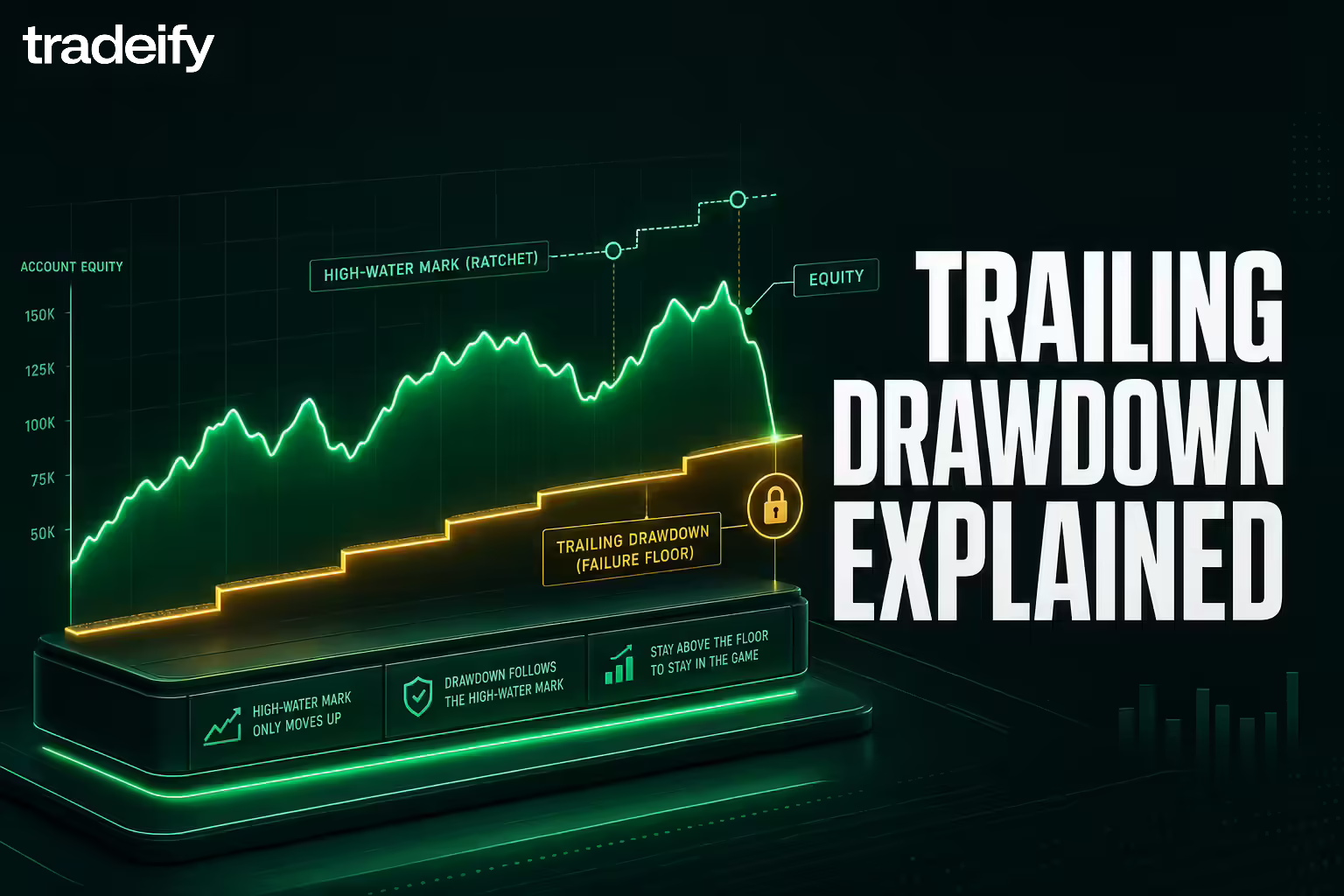


Table of Contents
- Why Trailing Drawdown Rules Matter
- Why Trailing Drawdown Mechanics Matter
- How This Trailing Drawdown Guide Works
- How Prop Firm Drawdown Rules Evolved
- What Drawdown Means Before It Trails
- How Trailing Drawdown Works in Prop Firms
- How Intraday Trailing Drawdown Works
- How EOD Trailing Drawdown Works
- Important Caveat: While the trailing mechanism only adjusts at the end of the day, the hard failure limit is still monitored in real time. If your failure floor is set at $48,000, and your live equity drops to $47,999 during the middle of the trading day, your account will be immediately liquidated. EOD mechanics dictate when the floor moves up, but dipping below the current floor remains an instant, real-time violation.
- What Actually Fails a Trailing Drawdown Account
- How Different Trailing Drawdown Models Behave
- Why Prop Firms Use Trailing Drawdown Rules
- How Tradeify Applies EOD Trailing Drawdown
- Tradeify Account Types and Trailing Drawdown Rules
- How the Trailing Drawdown Lock Works
TL;DR: Trailing drawdown is the moving failure line prop firms use to decide when an account is liquidated. The core formula is simple: trailing drawdown floor = high-water mark minus drawdown amount. Firms may also call it a trailing threshold, trailing max drawdown, max loss limit, or dynamic drawdown. EOD trailing drawdown is generally balance-based and recalculates from realized closing balance, while intraday trailing drawdown is generally equity-based and can move tick-by-tick with unrealized profit. Tradeify uses EOD trailing drawdown across Growth, Select, and Lightning plans, locks the floor once it reaches starting balance + $100, charges $0 activation fees, and pays traders 90% of profits from their very first payout.
Why Trailing Drawdown Rules Matter
For an amateur day trader stepping into the world of futures proprietary (prop) trading firms, the industry can offer real opportunity — but the rules can be unforgiving. Firms like Tradeify offer access to substantial institutional capital, allowing traders to keep the lion's share of their profits without risking their own funds. However, this capital is protected by programmatic risk management parameters. A common cause of failure among new traders is not the trading setup itself, but a misunderstanding of the automated risk guardrails that govern the account.
Why Trailing Drawdown Mechanics Matter
At the heart of these risk parameters lies the "drawdown" — the maximum permissible loss an account can suffer before it is automatically terminated. Prop firms typically do not use static loss limits; instead, they employ dynamic, trailing limits that follow your account's success. The precise mechanics of how and when this limit trails — whether it tracks your highest unrealized profit mid-trade, or your closed balance at the end of the session — will dictate your entire trading style. For many newer traders, End-of-Day (EOD) drawdowns are easier to manage because they give trades more room to move during the session.
How This Trailing Drawdown Guide Works
This guide explains trailing drawdown mechanics first, then uses Tradeify's Growth, Select, and Lightning accounts as a worked example of how EOD trailing drawdown rules apply in practice.
How Prop Firm Drawdown Rules Evolved
Retail day trading has changed significantly in the last decade. Historically, day trading the futures market (such as the S&P 500 E-mini (ES) or the Nasdaq 100 E-mini (NQ)) required substantial personal capital. Futures brokers demand significant margin requirements, and enduring the natural volatility of these markets requires a deep pocketbook. For the amateur trader, funding a $50,000 or $100,000 account out of pocket was a major barrier to entry.
Retail proprietary trading firms changed the access model. Prop firms offer a simple business model: the firm provides the capital, and the trader provides the skill. If the trader makes money, the profits are split — often generously in favor of the trader. If the trader loses money, the firm absorbs the financial loss.
However, to protect themselves from reckless trading and catastrophic losses, prop firms require traders to pass an evaluation phase (often called a "combine" or "challenge"). During this evaluation, traders trade simulated funds in live market conditions. They must prove they can reach a specific profit target while strictly adhering to rigorous risk management rules.
Of all the rules imposed during these evaluations, few are more important to understand than trailing drawdown. Prop firm drawdown rules dictate the maximum allowable losses a trader can incur before their funded trading account is terminated. For the amateur trader considering a firm like Tradeify, mastering the mechanics of the trailing drawdown is the first and most vital step toward securing a funded account.
What Drawdown Means Before It Trails
Before dissecting the complex trailing mechanics used by prop firms, we must establish a foundational understanding of what a drawdown is in traditional finance.
In broad terms, a drawdown is defined as the drop in your account balance from its highest point before it recovers. It represents the decline in an investment or trading account from its historical peak to its lowest trough over a specific period.
If your account starts at $100,000, grows to a peak of $150,000, and subsequently declines to $60,000 due to a series of losing trades, the drawdown is measured from the $150,000 peak down to the $60,000 trough.
There are generally three ways to express this decline:
- Absolute Drawdown: The loss compared to the initial starting capital. (Initial $100,000 - Lowest $60,000 = $40,000).
- Maximum Drawdown: The absolute largest drop from a peak to a trough. (Peak $150,000 - Lowest $60,000 = $90,000).
- Relative Drawdown: The percentage drop from the peak. ($90,000 / $150,000 = 60%).
How Drawdown Differs From a Trading Loss
It is crucial for amateur traders to mentally separate a "trading loss" from a "drawdown." A trading loss reflects the negative outcome of a single, isolated trade. A drawdown, conversely, measures the cumulative decline from the highest watermark your account has ever achieved.
This distinction becomes paramount when dealing with recovery mathematics. If an account suffers a 10% drawdown, it requires an 11.1% gain to recover to the previous peak. If it suffers a 50% drawdown, it requires a 100% gain just to break even. Prop firms understand this mathematics intimately, which is why they implement strict, automated drawdown rules that fail an account long before it reaches a point of mathematical no-return.
How Trailing Drawdown Works in Prop Firms
When you purchase an evaluation from a futures prop firm, you are typically given a starting balance (e.g., $50,000), a profit target (e.g., $3,000), and a maximum drawdown limit (e.g., $2,000).
If the firm used a Static Drawdown, your maximum loss limit would be calculated exclusively from your initial account balance and would remain constant. In a $50,000 account with a $2,000 static drawdown, your failure point would be fixed at $48,000 forever. If you made $5,000 in profit bringing your balance to $55,000, your failure point would still be $48,000, giving you a large $7,000 buffer.
While static drawdowns are highly preferred by traders, they expose the prop firm to meaningful risk. If a trader builds a large buffer and then begins trading recklessly, the firm could lose thousands of dollars of unrealized gains. To counter this, almost all modern futures prop firms utilize a Trailing Drawdown.
A trailing drawdown is a dynamic, moving loss limit designed to protect profits as your account grows. As your account equity reaches new high-water marks, the minimum allowable balance (the failure floor) moves upward alongside it. Crucially, the trailing drawdown acts like a ratchet: it only moves up when you make money; it never moves down when you lose money.
The industry divides the trailing drawdown into two vastly different operational mechanics: Intraday Trailing Drawdown and End-of-Day (EOD) Trailing Drawdown. Understanding the difference between these two is the single most important concept an amateur day trader must grasp.
How Intraday Trailing Drawdown Works
An Intraday Trailing Drawdown is a programmatic rule where your maximum loss limit trails your highest unrealized profit of the day in real time.
Under this model, the proprietary firm's software monitors your account equity tick-by-tick while you have open trades. Every time your open position reaches a new high — even if you haven't closed the trade — your failure floor is dragged upward.
An Intraday Trailing Drawdown Walkthrough
Consider a practical scenario that shows why this rule is difficult for many amateur day traders to manage.
Imagine you purchase a $50,000 evaluation account from a firm utilizing an Intraday Trailing Drawdown. Your drawdown limit is $2,000. Therefore, your initial failure floor is $48,000.
- Starting Balance: $50,000
- Trailing Drawdown Limit: $2,000
- Failure Floor: $48,000
You enter a long position on the Nasdaq (NQ). The market immediately rallies in your favor. Your open, floating profit reaches +$1,500.
- Current Unrealized Equity: $51,500
- Because the rule tracks unrealized equity in real time, your new failure floor is immediately recalculated: $51,500 - $2,000 = $49,500.
- New Failure Floor: $49,500.
Suddenly, macroeconomic news drops, and the market reverses violently. You decide to exit the trade at exactly your entry price, securing a $0 profit (a "breakeven" trade).
- Closed Balance: $50,000.
- Failure Floor: $49,500.
The Result: You closed a trade for zero profit and zero loss. Yet, because of the Intraday Trailing Drawdown, your failure floor permanently moved up by $1,500. You started the day with a $2,000 buffer. You now only have a $500 buffer remaining before your account is terminated.
Why Intraday Trailing Drawdown Is Hard to Manage
With Intraday Trailing Drawdown, a prop firm can fail an account even when a trade is in profit or ends at breakeven. If your unrealized profit spikes, drags your floor up, and then the market pulls back deeply enough to hit that new floor, your account is immediately liquidated and permanently closed.
This rule leaves little room for normal market volatility. It heavily penalizes swing trading, trend-following strategies, and the use of wide stops. Intraday trailing demands that traders take profits near the peak of a move, which is difficult to do consistently. It can also change a trader's psychology by encouraging premature profit-taking because unrealized gains can shrink the remaining drawdown buffer.
How EOD Trailing Drawdown Works
Some prop firms, including Tradeify, use End-of-Day (EOD) trailing drawdown instead of intraday trailing drawdown.
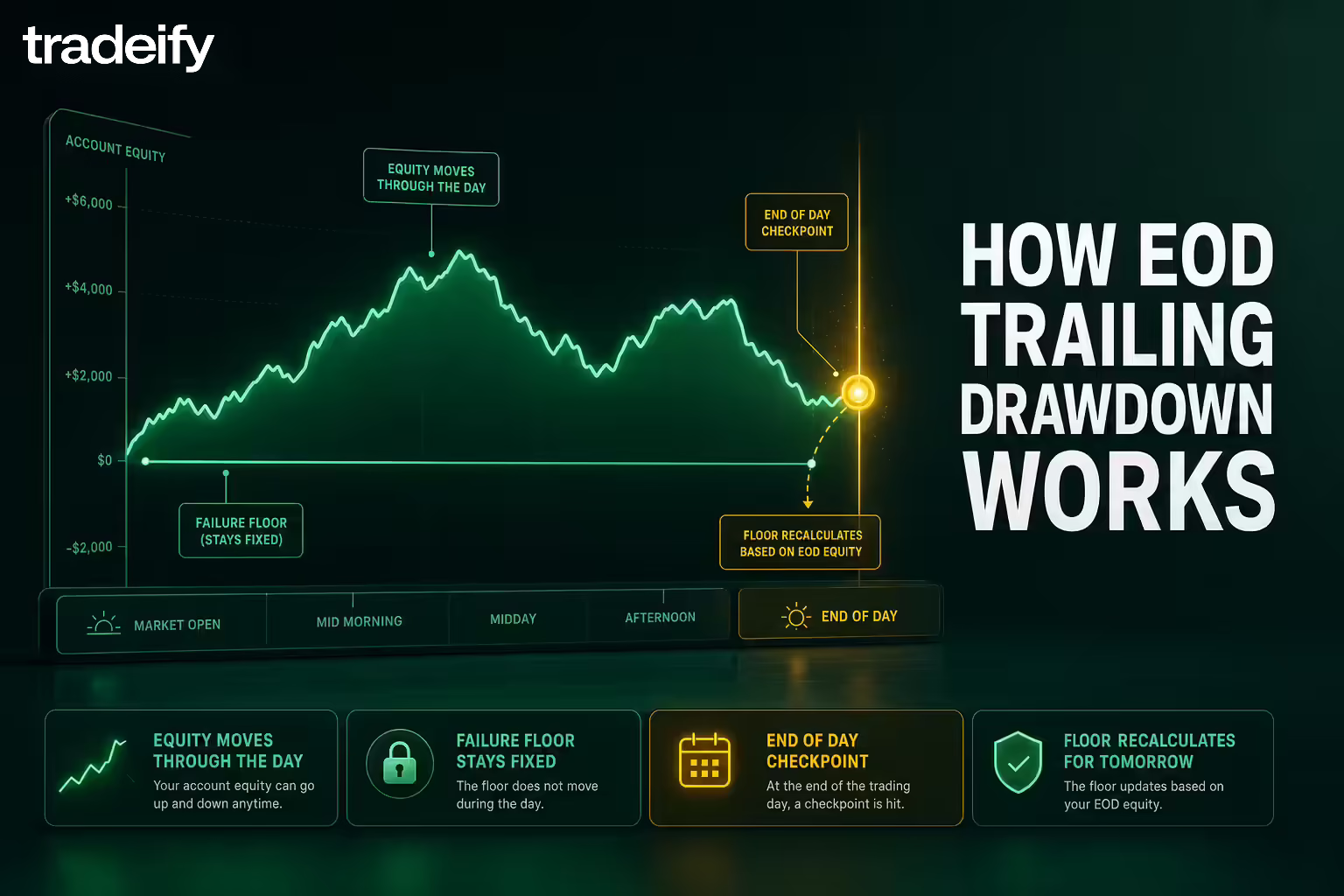
End-of-Day trailing drawdown is calculated from your account balance after the trading session officially closes (typically at 4:00 PM or 5:00 PM EST depending on the clearing house), not during the day.
Under an EOD drawdown, the evaluation software ignores unrealized, mid-trade equity peaks for purposes of moving the floor. It looks at the finalized, realized profit you have locked in when the market closes.
An End-of-Day Trailing Drawdown Walkthrough
Let us replay the exact same trading scenario, but this time under Tradeify's EOD Trailing Drawdown mechanics.
You have a $50,000 account with a $2,000 EOD Trailing Drawdown.
- Starting Balance: $50,000
- Trailing Drawdown Limit: $2,000
- Failure Floor: $48,000
You enter a long position on the NQ. Your open, floating profit reaches +$1,500. The market reverses, and you exit the trade at breakeven ($0 profit).
Because the EOD rule ignores intraday, unrealized peaks, your failure floor does not move during the trade.
At the end of the day, the market closes. The software checks your final realized balance. Your balance is $50,000.
Because your balance did not increase from the previous day's close, the failure floor remains static.
- New Failure Floor: $48,000.
The Result: You closed a trade at breakeven. You still possess your full, original $2,000 buffer. You survived the day, preserved your capital, and retained your full operational flexibility for the next trading session.
Why EOD Trailing Drawdown Gives More Room
EOD drawdown is often easier for swing-style and trend-following traders to manage than intraday trailing drawdown. It lets the account absorb normal intraday movement without raising the floor from unrealized peaks.
End-of-Day (EOD) drawdown typically gives a trader more room to manage volatility inside the trading day. It can also reduce the pressure to exit only because an unrealized profit briefly reached a high.
Important Caveat: While the trailing mechanism only adjusts at the end of the day, the hard failure limit is still monitored in real time. If your failure floor is set at $48,000, and your live equity drops to $47,999 during the middle of the trading day, your account will be immediately liquidated. EOD mechanics dictate when the floor moves up, but dipping below the current floor remains an instant, real-time violation.
What Actually Fails a Trailing Drawdown Account
Traders often blur two different events. A trailing drawdown breach is the serious one: the moment live equity touches the current failure floor, the account is terminated permanently.
A daily loss limit, on firms that use one, is usually a softer guardrail. Hitting it typically pauses or restricts trading for the rest of that session rather than ending the account outright.
EOD trailing drawdown only changes when the floor recalculates at session close. The current floor is still enforced in real time for the entire session, so traders should confirm their current liquidation threshold before placing trades.
How Different Trailing Drawdown Models Behave
| Drawdown Model | When the Floor Updates | Does Unrealized P&L Move the Floor? | Balance- or Equity-Based | Best-Fit Trader Profile | Main Risk |
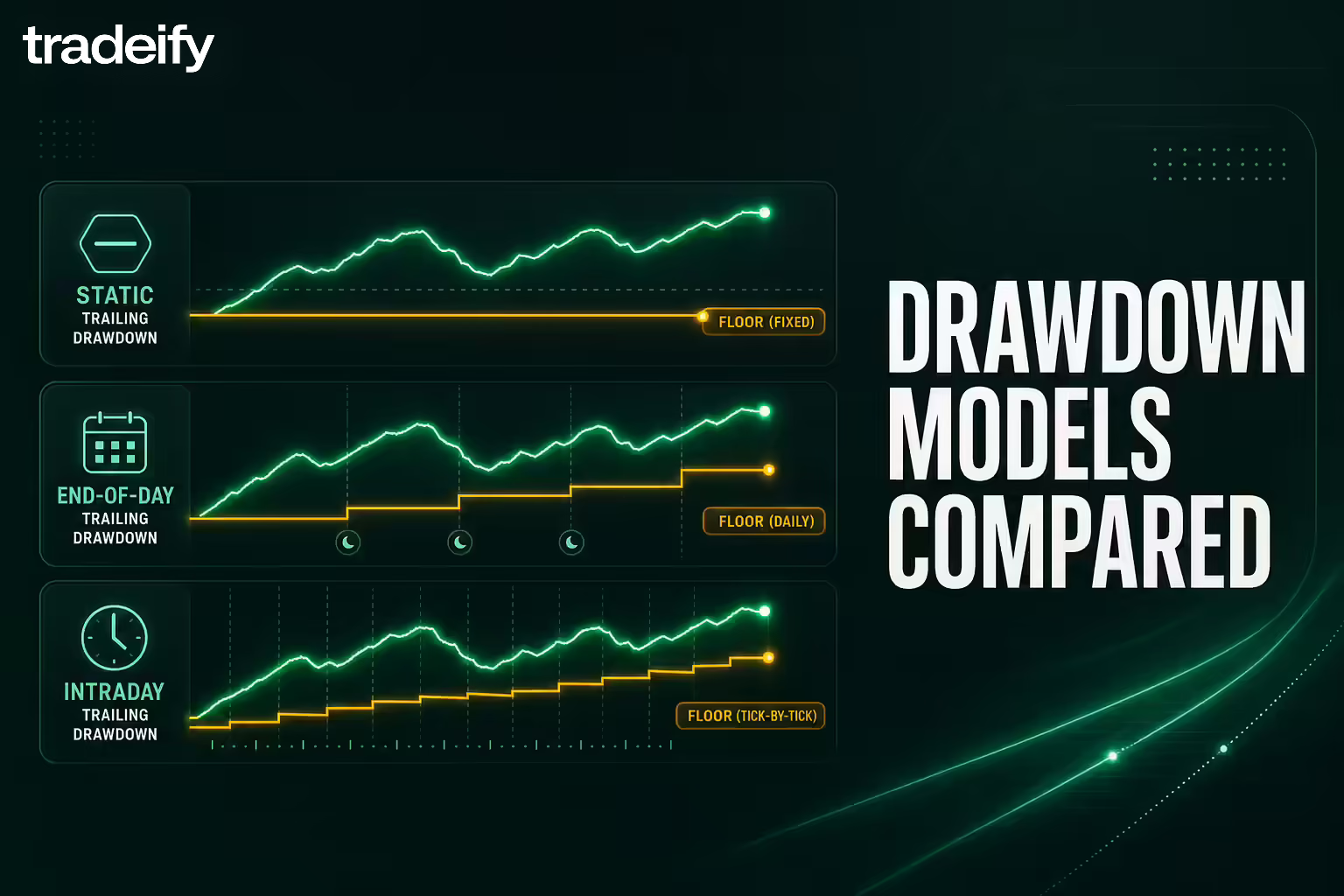
| Static | Never; fixed at starting balance minus the drawdown amount | No | Balance-based | Beginners who want one fixed, predictable failure point | Rarely offered, because it forces the firm to give back unrealized gains |
| End-of-Day trailing | Once per day, at session close, from your realized closing balance | No; intraday equity peaks are ignored | Balance-based | Swing and trend traders who hold through pullbacks with wider stops | Assuming you can lose unlimited amounts intraday, when the hard floor is still enforced in real time |
| Intraday trailing | Continuously, tick-by-tick, off your highest floating equity | Yes; every new unrealized high drags the floor up | Equity-based | Disciplined scalpers who bank profit quickly | A breakeven or winning trade can still raise the floor and liquidate you on the pullback |
Why Prop Firms Use Trailing Drawdown Rules
To the amateur trader, trailing drawdowns can feel like a trap. From the perspective of institutional risk management, they are a core risk control.
When a trader transitions from an evaluation to a Live Funded account, the prop firm is putting its actual, real-world capital on the line. If a trader with a $150,000 account decides to act recklessly, they could easily lose tens of thousands of dollars in a matter of minutes trading highly leveraged futures contracts.
Drawdown rules exist to enforce strict risk management and discipline. They act as an automated circuit breaker. By utilizing a trailing mechanism, firms ensure that as a trader generates profits, those profits act as a cushion protecting the firm's initial principal capital.
Furthermore, prop firms are aware that amateur traders are highly susceptible to "lottery trading" — the practice of leveraging an account to the absolute maximum in hopes of securing one large, lucky win. Trailing drawdowns, specifically when combined with "Consistency Rules" (which we will explore later), force traders to adopt a steady, repeatable, and disciplined strategy.
For a firm, the rule protects downside risk. For the trader, the calculation method determines how much room the strategy has to work. Tradeify's EOD model is one example of a balance-based approach.
How Tradeify Applies EOD Trailing Drawdown
Tradeify is a U.S.-based futures prop firm. For this article, its main relevance is that it uses EOD trailing drawdown across its account types, which makes it a useful worked example for balance-based drawdown mechanics.
For traders comparing drawdown rules, the relevant Tradeify mechanics are:
- End-of-Day (EOD) Trailing Drawdown: Tradeify uses EOD trailing drawdown across its evaluation plans.
- Zero Activation Fees: Many prop firms charge a low initial evaluation fee, then add a $130–$160 activation fee or data fee once the trader passes. Tradeify charges $0 activation fees across all its plans to move to a Sim Funded account.
- Profit Split: Once funded, traders keep 90% of their profits from their very first payout. This applies across Growth, Select, and Lightning Sim Funded accounts.
- Drawdown Lock Mechanism: Once a trader builds enough profit buffer, the trailing drawdown locks in place and stops ratcheting higher.
Tradeify Account Types and Trailing Drawdown Rules
Tradeify offers three main pathways with different rules and tradeoffs: the Growth Evaluation, the Select Evaluation, and the Lightning Funded (Direct to Sim) account.
All three account types share capital tier options of $25,000, $50,000, $100,000, and $150,000. All three utilize the End-of-Day Trailing Drawdown. However, their auxiliary rules — specifically Daily Loss Limits, Consistency Rules, and Payout Structures — differ significantly.
Tradeify Select Evaluation Drawdown Rules
The Select Evaluation is the Tradeify structure most focused on intraday flexibility and customizable payout options.
Key Features of the Select Evaluation:
- No Daily Loss Limit: During the evaluation phase, there is no Daily Loss Limit. Traders can absorb intraday swings as long as live equity does not breach the current EOD trailing drawdown floor.
- Drawdown: End-of-Day (EOD) Trailing Drawdown.
- Pass Speed: Minimum of 3 trading days required to pass.
- Consistency Rule (Evaluation): 40% consistency rule. No single trading day can represent more than 40% of your total evaluation profit. This prevents traders from passing purely through one lucky "home run" trade.
- No Consistency Rule in Funded Mode: Once you pass and move to a Select funded account, the 40% consistency rule is removed entirely, regardless of which payout policy you choose.
- Payout Customization: Upon passing the Select Evaluation, the trader gets to choose their payout policy for the funded account: "Flex" or "Daily."
Select Account Sizing and Drawdown Metrics:
- $25,000 Account: $1,500 Profit Target | $1,000 EOD Trailing Drawdown
- $50,000 Account: $3,000 Profit Target | $2,000 EOD Trailing Drawdown
- $100,000 Account: $6,000 Profit Target | $3,000 EOD Trailing Drawdown
- $150,000 Account: $9,000 Profit Target | $4,500 EOD Trailing Drawdown
Why Choose the Select Account? Traders who use wider stops, hold through deeper pullbacks, or dislike daily loss limits may prefer Select because it has EOD trailing drawdown and no daily loss limit during evaluation. The ability to choose your payout policy after passing adds another layer of flexibility.
Tradeify Growth Evaluation Drawdown Rules
The Growth Evaluation is the lower-cost, faster-paced Tradeify option. It uses stricter daily risk parameters in exchange for simpler pass-speed rules.
Key Features of the Growth Evaluation:
- Daily Loss Limit (Soft Breach): Growth accounts feature a Daily Loss Limit. If you hit this limit, your trading is automatically paused for the remainder of the session. This is a soft breach: hitting the Daily Loss Limit does not fail the evaluation, but it prevents trading until the next day.
- Drawdown: End-of-Day (EOD) Trailing Drawdown.
- Pass Speed: Can be passed in as little as 1 trading day.
- Consistency Rule: No consistency rule during the evaluation. However, once funded, a 35% consistency rule applies to payout requests.
- Payout Policy: Fixed (cannot be customized like the Select account).
Growth Account Sizing and Drawdown Metrics:
- $25,000 Account: $1,500 Profit Target | $1,000 EOD Trailing Drawdown | $600 Daily Loss Limit
- $50,000 Account: $3,000 Profit Target | $2,000 EOD Trailing Drawdown | $1,250 Daily Loss Limit
- $100,000 Account: $6,000 Profit Target | $3,500 EOD Trailing Drawdown | $2,500 Daily Loss Limit
- $150,000 Account: $9,000 Profit Target | $5,000 EOD Trailing Drawdown | $3,750 Daily Loss Limit
Why Choose the Growth Account? The Growth account may fit active day traders and scalpers who use tight stops. The Daily Loss Limit can act as a session-level circuit breaker, and the lack of an evaluation consistency rule can shorten the path for traders who already have a consistent process.
Tradeify Lightning Account Drawdown Rules
For experienced traders who want to skip the evaluation process, Tradeify offers the Lightning Funded program.
Key Features of the Lightning Funded Account:
- Instant Funding: The evaluation phase is skipped, and the trader starts in a Simulated Funded account eligible for payouts from the start.
- Drawdown: End-of-Day (EOD) Trailing Drawdown.
- Daily Loss Limit: Applies to most tiers (no DLL on the $25k account; $1,250 for 50k, $2,500 for 100k, $3,750 for 150k).
- Consistency Rule: Lightning accounts use a progressive consistency rule. For accounts purchased after September 12, 2025, the requirement starts at 20% for the first payout, increases to 25% for the second, and 30% for the third payout and beyond. Accounts purchased before that date follow a flat 20% rule across all payouts.
Lightning Account Sizing and Drawdown Metrics:
- $25,000 Account: $1,000 EOD Trailing Drawdown | No Daily Loss Limit
- $50,000 Account: $2,000 EOD Trailing Drawdown | $1,250 Daily Loss Limit
- $100,000 Account: $4,000 EOD Trailing Drawdown | $2,500 Daily Loss Limit
- $150,000 Account: $6,000 EOD Trailing Drawdown | $3,750 Daily Loss Limit
Why Choose the Lightning Account? The Lightning account has a higher upfront cost than an evaluation and places the trader directly into a Sim Funded structure. It is generally better suited to experienced traders who already have a tested process and strong risk discipline.
How the Trailing Drawdown Lock Works
One of the most important mechanics in Tradeify's funded structure is the drawdown lock.
A trailing drawdown is designed to protect the firm's initial capital. Once a trader builds enough cushion above the starting balance, Tradeify halts the trailing mechanism.
Lock rules are not standardized across the industry. Many firms stop the trailing floor the moment it climbs back to your original starting balance, which caps your worst-case loss at whatever profit you have earned above it. Others lock at the starting balance plus a small fixed buffer, and some apply different lock thresholds depending on the account type, capital tier, or tradid to protect the firm's initial capital. Once a trader builds enough cushion above the starting balance, Tradeify halts the trailing mechanism.
Lock rules are not standardized across the industry. Many firms stop the trailing floor the moment it climbs back to your original starting balance, which caps your worst-case loss at whatever profit you have earned above it. Others lock at the starting balance plus a small fixed buffer, and some apply different lock thresholds depending on the account type, capital tier, or trading platform. The practical takeaway is to confirm the exact lock trigger for your specific account rather than assuming the trailing mechanism ever stops on its own. Tradeify's rule is a clear worked example of the starting-balance-plus-a-buffer approach.
In Tradeify's Sim Funded accounts, the EOD trailing drawdown will continue to trail your peak end-of-day balance until your failure floor reaches Starting Balance + $100. Once your floor reaches this point, the trailing stops. Your failure floor locks permanently at that amount.
Trailing Drawdown Lock Math for a $50,000 Account
- Starting Balance: $50,000
- EOD Drawdown Limit: $2,000
- Initial Failure Floor: $48,000
Trading Progression to the Drawdown Lock:
- Day 1 Close: $51,000. New Floor: $49,000.
- Day 5 Close: $52,000. New Floor: $50,000.
- Day 10 Close: $52,100. New Floor: $50,100.
At $50,100, the failure floor has reached the starting balance ($50,000) plus $100. The trailing mechanism permanently deactivates.
If you subsequently grow the account to $60,000, your failure floor remains at $50,100. You now have a $9,900 operational buffer. This transition point matters because the account stops getting tighter after new highs. Once the drawdown locks, the trader can manage risk against a fixed floor rather than a moving one.
How Trailing Drawdown Calculation Works in Practice
For amateur traders to survive the evaluation phase, they must understand how their contract sizing mathematically interacts with their drawdown limits. Failure to align position sizing with the trailing drawdown is a common cause of blown accounts.
Futures contracts traded on the Chicago Mercantile Exchange (CME) are highly leveraged instruments. The two most popular products for day traders are the S&P 500 E-mini (ES) and the Nasdaq 100 E-mini (NQ).
- 1 ES Mini Contract: Every 1-point move equals $50. (A 10-point stop loss = $500 risk).
- 1 NQ Mini Contract: Every 1-point move equals $20. (A 25-point stop loss = $500 risk).
For smaller sizing, the CME introduced "Micro" contracts (MES and MNQ), which are exactly 1/10th the size of their Mini counterparts.
- 1 MES Micro Contract: Every 1-point move equals $5.
- 1 MNQ Micro Contract: Every 1-point move equals $2.
Position Sizing Around the Drawdown Buffer
Let us mathematically analyze a $50,000 Tradeify Select account with a $2,000 EOD Trailing Drawdown.
If an amateur trader decides to trade 2 ES Mini contracts, a normal intraday fluctuation of 15 points against their position results in an unrealized drawdown of $1,500 (2 contracts × $50/point × 15 points = $1,500). While Tradeify's EOD drawdown protects them from this moving their failure floor, it means they are dangerously close to hitting their hard limit of $2,000 and blowing the account mid-trade. Trading Minis on a $50,000 account leaves almost zero room for error.
Conversely, if the trader utilizes 4 MES Micro contracts, the same 15-point fluctuation against them results in a drawdown of only $300 (4 contracts × $5/point × 15 points = $300). This uses a mere 15% of their allowable drawdown buffer, leaving ample room to manage the trade, endure volatility, and let the strategy play out.
The practical rule of prop sizing: newer day traders should consider Micro contracts (MES/MNQ) until they have built enough account buffer for the trailing drawdown to lock. Tradeify supports this approach with tiered contract limits that scale as your equity grows.
How Trailing Drawdown Affects Trader Psychology
The financial mathematics of trailing drawdowns are straightforward; the psychological mathematics are devastatingly complex. Trading is an inherently emotional endeavor, and trailing drawdowns act as an emotional pressure cooker.
High Water Mark Anxiety in Trailing Drawdown
Under an Intraday Trailing Drawdown, traders suffer from acute "High Water Mark" anxiety. Because the floor trails unrealized profit, the trader is constantly paranoid about giving back open gains. This fear manifests in "cutting winners short." A trader might have a strategy designed to capture 40 points on the NQ. However, when the trade hits +20 points, the fear of the pullback destroying their drawdown buffer overwhelms their discipline. They exit prematurely, destroying the Risk-to-Reward (R:R) ratio required to remain profitable over the long term.
Tradeify's End-of-Day drawdown can reduce this anxiety. Because intraday peaks do not permanently drag the floor upward, the trader has more room to hold positions to planned technical targets.
How Revenge Trading Blows Drawdown Buffers
When an amateur trader takes a loss and sees their drawdown buffer shrink, the natural human psychological response is to attempt to "win it back" immediately. This is known as revenge trading. The trader increases their position size, abandons their trading plan, and forces mediocre setups.
In prop firm trading, revenge trading can quickly lead to account liquidation. This is where Tradeify's Growth account structure can help. By implementing a Daily Loss Limit (soft breach), the Growth account forces the trader into a mandatory "cool-down" period. If you hit the $1,250 daily limit on a 50k account, the platform locks you out for the day. The trader is forced to stop, reset, and return the next session.
Risk Management for Trailing Drawdown Survival

Surviving an evaluation and maintaining a funded account requires a rigorous, mechanical approach to risk management. Hope is not a strategy; math is.
The Per Trade Rule for Drawdown Buffers
Professional traders rarely risk more than 1% to 2% of their total account equity on a single trade. However, in prop firm trading, your "account equity" is an illusion.
If you have a $100,000 account, you do not actually have $100,000 to risk. If your trailing drawdown limit is $3,000, your true operational capital is $3,000.
Therefore, you should not calculate your risk based on the nominal account size; you must calculate your risk based on your drawdown buffer.
- Incorrect: Risking 1% of $100,000 = $1,000 risk per trade. (This risks 33% of your actual $3,000 drawdown buffer in a single trade).
- Correct: Risking 5% of your $3,000 Drawdown Buffer = $150 risk per trade.
By risking $150 per trade, you give yourself 20 consecutive losing trades before blowing the account. This provides the statistical longevity required to weather the natural losing streaks inherent in any trading system.
Building the Drawdown Buffer Early
The highest risk point of any prop firm account is Trade #1. You start at the failure floor with zero operational buffer.
Your primary objective when opening a Tradeify evaluation is not to pass it as fast as possible; your primary objective is to build a $500 to $1,500 safety buffer using Micro contracts.
Once you have established this initial safety net, you can begin to scale up your position sizing to standard Mini contracts to aggressively pursue the profit target. This phased approach can improve survival odds.
Using EOD Trailing Drawdown Without Overreaching
Because Tradeify uses End-of-Day drawdowns, traders can use intraday volatility with more flexibility. If you build a $1,000 realized profit on Monday, your floor moves up. On Tuesday, you can afford to take a trade with wider, structural stops, knowing that even if the trade temporarily dips $800 into the red during the session, it will not affect your EOD floor calculation as long as you manage it effectively before the close.
Consistency Rules and Payout Mechanics
One of the most frequently misunderstood mechanics of the prop firm model is the "Consistency Rule." Traders often view this rule as an arbitrary hurdle, but it is a risk management tool designed to reward repeatable performance rather than one oversized winning day.
How the Consistency Rule Works
A consistency rule mandates that no single trading day can account for more than a specific percentage of your total accumulated profits.
Tradeify Select Evaluation - 40% Consistency:
During the Select Evaluation, no single day can represent more than 40% of your total profit. If the profit target is $3,000, 40% of that is $1,200. Therefore, if you make $2,400 on Day 1, you cannot simply make $600 on Day 2 and pass. Your total profit would be $3,000, but Day 1 represents 80% of the total. You must continue trading and generating smaller, consistent profits until that $2,400 day represents only 40% or less of your overall total. Importantly, this consistency rule applies only during the evaluation phase - once you pass and move to a Select funded account, it is removed entirely.
Tradeify Growth Sim-Funded - 35% Consistency:
While the Growth account has no consistency rule during the evaluation, it enforces a 35% rule during the Sim-Funded stage when requesting payouts. You cannot rely on one large CPI news event to fund an entire withdrawal; you must demonstrate sustained profitability.
Tradeify Lightning - Progressive Consistency:
Because Lightning skips the evaluation, Tradeify applies a consistency rule for payout requests. For accounts purchased after September 12, 2025, the requirement starts at 20% for the first payout, increases to 25% for the second, and 30% for the third and all subsequent payouts. The progressive structure is designed to verify that traders are building real consistency over time rather than concentrating results in single large trading days. Accounts purchased before September 12, 2025 follow a flat 20% rule across all payouts.
Payout Structures - Daily vs Flex
Tradeify offers customizable payout structures, particularly within its Select accounts.
Upon passing a Select evaluation, the trader chooses their payout policy:
- Select Flex (The Swing/Volume approach): Requires 5 winning trading days to request a payout. This policy offers larger payout caps and no daily loss limit, catering to traders who prefer larger, less frequent withdrawals.
- Select Daily (The Cashflow approach): Allows traders to request payouts daily without the 5-day wait, provided they are above the minimum buffer. However, this policy imposes smaller maximum payout caps and enforces a daily loss limit.
By understanding these mechanics, traders can choose the path that best matches their goals and risk tolerance.
How Tradeify Compares on Trailing Drawdown Rules
To evaluate Tradeify's drawdown rules, a trader needs the wider industry context. The fine print in a prop firm's terms can be the difference between a workable account and repeated rule violations.
Tradeify Compared With Intraday Trailing Drawdown
Some firms use intraday trailing drawdown. As outlined in this article, this mechanic can make open positions harder to manage. It can penalize traders for letting trades run and may encourage earlier profit-taking. Tradeify's use of End-of-Day (EOD) trailing drawdown across Growth, Select, and Lightning gives traders a more forgiving calculation method than intraday trailing drawdown.
Why Activation Fees Hurt Prop Firm Traders
A common practice in the industry is the "back-end fee" pricing model. A firm will offer an evaluation account for a steeply discounted price, perhaps $35. The amateur trader buys it, successfully passes the rigorous evaluation, and is immediately hit with an email stating: "Congratulations! To activate your funded account, please pay the $150 lifetime data activation fee."
Those extra fees change the total cost of funding. Tradeify charges $0 activation fees across its plans, so the evaluation-to-Sim-Funded transition does not add a separate activation charge.
Tradeify Live Capital Path
Most modern prop firms operate entirely in a "Sim-Funded" program. The trader is trading simulated money on live market data, and the firm pays out profits from its own treasury based on the trader's simulated performance. Very few firms actually transition traders to live, real-money brokerage accounts.
Tradeify offers a defined progression system.
- Phase 1: Pass the Evaluation (Growth or Select), or purchase a Lightning Funded account.
- Phase 2: Sim-Funded Account. Trade with discipline, meet consistency rules, and build a payout history.
- Phase 3: Tradeify Elite. Once a trader meets the eligibility threshold - either 3 payouts on a single account, or 10 total payouts across all plans since the last live transition - they may be considered for a Tradeify Elite Live account. Meeting the threshold represents the minimum requirement for consideration, not an automatic guarantee. Tradeify reviews performance and selects traders for live transition based on their overall track record.
This gives traders a defined route beyond the Sim-Funded stage, though progression depends on meeting account rules, payout milestones, and Tradeify's assessment of trading performance.
Choosing a Tradeify Account by Drawdown Fit
With a clear understanding of trailing drawdowns, consistency rules, and daily limits, the trader can choose the Tradeify account that best matches their style.
Profile A - The Disciplined Scalper
- Trading Style: High frequency, tight stops, trades mostly during the first two hours of the market open.
- Psychological Weakness: Prone to revenge trading after a sudden loss.
- Recommendation: The Growth Account. The presence of the Daily Loss Limit (soft breach) acts as a necessary circuit breaker for this trader. Furthermore, the lack of an evaluation consistency rule allows this high-frequency trader to potentially pass the challenge in a single, highly productive session.
Profile B - The Patient Swing or Trend Trader
- Trading Style: Takes 1 or 2 trades a day. Uses wider stops to absorb normal market structure pullbacks. Aims for large risk-to-reward ratios.
- Psychological Weakness: Frustrated by artificial daily constraints preventing trades from playing out.
- Recommendation: The Select Account. This is often the better fit. The absence of a Daily Loss Limit during the evaluation, combined with EOD trailing drawdown, gives this trader more operational flexibility. The 40% consistency rule is manageable for a trader taking consistent, methodical setups over several days.
Profile C - The Seasoned Professional
- Trading Style: Proven edge, highly disciplined, consistent daily profitability.
- Psychological Weakness: Dislikes the time commitment of evaluation phases.
- Recommendation: The Lightning Funded Account. This allows immediate access to simulated funding and rapid payout eligibility, bypassing the evaluation mechanics entirely. (Again, heavily discouraged for amateur day traders without a verified edge.)
Managing Trailing Drawdown After Evaluation
Passing a Tradeify evaluation is a meaningful milestone, but it is only the first step. The transition from the evaluation phase to the Sim-Funded phase is where many amateur traders falter.
When you transition to a Sim-Funded account, the psychology of trading shifts dramatically. During the evaluation, the money can feel abstract - more like a scorekeeping exercise required to reach the next stage. In the Sim-Funded program, those points represent real withdrawable cash. The 90% profit split means every $1,000 made puts $900 in the trader's pocket.
This can trigger a phenomenon known as "payout paralysis." Traders may become so focused on avoiding an EOD trailing drawdown breach that they alter the strategy that passed the evaluation. They stop taking valid setups, tighten stops too much, and bleed the account through a string of small avoidable losses.
To combat this, funded traders must adhere strictly to the "Buffer Building" phase. As discussed, the trailing drawdown will eventually lock at Starting Balance + $100. Until that lock is achieved, the trader should operate defensively, using Micro contracts to build the necessary profit buffer. Only after the drawdown lock is secured should the trader consider increasing leverage or pursuing larger payouts.
Common Trailing Drawdown Pitfalls
Despite the EOD mechanics used by Tradeify, the failure rate for amateur prop firm traders remains high. Awareness of the most common pitfalls is essential.
- News Trading Disasters: While Tradeify permits Tier 1 news trading, amateur traders consistently underestimate the volatility and slippage that occurs during CPI, FOMC, or NFP data releases. A sudden 50-point whip in the NQ can instantly liquidate an account before a stop-loss order can be executed. Amateur traders should remain flat (no open positions) during major macroeconomic announcements.
- Over-Leveraging on Tilt: The allure of instant wealth leads traders to load up on multiple Mini contracts on a $50,000 account. One minor pullback triggers the drawdown limit. Stick to Micro contracts until the drawdown lock is achieved.
- Misunderstanding the EOD Calculation: Some traders erroneously believe that the EOD drawdown allows them to lose unlimited amounts intraday as long as they recover by the close. This is false. If you hit your maximum hard drawdown limit at any moment during the day, the account is immediately terminated. The EOD rule simply means the trailing floor does not adjust upwards until the end of the day.
- Ignoring the Consistency Rule: Traders on the Select evaluation often attempt to "speedrun" the combine, making 80% of the target on day one, only to realize they are trapped by the 40% consistency rule. They may then feel forced to enter and exit minimum sizes repeatedly for days to dilute their percentage. This can build bad habits. Plan your evaluation to be a steady 3-to-5 day process.
Trailing Drawdown Recovery Tactics
Even the most disciplined traders will eventually face a severe drawdown. If you find your Tradeify account hovering precariously close to the failure floor, use defensive risk controls.
- Halt Trading: Do not attempt to immediately trade your way out of the hole. Step away from the screens for a minimum of 24 hours. Reset your psychological state.
- Drop to Minimum Sizing: If you were trading 2 Minis, drop to 1 Micro. The goal is no longer to make large profits. The goal is survival and clean execution.
- Increase Expected Value (EV) Requirements: Only take "A+" setups. If a trade setup typically has a 60% probability of success, ignore it. Wait for the textbook, 80% probability setups that align with higher timeframe trends, key volume nodes, and clear market structure.
- Utilize the EOD Advantage: On Tradeify's EOD drawdown system, intraday volatility will not ratchet the failure floor upward. That does not remove risk, but it can reduce the pressure to exit a structurally valid trade only because it temporarily moves against you.
Frequently Asked Questions About Trailing Drawdown
Which drawdown type is better for traders?
For most day traders, static drawdown is the easiest to understand but is not always available. EOD trailing drawdown is usually the best practical fit for traders who need room for intraday pullbacks. Intraday trailing drawdown is the hardest version to manage because unrealized profit can raise the floor before a trade is closed.
Is trailing drawdown good or bad?
Trailing drawdown is neither good nor bad by itself. It is a risk rule. The practical impact depends on how it is calculated, how much buffer the account gives you, and whether your position size is based on the drawdown buffer rather than the headline account size.
Why do prop firms use trailing drawdown?
Prop firms use trailing drawdown to limit account risk and discourage oversized trades. As a trader builds profit, the moving floor preserves part of that progress as a cushion around the firm's capital.
Does trailing drawdown reset every day?
No. The floor only moves up as the account sets new highs and never moves back down. EOD trailing drawdown recalculates at session close, but recalculating means it can ratchet higher, not that it resets to a more forgiving level each morning. On Tradeify, once the floor locks at starting balance + $100, it stops moving entirely.
Trailing Drawdown Explained - Conclusion
The trailing drawdown is a central rule of the proprietary trading industry. It is a mathematical enforcement of discipline, designed to protect institutional capital from reckless speculation.
For newer day traders, these mechanics can be difficult at first. Intraday trailing drawdown is difficult because it can turn unrealized gains into a tighter failure floor. EOD trailing drawdown is easier to manage for traders who need room for pullbacks.
Tradeify's EOD trailing drawdown, $0 activation fees, Select evaluation structure, and live-capital path are the main account mechanics traders should compare against other firms.
Success in these evaluations is not guaranteed by better rules alone. Traders still need to manage psychology, understand position sizing, and treat the account as a rules-based evaluation rather than a lottery ticket. Used correctly, EOD trailing drawdown can give disciplined traders more room to manage trades while they work toward funding and consistent payouts.
.svg)
.svg)
.svg)
.svg)

.webp)