



TL;DR: Basis in futures is the gap between a cash or spot price and a related futures price, and the sign depends on the market's convention. Grain basis is cash minus futures, quoted as cents over or under; ES, FX and crypto desks quote futures minus spot. Financing, dividends, storage and location set the gap, and it shrinks toward zero as expiration nears. Hedgers carry basis risk, about $250 per wheat contract for a 5-cent miss; basis traders bet on convergence, often with borrowed money.
Basis in futures is the price difference between a cash market and a futures contract on the same or a related asset. It sounds like one line of subtraction. In practice it tells you what it costs to hold the asset until expiration, what the local market is paying versus the exchange, and how much room there is between two prices that are supposed to meet.
The trouble starts with the sign. A grain merchant, an equity index desk and a crypto trader can look at the same kind of spread and write it with opposite signs. Get the convention wrong and a "strong" basis reads as a weak one.
What Basis in Futures Means
Basis in futures is the difference between the spot or cash price of an asset and the price of a futures contract on that asset or a closely related one. The CFTC glossary defines it that way, adds that it is typically calculated as cash minus futures, and notes that it is usually measured against the futures contract next to expire.
The cash price is what the asset is worth for delivery now, in a specific place, grade and form. The futures price is the exchange price for a standardized contract that settles later. Those are related claims, not identical ones, so the gap between them is rarely zero.
A grain example from CME's basis course shows the idea. Corn futures trade at $3.52 and a local elevator pays $3.76 for cash corn. The basis is $0.24, and the trade quotes it as "24 over" because cash sits above futures. If cash sat below futures, it would be quoted as "under."
That quote format is how a lot of physical grain actually gets priced. The CFTC calls it a basis quote: a cash price stated as a difference above or below a futures price, such as 10 cents over December corn. A farmer reading "35 under July" knows the cash bid moves with July futures, minus 35 cents.
Related lesson: How a futures contract is built and settled
How to Calculate Futures Basis in Each Market

The basic futures basis formula is a subtraction, but which price goes first depends on the market. Before you calculate anything, check which convention the source uses.
| Market | Usual basis formula | What a negative number means |
|---|---|---|
| Grains and oilseeds | Cash price minus futures price | Local cash is under futures |
| Equity index futures | Futures price minus spot index | Futures trade at a discount to the index |
| Currency futures | Futures price minus spot rate | Futures trade at a discount to spot |
| Treasury futures | Cash price minus (futures price x conversion factor) | Cash bond is cheap to the converted futures price |
| Crypto futures | Futures price minus spot price (common usage) | Futures trade at a discount to spot |
Grain basis as cash minus futures
CME's grains course defines basis as the cash price minus the futures price. Local cash prices differ from futures because of freight, handling, storage, quality, and local supply and demand. A basis of minus 35 cents means local cash is 35 cents under the futures contract you are quoting against.
Equity index basis as futures minus spot
CME's equity index course quotes basis the other way: futures price minus the spot index value. Its example has September 2016 E-mini S&P 500 futures (ESU6) at 2187.75 while the S&P 500 index stood at 2188.51. The basis was negative 0.76 index points, so the futures traded at a discount to the index.
Index futures carry no dividends and no ownership rights, so their price reflects financing costs minus the dividends a stockholder would collect. CME's fair value formula captures that:
Fair value = Cash x [1 + r x (days / 360)] - Dividends
CME's worked example uses an index of 1146, a 5.7% rate, 78 days and 3.47 points of dividends. Fair value comes to 1156.68, so futures at 1157.00 were 0.32 points over fair value.
Treasury basis with a conversion factor
Treasury futures need an extra step because several bonds can be delivered into one contract. Each has its own conversion factor, fixed for the life of the contract month. CME defines the gross basis as:
Basis = Cash price - (Futures price x Conversion factor)
In CME's example, a cash 5-year note priced at 99.328125 sits against 5-year futures at 117.578125 with a conversion factor of 0.8292. The converted futures price is 97.49578125, the gross basis is 1.83234375 points, and the market quotes that as 58.64 thirty-seconds.
Currency basis from interest rates
CME prices currency futures from the spot rate plus the short-term interest rate gap between the two currencies, and quotes basis as futures minus spot. Its Mexican peso example puts spot at 0.05158 and the 82-day futures at 0.05116 implied, a basis of minus 43 points.
Positive and Negative Basis, Strong and Weak
Positive and negative basis only mean something once you know the formula. Under the grain convention (cash minus futures), a positive basis means cash is above futures. Under the equity index convention (futures minus spot), a positive basis means futures are above the index.
Strength is about direction of change, not the sign. CME's grains course puts it plainly: the more positive or less negative the basis becomes, the stronger it is. The more negative or less positive it becomes, the weaker it is.
So a grain basis moving from 35 under to 30 under has strengthened, even though it is still negative. That is where newer traders get caught. They see a negative number and read weakness, when the useful question is which way it is moving and why.
A changing basis has a source. Before you draw a conclusion, ask:
- Did the cash price move while futures held still?
- Did futures move while the cash market stayed put?
- Did the quote switch to a different contract month?
- Did a local supply or transport change hit the cash side only?
Basis also connects to the futures curve. The CFTC describes contango as later delivery months priced progressively higher than the nearest month, and backwardation as the opposite. In a stock index, financing above the dividend yield lifts futures over spot. CME notes that when dividends exceed short-term rates (positive carry), futures trade at a discount instead. Curve shape and basis are related measurements, but they are not the same number: one compares contract months, the other compares cash with one contract.
Why Futures Basis Converges at Expiration

Futures basis tends to narrow as expiration approaches because the futures contract and the cash asset become close substitutes. The CFTC calls this convergence, the tendency of cash and futures prices to approach each other, usually during the delivery month, and notes it is also called a narrowing of the basis.
Time does most of the work. CME's peso example shows it. At 82 days to expiration the futures sat 43 points under spot. Cut the time to 30 days with the same rates and the gap shrinks to minus 15 points. At expiration, CME says futures and spot converge to the same level.
The same logic holds for index futures. Take an illustrative index at 6,000.00, financing at 4.00% and the CME fair value formula:
| Days to expiration | Dividends to expiration (points) | Fair value | Basis (futures minus spot) | Value per ES contract |
|---|---|---|---|---|
| 60 | 10.00 | 6,030.00 | +30.00 points | $1,500 |
| 30 | 5.00 | 6,015.00 | +15.00 points | $750 |
These are round illustrative numbers, not quotes, and the point is the trend rather than the level. The 4.00% rate sits at the top of the Fed's 3.75%-4.00% target range as of November 4, 2026. Each ES point is worth $50, so the carry built into one contract halves as the days to expiration halve.
Convergence is a tendency, not a promise at every instant. Delivery location, quality differences, financing, transaction costs and the exact settlement procedure can leave a small gap. Cash-settled contracts close the gap through their final settlement price rather than physical delivery.
Related lesson: What carrying an asset costs and how it sets futures prices
Why Traders Use Basis
Traders use basis for different reasons, and the reason changes what they watch.
- Hedgers price their real business. A farmer selling grain or a feed buyer purchasing meal can lock in the futures part of a price, but the final number still depends on basis. CME's grains course puts it as hedgers reducing price risk by taking on basis risk, which is typically much smaller.
- Arbitrage and relative-value desks trade convergence. If futures sit far enough above fair value to pay for financing and costs, a desk can buy the cash asset and sell futures. The Federal Reserve notes that Treasury basis traders keep futures prices near fair value relative to the cash bonds.
- Carry seekers want a known spread. In crypto, a gap between spot and a dated future can work out to an annualized return that some desks compare with money-market rates.
- Index and fund desks move exposure. CME's BTIC example shows a fund manager and a lending desk trading bitcoin futures at an agreed spread to the reference rate, so both sides line up against the same benchmark.
- Directional traders read it as context. A basis that suddenly strengthens in a local grain market can flag tight local supply before futures react. An index future far above fair value tells you futures buyers are paying up relative to the stocks.
The common thread is that basis isolates the relationship between two prices. For a hedger, it's the risk left over after the hedge. For a basis trader, it's the whole trade.
Basis Risk in a Futures Hedge
Basis risk is the chance that basis moves between the day a hedge is placed and the day it is lifted. The CFTC defines it as the risk of an unexpected widening or narrowing of the basis over that period.
A short hedge where basis decides the price
CME's grains course has a wheat producer in March who plans to sell in mid-June. July wheat futures are at $6.50, and local cash in mid-June is normally about 35 cents under July. Selling July futures targets roughly $6.15 per bushel.
The futures leg covers the price move. Basis decides the rest:
| June basis outcome | Net selling price | Change from plan |
|---|---|---|
| 35 cents under (as expected) | $6.15 | None |
| 30 cents under (stronger) | $6.20 | +5 cents |
| 40 cents under (weaker) | $6.10 | -5 cents |
A short hedger gains from a strengthening basis and loses from a weakening one.
A long hedge works the opposite way
CME's buyer example has a livestock feeder planning to buy soybean meal in April with May futures at $350 per ton and a usual April basis of $20 over. The expected purchase price is $370. If basis strengthens to $40 over, the cost rises to $390. If it weakens to $10 over, the cost drops to $360. Long hedgers benefit from a weakening basis.
The basis risk formula
Basis risk for a hedge comes down to one subtraction:
Basis change = Basis when the hedge is lifted - Basis when the hedge is placed
Multiply by the contract size to get dollars. Chicago wheat futures cover 5,000 bushels, so a basis that ends at 40 under instead of the expected 35 under costs the producer $0.05 x 5,000 = $250 per contract. A basis 5 cents stronger than planned adds the same $250.
Basis records help here, and CME recommends keeping them. Compare like with like, though: the same location, grade, season and contract month. An average built from a different harvest or a different elevator gives you a plan that looks precise and isn't.
Related lesson: How hedges offset price risk and what they leave behind
How a Basis Trade Works
A basis trade holds offsetting positions in a cash asset and a related futures contract so the result depends on the spread between them, not on the asset's direction. The Federal Reserve describes the Treasury version as buying the relatively undervalued side and selling the other in a bet that the prices will converge.
Steps in an index cash-and-carry basis trade
A basis trade follows a fixed sequence. Here is an illustrative equity index cash-and-carry, using round numbers:
- Measure fair value. With the index at 6,000.00, financing at 4.00%, 60 days left and 10.00 points of dividends, fair value is 6,030.00.
- Compare it with the market. If the futures trade at 6,034.00, they sit 4.00 points rich, worth $200 per ES contract at $50 a point.
- Check the gap against costs. Commissions, the bid-ask spread on both legs, the cost of buying the full stock basket, and any gap between your financing rate and the one in the model all come out of that 4.00 points. If they eat it, there is no trade.
- Size the legs to match. The stock basket has to match the futures notional, which is $50 times the index level per ES contract. A mismatch turns a spread trade into a directional one.
- Enter both legs together. Fill one leg and miss the other and you are holding outright market risk until you complete the pair. Large desks often use exchange-for-physical (EFP) trades, which CME allows for Treasury basis under its Rule 538, so both legs print at once.
- Finance and margin the position. The cash leg is funded, often by borrowing, and the futures leg is marked to market daily. A move against the futures side calls for cash even if the spread is fine.
- Exit through convergence or an unwind. The trade can be held to expiration, when futures settle to the index, or closed early if the basis returns to fair value sooner.
What breaks a basis trade thesis
The thesis in a basis trade is narrow: futures are rich to fair value and should come back. What would invalidate it? A financing cost that jumps, a dividend estimate that turns out wrong, or a basis that keeps widening long enough to force you out before convergence arrives.
Long and Short Basis Positions
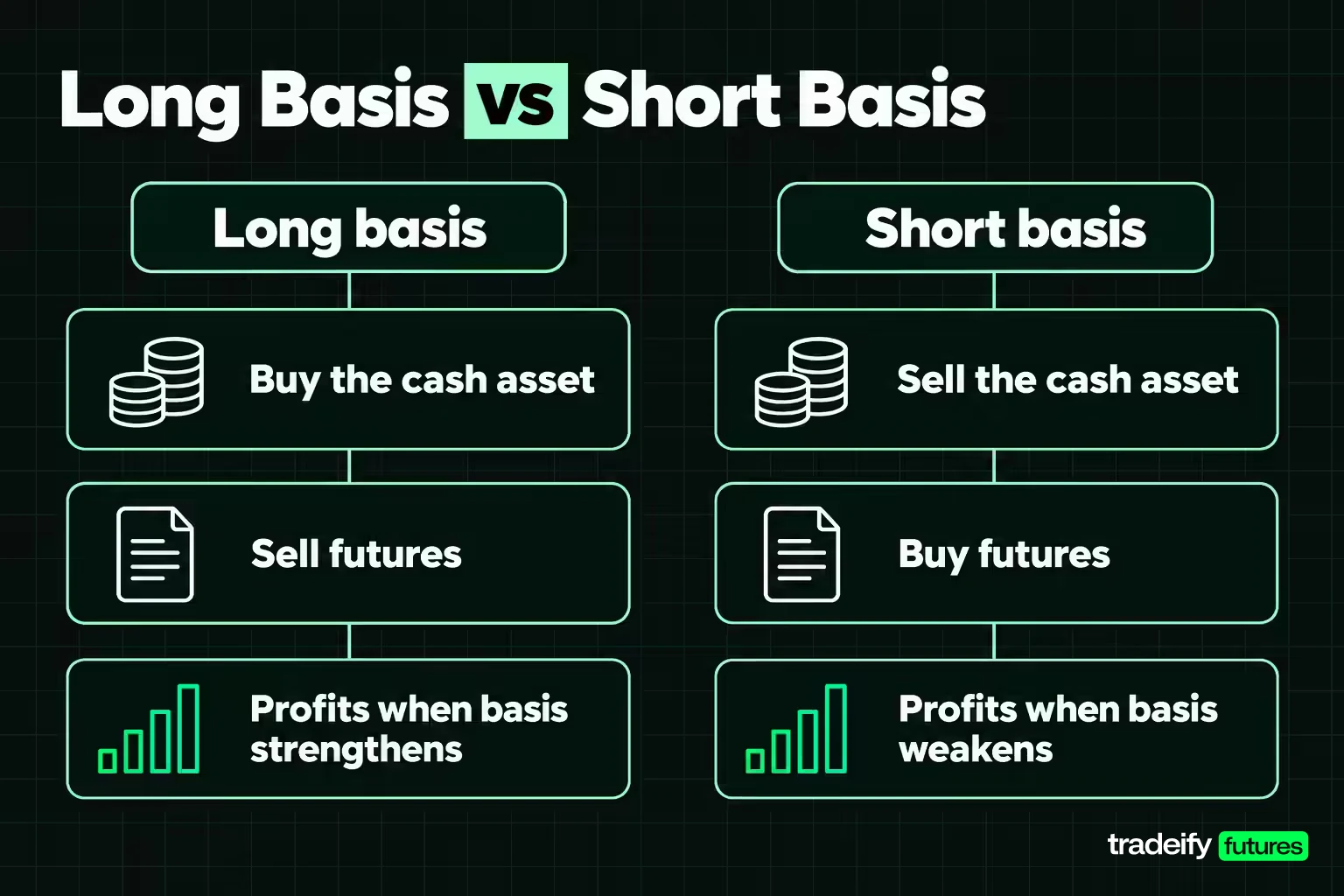
Long and short basis positions are named for the cash leg, which trips people up because the futures leg points the other way.
| Position | Cash leg | Futures leg | Profits when | Typical reason |
|---|---|---|---|---|
| Long basis | Buy the cash asset | Sell futures | Basis strengthens (cash gains on futures) | Futures look rich, or a producer holding inventory hedges |
| Short basis | Sell or short the cash asset | Buy futures | Basis weakens (futures gain on cash) | Futures look cheap, or a buyer hedges a future purchase |
The Federal Reserve note uses this language for Treasuries. When futures are relatively expensive compared with the cash bond, a trader can buy the bond and sell futures, which the note calls the long basis trade.
Hedgers end up in these basis positions naturally. A farmer with grain in the bin who sells futures is long the basis, which is why CME's grains course says short hedgers benefit from a stronger basis. A processor who buys futures ahead of a purchase is short the basis.
The short basis side tends to be harder to run. Shorting a cash asset can mean borrowing it, paying a fee and facing recall. That cost belongs in the calculation before the trade is placed.
Basis Trading Strategies
Basis trading strategies share one idea: own the relationship, not the direction. The differences are in which market, which costs and how the spread gets closed.
Cash-and-carry
Buy the cash asset, sell the futures, and hold until they converge. The trade earns the gap between the futures price and the spot price, minus financing and holding costs. It works when futures trade above fair value by more than the costs of carrying the position. Index arbitrage between ES and a stock basket follows this pattern, and so does most crypto basis trading.
Reverse cash-and-carry
Sell or short the cash asset and buy the futures when futures trade below fair value. The profit comes from futures catching up to cash at expiration. It needs a way to short the cash side, which is easy for some assets and expensive or impossible for others.
Treasury basis and the cheapest to deliver
Treasury desks compute the gross basis for every deliverable bond, then go further. CME describes the gross basis as a starting point for finding the cheapest-to-deliver security. The Federal Reserve measure also accounts for accrued interest, repo financing to the delivery date and the delivery options the futures seller holds. Those options are why a Treasury basis can stay positive without being free money.
Grain store-and-hedge
A grain holder facing a weak harvest basis can store the crop, sell deferred futures, and wait for the basis to strengthen. The payoff is the basis gain minus storage and interest. It is a basis trade run by a business with a warehouse.
Trading at a fixed basis with BTIC or EFP
Some venues let you trade the spread directly. CME's Basis Trade at Index Close (BTIC) lets participants buy or sell futures at an agreed spread to a reference price. In CME's bitcoin example, a BTIC trade at plus $100 against a reference rate of 40,500 clears the futures at $40,600. EFPs swap a futures position for the cash asset in one negotiated trade.
None of these is arbitrage in the textbook sense. The CFTC notes that in a theoretically efficient market there is a lack of opportunity for profitable arbitrage. What remains is a spread trade that pays for taking financing, liquidity and timing risk.
Related lesson: How arbitrage works and where it breaks
Where Basis Trading Is Used
Basis trading shows up wherever a cash market and a futures market price the same thing. The drivers differ by market.
| Market | Cash side | What drives the basis | Who trades it |
|---|---|---|---|
| Grains and oilseeds | Local elevator or processor bid | Freight, storage, quality, harvest supply | Farmers, merchants, processors |
| Energy | Physical crude or gas at a delivery hub | Pipeline and storage capacity, location | Producers, refiners, utilities |
| Equity index | The stock basket behind the index | Financing rate minus dividends | Index arbitrage desks, fund managers |
| Treasuries | Deliverable notes and bonds | Repo rates, coupon income, delivery options | Hedge funds, dealers, asset managers |
| Currencies | Spot exchange rate | Interest rate gap between the two currencies | Banks, corporates, macro funds |
| Crypto | Spot bitcoin or ether | Financing demand, sentiment, funding rates | Crypto funds, ETF desks, market makers |
The Treasury version is the largest and most watched. The Federal Reserve estimated that hedge funds built up at least $317 billion of Treasury holdings tied to basis trades from the first quarter of 2022, and that leveraged funds' short Treasury futures positions climbed well over $1 trillion in notional exposure by the end of 2023. Those short futures include other trades, so the Fed treats them as an upper proxy, not a clean count.
Contract design shapes the trade too. CME notes the deliverable list for a Treasury contract can run from three issues for the Ultra Ten-Year to 18 issues for the Ultra Bond, and each issue has its own basis.
Crypto Basis Trading With Bitcoin Futures
Crypto basis trading compares spot bitcoin or ether with a futures price, usually a dated future or a perpetual swap. The mechanics match the cash-and-carry trade, but the drivers lean more on demand for leverage and market mood than on storage or dividends.
Basis on dated bitcoin futures
CME Bitcoin futures (BTC) cover 5 bitcoin, settle financially against the CME CF Bitcoin Reference Rate, and stop trading at 4:00 PM London time on the last Friday of the contract month. Cash settlement against the reference rate is what pulls the futures toward spot at expiration.
CME says the crypto basis depends on the futures implied financing rate, time to maturity and perceived volatility, and can be positive or negative. CF Benchmarks adds that bullish momentum tends to push the CME bitcoin basis positive and sharp declines can turn it negative.
Annualizing makes basis comparable across dates. CF Benchmarks gives an example of spot at $100,000 and a near-expiry future at $101,000. The $1,000 basis is 1% over about 30 days, roughly 12.2% annualized (1% x 365 / 30).
A live snapshot of mid versus executable basis
A real quote shows why the headline number overstates what you can capture. As of 11:00:59 UTC on November 5, 2026, Kraken's spot bitcoin market showed $80,230.00 bid and $80,230.10 ask. Its March 26, 2027 fixed-maturity future, 141 days out, showed $81,936 bid and $81,972 ask.
| Measure | Basis in dollars | Basis in percent | Annualized |
|---|---|---|---|
| Midpoint to midpoint | $1,723.95 | 2.149% | 5.56% |
| Buy spot at the ask, sell the future at the bid | $1,705.90 | 2.126% | 5.50% |
On the longer contract the difference is small. On the thinner December 25, 2026 future, 50 days out, the same snapshot showed a $363 bid-ask spread, about 44.87 basis points of the price. The executable basis there annualized to 4.40%, against $665.45 of basis at the midpoint versus $483.90 you could trade. These numbers change every second. They are an illustration of method, not a current rate.
Perpetual futures and funding rates
Perpetual swaps never expire, so convergence cannot do the work. Binance explains that perpetuals use funding rates, periodic payments between longs and shorts that keep the contract anchored to the spot index. When the rate is positive, longs pay shorts; when it is negative, shorts pay longs. Payments land every 8 hours by default. A trader who holds spot and shorts the perpetual collects funding while it stays positive and pays it when it flips.
Crypto basis trades carry the same exposure as any basis trade plus exchange, custody and liquidation risk on the futures leg. A leveraged short future can be liquidated in a fast rally even when the spot leg has gained the same amount.
Risks in Basis Trading
Risks in basis trading come from the fact that a small spread usually needs a large position to matter. The Federal Reserve notes the Treasury basis trade is typically highly leveraged, and that the rapid unwinding of these trades by hedge funds contributed to Treasury market stress in March 2020.
- Basis can move against you before it converges. Convergence is expected at expiration, not along the way. A spread that widens can produce losses large enough to force an exit first.
- Financing can change. The cash leg is usually borrowed against. A higher repo or borrowing rate cuts the carry the trade was built on.
- Margin calls hit one leg at a time. The futures leg is marked to market daily. A sharp move against it calls for cash, even if the cash leg gained the same amount on paper.
- Liquidity is uneven. In a Kraken snapshot taken November 5, 2026, the thinly traded December 25, 2026 bitcoin future had a bid-ask spread of about 44.87 basis points. Wide spreads on either leg come straight out of the basis.
- Legging risk. Filling one leg and missing the other leaves an outright position at exactly the wrong moment.
- Delivery terms matter. In Treasuries, the futures seller chooses what to deliver and when, so the raw basis overstates the profit available to the buyer of that option.
- Model error. A wrong dividend forecast, a stale conversion factor or the wrong sign convention turns a calculated edge into a loss.
- Hedge basis risk. For hedgers, the CFTC's definition applies directly: an unexpected widening or narrowing of the basis changes the final price.
Each of these can be measured before the trade. If the position only works when none of them shows up, it isn't a spread trade anymore. It's a bet on a quiet market.
Reading Basis as an Intraday Futures Trader
Basis matters to an intraday futures trader even if you never hold a cash leg. It explains numbers you see every day on an E-mini chart.
Equity index futures are contracts on a stock index, such as the E-mini S&P 500 on the S&P 500. When short-term rates exceed the dividend yield, the fair value formula puts the futures above the index. Using the illustrative inputs of a 6,000.00 index, 4.00% financing and 60 days, ES would trade around 30.00 points above the cash index. That gap is carry, not a forecast.
Basis effects on E-mini charts
The ES basis has three practical effects on an intraday chart:
- Levels differ between ES and the index. A support level drawn on the S&P 500 cash index sits at a different price on ES. Translate levels using the current basis or draw them on the chart you trade.
- Fair value explains premarket quotes. When futures are described as above or below fair value before the stock market opens, this calculation is the reference. Futures 4.00 points over fair value are worth $200 per ES and $20 per MES.
- The roll creates a chart gap. With the same illustrative inputs, a contract with 30 days left has a fair value near 6,015.00, while the next quarterly contract at 120 days and 20.00 dividend points sits near 6,060.00. That 45.00-point difference, $2,250 per ES, shows up as a jump on a continuous chart when the roll happens. It is carry, not a breakout.
Basis checklist before acting on a reading
Before acting on any basis reading, write the comparison out in full: the cash instrument and futures contract, the timestamp for both, the formula, matching units and multipliers, the costs on both legs, and what would make the reading wrong.
On our accounts, you trade CME Group futures such as ES, NQ, CL, GC, ZC and 6E, and every position is closed by 4:45 PM ET with no overnight holds. We don't offer cash stocks, spot forex, options, crypto derivatives or Treasury futures. A classic basis trade needs a cash leg and usually weeks to converge, so it isn't something you can run on our accounts; basis is context for reading the futures you trade.
Basis in Futures FAQ
What does basis mean in finance?
In futures, basis is the gap between a cash price and a futures price. In tax and accounting, the IRS uses basis to mean what you paid for an asset, including costs such as commissions, which sets the gain or loss when you sell. A basis point is a separate term, 1/100 of one percent.
What does equity futures mean?
Equity futures are futures contracts on a stock index or, in some markets, a single stock. Their price tracks the index plus financing costs minus expected dividends. The equity index basis, futures minus the index, reflects that carry and shrinks to zero at expiration.
What is the formula for calculating basis risk?
Basis risk is the change in basis between placing and lifting a hedge: basis at the exit minus basis at the entry. Multiply the change by the contract size for the dollar effect. A 5-cent weaker basis on a 5,000-bushel wheat contract costs $250.
Can a basis trade lose money?
Yes. Basis can widen before it converges, financing costs can rise, margin calls can force an early exit, and wide spreads can eat the gap. The Federal Reserve links the rapid unwinding of leveraged Treasury basis trades to market stress in March 2020.
What does a negative basis mean?
Under the cash-minus-futures formula, a negative basis means cash sits below futures. Under futures minus spot, it means futures trade at a discount, often because the asset's income exceeds the financing cost.
Futures, crypto derivatives and basis trades are leveraged and can lose more than you expect, including more than your deposit in some accounts. This is education, not investment, tax or legal advice, and evaluation and funded prop-firm accounts are simulated.


