



TL;DR: How futures contracts work starts with one deal, a price agreed today on a fixed quantity that settles later. The exchange sets the unit and tick, such as $5 per point on the Micro E-mini S&P 500 and $50 on the E-mini. A clearinghouse stands between both sides and settles gains and losses in cash every session. Margin is a performance bond of typically 3% to 12% of notional, so a small move can take a large share of it.
You can read an S&P 500 chart perfectly and still lose more than you planned on a futures trade. The chart was fine. The contract did something you did not account for, like charging ten times more per point than you assumed or pulling cash out of the account before you closed.
That is why the textbook definition only gets you halfway. A futures contract is an agreement to buy or sell a fixed amount of something at a price set today, with settlement later. In practice, it is a position that pays or charges you cash every session, on terms the exchange wrote before you arrived.
This guide walks through those terms in dollars: what a futures contract is, what every contract fixes, where futures trade, how daily settlement and margin work, who uses futures and why, and what happens at expiration.
What a Futures Contract Is and What It Commits You To
A futures contract is a standardized agreement, traded on a regulated exchange, to buy or sell a set quantity of an asset at a price agreed now for delivery or settlement later. The CFTC's glossary adds the part that matters most to a trader: the contract obligates both parties, it is used to take on or shift price risk, and it can be satisfied either by delivery or by offset.
Standardized is the working word. You do not negotiate the quantity, the grade, the delivery month or the delivery location. The exchange sets all of it, which leaves price as the only open variable. That is what makes a futures contract tradable, because every buyer and seller holds identical terms and can hand the obligation to someone else.
So what does a futures contract represent? It represents a price commitment on a defined quantity of an underlying asset, such as 50 dollars times the S&P 500 Index or 1,000 barrels of crude oil. You are not buying the asset. You are agreeing to a price for it.
Three consequences follow, and new traders tend to miss all three:
- Your account holds a position, not an asset. It gains or loses money as the reference price moves.
- Both sides are bound. Neither party walks away because the market moved against them.
- You exit by offsetting. The CFTC defines offset as selling the same number of contracts in the same delivery month you bought (or buying back what you sold). Most futures contracts are closed this way before the delivery date.
The Terms Every Futures Contract Fixes
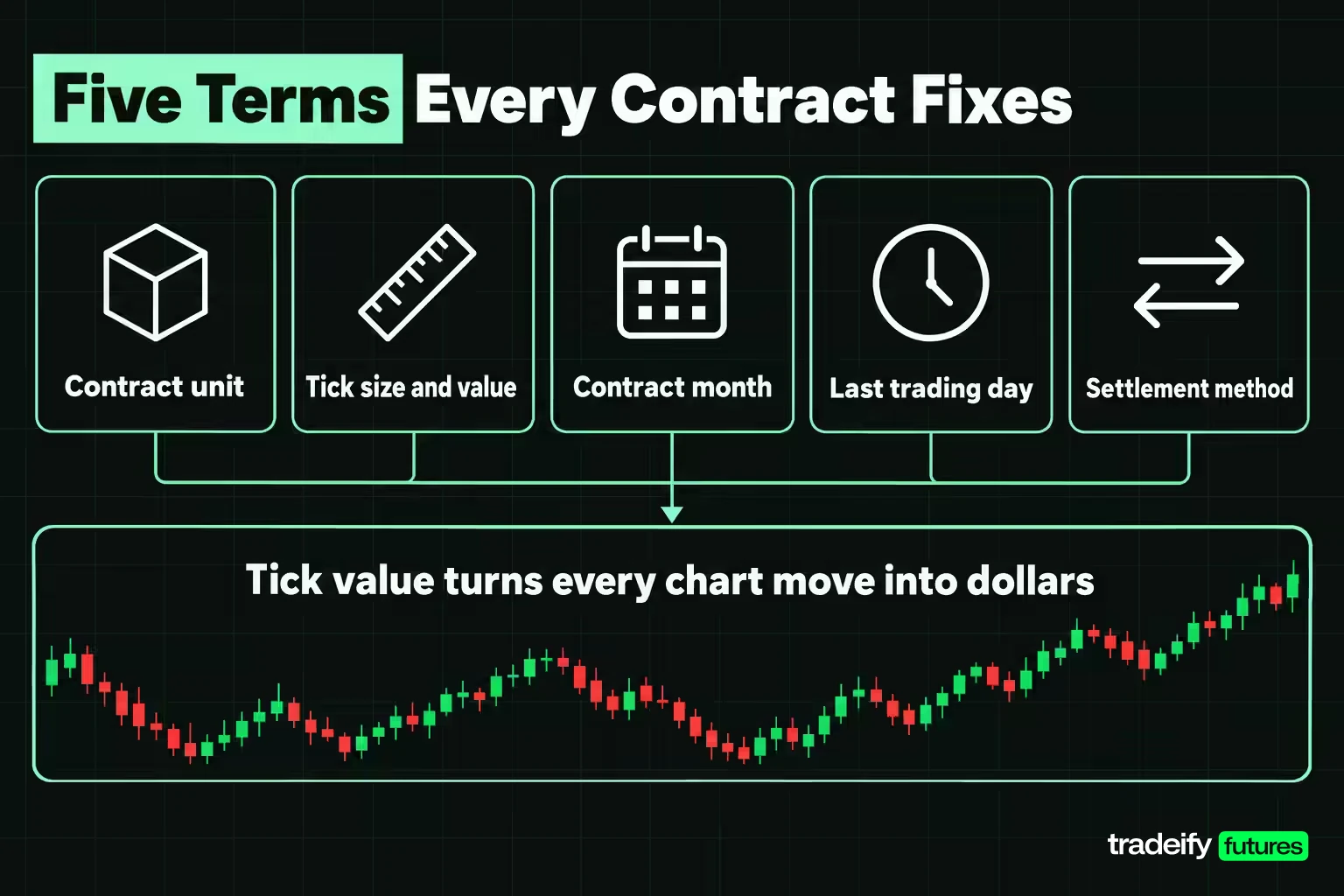
Every futures contract has a specification card published by its exchange. Five items on that card decide what a trade costs and when you have to deal with it.
- Contract unit. What one contract represents. The Micro E-mini S&P 500 (MES) is 5 dollars times the S&P 500 Index. Light Sweet Crude Oil (CL) is 1,000 barrels. Gold (GC) is 100 troy ounces.
- Minimum tick and tick value. The tick is the smallest price change the exchange allows. Its dollar value is the tick size times the unit. MES moves in 0.25 index points, so one tick is $1.25. CL moves in $0.01 per barrel, so one tick is $10.00.
- Contract month and code. Each contract carries a delivery month, written as a letter code. H is March, M is June, U is September and Z is December, so ESZ6 is the December 2026 E-mini S&P 500.
- Last trading day. The point where the contract stops trading. For ES and MES, CME lists it as 9:30 AM ET on the third Friday of the contract month.
- Settlement method. Either cash (financially settled) or physical delivery. CME lists ES and MES as financially settled, and CL and GC as deliverable.
What a 40-tick move costs on each futures contract
Tick value is the one to memorize first, because it converts every chart idea into money. The table holds the move constant at 40 ticks and shows what that costs on eight contracts, using CME's published specifications.
| Contract | Unit | Tick size | Tick value | Cost of 40 ticks |
|---|---|---|---|---|
| Micro E-mini S&P 500 (MES) | $5 x S&P 500 Index | 0.25 index points | $1.25 | $50.00 |
| E-mini S&P 500 (ES) | $50 x S&P 500 Index | 0.25 index points | $12.50 | $500.00 |
| Micro E-mini Nasdaq-100 (MNQ) | $2 x Nasdaq-100 Index | 0.25 index points | $0.50 | $20.00 |
| E-mini Nasdaq-100 (NQ) | $20 x Nasdaq-100 Index | 0.25 index points | $5.00 | $200.00 |
| Micro WTI Crude Oil (MCL) | 100 barrels | $0.01 per barrel | $1.00 | $40.00 |
| Light Sweet Crude Oil (CL) | 1,000 barrels | $0.01 per barrel | $10.00 | $400.00 |
| Micro Gold (MGC) | 10 troy ounces | $0.10 per troy ounce | $1.00 | $40.00 |
| Gold (GC) | 100 troy ounces | $0.10 per troy ounce | $10.00 | $400.00 |
Read the first two rows together. A 10-point stop on an S&P 500 chart is 40 ticks on either contract, but it costs $50 on one MES and $500 on one ES. The chart did not change. The unit did.
Related lesson: The full specification sheet for each contract
Types of Futures Contracts by Underlying Asset
Futures contracts are grouped by what they track. The mechanics are the same across groups, but the unit, the trading calendar and the settlement method change with the underlying.
| Futures type | Example contract | Contract unit | Settlement method |
|---|---|---|---|
| Equity index | E-mini S&P 500 (ES) | $50 x S&P 500 Index | Financially settled |
| Energy | Light Sweet Crude Oil (CL) | 1,000 barrels | Deliverable |
| Metals | Gold (GC) | 100 troy ounces | Deliverable |
| Agricultural | Corn (ZC) | 5,000 bushels | Deliverable |
| Currency | Euro FX (6E) | 125,000 euro | Deliverable |
| Interest rate | 10-Year T-Note (ZN) | $100,000 face value | Deliverable |
Two details in that table catch people. First, a futures contract can be deliverable even when it has nothing to do with farms or barrels. The euro and Treasury note contracts settle by delivering the currency or the notes.
Second, a micro version of a contract does not always settle the same way as its parent. CME lists Micro WTI Crude Oil (MCL) as financially settled, while the full-size CL contract is deliverable. Read the specification card for the exact contract you trade, not the family it belongs to.
Equity index futures are the type most retail day traders start with. They are cash settled, they trade nearly around the clock, and micro versions exist for smaller accounts.
Where Futures Contracts Trade and Who Regulates Them
Futures contracts trade on regulated exchanges, not over the counter. In the United States, the largest group is CME Group, which runs four exchanges: CME, CBOT, NYMEX and COMEX. The CBOT dates to around 1848 as a grain exchange and introduced standardized futures contracts in 1865. CBOT and CME merged into CME Group in 2007.
Most trading is now electronic. E-mini S&P 500 futures trade on CME Globex from Sunday 6:00 PM to Friday 5:00 PM ET, with a daily maintenance break from 5:00 PM to 6:00 PM ET. That near-24-hour schedule is one reason futures react to overnight news before the stock market opens.
How the clearinghouse stands in the middle
Every exchange-traded futures contract is cleared. The CFTC describes a derivatives clearing organization as an entity that substitutes its own credit for the credit of the two parties through novation. In plain terms, once your trade is matched, the clearinghouse becomes the buyer to every seller and the seller to every buyer.
That changes the risk you carry. You do not need to know who took the other side or whether they can pay. Your exposure is to price, and the clearinghouse collects from the losing side every day to keep it that way.
How the CFTC and NFA regulate futures
The Commodity Futures Trading Commission (CFTC) oversees U.S. futures markets. Exchanges operate as designated contract markets, which the CFTC defines as a board of trade or exchange designated to trade futures, swaps or options under the Commodity Exchange Act.
Firms that handle customer money sit under a second layer. The CFTC says companies and individuals who handle customer funds or give trading advice must register with the National Futures Association (NFA), a self-regulatory organization approved by the CFTC. It also requires customer funds to be held separately from the firm's own funds and customer accounts to be adjusted to each trading day's market value at the close.
How Futures Contracts Work Day by Day
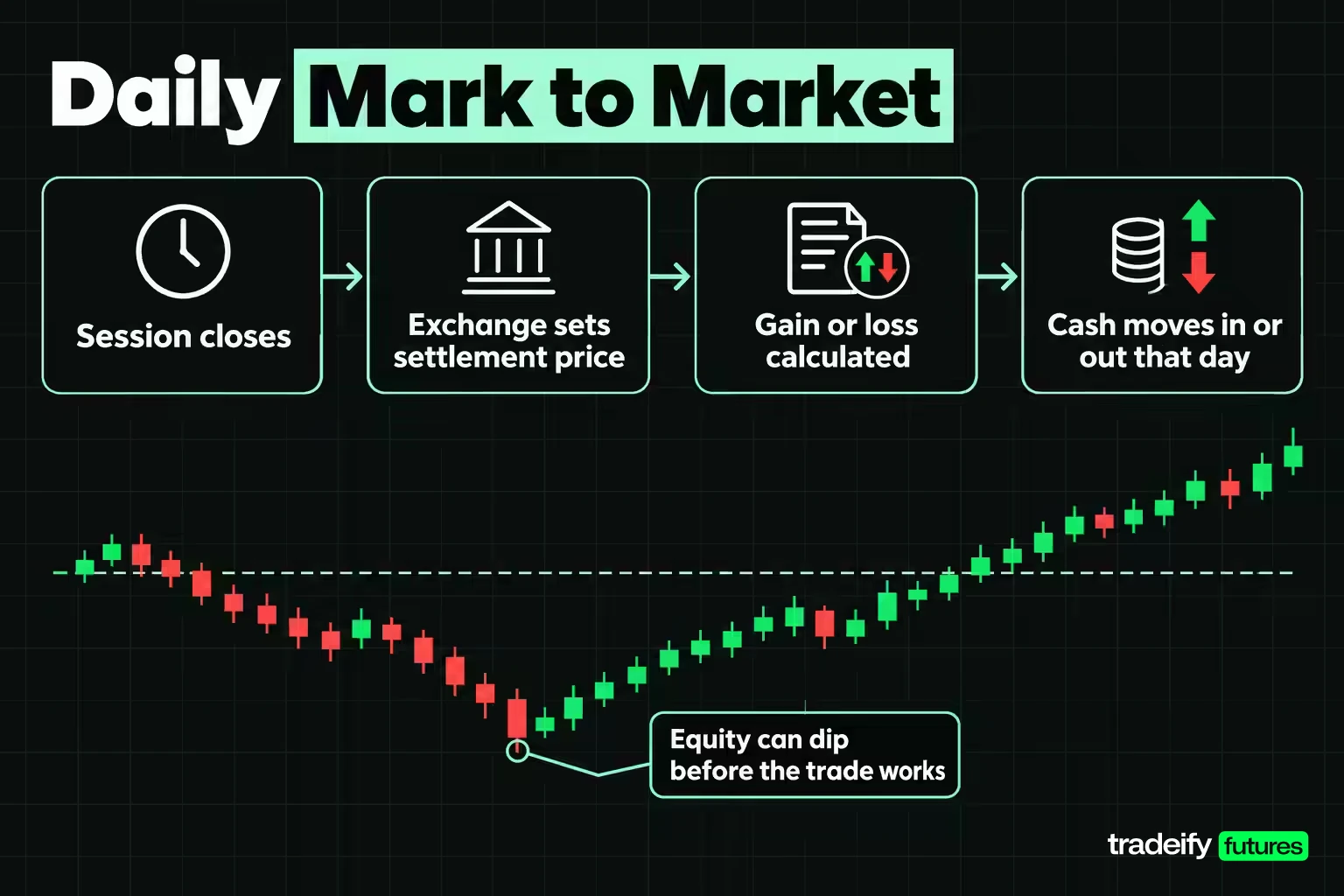
Futures contracts differ from almost everything else a retail trader has held because of one process: daily mark to market. A stock position shows an unrealized gain or loss until you sell. A futures position is settled against the exchange's settlement price at the end of every session, and cash moves into or out of the account that day.
CME puts it bluntly. The final daily settlement price is the same for everyone, losers pay winners every day, and no losses are carried forward.
Follow one contract to see it. Imagine a trader who buys one Micro E-mini S&P 500 contract at 7,000.00 with $2,000 of account equity. MES is worth $5 per index point. Every price here is an illustrative round number, not a quote.
| Session | Settlement or exit price | Change in index points | Cash credited or debited | Account equity |
|---|---|---|---|---|
| Entry | 7,000.00 | None | None | $2,000.00 |
| Session 1 | 7,012.50 | +12.50 | +$62.50 | $2,062.50 |
| Session 2 | 6,987.50 | -25.00 | -$125.00 | $1,937.50 |
| Session 3 | 7,025.00 | +37.50 | +$187.50 | $2,125.00 |
| Session 4 | 7,043.75 | +18.75 | +$93.75 | $2,218.75 |
| Exit in session 5 | 7,037.50 | -6.25 | -$31.25 | $2,187.50 |
Session two is the one to notice. The position finished well, but after two sessions the account sat $62.50 below where it started. If a daily rule is written against account equity, that equity changed four times before the trader made a single decision.
Why the daily cash flows add up to the price move
The MES ledger reconciles two ways. The credits ($62.50, $187.50 and $93.75) total $343.75. The debits ($125.00 and $31.25) total $156.25. The difference is $187.50.
Now measure the trade the simple way. Entry at 7,000.00 and exit at 7,037.50 is 37.50 index points, and 37.50 points at $5 is $187.50. That is also 150 ticks at $1.25.
Both routes give the same number, and they have to. Mark to market does not create or destroy money. It changes when the money arrives. If your statement ever fails to reconcile to your entry and exit prices, one of the two numbers is wrong, and it is usually the one you assumed.
Related lesson: The full mechanics of the daily settlement process
Futures Margin and Leverage in Dollars
Futures margin is not a down payment and not a loan. The CFTC glossary calls it a performance bond: money deposited to show you can meet the obligation, and "not partial payment on a purchase." Two levels matter.
- Initial margin is what the broker requires when you open the position.
- Maintenance margin is the minimum equity you must keep while the position is open. If equity drops to or below it, the broker issues a margin call.
CME's education material says futures margin typically runs 3% to 12% of a contract's notional value, and requirements can rise when markets get more volatile. Treat any specific number as something to check with your broker on the day, never as fixed.
How leverage scales a futures move
Leverage comes from the gap between what you post and what you control. One MES at an illustrative 7,000 controls $35,000 of S&P 500 exposure (7,000 times $5). On CME's 3% to 12% range, that would be $1,050 to $4,200 of margin.
Assume an illustrative initial margin of $2,000. That is 17.5 to 1. A 1% move in the index is 70 points, or $350, which is 17.5% of the $2,000 you posted. The same ratio works in both directions, which is the whole point of the word leverage.
How a margin call is calculated
Margin calls surprise people because of one rule: the call restores the account to the initial level, not the maintenance floor. The CFTC glossary describes a margin call as a request to bring deposits "up to initial levels," and CME Rule 930 works the same way.
Here is an illustrative futures margin walk. The margin levels are assumptions for the example, not exchange or broker figures. A trader holds one MES long with $2,500 of equity, a $2,000 initial requirement and a $1,800 maintenance floor. Three sessions in a row, the index settles 60 points lower (240 ticks), costing $300 a session.
| Session | Settlement move | Debit | Equity after settlement | Below the $1,800 floor |
|---|---|---|---|---|
| Start | None | None | $2,500 | No |
| Session 1 | -60 points | $300 | $2,200 | No |
| Session 2 | -60 points | $300 | $1,900 | No |
| Session 3 | -60 points | $300 | $1,600 | Yes |
After session three the account is $200 below the floor, but the call is $400, because the deposit has to bring equity back to $2,000. Traders who budget only for the distance to maintenance find the call larger than planned. If the call is not met, CME's rules allow the clearing member to liquidate the position.
Who Trades Futures Contracts
Every futures contract has someone on the other side, and the mix of participants shapes how a market behaves. The CFTC says most participants are commercial or institutional producers and consumers acting as hedgers, while others are speculators trying to profit from price changes.
- Hedgers hold or expect to hold the real thing. A grain grower, a refiner or a fund with a large stock portfolio uses futures to offset price risk they already carry. The CFTC defines a hedger as someone taking futures positions opposite to their cash market positions to reduce the risk of loss.
- Speculators have no commercial exposure. The CFTC defines a speculator as a trader who does not hedge but trades to profit from anticipating price moves. Speculators supply much of the liquidity hedgers need.
- Spreaders and arbitrageurs trade the relationship between two prices, such as two delivery months or a futures contract and its underlying, rather than outright direction.
- Institutions such as banks, asset managers and commodity trading advisors trade futures for hedging, allocation and return.
- Retail traders are mostly short-term speculators, often in equity index micros.
The practical point for a small account: you are trading against participants who are far better capitalized and who often have a reason to trade that has nothing to do with your chart.
Related lesson: How hedgers, speculators and arbitrageurs differ
Hedging With Futures Contracts
Hedging with futures means taking a futures position that gains when your real-world exposure loses. The goal is a known price, not a profit.
Take an illustrative corn grower who expects to harvest 50,000 bushels. A CBOT corn contract (ZC) is 5,000 bushels, so the grower sells 10 contracts at an illustrative $4.30. By harvest, futures have fallen to $4.00 and the local cash price has fallen from $4.10 to $3.80.
- Futures gain: $0.30 times 50,000 bushels = $15,000.
- Cash crop revenue is $15,000 lower than it would have been at $4.10.
- Effective price: $3.80 cash plus $0.30 from futures = $4.10.
The hedge did its job. The grower gave up any upside if prices had risen, in exchange for knowing the price.
Hedges are rarely perfect, though. The gap between the local cash price and the futures price is the basis, and the CFTC calls an unexpected change in it basis risk. If the cash price had dropped to $3.70 instead of $3.80, the extra $0.10 across 50,000 bushels is $5,000 the hedge would not cover.
Related lesson: Hedging concepts beyond futures
Speculating With Futures Contracts
Speculating with futures means taking price risk on purpose, without an offsetting position in the real asset. Speculators can go long (buy, expecting a rise) or short (sell, expecting a fall). The CFTC glossary describes short selling a futures contract as selling with the idea of delivering on it or offsetting it later, so a short needs no borrowed shares.
An illustrative short shows the symmetry. A trader sells one MES at 7,000 and buys it back at 6,980. That is 20 points at $5, a $100 gain. If the index instead rises to 7,030 and the trader covers there, that is 30 points against the position, a $150 loss.
Futures trading strategies built on stop distance
The strategy a speculator uses matters less than three habits that keep the account alive long enough to find out whether the strategy works:
- Size from the stop. Decide the stop distance first, convert it to dollars with the tick value, then pick the number of contracts. A 10-point S&P 500 stop is $50 on one MES and $500 on one ES.
- Place the stop with the entry. A protective order placed at entry is a decision made calmly. One placed after the trade goes wrong usually is not.
- Do not average into a loser. Adding contracts to a losing position multiplies the tick value working against you at exactly the wrong time.
Short selling, spreads and trend following all exist as futures strategies, but none of them changes the arithmetic of tick value and stop distance.
Related lesson: Sizing futures positions from a stop distance
How Futures Contracts Work at Expiration
Every futures contract has an end date, and how it ends depends on the product, not your preference. Two dates on the specification card matter.
- Last trading day. For ES and MES, trading stops at 9:30 AM ET on the third Friday of the contract month. For CL, CME lists it as 3 business days before the 25th calendar day of the month before the contract month. The rules differ by product, so never assume the third-Friday pattern carries over.
- First notice day. On deliverable contracts, the CFTC defines it as the first day notices of intent to deliver can be received. It varies by commodity and exchange.
Cash settlement vs physical delivery
Cash-settled contracts end with a final payment based on an index or price, and nothing physical moves. Deliverable contracts end with the short delivering the actual commodity or instrument to the long. Most speculators never get near either outcome, because they offset before the final days.
Rolling a futures position
Traders who want to keep exposure past expiration roll. The CFTC describes roll-over as lifting a near-month position and re-establishing it in a more deferred month. The price difference between the two months is a real cost or credit.
- Contango is when later delivery months price progressively higher than the nearest month. A long who rolls sells low and buys high.
- Backwardation is the opposite, with later months priced progressively lower.
Put the last trading day, the first notice day (if the contract is deliverable) and your own roll date in your calendar before the trade, not during the final week.
Related lesson: Moving an open position to the next month
Futures vs Forward Contracts
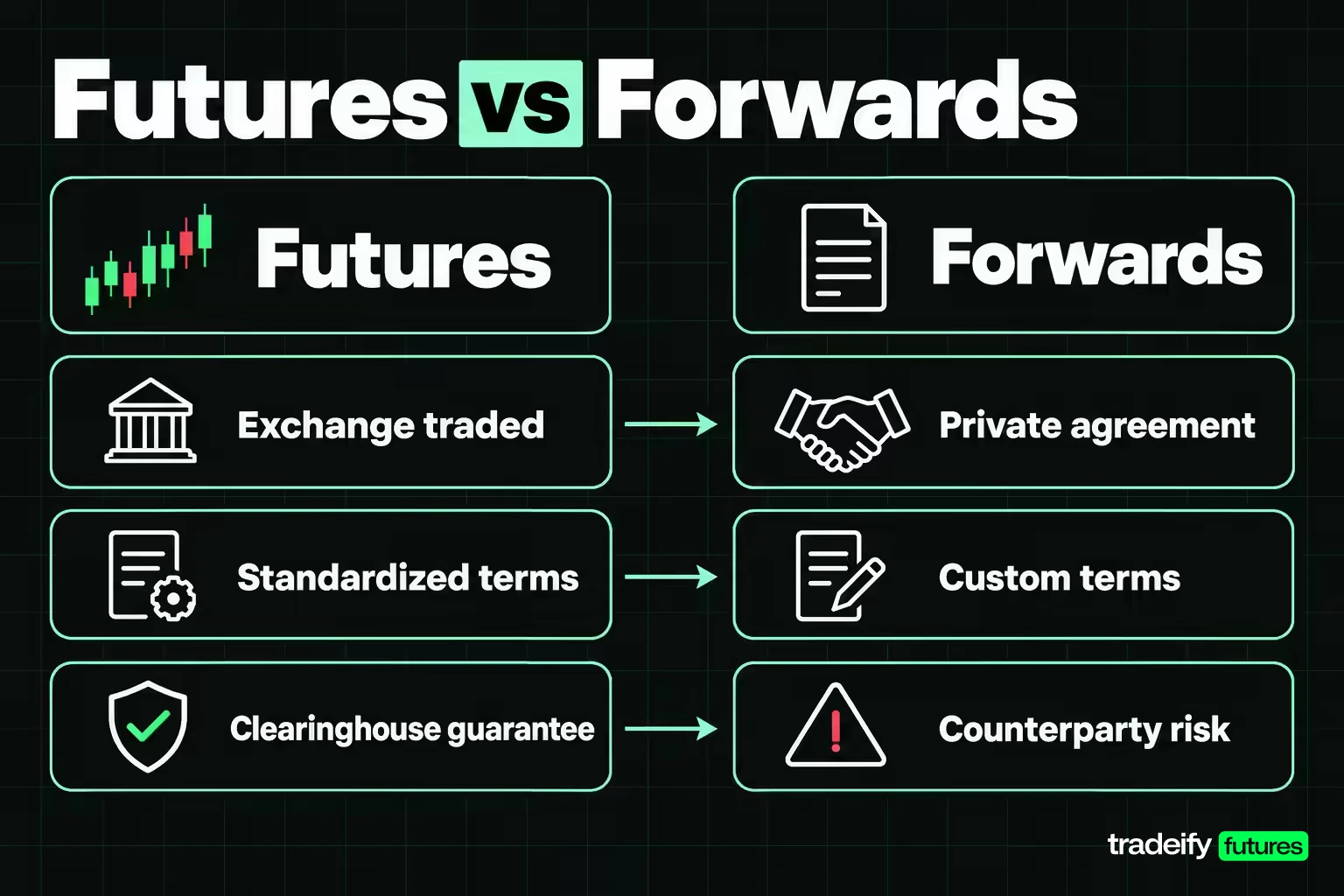
Futures and forward contracts both fix a price today for a later transaction. The difference is everything around that price.
A forward is a private agreement. The CFTC glossary describes it as a cash transaction where a commercial buyer and seller agree on delivery of a specified quality and quantity at a future date, with terms "more personalized" than standardized futures. CME notes that before post-2008 reforms most over-the-counter forwards had no official daily settlement price.
| Feature | Futures contract | Forward contract |
|---|---|---|
| Terms | Standardized by the exchange | Negotiated between the two parties |
| Where it trades | Regulated exchange | Privately, over the counter |
| Counterparty risk | Clearinghouse stands in the middle | Each side relies on the other |
| Daily settlement | Marked to market every session | Typically settled at the end |
| Exit before expiry | Offset with an opposite trade | Usually requires the other party's agreement |
For a trader, the practical takeaway is short. Futures trade like an instrument. Forwards behave like a contract between two companies.
Futures vs Stocks and Options
Futures, stocks and options all give price exposure, but they commit you to very different things. A stock is ownership. An option is a right. A futures contract is an obligation on both sides.
| Feature | Futures | Stocks | Options |
|---|---|---|---|
| What you hold | An obligation to buy or sell at a set price | A share of ownership in a company | A right (for the buyer) or obligation (for the writer) |
| Cash to open | Performance bond margin, typically 3% to 12% of notional | Full price, or 50% under Reg T margin | Premium paid by the buyer |
| Daily cash movement | Gains and losses settled every session | Unrealized until sold | Price changes, no daily cash settlement for the buyer |
| Expiry | Every contract expires | No expiry | Every option expires |
| Going short | Sell the contract, no borrowing | Borrow shares to short | Buy puts or write calls |
Take the same $35,000 of S&P 500 exposure. Bought as stock in a cash account, it costs $35,000. Under Regulation T's 50% initial margin, it needs $17,500. As one MES at an illustrative 7,000, it needs only the futures margin, which on CME's 3% to 12% range is $1,050 to $4,200.
Options differ in a different way. The CFTC defines an option as giving the buyer the right, but not the obligation, to buy or sell at a set price, while the writer takes on the obligation in exchange for the premium. A futures buyer has no such choice. If the price falls, the loss is settled in cash that session.
Risks of Futures Contracts and Where Traders Get Caught
The risks of futures trading come mostly from the structure of the contract rather than from bad analysis. The CFTC is direct about it: speculating in futures is "rarely suitable for individual investors," and many people lose all of their money and can be required to pay more than they invested.
- Leverage risk. At an illustrative 17.5 to 1, a 1% index move is 17.5% of the margin posted.
- Losses beyond the deposit. One MES long at 7,000 represents $35,000 of exposure. The margin is not the maximum loss.
- Gap risk. Futures stop for a daily maintenance break, and prices can open well away from the last trade after news. A stop order does not guarantee its price.
- Liquidity risk. Distant contract months and smaller products can have wide spreads and thin books.
- Margin changes. CME notes requirements can rise when volatility rises, which can force a funding decision on an unchanged position.
Futures contract mistakes and what they cost
Most futures mistakes come from a trader substituting a stock-market assumption for a fact on the specification card.
| Assumption | Contract fact | What it can cost |
|---|---|---|
| A stop is a stop, whatever the contract | Tick value scales with the unit | A 10-point stop is $50 on MES, $500 on ES |
| Losses are only on paper until I sell | Positions are marked to market every session | Cash leaves the account before you exit |
| The call only tops me up to maintenance | Calls restore the account to initial margin | A $200 shortfall can mean a $400 call |
| Micros settle like their full-size parent | Settlement method is set per contract | CL is deliverable, MCL is financially settled |
| My margin is my maximum loss | Notional value is the real exposure | One MES at 7,000 controls $35,000 |
| All contracts expire on the third Friday | Last trading day differs by product | CL and GC follow their own calendars |
So is it good to invest in futures? Futures are built for hedging and short-term speculation, not buy-and-hold investing, and every contract expires. For a trader with a tested plan and fixed risk per trade, they are an efficient instrument. Without one, the leverage works just as hard against you.
Getting Started With Futures Contracts in Five Steps
Getting started with futures is mostly about choosing small and reading first. A practical order looks like this:
- Pick one market and the smallest contract that trades it. Micro contracts such as MES or MNQ exist so a small account can take a normal stop.
- Read the specification card. Write down the unit, tick size, tick value, trading hours, last trading day and settlement method.
- Choose a registered broker. Firms that hold customer funds must be registered with the NFA, and customer funds must be kept separate from the firm's own money.
- Practice with a simulator first. Learn order entry, the settlement cycle and your platform's month codes before real money is at stake.
- Set risk per trade in dollars. Convert your stop distance to ticks and dollars, then choose the contract count. If the dollar figure makes you flinch, the position is too big, not the stop too wide.
The temptation at the start is to pick the contract with the most movement and figure out the rest later. Do it the other way round. The contract you can size correctly is the right first contract, even if it feels slow.
On our accounts, position size is set by contract limits rather than margin. A 50K account can hold up to 4 minis or 40 micros, with 10 micros counting as one mini. Every position is closed by 4:45 PM ET, so nothing is held overnight, and rolling just means choosing which contract month to trade in the next session. Funded accounts are simulated.
Do you need $25,000 to trade futures
No. The $25,000 figure is the pattern day trader minimum for securities margin accounts, and futures were never subject to it. That rule is itself being replaced. FINRA Regulatory Notice 26-10, effective June 4, 2026 with a phase-in ending October 20, 2027, replaces the day trading margin requirements, including the $25,000 minimum. A futures account needs whatever margin and minimum deposit your broker sets.
Related lesson: The beginner's route through futures
Futures Contract Questions
What does a futures contract represent
A futures contract represents a binding agreement on price for a standardized quantity of an underlying asset, such as $5 times the S&P 500 Index for MES or 1,000 barrels for CL. It does not represent ownership of the asset. Its value comes from the price agreed and how that price changes.
How does futures trading work
Futures trading works by buying or selling contracts and closing them with an opposite trade before expiration. Profit or loss is the price difference times the contract unit times the number of contracts. Gains and losses are settled in cash at the end of every session through mark to market.
Do I need $25,000 to trade futures
No. The $25,000 pattern day trader minimum applies to securities margin accounts, not futures, and FINRA Regulatory Notice 26-10 is replacing it. Futures brokers set their own margin and deposit requirements per contract.
Is it good to invest in futures
Futures suit hedging and active trading better than long-term investing, because every contract expires and leverage magnifies each move. The CFTC calls speculating in futures rarely suitable for individual investors. Anyone trading them needs a defined risk per trade and money they can afford to lose.
How much can you lose on a futures contract
More than your margin. One MES long at an illustrative 7,000 controls $35,000 of exposure, and a short has no upper price limit in theory. The CFTC warns that traders can be required to pay more than they invested.
Can you hold a futures contract until expiration
Yes, but what happens depends on the settlement method. A cash-settled contract such as ES ends with a final cash payment. A deliverable contract such as CL or GC can lead to a delivery obligation, which is why most speculators offset or roll before the final days.
Futures trading involves substantial risk of loss and is not suitable for everyone. Leverage means losses can exceed the money deposited. Every price, margin level and account figure in this guide is an illustration built from published contract specifications, not a quote or a projection. Simulated and funded evaluation accounts are simulated. Nothing here is investment advice.


