



TL;DR: Exchange-traded funds are pooled portfolios whose shares trade on an exchange like a stock. The real decision is what the fund holds, not the ETF label. Index equity ETFs averaged a 0.14% expense ratio in 2025, per ICI. Spreads, taxes and structure (ETF, ETN, 2x daily) can cost more than that fee.
Exchange-traded funds, usually called ETFs, let you buy a single share that represents a slice of a whole portfolio. That portfolio might hold every large U.S. company, a ladder of government bonds, one industry, gold futures or a strategy that resets its exposure every day.
That range is the point. It is also the trap. A broad stock-index ETF and a 3x daily leveraged fund sit on the same brokerage screen, carry the same three-letter label and trade with the same buy button. They behave nothing alike, and finding that out after the fact is expensive. This guide explains how ETFs work, what they cost, how they are taxed, how they compare with stocks, mutual funds and index futures, and how to check a fund before money goes in.
What Are Exchange-Traded Funds
An exchange-traded fund is a pooled investment whose shares are listed and traded on a securities exchange. The SEC's Investor.gov defines an ETF as an exchange-traded product that must register with the SEC as an open-end investment company or a unit investment trust. The fund pools money from many investors and invests it in stocks, bonds, money-market instruments, other assets or a mix of them.
Each ETF share represents part ownership of that portfolio and of the income it produces. The portfolio is usually run by an SEC-registered investment adviser, and the prospectus states what the fund is allowed to own and what it is trying to achieve.
ETFs, ETPs and ETNs
ETF is the most common type of exchange-traded product (ETP), but not every ETP is an ETF. FINRA groups ETFs, exchange-traded notes (ETNs) and commodity pools under the ETP umbrella. They all trade on an exchange during the day, yet their legal structure differs:
- ETFs are registered investment companies under the Investment Company Act of 1940 and hold a portfolio of assets.
- ETNs hold no assets at all. They are unsecured debt issued by a bank or other financial institution, so their value depends on the issuer staying solvent. Some can be called early by the issuer.
- Commodity pools and grantor trusts hold physical commodities, currencies or futures. Some are not registered under the 1940 Act, and some fall under CFTC rather than SEC oversight.
On a quote screen these can look identical. The prospectus or pricing supplement tells you which one you are actually buying.
What people mean by ETF stocks
"ETF stocks" is shorthand for ETF shares. An ETF share trades like a stock: it has a ticker, a live bid and ask, and it can be bought on margin, sold short or have options written on it, as FINRA notes. But owning it does not make you a shareholder of one company. You own a slice of a fund, and the fund owns the companies (or bonds, or contracts).
How ETF Creation, Redemption and Pricing Work

An ETF trades in two layers, and knowing both explains why its price usually stays close to the value of what it holds.
The primary market. The ETF signs agreements with large financial institutions, typically broker-dealers, called authorized participants. An authorized participant can deliver a basket of securities to the fund and receive a large block of new ETF shares, called a creation unit. It can also hand shares back and take the basket out. FINRA notes these primary-market transactions typically involve large blocks worth millions of dollars. Retail investors generally cannot create or redeem ETF shares directly with the fund.
The secondary market. Most trading, including nearly all retail trading, happens on an exchange between buyers and sellers. You buy from another investor or a market maker, not from the fund.
NAV versus market price in an ETF
Two prices matter for every ETF:
- Net asset value (NAV): the value of the fund's assets minus its liabilities, per share.
- Market price: what buyers and sellers agree on during the trading day.
When the market price sits above NAV, the ETF trades at a premium. Below NAV, it trades at a discount. Here is the math with illustrative numbers: if an ETF's NAV is $50.00 and it trades at $50.25, buyers are paying a $0.25 premium, or 0.5% above the value of the holdings.
Authorized participants have an incentive to close that gap. If shares trade rich, they can create new shares and sell them; if shares trade cheap, they can buy shares and redeem them for the basket. That arbitrage usually keeps premiums and discounts small in large, liquid funds. It works less well when the underlying assets are hard to trade, when markets are stressed, or when the creation and redemption process is disrupted, and FINRA warns the price can then deviate significantly from the underlying value.
FINRA suggests comparing an ETF's market price with published estimates of its value, such as an intraday indicative value, and considering order types other than market orders. For a buyer, the practical rule is simple: the ETF's quoted price is not automatically its fair value. Check the spread and the premium or discount before you hit buy.
Types of ETFs
ETFs are sorted by what they hold and how they choose it. Each type below is built for a different job, and each has a specific way of disappointing a buyer who expected something else.
Broad-market index ETFs
These funds try to match a benchmark such as a total-market, large-cap or international stock index. Investor.gov describes index funds as designed to achieve approximately the same return as an index before fees, and notes that passive management usually means less trading, lower realized capital gains and lower fees than active management. The catch: "index" does not mean "broad". An index can cover one sector or a few dozen companies.
Bond ETFs
Bond ETFs hold government, municipal, corporate, high-yield, international or maturity-specific debt. Unlike an individual bond, a bond ETF trades all day, and most hold a rolling portfolio with no maturity date, so there is no promise of getting a set amount back on a set day. FINRA notes some bond ETFs do carry a target maturity date. Prices react to interest rates and credit conditions.
Sector, thematic and single-country ETFs
These concentrate on one slice of the market: technology, energy, health care, a single country or a theme. They are useful when you want targeted exposure, but one industry event can move the whole position. A fund with 50 holdings in one industry can be less diversified than its holding count suggests.
Commodity and currency ETF products
Some products hold physical gold or silver; others hold futures contracts. Futures-based products must replace expiring contracts, so their returns can drift away from the spot price of the commodity. FINRA also notes that many commodity and currency products are structured as commodity pools or grantor trusts rather than 1940 Act funds, which changes investor protections and tax treatment.
Actively managed ETFs
An active ETF follows a manager's decisions rather than an index. FINRA notes active products may carry higher expense ratios, and while some active ETFs disclose holdings daily, others disclose them only periodically, like mutual funds. Judge an active fund against a fair benchmark, not against a fund with a similar name.
Leveraged, inverse and single-stock ETFs
Leveraged ETFs seek a multiple (such as 2x or 3x) of a benchmark's return. Inverse ETFs seek the opposite. Single-stock ETFs apply that idea to one company. The SEC's investor bulletin on these products explains that most reset daily, so their stated objective applies to one day, not to weeks or months. They use swaps, futures and other derivatives to get there.
Daily resets create compounding effects that surprise buy-and-hold investors. Take an illustrative 2x daily fund:
| Day | Index move | Index level | 2x fund move | 2x fund value |
|---|---|---|---|---|
| Start | None | 100 | None | 100 |
| Day 1 | Down 10% | 90 | Down 20% | 80 |
| Day 2 | Up 10% | 99 | Up 20% | 96 |
After two days the index is down 1%, but the 2x fund is down 4%, not 2%. The SEC's bulletin gives real-world versions of the same effect: over four months one index gained 2% while a fund seeking twice its daily return fell 6%, and a 3x fund fell 53% while its index gained around 8%. These are short-term trading tools, not amplified index funds.
ETF Diversification and Its Limits
The main appeal of a broad ETF is diversification in one trade. Investor.gov notes that many ETFs invest across a range of companies and industries rather than one stock or bond, which helps lower your risk if one company fails. Buying the same spread of holdings one stock at a time would take dozens or hundreds of separate orders.
That benefit depends entirely on what the fund owns. Investor.gov also points out that some ETFs are much less diverse, holding few investments or even tracking a single stock.
Where ETF diversification breaks down
- Holding count is not diversification. A fund with 100 stocks weighted heavily toward its top ten can move like a ten-stock portfolio. Check the top-holdings weight, not just the number of holdings.
- Funds overlap. FINRA warns that ETFs with sustainable or socially responsible objectives can hold very similar positions to popular indexes, and the same can be true of some active ETFs. Owning three funds that all hold the same mega-cap names is one bet bought three times.
- Diversification cannot stop a market-wide fall. It reduces company-specific risk. It does nothing about a broad sell-off in the asset class the fund holds. ETFs are not guaranteed or insured by the FDIC or any other government agency, and you can lose some or all of your money.
The useful question is not "how many holdings?" It is "what has to go wrong for this fund to fall hard, and do I already own that risk somewhere else?"
Related lesson: How diversification works
ETF Fees and Costs
ETF costs come in two kinds: what the fund charges every year you hold it, and what it costs to get in and out. Look only at the first one and you can pay more than you planned without ever seeing a bill.
The ETF expense ratio
The expense ratio is the percentage of a fund's average net assets used each year to pay operating expenses, such as management fees and other costs, per Investor.gov. You find it in the prospectus fee table. You never get a bill. The fund deducts the cost from its assets, so it shows up as a slightly lower NAV and return.
The arithmetic is direct. On a $10,000 holding:
- An expense ratio of 0.03% costs about $3 a year.
- 0.14% costs about $14 a year.
- 0.45% costs about $45 a year.
- 0.75% costs about $75 a year.
For context, as of its March 2026 fee study, the Investment Company Institute (ICI) reported that in 2025 the asset-weighted average expense ratio for index equity ETFs was 0.14%, while the simple average across all index equity ETFs offered was 0.45%. The gap says many investors gravitate to the cheapest funds. Index bond ETFs averaged 0.09% on an asset-weighted basis. These are 2025 industry averages; any single fund's figure is in its own prospectus.
How the ETF fee structure differs from other funds
FINRA notes ETFs carry expense ratios but do not have sales loads or 12b-1 fees, which some mutual fund share classes charge. The other costs sit outside the fund:
- Brokerage commissions, if your broker charges them. Many platforms offer commission-free ETF trades; FINRA cautions that "no commission" should not be the only factor.
- The bid-ask spread, the gap between the highest bid and the lowest ask. You cross part of it every time you trade. It can be close to zero on heavily traded funds and much wider on thin ones.
- Premiums and discounts, if you buy above NAV or sell below it.
- Embedded index costs, which FINRA notes some indexes carry.
Worked example of expense ratio versus spread
Suppose you put $5,000 into one of two ETFs trading near $100, so about 50 shares. Assume one purchase and one later sale, no commission, unchanged prices, and ignore taxes and returns so the comparison isolates costs. The numbers are illustrative.
| Cost item | ETF A | ETF B |
|---|---|---|
| Expense ratio | 0.20% | 0.05% |
| Bid-ask spread | $0.10 | $0.50 |
| Annual fund expense on $5,000 | $10 | $2.50 |
| Spread cost for one round trip (50 shares) | $5 | $25 |
| Total after one year | $15 | $27.50 |
| Total after five years | $55 | $37.50 |
ETF B saves $7.50 a year in fund expenses but costs $20 more to trade in and out. Its lower expense ratio catches up after about 2.67 years ($20 divided by $7.50). Hold it longer and B wins; trade in and out often and A wins. Neither fund is "cheaper" until you know your holding period. The expense ratio is the cost you see on the fact sheet; the spread is the cost you pay at the order ticket.
How ETFs Generate Returns and Income
An ETF can pay you in three ways, according to Investor.gov:
- Dividend and interest payments. The fund collects dividends from stocks or interest from bonds and passes nearly all of that income, less expenses, to shareholders as distributions.
- Capital gains distributions. When the fund sells holdings at a profit, it distributes the net gains, typically at year end.
- A higher market price. If the portfolio rises in value after expenses, the NAV rises and the market price usually follows. You realize that gain when you sell.
Most of the return on a broad stock ETF over time comes from the third source, price change, which can just as easily be negative. Past performance does not predict future returns.
ETF distributions and reinvestment
Income from an ETF is not a fixed coupon. Dividend and interest payments change as market conditions change. An illustrative $1,000 position with a 2% distribution yield pays about $20 a year, but that figure moves when the underlying companies change their dividends or bond yields shift.
A high distribution yield is not proof of a healthy fund. It can come from a falling share price, from a one-time capital gains payout, or from a strategy that trades upside for income. Look at total return (price change plus distributions) over a meaningful period.
Investor.gov also notes that reinvesting ETF distributions can be more complicated than with mutual funds and may involve extra commissions. Many brokers offer automatic dividend reinvestment, but check how yours handles it.
Related lesson: How dividends work
How ETFs Are Taxed
ETFs have a reputation for tax efficiency, and the reason is structural. Investor.gov explains that because many ETFs exchange portfolio securities in kind (handing a basket of securities to an authorized participant rather than selling them for cash), they typically make fewer capital gains distributions than mutual funds. Fewer distributions means fewer taxable events while you simply hold the fund in a taxable account.
That is a deferral, not an exemption. FINRA spells out the limits:
- You still owe tax on any realized capital gain when you sell your ETF shares.
- You must report dividends and interest the ETF pays you.
- Not every ETF gets the same treatment. Leveraged and inverse products, precious metal and other commodity products, and currency products can create different tax liabilities.
Holding period matters too. Under IRS Topic 409, a gain or loss on an asset held more than one year is generally long-term; held one year or less, it is short-term, and net long-term gains may be taxed at lower rates than ordinary income.
Holding ETFs in a tax-advantaged retirement account changes the tax math again. Because rules depend on your country, account type and income, read the prospectus tax section and talk to a tax professional before acting on a tax assumption.
ETFs vs Stocks
Buying a stock means owning part of one company. Buying a stock ETF means owning part of a fund that owns many companies. Both trade on an exchange at live prices, and both carry a bid-ask spread, so the buying experience is almost identical. The exposure is not.
| Feature | Stock ETF | Individual stock |
|---|---|---|
| What you own | A share of a pooled portfolio | Equity in one company |
| Company-specific risk | Spread across the holdings | All in one company |
| Ongoing cost | Expense ratio deducted from the fund | No fund expense ratio |
| Research needed | Fund objective, index rules and holdings | The company's business and financials |
| Upside ceiling | Diluted by the rest of the basket | One stock can outrun any index |
The tradeoff is concentration. One company can double or go to zero; a broad ETF rarely does either because its holdings offset each other. A single-stock or narrow sector ETF closes much of that gap, which is why the label alone tells you little.
A reasonable test: if you cannot explain why one company should beat its peers, a fund that owns the peers may fit better. If you have a researched view on one company, the stock expresses it more directly.
ETFs vs Mutual Funds

ETFs and mutual funds are both pooled, professionally managed portfolios regulated under the Investment Company Act of 1940, and many follow the same indexes. The big differences are how you trade them and how they pass costs and taxes on to you.
Investor.gov explains that mutual fund shares are bought from, and redeemed to, the fund itself at the next calculated NAV, plus or minus any fees. ETF shares trade between investors on an exchange at whatever the market price is during the day.
| Feature | ETF | Mutual fund |
|---|---|---|
| Where you trade | On an exchange through a broker | Directly with the fund or through a broker |
| Price you get | Live market price, may differ from NAV | Next calculated NAV, once per business day |
| Intraday trading | Yes | No |
| Sales loads and 12b-1 fees | None | Possible, depending on share class |
| Trading costs | Bid-ask spread, possible commission | Possible purchase or redemption fees |
| Minimum investment | Price of one share, or less with fractional shares | Set by the fund |
| Capital gains distributions | Typically fewer, due to in-kind redemptions | Typically more |
| Automatic reinvestment | Depends on the broker | Usually offered by the fund |
On costs, the comparison is closer than many expect. As of ICI's March 2026 fee study (covering 2025), the average expense ratio for equity mutual funds was 0.40%. But index equity mutual funds averaged 0.05% on an asset-weighted basis, below the 0.14% for index equity ETFs. ICI attributes much of that gap to differences in what the two groups hold. A cheap index mutual fund can cost less to own than a comparable ETF, so compare the two specific funds.
The deciding factor is usually how you invest. If you want to set up automatic monthly contributions and never look at a quote, a mutual fund can be simpler. If you want to trade during the day, control your price with limit orders, or keep taxable distributions down, an ETF often fits better.
Related lesson: A full comparison of ETFs and mutual funds
Pros and Cons of ETFs
Every ETF advantage below comes with a matching catch, and which side wins depends on the specific fund and how you use it.
| ETF advantages | ETF disadvantages |
|---|---|
| Broad exposure in one trade | A narrow fund can be as concentrated as a single stock |
| Often low expense ratios on index funds | Spreads, commissions and premiums add to the expense ratio |
| Trade any time the exchange is open | Easy intraday trading tempts overtrading |
| Low minimum, often one share or less | Fractional shares can't currently move between brokers |
| Typically fewer capital gains distributions | Commodity, currency and geared products can be taxed differently |
| Holdings and objective disclosed in the prospectus | Some active ETFs disclose holdings only periodically |
| Professional management | No FDIC insurance or guarantee of value |
The downside that catches people most often is behavioral. Because an ETF trades like a stock, it is easy to sell a long-term holding in a panic during a volatile session. A mutual fund's once-a-day pricing adds friction; an ETF does not. If the fund is meant to be a ten-year holding, decide in advance what would actually make you sell it.
ETF Risks That Matter More Than the Label
FINRA lists several risks that apply to exchange-traded products. Each one below can hurt even when your broad view of the market turns out to be right.
- Market risk. The ETF falls when its holdings fall. A broad fund cannot sidestep a broad sell-off.
- Concentration risk. A sector, country or single-stock fund rises and falls with one narrow exposure.
- Tracking risk. Returns can drift from the benchmark because of fees, sampling, cash drag and trading costs. FINRA notes this tracking error can help or hurt, and the price can also drift from NAV if creation and redemption are disrupted.
- Liquidity risk. Thinly traded products can show wide spreads and large premiums or discounts. If a product is delisted to over-the-counter quotation, liquidity can dry up.
- Structure risk. An ETN carries the credit risk of its issuer; if the issuer defaults you can lose some or all of your money. Futures-based products face roll effects.
- Closure and call risk. Some ETNs can be called at the issuer's discretion, and other ETPs can be liquidated, sometimes with little warning. You get cash back, but on someone else's schedule.
- Leverage and daily-reset risk. Geared funds can lose value in choppy markets even when the index ends near flat.
The practical test before buying any ETF: name the most likely way it disappoints you. If the answer is "I'm not sure", the position is not ready yet. Read the prospectus's principal risks section first.
How to Buy and Sell ETFs
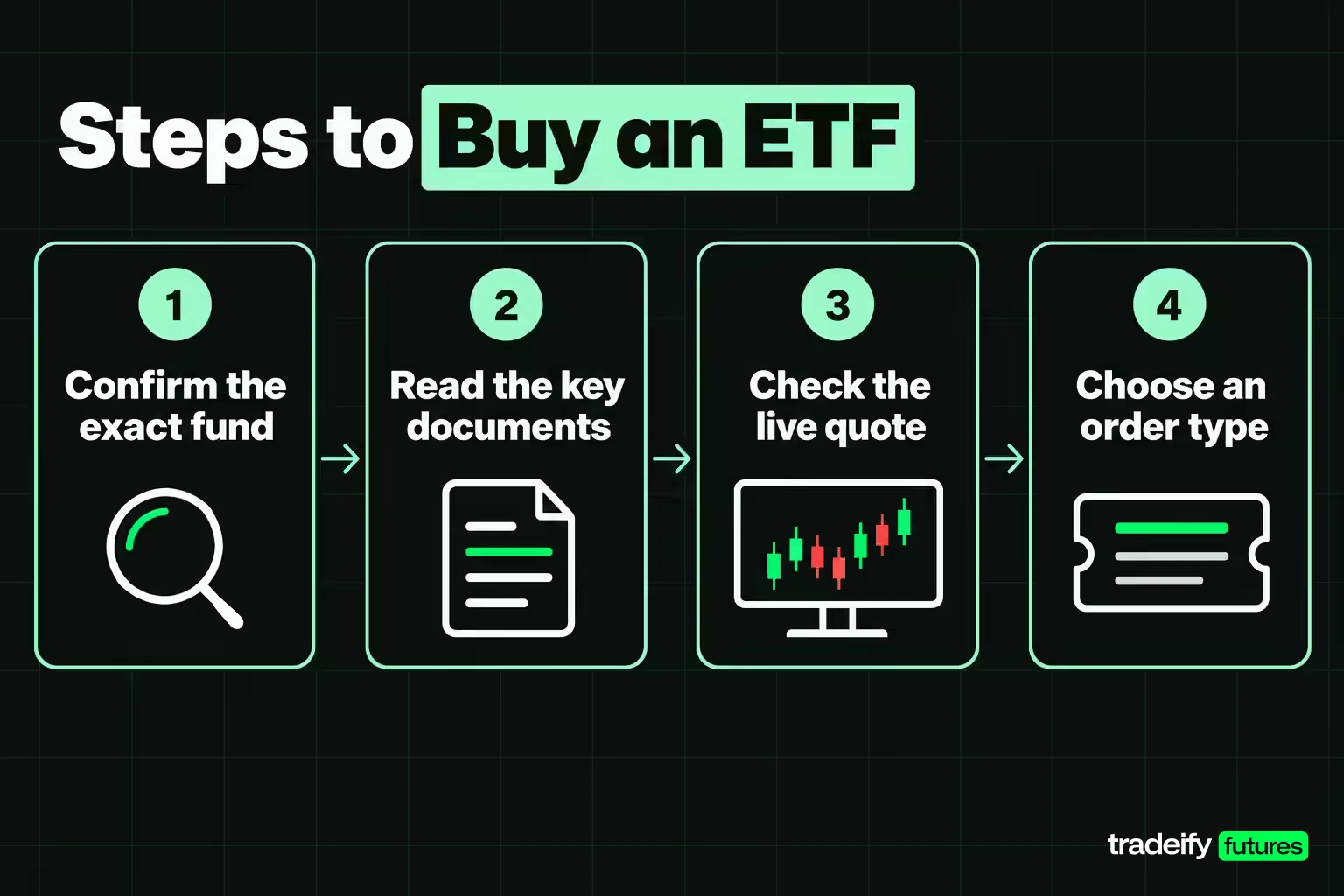
Buying an ETF works like buying a stock. You need a brokerage account, and you trade on the exchange during market hours.
Steps to buy an ETF
- Confirm the exact fund. Similar tickers and names can hide very different products. Check the issuer, objective and structure (ETF, ETN or commodity pool).
- Read the key documents. The prospectus and latest shareholder report, free on the SEC's website and the fund's site, show the objective, holdings, fees and principal risks.
- Check the live quote. Look at the bid, the ask, the spread and the price versus the fund's NAV or indicative value.
- Choose an order type. A market order fills fast at whatever price is available. A limit order sets the worst price you will accept, but it may not fill. On wide-spread funds, or near the open and close, a limit order gives you price control.
- Size the position by risk, not share price. A $30 ETF is not "cheaper" than a $300 ETF. What matters is how much you would lose if the exposure dropped 20%.
- Record why you own it. Write down the job the fund does in your portfolio and what would make you sell.
Selling is the same process in reverse. Since May 28, 2024, most U.S. securities trades settle on a T+1 basis, one business day after the trade date, according to the SEC.
Investing $1,000 in ETFs with fractional shares
You can invest $1,000 in ETFs; for many funds, one share costs far less. With illustrative numbers, $1,000 buys 4 shares of an ETF priced at $250. At $300 a share, it buys 3 whole shares with $100 left over, unless your broker offers fractional shares.
FINRA explains that fractional shares let you invest a dollar amount rather than a whole number of shares, and some brokers offer them on ETFs. Two limits apply: fractional shares can't currently be transferred to another brokerage, so moving accounts may mean selling first, and some brokers bundle fractional orders and fill them later in the day rather than in real time.
On costs, $1,000 in a fund charging 0.14% pays about $1.40 a year in expenses. At that size, a wide spread or a commission can cost more than a year of fund expenses, so the trading cost deserves as much attention as the expense ratio.
Related lesson: How limit orders control your price
ETF Investing Strategies
An ETF is a building block, not a strategy. How you combine and manage ETFs matters more than which ticker you start with. Common approaches:
- Core and satellite. A broad, low-cost index ETF forms the core, with smaller positions in sector or factor ETFs around it. The core carries the market exposure; the satellites express specific views, sized so a wrong view does limited damage.
- Regular contributions. Investing a fixed amount on a schedule spreads entries over time and removes the need to pick a day. It does not prevent losses in a falling market.
- Asset allocation across funds. Separate stock, bond and cash-like ETFs let you set the mix yourself rather than accepting a fund's built-in blend.
- Rebalancing. When one fund grows past its target weight, trimming it back resets the risk you signed up for. Rebalancing can trigger taxes in a taxable account.
- Income focus. Bond and dividend ETFs aim for regular distributions, with the caveat that payouts are not guaranteed.
- Tactical exposure. Sector, commodity or geared ETFs for short-term views. This is trading, and it needs a defined exit.
Why there is no list of the best ETFs
People search for "the top 5 ETFs to buy" or "the best ETF for $1,000". There is no honest single answer, because "best" depends on the job the fund has to do, your time horizon and what you already own. A cheap, broad index fund is a common starting point for long-term stock exposure, but it is a poor choice if what you actually need is short-term bond stability. This guide does not recommend specific funds.
A five-question check does more good than any list:
- What job does this fund do in my portfolio?
- What exactly does it hold, and how concentrated is it?
- What does it cost to own and to trade, given my holding period?
- How is it structured (1940 Act ETF, ETN, commodity pool, geared)?
- What is the most likely way it disappoints me?
Who Should Use ETFs
ETFs can suit a wide range of investors because the wrapper is flexible. Whether a particular ETF suits you depends on your goal, horizon and discipline.
- Beginners often start with broad index ETFs because one fund gives wide exposure at a low minimum. The risk is buying a narrow, geared or thematic fund on the assumption that all ETFs are diversified.
- Long-term investors use low-cost index ETFs as core holdings and benefit from fewer capital gains distributions in taxable accounts.
- Active traders use liquid ETFs to express market or sector views during the day. Geared ETFs exist for this purpose, but the SEC warns their returns over longer periods can differ sharply from the stated multiple.
An ETF is a poor fit when you need a guaranteed value or insured deposit, when you cannot explain what the fund holds, when the spread is wide relative to your holding period, or when the fund duplicates exposure you already own. Choosing not to buy is a valid decision. The fund will still be listed after you have done the reading.
ETF History and Growth
ETFs are a relatively young product. According to the SEC, it approved the first ETF in 1992. The early funds replicated broad domestic stock indexes; later ETFs added international, bond and sector indexes, then active strategies and geared products.
For decades each ETF needed its own exemptive order from the SEC to operate, and the SEC issued more than 300 of them. On Sept. 26, 2019, the SEC adopted Rule 6c-11 to give most ETFs a single, consistent framework. At that point the SEC counted approximately 2,000 ETFs with over $3.3 trillion in total net assets.
Growth since has been steep. ICI reported that ETF total net assets rose from $151 billion at year-end 2003 to $13.4 trillion at year-end 2025, taking ETFs from 2% to 30% of all assets managed by investment companies. Index ETFs held 89% of ETF net assets at year-end 2025. Index mutual funds and index ETFs together held 52% of long-term fund assets at year-end 2025, up from 19% at year-end 2010.
That growth brought lower average fees and far more choice. It also brought far more specialized products, which is why reading the prospectus matters more now than it did when most ETFs simply tracked a broad index.
ETFs and Index Futures for Active Traders
Active traders often weigh an S&P 500 ETF against S&P 500 index futures because both track the same index. They are built for different jobs.
| Feature | S&P 500 ETF | E-mini S&P 500 futures (ES) |
|---|---|---|
| What you hold | Shares of a fund that owns the stocks | A standardized exchange contract |
| Size | Any number of shares, or fractions | $50 times the index per contract |
| Ongoing cost | Expense ratio | Commissions and fees per trade; no expense ratio |
| Expiry | None | Quarterly contracts (March, June, September, December) |
| Gains and losses | Realized when you sell | Marked to market at the end of every session |
| Built-in leverage | None unless bought on margin | Yes, a margin deposit (performance bond) backs the full contract value |
The size difference is the one that bites. At an illustrative index level of 6,000, one ES contract controls 6,000 times $50, or $300,000 of exposure. The Micro E-mini (MES), at $5 times the index, controls $30,000. A 1% move in the index is $3,000 on one ES and $300 on one MES. An ETF investor with $3,000 in the fund would see $30 from the same move.
Futures suit traders who want precise exposure, CME Globex hours from Sunday 6:00 PM to Friday 5:00 PM ET (with a daily 5:00 PM to 6:00 PM ET maintenance break), and no fund expenses. ETFs suit investors who want to hold without contract expiry or daily mark-to-market cash flows. The question to ask is not which one tracks the index better. It is whether a 1% move on your position size is a number you can sit through.
We don't offer ETFs, cash stocks, options or single stock futures on our accounts; only the futures on our supported products list can be traded. Traders who want index exposure on our accounts use CME equity index futures such as ES, MES, NQ and MNQ, close every position by 4:45 PM ET, and trade in a simulated funded account.
Exchange-Traded Funds FAQ
What is the downside to an ETF?
An ETF can lose value, trade above or below the value of its holdings, and cost more than its expense ratio once spreads and commissions are counted. Narrow, leveraged, inverse or futures-based products add concentration, compounding or roll risks. The downside depends on the fund's holdings and structure, not on the ETF label.
What are ETF stocks?
"ETF stocks" usually means ETF shares, which trade on an exchange like stocks. Owning one gives you a slice of a fund's whole portfolio rather than ownership of a single company. Many stock ETFs hold hundreds of companies in one share.
What are the top 5 ETFs to buy?
There is no universal top five, because the right ETF depends on the job it does, your time horizon and what you already own. Rankings also change with markets and fees. Start from the exposure you need, such as broad stocks, bonds or income, then compare funds on holdings, expense ratio, spread and structure.
Can I invest $1,000 in ETFs?
Yes. Many ETFs trade for less than $1,000 a share, and some brokers sell fractional shares by dollar amount. At this size, check the spread and any commission, because trading costs can outweigh a year of fund expenses.
What is the expense ratio of an ETF?
The expense ratio is the yearly percentage of a fund's assets used to pay its operating costs, deducted from the fund's value. In ICI's March 2026 fee study, index equity ETFs averaged 14 basis points on an asset-weighted basis for 2025. Each fund lists its own figure in the prospectus fee table.
This article is for general education only and is not investment, tax or legal advice. ETFs and other exchange-traded products can lose value, including the money you invest, and diversification does not guarantee a profit or protect against loss. Leveraged, inverse and futures-based products can produce losses very different from the index they track. Futures carry built-in leverage and can lose more than expected. Funded and evaluation accounts at prop firms are simulated and differ from live brokerage trading. Read a fund's current prospectus before investing.


