



TL;DR: Hard vs soft commodities comes down to origin: hard ones are mined or drilled, soft ones are grown or raised. Gold, crude oil and copper are hard; coffee, cocoa, sugar, cotton, grains and cattle sit on the soft side. The label tells you which supply chain and reports to study, not how volatile a contract will be. One gold contract (100 oz) controls far more money than one corn contract (5,000 bushels). Check size, trading hours and the next report before trading either group.
Hard vs soft commodities is one of the first splits you meet in commodity markets. Hard commodities are extracted from the earth. Soft commodities are grown or raised.
That definition is correct, and it is where a lot of traders stop. The mistake is assuming the label tells you how a contract will behave.
It doesn't. It tells you how the commodity reaches the market, which points you to the right questions: production and inventories for crude oil, weather and harvest timing for coffee. It says nothing about how far a contract moves in a day, how much money one contract controls, or what hours it trades.
This guide covers both groups, how they differ, what moves their prices, where they trade, and how to turn the classification into a research routine you can actually use before an order goes in.
What Commodities Are and Why They Trade as Standard Contracts
A commodity is a raw or basic good that trades by grade and specification rather than by brand. A barrel of crude oil of a given quality is interchangeable with another barrel of the same quality. A bushel of corn that meets the contract grade is interchangeable with another bushel.
The Commodity Futures Trading Commission (CFTC) calls this fungibility. Futures contracts for the same commodity and delivery month on the same exchange are interchangeable because the exchange standardizes quality, quantity, delivery date and delivery location. That standardization is what lets thousands of buyers and sellers trade the same contract without inspecting the goods.
The CFTC also separates physical commodities from financial ones. A physical commodity is a tangible good, typically an agricultural commodity, an energy commodity or a metal. Interest rates, currencies and stock indexes are commodities in the legal sense too, but they are financial, and the hard versus soft split does not apply to them.
Most commodity traders never touch the physical goods. The CFTC notes that most futures contracts are closed before the delivery date, and some contracts settle in cash instead of delivery. Delivery still matters, though, because the possibility of delivery is what ties the futures price to the physical market.
Commodity Categories and the Hard vs Soft Split
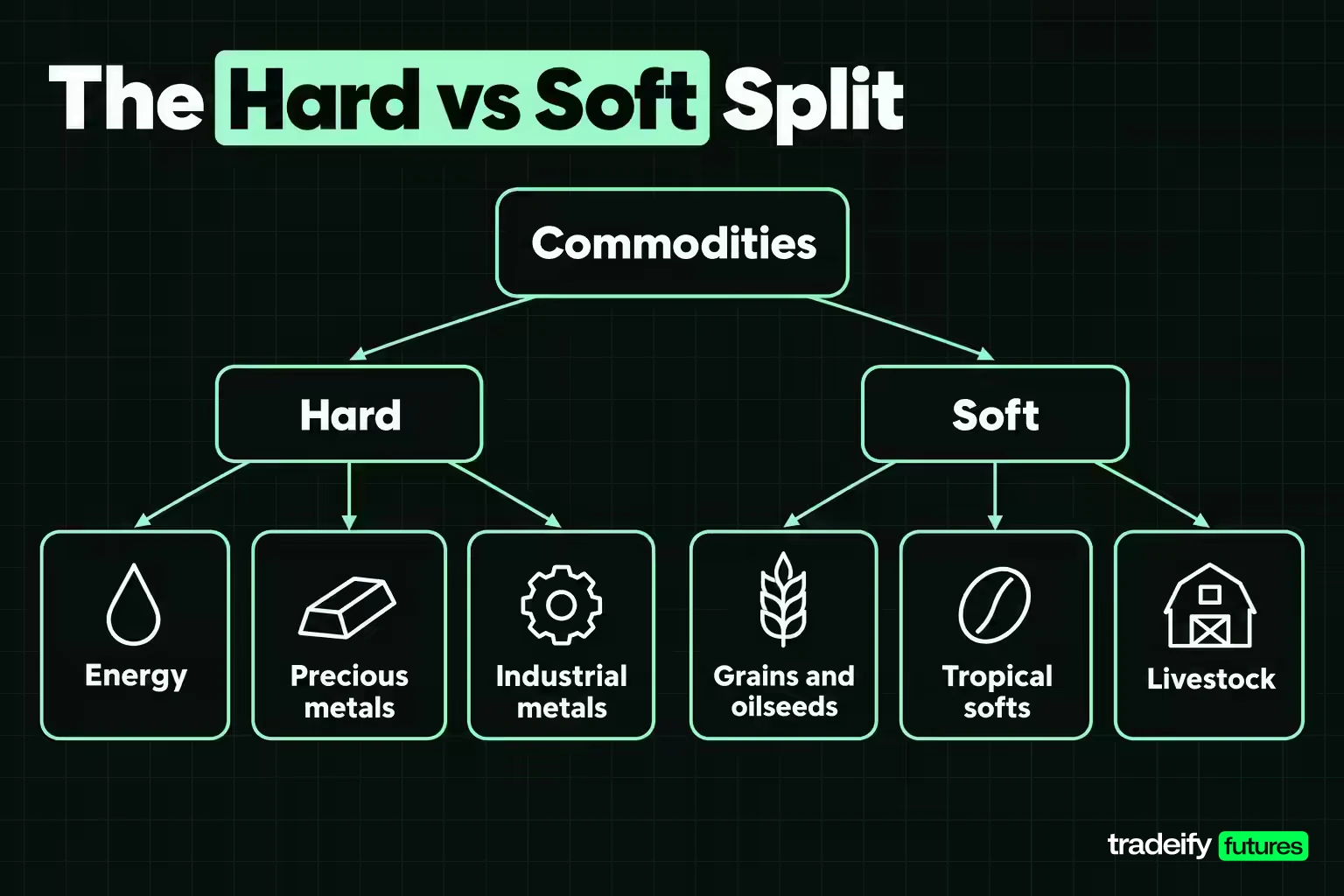
Commodity categories usually come in four broad groups: energy, metals, agriculture and livestock. Metals are often split again into precious metals (gold, silver, platinum) and industrial or base metals (copper, aluminum, zinc, nickel). Agriculture is often split into grains and oilseeds and the "softs."
The hard versus soft split sits on top of those groups.
| Commodity group | Examples | Hard or soft |
|---|---|---|
| Energy | Crude oil, natural gas, gasoline, heating oil | Hard |
| Precious metals | Gold, silver, platinum, palladium | Hard |
| Industrial metals | Copper, aluminum, zinc, nickel | Hard |
| Grains and oilseeds | Corn, wheat, soybeans, soybean oil | Soft (broad usage) |
| Tropical softs | Coffee, cocoa, sugar, cotton, orange juice | Soft |
| Livestock | Live cattle, feeder cattle, lean hogs | Soft (broad usage) |
US law draws almost the same line. The CFTC's definition of an agricultural commodity covers enumerated goods such as wheat, cotton, corn, the soybean complex and livestock, plus anything that is, or once was, or is derived from a living organism. Energy and metals fall into a different bucket the law calls exempt commodities. In plain terms, the legal agricultural group is the soft side and the exempt group is the hard side.
The narrow meaning of softs
Be careful with the word "softs." In broad education articles, every grown or raised commodity counts as soft. On trading desks and in index methodology, "softs" usually means a narrower group: coffee, cocoa, sugar and cotton, sometimes orange juice. Grains and livestock get their own groups.
The Bloomberg Commodity Index shows the narrow usage. Its 2027 target weights, announced October 29, 2026, list Grains at 20.61%, Softs at 8.84% and Livestock at 5.94% as three separate groups. If a report says "softs fell," it probably means coffee, cocoa, sugar and cotton, not corn.
Hard Commodities Explained
Hard commodities are natural resources that are mined, drilled or otherwise extracted. They fall into two families: energy and metals.
Energy hard commodities
Crude oil and natural gas are the core energy hard commodities, along with refined products such as gasoline and heating oil. The flagship US crude contract, NYMEX Light Sweet Crude Oil (CL), covers 1,000 barrels. Henry Hub Natural Gas (NG) covers 10,000 MMBtu.
Energy prices respond to production decisions, storage levels, refinery and power demand, pipeline and shipping limits, weather and politics. Inventory matters because stored supply is the buffer between what is produced today and what is used today.
Metal hard commodities like gold and copper
Gold, silver, copper, platinum and aluminum are mined. COMEX Gold (GC) covers 100 troy ounces, Silver (SI) covers 5,000 troy ounces and Copper (HG) covers 25,000 pounds.
The metals share an origin but not a demand profile. Gold trades as both a physical metal and a financial asset, so interest rates, the dollar, central-bank buying and risk sentiment often matter as much as mine supply. Copper is tied to construction, manufacturing, power grids and global industrial demand.
So a mine strike headline can matter a lot for copper and barely register in gold. Same label, different questions.
What sets hard commodities apart
Hard commodities tend to share a handful of features that shape how they trade.
- Durability. Gold, copper and crude oil do not rot. They can sit in vaults, warehouses and tanks for years, so stockpiles build up and become a major price input.
- Industrial use. Much of the demand comes from factories, power plants, transport and construction, which ties prices to the economic cycle.
- Capital-heavy supply. A new mine or oil field takes years and large investment to bring online, so supply responds slowly to higher prices even though the goods themselves never spoil.
- Storage and logistics. Pipelines, tankers, refineries and approved warehouses decide where supply can actually go. The London Metal Exchange, for example, runs a worldwide network of LME-approved warehouses for physical delivery.
- Standardized contracts. Liquid futures exist for most major hard commodities, often trading nearly around the clock.
Soft Commodities Explained
Soft commodities are grown or raised rather than extracted. The classic soft commodities are coffee, cocoa, sugar and cotton. In broad usage, grains, oilseeds and livestock also sit on the soft side.
What unites them is a biological clock. Crops have to be planted, grow through sensitive stages and be harvested. Herds take time to breed and feed. Nobody can speed that up, and output lost to a bad season usually stays lost until the next cycle.
That is why soft markets can stay tight for a long time after a weather shock. Higher prices cannot pull more cocoa out of trees that were damaged months ago.
Tropical softs and how their contracts are graded
The main tropical softs trade on ICE Futures U.S. in New York.
- Coffee C: 37,500 pounds of coffee per contract. The exchange grades the beans and cup-tests them for flavor before they are certified for delivery.
- Cocoa: 10 metric tons per contract, with deliverable origins split into groups that carry different premiums.
- Sugar No. 11: 112,000 pounds of raw cane sugar, based on 96 degrees average polarization.
- Cotton No. 2: 50,000 pounds net weight per contract.
That grading detail is a real difference from gold. One ounce of fine gold is much like another, but coffee and cocoa vary by origin, quality and flavor, and the exchange has to price those differences.
Grains and livestock on the soft side
Grains and oilseeds trade mainly on CBOT, part of CME Group. Corn (ZC) and soybeans (ZS) each cover 5,000 bushels. Live cattle (LE) trades on CME and covers 40,000 pounds.
These markets follow a planting and harvest calendar, and they carry an old-crop versus new-crop split. Contract months before harvest price the existing stock; months after harvest price a crop that is still in the ground or not yet planted. Livestock adds feed costs, animal weights, herd cycles and processing capacity.
Storage changes how a shock travels. Grains can be stored for long periods under the right conditions. Other soft commodities face quality loss, spoilage or handling limits, and cattle cannot be held back once they reach market weight without costs mounting.
Related lesson: How seasonal patterns show up in commodity prices
Key Differences Between Hard and Soft Commodities
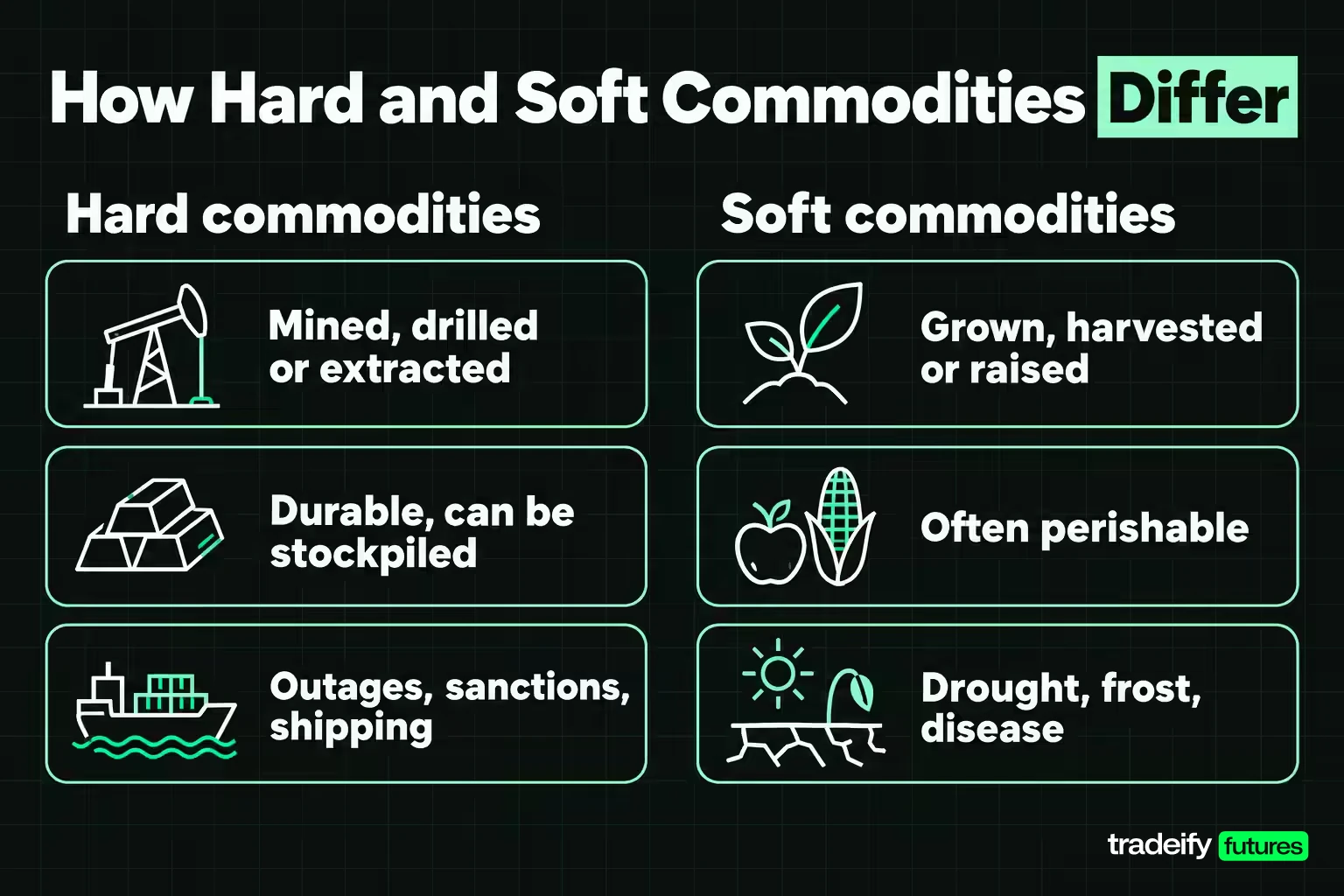
The key difference between hard and soft commodities is production method: extraction versus cultivation. For a trader, the more useful comparison is how each one turns a shock into a price change.
| Feature | Hard commodities | Soft commodities |
|---|---|---|
| Origin | Mined, drilled or extracted | Grown, harvested or raised |
| Supply response | Slow; new mines and wells take years | Fixed by planting and breeding windows |
| Storage | Durable; stockpiles can last years | Perishable or quality-sensitive for many |
| Typical shocks | Outages, sanctions, inventory surprises, shipping disruption | Drought, frost, disease, planting delays, export rules |
| Key US reports | EIA petroleum and gas storage reports | USDA WASDE and crop reports |
| Demand driver | Industrial activity, energy use, investment demand | Food, feed, textiles, consumer demand |
| Grading | Standard purity or quality specs | Origin, grade and quality differences often priced in |
The two lists overlap more than the table suggests. Hurricanes can shut energy production in the Gulf of Mexico, and governments can restrict grain exports for political reasons. The category points to the first question to ask, not the only one.
Trading hours differ between hard and soft commodities
Trading hours are one of the most practical differences, and most guides skip it. Major hard commodity futures on CME Globex trade nearly 23 hours a day. Crude oil, natural gas, gold, silver and copper run Sunday to Friday from 6:00 PM to 5:00 PM ET with a 60-minute daily break.
Many soft commodities trade far shorter sessions.
| Contract | Exchange | Electronic hours (ET) |
|---|---|---|
| Crude oil (CL) | NYMEX | 6:00 PM to 5:00 PM, Sunday to Friday |
| Gold (GC) | COMEX | 6:00 PM to 5:00 PM, Sunday to Friday |
| Corn (ZC) | CBOT | 8:00 PM to 8:45 AM, then 9:30 AM to 2:20 PM |
| Live cattle (LE) | CME | 9:30 AM to 2:05 PM, Monday to Friday |
| Coffee C | ICE Futures U.S. | 4:15 AM to 1:30 PM |
| Cocoa | ICE Futures U.S. | 4:45 AM to 1:30 PM |
| Sugar No. 11 | ICE Futures U.S. | 3:30 AM to 1:00 PM |
Short sessions change the trade. News that breaks after coffee closes at 1:30 PM ET cannot be traded until the next morning, so the price can open far from the prior close. A crude oil trader can react within minutes at almost any hour.
How volatile hard and soft commodities have been
A common claim is that soft commodities are more volatile than hard ones, or the reverse. The data does not support either as a rule.
To test it, the median daily move was measured for 13 front-month futures over 250 sessions from November 5, 2025 through November 4, 2026. The method used continuous front-month daily closes from Yahoo Finance and measured the absolute close-to-close percentage change each session. The median is used because it is barely affected by the few roll days in a continuous series.
| Futures contract | Group | Median daily move | Sessions with a 2%+ move |
|---|---|---|---|
| Natural gas | Hard (energy) | 2.1% | 52% |
| Silver | Hard (metal) | 2.1% | 51% |
| Crude oil | Hard (energy) | 2.0% | 50% |
| Cocoa | Soft | 2.0% | 50% |
| Coffee | Soft | 1.5% | 36% |
| Sugar | Soft | 1.1% | 24% |
| Gold | Hard (metal) | 1.0% | 21% |
| Copper | Hard (metal) | 1.0% | 21% |
| Wheat | Soft (grain) | 1.0% | 22% |
| Cotton | Soft | 0.8% | 14% |
| Corn | Soft (grain) | 0.7% | 10% |
| Soybeans | Soft (oilseed) | 0.6% | 7% |
| Live cattle | Soft (livestock) | 0.6% | 5% |
Cocoa moved as much as crude oil over that year. Gold and copper moved less than coffee. Soybeans and live cattle were the calmest of the group, and natural gas and silver the most active. Hard and soft contracts show up at both ends of the list.
Treat this as one year of history, not a forecast. Volatility rises and falls with each market's own supply story, so check recent ranges for the exact contract you plan to trade rather than assuming its label tells you.
What Moves Commodity Prices
Commodity prices move on supply and demand, but the forces behind supply and demand differ between hard and soft commodities. Some drivers hit both groups.
Price drivers shared by every commodity
- Global growth. Faster growth lifts demand for energy and metals, and for feed and food over time.
- The US dollar. Most major commodities are priced in dollars, so a stronger dollar can make them more expensive for buyers using other currencies.
- Interest rates and inflation. Higher rates raise the cost of holding inventory and compete with non-yielding assets like gold. Rising inflation can increase demand for real assets.
- Government policy. Tariffs, sanctions, export bans, biofuel mandates and strategic reserves can all shift supply or demand overnight.
- Technology. Shale drilling changed oil supply; electric vehicles and grid build-outs are changing demand for copper; better seeds raise crop yields.
- Positioning. The CFTC's Commitments of Traders report shows how commercial hedgers and speculators are positioned, using Tuesday data that is generally released on Friday.
What moves hard commodity prices
Hard commodity prices react to production, inventories, capacity and end-user demand. In energy, the US Energy Information Administration (EIA) publishes the Weekly Petroleum Status Report on Wednesdays at 10:30 AM ET and the Weekly Natural Gas Storage Report on Thursdays at 10:30 AM ET.
Here is what one release looks like. The EIA's November 4, 2026 report showed US commercial crude stocks (excluding the Strategic Petroleum Reserve) at 409,760 thousand barrels for the week ending October 30, down 865 thousand barrels on the week. As of the October 29, 2026 storage report, US working gas stood at 3,724 Bcf, up 80 Bcf on the week and 38 Bcf above the five-year average.
A number on its own says little, and this is where newer traders get caught. They see "crude stocks fell" and buy. Traders who have been burned before compare the figure with the prior week, the same week last year, the five-year average and what analysts expected. A draw that was smaller than forecast can push prices down even though stocks fell.
For metals, the inputs shift toward mine output, exchange warehouse stocks, industrial data from major consumers, the dollar and real interest rates.
What moves soft commodity prices
Soft commodity prices react to weather, crop stage, yields, quality, disease, export flows and demand for food, feed and fiber. Timing matters: the same rain can help a crop early in the season and hurt it near harvest.
The USDA's World Agricultural Supply and Demand Estimates (WASDE) is the main scheduled report for US-traded agricultural markets. It comes out monthly at 12:00 PM ET and covers US and world wheat, rice, coarse grains, oilseeds and cotton, plus US sugar, meat, poultry, eggs and milk. The next release is November 10, 2026. As with EIA data, the market reacts to the change from the prior estimate and the gap from expectations, not just the level.
Tropical softs add producer-country factors: rainfall in Brazil, Vietnam, West Africa or India, crop disease, port arrivals, local currencies and export policy.
Where Commodities Are Traded
Commodities trade on regulated futures exchanges, in physical spot markets between producers and users, and over the counter between large firms. For most traders, the exchange is where access starts.
- CME Group (US). Its four exchanges cover most US-traded hard commodities and grains: NYMEX for crude oil and natural gas, COMEX for gold, silver and copper, CBOT for corn, wheat and soybeans, and CME for live cattle and lean hogs.
- ICE Futures U.S. Home of the main tropical soft commodity contracts: Coffee C, Cocoa, Sugar No. 11 and Cotton No. 2.
- London Metal Exchange (LME). The world center for industrial metals, handling the majority of non-ferrous metal futures business. It has run since 1877 and is part of HKEX Group.
- Multi Commodity Exchange of India (MCX). Describes itself as India's top exchange for bullion futures, with gold in several contract sizes from 1kg down to 1 gram, plus crude oil, natural gas, base metals, cotton and others.
Venue matters more than it first appears. The same commodity can have different contract sizes, currencies, trading hours and delivery terms on different exchanges. A trader looking at "copper" on COMEX and on the LME is looking at two different products with different rules.
How to Trade Commodities Through Futures, Funds and Stocks
You can trade commodities directly through futures or the physical market, or indirectly through products that track them.
- Futures. The most direct exchange-traded route. You agree to buy or sell a set quantity at a set price on a future date, and most traders close before delivery. Futures use margin, so gains and losses are large relative to the money deposited.
- Options on futures. Give the right, not the obligation, to buy or sell a futures contract at a set price. They add pricing factors such as time decay and implied volatility.
- Spot and physical. Buying the goods themselves. This is realistic for gold coins or bars, and impractical for most individuals in oil, grain or cattle.
- CFDs and spread bets. Over-the-counter products offered by brokers in some countries. You trade the price difference with the broker as counterparty, not on an exchange, and availability depends on where you live.
- Commodity stocks and ETFs. Covered in the stocks and ETFs part of this section.
Commodity futures contract math
Commodity futures contract size decides how much money is at stake, and it varies far more than the hard versus soft label suggests. The prices in this table are round, illustrative levels, not quotes. The typical day applies each contract's median daily move over 250 sessions from November 5, 2025 through November 4, 2026, measured from Yahoo Finance front-month daily closes.
| Contract | Contract size | Illustrative price | Notional value | Typical day at the median move |
|---|---|---|---|---|
| Crude oil (CL) | 1,000 barrels | $90 per barrel | $90,000 | $1,800 (2.0%) |
| Natural gas (NG) | 10,000 MMBtu | $3.00 per MMBtu | $30,000 | $630 (2.1%) |
| Gold (GC) | 100 troy ounces | $4,000 per ounce | $400,000 | $4,000 (1.0%) |
| Silver (SI) | 5,000 troy ounces | $50 per ounce | $250,000 | $5,250 (2.1%) |
| Copper (HG) | 25,000 pounds | $6.00 per pound | $150,000 | $1,500 (1.0%) |
| Corn (ZC) | 5,000 bushels | $4.50 per bushel | $22,500 | $157.50 (0.7%) |
| Soybeans (ZS) | 5,000 bushels | $12.00 per bushel | $60,000 | $360 (0.6%) |
| Live cattle (LE) | 40,000 pounds | $2.20 per pound | $88,000 | $528 (0.6%) |
| Coffee C | 37,500 pounds | $2.80 per pound | $105,000 | $1,575 (1.5%) |
| Cocoa | 10 metric tons | $5,500 per ton | $55,000 | $1,100 (2.0%) |
| Sugar No. 11 | 112,000 pounds | $0.18 per pound | $20,160 | $221.76 (1.1%) |
| Cotton No. 2 | 50,000 pounds | $0.80 per pound | $40,000 | $320 (0.8%) |
Two lessons jump out. First, one gold contract at these prices controls about 18 times the value of one corn contract, so "one contract" is not a unit of risk. Second, gold's calm percentage moves still produce the second-largest typical dollar swing in the table because the contract is so large.
This is where the label quietly misleads people. A trader who thinks "gold is the steady one" and sizes it like corn is taking on many times the risk they meant to.
Tick values for hard and soft commodity contracts
Commodity tick values tell the same story at a smaller scale. One tick is $10.00 in crude oil and gold, $12.50 in copper, corn and soybeans, $18.75 in coffee, $11.20 in sugar and $5.00 in cotton. Before any trade, convert your stop distance into ticks and then into dollars.
Related lesson: The contract fields to check before placing an order
Commodity stocks and ETFs
Indirect exposure comes through company shares and funds. Mining, oil and gas, fertilizer and agribusiness stocks give exposure to commodity prices, but they also carry company risks such as costs, debt, management and hedging policy. A gold miner can fall while gold rises.
Commodity ETFs and exchange-traded products either hold the physical good (common for gold and silver) or hold futures and roll them forward as they expire. Futures-based funds can drift away from the spot price over time because of roll costs when later months are more expensive. Read how a fund gets its exposure before assuming it tracks the commodity.
A Pre-Trade Research Checklist for Any Commodity
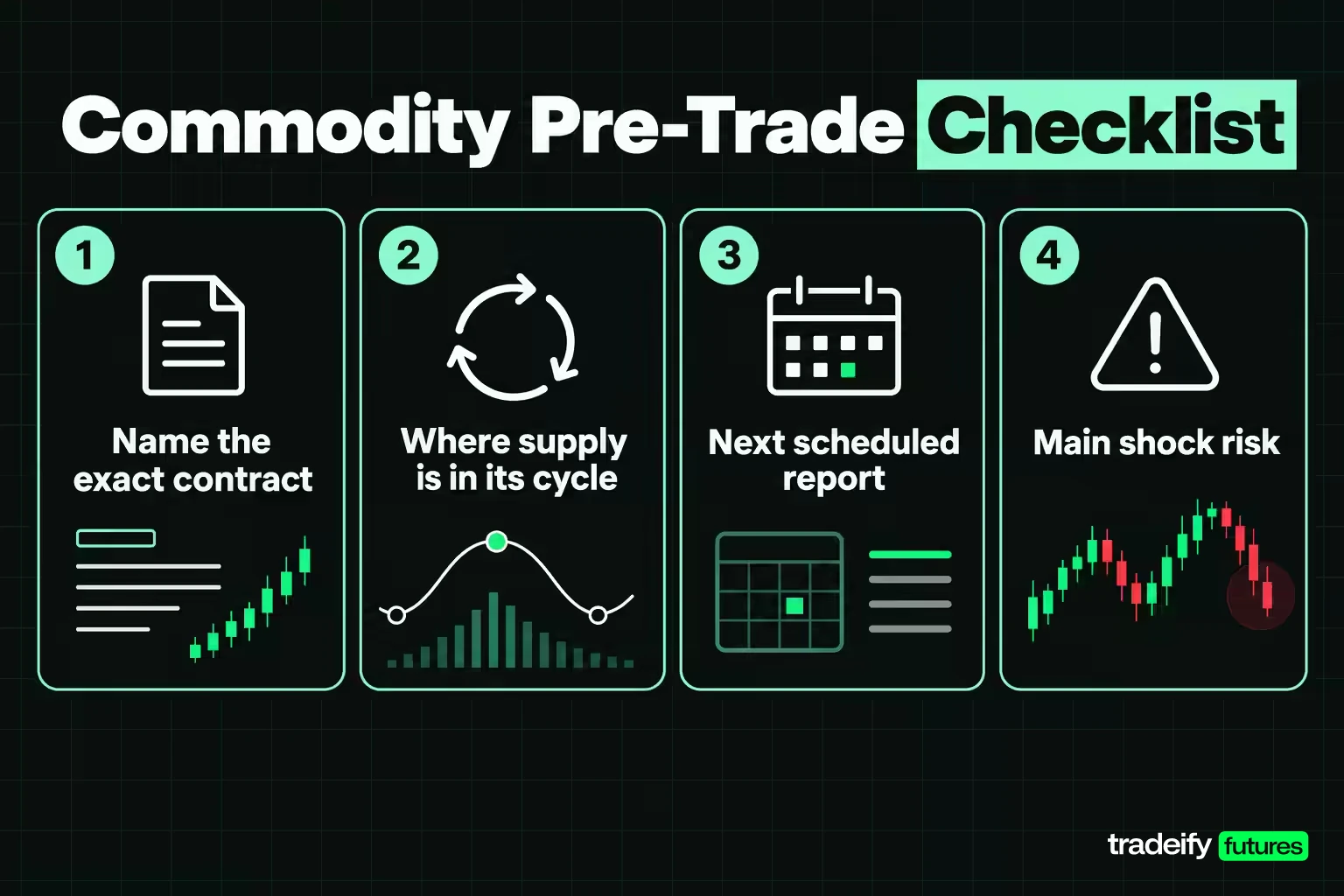
A commodity checklist turns a story ("oil looks tight," "cocoa crop is in trouble") into conditions you can test. The hard or soft label tells you which questions to ask first. It does not do the work.
- What is the exact contract? Write the commodity, exchange, contract month, contract size, tick value and settlement method. "Oil" or "coffee" is not precise enough.
- Where is supply in its cycle? For a hard commodity, check production, maintenance, transport and inventories. For a soft commodity, find the crop or herd stage: planting, development, harvest, storage.
- What is the next scheduled report? Name it, its release time, the expected figure and the result that would change the balance.
- What is the main shock risk? Pick one: a pipeline outage, a mine strike, frost, drought, disease, an export rule. A list so broad that every outcome fits is not a thesis.
- What would prove the idea wrong? Define the price level, report result or spread move that ends the trade.
Worked crude oil checklist example
Imagine a trader studying the front-month crude oil contract on a Tuesday, the day before the weekly EIA report.
- Contract: NYMEX crude oil, the named delivery month, 1,000 barrels, $10.00 per tick.
- Supply stage: production, imports, refinery runs and commercial stocks form the near-term balance.
- Next report: the EIA Weekly Petroleum Status Report, Wednesday at 10:30 AM ET, with the consensus stock change written down in advance.
- Main shock risk: a shipping disruption that tightens prompt supply.
- Invalidation: stocks rise more than expected while refinery runs fall and the spread between the first two months weakens.
None of that is a buy signal. It is a set of conditions that can be checked against the release.
Worked cocoa checklist example
Now imagine a trader studying cocoa during a sensitive crop stage in West Africa.
- Contract: ICE cocoa, the named delivery month, 10 metric tons, $10.00 per tick.
- Supply stage: crop development, port arrivals and the timing of the next harvest.
- Next report: the next arrivals or grindings data relevant to that market.
- Main shock risk: persistent dry weather or crop disease cutting expected output.
- Invalidation: improving field reports, stronger arrivals and a weakening nearby spread.
The questions change because the production clock changes. The discipline stays the same, and so does the step most traders skip: writing down the invalidation before the order.
Related lesson: Converting a stop distance into contract-level risk
Commodities in a Portfolio as Diversifier and Inflation Hedge
Long-term investors add commodities for two main reasons: diversification and inflation protection. Commodity prices are driven by physical supply and demand, so they do not always move with stocks and bonds.
The inflation link is real but uneven, and the hard versus soft split shows it. In the September 2026 US Consumer Price Index, released October 14, 2026, the energy index was up 20.4% from a year earlier while food was up 2.5%. Energy, a hard commodity group, was doing most of the inflation work in that release.
Broad commodity indexes lean toward the hard side. In the Bloomberg Commodity Index 2027 target weights, energy, industrial metals and precious metals add up to about 64.6% of the index, and grains, softs and livestock about 35.4%. Gold alone is the largest single component at 14.93%.
The limits matter too. Commodities pay no interest or dividends, futures-based funds carry roll costs, and commodity prices can fall hard in a recession. Allocation is a personal decision that depends on goals and risk tolerance, so treat commodities as one possible piece of a portfolio, not a guaranteed hedge.
Risks of Trading Commodities
Commodity futures carry the usual market risk plus a few risks specific to physical goods.
- Leverage and margin. CME describes futures margin as a deposit, not a down payment, and typically 3-12% of a contract's notional value. On a $90,000 crude contract, that range works out to $2,700 to $10,800 of margin controlling the full position. Exchanges can raise margin when volatility jumps.
- Gaps and limit moves. Short trading sessions and overnight news can open prices far from the prior close. Some contracts have daily price limits; ICE cotton's limit can range from 3 to 7 cents per pound, and a market locked at its limit may not let you exit.
- Liquidity. Front months are usually liquid. Deferred months and smaller contracts can have wide spreads and thin volume.
- Delivery. Many commodity futures are physically delivered. Holding into the delivery period can create obligations most traders do not want.
- Event risk. Weather, outages, sanctions and government reports can move prices sharply in minutes.
The CFTC warns that many individuals lose all of their money in futures and can be required to pay more than they initially invested. Size every position from its dollar risk, not from how convinced you are by the story. A strong drought thesis does not make a coffee contract any smaller.
Which Commodities Suit Beginners
Neither hard nor soft commodities are automatically easier for a beginner. What matters is contract size, trading hours, liquidity and how many reports you have to track. The temptation is to pick whichever market had the biggest move last week. That is usually the hardest place to learn.
Liquid hard commodity contracts with micro versions, such as Micro Gold or Micro Crude Oil, let a beginner trade a fraction of the full-size exposure and practice during long, continuous sessions. Gold also has fewer scheduled supply reports to track than most crops, though it reacts strongly to interest-rate and dollar news.
Soft commodities ask more of a beginner. Short sessions mean overnight gaps, crop and weather calendars take time to learn, and several tropical softs have large contracts relative to their daily moves. A sensible path is to learn one market deeply, its contract specs, its hours, its report calendar and its normal daily range, before adding a second.
Our product list includes the main CME hard commodities, crude oil, natural gas, gold, silver, copper, platinum and palladium with micro gold and micro crude, plus corn, wheat, soybeans, soybean oil and meal, lean hogs, live cattle and feeder cattle. ICE softs such as coffee, cocoa, sugar and cotton are not on it. Every position on our accounts closes by 4:45 PM ET, and a full-size contract such as one GC or one CL counts as one mini toward the contract limit. Corn and live cattle sessions end at 2:20 PM ET and 2:05 PM ET, before that flat time, so a position there has to be closed by that market's own close. Funded accounts are simulated.
Hard vs Soft Commodities FAQ
Is gold a hard or soft commodity?
Gold is a hard commodity because it is mined. It behaves differently from many other hard commodities because interest rates, the dollar, central-bank buying and investment demand drive it alongside mine supply.
Are grains soft commodities?
In broad usage, yes, because grains are grown. On trading desks and in commodity indexes, "softs" usually means coffee, cocoa, sugar and cotton, while grains form a separate group.
Are soft commodities more volatile than hard commodities?
Not as a rule. Over the year to November 4, 2026, cocoa moved about as much as crude oil each day, while soybeans and live cattle moved less than gold. Volatility depends on the specific market and its current supply story.
What are the four types of commodities?
The four common types are energy, metals, agriculture and livestock. Energy and metals are hard commodities; agriculture and livestock are soft commodities.
What are the top 3 commodities?
By weight in the Bloomberg Commodity Index for 2027, the top three commodities are gold at 14.93%, Brent crude oil at 8.59% and natural gas at 7.02%. There is no single official ranking, so a list by trade value or futures volume can differ.
How much is 1 lot of gold in MCX?
The standard MCX gold contract is 1kg. MCX also lists Gold Mini at 100 grams, Gold Ten at 10 grams, Gold Guinea at 8 grams and Gold Petal at 1 gram.
What does the word commodities mean?
Commodities are basic goods that trade by grade and specification rather than by brand, so one unit can stand in for another. Examples include crude oil, gold, wheat and coffee.
Putting the Commodity Label to Work
Use the hard or soft commodity label as a starting filter, then move past it. For your next commodity idea, write down five things: the exact contract and its tick value, where supply sits in its cycle, the next scheduled report and its time, the one shock that matters most, and the price or data point that would prove you wrong.
Then check the contract's hours and its normal daily dollar range against your risk limit. If you can't fill in every line, the idea is still a story, not a trade plan.
Commodity futures and leveraged products carry a high risk of loss, and losses can exceed the amount you put up in a live brokerage account. Evaluation and funded accounts are simulated and differ from live trading in execution and costs. This article is general education, not financial advice or a recommendation to trade any commodity or contract.


