




TL;DR: Futures contract specifications are the exchange-set terms that decide what one contract is worth per tick and when it ends. The contract unit times the tick size gives the tick value, which turns every stop into dollars. The same 40-tick stop costs $20.00 on some micro contracts and $500.00 on the E-mini S&P 500. Read the unit, tick, settlement method and last trading day before sizing any trade.
You've found a setup on a contract you haven't traded before. Before the stop goes in, one question decides whether the trade is sized right: what is a tick on this thing actually worth?
Futures contract specifications answer that. They are the rules an exchange writes for each futures product: how much of the underlying one contract represents, how its price is quoted, the smallest price change allowed, which months are listed, when trading stops, and how the contract settles. Every trader in that contract trades the same terms. Only the price is negotiated.
This guide walks through each field on a specification page, using CME Group specs for twelve common contracts read on November 4, 2026, and shows how those fields decide your dollar risk before you place an order.
What Futures Contract Specifications Are
A futures contract is a legally binding agreement to buy or sell a standardized asset on a specific date or during a specific month, traded through a futures exchange. That is CME Group's definition, and the key word is standardized. The exchange sets the quantity, quality, delivery time and location, so the specifications are identical for every participant and the only variable left is price.
The CFTC describes the same thing from the regulator's side. Exchanges set the contract size, the delivery months, the last trading day, the delivery locations and the acceptable grades. That standardization is what lets thousands of buyers and sellers trade one instrument without negotiating terms.
Futures contracts are also centrally cleared. Once a trade matches, the clearing house becomes the buyer to every seller and the seller to every buyer.
For a trader, this means futures contract specifications are not a negotiation. You are reading terms someone else set. The specs tell you what a one-point move costs, whether the contract can end in a delivery obligation, and when it stops trading.
Get one field wrong and the position size, the stop or the exit plan is wrong with it. The chart won't warn you. Two contracts on the same index can look identical on screen while one carries ten times the dollar risk per point.
The Fields on a Contract Spec Sheet
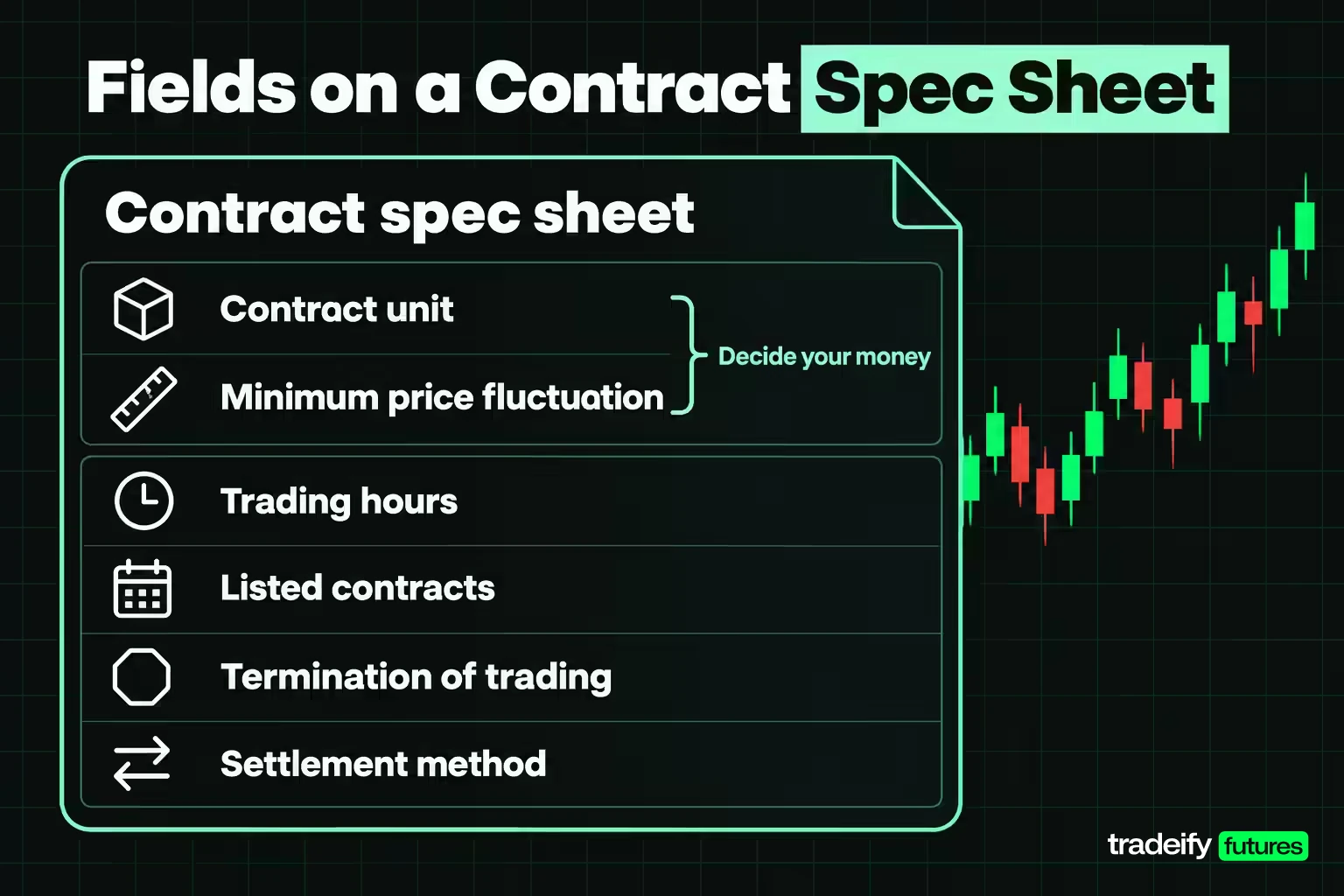
Every contract spec sheet on CME Group lists roughly the same fields. The values differ from product to product, and so does what each field decides.
| Spec field | E-mini S&P 500 (ES) | Crude Oil (CL) | What the field decides |
|---|---|---|---|
| Contract unit | $50 x S&P 500 Index | 1,000 barrels | Dollar exposure per point or per unit of price |
| Price quotation | Dollars and cents per index point | Dollars and cents per barrel | The units a quote is written in |
| Minimum price fluctuation | 0.25 index points = $12.50 | $0.01 per barrel = $10.00 | Smallest valid price change and its dollar value |
| Trading hours | Sunday 6:00 PM to Friday 5:00 PM ET, daily break | Sunday to Friday 5:00 PM to 4:00 PM CT, daily break | When you can enter or exit |
| Listed contracts | Quarterly, Mar, Jun, Sep, Dec | Monthly | Which expiries exist |
| Termination of trading | 9:30 AM ET, third Friday of the contract month | 3 business days before the 25th calendar day of the prior month | The last moment to exit |
| Settlement method | Financially Settled | Deliverable | What happens to a position held through expiry |
| Price limits | Equity index limits | Dynamic Circuit Breakers | How far price can move before trading pauses |
Two of these fields decide your money: the contract unit and the minimum price fluctuation. Multiply them and you have the tick value. The rest decide your obligations and your timing, which is where traders get caught near expiry. Margin is not part of the spec itself. It is published separately and changes more often.
Related lesson: How futures contracts work
Contract Unit and Multiplier
The contract unit tells you what one contract represents. Futures contract specifications express it in one of two ways.
Equity index futures use a dollar multiplier of the index. The E-mini S&P 500 is $50 x S&P 500 Index, so each full index point is worth $50 per contract. The Micro E-mini S&P 500 is $5 x the same index.
Physical commodities use a quantity. Crude Oil is 1,000 barrels, Gold is 100 troy ounces, and Corn is 5,000 bushels.
| Contract | Symbol | Contract unit | Illustrative price | Notional value at that price |
|---|---|---|---|---|
| Micro E-mini S&P 500 | MES | $5 x S&P 500 Index | 7,000 | $35,000 |
| E-mini S&P 500 | ES | $50 x S&P 500 Index | 7,000 | $350,000 |
| Micro E-mini Nasdaq-100 | MNQ | $2 x Nasdaq-100 Index | 25,000 | $50,000 |
| E-mini Nasdaq-100 | NQ | $20 x Nasdaq-100 Index | 25,000 | $500,000 |
| Micro WTI Crude Oil | MCL | 100 barrels | $70.00 | $7,000 |
| Crude Oil | CL | 1,000 barrels | $70.00 | $70,000 |
| Micro Gold | MGC | 10 troy ounces | $4,000.00 | $40,000 |
| Gold | GC | 100 troy ounces | $4,000.00 | $400,000 |
| Corn | ZC | 5,000 bushels | 450 cents | $22,500 |
The prices in that table are round illustrative levels, not quotes. The point is the multiplication. Notional value is price times the contract unit, and it tells you how much market exposure one contract carries.
The answer to "what is the standard size of a futures contract" is that there isn't one. Each product has its own unit, and even two contracts on the same index can differ by ten times.
Related lesson: What notional value means
How a Contract Spec Quotes Price
The price quotation field tells you which units a futures price is written in. You need it before any quote on your screen means anything.
- Equity index futures are quoted in U.S. dollars and cents per index point.
- Crude Oil is quoted in U.S. dollars and cents per barrel.
- Gold is quoted in U.S. dollars and cents per troy ounce.
- Corn is quoted in U.S. cents per bushel.
Corn is where the quotation field trips people up. A corn quote of 450 means 450 cents, which is $4.50 per bushel, not $450. Using the corn spec, a move of 3.25 cents is $0.0325 x 5,000 bushels, or $162.50 per contract, and that is 13 ticks of a quarter cent.
The mistake is easy to make when you switch markets mid-session. Carry "dollars per unit" over from crude oil to a cents-quoted grain contract and every quote is off by a factor of one hundred, including the one your stop is based on.
Tick Size in a Futures Spec
Tick size is the minimum price fluctuation: the smallest price change the exchange accepts. Futures specs list it in the contract's own quote units.
- E-mini S&P 500, E-mini Nasdaq-100 and their micros tick in 0.25 index points, so there are 4 ticks per index point.
- E-mini Russell 2000 and Micro E-mini Russell 2000 tick in 0.10 index points, so 10 ticks per point.
- E-mini Dow and Micro E-mini Dow tick in 1.00 index point, so 1 tick per point.
- Crude Oil and Micro WTI Crude Oil tick in $0.01 per barrel, so 100 ticks per $1.00.
- Gold and Micro Gold tick in $0.10 per troy ounce, so 10 ticks per $1.00.
Tick size matters most when you place a stop. A price distance has to be a whole number of ticks to be a valid price. A 20-point stop on MES is 80 ticks, which works. A 20.1-point stop is 80.4 ticks, which is not a price the contract can trade at, so a platform may reject it or round it in a direction you didn't choose.
The same check applies to commodities. On Micro Gold, a $12.30 distance is 123 ticks, while $12.35 is 123.5 ticks and can't be placed.
Some specs also list a smaller tick for calendar spreads. The E-mini S&P 500 outright tick is 0.25, while its calendar spread tick is 0.05 index points = $2.50. If you trade outrights, the outright tick is the one that counts.
Related lesson: Tick size and tick value
Tick Value From the Contract Specs
Tick value is the dollar amount one tick is worth on one contract. You get it by multiplying the contract unit by the tick size, and the exchange prints the result on the spec page.
| Contract | Symbol | Tick size | Tick value |
|---|---|---|---|
| Micro E-mini S&P 500 | MES | 0.25 index points | $1.25 |
| E-mini S&P 500 | ES | 0.25 index points | $12.50 |
| Micro E-mini Nasdaq-100 | MNQ | 0.25 index points | $0.50 |
| E-mini Nasdaq-100 | NQ | 0.25 index points | $5.00 |
| Micro E-mini Dow | MYM | 1.0 index point | $0.50 |
| E-mini Dow | YM | 1.00 index point | $5.00 |
| Micro E-mini Russell 2000 | M2K | 0.10 index points | $0.50 |
| E-mini Russell 2000 | RTY | 0.10 index points | $5.00 |
| Micro WTI Crude Oil | MCL | $0.01 per barrel | $1.00 |
| Crude Oil | CL | $0.01 per barrel | $10.00 |
| Micro Gold | MGC | $0.10 per troy ounce | $1.00 |
| Gold | GC | $0.10 per troy ounce | $10.00 |
Check the formula on any row. ES is 0.25 x $50 = $12.50. MGC is $0.10 x 10 = $1.00. NQ is 0.25 x $20 = $5.00. CL is $0.01 x 1,000 = $10.00. Corn, off the table, is $0.0025 x 5,000 = $12.50. If a number you copied fails that multiplication, it is wrong.
Tick value alone can mislead. MNQ, MYM and M2K all tick at $0.50, but one MNQ tick is a quarter of an index point, one M2K tick is a tenth of a point, and one MYM tick is a full point. Same dollar per tick, very different market moves per tick.
One 40-Tick Stop Across Twelve Contract Specs
Here is what the contract specs do to a single stop. Hold the stop at 40 ticks and change only the contract. Then ask how many contracts a $500 risk budget can carry with that stop.
| Symbol | 40 ticks as a price distance | Cost per contract | Contracts on $500 | Risk used | Unused budget |
|---|---|---|---|---|---|
| MES | 10.00 index points | $50.00 | 10 | $500.00 | $0.00 |
| ES | 10.00 index points | $500.00 | 1 | $500.00 | $0.00 |
| MNQ | 10.00 index points | $20.00 | 25 | $500.00 | $0.00 |
| NQ | 10.00 index points | $200.00 | 2 | $400.00 | $100.00 |
| MYM | 40 index points | $20.00 | 25 | $500.00 | $0.00 |
| YM | 40 index points | $200.00 | 2 | $400.00 | $100.00 |
| M2K | 4.00 index points | $20.00 | 25 | $500.00 | $0.00 |
| RTY | 4.00 index points | $200.00 | 2 | $400.00 | $100.00 |
| MCL | $0.40 per barrel | $40.00 | 12 | $480.00 | $20.00 |
| CL | $0.40 per barrel | $400.00 | 1 | $400.00 | $100.00 |
| MGC | $4.00 per ounce | $40.00 | 12 | $480.00 | $20.00 |
| GC | $4.00 per ounce | $400.00 | 1 | $400.00 | $100.00 |
Every row is 40 ticks. The cost runs from $20.00 to $500.00 per contract, which is 25 times. The price distance runs from $0.40 per barrel to 40 index points.
So "I risk 40 ticks" says nothing about risk until you name the contract. The tick count describes the chart. The dollar figure describes your account.
The unused budget column is the granularity point. You can't buy half a contract, so with a $200.00 per-contract cost, $500 funds 2 contracts and leaves $100.00 unused. Micro contracts let a trader use the budget almost exactly, which matters more on a small account than any headline leverage figure.
Related lesson: Sizing a futures position from a stop distance
How Contract Specs Turn Price Moves Into Gains and Losses
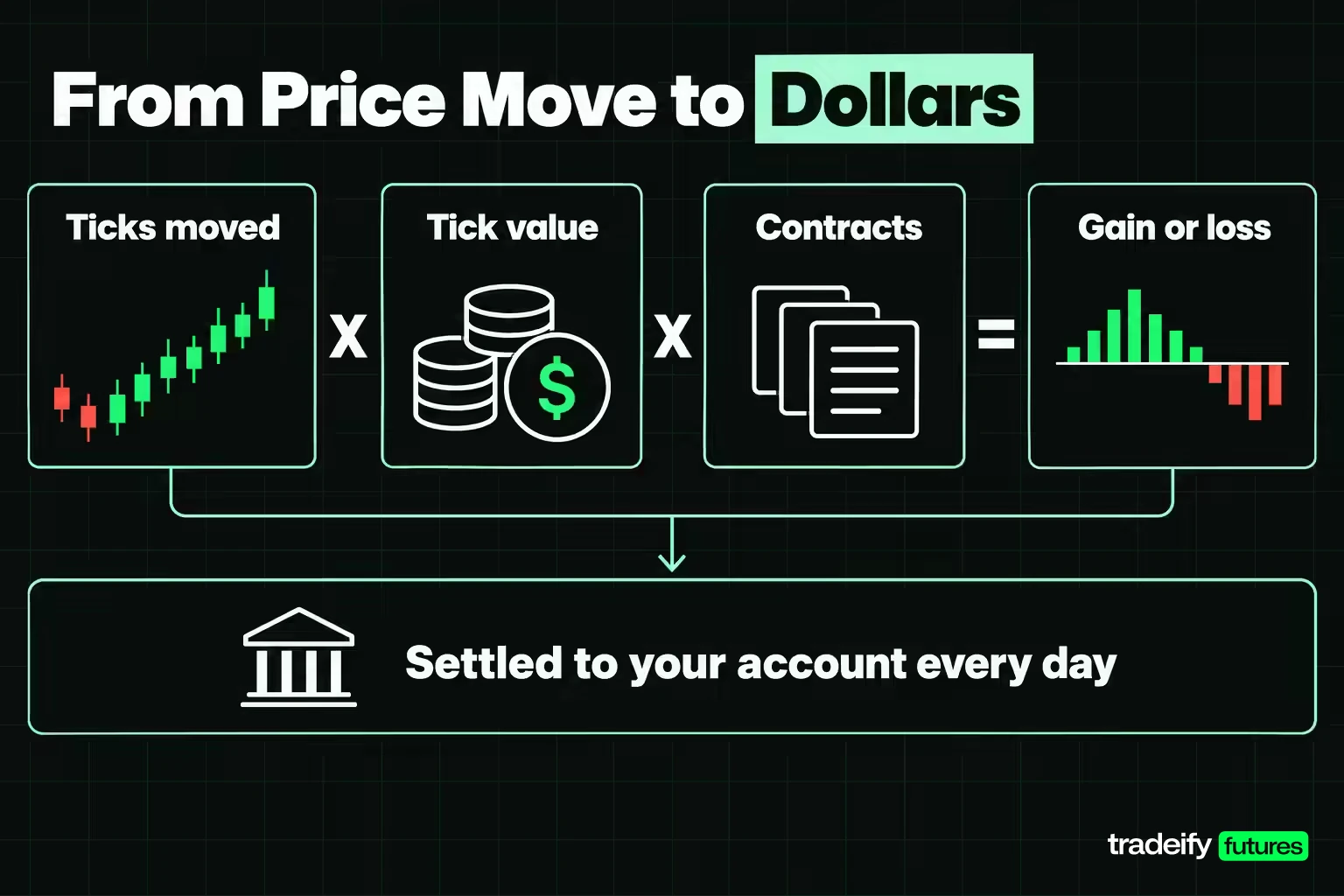
Gains and losses on a futures position come straight from the contract specs: ticks moved x tick value x number of contracts. The direction tells you the sign.
Futures are also marked to market every day. CME Group sets one official daily settlement price for each contract, the same for everyone, and the method is disclosed in the specifications and the rulebook. The difference between yesterday's settlement and today's settlement is credited to or debited from your account. CME puts it simply: losers pay winners every day, and no losses are carried forward.
Here is an illustrative Micro E-mini S&P 500 trade held across sessions in a standard brokerage account:
- Buy 2 MES at 7,000.00.
- Day 1 settles at 6,985.50. That is -14.50 points x $5 x 2 = -$145.00, debited that evening.
- Day 2 settles at 7,012.25. That is +26.75 points from the prior settlement, +$267.50, credited.
- Day 3 you sell at 7,020.00. That is +7.75 points from the last settlement, +$77.50.
The daily flows add up to +$200.00, the same as 20 points x $5 x 2 from entry to exit. Mark-to-market doesn't change the total. It changes when the cash moves, and a bad first day can trigger a margin call before the trade has a chance to come back.
The settlement time is in the specs too. The E-mini S&P 500 daily settlement uses a volume-weighted average of lead-month trades between 3:14:30 PM and 3:15 PM CT, while corn settles from trading between 1:14 PM and 1:15 PM CT.
Related lesson: The daily settlement arithmetic behind futures P&L
Trading Hours and Listed Months in the Specs
The trading hours field tells you when the contract trades on CME Globex. Hours differ more than most new traders expect.
- Micro E-mini S&P 500: Sunday 6:00 PM to Friday 5:00 PM ET, with a daily maintenance period from 5:00 PM to 6:00 PM ET.
- Crude Oil: Sunday to Friday 5:00 PM to 4:00 PM CT, with a 60-minute break each day starting at 4:00 PM CT. That is 6:00 PM to 5:00 PM ET.
- Corn: Sunday to Friday 7:00 PM to 7:45 AM CT, then Monday to Friday 8:30 AM to 1:20 PM CT. Corn has a gap in the morning and closes in the early afternoon.
The listed contracts field tells you which expiries exist.
- E-mini S&P 500 lists quarterly contracts (Mar, Jun, Sep, Dec) for 21 consecutive quarters. The Micro E-mini S&P 500 lists 5 consecutive quarters.
- Crude Oil lists monthly contracts for the current year and the next 10 calendar years, plus 2 additional months.
- Micro WTI Crude Oil lists monthly contracts for the current year and the next 3 calendar years.
- Gold lists 26 consecutive months plus any June and December in the nearest 72 months.
- Micro Gold lists only Feb, Apr, Jun, Aug, Oct and Dec in the nearest 24 months.
So a micro contract doesn't always offer the same months as its full-size parent. Micro Gold has no November contract at all.
Related lesson: Futures symbols and month codes
Settlement Method in a Futures Spec
The settlement method field says how a contract ends if it is still open when trading terminates. There are two answers.
Financially Settled means no goods change hands. Open positions are closed against a final settlement price and the difference is paid in cash. All eight equity index contracts in this guide (ES, MES, NQ, MNQ, YM, MYM, RTY, M2K) are financially settled.
Deliverable means the contract can end in physical delivery of the underlying. Crude Oil, Gold, Micro Gold and Corn are deliverable.
Micro WTI Crude Oil is the exception worth remembering. It is financially settled while its full-size parent, Crude Oil, is deliverable. Ten MCL contracts carry the same 1,000 barrels of exposure as one CL, but they don't end the same way.
Related lesson: Cash vs physical settlement
Last Trading Day, Expiration and Delivery
The termination of trading field gives the last moment you can trade an expiring contract. The rule differs by product family.
| Contract | Termination of trading |
|---|---|
| ES, MES, NQ, MNQ, YM, MYM, RTY, M2K | 9:30 AM ET on the third Friday of the contract month |
| CL | 3 business days before the 25th calendar day of the month before the contract month |
| MCL | 1 business day before the matching CL contract terminates |
| GC | 12:30 PM CT on the third last business day of the contract month |
| MGC | Third last business day of the contract month |
| ZC | Business day before the 15th day of the contract month |
Two details stand out. Crude Oil stops trading in the month before its contract month, so the December contract expires in November. And "third Friday" is an equity index rule, not a futures rule in general.
What Happens to a Futures Contract at Expiry
What happens at expiry depends on the contract's settlement method.
For the E-mini S&P 500, CME's rulebook says delivery is by cash settlement against a special opening quotation of the S&P 500, calculated on the third Friday from the opening prices of the index stocks. A long or short position still open after 9:30 AM ET that day is simply paid or charged the difference.
For Crude Oil, a position open at termination becomes a delivery obligation. The NYMEX rulebook sets delivery at pipeline or storage facilities in Cushing, Oklahoma. Gold delivered under the contract must assay to a minimum of 995 fineness. Corn has its own delivery grades, with #2 Yellow at contract price.
Most traders never get there. The CFTC notes that most futures contracts, by volume, are closed by an offsetting trade before delivery, and the delivery provision exists to keep the futures price tied to the cash market.
That doesn't make the termination field optional. A short-term trader holding a deliverable contract has no use for 1,000 barrels in Oklahoma, so the only sensible plan is to know the last trading day and be out, or rolled to the next month, well before it.
Related lesson: Futures expiration dates
Margin Requirements Next to the Contract Specs
Margin sits next to futures contract specifications on most broker and exchange pages, but it is a different kind of number. The spec fields are product terms. Margin is a deposit requirement that the clearing house resets as volatility changes.
The CFTC describes futures margin as a performance bond, not a down payment, typically between 2% and 10% of the contract's total value. Initial margin is posted to open a position. Maintenance margin is the level the account must stay above. If a daily mark-to-market loss takes equity below maintenance, the trader has to top the account back up to the initial level.
On an illustrative $35,000 MES notional, that 2% and 10% band works out to $700 to $3,500. That is a range for orientation, not a CME or broker figure. CME Clearing raises margins when volatility rises and lowers them when it falls, with at least 24 hours' notice, and brokers often charge more than the exchange minimum.
So treat any margin number you see as a reading with a date on it. A figure saved from a quiet month can be wrong after a volatile week. Check the current requirement with your broker for the exact contract month before you trade.
Price Limits and Circuit Breakers in the Specs
The price limits field links to the rules that stop or pause trading after an extreme move. The rules differ by product.
- Equity index futures. During regular hours (8:30 AM to 2:25 PM CT), CME sets downside limits at 7%, 13% and 20% below a reference price. Overnight, a hard limit of 7% applies in both directions. On an illustrative reference of 7,000, 7% is 490 points, which is $2,450 per MES and $24,500 per ES.
- Energy and metals. Crude Oil and Gold use Dynamic Circuit Breakers. If price moves beyond a set variant from the high or low of a rolling 60-minute window, trading pauses for two minutes.
- Grains. Corn has a daily price limit that CME resets twice a year. As of November 2026, the corn initial limit is $0.35 per bushel, or $1,750 per contract, with an expanded limit of $0.55.
Price limits matter for risk because a stop order can't fill at a price the market isn't allowed to trade. If a contract pauses or locks at its limit, your stop waits with everyone else's, and the fill can land well past the level you planned. A stop limits risk in normal trading. It does not cap it.
Related lesson: Futures price limits
Micro and Full-Size Contract Specs Compared
Micro futures contract specs are built as exact fractions of the full-size contract. Across the six most common pairs, the micro unit is one tenth of the parent.
| Pair | Full-size unit | Micro unit | Full-size tick value | Micro tick value | Settlement |
|---|---|---|---|---|---|
| S&P 500 (ES and MES) | $50 x index | $5 x index | $12.50 | $1.25 | Both financially settled |
| Nasdaq-100 (NQ and MNQ) | $20 x index | $2 x index | $5.00 | $0.50 | Both financially settled |
| Dow (YM and MYM) | $5 x index | $0.50 x index | $5.00 | $0.50 | Both financially settled |
| Russell 2000 (RTY and M2K) | $50 x index | $5 x index | $5.00 | $0.50 | Both financially settled |
| WTI crude (CL and MCL) | 1,000 barrels | 100 barrels | $10.00 | $1.00 | CL deliverable, MCL financially settled |
| Gold (GC and MGC) | 100 troy ounces | 10 troy ounces | $10.00 | $1.00 | Both deliverable |
The tick size is the same inside every pair, so the tick value falls by exactly ten times. What doesn't always match is everything else on the spec sheet: settlement method for crude oil, listed months for gold, and termination timing for crude oil. Read the micro product's own spec page rather than assuming it mirrors the parent.
Related lesson: Mini and micro futures contracts
Which Specification Fields Change and Which Stay Put
Some specification fields are close to permanent. Others move on a schedule or with the market.
| Field | How often it changes | When to re-check |
|---|---|---|
| Contract unit | Rarely, only by a formal exchange product change | Once, when you first trade the product |
| Tick size and tick value | Rarely | Once, and after any exchange notice |
| Settlement method | Rarely | Once per product |
| Listed contract months | Continuously, as old months expire and new ones list | Each time you pick a contract month |
| Termination of trading date | Every contract month has its own date | Before each expiry you trade near |
| Price limits | Equity index limits are rule-based; corn limits reset twice a year | Each reset, and before volatile events |
| Margin | Any time volatility changes | Before every new position size |
Save the unit, the tick and the settlement method once. Re-read the listed months, the termination date and the margin each time.
A Pre-Trade Checklist for Futures Contract Specs
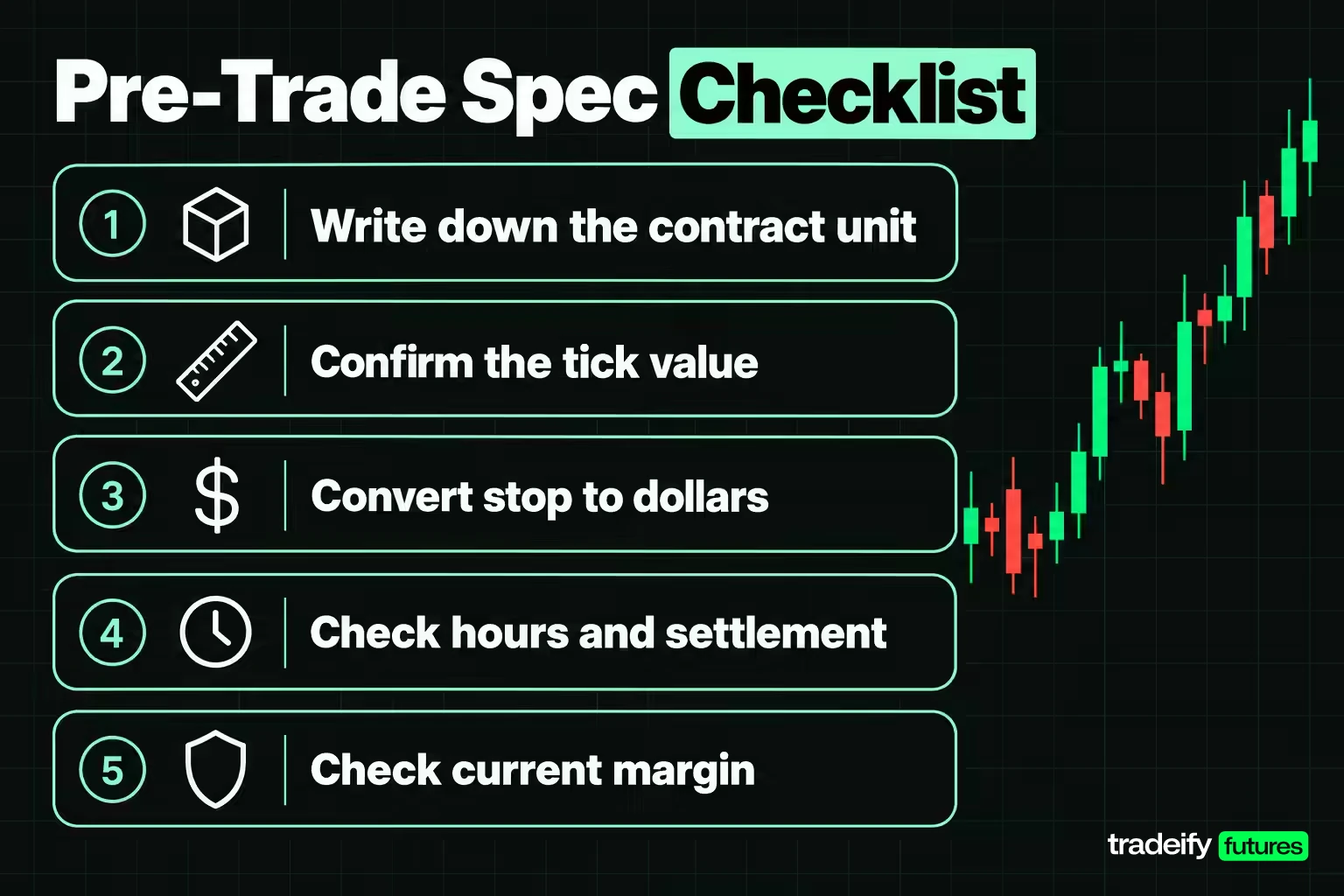
Use the spec sheet in this order before you trade a contract for the first time.
- Write down the contract unit in its own terms, for example $5 x S&P 500 Index or 10 troy ounces.
- Find the tick size and multiply it by the unit. Confirm that the result matches the tick value printed on the page.
- Convert your stop into ticks and check that it is a whole number.
- Multiply the ticks by the tick value to get dollar risk per contract. Divide your risk budget by that figure and round down. A 20-point MES stop is $100 per contract, so a $500 budget funds 5 contracts.
- Check the trading hours, so you know when you can and can't exit.
- Check the settlement method and the termination of trading date, and decide in advance when you will exit an expiring month.
- Check the current margin with your broker for that contract month.
A funded or evaluation account adds a rule layer on top of the spec sheet. Daily loss limits, drawdown limits and contract caps are measured in dollars and contracts, so the tick value decides how fast a given move uses up those limits.
On our accounts at Tradeify, positions are sized by contract limits. A 50K account allows 4 minis or 40 micros, 10 micros count as 1 mini, and full-size contracts such as GC or CL each count as one mini. All positions must be closed by 4:45 PM ET, so none of our positions is held into expiry or delivery. That leaves the unit, the tick value and the current contract month as the spec fields that matter most. Our funded accounts are simulated.
Futures Contract Specifications FAQ
Where can I find futures contract specifications?
The exchange that lists the contract publishes them. For CME Group products, each product page has a contract specs tab with the unit, tick, hours, listed months, termination rule and settlement method. Broker pages often copy these, so check the exchange page if a figure looks off.
What is the most important number on a futures spec sheet?
Tick value, because it converts market moves into dollars. It equals the contract unit times the tick size, and it is the divisor in every position-sizing calculation. MES ticks at $1.25 and MGC at $1.00, so the same tick count costs different amounts on each.
What is the standard size of a futures contract?
There is no single standard size. Each product has its own contract unit, such as 1,000 barrels for Crude Oil, 100 troy ounces for Gold or $50 x the S&P 500 Index for the E-mini S&P 500. Micro versions are usually one tenth of the full-size unit.
Do micro futures have the same specifications as full-size contracts?
Not fully. The tick size usually matches and the unit is one tenth, but listed months, settlement method and termination rules can differ. Micro WTI Crude Oil is financially settled while Crude Oil is deliverable, so read each product's own spec page.
How often do futures contract specifications change?
The contract unit, tick size and settlement method change rarely. Listed months and termination dates change with every contract cycle, and margin can change whenever volatility shifts. Re-check the moving fields before each new contract month.
Futures trading involves substantial risk, and leverage means losses can exceed the amount you deposit. The prices in this article are round illustrative levels, not quotes or forecasts, and contract figures come from exchange specifications read in November 2026. Evaluation and funded accounts are simulated and their rules differ from a live brokerage account. This article is educational and is not investment advice.


