



TL;DR: Intraday vs overnight futures margin comes down to a clock: the small day rate only applies if you are flat before your broker's cutoff. Overnight margin is built on the exchange initial requirement and can be 20 times the day rate on index futures. Most contracts get no intraday discount at all. Size by dollar risk, not by the day rate, and decide flat or carry before the cutoff.
Futures brokers often quote two margin numbers for the same contract. One is small and applies while you trade during the day. The other is large and applies to any position still open at the end of the session. If you have only ever sized against the small one, the large one tends to show up at the worst moment: a few minutes before the close, with a position you were planning to hold.
The gap between them can be huge. As of November 4, 2026, one broker published an intraday figure of $1,436.15 for one E-mini S&P 500 contract and an overnight figure of $28,723 for the same long position. This guide explains where each number comes from, when one turns into the other, and what happens if you are still holding when it does.
Intraday vs Overnight Futures Margin Defined

Intraday margin (also called day trading margin or day margin) is the reduced amount a broker requires per contract for a position you open and close inside its intraday window. The broker sets it. No exchange publishes it.
Overnight margin is the requirement for a position you carry past the broker's cutoff into the next session. It is built on the exchange's initial margin, which the clearing house sets, plus any extra "house" requirement the broker adds.
AMP Futures puts the split plainly on its margin page. Maintenance margin is set by the exchange and is the amount required to carry a contract past the daily close. Day trading margin is set by AMP and is only the amount required to enter a position on an intraday basis. AMP adds that the day margin is not the liquidation trigger and not the maximum the account can lose.
Both numbers are performance bonds, not down payments. The CFTC glossary describes margin as money deposited to cover the obligations of the position, and states that it is not partial payment on a purchase. CME Group's education course puts typical exchange margin at 3% to 12% of a contract's notional value.
The practical meaning is simple. The intraday figure is a broker privilege with a deadline. Nothing about the contract changes at the cutoff, and the market does not care what time it is. What changes is the amount the broker will accept for letting you hold it.
How Intraday Margin Is Set
Intraday margin is usually set as a percentage of the overnight requirement. A broker that offers it is making its own risk decision: it expects to be able to watch the position and close it before the session ends, so it accepts less collateral for those hours.
TradeStation publishes the multiplier directly. Its schedule has an "Intraday Rate" column, and on every row the intraday initial figure equals that rate times the larger of the long and short overnight figures. On the E-mini S&P 500 the rate is 0.05, so $28,723 times 0.05 gives the $1,436.15 intraday figure. On crude oil the rate is 0.50, and 0.50 times the $9,537 short figure gives $4,768.50.
Webull's schedule shows the same idea with different percentages. As of November 4, 2026, its day margin was 3.5% of initial on the E-mini S&P 500, Micro E-mini S&P 500 and E-mini Nasdaq-100, 10% on gold and 15% on crude oil. Interactive Brokers uses a flat 50% of normal margin on the products it lists for intraday treatment.
Intraday Margin Discount Tiers on One Live Schedule
A common belief is that every futures contract gets a cheaper intraday rate. To test it, the full TradeStation margin schedule was read on November 4, 2026 and every row was compared. The page lists 271 contracts. Two (the Russian ruble and uranium) publish an intraday figure of zero and were excluded, leaving 269.
| Intraday rate vs overnight | Contracts | Share of 269 | Examples |
|---|---|---|---|
| 5% | 4 | 1.5% | ES, MES, NQ, MNQ |
| 10% | 2 | 0.7% | YM, MYM |
| 25% | 27 | 10.0% | RTY, M2K, GC, MGC, SI, Treasury and currency futures |
| 50% | 8 | 3.0% | CL, MCL, NG, HO, RB, QM, CME Bitcoin and Ether |
| 100% (no discount) | 227 | 84.4% | grains, dairy, livestock and most other rows |
| 300% | 1 | 0.4% | U.S. Midwest Hot-Rolled Coil Steel |
Three findings stand out. First, 227 of 269 contracts (84.4%) get no intraday discount at all on this schedule, so for most products the intraday versus overnight question changes nothing. Second, the deep discounts sit almost entirely on equity index futures, which is why index day traders talk about day margin far more than grain traders do. Third, one contract (hot-rolled coil steel) carries an intraday figure of $2,310 against an overnight figure of $770, three times higher. "Intraday is always cheaper" is a rule of thumb, not a rule.
This is one broker's schedule on one date. Other brokers apply their own rates, and the same broker can change them without notice.
Overnight Margin and the Exchange Initial Requirement
Overnight margin is the number that matters once a position survives the session close. It starts with the clearing house. CME Clearing sets initial and maintenance margin for each contract, and the CFTC glossary notes that futures margin is calculated by SPAN, a system that looks at all positions in a portfolio together, so offsetting positions can need less margin than the sum of their parts.
For what CME calls heightened risk profile accounts, initial margin is 110% of maintenance. That is why broker schedules so often show initial and maintenance figures exactly 10% apart. On the TradeStation schedule read on November 4, 2026, maintenance equals 90.9% of the overnight initial figure on 172 of 269 contracts (63.9%). Webull's E-mini S&P 500 figures on the same date show the same ratio: $28,723.20 initial against $26,112 maintenance. The ratio is stable, but the dollar amounts behind it change whenever the exchange resets margins.
Overnight requirements also differ sharply by product, because each contract's size and volatility differ. Webull's published initial figures as of November 4, 2026 show the spread.
| Contract | Overnight initial (Webull) | Day margin (Webull) |
|---|---|---|
| E-mini S&P 500 (ES) | $28,723.20 | $1,005.31 |
| Micro E-mini S&P 500 (MES) | $2,872.10 | $100.52 |
| E-mini Nasdaq-100 (NQ) | $45,766.60 | $1,601.83 |
| Crude oil (CL) | $9,537 | $1,430.55 |
| Gold (GC) | $22,401.50 | $2,240.15 |
These are snapshots, not fixed rates: exchanges and brokers change them as volatility changes. The micro contract's overnight figure is almost exactly one tenth of the E-mini's, which matches its one-tenth size ($5 per index point against $50).
SPAN and Portfolio Margin for Futures
Exchange overnight margin is calculated for the whole portfolio, not just contract by contract. CME's SPAN methodology builds a risk array for each contract: a set of gains and losses under scenarios that combine a price change, a volatility change and the passage of time. It sums the scan risk and spread charges for each group of related contracts, then subtracts credits for offsetting positions across groups.
CME is phasing in a successor, SPAN 2, product group by product group. It is based on historical value at risk, using historical data to model how a portfolio may gain or lose value, and adds stress, liquidity and concentration components on top.
For a trader, the practical result is that a single outright position pays the full published figure, while a spread or hedged pair can need less than the two legs separately. Broker day margins are usually quoted per contract, and Interactive Brokers says spreads always get 100% of normal margin rather than an intraday discount.
Long and Short Overnight Margin Can Differ
Some futures margin schedules publish separate overnight figures for long and short positions. On the TradeStation schedule as of November 4, 2026, 40 of 269 contracts (14.9%) do. The E-mini S&P 500 was published at $28,723 long and $25,581 short, about 12% apart. Crude oil ran the other way: $9,098 long and $9,537 short. Both pairs move whenever the underlying margins are reset.
Margin models stress positions with up and down price shocks, and the losses in each direction are not always equal. Check the column that matches your side of the trade. Do not assume shorts always cost more.
Initial and Maintenance Margin on a Carried Position

Initial margin is what a position needs when it is opened or carried into a new session. Maintenance margin is the lower floor the account must stay above while the position stays open. Per the CFTC glossary, if equity falls to or below maintenance, the broker issues a call to bring the account back up to the initial level, not just back to maintenance.
Take one E-mini S&P 500 contract carried long in a $30,000 account, using the TradeStation figures as of November 4, 2026. Initial is $28,723 and maintenance is $26,112. The cushion above maintenance is $3,888, which equals 77.76 index points at $50 per point.
That cushion is not static. Futures are marked to market every day: the clearing house moves cash between accounts at each settlement, and the CFTC glossary describes variation margin as payment made on a daily or intraday basis based on adverse price movement. CME Clearing marks positions twice a day. Each settlement lowers or raises your equity before the maintenance check is applied.
When Intraday Margin Switches to Overnight Margin
The switch happens at the broker's cutoff, and brokers do not agree on when that is. That is the source of a recurring trader question: does intraday margin start when regular stock hours open at 9:30 AM, or when the futures session reopens at 6:00 PM ET?
Short answer: it depends on the broker, and the difference is not cosmetic. Equity index futures trade on CME Globex from Sunday 6:00 PM to Friday 5:00 PM ET, with a daily break from 5:00 PM to 6:00 PM ET. Regular trading hours for equity index futures run from 9:30 AM to 4:15 PM ET. Brokers choose which of those hours qualify for the reduced rate.
| Broker | When the reduced rate applies | What happens at the cutoff |
|---|---|---|
| TradeStation | 9:00 AM to 4 PM ET, Monday to Friday, on index and select other contracts | Must be above initial overnight margin or out of the position |
| Webull | 9:00 AM to 4:15 PM EST on selected contracts | Full initial margin applies |
| Interactive Brokers | Liquid trading hours, at 50% of normal margin | Reverts to 100% 15 minutes before the normal session close |
| AMP Futures | Day and overnight sessions, except the last 15 minutes | Flatten or meet exchange maintenance before the close |
These windows were read on each broker's site on November 4, 2026. Interactive Brokers notes that for Globex products the cutoff is the earlier of 15 minutes before the open-outcry close or 3:45 PM EST, and that its intraday benefit for currency futures was temporarily suspended at the time.
Day Margin in the Globex Overnight Session
The difference between broker margin windows matters most at night. On a broker whose window runs 9:00 AM to 4 PM ET, a position opened at 8:00 PM during the Globex overnight session needs full overnight margin from the start. On a broker that offers day rates in both sessions, the same position can be opened at the day rate. AMP also notes that it sets equity index margins at 25% during the U.S. overnight session until after certain economic releases.
Related lesson: How the Globex session and the daily maintenance window fit together
Broker Day Trading Margin Policies Compared
The intraday figure is a commercial decision, so the same contract can carry very different day margins at different brokers. The overnight figures cluster much more tightly, because they all start from the same exchange requirement.
| Contract | AMP day margin | Webull day margin | TradeStation intraday initial | TradeStation overnight (long) |
|---|---|---|---|---|
| ES | $400 | $1,005.31 | $1,436.15 | $28,723 |
| MES | $40 | $100.52 | $143.60 | $2,872 |
| NQ | $1,000 | $1,601.83 | $2,288.35 | $45,767 |
| CL | $2,852.50 | $1,430.55 | $4,768.50 | $9,098 |
| GC | $5,797.50 | $2,240.15 | $5,739.50 | $22,958 |
All figures are as published on November 4, 2026 and can change without notice. On the E-mini S&P 500, TradeStation's intraday figure is about 3.6 times AMP's. On crude oil the order flips: Webull's day margin is the lowest and TradeStation's is about 3.3 times higher. There is no single "cheap" broker across all contracts.
Day Margin Conditions at Futures Brokers
Futures brokers attach conditions to their day trading margin, and those conditions sit in the notes under each margin table rather than in the headline figure. The ones published as of November 4, 2026 include the following.
- TradeStation requires a valid stop order at all times while you use the day-trade rate, with the stop risking no more than 50% of the intraday margin rate. Repeat violations can cost the account access to reduced intraday margin.
- TradeStation also warns that an account using its maximum day-trade buying power faces a greater risk of immediate liquidation, and that all margin calls must be met the same day.
- Webull offers intraday rates at its sole discretion, only on selected contracts, and not on options on futures. It can raise margins above exchange levels when volatility rises, without prior notice.
- AMP publishes maximum position limits per symbol, which cap size no matter how much margin the account holds.
- Schwab states that it can raise its house requirements at any time without notice and that no extension of time applies to any margin call.
Margin Calls and Liquidation at the Margin Cutoff
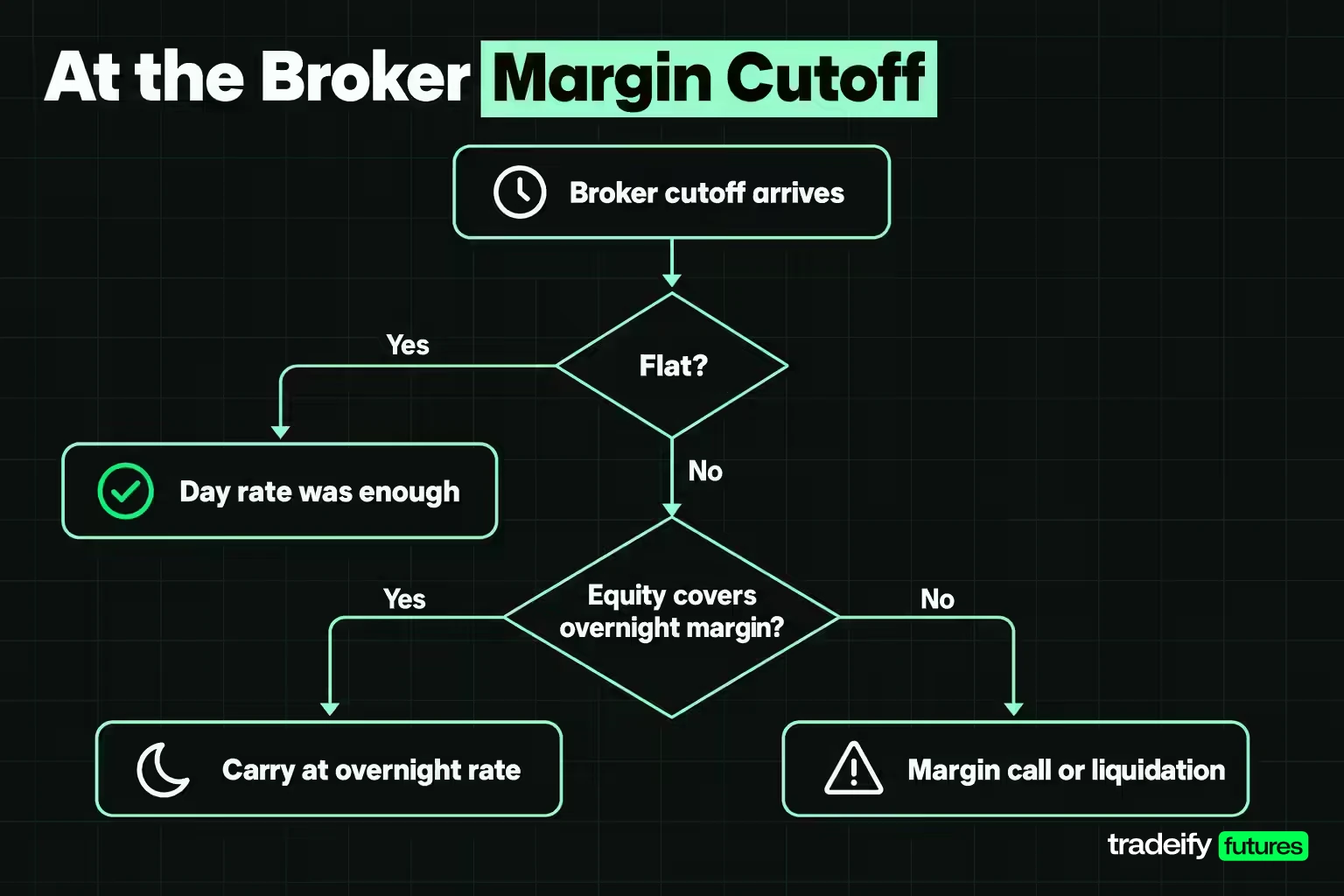
What happens at the cutoff depends on whether your equity covers the overnight figure. If it does, the position simply moves to the overnight requirement. If it does not, you face a margin call, a forced liquidation, or both.
Take a $50,000 account holding two E-mini S&P 500 contracts long a few minutes before TradeStation's 4 PM ET cutoff, using its figures as of November 4, 2026.
| Line | Amount |
|---|---|
| Intraday requirement for 2 ES | $2,872.30 |
| Overnight long requirement for 2 ES | $57,446 |
| Account equity | $50,000 |
| Shortfall against overnight margin | $7,446 |
| Maintenance for 2 ES | $52,224 |
| Shortfall against maintenance | $2,224 |
The account is not just short of initial margin. It is $2,224 below maintenance before the market moves a single tick, so the position cannot be carried as it stands.
This is where the temptation shows up. The trade is green, the close is near, and holding "just one more session" feels like a small decision. On these numbers it is not a decision at all. The broker has already made it for you, and the only open question is whether you close the position at a price you choose or the risk desk closes it at a price it gets.
From here the sequence usually runs one of two ways. A margin call is a demand to deposit funds or reduce the position, and a broker can set a short deadline (TradeStation says the same day). Forced liquidation is the broker closing some or all of the position itself, at market prices, often without waiting for a deposit. Most broker agreements allow either one. Interactive Brokers, for example, says it does not issue margin calls at all and liquidates in real time when an account is deficient.
Closing one contract fixes the problem. One ES long carried in the same account needs $28,723 and leaves $21,277 above the overnight figure.
Related lesson: Margin calls and forced liquidation
Day Trading Margin vs Leverage and Real Risk
A small intraday figure does not mean a small position. It means a large position backed by little collateral. The day rate is not the broker telling you the trade is safe. It reflects how confident the broker is that it can close you out before the collateral runs out.
Use an illustrative E-mini S&P 500 level of 6,000 (a round number, not a quote). One contract then controls $300,000 of index exposure. TradeStation's intraday figure of $1,436.15 is about 0.48% of that, roughly 209 times leverage. Its overnight figure of $28,723 is about 9.57%, roughly 10.4 times.
The same $50,000 account could open 34 E-mini contracts at the intraday figure by margin alone, but carry only one at the overnight figure. Nothing about the risk per point changed. Each E-mini contract still gains or loses $50 per index point.
Another way to read the gap: the intraday requirement covers about 28.72 index points of adverse movement per contract, while the overnight requirement covers about 574.46. The day rate is built on the assumption that someone, you or the broker's risk desk, will act long before a 29-point move against you runs out of collateral.
Margin and risk are different quantities. Margin is the minimum deposit the broker accepts. Risk is stop distance times contracts times dollars per point. Two E-mini contracts with a 20-point stop risk $2,000, or 4% of a $50,000 account. A 100-point overnight gap on the same two contracts costs $10,000, or 20%, and a stop order cannot always prevent it if the market opens through the stop.
Futures Margin Hikes in Volatile Markets
Exchange margins are not fixed. CME Clearing sets margins to cover 99% of potential price moves and raises them when volatility rises. CME's own gold example shows the scale: initial margin was $5,500 and maintenance $5,000 on January 10, 2020, and by March 24, 2020 they were $7,700 and $7,000, a 40% increase in both.
CME usually announces changes after the close with at least 24 hours' notice. Broker house requirements can move faster. Webull and AMP both state that they can change margins without prior notice, and Webull says it can raise them above exchange levels based on volatility.
A hike hits carried positions hardest. A position that cleared the overnight requirement with a thin buffer can fall below the new maintenance level without any price move at all, and the call that follows asks for the new, higher initial figure. Day positions closed before the cutoff never face the overnight number, but a broker can also cut or withdraw its intraday discount during volatile sessions.
Futures Margin Checklist Before the Session Close
The most useful margin habit is a short check before every session close, done in the same order each time. Run it while you still have time to act. If any step fails, the answer is to cut size, not to hope today's cutoff is later than usual.
- Confirm the cutoff for the contract you hold at your broker, including holiday early closes. Do not rely on memory.
- Look up the overnight figure for your side of the trade (long or short) and multiply it by your contract count.
- Compare that total with your account equity. If it is larger, the position cannot be carried, and the decision is already made.
- If it fits, check the buffer above maintenance in points, not dollars, and ask whether a normal overnight move would eat through it.
- Write down the dollar risk of the position if the market gaps, not the margin. That is the number that decides whether to carry.
Sizing Micro Contracts for an Overnight Margin Hold
Micro contracts are the usual way to carry a smaller version of the same exposure. On the TradeStation figures, a $50,000 account can carry 17 Micro E-mini S&P 500 contracts overnight at $2,872 each, a total of $48,824, which leaves only $1,176 of buffer. Those 17 micros equal 1.7 E-minis of exposure, still a large position for the account.
A margin buffer is not a risk limit. Sizing to the overnight figure means sizing to the maximum the broker allows, which leaves no room for a margin hike or a gap. Many traders cap risk per trade as a percentage of the account and treat margin only as a ceiling they stay well under.
Related lesson: Converting a stop distance into contracts
Overnight Margin Rules on Prop Firm Accounts
Evaluation and funded futures accounts at prop firms usually work differently from a personal brokerage account. Instead of a margin schedule, the trader gets a contract limit and a rule about when positions must be flat. On those accounts, the binding constraint at the end of the day is the clock, not the overnight margin figure.
On our accounts there is no overnight figure to plan around, because nothing is carried overnight: every position must be closed by 4:45 PM ET (12:59 PM ET on holiday early closes), with no overnight, weekend or swing holds. A position can still run through one trading day, which spans 6:00 PM to 5:00 PM ET, so opening at 8 PM Monday and closing at 2 PM Tuesday is allowed. Size is set by contract limits rather than margin, for example 4 minis or 40 micros on a 50K account, and positions left open at the close are closed automatically without failing the account, though the fill can slip. Our evaluation and funded accounts are simulated.
Intraday and Overnight Margin FAQ
Is intraday margin always lower than overnight margin?
No. On the TradeStation schedule read on November 4, 2026, 227 of 269 contracts (84.4%) had no intraday discount. One contract, hot-rolled coil steel, had an intraday figure three times its overnight figure. The deep discounts sit mainly on equity index futures.
Does the intraday rate apply during the overnight session?
Only at some brokers. AMP applies day margins in both the day and overnight sessions, except the last 15 minutes of each. TradeStation's window runs 9:00 AM to 4 PM ET and Webull's 9:00 AM to 4:15 PM EST, so overnight-session trades there need full margin.
What happens if I hold past the intraday cutoff without enough margin?
The position moves to the overnight requirement. If equity does not cover it, the broker can issue a margin call, liquidate the position at market, or both. TradeStation states that its margin calls must be met the same day.
Does holding futures overnight change how they are taxed?
Not in the U.S. Regulated futures contracts fall under Section 1256 of the tax code. Gains and losses are treated as 60% long-term and 40% short-term regardless of how long you held the position, and open contracts are marked to market at year end.
Do I need overnight margin if I always close before the cutoff?
No, if you are genuinely flat before your broker's cutoff, the overnight figure never applies. The risk is a trade you meant to close and did not, so know the exact cutoff, including holiday sessions.
Futures trading involves substantial risk and losses can exceed the margin you deposit; the margin figures here are dated snapshots that can change at any time, and examples use illustrative prices. Evaluation and funded prop accounts are simulated, and this article is education, not financial advice.


