



TL;DR: Margin calls and liquidation are two separate events: a call demands money, and liquidation closes positions when it isn't met. The gap between them decides whether you choose the remedy or the broker chooses it for you. A forced sale is usually several times the shortfall, since curing a 25% floor takes $4 of stock sold per $1 of deficiency. Know your call price, your cushion and your deadline before the trade, not after the notice.
Margin calls and liquidation usually get talked about as one thing, and usually after the damage is done. "I got margin called" tends to mean "my position was closed at a price I didn't pick." Those are two different events. The space between them is the only part of the process you still control.
So treat that space as something you measure before the trade, not something you find out about during it. Below: what a margin call is, what sets the line, what triggers it, how much time you get, how forced liquidation actually works, and how the same mechanics show up in stock accounts, futures and crypto venues. Every worked number is illustrative and built from published rules.
What a Margin Call Is and How Liquidation Differs
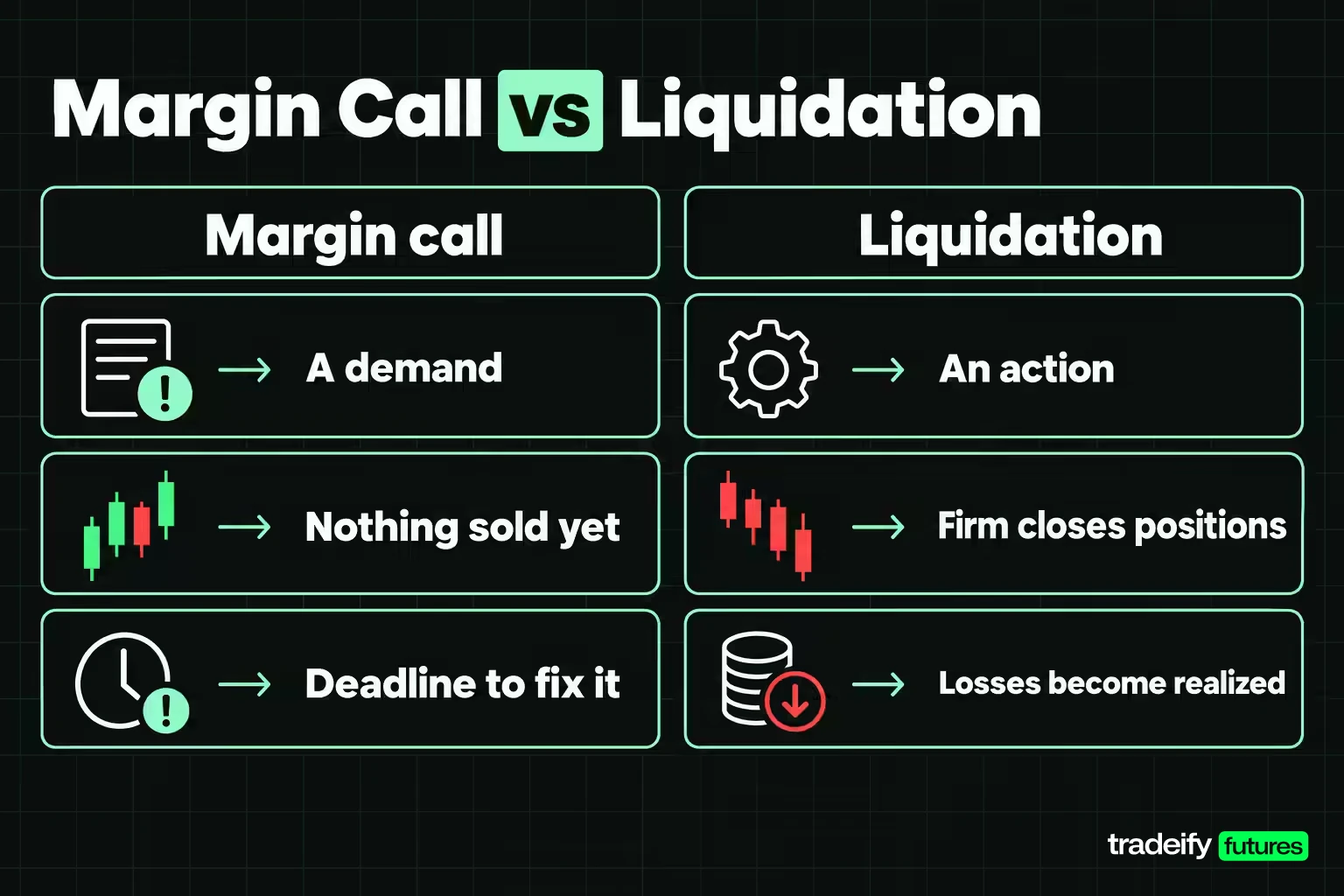
A margin call is a demand. Your broker (or futures commission merchant, or crypto venue) tells you the equity in your account no longer meets a requirement, and asks you to fix it by adding cash, adding eligible securities or reducing the position. Nothing has been sold yet. A margin call is information with a deadline attached.
Liquidation is an action. The firm closes positions in your account without asking, and the losses become realized. In futures, CME Group's own education material lays out the sequence: below the maintenance level you may receive a call to bring the account back to the initial level, you may reduce the position yourself, or the position may be liquidated automatically.
The difference matters because the call is where you still have choices:
- During the call, you pick the remedy, the timing and which positions go.
- After liquidation, the firm has picked all three. FINRA states plainly that firms don't have to let you choose which securities are sold.
So the useful question is never "will I get a margin call?" It's "how far is the call from where I am, and how much time sits between the call and the forced sale?" Some brokers close that gap to almost nothing. One large broker's own glossary says it does not make margin calls at all; real-time liquidations occur when an account has a margin deficiency.
Buying on margin and getting a margin call are also different things. Buying on margin is the choice to borrow part of the purchase price. A margin call is the consequence that arrives when the borrowed position moves far enough against you.
Related lesson: How a requirement is set and collected
Margin Accounts and the Loan Behind a Margin Call
A margin call only exists because there is a loan or a performance obligation behind the position. In a stock account, that's a margin loan. When you buy on margin, the broker lends you part of the purchase price and holds the securities as collateral. The amount you owe is the debit balance, and the margin call is the broker protecting that loan.
Margin investing in a US stock account runs on a few basic numbers:
- Initial borrowing limit. Under the Federal Reserve's Regulation T, firms can initially lend up to 50% of the purchase price of an eligible stock. That limit applies to new positions only.
- Minimum equity. FINRA rules require an account value of at least $2,000 before margin trading.
- Interest. The loan carries interest from the broker, and it runs whether the trade is working or not.
Most large brokers offer margin loans. Charles Schwab, for example, lists $2,000 in cash or marginable securities as the requirement to trade on margin (as of November 4, 2026). Approval, rates and house requirements are set by each firm and spelled out in its margin agreement.
Futures margin works differently. There is no loan and no partial payment on a purchase. Both buyer and seller post a performance bond, a good-faith deposit that covers potential losses. A futures margin call is a demand to top that deposit back up, and under CME Rule 930.E the call must bring the account back to the initial requirement, not just to the maintenance floor.
Crypto margin sits closer to the stock model on spot margin (you borrow to buy) and closer to futures on perpetual contracts (collateral backs a leveraged position). Either way, the venue tracks a margin ratio and closes positions when it crosses a line.
Margin Requirements That Set the Margin Call Line
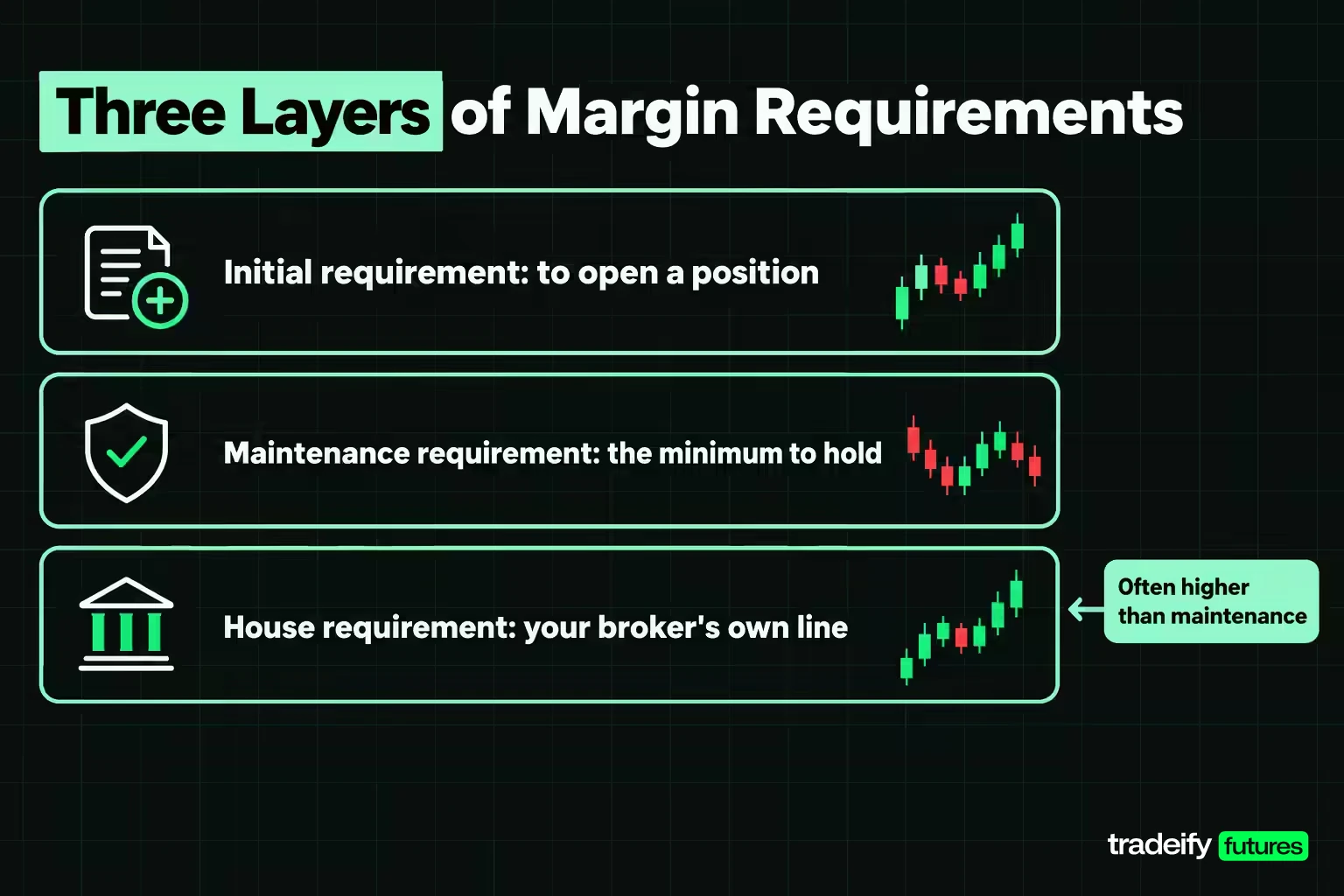
The margin call line is wherever the governing requirement says it is, and there are usually three layers stacked on top of each other.
| Layer | Who sets it | Typical figure | What a breach does |
|---|---|---|---|
| Initial requirement | Regulation T for stocks; the exchange clearing house for futures | 50% on a new stock purchase; a dollar amount per futures contract | Blocks the new position or creates a Reg T call |
| Maintenance requirement | FINRA Rule 4210 for stocks; the clearing house for futures | 25% of current market value on long stock | Creates a maintenance call |
| House requirement | Your own broker | Often 30% or 40% on stock, sometimes higher | Creates a house call, even when the regulatory floor is met |
A margin call is based on equity compared with the requirement that applies right now. In a stock account, equity is the market value of your securities minus the debit balance. FINRA's rule says equity generally must not fall below 25% of the current market value of long securities. Firms can and do set higher house requirements: FINRA notes a firm might set maintenance at 30% or even 40%, and the SEC's investor bulletin says many firms sit between 30 to 40 percent.
House requirements are the line that catches people. FINRA says firms may increase them at any time and aren't required to give advance written notice.
Futures requirements are dollar amounts per contract rather than percentages. CME sets the initial requirement for heightened-risk accounts at 110% of maintenance, and for non-heightened accounts at 100%. At 100% there is no gap at all between the level where you enter and the level that triggers a call.
Related lesson: The two numbers and why they differ
What Triggers a Margin Call
FINRA lists three ways a margin call can be triggered. Only two of them involve anything you did.
- You trade into a deficit. Under Reg T, a new purchase needs initial margin within one payment period. FINRA's example: with $2,000 of margin excess, a $10,000 stock purchase needs an initial deposit of $4,000 (50% of $8,000). Miss it and you get a call regardless of whether the stock moved.
- Your account value falls. Equity drops below the maintenance or house requirement because positions lost value. This is the margin call most traders have in mind.
- The requirement rises. Your broker raises the house requirement on a stock or a group of stocks, or the exchange raises futures margins. FINRA says firms often do this when a company is bankrupt, delisted or experiencing large daily price swings.
The third trigger deserves a number, because "the price didn't move" feels like it should mean "nothing changed." CME documented Gold futures margins of $5,500 initial and $5,000 maintenance in January 2020, then $7,700 and $7,000 by late March 2020, a 40% increase in both figures. An account holding one gold contract with a $6,000 balance was fine under the January pair. Under the March pair, the same balance sits below the $7,000 maintenance level with no price change at all, and a call to restore the $7,700 initial requirement is $1,700.
That's the trap with margin calls triggered by requirement changes. The check you did at entry was one observation of a number that the exchange and your broker are both free to revise.
How Margin Calls Work From Notice to Deadline
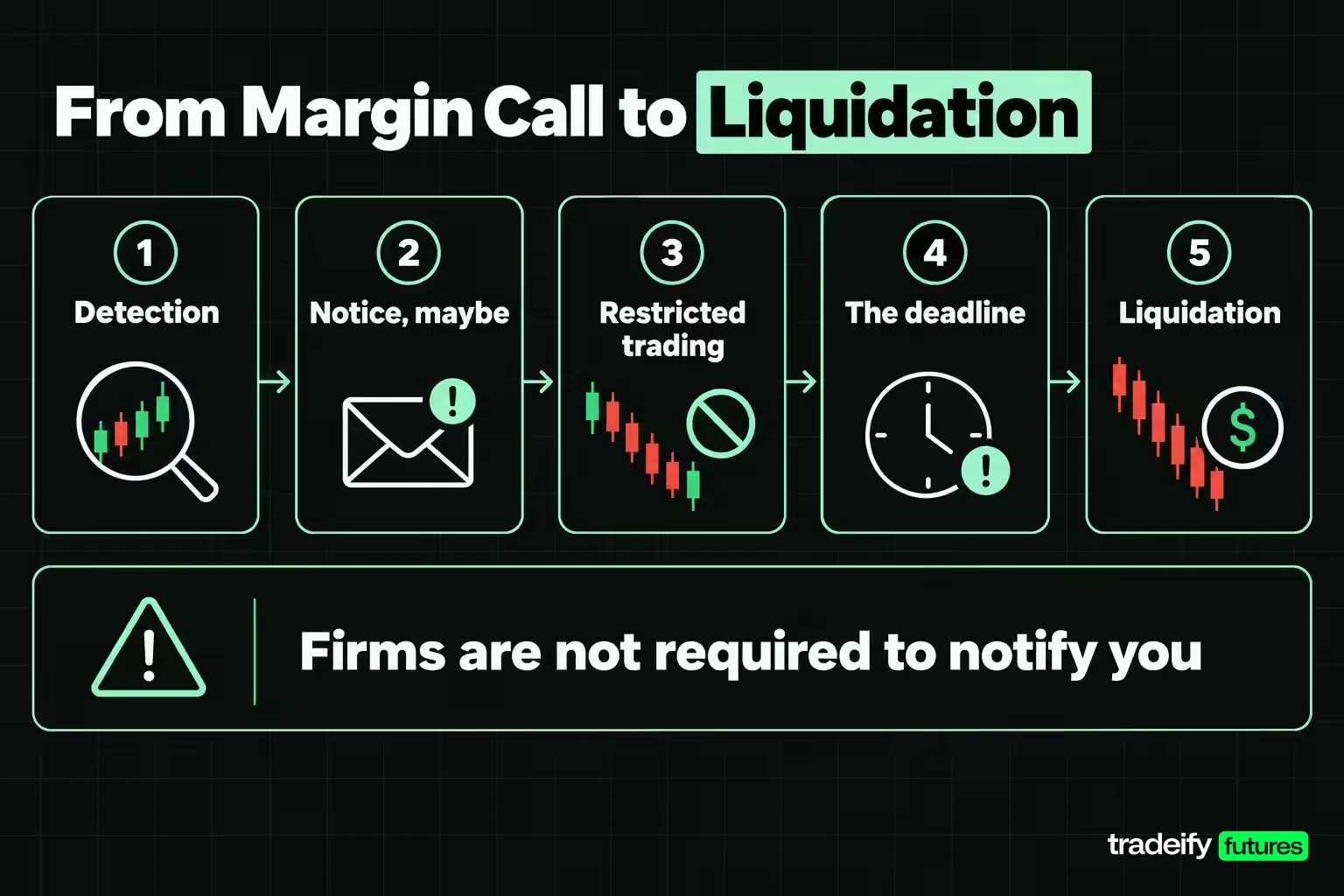
How margin calls work depends on the call type, and the deadlines are shorter than most traders assume. The process usually runs in this order.
- Detection. The firm calculates your equity against its requirement. FINRA notes that some firms monitor in real time and block trades that would create intraday deficits, while others compute margin at the end of the day.
- Notice, maybe. Most firms try to notify you by email, platform alert or phone. FINRA is explicit that they aren't required to: a firm isn't required to notify you when equity drops below the minimum, and you have no right to an extension.
- Restricted trading. While a call is outstanding, firms commonly limit you to closing or reducing trades. CME Rule 930.D lets a clearing member accept only risk-reducing orders from an account that has been under calls for an unreasonable time.
- The deadline. This is where call types diverge sharply.
- Liquidation if the call is not met, or earlier if the firm decides the risk can't wait.
Margin call deadlines by call type
| Call type | Governing rule | Time to meet it |
|---|---|---|
| Reg T call on a new purchase | 12 CFR 220.4 | One payment period, which FINRA describes as currently three business days from the trade date; the firm may shorten it |
| Maintenance or house call | Your margin agreement | Set by the firm; it can sell before any deadline it quotes |
| Intraday margin deficit | FINRA intraday margin requirements | Expected as soon as possible; the account may be restricted if not met within five business days |
| Futures performance bond call | CME Rule 930.K | A reasonable time, which the clearing member may deem to be one hour |
| Crypto margin call | Venue terms | Often none; liquidation is automated once the venue's level is hit |
Regulation T defines the payment period as the standard US settlement cycle plus two business days. An extension is something the firm applies for to its examining authority, not something you're owed.
Investor.gov adds the line every margin trader should know by heart: even if a brokerage firm tells you that you have a certain number of days to cover the shortfall, it still may sell your securities before then.
FINRA's intraday margin requirements took effect June 4, 2026, with a transition period through October 20, 2027, and they are replacing the old pattern day trader rule and its $25,000 minimum equity. Under them you must keep adequate equity throughout the day, not just at the close.
How to Calculate Your Margin Call Price and Cushion
You can calculate the margin call price before you ever place the trade. For a long stock position, the formula is:
Margin call price = debit balance ÷ shares ÷ (1 − maintenance requirement)
Equity equals market value minus the debit, and the call arrives when equity falls to the maintenance percentage of market value. Solving for price gives the formula above.
Take an illustrative 400 shares bought at $75.00 for $30,000, funded with $15,000 of your money and a $15,000 debit:
| Maintenance requirement | Margin call price | Price decline from $75.00 |
|---|---|---|
| 25% | $50.00 | 33.33% |
| 30% | $53.57 | 28.57% |
| 35% | $57.69 | 23.08% |
| 40% | $62.50 | 16.67% |
The house requirement moves your call price a long way. At 40%, a 16.67% drop is enough, which is less than half the move a 25% floor allows.
Calculating the margin cushion
FINRA calls the buffer your cushion, the maintenance margin excess. To turn it into a market move, divide the excess by one minus the requirement. At entry in the example, equity is $15,000 and the 25% requirement is $7,500, so excess is $7,500. Divided by 0.75, that's $10,000 of market value, or $25.00 per share, before a call.
Calculating the cushion on a futures position
Futures cushions are easier: balance minus maintenance requirement, divided by the contract's dollar value per point or tick. Using CME's January 2020 gold pair ($5,500 initial, $5,000 maintenance) and the GC contract's $10.00 tick (a $0.10 move on 100 troy ounces):
- Balance of $5,500: cushion $500, which is $5.00 per ounce, or 50 ticks.
- Balance of $8,000: cushion $3,000, which is $30.00 per ounce, or 300 ticks.
Compare that cushion with your planned stop. If the stop is further away than the cushion, the margin call arrives first.
A Worked Margin Call and Liquidation Example
This illustrative example follows one margin position from entry down to forced liquidation, so you can see where each line sits. You buy 400 shares at $75.00, the position is worth $30,000, and you borrow $15,000. The debit stays at $15,000 while the price falls.
| Share price | Market value | Equity | Equity percentage | 25% requirement | 30% requirement |
|---|---|---|---|---|---|
| $75.00 | $30,000 | $15,000 | 50.00% | $7,500 | $9,000 |
| $70.00 | $28,000 | $13,000 | 46.43% | $7,000 | $8,400 |
| $60.00 | $24,000 | $9,000 | 37.50% | $6,000 | $7,200 |
| $50.00 | $20,000 | $5,000 | 25.00% | $5,000 | $6,000 |
| $40.00 | $16,000 | $1,000 | 6.25% | $4,000 | $4,800 |
Read the rows top to bottom and notice where the decision points sit.
- $70.00 and $60.00. The account is losing money but is above both requirements. Nothing happens unless the house requirement changes.
- $53.57. Equity is $6,428, exactly 30.00% of $21,428 market value. Under a 30% house requirement this is your call price.
- $50.00. Equity is $5,000, exactly the 25% regulatory floor. The stock has dropped 33.33%, but your $15,000 has shrunk to $5,000, a 66.67% loss. Under a 30% house requirement you're already $1,000 short.
- $40.00. Equity is $1,000 against a $4,000 requirement at 25% (short $3,000) or $4,800 at 30% (short $3,800). If the call wasn't met, liquidation is now likely.
Two more prices finish the example. At $37.50, the market value equals the $15,000 debit and your equity is $0: a 50% fall has wiped out the entire deposit. At $35.00, market value is $14,000 and equity is -$1,000. If the firm sells everything there, you still owe the broker $1,000 plus interest. FINRA states you're responsible for any shortfall after a forced sale.
A gap through these levels (an overnight earnings drop, for instance) can take you from the comfortable rows to the negative row with no chance to act in between.
Related lesson: What happens when an account goes past zero
How Forced Liquidation Works
Forced liquidation is the firm closing enough of your position to remove its risk, on its timing and at market prices. Several rules shape what that looks like.
How much the broker sells
Regulation T says that when a call isn't met in full, the firm shall liquidate securities sufficient to meet the call or to eliminate the deficiency, whichever is less, and that no action need be taken if the deficiency is $1,000 or less. FINRA adds that firms may sell enough securities to completely pay off your margin loan, not just meet the call. So the answer to "does the broker liquidate the whole account or just the amount needed?" is: at least enough to cure the call, and possibly everything, depending on your margin agreement. FINRA notes that failure to meet a call may lead to liquidating a portion of (or in certain circumstances all of) the account.
Why the forced sale is bigger than the shortfall
Selling stock to cure a deficiency doesn't just add equity. It also shrinks the market value the requirement is measured against. The sale has to be the deficiency divided by the maintenance percentage. FINRA's worked example: a $100,000 position falls to $60,000 with a $50,000 loan, equity is $10,000 against a $15,000 requirement, and the firm could liquidate $20,000 of securities to meet a $5,000 call.
The illustrative 400-share position at $40.00 shows how the multiple changes with the requirement:
| Maintenance requirement | Deficiency at $40.00 | Stock sold to cure it | Shares sold of 400 | Multiple of the deficiency |
|---|---|---|---|---|
| 25% | $3,000 | $12,000 | 300 | 4.00x |
| 30% | $3,800 | $12,666.67 | 316.67 | 3.33x |
| 35% | $4,600 | $13,142.86 | 328.57 | 2.86x |
| 40% | $5,400 | $13,500 | 337.50 | 2.50x |
At a 25% floor, a $3,000 call means selling 300 of your 400 shares. After that sale, market value is $4,000, the debit is $3,000 and equity is $1,000, exactly 25%. A trader who plans around the $3,000 is planning around a quarter of the real number.
Who picks what gets sold
The firm does. FINRA says firms don't have to let you choose which securities or assets are sold. Investor.gov says the brokerage firm decides which of your securities to sell. In practice that can mean your best position goes first because it's the most liquid.
What liquidation costs beyond the loss
Forced sales are typically market orders into whatever liquidity exists at that moment, so you take the spread and any slippage on top of the loss. Afterward, any negative balance is a debt. That's why ignoring a margin call is usually the most expensive way to "resolve" it.
What to Do After a Margin Call
When a margin call arrives, the first instinct is usually to make it go away as fast as possible. Slow down for the two minutes it takes to price the options, because the cheapest remedy and the fastest one are rarely the same. Then act before the deadline, which may be shorter than the notice says.
- Deposit cash. Cash for the call amount cures it and keeps every share in place.
- Deposit margin-eligible securities. The deposit has to be larger than the call, because the deposited securities are margined too. FINRA's formula is call ÷ (100% minus the requirement): a $6,000 call with stock carrying a 40% requirement needs $10,000 of that stock.
- Sell securities. FINRA's formula is call ÷ requirement: the same $6,000 call means selling $15,000 of stock with a 40% requirement.
- Close or cut the position. Sometimes the call is the market telling you the trade thesis has already failed.
Curing the call versus restoring the account
Meeting the call and getting back to a comfortable margin level are different amounts. In the 400-share example at $40.00, curing the 25% deficiency takes $3,000. Restoring the account to 50% equity at the same price takes $7,000. If you deposit only $3,000 and the price slips another dollar, you're back in a call.
A step-by-step margin call response checklist
This checklist turns a margin call notice into a decision in five steps.
- Identify the margin call type: Reg T, maintenance, house, intraday or performance bond. Each has a different deadline and amount.
- Find the deadline in your margin agreement or the notice, and assume the firm can act earlier.
- Convert the call into the sale it would force (call ÷ requirement) so you know what doing nothing costs.
- Compare cash, securities and a sale you choose yourself.
- Recalculate your new margin call price after whatever you do: debit balance ÷ shares ÷ (1 − maintenance requirement) for stock, or balance minus maintenance requirement divided by tick value for futures.
A deposit that rescues a losing trade only makes sense if the thesis is still valid. Adding money to defend a position you'd never open today is averaging down with extra steps.
Margin Calls and Liquidation in Futures
Margin calls and liquidation in futures run faster than in stock accounts, and the rules are written per contract rather than as a percentage of value.
- Calls restore to initial. CME Rule 930.E requires clearing members to issue calls that bring an account up to the initial performance bond requirement when equity falls below maintenance, and to make those calls within one business day of the event.
- Day trades are different. The same rule says a clearing member is not required to call for or collect performance bond for day trades, so intraday margins are set by your broker's own policy.
- The deadline is short. CME Rule 930.K says that if an account holder fails to meet a call within a reasonable time, and the clearing member may deem one hour reasonable, it may close out the account holder's trades or sufficient contracts to restore required status. Clearing members keep full discretion over when positions are liquidated.
An illustrative gold example using CME's January 2020 figures: you hold one GC contract with a $5,500 balance. Gold falls $6.00 per ounce, a $600 loss, and the balance drops to $4,900, below the $5,000 maintenance level. The call is $600, the amount needed to get back to $5,500, not the $100 needed to reach maintenance. Fail to meet it and the position can be closed within the hour.
Futures margin increases and the shrinking cushion
Exchange margin changes hit the cushion directly. CME raises margins when volatility rises and gives at least 24 hours' notice. With an $8,000 balance on one gold contract, the cushion was $3,000 (300 ticks) under the January 2020 pair and $1,000 (100 ticks) under the March 2020 pair. Same position, same balance, a third of the room.
Stops don't fully protect you either. The CFTC's required risk disclosure warns that stop-loss or stop-limit orders will not necessarily limit losses, and that a limit move can make it difficult or impossible to liquidate a position. A fast market can blow through your stop and your margin cushion in the same move.
Margin Calls and Liquidation in Crypto Trading
Margin calls and liquidation in crypto trading are mostly automated. Venues track a margin level or margin ratio continuously and close positions the moment it crosses a threshold. There is rarely a deadline in the brokerage sense.
Kraken's two-level model
Kraken's support documentation (last updated October 1, 2026) uses two lines:
- Margin call level, approximately 80% margin level. You may get an email asking you to close positions or add collateral, but notifications are not guaranteed. Below this level Kraken may liquidate all positions, or enough to get back above 100%. Positions are liquidated First In, First Out, regardless of pair or whether the position is in profit.
- Liquidation level, 40% Margin Health for spot margin. Kraken may close positions at the index price with a 2% liquidation fee, or send market orders that pay the taker fee. Once started, the automated process can't be stopped.
Kraken's own worked example: buy 1 BTC at 20,000 USD with 5:1 leverage, trade balance 10,000 USD, used margin 4,000 USD, margin level 250%. The call comes when equity falls to 3,200 USD, at a BTC price of about 13,200 USD. Plugging the same numbers into Kraken's published liquidation formula puts liquidation at 11,600 USD. That's 34% below entry for the call and 42% below entry for liquidation, so the window between warning and forced close is about 8% of price.
Mark price, insurance funds and auto-deleveraging
Binance Futures liquidates when collateral (initial collateral plus realized and unrealized PnL) falls below maintenance margin, which is a margin ratio of 100%. Binance recommends keeping the ratio below 80%. Three crypto-specific details matter:
- Mark price, not last price, triggers liquidation. In Binance's example, a short's liquidation price was 17,006 USDT, but the mark price jumped from 17,000 USDT to 17,100 USDT within a second, and the position was liquidated at 17,100 USDT.
- Insurance fund takeovers. In volatile markets the insurance fund may take over liquidated positions at the bankruptcy price, which can be worse than the liquidation price. A liquidation clearance fee also applies.
- Auto-deleveraging (ADL). If the insurance fund can't absorb a bankrupt position, profitable and highly leveraged traders on the other side get closed out, highest-ranked first.
Crypto venues also carry counterparty and custody risk that regulated stock and futures accounts handle differently, so read the venue's own margin rules before using leverage there.
Risks and Benefits of Trading on Margin
The benefit and the risk of trading on margin are the same mechanism. Borrowing magnifies the result on your own money in both directions.
| Scenario on $15,000 of your own money | Cash account, 200 shares at $75.00 | Margin account, 400 shares at $75.00 |
|---|---|---|
| Price rises to $90.00 (+20%) | +$3,000, or +20% | +$6,000, or +40% before interest |
| Price falls to $50.00 | -$5,000, or 33.33% | -$10,000, or 66.67%, and at the 25% call line |
| Price falls to $37.50 | -$7,500 | Entire $15,000 gone |
| Price falls to $35.00 | -$8,000 | -$16,000, a $1,000 debit you owe |
The main risks of trading on margin:
- You can lose more than you deposit. FINRA lists this first among margin risks.
- Forced sales at the worst time. Calls arrive after losses, so liquidations tend to happen near lows.
- The firm decides. It can sell without notice and choose which assets go.
- Requirements move. House and exchange margins rise in exactly the volatile conditions where you have the least room.
- Interest drag. The loan costs money every day the position is open, win or lose.
The benefits are real but narrow: more buying power, the ability to short (which needs a margin account), and flexibility to act without selling other holdings. They only pay off for traders who size positions so a normal adverse move never reaches the call line.
How to Avoid a Margin Call and Forced Liquidation
Avoiding a margin call is mostly arithmetic done before entry. Margin calls and liquidation are predictable once you know your numbers.
- Know the call price before you click. Use debit ÷ shares ÷ (1 − requirement) for stocks, or balance minus maintenance divided by tick value for futures.
- Plan with the house requirement, not the regulatory floor. If your broker uses 30%, your call price in the worked example is $53.57, not $50.00.
- Keep the cushion bigger than your stop. If the distance to your call is shorter than your stop, the position is too big for the account.
- Leave room for requirement increases. A 40% margin hike, as in the 2020 gold example, can cut a cushion by two thirds overnight.
- Know how your broker monitors margin. FINRA suggests reading your margin agreement and learning whether your firm checks in real time or at the end of the day.
- Avoid using all your buying power. Borrowing less than the maximum is the simplest way to widen the gap between entry and the call.
- Watch concentration. One volatile stock can draw a house increase on its own and pull the whole account into a call.
None of these rules prevent losses. What they do is make sure a loss shows up as a decision you made, at a stop you chose, rather than as a liquidation someone else ran at a price nobody chose.
Related lesson: Setting size before the trade rather than after the call
Margin Calls Versus Loss Limits on Prop Firm Accounts
Prop firm evaluation and funded accounts usually work differently from margin accounts. There's no loan to protect, so instead of a margin call the platform enforces its own loss limits, daily caps or drawdown rules, and those lines don't shrink with market value the way a percentage requirement does. A fixed or trailing drawdown is a straight dollar line, which means sizing that feels safe against a margin floor can be too large against a drawdown limit.
On our accounts, positions are sized by contract limits rather than a margin figure (a 50K account allows 4 minis or 40 micros), and our Help Center doesn't describe a margin call or a deposit to cure one. The lines that close positions are our end-of-day trailing drawdown, enforced in real time on net liquidation value, where touching it fails the account; on Growth evaluations, a daily loss limit ($1,250 on a 50K) that puts the account in liquidation-only until the next trading day; and the 4:45 PM ET close, where any position left open is closed automatically without failing the account. Our evaluations and funded accounts are simulated.
Margin Calls and Liquidation FAQ
What does a margin call mean in trading?
A margin call means your account equity has fallen below the required level, and your broker wants you to add cash or securities, or reduce the position. It's a demand with a deadline. If you don't meet it, the broker can liquidate positions for you.
What is a margin call based on?
It's based on your equity compared with the requirement in force. In a stock account, equity is market value minus the debit balance, measured against the 25% regulatory minimum or your broker's higher house requirement. In futures, it's your account balance against the exchange's maintenance requirement per contract.
What happens if you ignore a margin call?
If you ignore a margin call, the broker liquidates positions in your account to cure it, usually selling several times the shortfall, because the requirement is a percentage of the remaining value. It may sell more, up to repaying the whole loan, and it chooses what to sell. If the sale leaves a negative balance, you owe that debt.
Can I get a margin loan from Charles Schwab?
Yes, Schwab offers margin accounts subject to approval. Its margin page lists $2,000 in cash or marginable securities as the requirement to trade on margin (as of November 4, 2026). Rates and house requirements are set in Schwab's margin agreement.
What is the difference between buying on margin and a margin call?
Buying on margin means borrowing part of the purchase price from your broker. A margin call is what can follow when that borrowed position loses enough value that your equity drops below the maintenance requirement.
Can a broker liquidate without a margin call?
Yes. FINRA says firms don't have to issue a margin call before selling securities to meet one. Some brokers skip calls altogether and liquidate in real time whenever an account shows a deficiency.
How long do you have to meet a margin call?
Anywhere from about an hour to a few business days, depending on the call type. A Reg T call runs one payment period, currently three business days from the trade date. Maintenance calls follow the firm's agreement, and it can sell sooner. A futures performance bond call can be treated as unmet after one hour under CME rules.
Trading on margin, futures and leveraged crypto products carries a substantial risk of loss, and losses can exceed the money you deposit. Margin requirements are set by regulators, exchanges and individual firms and can change at short notice. All worked examples here are illustrative calculations from published rules, not live market data or trading results. Prop firm evaluation and funded accounts are simulated. This article is educational and is not investment advice.


