




TL;DR: How to prepare for a prop firm evaluation starts with turning the rule sheet into dollar limits before your first trade. With a $1,000 daily loss limit, a $500 soft stop allows $250 of risk per trade, or six MNQ at a 20-point stop. Check whether the drawdown is static or trailing, and divide your best day by the consistency cap. Rehearse those limits in sim for three weeks, then pace the target over weeks, not days.
Most traders prepare for a prop firm evaluation by hunting for a better setup. The test is narrower than that. An evaluation is a fixed rule sheet you have to survive while you make money, and the rules interact in ways that catch people who are already profitable.
Imagine a trader up $2,000 on a $2,500 target who still fails the account. One oversized loss crosses the drawdown floor, or one big day breaks a consistency cap that only gets checked at the end. Neither failure has anything to do with reading the chart.
So the order of preparation matters: rules first, position size second, routine third, and only then the trading. This guide works through each step with one illustrative rule sheet, contract math on Micro E-mini futures, a worked week with costs, and a three-week preparation plan.
How Prop Firm Evaluations Work
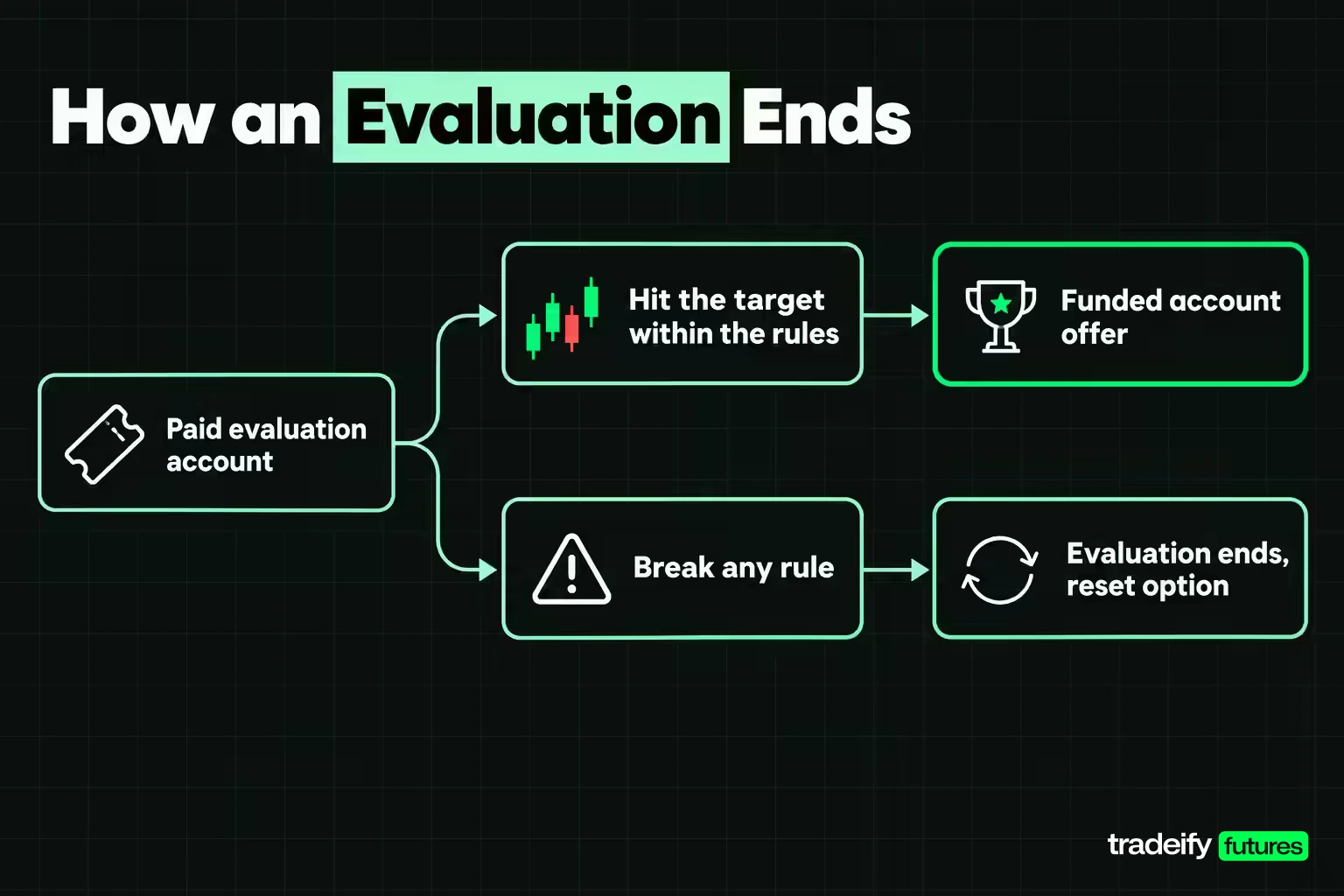
A prop firm evaluation is a paid trading test. You buy an account with a profit target and a set of loss limits, and you pass by reaching the target without breaking any rule. Pass, and the firm offers a funded account with its own payout terms. Break a rule, and the evaluation ends, usually with an option to reset or buy again.
Most evaluations come in one of two structures:
- One-step evaluation: one profit target, one set of limits, and a pass once the target and any minimum trading days are met.
- Two-step evaluation: a first phase with its own target, then a second phase, often with a smaller target, under the same or similar limits. You clear the test twice.
Whatever the structure, the rule sheet tests a short list of things:
- Profit target: can you make a defined amount?
- Maximum drawdown: can you stay above a floor while doing it?
- Daily loss limit: can you stop yourself on a bad day?
- Consistency rule: is the profit spread across days rather than coming from one lucky session?
- Minimum trading days and time limits: did you trade enough sessions to show a process?
- Conduct rules: news windows, overnight holds, hedging, automated strategies, copying trades and very short holding times.
Notice what is missing from that list. Nothing on the sheet rewards a clever entry. Evaluations measure risk control under pressure, and the target is the part that tempts you to forget it.
Evaluation accounts are usually simulated
At many firms the evaluation runs in a simulated account on live market data, and the funded stage often stays simulated too. Payouts come from the firm under its own terms rather than from fills in a live brokerage account. That does not make the test fake, but it changes what you are preparing for. You are preparing to perform inside a rule engine, and the payout depends on the firm honoring its agreement, so read the funded trader agreement before you read the profit target.
Turning the Evaluation Rule Sheet Into Numbers
Rule sheets are written in percentages and paragraphs. Trading decisions are made in dollars and contracts, so the first preparation job for an evaluation is translation.
Take an illustrative $50,000 evaluation with these rules. They are examples for the arithmetic, not any firm's live terms:
| Rule on the sheet | Illustrative setting | Number you trade against |
|---|---|---|
| Profit target | 5% of starting balance | $2,500 |
| Maximum drawdown | $2,500, static version | Account fails at $47,500 |
| Daily loss limit | $1,000 per trading day | Hard stop for the day |
| Consistency cap | Best day no more than 30% of total profit | A $750 best day needs $2,500 of total profit |
| Minimum trading days | 5 days | Target alone is not enough to pass |
Write those five numbers on a card next to your platform. If you have to look a rule up during the session, you do not know it well enough yet.
When the evaluation day resets
Daily loss limits reset at a set time, and that time is often the futures session close, not midnight in your time zone. CME Globex equity index futures trade from Sunday 6:00 PM to Friday 5:00 PM ET with a daily maintenance break from 5:00 PM to 6:00 PM ET, so many futures evaluations treat 6:00 PM ET as the start of a new trading day. A trade you open at 7:00 PM ET counts toward the next day's limit, which surprises traders in Asia and Europe more than anyone else. Find the reset time in writing.
Open losses usually count
Many firms measure the drawdown and the daily loss limit in real time on account equity, including the loss on any open position. That means a trade does not need to close for it to fail the account. If your stop sits $240 away and price gaps through it during a fast move, the open loss can blow past your plan before the order fills.
Some firms treat a daily loss limit as a soft breach, so the account is locked for the rest of the day but survives. Others treat it as a hard breach that ends the evaluation. Those two rules call for the same behavior from you, which is never testing the limit, but they change how expensive a mistake is.
Static vs Trailing Drawdown in an Evaluation
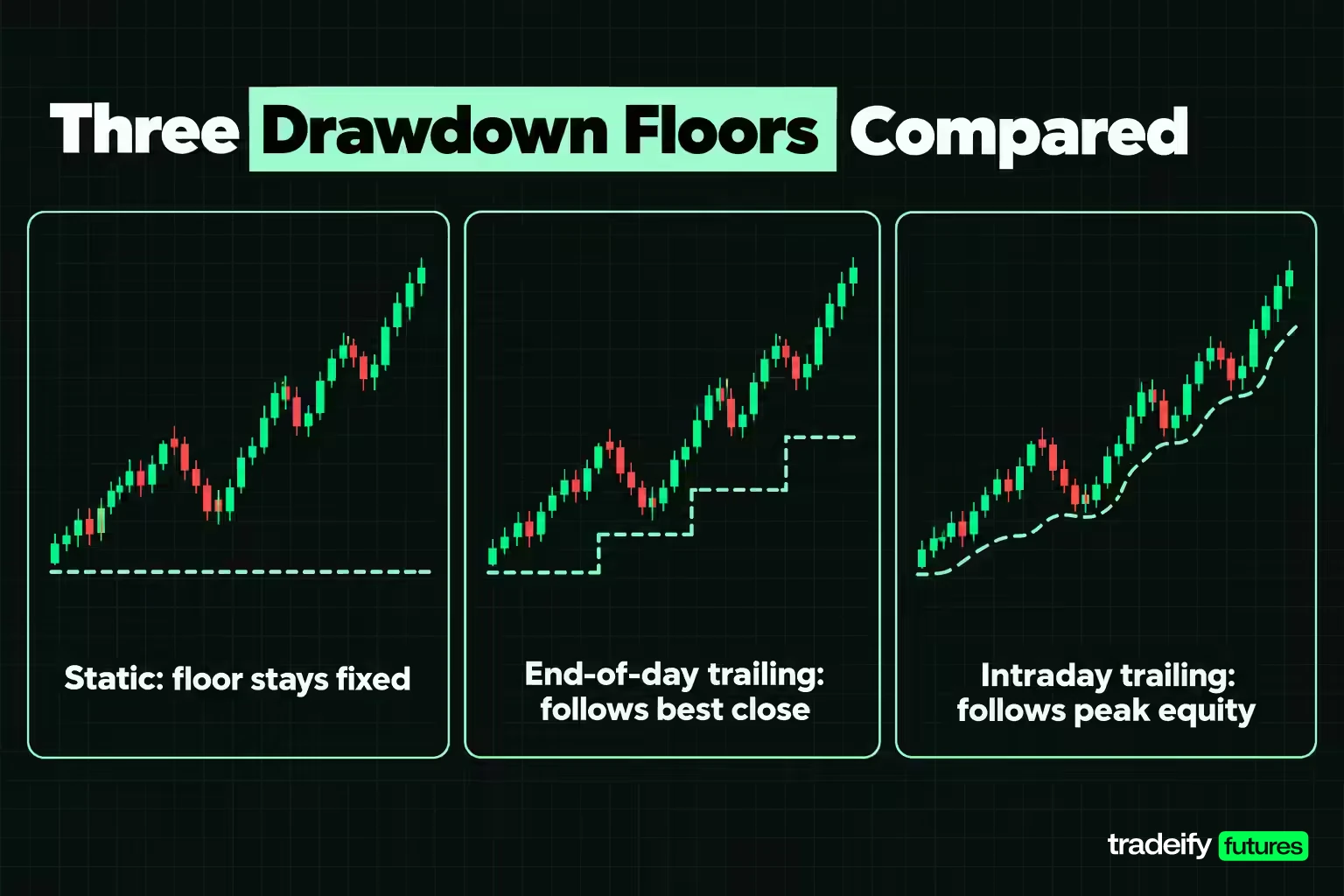
The drawdown type is the rule traders misread most often, and it changes the whole plan.
- Static drawdown: the floor is fixed at the starting balance minus the allowance. On the illustrative account it stays at $47,500 no matter how well you trade.
- End-of-day trailing drawdown: the floor follows your highest closing balance upward. Profit you keep at the close raises the level at which you fail.
- Intraday trailing drawdown: the floor follows your highest equity during the session, including open profit you never banked.
Here is how the three floors move on the same two illustrative days with a $2,500 allowance:
| Moment | Account equity | Static floor | End-of-day trailing floor | Intraday trailing floor |
|---|---|---|---|---|
| Start | $50,000 | $47,500 | $47,500 | $47,500 |
| Day 1 close | $51,200 | $47,500 | $48,700 | $48,700 |
| Day 2 intraday high | $51,900 | $47,500 | $48,700 | $49,400 |
| Day 2 close | $51,000 | $47,500 | $48,700 | $49,400 |
At the Day 2 close the account holds the same $51,000 under all three rules, but the room left to the floor is $3,500, $2,300 or $1,600. The intraday version charged you $700 of cushion for a winning trade you let come back.
Which drawdown type fits which style
A static floor is the most forgiving for a trader who builds profit slowly, because every dollar banked is cushion. An end-of-day trailing floor punishes holding a winner into the close and then giving it back the next morning. An intraday trailing floor punishes letting open profit run and retrace, which is hard on swing-style targets inside the day and easier on traders who scale out quickly.
Many firms stop trailing once the floor reaches a set level, often the starting balance or slightly above it, but some do this only on funded accounts and never during the evaluation. Check which stage the lock applies to. If your rule sheet trails and you plan against a fixed floor, the plan is wrong before the first trade.
Choosing a Prop Firm Evaluation That Fits Your Style
Preparation starts before you pay. The best preparation plan cannot fix an evaluation whose rules fight your style, so read the sheet with your own trading in mind.
| Rule sheet question | Why it matters for your evaluation |
|---|---|
| Static, end-of-day trailing or intraday trailing drawdown? | Decides how much a winning trade that retraces costs you |
| Soft or hard daily loss limit, and when does the day reset? | Decides whether one bad session ends the account |
| Consistency rule during the evaluation, at payout, or both? | Decides how you finish once you are near the target |
| Minimum trading days and any time limit? | Decides how fast you can pass and whether a deadline adds pressure |
| Must you be flat by a set time, and are overnight holds allowed? | Rules out swing holds and changes how you trade late in the session |
| Are news releases, very short trades, hedging and copy trading allowed? | Removes or permits whole styles |
| Which products, contract limits and platforms are supported? | Your tested market and platform must be on the list |
| One-time fee or monthly subscription, and what do resets cost? | Sets the true cost of a failed attempt |
| What changes in the funded stage, and is it simulated? | Sets the payout rules you will live under after passing |
A few mismatches show up again and again. A trader who holds swing positions cannot use an evaluation that requires being flat every afternoon. A trader whose edge comes in the first minutes after a data release needs an evaluation that allows news trading. A trader who takes large, infrequent wins will struggle with a tight consistency cap.
Account size and the cost of a failed attempt
Bigger evaluations come with bigger targets and bigger allowances, but the rules usually scale together, so a larger account rarely makes the test easier. Choose the size whose daily loss limit lets you take your normal stop at a sensible contract count. If your strategy needs a 20-point stop on MNQ and you trade six contracts, the daily limit has to cover several of those losses, not one.
The fee structure matters as much as the size. A monthly subscription charges you for time spent not passing, while a one-time fee charges per attempt and per reset. Count the cost of three attempts, not one, because a first attempt that fails is common and usually teaches more than a pass.
Building a Repeatable Evaluation Strategy
An evaluation needs a strategy you can execute the same way every session, with a defined entry, stop, target and a rule for doing nothing. A strategy you only understand when the chart is clean is not ready for a rule sheet.
What an evaluation-ready strategy has in writing:
- One setup, one market, one session. For example, a pullback entry on MNQ during the first two hours of the cash session. Every extra setup splits your sample.
- A stop that comes from structure, not from a dollar figure you like. The contract count adjusts to the stop, never the other way round.
- A target or exit rule you can state before entering.
- A no-trade rule: the conditions under which you sit out, such as a range too tight to reach your target or the minutes around a scheduled release.
Measure the edge in R before you pay
R is the amount you risk on a trade. A trade that makes twice what it risked is +2R, and a full loss is −1R. Measuring in R lets you compare a sample across different contract counts and stop sizes.
Expectancy is the average R per trade: win rate times average win, minus loss rate times average loss. An illustrative strategy that wins 45% of the time with an average winner of 1.8R and an average loser of 1R has an expectancy of 0.45 × 1.8 − 0.55 × 1 = 0.26R per trade. That is a real edge, and it is also small enough that costs and a handful of rule-breaking trades can erase it.
Get that number from at least 50 simulated or historical trades taken exactly as the rules say. A smaller sample tells you very little about whether the edge is real.
Losing streaks are normal, so plan for them
The same 45% strategy loses 55% of the time. Over 50 trades, the probability of at least one run of five or more losses in a row is about 71%, and the probability of a run of six or more is about 46%. Those are illustrative figures from the binomial arithmetic of independent trades, not a forecast, but they make the point: a five-loss streak is something to plan for, not a sign the strategy broke.
Size the evaluation so that a five-loss streak costs you a bad week, not the account. If one streak can end the attempt, the size is wrong, not the strategy.
Position Sizing for Evaluation Rules
Size every evaluation trade from two numbers: your stop distance and the tightest rule that a normal losing streak could hit. On most rule sheets the tightest rule is the daily loss limit.
On the illustrative account the daily loss limit is $1,000. A sensible personal soft stop sits at half of it, $500, so the firm's limit is a backstop you never reach. Allowing two full losses before the soft stop gives a risk budget of $250 per trade. Five straight losses at $250 is $1,250, which is half the $2,500 drawdown allowance. Painful, but survivable, and that is the whole point of the budget.
Contract math on MNQ and MES
Micro E-mini Nasdaq-100 futures (MNQ) are valued at $2 times the Nasdaq-100 index, with a minimum tick of 0.25 index points worth $0.50. One full index point is $2 per contract.
| MNQ stop | Risk per contract | Contracts inside $250 | Risk at that size |
|---|---|---|---|
| 10 points | $20 | 12 | $240 |
| 20 points | $40 | 6 | $240 |
| 30 points | $60 | 4 | $240 |
| 40 points | $80 | 3 | $240 |
At a 20-point stop, six contracts risk $240 and sit inside the budget. Seven contracts risk $280 and break it. That single contract is the difference between a plan and a rule breach waiting for a bad day.
Micro E-mini S&P 500 futures (MES) are valued at $5 times the S&P 500 index, with a 0.25-point tick worth $1.25, so one point is $5 per contract. A 10-point stop risks $50 per contract, so five contracts risk $250. A 20-point stop risks $100 per contract, so two contracts risk $200 and three would risk $300.
Trading costs in evaluation sizing
Commissions and fees come out of every trade. Using an illustrative cost of $1.00 per contract per side, a round turn on six MNQ contracts costs $12. A full −1R loss is then $252, and a +1.5R winner of 30 points nets $348 instead of $360. Use your firm's actual fee schedule; the point is to see net R, not gross R.
Do the sizing math once per instrument and stop distance, write it in a table, and keep it next to the platform. Sizing should never be a decision you make while a setup is forming.
Execution Standards During the Evaluation
Execution is where a good plan breaks under pressure, so set standards for the evaluation that remove decisions from the moment of entry.
- Use a bracket order on every trade. A bracket places the stop and target together with the entry, linked so that when one fills the other cancels. The stop exists before you have time to talk yourself out of it.
- Trade the session your sample came from. If your 50 trades were taken in the first two hours of the US cash session, the overnight session is a different market with thinner volume and different behavior.
- Decide your holding time in advance. Some firms block payouts when too many trades are held only a few seconds, and very fast trading inflates costs. Know whether the rule sheet has a minimum holding time.
- Stand aside around scheduled data unless your strategy is built for it. US CPI is released at 8:30 AM ET, and fills around major releases can slip well past a stop.
- One position at a time until the routine is automatic. Adding to a loser to rescue it is the fastest way to turn −1R into the daily limit.
Plan for the stop that slips
A stop order becomes a market order once triggered, so in a fast move it can fill worse than the stop price. On six MNQ contracts, a stop that slips 4 points beyond a 20-point stop turns a $240 loss into $288 before costs. Build that possibility into your personal daily stop, which is one reason to set it at half the firm's daily loss limit rather than just under it.
Related lesson: Bracket Orders
Pacing the Evaluation Profit Target
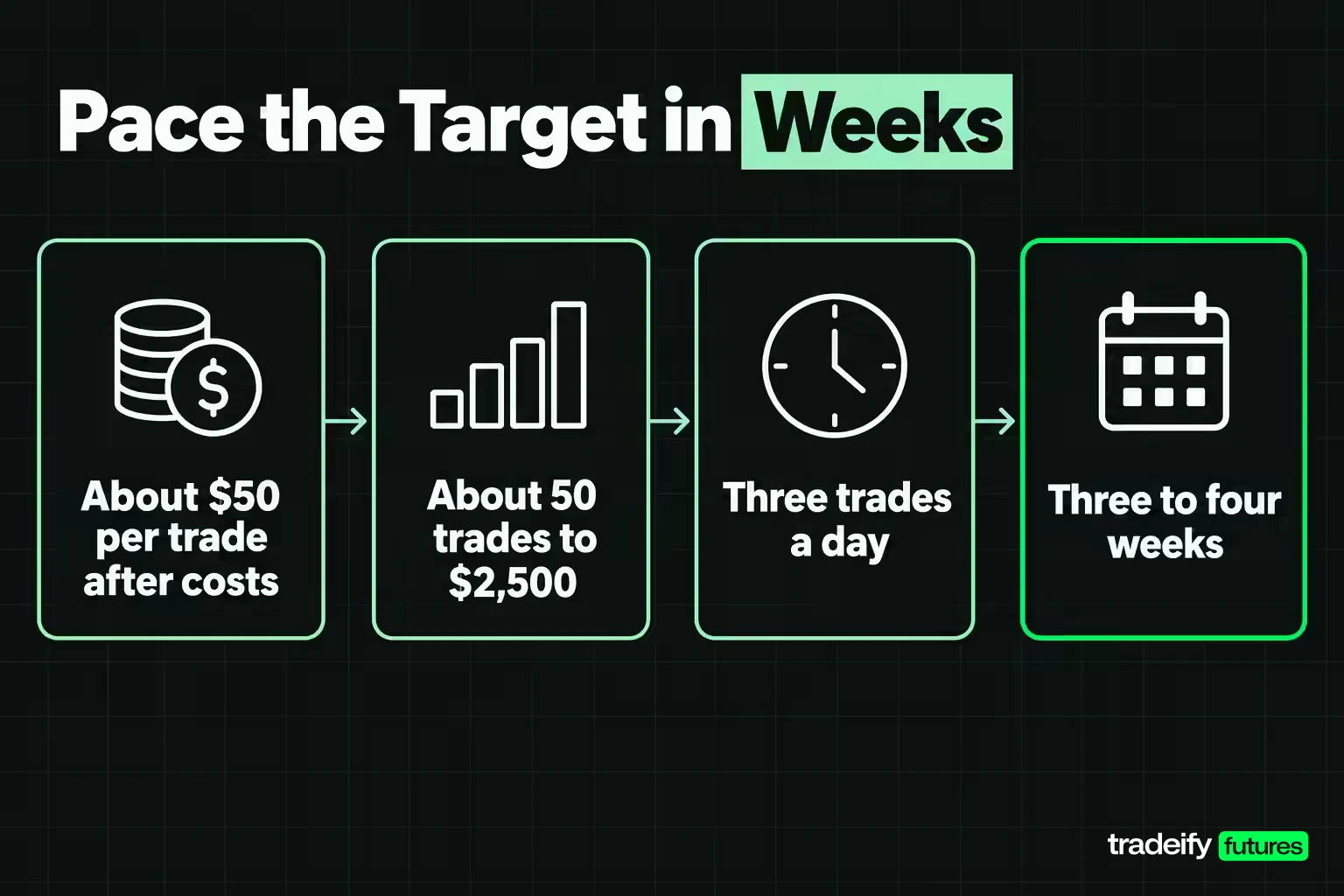
A profit target tempts you to calculate how fast you could pass. The useful calculation is how fast your edge can pass without breaking anything.
Take the 0.26R strategy at $240 per R. Expected gross profit per trade is about $62, and after $12 of illustrative costs about $50. Reaching $2,500 at that rate takes about 50 trades. At three trades a day that is around 17 trading days, or three to four weeks.
That number does two jobs. It tells you the target is a multi-week project, and it tells you that pressing to pass in three days means trading far more often or far larger than the edge supports.
Set a daily trade limit before the session
A fixed trade count stops the slide from one loss into five. A simple version for the illustrative account:
- Maximum three trades per session.
- Stop for the day after two full losses, which is also the $500 soft stop.
- Stop for the day after a +2R day if you notice you want to keep going for more.
- No new trades in the last 30 minutes before you must be flat.
Overtrading rarely feels like overtrading in the moment. It feels like suddenly seeing more setups after a loss. The trade limit is a rule you write on a calm day for the version of you sitting in the red.
How a consistency cap changes the finish
A consistency rule caps your best day as a share of total profit, usually checked when you request the pass or a payout. Under a 30% cap, the total profit you need is your best day divided by 0.30. A $900 best day needs $3,000 of total profit; a $1,200 best day needs $4,000.
The cap changes the end of an evaluation, not the start. If you make one big day early, keep trading the same size until the total catches up. Pressing size to catch up creates a new best day and moves the goalposts again.
A Worked Evaluation Week
This illustrative week runs on the $50,000 rule sheet, trading six MNQ contracts with a 20-point stop, so one R is $240. Costs are the illustrative $12 per round turn on six contracts.
| Day | Trades | Result in R | Gross P&L | Costs | Net P&L | Closing balance |
|---|---|---|---|---|---|---|
| Monday | Win at 30 points, loss at 20 points | +1.5R, −1R | $120 | $24 | $96 | $50,096 |
| Tuesday | Loss at 20 points, then stopped by choice | −1R | −$240 | $12 | −$252 | $49,844 |
| Wednesday | Win at 40 points | +2R | $480 | $12 | $468 | $50,312 |
| Thursday | Loss at 20 points, win at 30 points | −1R, +1.5R | $120 | $24 | $96 | $50,408 |
| Friday | Two wins at 40 points | +4R | $960 | $24 | $936 | $51,344 |
The week nets $1,344 from 8 trades, 5 winners and 3 losers, for +6R gross. The only losing day, Tuesday, closed down $252, about a quarter of the $1,000 daily limit and well inside the $500 soft stop.
The worked week under drawdown and consistency rules
- Static drawdown: the floor stayed at $47,500 all week. The account finished $3,844 above it.
- End-of-day trailing drawdown: the floor rose to $47,596 after Monday's close and to $48,844 after Friday's close of $51,344. The cushion is $2,500, exactly the allowance, because Friday was a new high.
- Consistency cap: Friday's $936 is about 70% of the $1,344 total. Under a 30% cap the account cannot pass yet, even though it is up on the week.
Friday's best day needs $936 ÷ 0.30 = $3,120 of total profit behind it. Here is the catch: reaching the $2,500 target is not enough, because $936 is still 37.4% of $2,500. The account needs $620 more than the target before a pass request would clear the cap, unless a later day becomes the new best day and moves the requirement again. That is exactly the kind of detail you want to find in a simulated week, not on a paid attempt.
Lessons from the worked evaluation week
The illustrative week of six MNQ contracts on a $50,000 rule sheet leaves three lessons. One large day creates a consistency debt that later days have to pay. A 1R risk with 1.5R to 2R winners can reach a $2,500 target in a few weeks at a pace of about $1,344 a week, which is the argument against chasing it in three days. And the $1,000 daily loss limit never came close to mattering, which is what a working plan looks like.
Journaling Evaluation Trades
A journal turns an evaluation from a pass or fail event into data. Log every trade, including the winners, because a winning trade taken outside your rules is a warning, not a success.
For each trade, record:
- Date, session and time of entry.
- Instrument, contract count and stop distance.
- Setup name, and whether it met every rule in writing.
- Result in R and in dollars after costs.
- Whether the stop or target was moved, and why.
- One line on what you felt before entering.
Track the three evaluation numbers daily
At the end of each day, write down three numbers that tell you where the evaluation stands:
- Distance to the drawdown floor, using the trailing floor if your rule sheet trails.
- Progress toward the target, in dollars and as a share of it.
- Best day as a share of total profit, if there is a consistency rule.
After 20 or more trades, review by setup, time of day and day of week. If one setup or one time window carries all of the losses, you have found a filter in the data rather than a feeling. A failed evaluation with a full journal is worth more than a passed one without it.
Related lesson: How to Keep a Trading Journal
Pre-Trade Checklist for Evaluation Days
A checklist catches the practical problems that end evaluations on ordinary days. Most of them are platform and calendar problems, not trading problems. Run this before the first trade of each evaluation session:
- Confirm the platform is connected to the evaluation account, not a different account.
- Confirm the contract month you are trading is the active front month.
- Check the economic calendar for scheduled releases during your session, such as CPI at 8:30 AM ET.
- Write today's drawdown floor, using the trailing value if it moved yesterday.
- Write today's soft stop, maximum trades and contract count for your stop distance.
- Confirm the time you must be flat and the time the trading day resets.
- Set your platform's own daily loss lockout at your soft stop, if it has one.
- Ask one question: is there any reason I want to trade bigger today? If yes, trade smaller.
The whole checklist should take under five minutes. If it takes longer, the rules are not yet automatic.
How to Prepare for a Prop Firm Evaluation in Three Weeks
Three weeks is a reasonable minimum to prepare for a prop firm evaluation if you have never traded under a rule sheet. Each week produces something specific and ends with a test.
| Week | Focus | What you produce | Test before moving on |
|---|---|---|---|
| Week one | Rules and sizing | Rule sheet rewritten in your own words, five numbers on a card, a contract table for your instrument and stop | You can state your floor, soft stop and contract count without looking |
| Week two | Rehearsal | Ten to fifteen simulated sessions under the evaluation's exact limits, all journaled | No day reaches the daily limit and every position matches the contract table |
| Week three | Review and admin | Journal review, session plan, platform and lockout checks, funded agreement read | Your best rehearsal day fits inside the consistency cap and the checklist runs in under five minutes |
Week three is the one traders skip, and it catches the problems that end paid attempts: a lockout that never triggered, an order type the platform handles differently, a flat time earlier than you assumed, or a daily reset in a different time zone.
A rehearsal only counts if it uses the same account size, daily limit, drawdown type, consistency cap and session rules as the real evaluation. A simulator with an oversized balance and no limits teaches the opposite of what the evaluation tests.
Related lesson: Practice with Paper Trading
Common Prop Firm Evaluation Mistakes
Evaluation failures repeat. The same handful of mistakes end most attempts, and each one has a specific preparation fix.
| Mistake | What it looks like | Why the rules punish it | Preparation that prevents it |
|---|---|---|---|
| Sizing to conviction | Doubling size on the setup you like most | One loss takes most of the daily limit | A written contract table and no size changes mid-week |
| Chasing the target | Pressing after a slow start or near the finish | A flat day becomes a drawdown breach | A fixed trade count and a soft stop at half the limit |
| Changing strategy mid-evaluation | Switching setups after two losses | The new setup has no sample and no proven edge | Commit to one setup for the whole attempt |
| Ignoring session data | Trading the overnight session with a strategy built on the open | Different volume and behavior than the sample | Trade only the session your sample came from |
| One big day | Most profit from a single session | The consistency cap blocks the pass | Track best day share and keep normal size after it |
| Misreading the drawdown | Planning against a fixed floor on a trailing rule | The floor moved up with your peak | Identify the drawdown type in writing before trading |
| Testing the daily limit | Trading on after the soft stop | The account ends at the firm's number | Close the platform when the soft stop hits |
| Breaking a conduct rule | Holding past the flat time or trading a restricted release | Account ends regardless of profit | Read the conduct rules and set alarms |
The common thread is that none of these is a chart-reading failure. A trader with an average strategy and strict rules usually lasts longer in an evaluation than a trader with a sharp strategy and loose sizing.
Running More Than One Evaluation Account
Some traders run several evaluations at once, often by copying trades from one account to the others. It can spread fees over more chances to pass, but it multiplies risk: a single bad trade hits every account together, so five accounts do not give you five independent attempts.
Before running more than one evaluation account:
- Check the account caps. Many firms limit how many evaluations or funded accounts one person or household can hold.
- Check the copy trading rules. Copying between accounts you own is often allowed, while copying someone else's trades or sharing signals usually is not.
- Never hedge across accounts. Holding opposite positions in two accounts, or in closely related products, is commonly prohibited and can void every account involved.
- Pass one first. A single account with a full journal tells you whether your process holds up before you spend fees on more.
Prop Firm Evaluation Preparation FAQ
How do you pass a prop firm evaluation?
You pass by reaching the profit target and minimum days without breaking any loss or conduct rule. In practice that means small fixed risk per trade, one tested setup, a daily trade limit and patience with the target. Most attempts end on sizing and rules rather than on strategy.
What percentage of traders pass prop firm evaluations?
No reliable industry-wide pass rate exists, because no regulator or independent auditor publishes one. Figures quoted online usually come from firms or marketers, so treat any single number with caution. Your own pass odds depend far more on your sizing and rule discipline than on an industry average.
How much does a prop firm evaluation cost?
An evaluation costs whatever the firm charges for that account size, and prices change often with promotions. Some firms charge a one-time fee per attempt, while others charge a monthly subscription until you pass. Count reset fees and the likely number of attempts, not just the first purchase.
Can I hold my evaluation trade overnight?
Often not, because many futures evaluations require you to be flat by a set time each afternoon, and some ban weekend holds entirely. Check the rule sheet, because a position left open past the flat time can be closed automatically or end the account. Swing traders should confirm this before buying.
Should my first evaluation trade be smaller?
A first trade at your normal size is fine if that size already comes from your contract table. Trading smaller on day one is reasonable if nerves are high, because hesitation causes its own execution errors. Never trade larger to get a fast start.
How long does it take to prepare for a prop firm evaluation?
About three weeks for most traders new to rule sheets: one week on rules and sizing, one week of simulated sessions under the real limits, and one week of review. Traders who already journal and size from a fixed risk can shorten the rehearsal week.
Managing a Funded Account After the Evaluation
Passing changes the rules you trade under, so prepare for the funded stage before you need it. Funded accounts usually keep a drawdown and often a daily limit, and they add payout rules: minimum profitable days, a balance buffer before you can withdraw, payout caps and sometimes a consistency rule that did not apply during the evaluation.
The common mistake right after passing is relaxing, or the opposite, sizing up because the account finally feels like yours. The routine that passed the evaluation is the routine that keeps the funded account, so keep the same size, the same trade count and the same journal for the first few weeks. Treat the first payout as the next target and the drawdown floor as the thing to protect. If the funded drawdown trails until it locks, the first weeks are when the account is most fragile.
On our accounts, the Growth Evaluation has a daily loss limit ($1,250 on a 50K account) and no consistency rule during the evaluation, while the Select Evaluation (25K to 150K) has no daily loss limit but a 40% consistency rule and a minimum of 3 trading days. Our drawdown is end-of-day trailing, enforced in real time, and it never locks during an evaluation. All positions must be closed by 4:45 PM ET, a 50K account can hold up to 4 minis or 40 micros, and our funded accounts are simulated.
Trading futures involves substantial risk of loss and is not suitable for everyone. Futures are leveraged, so losses can exceed what you expect, and fast markets can fill stops at worse prices. Evaluation and funded accounts are commonly simulated, and simulated results do not represent actual trading and may not reflect real market factors such as liquidity. All figures in this article are illustrative examples on a hypothetical rule sheet, not a forecast or a promise that any account will pass or earn a payout. This article is education, not individual financial advice.


