



TL;DR: Paper trading is simulated trading on live prices with virtual money, and its real job is to test your process, not prove an edge. Use it to practise order entry, sizing and journalling under fixed rules. Add commission and slippage to every simulated trade, because a small gross edge can turn negative once costs count. On MES, $3.50 of cost per trade cuts a 0.365R gross edge to 0.085R. Forty practice trades measure discipline, not profitability.
Most traders open a paper trading account for the same reason: they want to know whether they can trade before they pay to find out. That instinct is sound. The mistake usually comes next. A few weeks of unstructured clicking, a virtual balance that went up, and a conclusion the sample cannot support.
A paper trading account can show whether your entries, exits and sizing hold up on a live chart. It cannot show whether you stay calm when the money is real. Those are two separate tests, and only the first one is free. This guide treats paper trading as what it is good at: a cheap place to prove your process, with the costs and limits counted honestly.
Related lesson: How to start trading
What Is Paper Trading
Paper trading is simulated trading: you place real order types on live or near-live market prices, but the account holds virtual money and no order reaches an exchange. The name comes from the old habit of writing trades on paper and tracking them by hand. Today the simulator is built into the trading platform, so a paper trade looks and feels like a live one.
Most platforms call the same thing a demo account, a practice account or a simulated account. TradingView, for example, describes its Paper Trading feature as "also known as demo trading" and a way to practise buying and selling "using simulated money".
How a paper trading order gets filled
When you press buy in a paper trading account, the platform's simulator decides whether and where you were filled. It looks at the live price feed and books the trade inside the platform. Nobody on the other side took the trade, and your order joined no queue.
That one detail explains most of what paper trading can and cannot teach. A market order in a live account guarantees execution but not the price, and Investor.gov notes that a limit order can only fill at the limit price or better. A simulator often fills a limit order as soon as price touches it, while a live limit order at the same price may wait behind earlier orders and never fill.
What paper trading is really testing
A paper trading account tests the parts of trading that are mechanical: can you find the setup, place the order you meant to place, attach a stop, size the position, and record the result. It does not test the part that is emotional, because a virtual loss costs nothing. Keep those two questions separate and the account becomes useful.
Benefits of Paper Trading
The main benefit of paper trading is that mistakes in mechanics cost nothing. A first live account often loses money to errors that have nothing to do with market analysis: a buy entered as a sell, a stop placed on the wrong side, ten contracts typed instead of one. A simulated account is where those errors should happen.
The benefits that hold up in practice:
- Learning the platform. Order tickets, chart trading, the depth-of-market ladder, hotkeys and bracket orders all behave a little differently on each platform. Learning them in a simulated account means you are not reading menus while a position moves.
- Practising order types. Webull's paperTrade, for example, supports Limit, Market, Stop, Stop-Limit, OCO and Trailing Stop orders. Placing each one on purpose, and watching how it reacts to a fast move, teaches more than reading definitions.
- Building the sizing habit. Every trade can be sized from the stop distance and a fixed dollar risk, so the arithmetic becomes routine before it matters.
- Building the journal habit. Logging every trade, including the ones you skipped, costs nothing in a practice account and is the only way to review a process later.
- Testing rules on a live tape. A written strategy can be run in real time to see whether its rules are clear enough to follow when the chart is moving.
Related lesson: How to keep a trading journal
Paper Trading Pros and Cons
Paper trading has clear advantages and clear disadvantages, and both come from the same fact: nothing is at stake. That makes practice cheap and also makes some of the results unreliable.
| Area of practice | What paper trading does well | Where paper trading falls short |
|---|---|---|
| Order entry and exits | Real order types on live prices, unlimited repetitions | No rejections, queues or partial fills in most simulators |
| Position sizing | Sizing from the stop can be drilled on every trade | An oversized virtual balance removes the constraint you are testing |
| Strategy rules | Rules can be followed in real time on a live chart | Small samples say little about whether the rules have an edge |
| Costs | Costs can be added by hand in a journal | Many simulators show results with no commission or slippage |
| Emotions | Calm practice makes it easier to learn the mechanics | A virtual loss does not test fear, hesitation or revenge trading |
| Confidence | A clean process record shows progress | A clean profit record can create false confidence |
Read the last two rows twice. The pros are mostly about mechanics, and the cons are mostly about behaviour and evidence. A trader who uses paper trading for the first and does not trust it for the second is using it correctly.
Paper Trading vs Live Trading
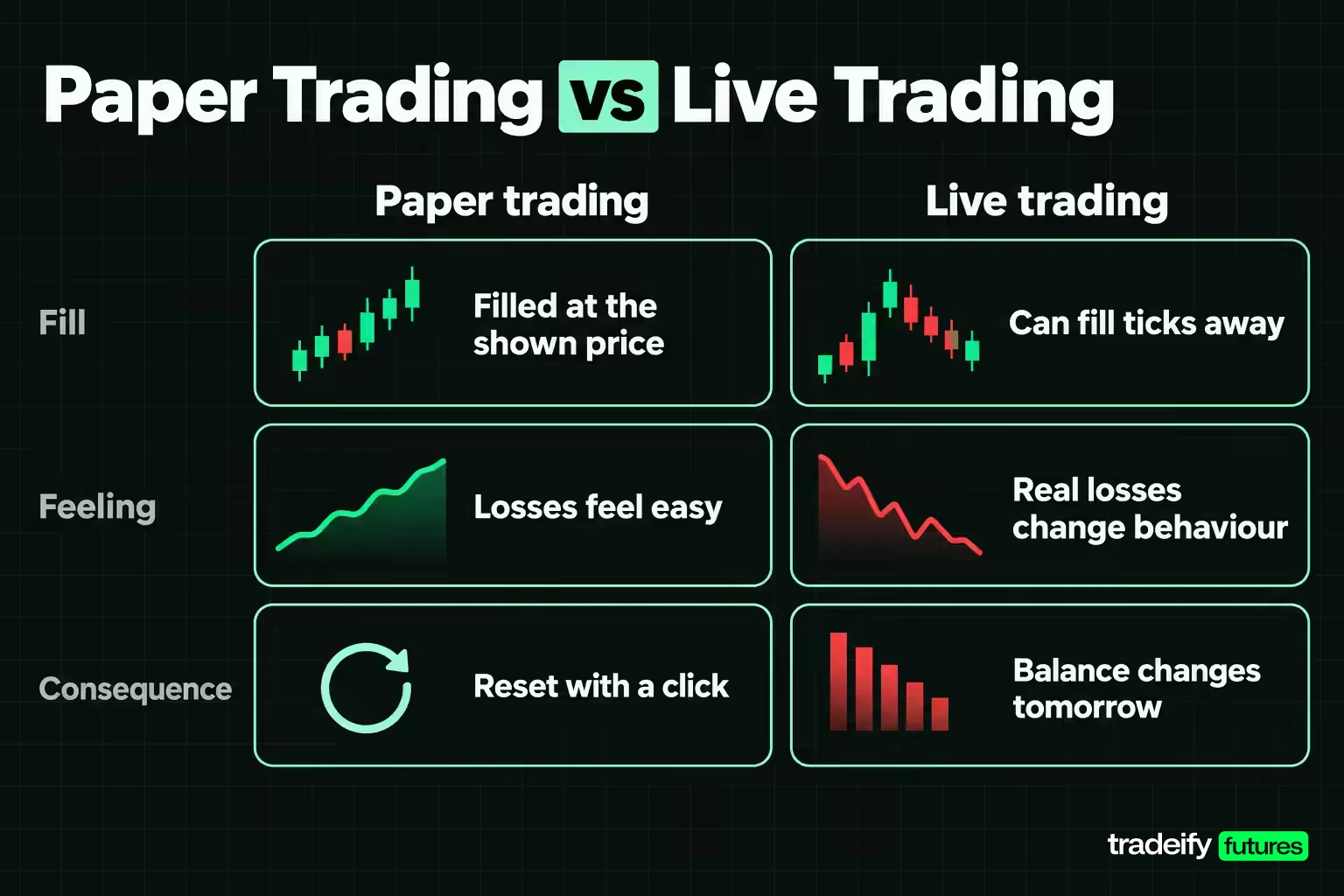
Paper trading and live trading use the same charts and the same order tickets, so they look identical. They differ in three places: the fill, the feeling and the consequence.
The fill. In live trading your order meets real liquidity. A market order can fill a tick or two away from the price you saw, and in a fast market a stop order, which becomes a market order once its price is reached, can fill well past the stop. Most paper trading simulators fill you at or near the displayed price, so your simulated results carry a built-in best case.
The feeling. Losing real money changes behaviour. In a study of trading records for 10,000 accounts at a large discount brokerage, the finance researcher Terrance Odean documented the disposition effect: investors tended to sell winners too soon and hold losers too long. That habit exists because booking a real loss is unpleasant. A simulated loss is not, so a paper trading record can show a clean habit of cutting losers that does not survive the first live losing trade.
The consequence. A paper loss resets with a click. A live loss changes the balance you trade with tomorrow, and that change pulls on the next decision. This is why a losing streak in practice is information about your rules, while a losing streak in a live account is information about your rules plus pressure to win it back.
Paper Trading Limitations That Flatter Results
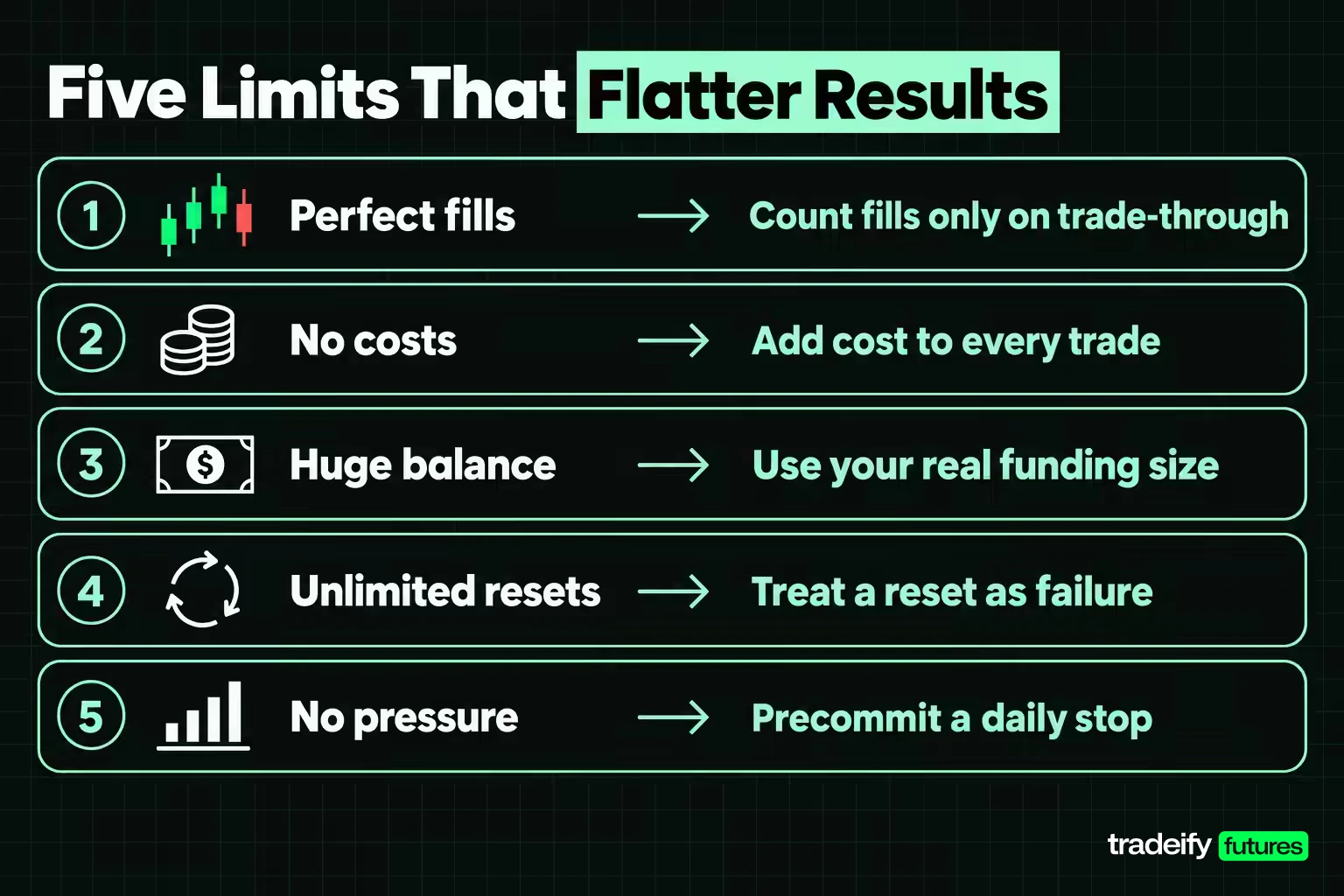
Paper trading results tend to look better than the same trades would have looked live. That is not because the trader tried less. It comes from a handful of simulator assumptions, and each one has a simple fix.
| Paper trading limitation | Why it flatters the result | Practical fix |
|---|---|---|
| Perfect or near-perfect fills | Limit orders fill on a touch and market orders fill at the shown price | Count a limit fill only if price trades through your level |
| No costs | Commission, exchange fees and slippage are missing | Add a fixed cost per round turn to every journal row |
| Huge virtual balance | Sizing mistakes never threaten the account | Set the balance to the money you would actually fund |
| Unlimited resets | A blown account carries no lasting consequence | Treat a reset as a failed test and write down why it happened |
| No real pressure | Rules are easy to follow when nothing is at stake | Precommit a daily stop and a session length, and log every breach |
The balances on offer show how far this can go. TradeZero's paper trading account starts with $1,000,000 in virtual funds, and Webull advertises unlimited virtual funds with the option to reset whenever you like. Those settings test a platform well and test a risk plan badly.
US futures regulation takes the gap seriously too. Under the CFTC's Rule 4.41, anyone presenting simulated or hypothetical performance must state that the results do not represent actual trading, may not account for factors such as lack of liquidity, and are designed with the benefit of hindsight. The same warning applies to your own paper trading record.
Related lesson: Slippage explained
How Well Paper Trading Transfers to Live Results
Paper trading works well for some goals and poorly for others, and the research on simulators points in the same direction. It is good at building skills and process. It is weak as a verdict on whether you are ready to make money.
Research on paper trading simulator users
A study by Anginer, Piza, Ray and Xu, "Trading Simulations and Real Money Outcomes", published in the Journal of Behavioral Finance in 2024, followed stock simulator users into real money accounts. The most active simulator users, those who took more risk, and those with the best single-stock results were more likely to open real money accounts. They also traded more actively with real money and significantly underperformed. The authors' reading is that simulator users can draw the wrong conclusion about their skill without accurate performance evaluation.
In plain terms, a good paper trading run made some people overconfident. The simulator did not cause the losses. The conclusion drawn from it did. Confidence without a large enough sample is a story, not evidence.
Paper trading sample size and the true win rate
Sample size is the second limit. Take a practice record of 40 trades with a 52.5% win rate. Using the standard error of a proportion, the 95% range for the true win rate runs from roughly 37% to 68%, plus or minus about 15.5 points. With 100 trades the range narrows to plus or minus 9.8 points, and with 400 trades to about 4.9 points.
So 40 paper trades can tell you whether you followed your rules 40 times. They cannot tell you whether the rules have an edge. That needs a far larger sample, which is the job of a backtest.
Related lesson: Trading expectancy
When to Use Paper Trading
Paper trading fits any situation where the question is "can I execute this?" rather than "will this make money?" The common ones:
- Learning to trade. A beginner needs repetitions of order entry, stop placement and journalling before any real money is involved.
- Switching platforms. Every platform puts buttons in different places. A week of simulated trades on the new one prevents expensive clicks on day one.
- Trying a new market. A trader moving from stocks to futures, for example, needs to learn tick values, contract sizes and session hours. Paper trading lets that learning happen on a live tape.
- Testing a new strategy in real time. After a backtest, a simulated account shows whether the rules are clear enough to follow while price is moving and the setup is not textbook.
- Coming back after a break. A short spell of paper trading after time away, or after a rough patch, rebuilds the routine without adding pressure.
- Practising a specific skill. Scaling out, moving a stop to breakeven, or using bracket orders can each be drilled in isolation.
Paper trading is the wrong tool when the question is about emotional control under real loss, or about whether a strategy is profitable over hundreds of trades. The first needs small real stakes. The second needs a backtest. Using a simulator to answer either one tends to produce a confident answer to the wrong question.
Paper Trading Platforms Compared
Paper trading platforms differ in virtual balance, markets, cost and how long access lasts. The table summarises what each provider published on its own page as of November 4, 2026. Terms change, so check the provider's current page before you sign up.
| Paper trading platform | Virtual balance | Markets | Cost and access as published |
|---|---|---|---|
| TradingView Paper Trading | Not stated on the page | Stocks, forex, crypto, commodity and index futures | Available to all users with no fees |
| Schwab thinkorswim paperMoney | $100,000 of virtual buying power | Equities, options, futures and forex | Free to Schwab clients, Schwab account required |
| TradeZero Paper Trading | $1,000,000 in virtual funds | Stocks, options and ETFs | 30 days free, then a funded account is needed |
| Webull paperTrade | Unlimited virtual funds | Stocks, multi-leg options and simulated crypto grids | Reset at any time |
| CME Group Trading Simulator | Not stated on the page | All seven of CME's asset classes, standard, E-mini and Micro contracts | Registration required, check current terms |
A few points matter more than the balance. Practise on the platform and chart layout you plan to use live, so nothing has to be relearned under pressure. Check whether the data is real-time or delayed, because delayed data turns every entry into a different exercise. And check whether the simulator lets you add commissions, since a result with zero costs cannot happen live.
If you mainly trade futures, a simulator that carries the actual contracts you will trade, including micro contracts, is worth more than a larger virtual balance.
How to Start Paper Trading
Starting paper trading takes a few minutes. Getting useful results from it takes a plan. The order below matters, because each step depends on the one before it.
- Pick the platform you intend to trade on live. On TradingView, for example, you open a chart, click Trade, choose Paper Trading and connect.
- Choose one market and one instrument. Learning a single contract's tick value, hours and typical range is more useful than hopping across ten.
- Write a one-page plan before the first trade. It needs the setup, the entry trigger, where the stop goes, the dollar risk per trade, and a daily loss limit.
- Set the virtual balance to a realistic number. Use the amount you would actually fund, not the default.
- Place one planned trade. Attach the stop and target as you enter, and write the dollar risk in your journal before you click.
- Log the result with costs. Add an assumed commission and slippage to the row, even if the simulator shows none.
- Review at the end of each session. Note every unplanned entry, every skipped setup, and every rule you bent.
Setting Up a Paper Trading Account
A paper trading account set up with default settings often tests the wrong things. Five settings make the virtual account behave more like the real one you are preparing for.
- Balance. Set it near the capital you would trade with. Schwab's paperMoney gives $100,000 of virtual buying power and TradeZero gives $1,000,000, so most traders need to lower the number or apply their own sizing cap.
- Market data. Use real-time data where the platform offers it, and sign any data agreement the platform asks for. Delayed quotes change every entry decision.
- Costs. Turn on simulated commissions if the platform has the option. If it does not, keep a cost column in your journal.
- Size limit. Write a maximum position size and maximum dollar risk per trade, and treat any breach as a failed session.
- Session limit. Cap each session, for example at two hours or three setups. Paper trading makes it easy to take trades you would never take with money.
Change nothing else for the first few weeks. A paper trading account that keeps changing settings cannot produce a clean record.
Paper Trading for Beginners in Four Weeks
Paper trading for beginners works best with a structure, because unstructured practice produces screen time and no decision. Give each week one job and one condition for moving on, and repeat the week if you miss the gate. Repeating a week costs nothing, which is the whole advantage of practising on a simulator.
| Week | Focus | Pass gate |
|---|---|---|
| Week one | Mechanics, one planned trade a day with a stop, a target and the dollar risk written down before entry | Five sessions logged with no unplanned entry and a risk figure on every row |
| Week two | Sizing, every trade sized from the plan rather than the virtual balance | Twenty trades logged with no position above the plan's maximum risk |
| Week three | Filtering, every qualifying setup and every skipped setup written down | Ten sessions where each skipped setup has a written reason |
| Week four | Consistency, the same rules run all week on live prices without editing them | Twenty trades with no rule change and a cost figure on every trade |
Two rules keep the plan honest. Log every session, including the trades you passed on, because skipped setups are the only evidence that your plan has a filter. And change no rules between week one and week four, because a plan edited every week cannot be evaluated.
The feeling to watch for in week three is boredom. A slow session makes it tempting to invent a trade just to have something to log. Writing "no setup, no trade" is a passing entry.
Related lesson: Trading discipline
Paper Trading Strategies and How to Test Them
Paper trading strategies are not special strategies. They are your real strategy, run on a simulator under conditions strict enough to tell you something. The method matters more than the setup you choose.
Testing one trading strategy at a time
Run one setup with written rules: what qualifies, where you enter, where the stop goes, where you take profit, and what cancels the idea. A pullback in an uptrend, a breakout and retest of a level, or an opening range break are all common choices for a first test. Two setups at once make it impossible to tell which one produced the result.
Recording what a strategy test needs
Each journal row needs the time, instrument, setup name, entry, stop, target, size, dollar risk, result in dollars, result in R (the multiple of the amount risked), and the assumed cost. Add one line on whether you followed the rules. That last column is the one paper trading is actually good at measuring.
Deciding when a strategy test is finished
Decide the sample size before you start, for example 40 trades, and do not judge the strategy until you reach it. A rough week is one line in the sample, not a verdict. If the rules turn out to be unclear, rewrite them once, then start a fresh sample rather than blending the two.
Related lesson: Backtesting a trading strategy
A Forty Trade Paper Trading Sample With Costs
A worked paper trading sample shows how much a simulator can hide. This hypothetical uses Micro E-mini S&P 500 futures (MES), where the contract is $5 times the index and the minimum price move is 0.25 index points, so each tick is worth $1.25. All costs are illustrative assumptions, not quotes.
Imagine a trader with a written plan. The stop is 10 ticks, or 2.5 index points, so the risk is $12.50 per contract. Average winners return 1.6R and losers are cut at 1.0R. Over 40 trades the trader wins 21 and loses 19.
| Sample item | Value |
|---|---|
| Instrument | Micro E-mini S&P 500 futures (MES) |
| Tick value | $1.25 per 0.25 index point |
| Stop distance and risk | 10 ticks, $12.50 per contract |
| Trades, winners, losers | 40 trades, 21 winners, 19 losers |
| Win rate | 52.5% |
| Average winner and loser | 1.6R and 1.0R |
| Gross result | 14.6R, or 0.365R per trade |
| Last ten trades | 2 winners and 8 losers, minus 4.8R |
On paper that is a decent record. A 52.5% win rate with 1.6R winners is an edge before costs, and the break-even win rate with no costs is 38.5%.
Adding commission and slippage to the sample
Now add the part most simulators leave out. Assume a round-turn commission and fees of $1.00 or $3.00 per micro contract, plus two ticks of slippage worth $2.50. That puts the cost per trade at $3.50 or $5.50. Your own broker's fee schedule is the only number that counts.
| Cost item | $1.00 commission case | $3.00 commission case |
|---|---|---|
| Cost per trade with 2 ticks of slippage | $3.50 | $5.50 |
| Friction at a 10 tick stop | 0.28R | 0.44R |
| Net result over 40 trades at 10 ticks | Plus 3.4R, or 0.085R per trade | Minus 3.0R, or minus 0.075R per trade |
| Break-even win rate at 10 ticks | 49.2% | 55.4% |
| Friction at a 4 tick stop, $5.00 risk | 0.70R | 1.10R |
| Net result over 40 trades at 4 ticks | Minus 13.4R, or minus 0.335R per trade | Minus 29.4R, or minus 0.735R per trade |
| Break-even win rate at 4 ticks | 65.4% | 80.8% |
The same 40 trades now land somewhere between plus 3.4R and minus 3.0R. The trader's skill did not change and the win rate did not change. Only the cost of each trade was counted.
Why a tighter stop can cost more in paper trading math
Tightening the stop from 10 ticks to 4 cuts the dollar risk per contract from $12.50 to $5.00, which feels safer. Per unit of risk it is not, because the fixed cost of a round turn does not shrink with the stop. Friction jumps to 0.70R or 1.10R, and the break-even win rate climbs to 65.4% or 80.8%.
That is one of the most useful things a paper trading account can show, and it stays invisible if you only count wins and losses. A tight stop is not automatically safer. Whether it helps depends on your fixed cost per trade against the risk you take.
What the losing stretch in the sample means
In the hypothetical 40-trade MES paper trading sample, with 1.6R winners and 1.0R losers, the last ten trades were 2 winners and 8 losers, a drop of 4.8R. In a live account the temptation would be to decide the edge had vanished and start changing rules. The same rules produced the winning stretch and the losing one, so a losing cluster is a reason to check whether you followed the process, not a reason to rewrite it.
Paper Trading vs Backtesting, Replay and Stock Simulators
Paper trading is often confused with three other practice tools. Each one answers a different question, so it helps to know which you are using.
| Practice tool | How it works | Question it answers |
|---|---|---|
| Paper trading | Live prices, virtual money, trades placed in real time | Can I execute my rules on a live chart? |
| Backtesting | Rules applied to historical data, often hundreds of trades at once | Do these rules have an edge over a large sample? |
| Bar or chart replay | Historical price played back bar by bar while you trade it | Can I make decisions without knowing what comes next, faster than real time? |
| Stock market simulator game | Virtual portfolio contests, often with leaderboards | Can I beat other players over a set period? |
Backtesting tests the rule. Paper trading tests the trader. Replay sits between them: it gives you many more decisions per hour than live paper trading, but you can pause the market, which a live session never allows.
Stock market simulator games are a different thing again. Leaderboards reward the biggest gains over a short window, which pushes players toward large size and concentrated bets. TradingView, for instance, runs a virtual competition called The Leap with real-money prizes. A contest can be fun and educational, but its scoring rewards the very behaviour your risk rules exist to stop.
Moving From Paper Trading to a Live or Funded Account

Moving from paper trading to a real account comes down to two questions, and neither is whether the paper account made money.
The first is whether your process held. The four-week log answers that with evidence: no unplanned entries, a risk figure on every row, no rule edits, and a cost estimate on every trade. If the log shows gaps, the practice phase is not finished.
The second is how you behave once losses are real. A simulator cannot answer that, and more paper trading will not either. So make the move deliberate and reversible. Trade smaller than your plan's maximum for a fixed number of trades, keep the same journal, and compare live discipline and costs against the practice record. If your process slips, the answer is smaller size, not a new strategy.
Funded evaluations sit between the two. They replace your own deposit with a published rule set, usually stricter than a brokerage account, with drawdown limits and often a daily loss limit. Practice trades in your own simulator do not count toward an evaluation, but the sizing and journalling habits carry over directly.
Our evaluations and Sim Funded accounts at Tradeify run on simulated fills too, so the paper trading limits on execution still apply. The difference is that the rules have consequences: touching the end-of-day trailing drawdown fails the account, and every position has to be closed by 4:45 PM ET on a regular trading day. We are a prop firm, not a free paper-trading app, and profits on a Sim Funded account can lead to real payouts. For practice on past sessions, WealthCharts, one of the platforms we support, includes Chart Replay.
Paper Trading FAQs
Can I paper trade for free?
Yes, several platforms offer free paper trading. As of November 4, 2026, TradingView lists its Paper Trading as available to all users with no fees, Schwab's paperMoney is free to Schwab clients, and TradeZero offers 30 days free. Check the current terms, because trial lengths and data access change.
How does paper trading work?
You connect to a simulated account inside a trading platform, place orders on live prices, and the platform books the fills and tracks your virtual balance. No order reaches an exchange. The simulator usually fills you at or near the shown price, so live fills can be worse.
Is $100 enough to start day trading?
For futures, $100 is very thin. Risking 1% of $100 is $1, which is less than a single $1.25 tick on one Micro E-mini S&P 500 contract. For US stock margin accounts, the old $25,000 pattern day trader minimum is being replaced under FINRA Regulatory Notice 26-10, with a phase-in that ends October 20, 2027.
Is it possible to make $1000 a day day trading?
It is possible for some traders on some days, but no practice record makes it a realistic target. Making $1,000 in a day on one E-mini S&P 500 contract, at $50 per point, means capturing 20 ES points net of costs. Investor.gov warns that day trading is extremely risky and can cause substantial losses in a very short time.
How long should you paper trade before going live?
Paper trade until you meet written pass conditions, not until a calendar date. For many beginners that is four to eight weeks of logged sessions and at least 40 trades under fixed rules. Weeks of unplanned trades are not preparation.
Can you make money from paper trading?
No, you cannot make money from paper trading itself, because the account holds only virtual money. Schwab's own FAQ says the same thing plainly. Some platforms run virtual contests with real prizes, which are separate competitions with their own rules.
Paper Trading Checklist Before Going Live
Run this paper trading checklist once, in writing, on the day you plan to move to a real account.
- At least 40 logged practice trades, each with the dollar risk written before entry.
- Three or more sessions in a row with zero unplanned entries.
- No rule changes in the last 20 trades.
- Your cost per trade in R, worked out from your own broker's fees rather than a guess.
- The dollar value of your normal stop on the instrument you will trade, and confirmation that it fits the balance you will fund.
- A written answer for what you will do after three losses in a row and after three wins in a row, and the two answers are the same.
If any line fails, the practice phase is not over. That is a normal result, not a setback. You found the gap without paying for it, which is exactly what a paper trading account is for.
Related lesson: Place your first trade
This guide is educational and is not financial advice or a recommendation to trade any instrument. Futures and other leveraged products carry substantial risk, and losses can exceed the amount deposited. Paper trading, evaluation and funded accounts are simulated and do not reproduce live fills or your behaviour with real money, so simulated results do not predict live results. All prices, costs and stop distances in the examples are illustrative assumptions.


