



TL;DR: The order book is the live list of resting buy and sell orders at each price, and it shows what your order will cost to fill. Bids and asks meet at the spread; on Micro E-mini S&P 500 futures one 0.25 tick is $1.25 per contract. A matching engine fills by price first, then by a rule such as FIFO or pro rata, and changing a FIFO order can cost its place in line. On an illustrative MES book, a 420 lot market buy walks four levels and pays $1,137.50 more than the quoted ask. Visible size can be cancelled, hidden in icebergs or faked, so read the book as current conditions, not a forecast.
An order book is the list a trading venue keeps of every order that is waiting to trade. Each order says what someone is willing to pay or accept, and how much. The order book is where those intentions sit until a matching engine pairs them with an opposite order, or until the trader cancels.
If you have opened a depth ladder and seen a wall of numbers, that is the book. Those numbers decide your fill price, your place in line and how much a bigger order really costs. They also leave out a lot, and knowing what they leave out is half the skill.
What Is an Order Book
An order book is a venue's record of the buying and selling interest in one instrument that has not traded yet. Wikipedia's definition is a clean starting point: the list of orders a trading venue uses to record the interest of buyers and sellers, which a matching engine then uses to decide which orders can be fully or partially executed.
The order book has two sides.
- Bids are resting buy orders. The highest bid is the best price anyone is currently willing to pay.
- Asks (also called offers) are resting sell orders. The lowest ask is the best price anyone is currently willing to sell at.
- Top of the book is that pair, the highest bid and the lowest ask.
- The spread is the gap between them. If you want to buy right now, you pay the ask. If you want to sell right now, you receive the bid.
Orders are grouped by price. Every order resting at the same price forms one price level, and the total size at that level is what most screens show next to the price.
What the order book is not
The order book is not a price chart. A chart records trades that already happened. The book records orders that have not happened yet, and most of them can be cancelled in a fraction of a second.
The order book is not a forecast either. It shows where size is sitting right now. It does not show whether that size is genuine, whether it will still be there when price gets close, or which way price goes next.
Here is where traders get caught. A large number on the ladder looks like a promise. It is an intention, and intentions change.
Related lesson: Bid price vs. ask price
What One Row of the Order Book Shows
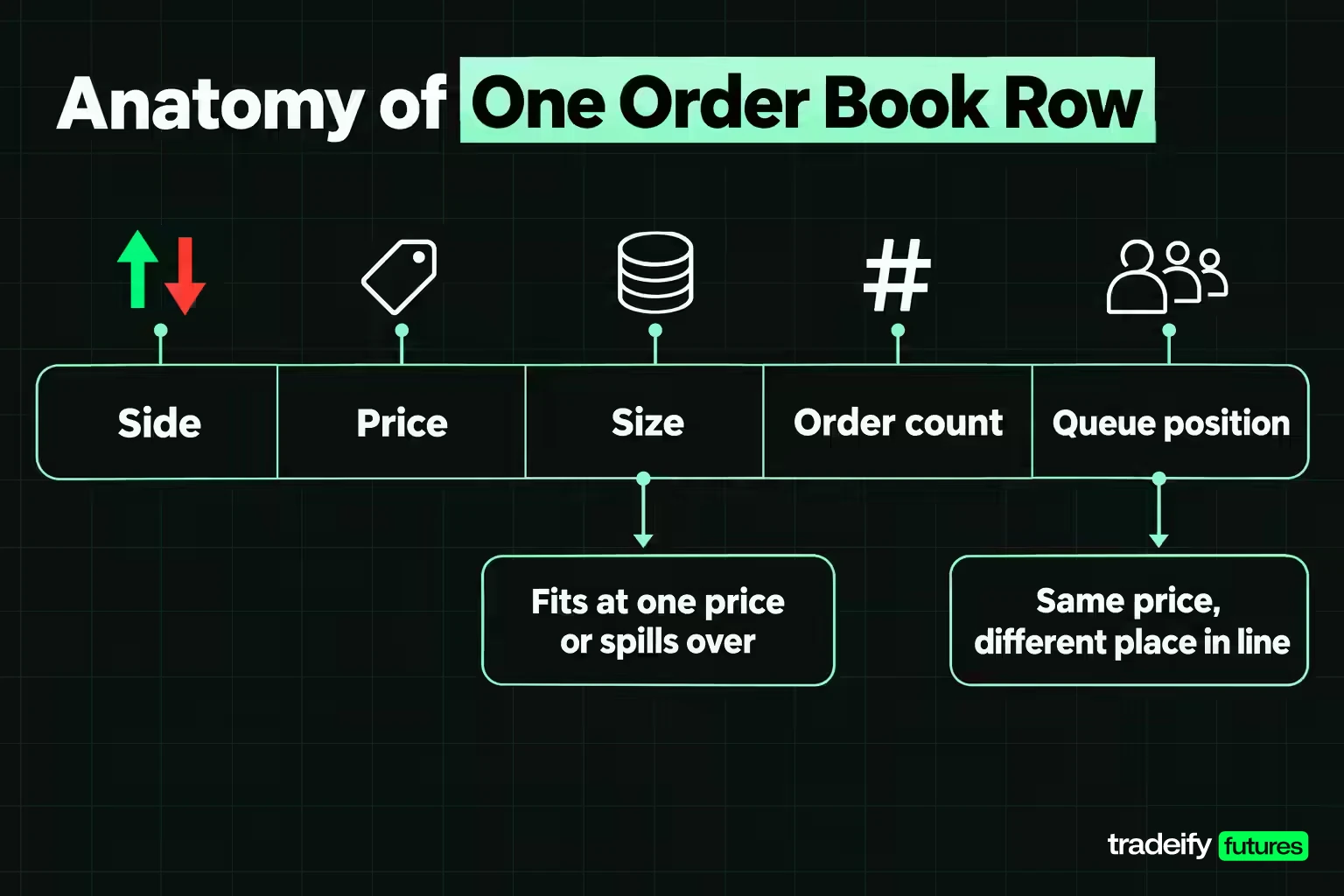
Each price level in an order book is really a small stack of records. A typical display collapses that stack into one number, but the underlying information looks like this.
| Field | What it holds | Why it matters to you |
|---|---|---|
| Side | Bid or ask | Buy interest and sell interest never mix at one level |
| Price | One price on the instrument's tick grid | Everything at this level fills at this price before the next level is touched |
| Size | Total quantity resting at the price | Decides whether your order fits at one price or spills to the next |
| Order count | How many separate orders make up the size | A level built from many small orders behaves differently from one big order |
| Queue position | Where each order sits in line at its price | Same price does not mean the same claim on the next fill |
| Displayed vs hidden | What is shown and what is held back | Iceberg orders show only part of their real size |
Market by price vs market by order
How much of that stack you can see depends on the data feed. CME Group's MDP 3.0 market data offers a 10-Deep Market By Price (MBP) book, which aggregates each of the top 10 price levels into a single size figure, and a Market By Order Full Depth (MBO) feed that disseminates individual orders and quotes at every price level.
The practical difference shows up in the order count. Take an order book level showing 120 contracts. On an aggregated feed it is just "120." On an order-by-order feed you might find twelve orders of 10, or one order of 120. Twelve traders each have to decide to cancel before the first version disappears. The second version is one click from vanishing.
That is why experienced book readers care about who makes up the size, not just how much size there is.
How an Order Book Works When a New Order Arrives
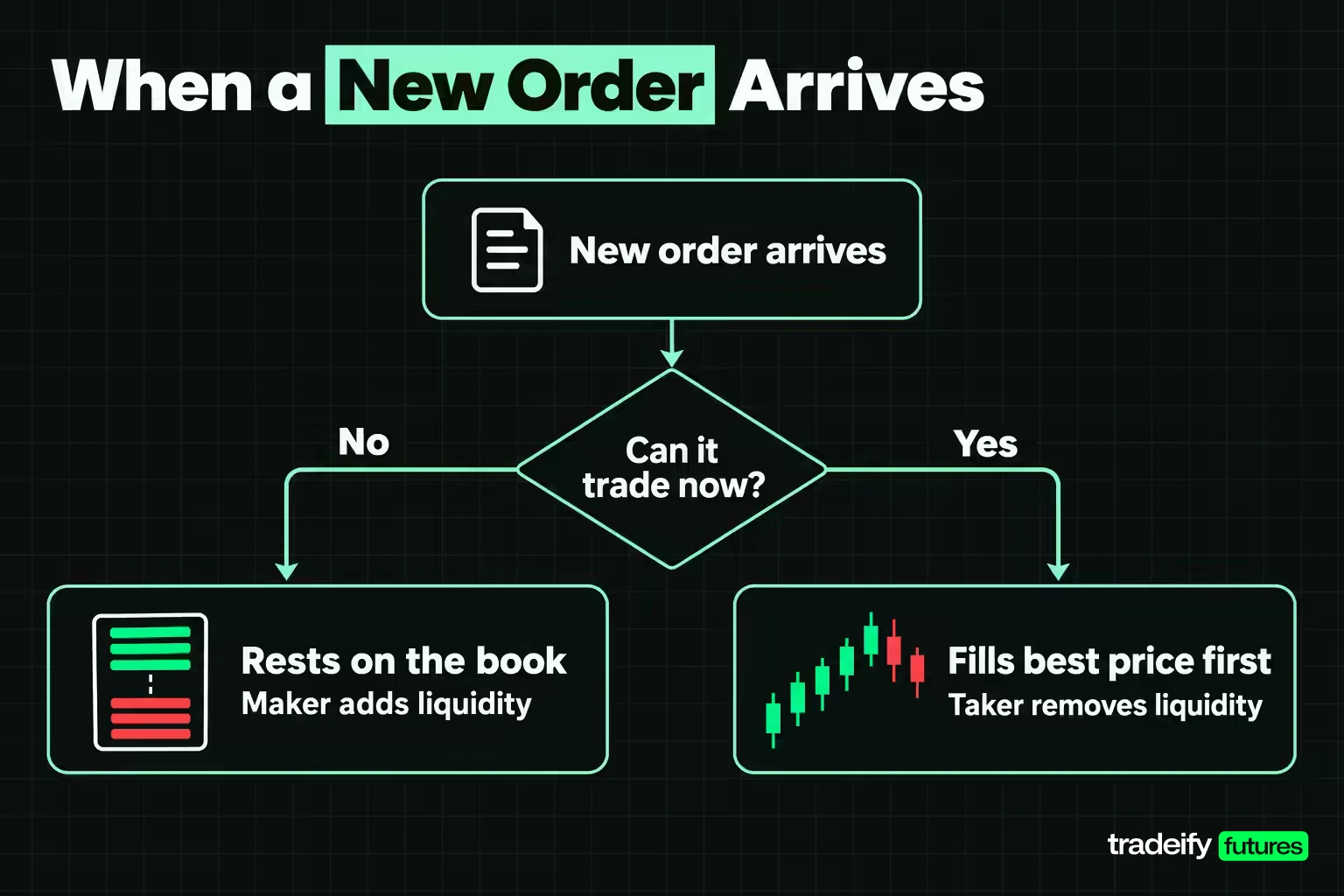
An order book works through a matching engine: software that checks every incoming order against the resting orders on the opposite side. The CFTC's glossary describes a matching algorithm as a set of rules, encoded in software in electronic markets, that decides when and if bids and offers are matched.
What happens next depends on the order's price.
- A limit order that cannot trade yet goes onto the book and waits. A buy limit below the best ask joins the bid side. This adds liquidity, and the trader becomes a "maker."
- An order that can trade immediately (a market order, or a limit priced at or through the opposite side) takes liquidity. It fills against resting orders, best price first, and the trader becomes a "taker."
- A partial fill happens when the incoming order is larger than the size available at its price. The filled part becomes a trade, and the rest either rests on the book (a limit) or keeps walking to worse prices (a market order, within the venue's protections).
- A cancel removes a resting order. No trade, no print, just a smaller number on the ladder.
- A modification changes a resting order. On many venues, a modification costs you your place in line.
Price-time priority and your place in the queue
Most order books rank resting orders by price-time priority. Optiver explains it simply: the best price executes first regardless of when it arrived, and at the same price, the order that arrived first is first in line.
Here is what that means in practice. Imagine 40 contracts are already resting at a bid of 7000.00 and you add a limit buy for 25 at the same price (illustrative numbers). You are now behind those 40. Sellers have to hit 40 contracts at 7000.00 before your first contract fills. If price touches 7000.00, trades 30 there, and bounces, you were "at the price" and still got nothing.
That is the most common confusion about limit orders. Price touching your level is not the same as your order filling.
On CME Globex, FIFO matching makes the queue rule explicit: an order loses its priority and is re-queued if you increase the quantity, change the price, or change the account number. Nudge your order up by one contract and you go to the back of the line.
When the book crosses
Normally the best bid sits below the best ask. If a bid arrives at or above the lowest ask, the two trade immediately and leave the book. Wikipedia notes that if that situation persists because of an error or a market condition, the book is described as crossed. On a functioning electronic order book this is rare and short-lived, and a screen that shows it for long usually has a data problem.
Related lesson: Partial fills
Order Book Matching Rules Beyond FIFO
Price comes first on every order book, but once an aggressive order reaches a price level with several resting orders, something has to decide who gets filled. CME Group publishes its supported algorithms on Globex: Allocation, FIFO, FIFO with LMM, FIFO with Top Order and LMM, Pro-Rata, Configurable, Threshold Pro-Rata, Threshold Pro-Rata with LMM, and Institutional Prioritization.
They are built from a handful of stages.
| Matching stage | How CME describes it | Who it favours |
|---|---|---|
| FIFO | Price and time are the only criteria; the first order at a price is the first matched | The earliest order at the level |
| Pro rata | The aggressor's quantity is split by each resting order's share of the level, rounded down | Larger resting orders |
| Top order | Priority to the first incoming order that betters the market | The trader who posted the new best price |
| Lead market maker (LMM) | Designated LMMs get a configurable percentage of the aggressor's quantity first | Designated liquidity providers |
| Institutional prioritization | A two pass FIFO that fills the aggressor's own institution group first | Members of that group |
| Residual | Lots left over after rounding are allocated FIFO | The earliest order still unfilled |
Pro rata matching is used in some CME products, SOFR futures among them. In the FIFO-only products, queue position is everything.
A worked pro rata vs FIFO split
The arithmetic shows why the rule matters. Three orders rest at one price: 5 lots, 12 lots and 8 lots, arriving in that order, 25 lots in total. A 20 lot aggressor arrives (illustrative numbers).
| Resting order | Size | Share of the level | Raw pro rata | Pro rata fill | FIFO fill |
|---|---|---|---|---|---|
| First | 5 | 20% | 4 | 5 | 5 |
| Second | 12 | 48% | 9.6 | 9 | 12 |
| Third | 8 | 32% | 6.4 | 6 | 3 |
Under pro rata, each order's raw allocation is its share of 20: 4, 9.6 and 6.4. Rounding down gives 4, 9 and 6, which is 19. The one residual lot goes FIFO to the earliest order, so the final split is 5, 9 and 6. Under FIFO, the same 20 lots go 5, 12 and 3.
Same order book, same aggressor, very different outcome for the third trader. CME's own pro rata variants add details on top of this, such as a minimum allocation (two lots in some versions) below which an allocation rounds to zero.
The behavioural consequence is real. Pro rata rewards displayed size, so traders in those products often show more size than they actually want filled. FIFO rewards being early, so traders in those products care about speed and about never touching a working order unless they have to.
A Worked Order Book Example on Micro E-mini Futures
Definitions get easier with numbers attached. This illustrative order book is for Micro E-mini S&P 500 futures (MES). Per CME's contract specification, MES is $5 times the S&P 500 Index, with a minimum tick of 0.25 index points worth $1.25 per contract. The prices are round illustrative levels, not a live quote.
| Book level | Bid price | Bid size | Ask price | Ask size |
|---|---|---|---|---|
| 1 | 7000.00 | 40 | 7000.25 | 30 |
| 2 | 6999.75 | 90 | 7000.50 | 70 |
| 3 | 6999.50 | 160 | 7000.75 | 120 |
| 4 | 6999.25 | 260 | 7001.00 | 200 |
| 5 | 6999.00 | 400 | 7001.25 | 300 |
The best bid is 7000.00 and the best ask is 7000.25. The spread is 0.25 points, one tick, or $1.25 per MES contract. The midpoint is 7000.125, which is not on the 0.25 tick grid, so no order can rest there. The mid is a reference point, not a price you can trade.
Read the columns as queues. There are 40 contracts ahead of any new bid at 7000.00 and 30 contracts available to buy at 7000.25. Visible ask size across all five levels is 720 contracts; visible bid size is 950.
What a market buy costs at different sizes on the MES book
Now send market buy orders of different sizes into the ask side of the illustrative MES order book (asks of 30, 70, 120, 200 and 300 contracts from 7000.25 up to 7001.25) and track the average fill. The extra cost is measured against the best ask of 7000.25, the price you saw when you clicked.
| Order size | Levels used | Average fill | Extra ticks per contract | Extra cost on the order | Extra cost per contract |
|---|---|---|---|---|---|
| 10 | 1 | 7000.25 | 0 | $0.00 | $0.00 |
| 50 | 2 | 7000.35 | 0.4 | $25.00 | $0.50 |
| 100 | 2 | 7000.425 | 0.7 | $87.50 | about $0.88 |
| 220 | 3 | about 7000.60 | about 1.41 | $387.50 | about $1.76 |
| 420 | 4 | about 7000.79 | about 2.17 | $1,137.50 | about $2.71 |
| 800 (720 filled, 80 unfilled) | 5 | about 7000.98 | about 2.93 | $2,637.50 | about $3.66 |
The 10 lot fits inside the first level and pays exactly the quoted price. That is why small orders in a liquid market feel free of slippage.
The 50 lot takes all 30 at 7000.25 and 20 at 7000.50. Those 20 contracts drag the average 0.10 points higher, which is $25.00 across the order.
By 420 contracts the order has eaten four levels and pays more than two ticks of extra cost on every contract in it. The 800 lot is the one worth sitting with: only 720 contracts are visible, so 80 are left unfilled, and in a real market they would keep chasing into whatever arrives next.
These sizes are bigger than most retail traders send, and that is the point of the example. Every order book has a size at which it starts charging you. On a busy contract that size is large. On a thin contract, or in the minutes around a major data release, it can be very small.
Related lesson: Slippage explained
How to Read an Order Book Step by Step
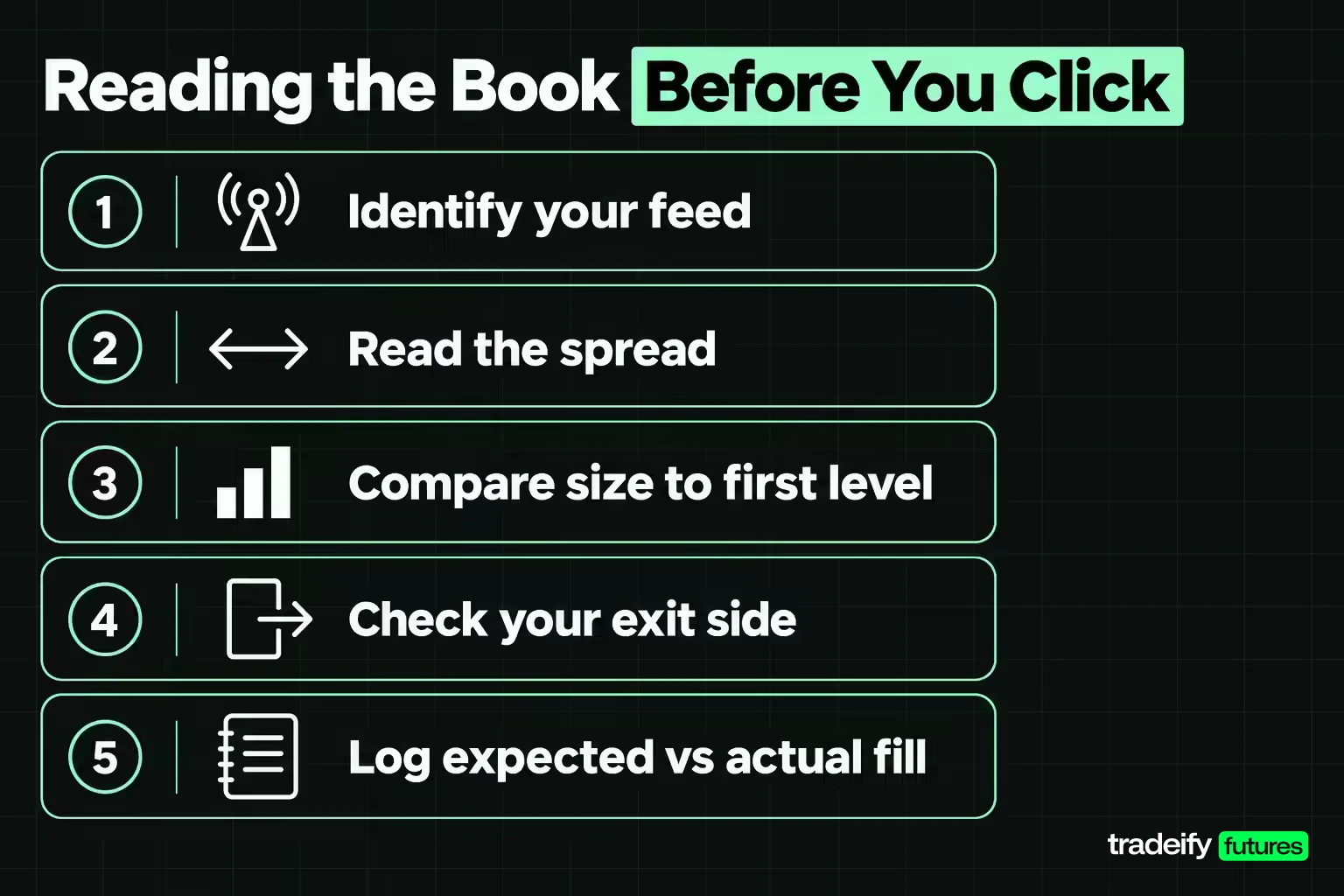
Reading an order book is mostly about answering a few mechanical questions before you send an order, not about predicting direction. A short routine works better than staring at the ladder.
- Identify your feed. Is the screen showing only top of book, an aggregated depth window, or individual orders? That decides how much weight the size numbers deserve.
- Read the spread. On MES, one tick is $1.25 per contract. That is the cost of crossing once, win or lose.
- Compare your size to the first level. If your order is smaller than the size at the touch, you should fill at the quoted price. If it is larger, work out where the average lands.
- Check the side you will exit on. Depth you can buy into is not depth you can sell into later. On an illustrative MES book with bids of 40 at 7000.00, 90 at 6999.75 and 160 at 6999.50, a market sell of 50 averages 6999.95 and costs $12.50 extra; a sell of 150 averages about 6999.78 and costs $162.50 extra.
- Look at order counts if you have them. Size spread across many orders is sturdier than one large order that can disappear at once.
- Watch time and sales for what actually traded. The book shows offers to trade. The tape shows trades. A level that keeps refilling after it trades is telling you something different from a level that gets pulled as price approaches.
- Write down the fill you expected and the fill you got. After a few weeks of entries, you have a measured cost of trading instead of a feeling.
The temptation is to turn step 6 into a signal: a big bid appears, so price must go up. Resist it. A large resting order shows you where someone is willing to trade right now. It does not tell you that they will still be there in ten seconds.
Related lesson: Time and sales
What the Order Book Cannot Tell You
The visible order book is evidence of declared interest. It is silent about everything that has not been declared, and some of what is declared is not what it looks like.
| Question you might ask | What the order book shows | What it cannot show |
|---|---|---|
| Where is liquidity right now? | Size at each displayed price level | Whether that size will stay or be pulled |
| Who is behind the size? | Order counts, and individual anonymous orders on an MBO feed | Any identity or intent |
| Is there more size than I see? | The displayed portion of each order | Hidden size behind iceberg orders |
| Will my limit order fill? | How much size is ahead of you | The cancels and new orders that arrive first |
| Which way will price move? | Imbalance in displayed size | Anything about the future |
Iceberg orders and hidden size
Many venues let traders show only part of an order. CME calls this display quantity. In CME's own example, a trader places a buy order for 100 with a display quantity of 10. No more than 10 is ever exposed; the rest is booked but not displayed. Each time 10 fill, the next 10 enter as a new order at the back of the queue.
So a level showing 10 contracts can absorb far more than 10. If you see a price trade much more volume than the ladder ever showed there, hidden size is one likely explanation.
Spoofing and fake size
Size can also be shown with no intention of trading. Under the Commodity Exchange Act, section 4c(a)(5)(C), the CFTC prohibits spoofing, which it describes as bidding or offering with the intent to cancel the bid or offer before execution.
Cancelling an order is legal and happens constantly. Placing one you never intended to let fill, to push other traders around, is not. You cannot tell the two apart from a screen, which is one more reason to treat displayed size as a condition rather than a promise.
Running an Order Book at an Exchange
Running an order book is the venue's job, not the trader's. For futures, the exchange operates the matching engine; for crypto, the exchange or the protocol does. Whoever runs it has to settle a short list of design questions.
- A price grid. Every order book has a minimum tick. MES moves in 0.25 point increments, and on Hyperliquid's order books prices must be integer multiples of the tick size and sizes integer multiples of the lot size.
- Published matching rules. Traders need to know how fills are allocated. CME publishes its algorithm list per product.
- Data distribution. The venue decides what the public sees: top of book, aggregated depth such as CME's 10-Deep Market By Price, or full order-by-order data.
- Integrity controls. Rules for crossed books, price limits, cancellations and conduct, plus surveillance for practices such as spoofing.
As a trader you never run any of this. You do benefit from knowing the venue's rules, because they decide whether being early, being big, or posting a new best price gets you filled.
Advantages and Drawbacks of an Order Book
An order book is the default market structure for exchanges because of what it gives traders. Uniswap's own documentation notes that most publicly accessible markets use a central limit order book.
The main advantages:
- Transparency. You can see resting interest at each price instead of guessing at it.
- Price formation in the open. Prices come from orders competing on one book, and the best bid and ask are visible to everyone with the feed.
- Choice of how you trade. You can pay the spread for immediacy with a market order, or rest a limit order and wait for someone to come to you.
- Known priority rules. Price-time priority, or whatever the venue publishes, applies to everyone the same way.
The drawbacks are just as real:
- Thin books are expensive. When few orders rest near the touch, a larger market order walks several levels and its average fill can drift ticks away from the price you saw.
- Visible size is cancellable. Depth can vanish exactly when you need it, often around news.
- Speed matters. Under FIFO, the earliest orders get filled first, which favours the fastest participants.
- It needs active makers. An order book is only as good as the people willing to rest orders on it. Without them, spreads widen and depth thins.
Order Books vs AMMs in Crypto Trading
Order books are not the only way to match buyers and sellers. Crypto markets use three main designs, and the comparison helps clarify what an order book actually does.
Centralized crypto exchanges generally run a central limit order book much like a futures exchange: bids, asks, price-time priority and a matching engine on the exchange's own servers.
Automated market makers (AMMs) replace the order book with a pool. Uniswap describes itself as an AMM, a set of smart contracts, instead of an order book. You trade against the pool's reserves, priced by a constant product formula: the two token balances multiplied together must stay constant (or increase) after every trade. Larger trades relative to the pool's depth move the price more, which Uniswap calls price impact.
Decentralized order book exchanges keep the book but move it onto a blockchain network. On dYdX Chain, each full node keeps an in-memory order book, and block proposers build blocks from their local book with matches generated by price-time priority. Because messages reach nodes in different orders, books can differ across the network until a block is committed. Hyperliquid's HyperCore keeps an order book for each asset, matches in price-time priority, and sorts cancels ahead of new orders within a block.
Hybrid order book and AMM designs
Hybrid designs try to combine an order book with an AMM pool. The usual idea is that resting limit orders provide precise prices near the market, while a pool provides a baseline of liquidity that is always there, even when few makers are quoting.
For a trader, a hybrid raises one practical question: where will my order actually fill? A router may send part of an order to the book and part to the pool, depending on which offers the better price at each step. That can help a larger order, because it is not limited to one source of liquidity. It also makes the cost harder to predict from the visible book alone, since the pool's price impact is not shown as resting size at a level.
The details vary a lot by protocol, including which side fills first, how fees differ between the book and the pool, and how block timing affects the order of events. Read the venue's own documentation before assuming how a hybrid will handle your order.
Comparing order books, AMMs and decentralized order books
| Design | Where prices come from | What a large order does |
|---|---|---|
| Central limit order book | Resting orders from makers | Walks through price levels |
| AMM pool | A formula on the pool's reserves | Moves along the price curve (price impact) |
| Decentralized order book | Resting orders, matched by network nodes | Walks through levels, with block timing added |
The underlying lesson carries across all three. A small order trades near the quoted price; a large one pays for the liquidity it consumes. An order book shows you that cost level by level, before you trade.
Level 1 and Level 2 Data on Futures Platforms
On a futures platform, the order book you see depends on your market data subscription. Level 1 gives the best bid, best ask and last traded price. Level 2 (depth of market) adds the resting size at further price levels, such as the 10 levels of CME's aggregated feed.
A price ladder (often called a DOM) can run on either. On Level 1 it shows the best bid and ask and lets you place and move your own orders. On Level 2 it also fills in the stacked size behind the touch. A working ladder is not proof that you have depth data.
Level 1 is enough to place and fill orders. Level 2 earns its keep when your decisions depend on how much size rests behind the touch, how quickly a level refills, or how far a larger order would walk.
We include free Level 1 CME Group data on every Tradeify account. Level 2 depth is an optional paid add-on you buy directly from Tradovate, and it is available on our Tradovate accounts only; our Rithmic and WealthCharts accounts are Level 1 only for now. If your ladder on those platforms shows only the best bid and ask plus your own working orders, nothing is broken. That is the Level 1 DOM doing its job.
Order Book FAQ
What is an order book in simple terms?
An order book is a venue's list of buy and sell orders that have not traded yet, grouped by price. The highest bid and lowest ask sit at the top, with the size waiting at each price next to it. A matching engine works through that list whenever a new order arrives.
Is the order book the same as Level 2?
Not exactly. The order book is the full record the exchange keeps. Level 2 is a data product that shows you part of it, usually the resting size at several price levels, and some feeds aggregate each level into one number.
What is the difference between an order book and a depth chart?
A depth chart plots the same order book data as cumulative size, with bids on one side and asks on the other. It is easier to scan at a glance. The book itself gives exact prices and sizes at each level.
What does a big wall in the order book mean?
A large resting order means someone is currently willing to trade a lot at that price. It may hold, it may get filled, or it may be cancelled as price approaches. Watch whether it actually trades before treating it as support or resistance.
Why does the order book change so fast?
Traders and algorithms add, modify and cancel orders constantly, often many times per second. Most of those changes never become trades. That is why the tape of actual trades is a useful check on what the book appears to show.
Do I need Level 2 to trade futures?
No. Top of book data is enough to place and fill orders. Level 2 helps when your method depends on resting size behind the best bid and ask, or on how a level refills.
This article is educational and is not financial advice or a recommendation to trade any instrument. Futures are leveraged, and losses can build faster and run larger than you expect, especially when an order fills at a worse price than you saw. The order book examples here are illustrative constructions, not live quotes, and exchange rules, data products and platform features change. Evaluation and funded accounts at a prop firm trade in a simulated setting, and simulated results do not predict live results.


