



TL;DR: Slippage is the gap between the price you expected and your average fill, and the real question is how much of it your edge can pay for. Measure it in ticks first, then dollars, against one fixed reference price. Market orders and triggered stops carry most of it; limit orders cap it but can miss the fill. A stop that slips 11 ticks on two MES contracts turns a planned $50.00 loss into $77.50.
You click buy at 7,000.25 and the fill comes back at 7,000.50. One tick. It is easy to shrug off as bad luck, and most traders do. The problem is that slippage is charged on almost every market order and every stop you send, and a cost you never measure is a cost you cannot manage.
This guide explains what slippage is, how it happens, what causes it, and how to calculate it in ticks, dollars and percent. It then works through futures examples on the Micro E-mini S&P 500 (MES) and shows how to turn slippage from a complaint into a line in your trading budget.
What Is Slippage in Trading
Slippage is the difference between the price you expected to trade at and the price you actually received. Wikipedia's finance entry defines it as the difference between the execution price the trader expected, usually the one shown in the trading software, and the price at which the trade actually happens.
The word sounds like an error, but slippage is built into how markets work. The SEC's investor bulletin on order types states that the price at which a market order executes is not guaranteed, and that the last-traded price is not necessarily the price a market order will get. The quote you see is a snapshot. Your fill is whatever the market offers when your order arrives.
Three reference prices for measuring slippage
A slippage number only means something if you say what it was measured against. Traders use three references, and they give different answers on the same fill.
- The price you aimed at. The quote, the last trade or the stop price you had in mind when you decided. This is the everyday trader's definition.
- The midpoint of the bid and offer. Wikipedia cites Nassim Nicholas Taleb's 1997 definition: the difference between the average execution price and the initial midpoint of the bid and the offer for the quantity being executed. Measured this way, every market order starts half a spread in the hole.
- Your own first fill. For large orders, the difference between your first fill and your average fill shows how far your own size pushed the price.
Pick one, name it in your journal, and stick with it. A slippage number with no reference is not really a number. Measuring against the touch (the best bid or offer) hides the spread you paid. Measuring against the midpoint shows the full cost of crossing the market.
Slippage outside trading
Outside markets, slippage keeps its plain English meaning. Merriam-Webster lists "an act, instance, or process of slipping" and "a loss in transmission of power." The Cambridge Dictionary gives "a reduction in the rate, amount, or standard of something" and "a failure to happen or finish on time," which is the sense used for project and schedule delays. In trading, it always means the price you got versus the price you expected.
Related lesson: Bid-ask spread
How Slippage Works Between Your Click and Your Fill
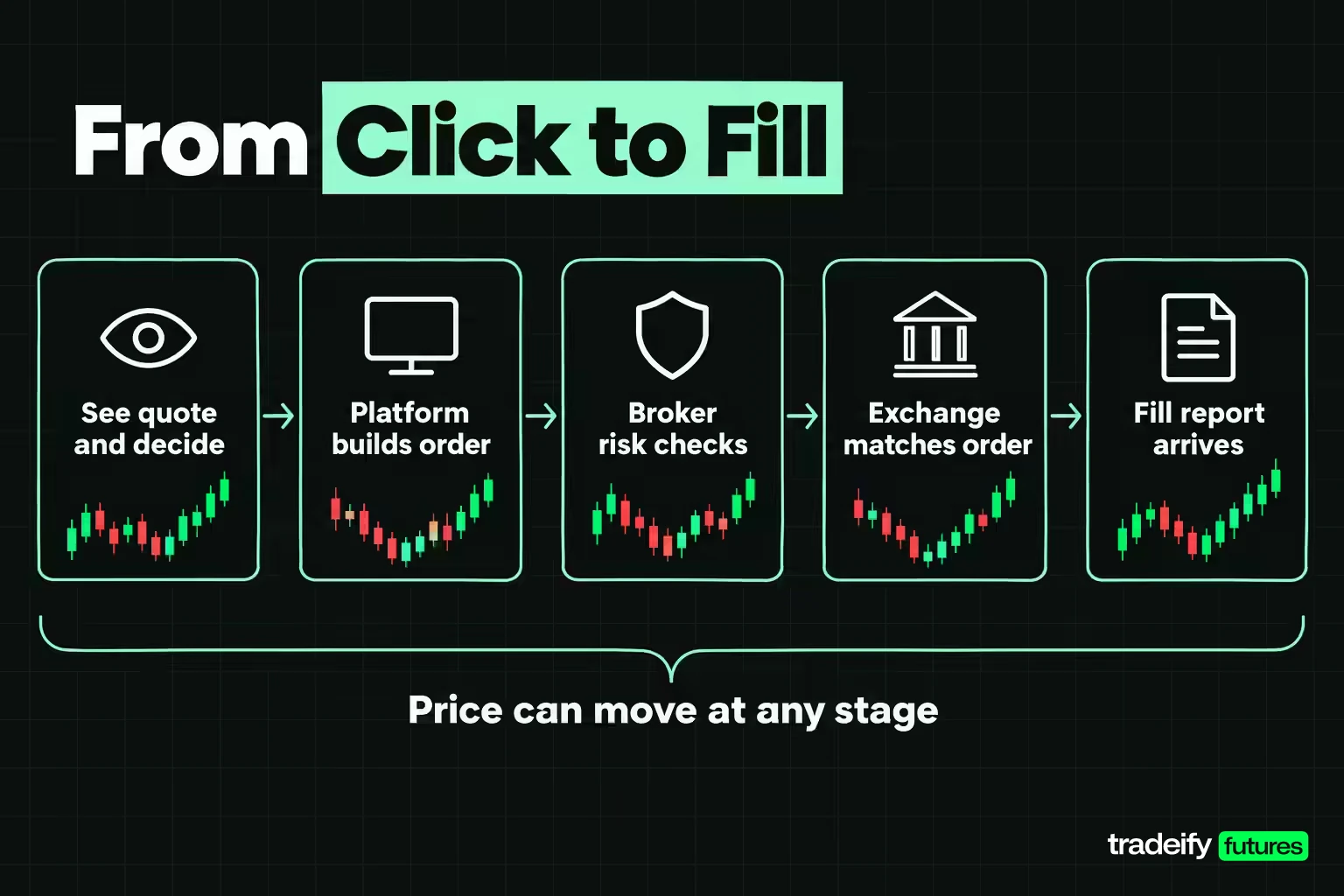
Slippage happens in the short window between deciding to trade and the exchange matching your order. That window has several stages, and the price can move during any of them.
- You see a quote and decide to trade.
- You click, and your platform builds the order.
- The order travels to your broker's risk checks and then to the exchange.
- The exchange matches it against resting orders on the other side of the book.
- You receive one or more fill reports and an average price.
In a quiet market, the whole trip takes a fraction of a second and the price usually has not moved. In a fast market, the best offer you saw at step 1 may be gone by step 4. Traders sometimes call that window "slippage time": the delay between the moment you decide and the moment you are filled.
There is a second way slippage happens even when the price does not move. The SEC bulletin notes that parts of a large market order may execute at different prices because there is not enough size available at one price. Its example is a market order for 1000 shares with the best offer at $3.00, where 500 shares fill at $3.00 and the other 500 fill higher. Your order eats the best price, then the next one, and your average climbs. Traders call that walking the book.
Slippage versus the bid-ask spread
The spread and slippage are both execution costs, but they are not the same thing. The spread is the standing gap between the best bid and the best offer, and you can see it before you trade. Slippage is what happens on top of it, between your decision and your fill.
Take an illustrative MES quote of 7,000.00 bid and 7,000.25 offered. On MES, one tick is 0.25 index points and is worth $1.25 per contract, according to CME Group's contract specifications. The midpoint is 7,000.125.
- A buy that fills at 7,000.25 has paid half the spread against the midpoint: 0.125 points, or $0.625 per contract. That is spread cost, and you could see it coming.
- If the offer lifts while your order is in flight and you fill at 7,000.50, the extra tick is slippage: $1.25 per contract that was not on the screen when you clicked.
Separating the two tells you what to fix. Spread cost points at the instrument and the order type. Slippage points at timing, size and speed.
Price protection on CME Globex futures
Futures traders have a structural limit on how far a market order can slip. CME Group's Client Systems Wiki describes Globex market orders as "market orders with protection": the order fills within a protected range, and for a buy, protection points are added to the current best offer to set a protection price limit. If the whole order cannot fill inside that range immediately, the unfilled quantity rests on the book as a limit order at the protection limit.
CME's own ES walkthrough shows the mechanics. The best offer is 900.25 and the protection is 6.00 points, so the protection price limit is 906.25. The order fills 2 lots at 900.25, 3 lots at 903.00 and 3 lots at 905.50. The next offer is 906.75, beyond the limit, so the remaining quantity rests at 906.25 instead of chasing higher.
Stop orders and price protection
Stop orders on CME Globex use the same price protection. A stop with protection is triggered when the market trades at or through the stop price and enters as a market order bounded by the trigger plus or minus protection points, which CME says usually equal half the product's non-reviewable range. Two things follow:
- A futures stop cannot fill without limit in normal operation. The exchange caps how far one order can sweep.
- Protection is not a guaranteed exit. If price runs past the protection limit, part of your stop can end up resting unfilled while the market keeps moving.
Protection values are set per product and can change, and many platforms and brokers add their own handling on top. Check the current values for the contract you trade rather than assuming a number.
Types of Slippage Traders Run Into
Slippage comes in a few recognizable shapes. Knowing which one you are looking at tells you which fix applies.
- Negative slippage. You filled worse than expected: a buy above your reference, a sell below it. This is the kind most traders mean when they complain about slippage.
- Positive slippage. You filled better than expected. CoinTracker's glossary describes slippage as running in either direction: a better price is positive, a worse one negative.
- Entry slippage. Paid when you open a position with a market order or a stop entry on a breakout. It reduces your reward-to-risk before the trade starts.
- Stop slippage. Paid when a stop triggers and becomes a market order. The SEC bulletin says the stop price is a trigger, not a guaranteed execution price, and the fill can deviate significantly from it. This is the type that turns a planned loss into a bigger one.
- Gap slippage. When price jumps past your stop without trading the levels in between, often at a session open or on a data release, the fill lands wherever trading resumes.
- Market impact. Your own order is large enough to move the price. Wikipedia's entry notes that market impact, liquidity and frictional costs all contribute to slippage.
Why positive slippage is not proof of skill
A favorable fill feels like a reward. It usually is not one. If you sent a market buy expecting 7,000.25 and filled at 7,000.00 on two MES contracts, you saved one tick per contract, or $2.50 in total. Nice, but ask why it happened. Often a seller hit the bid hard enough to drop the offer, which is the same selling pressure that can push your new position underwater a moment later.
Log favorable slippage in the same column as adverse slippage and judge each order type by the average over at least 20 fills. A run of good fills is variance, and it is a bad reason to start sending bigger market orders.
What Causes Slippage
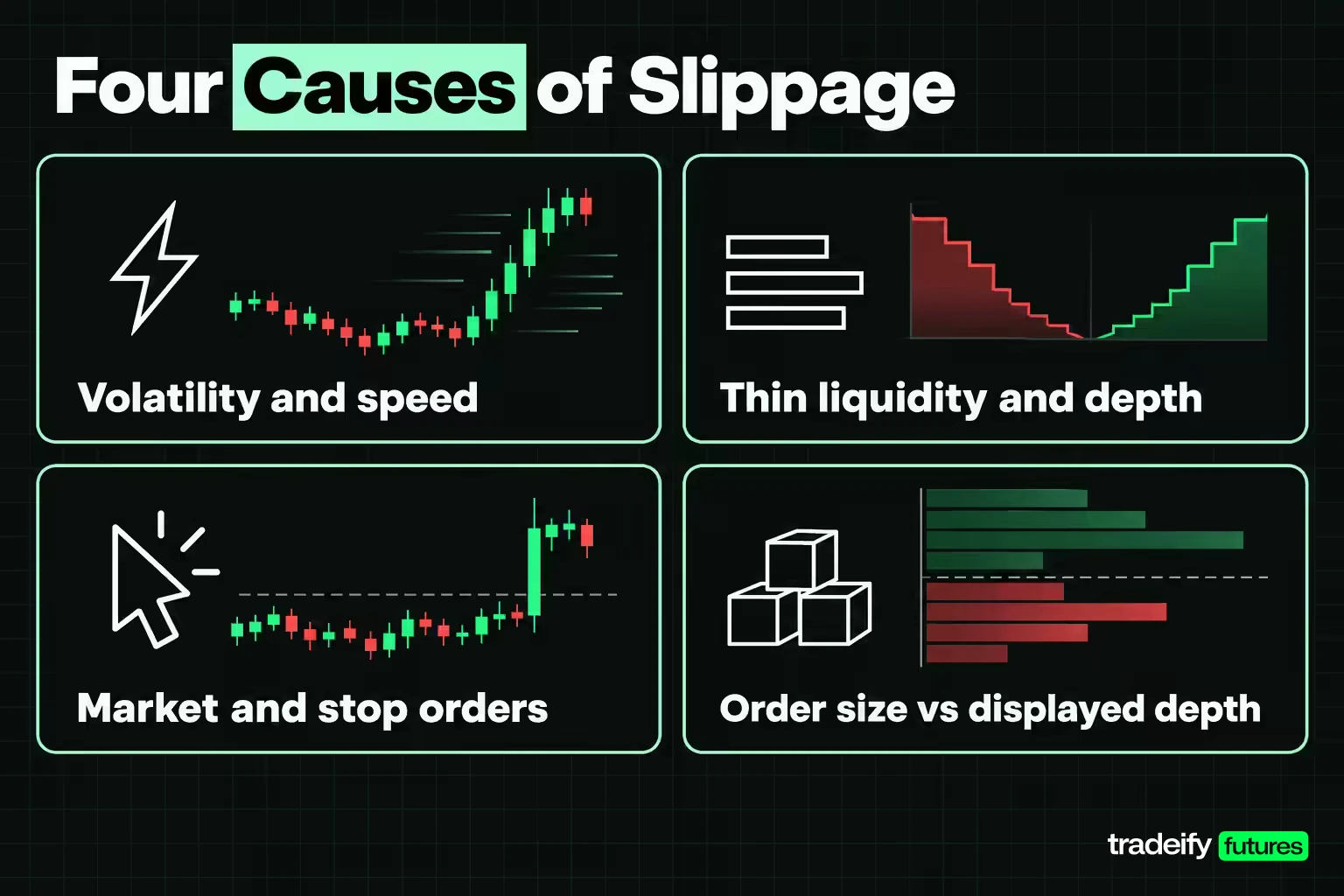
Almost every case of slippage traces back to four conditions. They often show up together, which is why the worst fills tend to cluster.
Volatility and speed
When prices move fast, the quote you saw is stale by the time your order arrives. Coinbase's help page on slippage ties it to volatility: prices can fluctuate often, depending on trade volume and activity. The faster price moves, the more it can travel while your order is in flight. Data releases, session opens and sudden headlines compress a lot of movement into a few seconds.
Liquidity and market depth
Liquidity is how much size is available near the current price. Coinbase describes it as how quickly you can buy or sell without moving the price, and says lower liquidity means a higher slippage percentage. eToro's glossary gives the mechanics: if a sell order is larger than the buying interest at the best bid, it moves on to the next price levels until it is complete. Thin contracts, off-hours sessions and back-month futures all have less depth than the front-month equity index futures.
Order type
Market orders and stop orders that convert to market orders accept the available price. Limit orders and stop-limit orders do not trade beyond their limit, so they cannot slip past it, but they can fail to fill. CoinTracker lists order type as a core cause for exactly this reason.
Order size relative to displayed depth
The same market can give a 1-lot order a perfect fill and a 10-lot order a poor one. If your order is bigger than the size showing at the best price, you will walk the book whether the market moves or not. Size is the cause you control most directly, and the one traders check least often.
How to Calculate Slippage in Ticks, Dollars and Percent
Slippage calculation takes a minute per trade and turns a vague feeling into a number you can track. Here is the method.
- Record the reference price before you send the order. Use the same reference every time: the touch, the midpoint, or your stop price for stop exits.
- Record your average fill price. Not your first or worst fill. Use the average price from your fill report or trade confirmation.
- Find the difference in price. For a buy, average fill minus reference. For a sell, reference minus average fill. A positive result is adverse slippage, a negative result is favorable.
- Convert to ticks. Divide the price difference by the contract's tick size.
- Convert to dollars. Multiply ticks by the tick value and by the number of contracts. On MES the tick value is $1.25. On the E-mini S&P 500 (ES), it is $12.50 per tick, per CME Group's specifications.
- Tag the trade. Record order type, size, time of day and setup, so you can later see which conditions cost the most.
The slippage formulas
- Slippage in ticks = (average fill minus reference) divided by tick size, signed by side.
- Slippage in dollars = slippage in ticks × tick value × contracts.
- Slippage in percent = (average fill minus reference) divided by reference × 100.
Futures traders mostly use ticks and dollars because the contract is priced that way. Crypto platforms and stock apps more often quote slippage as a percentage.
Is 0.1% slippage good
Whether 0.1% slippage is good depends entirely on the market. On a decentralized crypto exchange, it is a tight setting: Uniswap's help page says its automatic slippage setting runs between 0.5% and 5% depending on network cost and swap size, and that a setting too low can make the transaction fail.
On index futures, 0.1% is enormous. With ES at an illustrative 7,000, 0.1% is 7.00 index points, which is 28 ticks: $350 per ES contract or $35 per MES contract. A typical slippage figure on a small order in a liquid futures market is a fraction of that. A 10-lot MES market order that walks three levels of a thin illustrative book might slip 1.1 ticks against the best offer, which is about 0.0039% of price.
Related lesson: Tick size and tick value
Slippage Examples on a Micro E-mini Trade
These two slippage examples use round, illustrative MES prices, not live market data. MES is $5 per index point with a 0.25-point tick worth $1.25. ES is ten times larger at $50 per point and $12.50 per tick.
Walking the book with a market order
Say the illustrative offer side of the MES book shows 3 contracts at 7,000.25, then 3 at 7,000.50, then 4 at 7,000.75. You send a market buy and measure slippage against the best offer, 7,000.25.
| Order | How it fills | Average fill | Slippage vs best offer | Cost |
|---|---|---|---|---|
| 6 MES | 3 at 7,000.25 and 3 at 7,000.50 | 7,000.375 | 0.125 points, half a tick | $0.625 per contract, $3.75 total |
| 10 MES | 3 at 7,000.25, 3 at 7,000.50, 4 at 7,000.75 | 7,000.525 | 0.275 points, 1.1 ticks | $1.375 per contract, $13.75 total |
| 10 ES, same book | 3 at 7,000.25, 3 at 7,000.50, 4 at 7,000.75 | 7,000.525 | 0.275 points, 1.1 ticks | $13.75 per contract, $137.50 total |
Nothing in this example required the market to move. The 6-lot order was larger than the 3 contracts at the best price, so it took the next level. The 10-lot order took three levels. The slippage in ticks is identical for MES and ES on the same book, but the dollar cost is ten times larger on ES. Slippage is a market-structure cost measured in ticks, and the contract multiplier decides whether that tick is pocket change.
Stop slippage on a losing trade
Now say you are long 2 MES contracts at 7,010.00 with a sell stop at 7,005.00. Your planned risk is 5.00 points, which is 20 ticks, $25.00 per contract and $50.00 on the pair. A fast drop trades through the stop. The stop becomes a market order, and the two contracts fill at 7,003.50 and 7,001.00.
| Item | Planned | Actual |
|---|---|---|
| Exit price | 7,005.00 stop | 7,002.25 average fill |
| Points lost from entry | 5.00 | 7.75 |
| Ticks lost from entry | 20 | 31 |
| Loss per contract | $25.00 | $38.75 |
| Loss on 2 contracts | $50.00 | $77.50 |
The average exit is 2.75 points, or 11 ticks, past the stop. That is $13.75 per contract and $27.50 on the trade, so the loss is 55% larger than planned. If you sized this trade so a full stop-out would cost 1% of your account, this exit cost 1.55%.
That is the real damage of stop slippage. A stop sets the loss you intended, not the loss you take. Traders who size every trade from the stop price and never measure stop slippage are quietly taking more risk per trade than their plan says.
Related lesson: Stop orders
How Slippage Affects Trading Results
One tick of slippage looks small on a single trade. Across hundreds of trades it can decide whether a strategy makes money. The cleanest way to see this is to treat slippage as a budget measured against the risk you take per trade.
The table below uses one MES contract at $1.25 per tick and a $30.00 risk per trade, which is 24 ticks or 6.00 index points. It assumes slippage on both the entry and the exit.
| Slippage per side | Round-turn cost on 1 MES | Share of $30.00 risk | Over 500 round turns | Over 1,000 round turns |
|---|---|---|---|---|
| 1 tick | $2.50 | 8.3% | $1,250 | $2,500 |
| 2 ticks | $5.00 | 16.7% | $2,500 | $5,000 |
| 4 ticks | $10.00 | 33.3% | $5,000 | $10,000 |
At one tick per side, slippage takes 8.3% of every trade's risk budget. At four ticks per side, a third of the budget is gone before the market has done anything. And 500 round turns is only about two trades a day over a year of sessions.
Why short targets feel slippage most
The shorter your target, the bigger the bite. A scalper with an average winner of 8 ticks who pays 2 ticks of slippage on each side is handing over 4 of those 8 ticks: half the gross profit on every winner. The same 4 ticks on a 40-tick swing target is a much smaller share. That is the honest reason fast strategies need careful execution and slower ones can tolerate rougher fills.
The practical rule: work out the slippage your strategy can absorb before you add size, and compare it with the slippage you actually logged, not the slippage you hoped for.
Related lesson: Maximum risk per trade
How to Spot High Slippage Risk Before You Trade
High slippage risk is usually visible before you send the order. Check these signals first.
- A scheduled release is close. The SEC warns that in fast-moving markets the execution price often deviates from the quote. The minutes around major economic data and session opens are where that happens most.
- The book is thin at your price. If the size at the best bid or offer is smaller than your order, you will walk the book.
- The spread is wider than normal. A spread that has widened from its usual one tick is the market telling you liquidity has stepped back.
- You are trading a less active contract or session. eToro's glossary notes slippage is more likely in volatile, illiquid small-cap and mid-cap stocks than in large caps. The same pattern holds in futures between front-month index contracts and thinner products or hours.
- Your stop sits at an obvious level. Stops clustered under a well-watched low can trigger together, and all of them become market orders at once.
A slippage diagnostic table
When slippage feels random, it usually is not. Each symptom in a trading journal points to a specific measurement.
| Symptom | Likely cause | What to measure next |
|---|---|---|
| Slippage varies widely trade to trade | Order size changes relative to displayed depth | Average slippage grouped by order size |
| Slippage spikes at the same time each day | Thin hours or a scheduled release | Average slippage by hour of day |
| Stops exit several ticks past the trigger | Stop market orders in a fast tape | Gap between stop price and average fill, per trade |
| One contract slips more than another | Thinner book or wider spread | Average slippage in ticks per contract, same size |
| Favorable fills are followed by losses | Filling because price is coming toward you | Trade result 5 and 15 minutes after each favorable fill |
| Large orders slip far more than small ones | Your order is moving the price | Average fill against the midpoint at submission |
The value of the table is the right-hand column. Once you have the measurement, the fix is usually a change of order type, size or timing, not a change of strategy.
Related lesson: Market depth and Level II data
How to Minimize Slippage
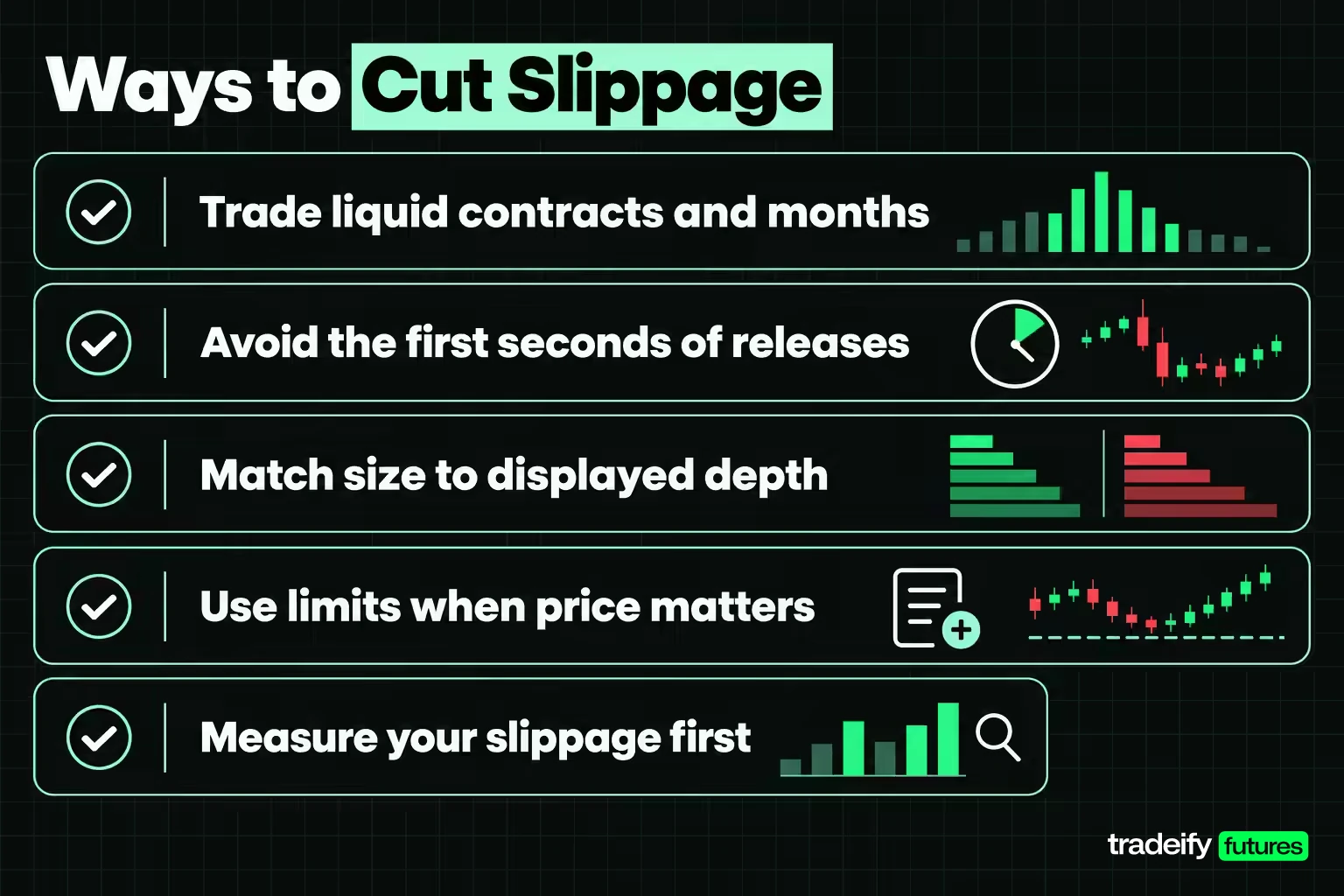
You cannot remove slippage, but you can usually cut it. These are the levers that matter, roughly in order of how much they help.
- Trade liquid contracts and months. Front-month equity index futures have the deepest books. Thinner products and expiring contracts cost more to enter and exit.
- Stay out of the first seconds of major releases. If you must be in the market around news, decide in advance how you will exit and accept that a stop may fill well past its price.
- Match order size to displayed depth. If your order is bigger than the size at the best price, expect to walk the book or split the order. CoinTracker recommends breaking large trades into smaller ones to limit price impact.
- Use limit orders when price matters more than speed. A limit order cannot fill beyond its price, at the cost of sometimes not filling at all.
- Check the estimate before you send. Some platforms show an average price estimate on a market order. Coinbase, for example, displays a slippage and average price estimate at the bottom of every market order.
- Know where your stop lives. Some platforms hold stops and brackets on the broker's servers rather than on your computer, so a dropped connection does not leave a position unprotected. Server-side handling does not prevent slippage, but it removes a source of late exits.
- Measure before you change anything. Two weeks of logged slippage by order type, size and session will tell you which single change is worth making.
Slippage on stops and why some traders accept it
A stop that slips is still doing its job: it gets you out. The alternative, a stop-limit that refuses to fill, can leave you holding a losing position while price keeps running. Many traders reduce stop slippage by placing stops away from obvious levels and by sizing so that a few extra ticks do not break their risk plan, rather than by giving up on stop market orders entirely.
Related lesson: Market orders
Using Limit Orders to Control Slippage
A limit order is the most direct slippage control there is. The SEC bulletin defines it as an order to buy or sell at a specific price or better: a buy limit only executes at the limit price or lower, and a sell limit only at the limit price or higher. CME's documentation describes futures limit orders the same way. You cannot slip past your limit.
The cost is certainty. The same SEC bulletin is clear that a limit order is not guaranteed to execute. If price touches your level and moves away, or trades there without reaching your place in the queue, you get no fill. That missed trade is not slippage, but it is a real cost: the winning trade you did not take.
Stop-limit orders for exits
A stop-limit applies the same idea to stops. Once the stop price is reached, it becomes a limit order rather than a market order. The SEC's example is a sell stop-limit with a stop price of $3.00 and a limit of $2.50: it activates at $3.00 but can only fill at $2.50 or better. On an illustrative MES position, a sell stop at 7,005.00 with a limit at 7,004.00 caps exit slippage at 1.00 point, which is four ticks or $5.00 per contract. If price gaps below 7,004.00, though, the order does not fill and the position stays open.
Choosing an order type to limit slippage
- Use a limit when your entry price matters more than whether you get in, such as fading a level or scaling into a position.
- Use a market order when getting in or out matters more than the exact price, in liquid conditions with a tight spread.
- Use a stop market for protective stops when being flat matters more than the price, and size so the expected slippage fits your risk.
- Use a stop-limit only when you would rather stay in the trade than accept a fill beyond your limit, and have a plan for the case where it does not fill.
Related lesson: Limit orders
Slippage and Prop Firm Loss Limits
Slippage matters more when a hard loss limit sits underneath the account. A personal account can absorb a few extra ticks on a stop and keep trading. An evaluation or funded account with a trailing drawdown or daily loss limit may not, because the risk system measures your actual fills, not the stop price you intended. If a stop slips through the level where a firm's drawdown sits, the account is breached even though the plan said the trade could not go that far. That is why slippage belongs in position sizing whenever your stop sits close to a firm's limit.
On our accounts, news trading is allowed, but our Help Center warns that orders around news may execute far from expected prices, and that the Daily Loss Limit is not a hard stop and should never be used as one, because slippage in volatile markets can push losses past it and into the max trailing drawdown. Positions still open at the close are closed automatically without failing the account, but those exits can slip too. Our order types guide suggests checking the spread before a market order and switching to limits when it is wider than 2 ticks.
Slippage FAQ
What is another word for slippage
Traders often just call it a bad fill. The closest technical term is implementation shortfall, a broader measure of the gap between the price when you decided to trade and the price you finally got. In everyday English, the Cambridge Dictionary's meanings line up with words like reduction, decline and delay.
What does slippage time mean
Slippage time usually means the delay between the moment you decide to trade and the moment your order fills. The longer that window, and the faster the market, the more the price can move against you before you are filled.
What does slippage mean in legal terms
In contracts and project agreements, slippage generally means a delay or shortfall against an agreed schedule or standard. The Cambridge Dictionary includes "a failure to happen or finish on time" as one meaning. Check the definition in the specific contract, since agreements can define the term their own way.
Does slippage happen with limit orders
A limit order cannot fill worse than its limit price, so it cannot slip past the price you set. It can fill at a better price, and it can fail to fill at all. Large limit orders may also fill in pieces, which is a partial fill rather than slippage.
Can you avoid slippage completely
No. You can reduce slippage by trading liquid contracts, avoiding the seconds around major releases, sizing to displayed depth and using limit orders when price matters most. Some slippage will remain, so it belongs in your cost model.
Risk note: This article is educational and is not investment advice or a recommendation to trade any instrument. Futures are leveraged, and losses can exceed what you expected, especially when stops slip in fast markets. Evaluation and funded prop accounts are simulated, and fills in a simulated account may differ from live fills. Contract specifications, exchange protection values and platform order handling change, so confirm current details with your broker or platform before relying on them.


