




TL;DR: A partially filled order is one where only part of your size executed, and the leftover is a decision. The filled part is a real position, priced and at risk from the fill. The remainder rests, cancels or waits for you, depending on the order type and time in force. Example: 5 of 12 MES fill at 7,000.00, and chasing the other 7 at 7,004.00 lifts risk from $1,800 to $1,940. Set your leftover rule before you send the order.
A partially filled order means the market gave you some of what you asked for and none of the rest. You sent 12 contracts and got 5, or bid for 1,000 shares and bought 200. Nothing broke. The order did exactly what its instructions allowed.
The pressure comes next. You now hold a live position that is smaller than planned and a leftover order that may or may not fill, and the temptation is to fix the size fast. That is usually where the real cost starts.
This guide covers why fills split, how each order type treats a partial, what happens to the unfilled part, and how a partial fill changes your price and your risk. The worked examples use Micro E-mini S&P 500 (MES) futures at round, illustrative prices.
What Is a Partially Filled Order
A partially filled order is an order that executed for less than the full quantity you submitted. Some of it traded and some of it did not.
FINRA describes it plainly: with most order types, a firm might buy or sell only the portion of the order that is available, which is known as a partial fill. Investopedia gives the textbook case. You place a limit order to buy 1,000 shares at $53.00 and only 200 shares execute at that price. That is a partial fill of 200 shares.
A full fill is the opposite outcome. Every unit you asked for executed, and there is no leftover to manage.
Two details matter more than the definition.
- The filled part is done. The 200 shares or 5 contracts are yours at the fill price, and they carry market risk from that moment. Treating "partial" as "not started yet" is how traders end up with an unmanaged position.
- The unfilled part is a separate question. It can keep working, cancel automatically, or wait for you to cancel it. Which one happens depends on the order type and time in force you chose, not on the broker's mood.
Related lesson: How resting limit orders behave
Why Partial Fills Happen
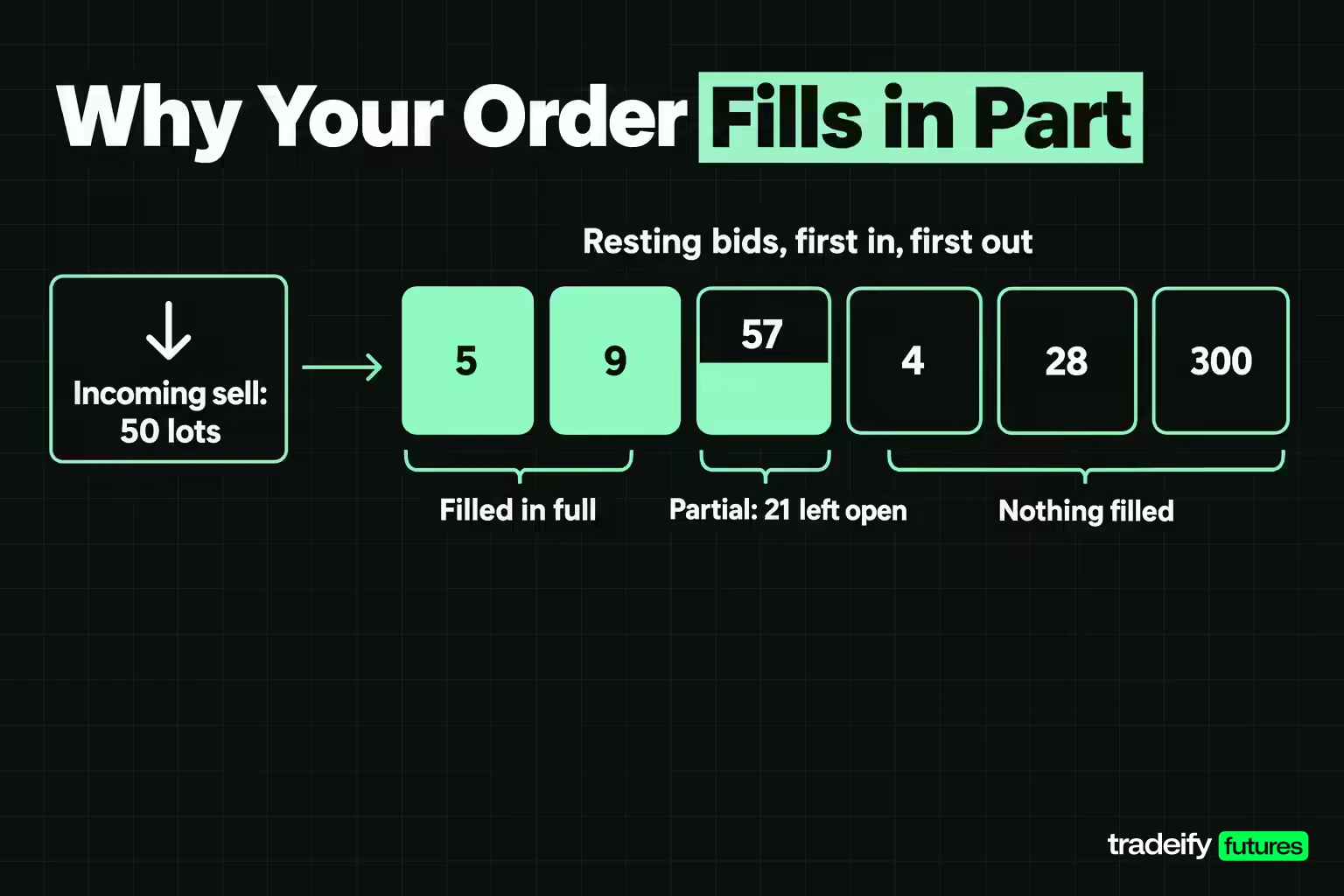
Partial fills happen because the other side of your trade was not there in one piece at your price. Three things decide how much of your order trades.
Depth at your price. Every price level on an order book holds a finite amount of size. If your buy limit at a price is bigger than the sell orders resting at that price or better, you get what exists and no more. Stake's support page explains it as price-time priority plus market depth: there may simply not be enough available at a single price to fill the order at once.
Your place in the queue. When you join a price level with a resting limit order, you stand behind everyone who got there first. CME Globex runs many futures order books on a first in, first out (FIFO) basis, where resting orders at the same price fill in timestamp order. CME's own matching example shows it: a 50-lot sell order hits six resting bids of 5, 9, 57, 4, 28 and 300 contracts at one price. The first two fill completely. The third gets a partial fill with 21 lots still open. The last three get nothing.
That example is the honest answer to "why did they get filled and I didn't." Size arrived, it was split by arrival time, and it ran out before it reached you. Nobody singled out your order.
Your own changes. On CME's FIFO books, an order loses its time priority if you raise the quantity, change the price or change the account. Nudging a limit by a tick to "help" it fill sends you to the back of the new line.
Price moving away. If the market trades at your price, takes some of your size and then lifts away, your remainder is left behind at a level nobody is trading anymore.
Conditions on the order. Price limits, protection ranges and time limits all cap how much can execute. A plain market order in a deep market rarely leaves anything behind. An order with a price cap can.
How Each Order Type Fills, Fully or Partially
Every order type answers two questions differently: how much can execute right now, and what happens to anything that does not. Futures traders need the exchange's version, because CME Globex handles some order types in ways that surprise people.
| Order type or instruction | What can execute | What happens to the unfilled part |
|---|---|---|
| Market order | Usually all of it, at the best available prices in sequence | Little or nothing left in a deep market, but the average price is not guaranteed |
| Limit order (day or GTC) | Whatever is available at your limit or better | Rests on the book until filled, cancelled or expired |
| Market-limit (CME) | As much as trades at the best available price | Becomes a limit order and rests at that price |
| Market with protection (CME) | Fills inside a protected price range | Rests as a limit order at the protection price limit |
| Stop order | Becomes a market order once triggered | Behaves like the market order it became |
| Stop-limit | Fills between the trigger and your limit once triggered | Rests as a limit order at the limit price |
| Stop with protection (CME) | Fills inside a protection range from the trigger | Rests at the protection price limit |
| Immediate or cancel (CME calls it fill and kill) | Whatever is available immediately | Cancelled at once |
| Fill or kill | Nothing unless the full size fills immediately | Whole order cancelled |
| All or none | Nothing unless the full size fills together | Keeps working until filled or cancelled |
| Minimum quantity (CME) | At least the minimum immediately, or nothing | Rest follows the order's time in force |
CME order types that can leave a remainder
The CME rows in the order type table are the ones to remember. A market order with protection sounds like "fill me now," yet CME states that if the whole order cannot fill inside the protected range, the unfilled quantity stays on the book as a limit order at the edge of that range. You can end up holding part of a position and a live resting order from a single click.
Stop orders carry the same risk on the way out. A CME stop with protection only executes within its protection range, and any remainder sits on the book at the protection price limit. A stop-limit can leave part of your exit unfilled if the market gaps through your limit. Both trade fill certainty for price control, which is fine as long as you know that is the trade.
The SEC adds the stock-side reminder for market orders: parts of a large market order may execute at different prices when there is not enough liquidity at one price. That is not a partial fill, because everything executed, but it is the same depth problem showing up in your average price.
Related lesson: The size-first order instruction
When a Limit Order Fills and Why It Can Fill in Part
A limit order fills only at your price or better. The SEC defines it that way: a buy limit executes at the limit price or lower, a sell limit at the limit price or higher. That price cap is the whole point, and it is also why limit orders are the type most exposed to partial fills.
Whether a limit order fills immediately depends on where you put it.
- Marketable limit. A buy limit at or above the best offer can trade right away against resting sellers. CME states that any portion of a limit order that can be matched is executed immediately. The rest stays on the book.
- Resting limit. A buy limit below the best offer cannot trade until sellers come down to it. It joins the queue and waits.
Even a resting limit that "gets touched" is not guaranteed a fill. Investopedia notes there is no guarantee a limit order fills immediately or at all. Fidelity says the same in its order-type FAQ: the fact that your price limit was reached does not guarantee an execution, because orders at each price fill in the sequence set by the market's rules. In practice, price usually has to trade through your limit, not just touch it, before you can count on a complete fill.
So a limit order can fill in part for two reasons. Either it was marketable for more size than was offered at your limit or better, or it rested, reached the front of the queue, and the selling stopped before your full size was done.
How Long a Partial Fill Takes to Complete
How long the remainder of a partial fill takes depends on the order type, how liquid the market is, and how far price is from your level.
Market orders are the fast end. Investopedia notes that market orders in actively traded stocks fill almost immediately, though unusually high volume can delay the trade. In a liquid futures contract during the main session, a small market order is typically done before you can move your mouse.
Limit remainders are the slow end, and they have no deadline except the one you set. Saxo's help center gives a worked case: an order to buy 500 shares at a maximum of 52.60 buys 330 right away, and the remaining 170 sit on the bid. If no seller wants 52.60 that day and the order lasts longer than one day, the 170 might fill the next day, later, or not at all. Saxo adds that in less liquid instruments, completing an order can take days, weeks or even months.
The time in force sets the outer limit on that wait.
- Day order. CME Globex treats orders as day orders unless told otherwise, and they expire at the end of the trading day. The remainder dies with the session.
- Good till cancelled (GTC). On CME it stays active until it fills, you cancel it, or the contract expires. Brokers set their own maximum life for stock GTC orders.
- Immediate or cancel and fill or kill. No wait at all. The remainder is cancelled on arrival.
The better question is not "how long will it take" but "how long am I willing to carry an unknown position size." For most day traders, the honest answer is minutes, not hours.
Multiple Parcel Execution and Order Splitting
One order can come back as several fills. Brokers call these parcels, executions or partial fills, and they are a normal side effect of how an order book is built.
Stake's support page shows the stock version. A buy order for 1,000 shares meets 200 shares at $10.00, 500 at $10.01 and 300 at $10.02. The order is matched against several smaller resting orders, and it arrives as separate parcels at different prices. In Stake's other example, a 100-share order fills 30 shares as 10 at $1.00, 10 at $1.25 and 10 at $1.50 before it is cancelled. That produces three trade confirmations and an average price of $1.25.
Futures work the same way. CME's order-type documentation shows the exchange sending a separate "Execution Report - Partial Fill" for each price level an order trades through.
Here is an illustrative MES book to make it concrete. Sellers rest at three levels:
| Offer price (illustrative) | Contracts offered |
|---|---|
| 7,000.25 | 6 |
| 7,000.50 | 8 |
| 7,000.75 | 10 |
A market order to buy 20 MES takes all 6 at 7,000.25, all 8 at 7,000.50 and 6 of the 10 at 7,000.75. That is three parcels, three execution reports and an average fill of 7,000.50. Every contract filled, so this is a full fill delivered in pieces.
Change it to a buy limit at 7,000.50 and the result changes. The order takes 6 at 7,000.25 and 8 at 7,000.50, which is 14 contracts at an average of 7,000.39. The other 6 rest as a bid at 7,000.50. That is a partially filled order, and the reason is visible in the book: only 14 contracts existed at your price or better.
Some traders split their own orders on purpose. CME's display quantity instruction, for example, lets a 100-lot buy show only 10 contracts at a time. Each displayed slice can fill separately, and every refresh goes to the back of the queue.
Related lesson: Splitting size across price levels on purpose
How a Partial Fill Changes Your Average Price and Fees
A partial fill changes your average price in two ways. The parcels you got may sit at different prices, and the remainder you still need may cost more or less than your first fill.
With a limit order, every parcel fills at your limit or better, so your average can only be equal to or better than your limit. Stake makes this point directly. The cost of that protection is size: you might only get part of the order if the market moves away.
With a market order, the order walks through the book, so your average can be worse than the price you saw when you clicked. In the illustrative MES book, a 20-contract market buy averages 7,000.50 against a best offer of 7,000.25. MES moves $1.25 per 0.25-point tick, so that 0.25 points across 20 contracts costs $25 compared with filling the whole order at the top of the book.
Fees are the second effect, and the rules differ by broker.
- Per order. Stake charges one brokerage fee per order, however many parcels it fills in.
- Per day with an execution. Saxo charges a transaction fee for each day an order is partially filled, while several fills on the same day count as one. Fidelity's FAQ says the same for GTC orders: one commission for several executions in a day, and a commission for each day with an execution if the order fills across days.
- Per contract. If your broker charges a fixed commission per contract or share, splitting the fill into parcels does not change the total commission for the same size.
A remainder that drips in over three sessions can cost three commissions where you planned for one. That is worth checking before you leave a GTC limit working.
Related lesson: What the worse average price does to your results
What Happens to the Unfilled Portion of an Order
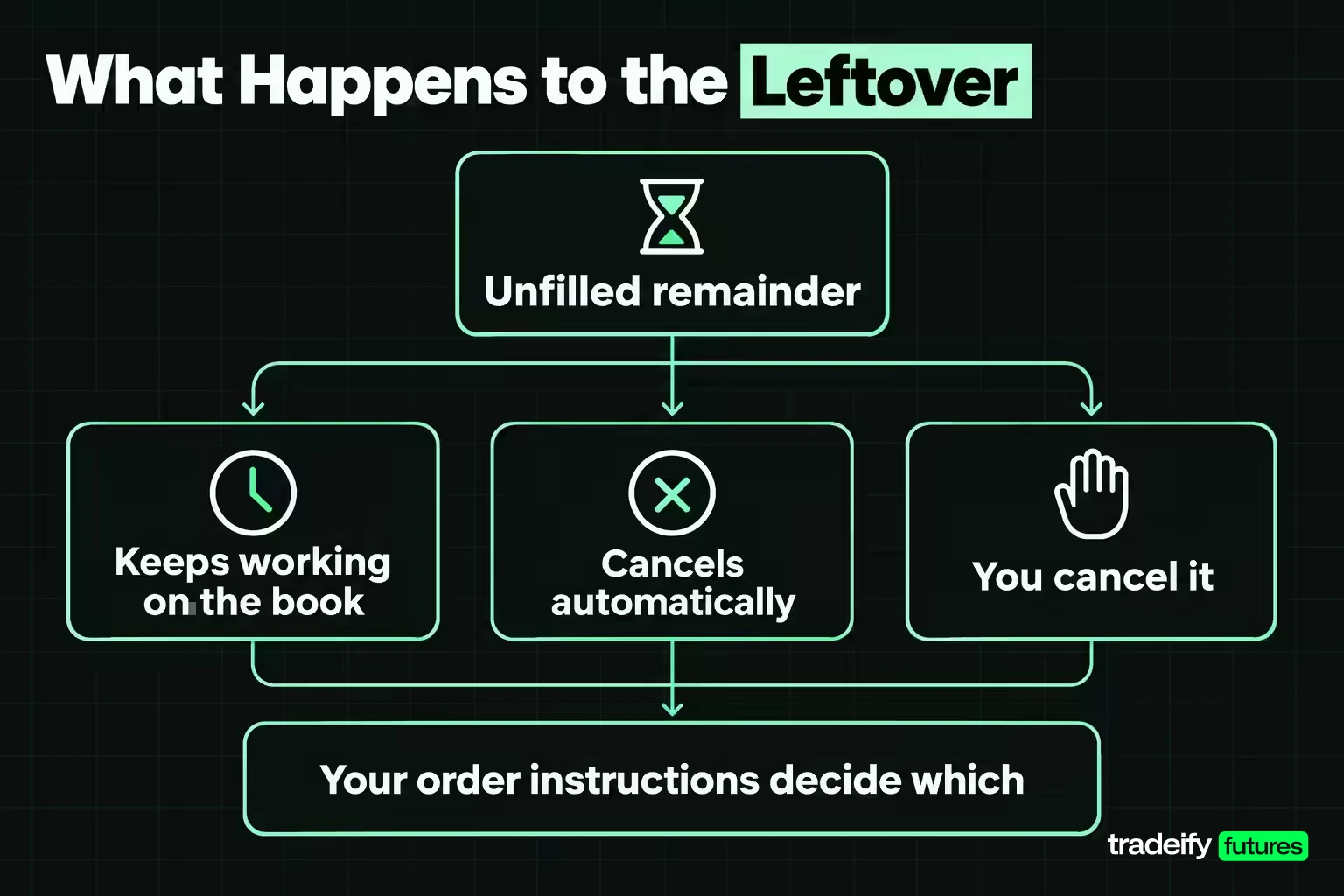
The unfilled portion of an order has three possible outcomes. It keeps working, it gets cancelled automatically, or you cancel it. Your order instructions decide which.
- It keeps working. A day or GTC limit order leaves the remainder resting on the book. A CME market-limit or market order with protection leaves its remainder resting as a limit order. A stop-limit leaves its remainder at the limit price. Saxo's 500-share example is the standard case: 330 fill and 170 wait on the bid.
- It cancels automatically. An immediate-or-cancel order (fill and kill on CME) cancels any balance that cannot trade immediately. A CME minimum quantity order cancels the whole order if the minimum cannot fill immediately. A day order's remainder expires at the end of the session.
- You cancel it. Stake notes that if the rest of an order is not filled before it expires or is cancelled, it simply won't execute. You keep what filled.
There is no hidden fourth outcome where the broker completes your order later at a worse price without your instruction. If the remainder is working, it is still bound by your limit.
What you should do with the remainder is a different question from what the system will do. You have three real choices.
- Accept the partial. Cancel the rest and manage the smaller position. It costs nothing extra, but your result is smaller than planned.
- Leave it working. You keep your price, but your position size, and therefore your risk, is undefined until the order resolves.
- Chase it. Cancel the remainder and buy or sell at the current market. That makes the size certain and charges you for it in price.
Are Partial Fills Normal Broker Behavior
Yes. A partial fill is normal market behavior that brokers pass through to you. It is not a broker error and it is rarely a platform fault.
Stake calls partial fills and multiple parcels "completely normal," especially on larger orders. Saxo says that for many liquid assets partial execution rarely occurs, while less liquid instruments can take days or longer to complete. Fidelity tells customers that limit orders for more than 100 shares or for multiple round lots may be filled completely or in part until completed, and that completing one can take more than one trading day.
Put those together and you get a simple rule of thumb. The bigger your order relative to the size resting at your price, and the thinner the market, the more likely a partial fill becomes. A one-lot in a deep futures contract almost never partials. A large limit order in a thin stock or an overnight futures session often does.
The one reaction that turns a normal partial fill into a real problem is assuming the order failed and sending it again. If the first order is still working, two orders can fill and you end up with double the size you meant to trade. Check the working orders window and the position window before re-sending anything.
Related lesson: The cost of needing to be in the trade
Partial Fills in Day Trading
In day trading, a partial fill is less about terminology and more about risk. Day traders size positions to a dollar stop, and a partial fill changes the size, so it changes the risk. Warrior Trading's glossary describes a common response on a fast-moving stock: cancel the remaining order and add to the position as it moves. That can be a legitimate plan when it is priced in advance. It is a problem when it is a reaction to missing the fill.
A partially filled entry on twelve MES contracts
Here is an illustrative plan. Imagine a trader buying 12 MES with a limit at 7,000.00, a stop at 6,970.00 and a target at 7,060.00. MES is worth $5 per index point, so the plan risks 30 points x $5 x 12, which is $1,800, to make 60 points x $5 x 12, which is $3,600. That is a 2 to 1 reward to risk with a break-even win rate of 33.3%.
The limit fills 5 contracts at 7,000.00 and leaves 7 working.
| Response | Position | Risk to the 6,970.00 stop | Reward to the 7,060.00 target |
|---|---|---|---|
| Accept the partial | 5 at 7,000.00 | $750, which is 41.7% of plan | $1,500 |
| Leave the order working | 5 filled, 7 pending | $750 now, $1,800 if it completes | $1,500 now, $3,600 if it completes |
| Chase the 7 at 7,004.00 | 12 at an average of 7,002.33 | $1,940, which is 7.8% over plan | $3,460 |
The chase row is the one traders reach for, and it is the one that quietly breaks the plan. Buying the last 7 contracts 4 points higher costs $20 per contract, $140 in total, and lifts the average entry to 7,002.33. The stop has not moved, so each contract now risks 32.33 points instead of 30. Risk rises to $1,940, reward falls to $3,460, and the break-even win rate climbs from 33.3% to 35.9%.
Chase cost ladder for a partial fill
Every row assumes the same 5 contracts filled at 7,000.00 and the other 7 bought at the chase price.
| Chase price | Extra per contract | Extra across 7 | New average | Risk on 12 | Over plan |
|---|---|---|---|---|---|
| 7,000.25 | $1.25 | $8.75 | 7,000.15 | $1,808.75 | 0.5% |
| 7,000.50 | $2.50 | $17.50 | 7,000.29 | $1,817.50 | 1.0% |
| 7,001.00 | $5.00 | $35.00 | 7,000.58 | $1,835.00 | 1.9% |
| 7,002.00 | $10.00 | $70.00 | 7,001.17 | $1,870.00 | 3.9% |
| 7,004.00 | $20.00 | $140.00 | 7,002.33 | $1,940.00 | 7.8% |
| 7,010.00 | $50.00 | $350.00 | 7,005.83 | $2,150.00 | 19.4% |
| 7,020.00 | $100.00 | $700.00 | 7,011.67 | $2,500.00 | 38.9% |
Even a one-tick chase breaks this plan. The reason is in the setup: $1,800 divided by $5 per point divided by 12 contracts is exactly 30 points, the distance from the limit to the stop. The highest average entry that keeps 12 contracts inside $1,800 is therefore 7,000.00, the limit price itself. This plan had zero room for a worse fill, and the partial fill is what exposed it.
Two ways to complete a partial fill within budget
If you still want to complete the position after chasing at 7,004.00, there are two honest ways to hold risk at the plan.
- Tighten the stop to 6,972.33. That keeps $1,800 of risk on 12 contracts at the 7,002.33 average, but the stop is 2.33 points (about 9 ticks) closer, so normal noise is more likely to hit it.
- Trade 11 instead of 12. Five at 7,000.00 plus 6 at 7,004.00 averages 7,002.18, and with the stop left at 6,970.00 the risk is $1,770.00, inside the plan.
What does not work is telling yourself that 12 contracts at a worse average is the same trade as 12 at your limit. The numbers say it is a different trade.
A partially filled stop-limit on the way out
Partial fills hurt most on exits. Say a trader is long 6 MES at 7,000.00 with a sell stop-limit triggered at 6,980.00 and limited at 6,978.00. The planned risk is 20 points x $5 x 6, which is $600.
Price drops fast. Only 2 contracts are bid at 6,979.00, and the next bid is 6,975.00. The stop triggers, 2 contracts sell at 6,979.00 for a $210 loss, and the other 4 sit unfilled as a sell limit at 6,978.00 while the market trades below it. If price reaches 6,970.00 with those 4 still open, their open loss is $600, and the total is $810. That is 135% of the planned risk, from an order that technically worked as designed.
The fix is a decision made before the trade, not during the drop. Know whether your stop is a stop market or a stop-limit, and know what you will do with an unfilled exit. For most traders that rule is simple: if the stop triggered and you are still holding size, get out at market and review the order choice afterward.
Related lesson: Sizing rules that survive partial fills
Pre-Market and Overnight Partial Fills
Orders placed outside the main session are more likely to fill in part or not at all, because fewer traders are on the other side.
For stocks, FINRA warns that extended-hours trading is less liquid, with comparatively fewer counterparties. As a result, your order may be executed partially or not at all, and if it executes, it might not be at a competitive price compared with regular hours. Investopedia makes the same point about pre-market orders: they may not fill if there are not enough shares to meet the order, and large orders in low-volume stocks are harder still.
Futures trade far more hours than stocks. CME Globex runs ES from Sunday 6:00 PM to Friday 5:00 PM ET, with a daily maintenance break from 5:00 PM to 6:00 PM ET. Being open does not mean being deep, though. The overnight book in an equity index future is usually thinner than during US cash hours, so a size that fills in one piece at 10:00 AM ET can arrive in parcels, or partly, at 2:00 AM ET. Treat that as a pattern to check on your own platform's depth display, not a fixed rule.
Two habits help outside the main session:
- Size down to what the book actually shows at your price.
- Use a time in force that matches your intent, so a leftover does not sit unnoticed into a session you are not watching.
How to Handle a Partially Filled Order
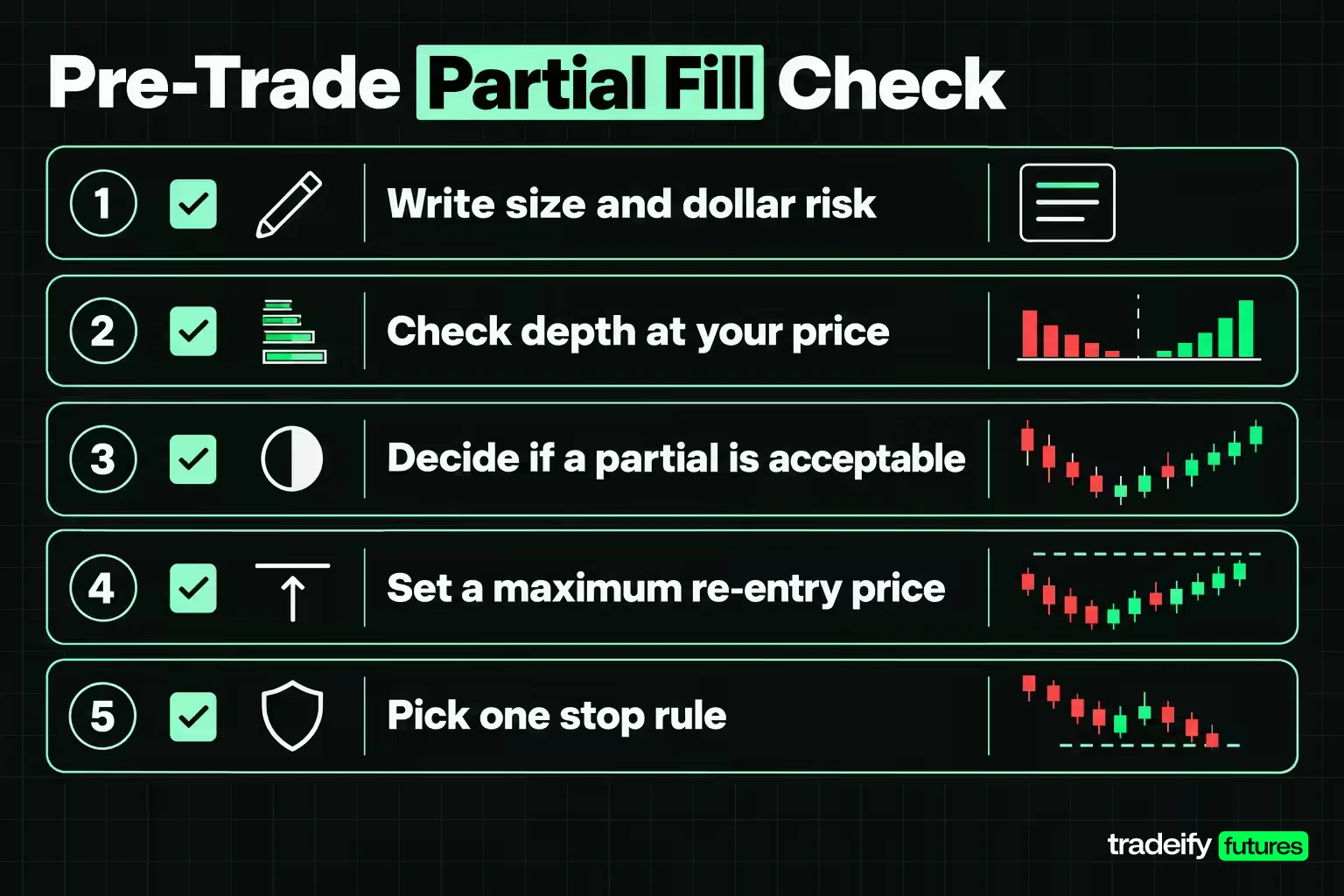
Handling a partially filled order well is mostly about decisions you make before you send the order. After the fill notice arrives, you are deciding under pressure with the market moving, which is the worst time to invent a rule.
A pre-trade check for partial fills
Run this check before you place a multi-contract or multi-lot order. It takes about a minute.
- Write down your intended size and your risk in dollars.
- Look at the depth at your price and one or two levels beyond it. Can your full size realistically fill there?
- Decide whether a partial fill is acceptable. If size is not negotiable, a fill or kill, all or none, or minimum quantity instruction may fit better than a plain limit, where your platform supports it.
- Set a maximum re-entry price. Anything above it means the trade has left your plan.
- Decide how a partial fill changes your stop: keep the stop and accept smaller size, or trim the full size. Pick one rule.
- Check whether a scheduled data release or the session close falls inside the life of the order, and cancel the remainder ahead of it.
- Know your fee schedule: per order, per day with an execution, or per contract.
Partial fill mistakes that turn into losses
| Mistake | What it looks like | Why it hurts | Better habit |
|---|---|---|---|
| Managing only the filled part | A stop for 5 contracts, then 7 more fill later | The stop no longer matches the position | Recheck the stop quantity after every fill notice |
| Chasing the remainder upward | Buying the rest higher because the trade is working | Average entry rises while the stop stays put | Cap the chase price before the order goes in |
| Leaving the remainder into a catalyst | A limit sits through a data release | The fill lands in a market you no longer want | Cancel the remainder before scheduled events |
| Re-sending a working order | Assuming the partial was a failure | Two orders fill and size doubles | Check working orders and positions first |
| Ignoring multi-day fees | A GTC remainder fills across sessions | Commissions stack per day of execution | Use day orders when one commission matters |
| Trusting a stop-limit to finish | Part of the exit fills, the rest rests | Open risk keeps growing past the plan | Have a market-exit rule for an unfilled stop |
Partial Fills on a Simulated Funded Account
On our accounts, partial fills work the same way they do anywhere else, because the order book does not care what kind of account you trade. Our Order Types Explained guide calls them normal for large orders when there isn't enough volume at your price, and suggests checking the remaining quantity, deciding whether to cancel it or wait, and using smaller sizes if you want full fills more often. All positions must be closed by 4:45 PM ET on regular days, and anything still open is closed for you, with possible slippage. So we suggest cancelling any working remainder before then, so it cannot fill after you have flattened. Orders that would take you past your account's position size limit can be rejected, and our funded accounts are simulated.
Frequently Asked Questions About Partial Fills
What happens if an order is partially filled?
You own the part that filled, at its fill price, and it is exposed to market moves right away. The unfilled part keeps working, cancels automatically, or waits for you to cancel it, depending on the order type and time in force. Recheck your stop size whenever more of the order fills.
What are partial fills?
Partial fills are executions for less than the full quantity of an order. They happen when there is not enough size at your price or better, or when the market moves away before your whole order trades. They are most common with large limit orders in thin markets.
What does "Fidelity partially filled orders" mean?
It refers to Fidelity's note that limit orders for more than 100 shares or for multiple round lots may be filled completely or in part until completed, sometimes over more than one trading day. Fidelity charges one commission for several executions on the same day. A GTC order that fills across several days is charged a commission for each day with an execution.
What happens if an order is filled but not contracted?
Usually it means the trade has executed at the stated price, but the confirmation or settlement step is still pending. The phrase is not standard exchange wording, so ask the broker that shows it what it means on their platform. US stock trades now generally settle one business day after the trade date (T+1) under SEC rules adopted in 2023.
Does a partial fill cost more in fees?
It can. Some brokers charge once per order, some charge for each day the order executes, and per-contract pricing charges the same total whatever the number of parcels. A GTC order that fills across several sessions is the case most likely to cost extra.
Should I chase the rest of a partially filled order?
Only if you priced the chase before it happened. Buying the remainder higher moves your average entry up while your stop stays put, so your risk grows. If you do complete the position, either tighten the stop or trade fewer contracts to stay within your original dollar risk.
This article is for education only and is not investment advice or a recommendation to buy or sell anything. Futures and other leveraged products can lose money quickly, and losses can be larger than planned when a stop does not fill as expected. The prices, fills and dollar figures in the examples are illustrative, not records of real trades or projections of results. Evaluation and funded prop accounts are simulated, and fills there may differ from live markets. Check current order rules and fee schedules with your broker or platform before you trade.


