



TL;DR: A stock is a share of ownership in a company, so your return depends on the business and what buyers will pay for it. Returns come from price gains and dividends, and neither is guaranteed. From 1928 to 2025 the S&P 500 compounded about 10% a year but lost money in 26 of 98 years. Common stock carries votes but is paid last if a company fails. A broad fund spreads that single-company risk across hundreds of stocks.
A stock quote looks simple: a ticker, a price and a green or red percentage. The thing behind that quote is more specific. When you buy a stock, you buy a small ownership stake in a company, with a defined set of rights and a price that the market resets every time shares change hands.
The gap between what you own and what the price is doing is where most new investors get caught. A strong company can be a poor purchase at the wrong price. A weak company can rally for months. So before asking whether a stock will go up, it helps to know exactly what a stock is, what rights come with it and what can change its value.
What Is a Stock in Simple Terms

A stock is a security that gives its holder a share of ownership in a company. Investor.gov, the SEC's investor education site, defines stocks this way and notes they are also called equities. A share is one unit of that ownership. People use "stock" and "shares" almost interchangeably: "I own stock in a company" and "I own 20 shares" describe the same holding at different levels of detail.
In simple terms, a stock is a slice of a business. If the business earns more over time, each slice can become worth more. If the business shrinks, or if buyers decide they were paying too much, each slice can become worth less, down to zero.
Three layers keep the definition practical:
- Claim. A share is a residual ownership claim. Lenders and other senior claims come first, and common shareholders get what is left.
- Rights. The share class sets your rights, which may include voting and eligibility for dividends when a board declares them.
- Price. The market price is simply what the latest buyer and seller agreed on. It can move far faster than the business itself changes.
Keeping these layers separate stops a common mix-up. A falling stock price does not mean your rights changed, and a rising price does not mean the company got better. Each layer answers a different question, and mixing them up is how people talk themselves into bad trades.
How Stocks Work From IPO to Trade Settlement
Stocks start with a company that wants money or wants to share ownership. Investor.gov lists the usual reasons companies issue stock: paying off debt, launching new products, expanding into new markets and building or enlarging facilities. Companies also issue shares to pay employees and to buy other businesses.
The primary market and the IPO
An initial public offering, or IPO, generally refers to when a company first sells its shares to the public. In that primary-market sale, the company receives the money from the newly issued shares, minus underwriting and offering costs. Later share sales by the company work the same way: new shares go out, cash comes in, and the number of shares outstanding grows.
The secondary market and settlement
After issuance, almost all stock trading happens between investors in the secondary market. If you buy 10 shares through a brokerage account, your money goes to whoever sold those shares, not to the company. That is why a rising stock price helps a company indirectly (cheaper future fundraising, stock worth more as employee pay or as acquisition currency) without sending each trade's cash into its bank account.
Public shares trade under a ticker symbol on an exchange or another regulated venue. Your broker routes the order, the market matches it with an opposing order, and the trade then settles. In the US, the SEC shortened the standard settlement cycle for most broker-dealer securities trades from two business days (T+2) to one business day (T+1), with a compliance date of May 28, 2024. Settlement is when cash and shares formally change owners, even though your account shows the position as soon as the order fills.
Market capitalization
The price of one share means little on its own. Market capitalization, the market's total value for a company, is the current share price multiplied by the total shares outstanding. A company with 10 million shares at $25 has a market capitalization of $250 million. A $25 stock and a $900 stock tell you nothing about which company is bigger until you multiply by the share count.
A Worked Stock Ownership Example
A single continuous example shows how stock ownership, price, dilution and splits fit together. All numbers here are round and illustrative.
Suppose a company has 10 million common shares outstanding and you buy 100 shares at $25 each.
- Cost. 100 × $25 = $2,500, before fees.
- Ownership. 100 ÷ 10,000,000 = 0.001% of the company's common shares.
- Price up. If the stock later trades at $30, your position is worth $3,000, an unrealized gain of $500.
- Price down. If it trades at $18, your position is worth $1,800, an unrealized loss of $700.
In both price cases you still own 0.001% of the company. The share count did not change; only the market's price for your claim did. A gain or loss stays unrealized until you sell.
Dilution when a company issues new shares
Now suppose the company sells another 2 million new shares and you buy none. There are 12 million shares outstanding, so your 100 shares now represent about 0.00083% of the company. That is dilution. You hold the same number of shares, but each one is a smaller slice. Dilution is not automatically bad: if the company raised that money at a good price and invests it well, the value of each slice can still rise. It does mean you should check the share count over time, not just the price.
What a stock split changes
A stock split is different. Investor.gov describes a split as an increase in the number of shares without a change in shareholders' equity, and notes that unlike issuing new shares, a split does not dilute existing owners. Its example: 100 shares at $100 become 200 shares at $50 after a two-for-one split. In this example, a 2-for-1 split turns your 100 shares at $25 into 200 shares at about $12.50. The position is still about $2,500. A split changes the size of each slice, not the size of the pie, and any per-share dividend falls in proportion.
Shareholder Rights That Come With a Stock
Shareholder rights depend on the share class and the company's governing documents, but most common stock follows a familiar pattern. Investor.gov says common stock entitles owners to vote at shareholder meetings and to receive dividends.
What common stockholders usually get:
- Votes. Typically one vote per share on matters such as electing directors and approving major changes. Some companies issue multiple classes with different voting power, so read the class terms.
- Dividends when declared. The board decides whether to pay. A shareholder is eligible, not entitled to a fixed amount.
- A residual claim. If the company is liquidated, Investor.gov lays out the order: bondholders are paid first, then preferred stockholders, and common stockholders get whatever is left, which may be nothing.
- Disclosure. Public companies file annual reports on Form 10-K and quarterly reports on Form 10-Q with the SEC, so owners and the public can read audited financial statements and risk factors.
What a share does not give you matters just as much. Shareholders own an interest in the corporation, and the corporation owns its property. You cannot claim a desk, a patent or a slice of the cash balance. You also do not run the business: owning stock does not let you set prices, pick products or hire staff. Your influence runs through votes and through the decision to buy or sell.
Types of Stock
Types of stock are sorted several ways at once, and a single stock can sit in several categories. A large utility might be common stock, a large-cap, an income stock and a member of the Utilities sector all at the same time.
Common stock and preferred stock
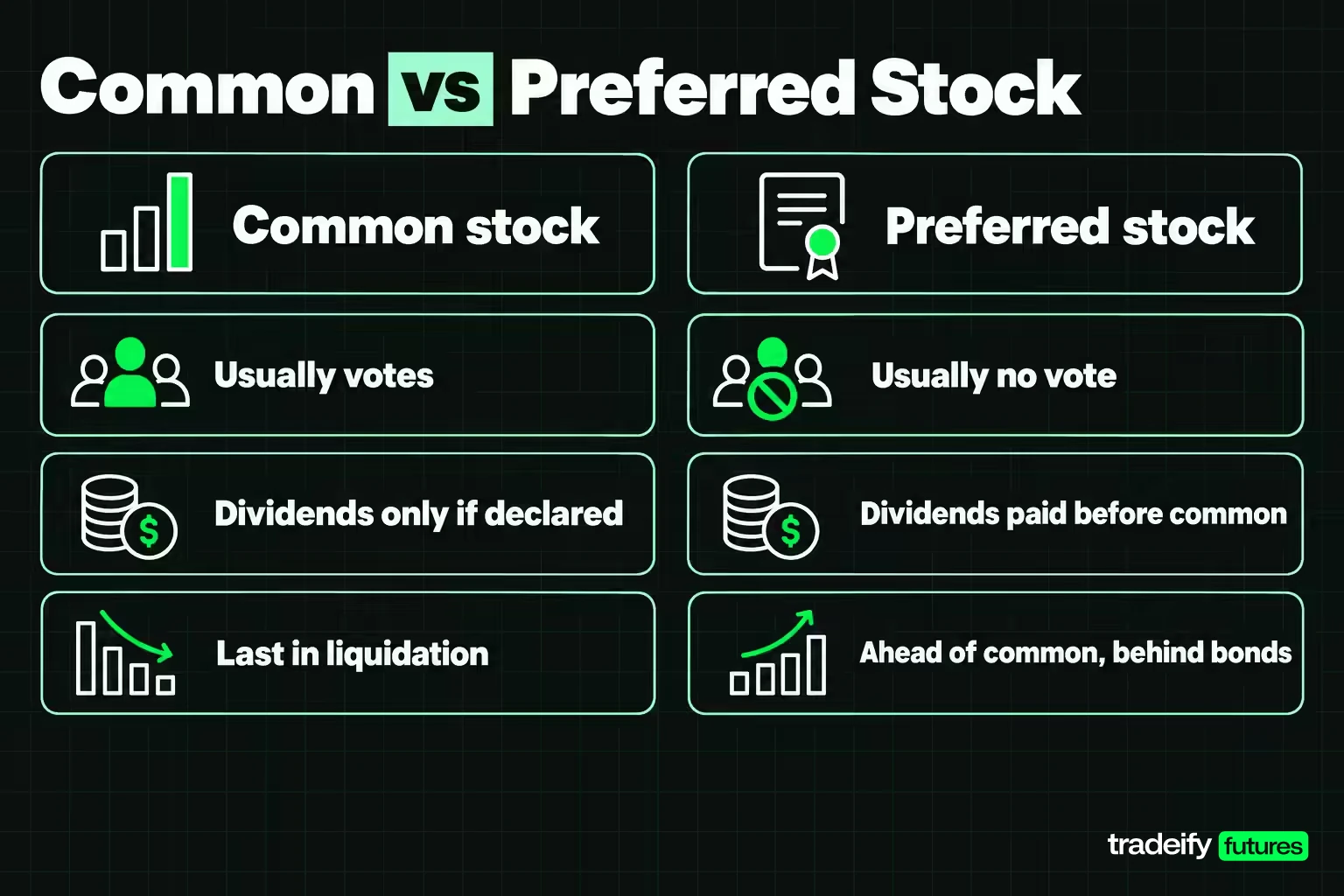
Investor.gov names two main kinds of stock. Common stock carries voting rights and dividends when declared. Preferred stockholders usually do not vote, but they receive dividends before common stockholders and have priority over them if the company is liquidated.
| Feature | Common stock | Preferred stock |
|---|---|---|
| Voting rights | Usually yes | Usually no |
| Dividends | Paid only if declared, can change | Paid before common, often a stated amount |
| Order in liquidation | Last, after bonds and preferred | Ahead of common, behind bonds |
| Price behavior | Tracks company growth and sentiment | Often sensitive to interest rates, like bonds |
| Typical holder | Most individual investors | Income-focused investors and institutions |
Neither label tells the whole story. Read the specific class terms rather than assuming every share has the same rights.
Growth, value, income and blue-chip stocks
These labels describe what investors expect from a stock, and Investor.gov defines them plainly:
- Growth stocks have earnings growing faster than the market average. They rarely pay dividends; buyers want price gains.
- Value stocks have a low price-to-earnings ratio, often because they have fallen out of favor. Buyers bet the market overreacted.
- Income stocks pay dividends consistently. An established utility is the classic example.
- Blue-chip stocks are shares of large, well-known companies with a solid growth history, and they generally pay dividends.
The labels are snapshots, not permanent traits. A growth stock that slows down can become a value stock without changing a single product.
Stocks by company size
Stocks are also grouped by market capitalization into large-cap, mid-cap and small-cap. Shares of very small companies are sometimes called microcap stocks, and the lowest-priced shares are known as penny stocks. Investor.gov warns that penny-stock companies may have little or no earnings, do not pay dividends and are highly speculative. Index providers and fund companies draw the size boundaries differently, so check how a specific fund defines them.
Stock sectors and domestic vs international stocks
Stocks are also grouped by what the company does. The Global Industry Classification Standard (GICS), developed by MSCI and S&P Dow Jones Indices, sorts companies into 11 sectors: Energy, Materials, Industrials, Consumer Discretionary, Consumer Staples, Health Care, Financials, Information Technology, Real Estate, Communication Services and Utilities. Sectors matter because stocks in the same sector often react to the same news, such as oil prices for energy stocks or interest rates for banks.
Finally, stocks are split into domestic and international. Owning foreign stocks adds currency risk: a foreign share can rise in its home currency and still lose value once converted back to dollars.
How Investors Make Money From a Stock
Stock returns come from two sources: the price change and any dividends. Added together, they make up total return.
Capital gains from price changes
If you sell above your purchase price, you realize a capital gain before costs. If you sell below it, you realize a loss. In the worked example, buying at $25 and selling at $30 is a $5 gain per share, or 20%. Selling at $18 is a $7 loss per share, or 28%. Taxes on those gains depend on your country, account type and holding period.
Dividends
Investor.gov defines a dividend as a portion of a company's profit paid to shareholders, usually on a fixed schedule, though companies can pay at any time; unscheduled payments are called special dividends. A dividend is a board decision, not a debt. The board can raise, cut, suspend or skip it.
As an illustration, 100 shares paying $0.50 a quarter produce $50 a quarter, or $200 a year. Dividends are also not free money. When a stock begins trading without the right to an upcoming dividend, its price tends to drop by roughly the dividend amount, other things equal. What counts is total return, not the dividend alone.
Dividend income math behind a monthly goal
A common goal is "$1,000 a month from stocks." That is $12,000 a year. At an illustrative 3% dividend yield, it takes $400,000 invested ($12,000 divided by 0.03) to produce that income from dividends alone, before taxes, and only if the dividends hold. Trying to reach the same income from a much smaller account means relying on price gains, which are irregular and can turn negative for years. The math does not say the goal is impossible; it says how much capital or risk the goal implies.
Related lesson: How dividends are declared and paid
Why Investors Own Stocks
Investors own stocks mainly for growth. Investor.gov says stocks offer the greatest potential for growth over the long haul, and that investors willing to stick with stocks over long periods, such as 15 years, have generally been rewarded with strong, positive returns.
The potential benefits in practical terms:
- Growth. Owners share in rising profits without running the business.
- Income. Dividend payers can provide cash flow.
- A chance to outpace inflation. Companies can raise prices over time, so owners have a chance to keep up with inflation in a way fixed interest payments cannot.
- Liquidity. Large listed stocks can usually be sold within seconds during market hours.
- Small entry points. Many brokers allow purchases in single shares or fractions.
Each benefit has a limit. Growth is not guaranteed, dividends can be cut, liquidity can thin out in a panic, and a long holding period only helps if you can actually hold through the bad years. The case for stocks is a long-run, many-company case, not a promise about any one stock or any one year.
Stock Market Returns Since 1928
Stock market history shows both why people own stocks and why they need patience. The figures below use annual S&P 500 total returns (including dividends) for 1928 through 2025, a 98-year record compiled by NYU Stern professor Aswath Damodaran. Past results do not predict future ones.
| Measure, S&P 500 1928 to 2025 | Result |
|---|---|
| Compound average annual return | About 10% |
| Years with a negative return | 26 of 98 |
| Worst calendar year | 1931, a 43.8% loss |
| 2008 return | A 36.6% loss |
| 2022 return | An 18% loss |
| $100 invested at the start of 1928 | About $1.16 million by the end of 2025 |
Two things stand out. First, the long-run growth is large: compounding at about 10% a year turned $100 into roughly $1.16 million over 98 years. Second, bad years are common, not rare. Roughly one year in four lost money, and the worst ones were brutal. A 43.8% loss needs a 78% gain just to get back to even.
Time horizon changes the odds. Using the same annual data, 84 rolling 15-year periods fit between 1928 and 2025, and only one of them (1929 to 1943) had a negative compound return, of about 0.2% a year. That matches Investor.gov's point about 15-year holders, and it also shows the limit: one 15-year stretch still went nowhere. History supports owning a broad market for a long time. It says nothing about any single stock, which can fall to zero and never come back.
What Moves a Stock Price
A stock price is set at the margin: the latest willing buyer and seller agree on a trade, and the next trade may print higher or lower as orders change. Over short periods, that can be driven by news, earnings surprises, economic data, interest rates and shifts in risk appetite. Investor.gov notes that prices can be hit by problems inside the company, such as a faulty product, or by events the company cannot control, such as political or market events.
Earnings versus expectations
Over long periods, stock prices tend to follow a company's ability to produce cash and reinvest it well. In the short run, the price already contains an expectation. A strong earnings report can still send a stock lower if investors expected even better. When a stock moves, ask three questions in order:
- What changed in the business: revenue, margins, debt, competition or guidance?
- What had the market expected before the news?
- Did the price investors pay per dollar of earnings change?
A worked stock valuation example
The price-to-earnings (P/E) ratio is the share price divided by earnings per share. Using round illustrative numbers:
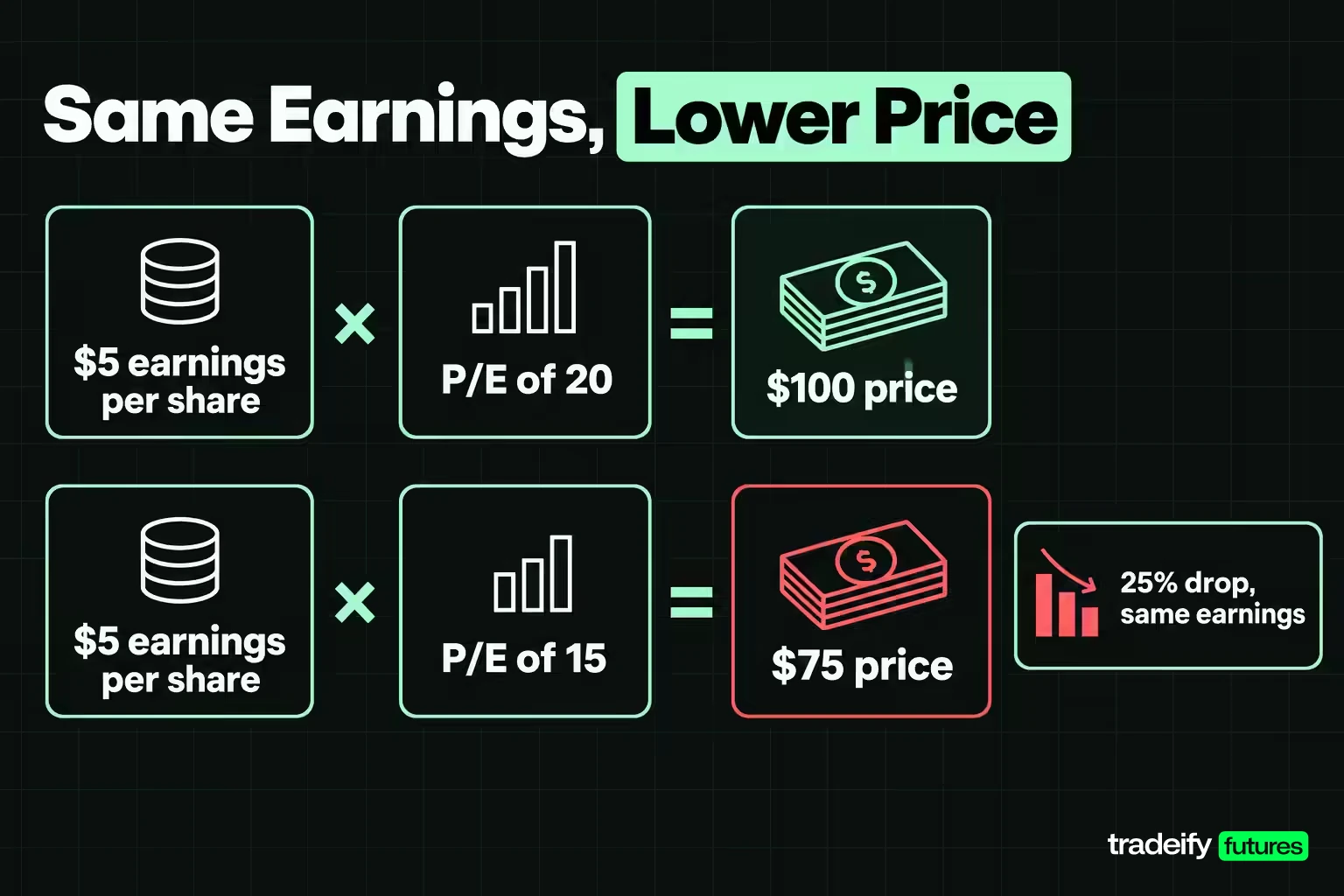
- A company earns $5 per share and its stock trades at $100, a P/E of 20.
- If investors decide the company deserves a P/E of 15, the price falls to $75, a 25% drop with no change in earnings.
- If earnings grow 10% to $5.50 but the P/E slips to 16, the price is $88. The business improved and the stock still fell.
This is valuation risk in a nutshell. The business can be right while the stock purchase is wrong. A great company bought at an extreme multiple can deliver weak returns for years.
Risks of Owning a Stock
The main risk of owning a stock is simple: you can lose part or all of the money you invest. Investor.gov notes that large company stocks as a group have lost money on average about one out of every three years, and that if a company goes bankrupt, common stockholders are last in line and may get nothing.
The specific risks to plan for:
- Company risk. Poor execution, fraud, lawsuits, a failed product or too much debt can sink one company.
- Market risk. A recession or financial panic can pull down sound companies alongside weak ones.
- Valuation risk. Paying too much can mean poor returns even if the business does well.
- Liquidity risk. Thinly traded shares can have wide bid-ask spreads and few buyers when you want out.
- Concentration risk. One stock, sector or theme can dominate an undiversified portfolio.
- Dilution risk. New share issuance can shrink your slice of the company.
- Behavior risk. Selling in a panic after a drop, or buying more only because a stock fell, turns market swings into permanent losses.
What broker protection does and does not cover
It is easy to assume your stocks are "insured." They are not insured against losses. SIPC protects customers of a failed SIPC-member brokerage firm up to $500,000, including a $250,000 limit for cash, when assets are missing from accounts. SIPC states plainly that it does not protect against a decline in the value of your securities. A stock that falls 60% is a market loss, not a covered event.
Stocks vs Bonds, Cash and Stock Funds
Stocks and bonds are the two building blocks of most portfolios, and they work differently. Investor.gov describes a bond as a debt security, like an IOU: the issuer borrows your money, promises a specified rate of interest and promises to repay the principal at maturity. A stock promises nothing. You own part of the business and share in whatever it earns.
| Asset | What you own | Income | Main risk | Long-run return profile |
|---|---|---|---|---|
| Common stock | Ownership stake | Dividends if declared | Price swings, company failure | Highest potential, widest swings |
| Bond | A loan to the issuer | Scheduled interest | Default, rising interest rates | Lower, steadier |
| Cash and T-bills | Short-term deposits or debt | Interest | Inflation eroding buying power | Lowest |
| Stock fund or ETF | Small stakes in many companies | Pooled dividends | Market-wide declines | Tracks the market it holds |
The Damodaran data puts numbers on that tradeoff. From 1928 through 2025, the S&P 500 compounded at about 10% a year, while 10-year US Treasury bonds compounded at about 4.5%. Bonds are steadier, but not risk-free: in 2022, 10-year Treasury bonds lost 17.8% in the same year the S&P 500 lost 18%. Stocks pay more over long periods because owners carry more risk along the way.
Diversifying Beyond a Single Stock
Owning one stock means betting on one company. Investor.gov describes diversification as spreading your money among various investments in the hope that if one loses money, the others will make up for those losses. Diversification reduces single-company risk; it does not protect against a market-wide decline.
The practical routes:
- Stock funds and ETFs. Investor.gov describes stock funds as mutual funds that invest mainly in stocks. A broad index fund or ETF can hold hundreds of companies in one purchase.
- Several stocks across sectors. Owning a handful of companies in the same sector is less diversified than it looks, because they often fall together.
- Asset allocation. Investor.gov describes asset allocation as dividing investments among stocks, bonds and cash, based on your time horizon and risk tolerance.
Allocation drifts as prices move. Investor.gov's example: a portfolio that starts at 60% stocks can rise to 80% stocks after market gains, carrying more risk than you chose. Rebalancing (selling some stocks or adding to other assets) brings it back.
Related lesson: What an ETF holds and how it trades
How to Buy and Sell a Stock
Buying a stock usually takes four steps: open an account, fund it, choose the stock and place an order. Investor.gov lists the main routes: a discount or full-service broker, a direct stock plan, a dividend reinvestment plan or a stock fund.
Choosing where to buy stocks
- Brokerage account. The most common route. Discount brokers charge lower commissions but leave the research to you; full-service brokers charge more and include advice.
- Direct stock plan. Some companies sell their own stock directly. Investor.gov notes these plans usually buy at set times (daily, weekly or monthly) at an average price, not at a price you choose, and may charge plan fees.
- Dividend reinvestment plan. Uses your dividends to buy more shares of the same company.
- Retirement accounts. Tax-advantaged accounts can hold stocks too, with their own contribution and withdrawal rules.
Check that a US broker is a SIPC member and registered with FINRA before sending money.
Placing a stock order
The two orders every beginner should know:
- Market order. Buys or sells right away at the best available price. Fast, but in a thinly traded stock or a fast market, the fill can be worse than the last quote.
- Limit order. Buys at your price or lower, or sells at your price or higher. You control the price, but the order may not fill.
Selling works the same way in reverse. Before you buy, decide what would make you sell: a change in the business, a better use of the money or a position that has grown too large. Write it down. Deciding after a 30% drop, with the red number staring at you, is much harder.
Fractional shares and small amounts
You do not always need the price of a full share. Investor.gov's fractional-share bulletin explains that a fractional share means owning less than one full share; with a stock at $1000, $100 buys .1 shares, and orders can be placed in dollars (such as $500) or shares (such as .5 shares). At an illustrative $200 share price, $10 buys 0.05 shares. Not every broker offers fractional shares, some limit them to certain stocks such as S&P 500 members, and some do not guarantee their liquidity even when full shares trade easily.
Pattern day trader rule changes for stock accounts
Frequent stock trading in a US margin account has long run into the pattern day trader rule and its $25,000 minimum equity. FINRA Regulatory Notice 26-10 replaces those day-trading margin requirements with new intraday margin standards, effective June 4, 2026, with a phase-in that ends October 20, 2027. During the phase-in, some brokers may still apply the old rules, so check your broker's current policy before trading actively.
How to Research a Stock Before Buying
Researching a stock starts with primary documents, not headlines. Investor.gov explains that most US public companies file an annual report on Form 10-K and quarterly reports on Form 10-Q, filed after the first, second and third fiscal quarters. All are public on the SEC's EDGAR system, and annual reports include financial statements audited by an independent firm.
The 10-K sections that do the most work for a new investor:
- Business. What the company sells and to whom.
- Risk Factors. The company's own list of what could go wrong.
- Management's Discussion and Analysis (MD&A). Management's explanation of the year's results.
- Financial Statements. The income statement, balance sheet and cash flow statement.
A stock research checklist
Before placing an order, try answering these in plain language:
- What does the company sell, and who pays for it?
- Is it profitable and cash-generating, or does it depend on raising outside money?
- How much debt does it carry, and is the share count rising?
- What rights come with this exact share class?
- What growth does the current valuation seem to assume?
- What evidence would make you change your mind?
- How much of your portfolio would this one position be?
- Could you hold through a 30% to 50% drop without being forced to sell?
If you cannot answer the first question, you are buying a ticker, not a business. That is a different trade, and usually a worse one. Social media posts and marketing pages can give you an idea; the filings are where you check it.
Related lesson: A deeper stock research routine
Are Stocks Right for Your Goals and Timeline
Whether stocks fit depends on your time horizon and risk tolerance. Investor.gov describes risk tolerance as your ability and willingness to lose some or all of your original investment in exchange for potentially greater returns, and notes that investors with longer horizons may be more comfortable with volatile investments.
Stocks tend to fit money you will not need for many years. They fit less well for money you need soon, such as an emergency fund, next year's tuition or a house deposit, because a bad year could arrive exactly when you need to sell. Paying down high-interest debt first is often the more certain return. If a 30% drop would push you to sell, a smaller stock allocation or a broad fund is a better match than a concentrated position.
Stock Options, Futures and Restricted Stock
Several instruments are built on stocks without being ordinary shares. Knowing them helps you read market news and avoid owning something by accident.
- Stock options. Contracts giving the right, but not the obligation, to buy or sell a stock at a set price before a set date. Options can expire worthless, and selling them can create large obligations.
- Single-stock futures. Contracts to buy or sell a specific stock at a future date.
- Stock index futures. Contracts on an index such as the S&P 500 or Nasdaq-100 rather than one company. They track the stock market but are not ownership: no votes, no dividends paid to the holder, and a futures position uses leverage, so losses can exceed the cash committed.
- ETFs and mutual funds. Pooled vehicles that own stocks on your behalf.
Restricted stock and Rule 144
Restricted stock is stock acquired in unregistered, private sales, often by founders, employees or early investors. The SEC explains that under Rule 144, restricted securities must be held at least six months if the issuer is an SEC reporting company, and at least one year if it is not, before they can be resold in the market. Large blocks of restricted stock becoming sellable can add selling pressure to a stock, which is why investors watch these dates after an IPO.
Trading stock index futures instead of shares
On our accounts, traders do not buy cash stocks, options or single-stock futures. They can trade futures on the stock indexes themselves: ES, NQ, YM and RTY, plus the micro contracts MES, MNQ, MYM and M2K. Our evaluation and funded accounts are simulated, and every position is closed by 4:45 PM ET, so nothing is held overnight the way a stock investor holds shares.
Related lesson: Futures vs. stocks compared
Stock FAQ
What is the difference between a stock and a share?
Stock refers to ownership in a company as a category. A share is a single unit of that ownership. "I own stock in the company" and "I own 20 shares" describe the same holding.
Is $10 enough to invest in stocks?
Yes, at brokers that offer fractional shares, $10 can buy part of a share, such as 0.05 shares of a $200 stock. Not every broker offers it or offers it for every stock. With $10, fees and diversification matter more than the stock you pick, so a broad fund is often the simpler start.
Can you make $1000 a month with stocks?
It is possible, but it takes far more capital than most beginners expect. At an illustrative 3% dividend yield, $1,000 a month in dividends needs about $400,000 invested. Earning it from price gains on a small account means taking large, irregular risk.
What is a stock in cooking?
In cooking, a stock is a flavored liquid made by simmering bones, vegetables or both in water, used as a base for soups and sauces. Cooks usually make stock mainly from bones and broth mainly from meat. It has nothing to do with company shares. The word "stock" has many meanings, and in finance it means ownership in a company.
Can a stock go below zero?
A share price cannot go below zero, so a normal stock purchase can lose at most the full amount paid. Borrowing on margin, short selling or using derivatives can create losses beyond the money originally invested.
Does every stock pay dividends?
No. Many companies, especially growth companies, keep their cash to reinvest or pay down debt. Even a company with a long dividend record can cut or suspend the payment.
This article is educational and is not financial advice or a recommendation to buy or sell any security. Investing in stocks involves risk, including the loss of the money invested; dividends can be cut, past returns do not predict future results, and diversification does not prevent losses. Futures and other leveraged products can lose more than the cash committed. Simulated or funded trading accounts are simulated environments, and results in them do not guarantee any future result.


