.svg)

.svg)
.svg)



TL;DR
Overtrading is a behavioral deviation from a trading plan driven by emotional states rather than market signals, classified into Discretionary, Technical, and Shotgun types. Scientifically linked to dopamine addiction loops and low Heart Rate Variability (HRV), overtrading causes specific failures in Tradeify accounts by inflating the End-of-Day (EOD) Trailing Drawdown and risking violations of Consistency Rules (capping single-day profit at 20% to 40% depending on account type) and Microscalping restrictions (requiring hold times over 10 seconds). To prevent account liquidation, traders must utilize the "Soft Breach" Daily Loss Limit as a strategic safety net, enforce volume constraints like the "3-Bullet Rule," use physical pre-trade checklists to interrupt impulsive neural pathways, and strictly apply a 15-minute walk-away protocol after consecutive losses to restore Prefrontal Cortex logic before resuming activity.
Key Takeaways
Overtrading is a behavior, not a strategy: It is defined by trading outside of your plan, driven by emotion rather than logic, and is a leading cause of failure in prop firm evaluations.
Know your enemy: There are distinct types of overtrading, including "Discretionary" (ignoring size rules), "Technical" (confirmation bias), and "Shotgun" (boredom trading).
The biological warning signs: Your body warns you before your account blows up. A drop in Heart Rate Variability (HRV) is a scientifically proven indicator of stress that often precedes poor decision-making.
Tradeify-specific risks: Overtrading is particularly dangerous for Tradeify traders due to the End-of-Day (EOD) Trailing Drawdown. Profits made and then lost in a frenzy raise your drawdown floor, tightening the limits on your account.
Practical solutions: Use pre-trade checklists, rely on Tradeify's "Soft Breach" Daily Loss Limit as a safety net, and understand that cash is a valid position.
Overtrading Being The Silent Killer of Trading Careers
If you ask a room full of former funded traders why they lost their accounts, very few will say, "I didn't understand support and resistance." Most will admit that they couldn't stop clicking the mouse.
Overtrading is the moment when a disciplined sniper turns into a machine gunner, spraying bullets at the market in hopes of hitting a target that isn't there. For retail traders, overtrading burns capital. But for Tradeify traders, attempting funded evaluations or managing live capital, overtrading is often the fastest route to hitting a trailing drawdown or violating consistency rules.
This guide examines the neuroscience of why traders overtrade, the specific dangers it poses within the Tradeify ecosystem, and the concrete, battle-tested strategies to stop it in its tracks.
Diagnosing Overtrading Before It Drains Your Account
What Overtrading Really Means for Your Account
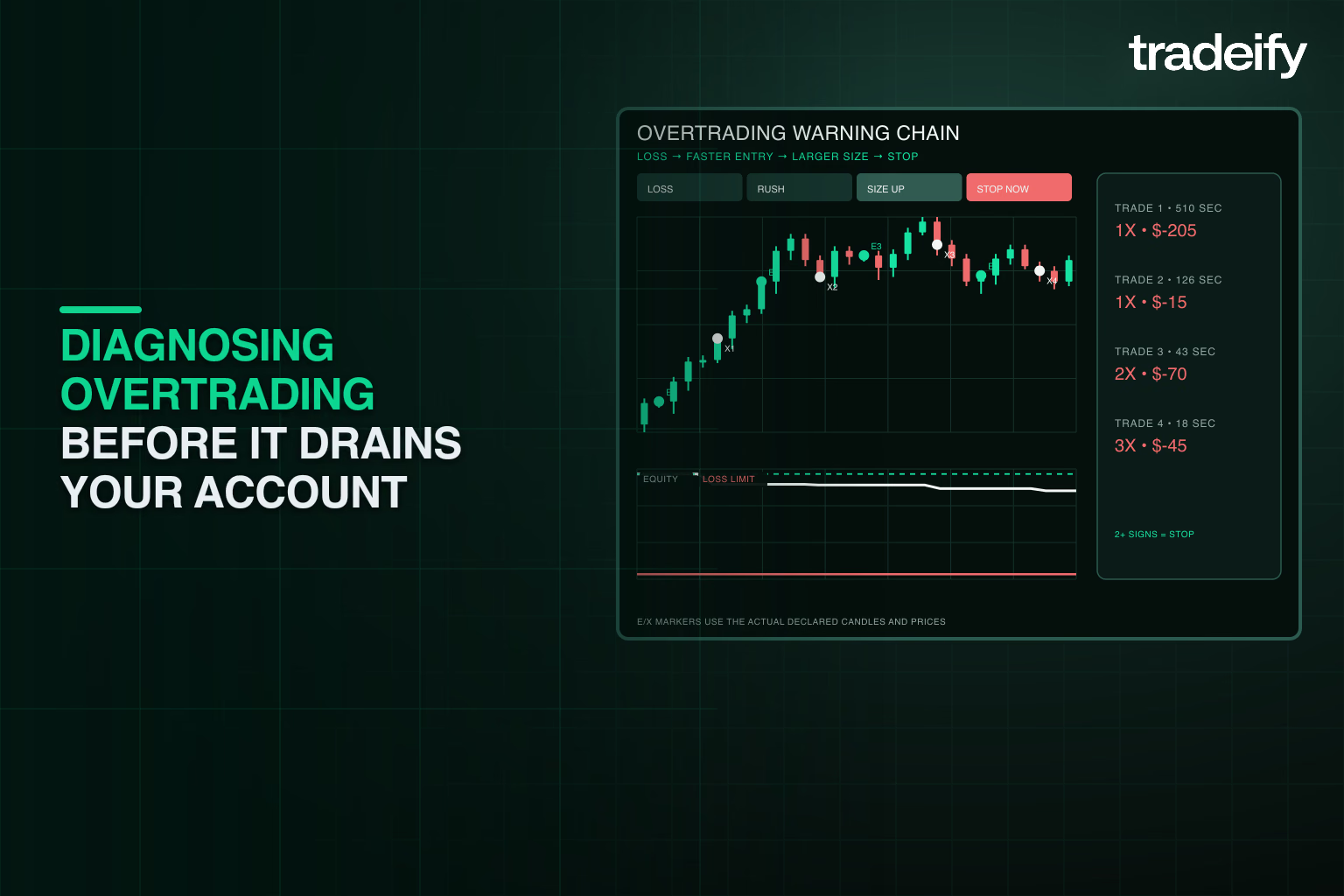
In the context of financial markets, overtrading isn't strictly defined by a specific number of trades. A scalper might legitimately take 20 trades a day, while a swing trader overtrades by taking two. Overtrading is defined by the deviation from your trading plan. It occurs when a trader engages in the market without a statistical edge, driven by an internal emotional state rather than an external market signal.
Research categorizes overtrading into three distinct behaviors. Recognizing which one plagues your strategy is the first step to a cure.
Discretionary Overtrading in Active Accounts
This is a common form of error among newer traders. It occurs when a trader has a plan for position sizing and margin usage but abandons it in the heat of the moment. For example, a trader might normally trade 2 Micro (MNQ) contracts, but after a loss, they suddenly switch to 2 Minis (NQ) to "make it back."
The Trap: The trader believes intuition outweighs rules. The flexibility that discretionary trading offers becomes a downfall because there is no consistent framework for risk.
Technical Overtrading That Drains Accounts
This behavior is driven by the "Confirmation Bias" trap. A trader decides they want to go Long because they feel the market is going up. Then, they stare at indicators until they find one, any one, that justifies the trade.
The Trap: Indicators are not used to analyze the market; they are used to validate an emotional impulse. Technical analysis is treated like a buffet, where the trader picks only the signals that agree with their gut and ignores the ones screaming "danger."
Shotgun Overtrading Across Multiple Accounts
This behavior is born from boredom or the desire for action. A trader starts firing off small positions across multiple instruments (Gold, Crude, NASDAQ) without a specific thesis for any of them.
The Trap: The trader craves the dopamine hit of being "in the market." This often happens when the market is slow. Activity is created where there is none, often described as "shouting at a quiet room."
Why Overtrading is Fatal for Funded Accounts
In a personal brokerage account, overtrading hurts the account balance. In a futures prop firm environment like Tradeify, overtrading interacts with specific risk management rules that can terminate an account even if the trader still has a positive balance.
The Trailing Drawdown Trap Caused by Overtrading Accounts
Tradeify uses an End-of-Day (EOD) Trailing Drawdown across all of its current account types, including Growth, Select, and Lightning. This mechanism calculates your drawdown based on your closing balance each day rather than tracking every tick in real time, which gives traders room to breathe during the session. But overtrading can weaponize this feature against a careless trader.
The Scenario:
Imagine a trader starts with a $50,000 Growth account and a $2,000 max drawdown (Bottom line: $48,000).
The trader overtrades aggressively in the morning and makes $2,500. The balance is $52,500.
High on dopamine, the trader keeps trading.
They enter a "churn and burn" phase and lose $2,000 in the afternoon.
The day finishes at $50,500.
The Result: Because the trader finished at a new high-water mark ($50,500), the trailing drawdown locks in behind them. The new liquidation threshold moves up. Even though the trader "gave back" profits, the drawdown calculation focuses on the closing balance. If the trader had stopped at the $2,500 profit, they would have a massive buffer. By overtrading and giving it back, risk is increased without increasing realized equity.
The Consistency Rule Breach from Overtrading Accounts
Tradeify enforces a consistency rule on funded accounts to ensure traders aren't gambling: no single day's profit can account for too large a percentage of total profit. The exact threshold depends on your account type. Growth funded accounts follow a 35% consistency rule, while Lightning funded accounts start at 20% and can scale to 25% or 30% on subsequent payouts. Select accounts have a 40% consistency rule during evaluation, though funded Select accounts do not enforce a consistency rule for payouts.
Overtraders often have "Hail Mary" days where they trade massive size and get lucky. If a trader overtrades and hits a massive windfall that represents 80% of total profit, they haven't "won." They have effectively frozen their ability to take a payout until they grind out significantly more trading days to dilute that percentage. Overtrading distorts consistency, making it harder to withdraw funds.

The Neuroscience Behind Overtrading (And Why Prevention Starts in the Brain)
Why do traders lose control? Why do smart, rational people make irrational financial decisions? The answer lies in brain chemistry.
The Dopamine Feedback Loop Behind Overtrading
Trading activates the same neural pathways as gambling. Every time a trader enters a trade, the brain anticipates a reward, releasing dopamine. This neurotransmitter isn't just about pleasure; it is about craving.
Neuroscience suggests that the uncertainty of the reward releases more dopamine than the reward itself. A slot machine is addictive because the outcome is unknown. Similarly, the market provides an intermittent reinforcement schedule.
The Cycle: Excitement (Entry) → Stress (Trade Management) → Relief/Regret (Exit).
The Addiction: If the trade wins, the trader gets a dopamine spike and wants to repeat it. If the trade loses, dopamine crashes, and the trader feels a compulsion to trade again to restore the chemical balance. This is the physiological basis of Revenge Trading.
The Amygdala Hijack Leading to Overtrading
When a trader suffers a loss, specifically a "stupid" loss caused by an error, the brain's fear center (the amygdala) activates. It perceives the loss of capital as a physical threat, triggering a fight-or-flight response.
Fight: The trader doubles down on position size (Revenge Trading).
Flight: The trader freezes and refuses to take a valid setup (Analysis Paralysis).
In this state, the Prefrontal Cortex—the part of the brain responsible for logic, planning, and following Tradeify rules—literally shuts down. A trader becomes chemically incapable of making good decisions until they calm down.
Biological Warning Signs of Overtrading via Heart Rate Variability
Recent studies in trading psychology have identified Heart Rate Variability (HRV) as a key biomarker for trader performance. HRV measures the variation in time between heartbeats.
High HRV: Indicates a state of calm, focus, and recovery. The trader is ready to trade.
Low HRV: Indicates stress, fatigue, or "fight or flight" activation.
If a trader's HRV drops significantly (a "nosedive") over a period of days or during a session, it is a biological red flag that they are prone to overtrading. The body knows it is about to tilt before the mind admits it.
Overtrading Prevention Strategies That Actually Work
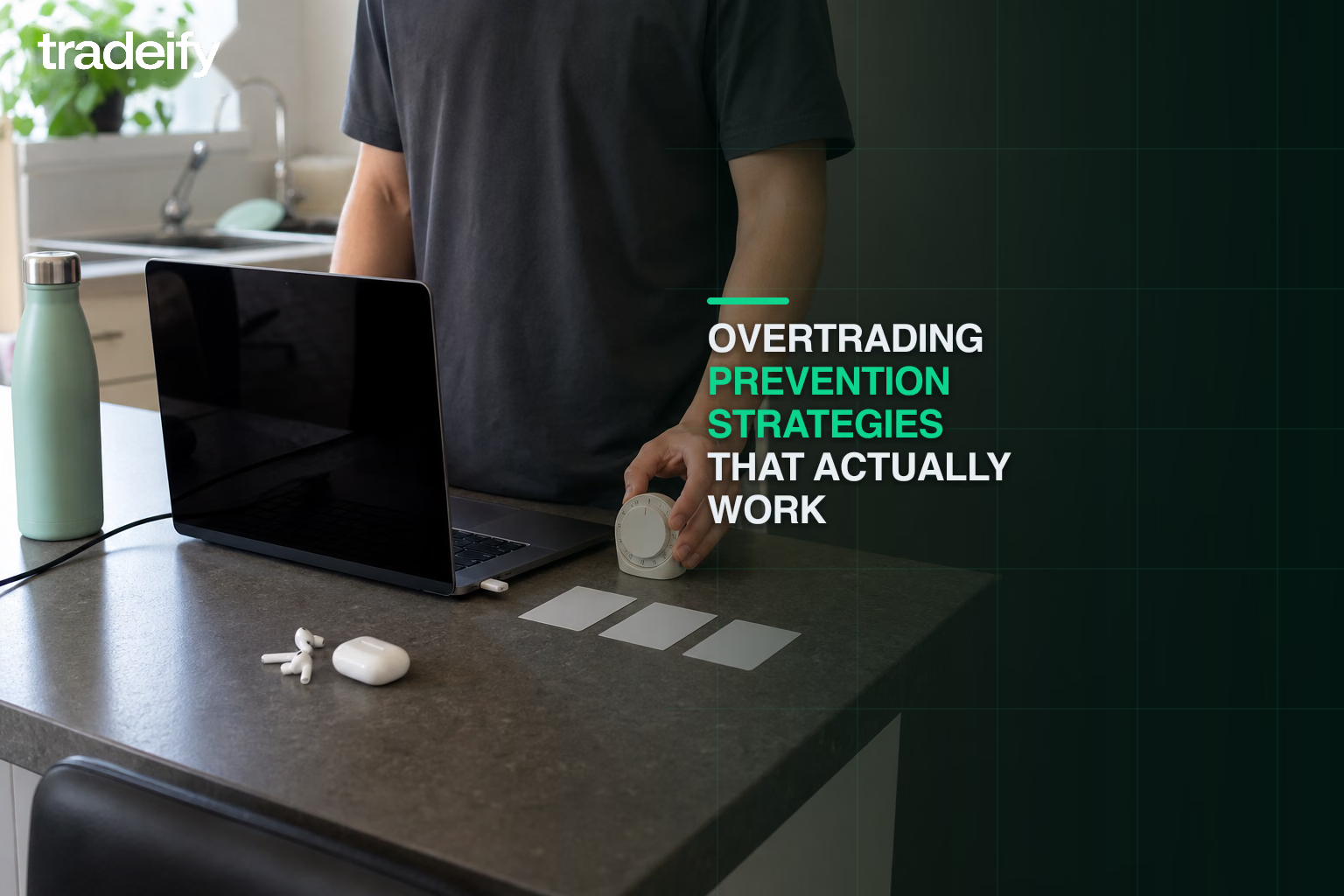
Understanding the problem is half the battle. This section outlines tactical solutions to keep a Tradeify account safe.
The Soft Breach Safety Net Against Overtrading
Most traders view the Daily Loss Limit (DLL) as a punishment. It should be reframed as a tool.
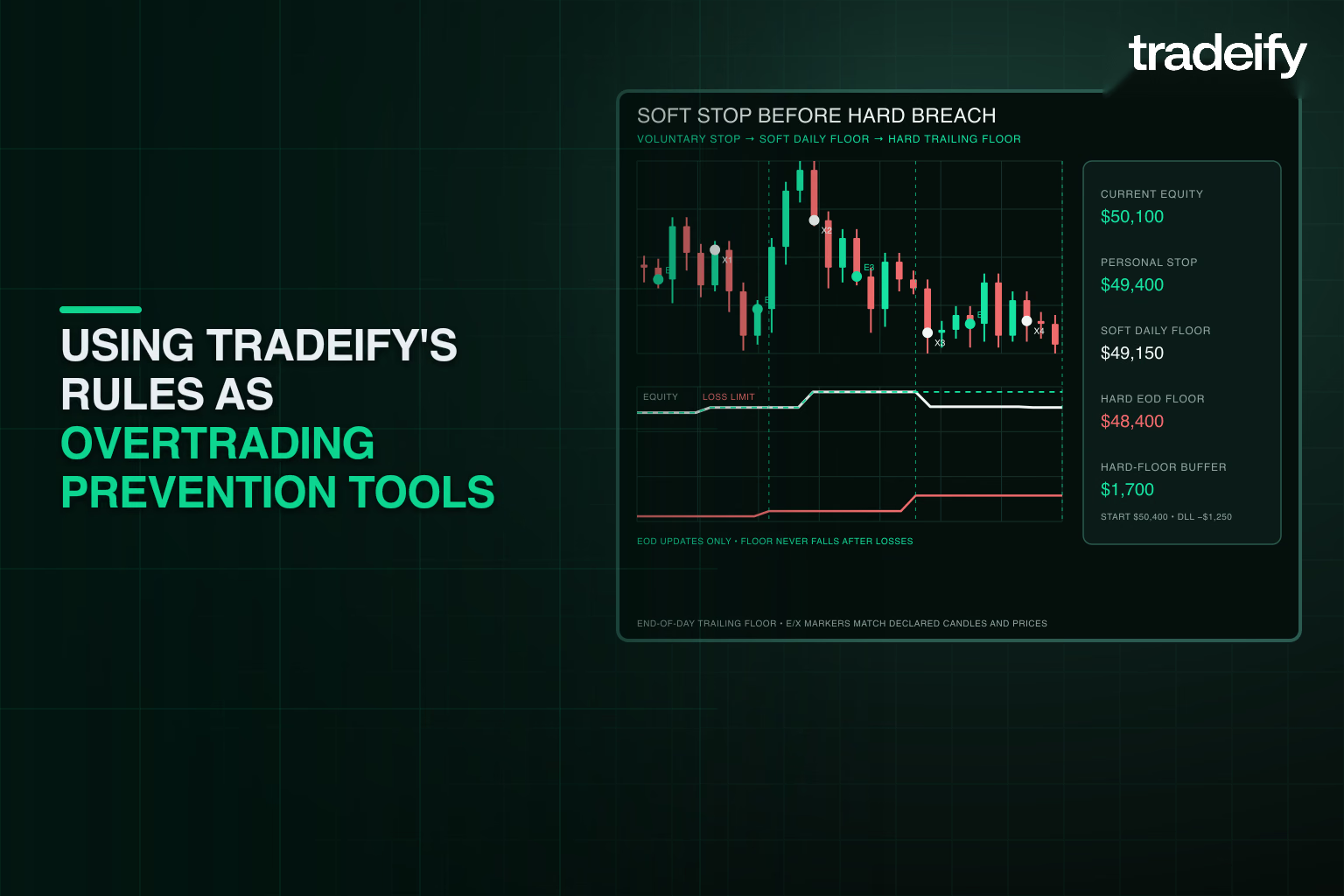
Tradeify's Daily Loss Limit is a "Soft Breach." This means if a trader hits their loss limit for the day (for example, $1,250 on a 50k Growth or Lightning account, or $1,000 on a 50k Select Daily account), they do not lose the account. The account is simply paused until the next market session (6:00 PM ET).
It's worth noting that not all account types carry a DLL. Select Flex funded accounts do not have a Daily Loss Limit, so traders on that path need to be even more disciplined about setting personal stop-loss thresholds. Additionally, on Growth accounts, the DLL is permanently removed once you reach a certain profit threshold (for example, $3,000 in profit on a 50k account), so this safety net won't be there forever.
Strategy: Do not set a mental stop loss at the exact Tradeify limit. If the limit is $1,250, set a personal "walk away" point at $1,000. If you lack the discipline to stop yourself, let the software do it. It is better to be locked out for 12 hours than to spiral into a drawdown breach that kills the account permanently.
The Sticky Note Pre-Trade Checklist to Prevent Overtrading
Overtrading thrives on speed. By forcing a pause between the impulse and the action, a trader can break the dopamine loop.
Create a physical checklist (or use a sticky note on the monitor) with 3-5 non-negotiable criteria.
Example Checklist:
☐ Is price at a Key Level (Support/Resistance)?
☐ Is the 5-minute trend aligned with the trade?
☐ Is the Stop Loss logically placed (not just a dollar amount)?
☐ Am I bored? (Be honest).
If every box cannot be checked, do not click. This simple friction can prevent impulsive trading.
The 10-Second Rule: Avoiding Hyper-Scalping and Overtrading
One of the most common forms of nervous overtrading is "Hyper-Scalping"—jumping in and out of trades in seconds to snatch a few ticks.
Tradeify has a specific rule regarding this: Microscalping.
The Rule: Over 50% of your trades must be held longer than 10 seconds, AND over 50% of your profit must come from trades held longer than 10 seconds. If you don't meet both criteria, you won't be able to activate a passed evaluation or request a payout.
The Prevention: If a trader finds themselves closing trades in 3, 5, or 8 seconds, they aren't just overtrading; they are risking payout eligibility. Use this rule as a constraint. If there is no conviction to hold a trade for at least 10 seconds, there is no trade—only an impulse.
Implement Trade Quotas to Limit Overtrading
For those who suffer from Discretionary Overtrading (deviating from the plan), imposing a hard limit on volume can help.
The 3-Bullet Rule: Give yourself a "clip" of 3 trades per day. If you win, great. If you lose all three, you are out of ammo.
The Power of Constraints: Constraints force creativity and selectivity. If a trader knows they only have one bullet left, they won't waste it on a sub-par setup. This naturally filters out low-quality trades that drag down P&L.
Cash is a Position That Protects Accounts from Overtrading
This is a mantra for every professional trader. Being "flat" (no open positions) is an active decision.
Reframing: Instead of thinking "I'm missing out" (FOMO), think "I am protecting my capital for the A+ setup."
The Prop Firm Math: In a Tradeify evaluation, capital preservation is just as important as capital growth. Every minute spent sitting on hands while the market is choppy is a minute not sliding toward the drawdown limit.
The Pattern Interrupt: Walking Away to Stop Overtrading
When a trader feels the symptoms of tilt (hot face, shallow breathing, slamming the mouse), they must physically remove themselves from the environment.
The 15-Minute Rule: If two consecutive losses occur, leave the screen for 15 minutes. Go outside, get water, reset.
Why it works: This allows the cortisol (stress hormone) to dissipate and lets the Prefrontal Cortex come back online. You cannot "think" your way out of an emotional spiral while staring at the candles that caused it.
Post-Trade Review Journaling to Spot Overtrading in Accounts
Overtrading often happens in a blur. Traders often don't realize how many trades they took until the day is over.
The Journal Solution: Force a log of every trade immediately after closing it. Write down why it was taken.
The Effect: If a trader has to write "I took this because I was bored/angry" five times in a row, the shame and realization become a powerful deterrent. Tradeify offers a built-in trading journal—use it to spot emotional patterns.
Using Tradeify's Rules as Overtrading Prevention Tools
To survive the long game, a trader must align their psychology with the specific rules of their funding partner.
Understanding Hard Breach vs Soft Breach When Overtrading
Tradeify employs two distinct types of rule violations. Understanding the difference is critical for risk management.
Max Trailing Drawdown = Hard Breach.
This is the account termination threshold. If the account balance drops below the minimum equity allowed (calculated based on the End-of-Day high water mark), the account is lost. Overtrading pushes a trader toward this cliff.
Daily Loss Limit = Soft Breach.
This is a temporary pause. If a trader hits the daily loss cap, they are prevented from trading until the market reopens at 6:00 PM ET. The account remains active as long as the Max Trailing Drawdown hasn't been hit.
The Pro Tip: If you feel yourself spiraling, check your distance to the Daily limit, not the Max drawdown. Aim to hit the pause button voluntarily before the market forces the hard stop. And remember: if your trailing drawdown is closer than your DLL, you could hit the drawdown first and fail your account before the DLL ever triggers.
Avoiding the Spiral: Take a Break Between Failed Accounts
For traders who lose an account via overtrading and immediately purchase a new one to "revenge trade" the evaluation, this is gambling behavior, not trading. Repeatedly failing and immediately repurchasing accounts without adjusting strategy is a pattern that undermines long-term success and capital.
The Risk: If a trader blows an account and immediately buys a new one with the same emotional state, they are likely to repeat the exact same mistakes. It is vital to take a break between failed evaluations to reset mental states, review the journal, and identify what went wrong before putting new capital at risk.
Overtrading Prevention Comes Down to Quality Over Quantity
The goal of a prop trader is not to be the busiest person in the market; it is to be the most profitable.
Overtrading is an attempt to force the market to pay on the trader's schedule. But the market pays on its schedule.
By respecting the Tradeify drawdown rules, recognizing the biological signs of stress (like HRV), and implementing hard constraints like checklists and trade quotas, traders can silence the noise. Remember, in the world of funded trading, survival is the highest form of skill.
Final Checklist to Prevent Overtrading:
❤ Check Pulse: Am I stressed, bored, or angry? (Check HRV if possible).
⚠ Check Rules: Am I near my Daily Loss Limit?
✔ Check Setup: Does this trade meet all my criteria on the sticky note?
⏱ Check Time: Am I willing to hold this for more than 10 seconds?
If the answer to all of the above is "Green," take the trade. If not, sit on your hands. Your funded account will thank you.
.svg)
.svg)
.svg)
.svg)






.webp)