.svg)

.svg)
.svg)

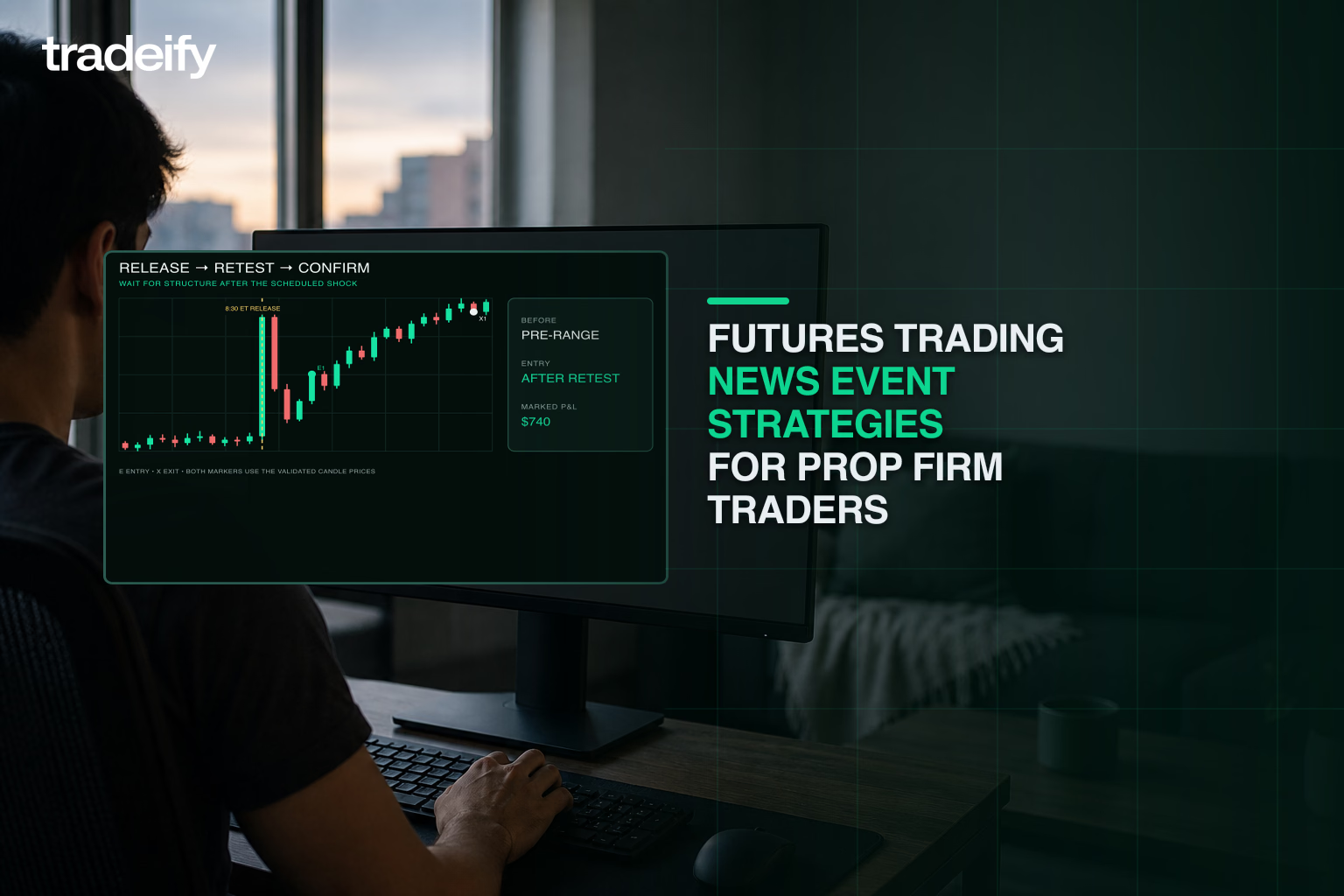


TL;DR: Trade news events with a written plan: know the release time, size down, avoid market orders in the first seconds, use a hard stop, and skip the trade if spreads/slippage get extreme or your risk rules would be violated.
News Event Execution Checklist (Pre / During / After)

Use this quick sequence to turn “news trading” into an executable process.
Pre-release (15–60 minutes before)
- Write your plan in one sentence: “If price does X at level Y, I will do Z.”
- Mark key levels from the prior session (high/low, VWAP, major support/resistance).
- Decide your max loss for the event (a hard dollar amount) and size down to match it.
- Pick your order type before the release (avoid improvising under stress).
- Decide your “no-trade” rules (e.g., if spread widens beyond your limit, you skip).
During release (0–5 minutes)
- Assume the first spike can be a fakeout; prioritize confirmation over being first.
- Avoid market orders in thin liquidity; use limit/stop-limit if your platform supports it.
- Place the stop where the trade idea is invalid, not where it “feels safe.”
- If slippage breaks your risk cap, flatten and stand down.
After release (5–60 minutes)
- Re-check structure: did price reclaim/lose the key level you planned around?
- Trail risk only after the market normalizes (spreads + order flow stabilize).
- Journal: entry reason, execution quality, slippage, and whether you followed rules.
Event-to-Action Map (Fast Decision Table)
This table is intentionally general—use it to choose how to trade an event, not to predict the outcome.
| Event type | Typical volatility | Preferred setup | Invalidation (when to exit) |
|---|---|---|---|
| Inflation (CPI/PCE) | High | Wait for first spike → trade reclaim/hold of key level | Key level fails + momentum flips |
| Jobs (NFP/Unemployment) | Very high | Stand aside 30–120s → trade second leg / pullback | Breaks back into pre-event range |
| FOMC rate decision | High | Range expansion → trade breakout only after retest | Retest fails; whipsaws through both sides |
| FOMC press conference | Choppy → trending | Let direction settle → trade trend continuation | Higher-timeframe level rejects twice |
| Energy inventories | Moderate–high | Fade extremes only with confirmation | Continuation impulse breaks your stop fast |
| Unexpected headline | Variable | Skip unless you have a ruleset for it | Any execution outside your risk limits |
FAQ: News Event Trading (Practical Questions)
When should I enter—immediately on the release or after the first spike?
For most traders, entering after the first spike is safer. Let spreads normalize, then trade a retest, reclaim, or second-leg continuation that matches your plan.
How do I handle slippage and spread widening?
Decide a maximum allowed slippage/spread before the release. If fills exceed your limit, flatten and skip the trade—treat it like a hard risk rule.
Where should my stop go during news volatility?
Place the stop where the idea is invalid (for example: back inside the pre-event range or through a key level). If that stop is too wide for your risk cap, reduce size or don’t trade.
How can news wins hurt payout eligibility under a consistency rule?
A single oversized win can make your best day “too large” versus your total profit, delaying payout eligibility. Use smaller targets and steadier sizing to keep daily P&L more even.
When should I skip a release entirely?
Skip if you can’t define invalidation, if liquidity is unusually thin, if your platform can’t control order types, or if the event would push you near your daily/max risk limits.
What’s a simple pre/during/post routine I can follow every time?
Use the checklist above: plan levels + max loss pre-release, prioritize confirmation during, and journal execution quality after.
The world of professional futures trading has undergone a significant transformation, moving from a capital-intensive model reserved for institutional desks and high-net-worth individuals to a decentralized, merit-based ecosystem facilitated by proprietary trading firms. This structural shift has democratized access to institutional-grade capital, allowing retail researchers and systematic traders to use high-performance infrastructure without the burden of unlimited personal liability. Central to this evolution is the utilization of centralized exchanges, primarily the Chicago Mercantile Exchange (CME), which ensures that all participants (regardless of size) interact with the same price identification mechanisms, volume data, and order flow. For the contemporary futures researcher, high-impact news events represent the apex of market opportunity, offering the liquidity and volatility necessary to execute sophisticated strategies that require significant price displacement.
Trading high-impact news is often described as "scheduled chaos," where the arrival of unanticipated information forces a rapid repricing of assets. For firms like Tradeify, the philosophy surrounding news trading is built on the principle of transparency and trader independence. Unlike many competitors that restrict trading during "red folder" events, Tradeify permits full market engagement during these periods, recognizing that volatility is the primary engine of alpha generation for skilled traders. However, trading these events requires more than just an understanding of price action; it demands a deep comprehension of the firm's specific risk parameters, the underlying market microstructure, and the quantitative frameworks used to model economic surprises.
How Prop Firms Handle News Event Trading Rules

The transition of the proprietary trading sector toward centralized futures models is driven by the search for reliability and clearer regulatory frameworks. Global interest in prop firm trading has surged over 55-fold since 2020, as traders seek an alternative to the fragmentation found in decentralized Forex and CFD markets. In the futures market, the centralization advantage eliminates price manipulation and ensures that every trade is cleared through regulated entities like the Chicago Mercantile Exchange (CME), following the strictures of the Commodity Futures Trading Commission (CFTC) and the National Futures Association (NFA).
Tradeify's "Lean Startup" model for traders offers a capped downside, where financial risk is strictly limited to the fees paid for evaluation or account access. This creates a zero-tail-risk environment for the individual, as the firm absorbs the impact of extreme market gaps or "black swan" events that could otherwise lead to negative balances in a standard retail account.
Tradeify Account Structures for News Event Trading
The choice of account type fundamentally alters the strategy for news trading due to the differing drawdown and consistency rules. Researchers must align their risk tolerance with the specific mechanics of each plan.
- Drawdown Type, Select Evaluation, End-of-Day (EOD) Trailing; Growth Evaluation, End-of-Day (EOD) Trailing; Lightning Funded, End-of-Day (EOD) Trailing.
- Consistency Rule, Select Evaluation, 40% Limit; Growth Evaluation, None in eval; 35% once funded; Lightning Funded, 20%/25%/30% (Escalating).
- Daily Loss Limit, Select Evaluation, None during evaluation; soft DLL applies once funded ($1,000–$1,750 by size); Growth Evaluation, Soft DLL ($1,250–$3,750); Lightning Funded, Soft DLL ($1,250–$3,750).
- News Trading, Select Evaluation, Allowed; Growth Evaluation, Allowed; Lightning Funded, Allowed.
- Payout Requirement, Select Evaluation, N/A; Growth Evaluation, N/A; Lightning Funded, 5 winning days, profit targets.
Economic Surprise, Volatility, and the News Trading Edge

To build a structured news event strategy, one must understand the concept of economic surprise. Financial markets are forward-looking mechanisms that price in expectations. Before a major release, such as the CPI report, traders, economists, and institutional desks develop a consensus forecast. This expected value becomes embedded in price.
The economic surprise is the delta between the reported data and the consensus expectation. The larger the surprise, the more violent the market reaction. A CPI print that matches expectations is often met with muted price action, whereas a print that deviates significantly from forecasts can trigger an immediate repricing of interest rate probabilities, affecting all rate-sensitive assets.
How Surprise Translates Into Futures Volatility
In futures markets, volatility is amplified due to leverage and the centralization of liquidity. When a large surprise hits the tape, the order book can experience an immediate liquidity vacuum. Market makers pull orders, spreads widen, and the market gaps as algorithms compete to reprice. This produces the characteristic "news spike" followed by rapid mean reversion or trend continuation.
For the researcher, this is where opportunity arises. Volatility is not noise; it is a signal that a new equilibrium is being sought. By modeling volatility expansion and using market microstructure tools, traders can position to capture these dislocations.
Futures News Event Strategies: Breakout vs. Mean Reversion

News trading strategies generally fall into two archetypes: volatility breakouts and mean reversion trades. The correct approach depends on the context and the behavior of the first impulse.
Strategy 1: Volatility Breakout Trading
Breakout news trading involves entering in the direction of the initial impulse once the market confirms that the move is not a fakeout. Confirmation can be defined by:
- A strong close outside of the pre-release range.
- Sustained order flow in one direction (CVD supporting the move).
- Acceptance above or below a key technical level (VWAP, previous high/low).
The most common mistake amateurs make is entering too early, directly into the initial spike. This often results in severe slippage and immediate reversal. Professional researchers allow the first wave of volatility to clear and then enter on the retest or continuation pattern.
Strategy 2: Mean Reversion News Trading
Mean reversion strategies involve fading the initial spike when there is evidence that the move is purely an overreaction and the market will revert toward the pre-release equilibrium. This strategy is higher risk, as fades can be steamrolled if the surprise is structurally significant.
Mean reversion setups are best deployed when:
- The economic surprise is small and within the margin of expectation.
- The initial spike is immediately met with absorption and rejection.
- Liquidity returns quickly and spreads normalize.
Managing Risk During News Trading in a Prop Firm Environment

In the prop firm environment, risk management is not optional; it is the primary constraint. News trading can be exceptionally profitable, but it can also produce instantaneous drawdown breaches. The goal is to deploy strategies that align with the firm's rules, particularly trailing drawdown and consistency limits.
How the Trailing Drawdown Shapes News Trading
Tradeify uses an End-of-Day trailing drawdown, which recalculates at the close rather than on intraday unrealized peaks. This structural advantage provides a more forgiving environment for news event trading, as it reduces the penalty for temporary volatility swings.
However, even with EOD trailing, a trader can still violate the daily loss limit or max drawdown if they oversize or chase the spike. Therefore, position sizing must be reduced during news events.
Consistency Rules and Payout Eligibility
Consistency rules are designed to prevent gamblers from passing by one lucky trade. These rules impose a cap on how much one day's profit can represent of the total profit when requesting a payout.
This means that a single oversized news trade can backfire even if it is profitable. If a trader makes $5,000 in one day on a Lightning account with a 20% consistency rule, they must accumulate $25,000 in total profit for that day to be only 20% of the total. Even if the actual minimum balance required for payout is lower, the consistency rule independently sets this bar. This structural constraint encourages researchers to target smaller, repeatable wins rather than "home runs" that create long-term eligibility barriers.
Putting Your Futures News Event Trading Strategy Together
Day trading news events in the futures market is a high-stakes endeavor that sits at the intersection of economic analysis, quantitative modeling, and rigorous risk control. For the researcher, Tradeify offers a unique platform where news trading is not just allowed but supported by flexible EOD drawdown models and high-performance Sim Funded accounts.
The key to long-term success lies in the ability to:
- Identify high-impact catalysts through tools like the economic calendar and AI sentiment analysis.
- Execute strategies (whether volatility breakouts or mean reversions) that respect the 10-second microscalping boundary.
- Utilize order flow tools like CVD and DOM to confirm that institutional "smart money" is participating in the move.
- Manage the mathematical constraints of the trailing drawdown and the consistency rule to ensure consistent payout eligibility.
As the business model used by futures prop firms continues to evolve toward "Elite Live" multi-account scaling and real-time data integration, the opportunity for researchers to monetize their edge has never been greater. By combining a deep understanding of market microstructure with a disciplined adherence to firm rules, the contemporary news trader can transform market volatility into a sustainable, professional career.
Disclaimer: The materials and content provided by Tradeify Holdings, Corp. (“Tradeify”), whether on our website, through distributed documents, or other communications, including this blog post (“Article”), are intended solely for educational and general informational purposes. This Article should not be viewed as an offer or solicitation to buy or sell futures, futures-related products/derivatives, or any futures products of any kind, or otherwise constitute any type of trading or investment advice, recommendation or strategy, or an endorsement of any financial instruments, companies, or funds.
Engaging in futures and other financial trading involves significant risk and is not appropriate for all readers. Certain investment products (e.g., securities futures, forex futures, and virtual currency derivatives and products) present heightened risks which are described in the Risk Disclosure section of the Tradeify website. It is possible to lose the entire amount of your investment, or even more. Only use risk capital—money you can afford to lose without impacting your financial security or lifestyle. Trading should only be undertaken by individuals who have the necessary risk capital and fully understand the risks involved. Past trading results do not guarantee future performance. Tradeify does not warrant the accuracy or completeness of the information provided and is not responsible for any losses or damages resulting from reliance on this information.
Readers are encouraged to do their own research and consult with a qualified financial adviser before making any financial decisions. This Article does not consider your personal financial situation, risk tolerance, or investment goals.
The authors’ (together with guest writers, analysts, and/or other contributors, collectively “Contributors”) views expressed in the Article are based on information the authors and Contributors believe to be accurate at the time of publication but are not guaranteed to be complete or up to date. The authors of this Article may be employees of Tradeify and receive compensation as such. In addition, the authors and/or Contributors may receive compensation (including, for example, referral fees) for soliciting and/or referring individuals to open accounts with Tradeify, both through this Article, as well as through outside activities. Because any testimonials or endorsements herein may be provided by individuals who have or may receive compensation, there is potential for bias in their statements. Such statements may not be representative of the experience of other clients and are not indicative of, or a guarantee of, future performance or success. No representation is being made that any Tradeify account will or is likely to achieve profits or losses similar to those discussed herein.
.svg)
.svg)
.svg)
.svg)






.webp)