.svg)

.svg)
.svg)



TL;DR: The best futures contracts for passing a prop firm challenge are Micro E-minis — specifically the MES (Micro S&P 500, $1.25/tick), MYM (Micro Dow, $0.50/tick), and MCL (Micro Crude Oil, $1.00/tick) — because their small tick values let traders size positions precisely against tight drawdown limits. The standard position sizing formula is Position Size = Account Risk / (Stop Loss Distance × Tick Value), and a common personal risk discipline is the 1% rule, though that's a trader-imposed practice, not a prop firm rule. Round-trip commissions run roughly $1.82 for equity Micros vs $5.76 for E-minis. Contracts ranked by liquidity: ES (Tier 1), MES (Tier 1.5), CL (Tier 2), NQ (Tier 3), RTY (Tier 4). Equity index futures roll quarterly (Mar/Jun/Sep/Dec) on the Monday before the third Friday, and trading the front month is essential for execution quality. Across the prop firm landscape, the rules that most affect contract choice are the drawdown type (intraday vs end-of-day), the presence and behavior of a daily loss limit, and any consistency rule that limits how concentrated profits can be on a single day. Tradeify offers two evaluation models — Select ($25K/$50K/$100K/$150K, EOD trailing drawdown, 40% consistency, no daily loss limit during eval, profit targets of $1,500/$3,000/$6,000/$9,000) and Growth ($25K/$50K/$100K/$150K, EOD trailing drawdown, daily loss limit as a soft breach, no consistency rule, single-day pass possible) — and supports Tradovate, WealthCharts, and Rithmic. A microscalping guideline requires that more than 50% of trades and profits come from positions held longer than 10 seconds, applying to both passing the evaluation and qualifying for payouts.
The structural evolution of the proprietary trading industry has pushed novice traders toward a more deliberate approach to instrument selection. While the appeal of high-margin simulated capital is significant, the path to a funded status is shaped by mechanical constraints that penalize volatility and impulsive execution. For a beginner, the primary objective of a prop firm evaluation is not maximum profit but disciplined risk management within the rules — specifically the 40% consistency rule on Select and the end-of-day trailing drawdown across both eval models. Central to that objective is selecting futures contracts that match the trader's risk parameters and psychological tolerance.
Equity Index Futures Contracts for Prop Firm Traders

Equity index futures, managed primarily by the CME Group, remain the most popular instruments for prop firm challenges due to their immense liquidity and clearly defined technical structures. For a beginner, the choice between the four major U.S. indices involves a trade-off between volatility and order book depth.
S&P 500 Futures Contracts (ES and MES)
The S&P 500 futures are widely regarded as the most stable environment for beginners. The E-mini S&P 500 (ES) has a thick order book that supports tight bid-ask spreads and minimizes slippage. Because the ES tracks 500 diversified companies across various sectors, it tends to be less prone to the erratic, news-driven spikes seen in technology-heavy indices.
For a participant in a $50,000 Select challenge, the full-sized ES contract — with a tick value of $12.50 — can be aggressive. A 10-point move against the trader is a $500 loss, which is 25% of the $2,000 drawdown limit. The Micro E-mini (MES), at one-tenth the size and a tick value of $1.25, is the more practical choice for traders learning to manage risk. The MES allows for granular position sizing in increments of 10 micro contracts, providing the flexibility to scale into positions and absorb intraday fluctuations without immediately threatening the drawdown.
Nasdaq-100 Futures Contracts (NQ and MNQ)
The Nasdaq-100 (NQ) is the primary vehicle for volatility-seeking traders, dominated by large-cap technology firms. The NQ offers significant intraday range but is characterized by a thinner order book and more frequent liquidity sweeps — violent moves that stop out participants before the market continues in the original direction. Each 0.25-point NQ tick is worth $5.00, meaning a full point of movement equals $20.00. With daily ranges often exceeding several hundred points, P&L can swing thousands of dollars per contract within minutes.
The Micro Nasdaq (MNQ) has a tick value of $0.50, which is essential for beginners who want exposure to the tech sector without the catastrophic risk associated with the full E-mini. Success in the NQ requires an advanced understanding of market structure and high tolerance for whipsaw price action. Most beginners are better served cutting their teeth on the ES or YM before transitioning to the NQ.
Dow Jones Futures Contracts (YM and MYM)
The Dow Jones Industrial Average futures (YM) track 30 blue-chip industrial companies. The YM is often described as a trending instrument that respects horizontal support and resistance levels more consistently than the NQ. With a point value of $5.00, it sits between the slow-moving ES and the hyper-volatile NQ. The Micro Dow (MYM) carries a tick value of $0.50, making it a strong alternative for beginners who prefer a market that trends with more purpose than the S&P 500 but without the erratic nature of the Nasdaq.
Equity Index Futures Contract Specs
| Instrument | Symbol | Exchange | Tick Size | Tick Value (Mini) | Tick Value (Micro) |
|---|---|---|---|---|---|
| S&P 500 | ES / MES | CME | 0.25 Points | $12.50 | $1.25 |
| Nasdaq-100 | NQ / MNQ | CME | 0.25 Points | $5.00 | $0.50 |
| Dow Jones | YM / MYM | CBOT | 1.00 Point | $5.00 | $0.50 |
| Russell 2000 | RTY / M2K | CME | 0.10 Points | $5.00 | $0.50 |
Eurex and Bond Futures Contracts for Prop Firm Challenges
A complete contract selection strategy should also account for international indices and interest rate products, particularly for traders who operate outside the standard New York session.
DAX and Euro Stoxx 50 Futures Contracts
Tradeify supports instruments from the Eurex exchange, including the DAX Index (FDAX) and the Mini-DAX (FDXM). The DAX is the benchmark for the German equity market and is known for high volatility and strong correlation with U.S. indices, often serving as a precursor to the New York open. The Micro DAX (FDXS) offers a more manageable point value of €1.00, providing exposure to the European session with controlled risk.
Bond Futures Contracts (ZN and ZB)
Bond futures, such as the 10-Year T-Note (ZN) and the 30-Year T-Bond (ZB), are often overlooked but offer strong technical cleanliness. These markets are driven by macroeconomic trends, inflation data, and Federal Reserve policy. While they lack the flashy intraday ranges of the NQ, they tend to move in structured waves that suit mean reversion or trend-following strategies. The tick value of the 10-Year T-Note is $15.625, making it a heavy contract that requires precise entry and exit.
Note: Tradeify's supported products include Eurex bond futures (Euro-Bund, Euro-Bobl, Euro-Schatz, Euro-Buxl) but traders should verify availability of US Treasury futures on their specific platform before trading.
Commodity Futures Contracts for Prop Firm Trading
Commodities represent a distinct asset class with supply-demand drivers that differ fundamentally from equity indices. They offer high volatility and the potential for rapid profit accumulation, but they also carry significant risk during fundamental news releases.
Crude Oil Futures Contracts (CL and MCL)
Crude Oil (CL) is widely considered the most volatile commodity in the futures market. It is subject to extreme price swings triggered by OPEC decisions, geopolitical conflicts, and the weekly EIA inventory reports. Each standard CL contract represents 1,000 barrels, and a $1.00 move in price results in a $1,000 gain or loss.
For a beginner, the E-mini Crude Oil (QM) or the Micro WTI Crude Oil (MCL) are the only realistic choices. The MCL tick value is $1.00, allowing for a $100 P&L move per $1.00 price shift. Crude oil is highly technical but unforgiving of loose risk management; CL routinely moves 100 ticks ($1,000) within minutes of an inventory release. Beginners should avoid trading during these specific windows unless they have a dedicated event-driven strategy.
Gold Futures Contracts (GC and MGC)
Gold (GC) is the primary safe-haven asset, reacting strongly to fluctuations in the U.S. dollar, interest rates, and global economic uncertainty. A standard Gold contract has a tick value of $10.00 for every 0.10 index points. The E-Micro Gold (MGC) reduces this to $1.00 per tick. Gold often exhibits long, sustained trends during periods of inflation or geopolitical crisis, which makes it a favorite for trend-following traders. Its behavior can be erratic during the London-New York crossover, requiring traders to be mindful of session-based liquidity shifts.
Commodity Futures Contract Specs
| Category | Contract | Symbol | Tick Value (Mini) | Tick Value (Micro) | Key Driver |
|---|---|---|---|---|---|
| Energy | Crude Oil | CL / MCL | $10.00 | $1.00 | Geopolitics / OPEC |
| Metal | Gold | GC / MGC | $10.00 | $1.00 | Inflation / USD |
| Metal | Silver | SI | $25.00 | N/A (Mini only) | Industrial Demand |
| Currency | Euro FX | 6E / M6E | $6.25 | $1.25 | Central Bank Policy |
Risk Management for Prop Firm Futures Trading

Contract selection is only half of the equation. The other half is applying quantitative risk management to that contract. A common discipline among professional traders is the 1% rule — risking no more than 1% of a defined risk budget on any single trade. Note that this is a personal risk-management practice, not a Tradeify-enforced rule. In a $50,000 Select account, the practical risk capital is the maximum drawdown of $2,000, not the full balance, which would put a 1% per-trade risk at $20.
ATR-Based Position Sizing for Futures Contracts
To apply rules like this consistently, traders often calibrate stop-losses to current market volatility using the Average True Range (ATR) indicator. ATR measures the average range of a price bar over a specified period, providing a realistic expectation of how much a contract might move in a given timeframe.
For example, if the 14-day ATR for the MES is 60 points, a 15-minute chart might show an ATR of 5 points ($25 in risk). If a trader's chosen risk per trade is $20, they cannot trade a full micro contract with a stop-loss that accounts for normal market noise. They need either a more precise entry on a lower timeframe or a period of lower volatility.
The mathematical formula for position sizing is:
Position Size = Account Risk ($) / (Stop Loss Distance (Ticks) × Tick Value ($))
Using this formula, a trader can ensure that contract selection is backed by mathematical discipline rather than emotional impulse.
Psychological Discipline in Prop Firm Trading
Trading inside a prop firm structure introduces psychological pressures that are absent in personal trading. The fear of failing an account and the pressure to reach a profit target often produce two common failures: overtrading and revenge trading.
The One Trade a Day Prop Firm Strategy
Many traders find the "One Trade a Day" approach useful as a psychological guardrail. By limiting themselves to a single high-quality setup, traders eliminate the possibility of "Winner's Tilt" — the overconfidence that comes from a morning win that gets given back in the afternoon. It also discourages revenge trading, since a failed trade means an immediate exit from the desk until the next session. This kind of approach pairs well with trending contracts like the Dow (YM) or safe-haven contracts like Gold (GC).
The 10-Second Rule on Tradeify
An often overlooked guideline in the Tradeify ecosystem is the microscalping rule. More than 50% of a trader's trades and profits must come from positions held longer than 10 seconds. This currently applies to both qualifying for payouts on funded accounts and passing the evaluation phase. The rule is designed to prevent high-frequency spamming of the market to satisfy other requirements. Beginners should select contracts and strategies that allow for breathing room in price action rather than scalping 1-tick moves in hyper-liquid markets.
Trading Platforms for Prop Firm Futures Contracts
Tradeify supports multiple execution platforms — Tradovate, WealthCharts, and Rithmic — and the best choice comes down to individual preference rather than any single platform being "optimal." Each platform brings a different feel to order entry, charting, and analytics, and traders are encouraged to try the options to find what fits their workflow.
Tradovate offers a clean, web-based interface that is well-suited for managing simple bracket orders on Micro contracts and is a good starting point for beginners. WealthCharts is a charting and order-routing platform that some traders prefer for its visual analysis tools. Rithmic provides a low-latency data and execution path that connects to a wide range of front-end platforms and is often favored by traders running automated strategies or advanced order flow analysis. NinjaTrader 8 is also accessible to traders who require advanced order flow tools or want to run automated strategies in NinjaScript, depending on connectivity options at the time of account setup.
Rotating Futures Contracts by Market Regime
An accessible advanced strategy is contract rotation — selecting the index that is currently leading the market. By monitoring the four major indices (ES, NQ, YM, RTY) side by side, a trader can identify which sector has the highest risk appetite.
For example, if the Nasdaq (NQ) is up 1% while the Dow (YM) is flat, technology stocks are driving the tape. In that regime, the NQ is likely to offer the cleanest breakouts, but it also carries the highest risk. Conversely, if the Russell 2000 (RTY) is lagging while the ES is green, it can signal a lack of broad market confidence and suggest that any rally might be a fakeout. Understanding these inter-market relationships allows a trader to stack the deck before placing a trade.
Economic Events and Impacted Futures Contracts
| Event | Primary Contract Impacted | Volatility Level |
|---|---|---|
| FOMC Rate Decision | ES, NQ, ZN (Bonds), 6E (Euro) | Critical |
| Non-Farm Payrolls (NFP) | ES, NQ, 6E (Euro) | High |
| EIA Inventory Report | CL (Crude Oil) | High |
| CPI (Inflation Data) | GC (Gold), ES, ZN (Bonds) | High |
| USDA Crop Reports | ZS (Soybeans), ZC (Corn) | Moderate |
Beginners should generally avoid holding positions through the immediate aftermath of these reports. The sudden injection of volume can cause price gaps where the market skips price levels, resulting in stops being filled at much worse prices than intended — a phenomenon that can fail an evaluation account in seconds.
The Ideal Futures Contract Lineup for Tradeify Beginners
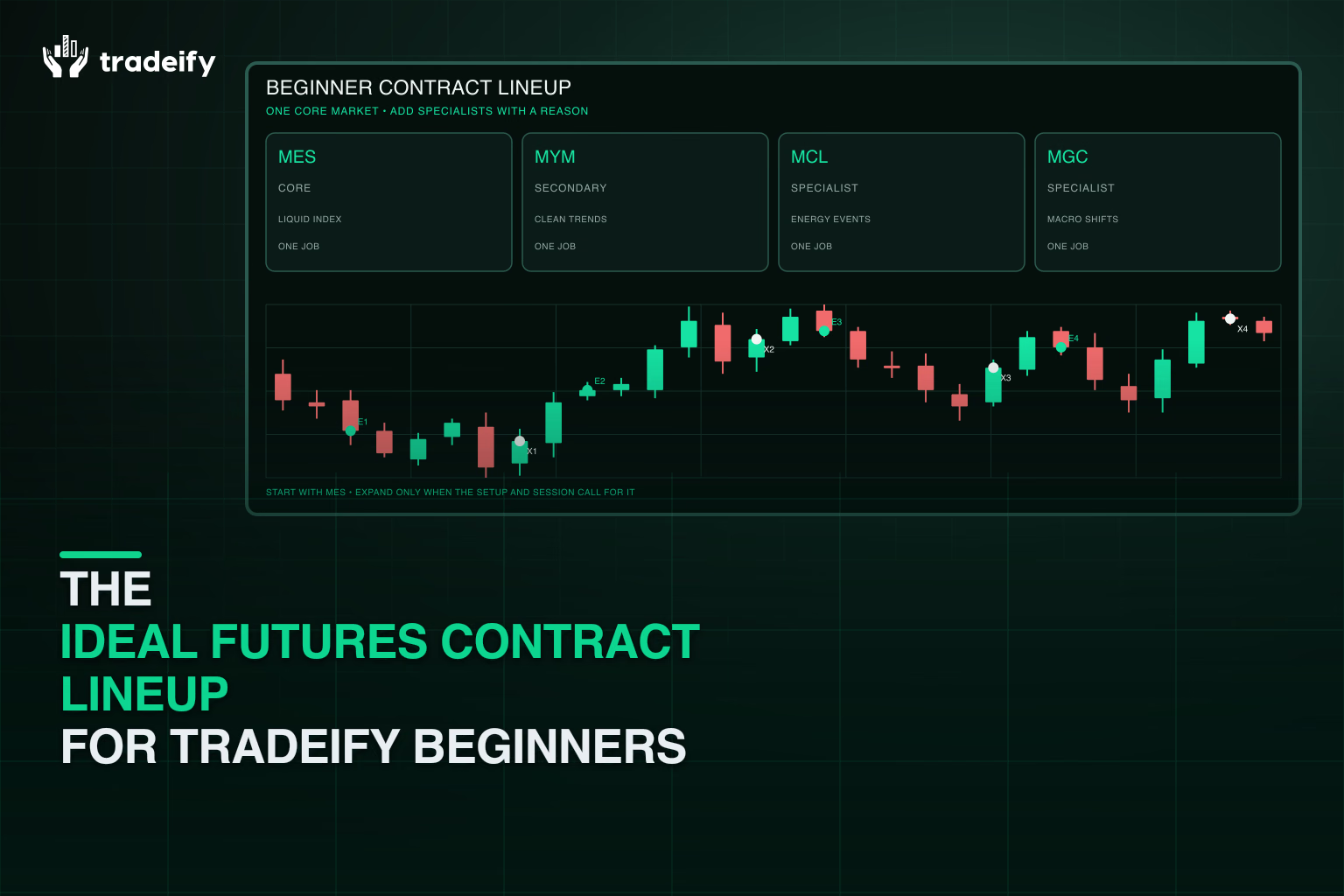
The combination of account mechanics, contract specifications, and psychological frameworks suggests that the most effective path to passing a Tradeify challenge is centered on Micro contracts and a disciplined, low-volume approach. For the $50,000 Select Evaluation, a practical loadout is the Micro E-mini S&P 500 (MES) traded in sizes of 1 to 5 contracts. That allows for a $20 to $100 risk profile that respects the drawdown limit while still providing enough scale to work toward the $3,000 profit target.
Combined with the discipline of a structured risk approach and the psychological benefit of a "One Trade a Day" framework, traders can move past the emotional turbulence that breaks most challenge attempts. Success is rarely about catching the largest move in the most volatile index; it's about consistent application of a high-probability strategy to a liquid, technically sound instrument. The MES, MYM, and MCL all reflect that approach.
Market Liquidity and Slippage for Prop Firm Futures Contracts

For a novice trader, liquidity is a concept that is often understood theoretically but ignored mechanically until a trade is filled. In futures, liquidity is the lifeblood of efficient execution. The E-mini S&P 500 (ES) is the most liquid futures contract in the world, often trading more than 1 million contracts per day. That volume ensures even a 4-mini contract position (the maximum for a $50K Select evaluation account) can be filled at the displayed market price without moving the index.
Conversely, trading during illiquid periods (such as 3:00 AM EST for U.S. indices) can result in slippage — the difference between the price a trader intended to buy at and the price the order was actually filled at. For a prop trader with a $2,000 drawdown, a 2-tick slippage on a 5-contract NQ position represents $50 of hidden cost ($5.00 per tick × 2 ticks × 5 contracts). Across 10 trades, that hidden tax of $500 represents 25% of the account's total drawdown capacity.
Futures Contract Liquidity Ranking for Prop Firm Beginners
- ES (E-mini S&P 500): Tier 1 liquidity. Suitable for any strategy.
- MES (Micro S&P 500): Tier 1.5 liquidity. Excellent for beginners, though spreads can occasionally be 2 ticks instead of 1.
- CL (Crude Oil): Tier 2 liquidity. Deep order book but prone to rapid thinning during news.
- NQ (Nasdaq-100): Tier 3 liquidity. Known for slipping several points during fast moves.
- RTY (Russell 2000): Tier 4 liquidity. Lightest volume of the major indices; requires patient execution.
By prioritizing high-liquidity contracts like the ES and MES, beginners protect their drawdown from the erosion of execution inefficiency.
Inter-Market Correlations for Prop Firm Futures Trading
Beginner traders often view each futures contract as an isolated instrument, but the global financial system is deeply interconnected.
Risk-On vs. Risk-Off Signals Across Futures Contracts
When equity indices (ES, NQ, YM) are rising together while Gold (GC) and Treasury Bonds (ZN) are falling, the market is in a "Risk-On" regime. In this environment, long positions in the NQ or RTY tend to yield the highest returns, since they are most sensitive to positive sentiment.
If the ES is making new highs but the Russell 2000 (RTY) is making lower lows, that's a divergence. It often signals that the rally is being propped up by a few large-cap stocks and lacks the broad participation needed for a sustained move. A trader who recognizes this can avoid taking a high-risk long position in the NQ and instead wait for a more stable setup in the ES, or even consider a short position in the weak-performing RTY.
Scaling from Micro to Mini Futures Contracts

A defining feature of Tradeify's funded accounts is the Contract Scaling Plan. During the evaluation phase, traders have access to their full contract limits immediately (1/10 for $25K, 4/40 for $50K, 8/80 for $100K, 12/120 for $150K). Once funded, Select accounts use a progressive scaling system that starts with reduced limits and increases as account equity grows. Scaling is calibrated at end of day, meaning contract limits update based on closing balance each trading day.
For a $50,000 funded account, the progression starts with a reduced maximum position and steps up as the account moves further past starting balance. The structure is designed to protect the trader from over-sizing while the account is still close to its starting balance and most exposed to drawdown. By staying in Micro contracts (MES/MNQ) during this scaling phase, traders limit the damage that a single volatile move can do to the account.
Prop Firm Comparison for Beginner Futures Traders
Prop firms differ meaningfully in how they handle drawdown and intraday risk:
- Some firms use intraday trailing drawdown, where the drawdown floor moves up in real time as unrealized profit grows. If a trader is up $1,000 in a trade and it retraces to break-even, the drawdown floor has already moved up by $1,000 — effectively losing risk capital on a flat trade.
- Some firms use EOD drawdown but enforce a strict daily loss limit during the evaluation. This ends the trading day prematurely if the limit is hit, which can frustrate a learner who is still perfecting their timing.
- Tradeify Select uses EOD drawdown with no daily loss limit during the evaluation phase. That gives a beginner the intraday freedom to let trades play out according to their plan, provided they close the day within the drawdown boundaries. Tradeify Growth uses EOD drawdown with a daily loss limit that pauses trading rather than failing the account, which can act as a useful guardrail without ending the run.
Final Takeaways on Futures Contracts for Prop Firm Success
The "best" contract is not the one with the highest potential profit — it's the one that offers the most manageable risk relative to the prop firm's rules.
The MES (Micro S&P 500) serves as the primary instrument because of its technical structure and liquidity. The MYM (Micro Dow) provides a strong secondary option for trend-following. The MCL (Micro Crude) and MGC (Micro Gold) offer specialized opportunities during macro shifts, provided they are traded with extreme caution around news.
By layering these instrument choices with disciplined risk management and the psychological guardrails of approaches like "One Trade a Day," a beginner can transform the prop firm challenge from an obstacle into a scalable professional path. Tradeify's infrastructure — Select Evaluation with EOD drawdown, Growth Evaluation with a soft-breach DLL, and platform options across Tradovate, WealthCharts, and Rithmic — gives traders the flexibility to build the workflow that fits them best.
Futures Contract Fees and Commissions
For the retail trader inside a proprietary firm ecosystem, transaction costs represent friction that has to be accounted for in the overall P&L calculation. Unlike traditional brokerage accounts where commissions may be waived, prop firms pass through a variety of exchange and clearing fees.
Round-Trip Cost Per Futures Contract
| Contract Type | Symbol | Round-Trip Cost (Approx.) | Implication |
|---|---|---|---|
| Equity Mini | ES, NQ, YM, RTY | $5.76 | Cost-effective for larger targets. |
| Equity Micro | MES, MNQ, MYM, M2K | $1.82 | Higher cost relative to point value. |
| Energy Mini | CL (Crude Oil) | $6.00 | High liquidity offsets fee. |
| Energy Micro | MCL (Micro Oil) | $2.12 | Efficient entry into commodities. |
| Metal Micro | MGC (Micro Gold) | $2.12 | Best for learning safe-haven trades. |
Round-trip cost on Micro contracts looks lower in absolute terms, but it is higher as a percentage of contract notional value. Trading 10 MES contracts (equivalent to 1 ES) costs roughly $18.20 in commissions versus $5.76 for a single ES contract. For a beginner, this commission "tax" is a worthwhile expense for the precise risk control and ability to scale in and out of positions. As the trader builds consistency and progresses through funded stages, transitioning to E-mini contracts can become a strategic move to optimize profit retention.
Futures Contract Expiration and Rolling
A technical hurdle for many beginners is contract expiration. Futures contracts have defined end dates, typically quarterly for equity indices (March, June, September, December). As a contract approaches expiration, liquidity shifts from the front month to the next month in a process known as rolling.
Failure to trade the most active contract can lead to:
- Low volume, resulting in wider bid-ask spreads and poor execution.
- Unpredictable gaps, since prices between the expiring month and the new month can diverge significantly.
- Automatic closure, as Tradeify and other firms may automatically close positions in expiring contracts, potentially at disadvantageous prices.
Traders should monitor the roll date for equity indices, which is typically the Monday prior to the third Friday of the expiration month. For energy and metals contracts, the roll occurs roughly 7-10 days before the last trading day. The general rule: trade the contract with the highest daily volume.
Best Trading Hours for Prop Firm Futures Contracts

Tradeify allows trading nearly 24 hours a day, beginning Sunday at 6:00 PM EST and closing Friday at 5:00 PM EST. The character of different futures contracts changes dramatically across sessions.
- The New York Open (9:30 AM – 10:30 AM EST): Highest volume and volatility. Contracts like the NQ and CL are extremely aggressive during this window.
- The Mid-Day Lull (12:00 PM – 2:00 PM EST): Volume drops as institutional traders take breaks. Markets often enter a choppy phase where false breakouts are common.
- The Afternoon Rally/Sell-Off (3:00 PM – 4:00 PM EST): Large funds rebalance their positions, often producing strong directional moves in the ES and YM.
- The Asian and European Sessions (6:00 PM – 8:00 AM EST): For traders with limited daytime hours, the Euro FX (6E) or the DAX (FDXS) can offer opportunities while U.S. indices are stagnant.
Selecting the right contract also means selecting the right time to trade it. A trader attempting to scalp the NQ at 1:00 PM EST is likely to get chopped up; the same trader following a trend in the ES at 10:00 AM EST may find a much higher probability of success.
Scaling Futures Contracts from Evaluation to Elite Live
The Tradeify progression is structured as a three-stage path: Evaluation, Sim Funded, and Elite Live. Contract selection should evolve along with this progression.
- Evaluation Stage: Focus on Micros (MES, MNQ, MCL). The goal is to prove the strategy and pass with a consistent equity curve.
- Sim Funded Stage: Stay in Micros early to manage risk while the account is closest to its starting balance and most exposed to a drawdown breach. The right approach here depends heavily on which payout policy the account is operating under — for example, Select Daily 25k and 50k accounts can become payout-eligible at relatively modest profit levels, so the priority shifts from "build a buffer" to "trade within the rules and request payouts as eligibility allows." Other policies have different cadences, so traders should review the rules attached to their specific account.
- Elite Live Stage: Transition to E-minis can become viable for commission efficiency, while maintaining the same percentage-based risk discipline. At this stage, the trader is managing real brokerage capital and should adhere to institutional-grade risk standards.
Final Prop Firm Futures Contract Recommendations
The "best" futures contracts are not universal — they're context-dependent. For most beginners, the Micro E-mini S&P 500 (MES) and the Micro E-mini Dow (MYM) are the foundational instruments for evaluation success. They offer the most reliable price action and the finest-grained risk controls available within the prop firm model.
By combining the right contract choices with a conservative trading mindset, traders can work through the requirements of a Tradeify Select or Growth Evaluation. Prop trading is a marathon, not a sprint — and the contracts selected should reflect a commitment to longevity and the long-term goal of sustainable funding.
Beginner-Friendly Prop Firm Features at Tradeify
| Feature | Tradeify Select | Tradeify Growth | Advantage for Beginners |
|---|---|---|---|
| Drawdown Type | End-of-Day (EOD) | End-of-Day (EOD) | Provides intraday flexibility and room to breathe. |
| Daily Loss Limit | None (during eval) | Yes (soft breach) | On Select, allows the day to play out; on Growth, the DLL pauses trading instead of failing the account, helping avoid liquidation. |
| Consistency Rule | 40% (eval only) | None | Select encourages steady habits; Growth allows a single-day pass for traders who hit the target cleanly. |
| Micro Contracts | Fully Supported | Fully Supported | Essential for granular risk management and scaling. |
| Activation Fee | $0 | $0 | Reduces sunk-cost pressure on the trader. |
This framework gives a beginner trader a clear path from aspiring participant to consistently funded — whether the right starting point is the consistency-driven Select model or the faster, DLL-protected Growth model.
How Tradeify Prop Firm Evaluations Work
Success in a Tradeify evaluation starts with understanding the two evaluation models: the Select Evaluation and the Growth Evaluation. Each imposes a different set of operational boundaries that influence which futures contracts are most viable for a beginner. The Select Evaluation is built around a 40% consistency rule and has no daily loss limit during the evaluation phase. The Growth Evaluation has no consistency rule but does include a daily loss limit, which means a Growth eval can be passed in a single day if the profit target is hit while staying inside the drawdown and DLL.
Both evaluation types use End-of-Day (EOD) trailing drawdown. The drawdown floor is recalculated based on the account's closing balance each trading day, which gives traders more intraday flexibility than account types that track unrealized P&L in real time. The drawdown is still enforced on a real-time basis throughout the day — meaning a position that takes the account below the current floor will trigger a breach — but the floor itself only moves at the close, not on intraday peaks.
For the Growth model specifically, the daily loss limit functions as a soft breach. If a trader hits the DLL, trading is paused for the remainder of the session but the account is not failed. The trader resumes the next session. This is a meaningful safeguard for beginners who are still calibrating their timing — a bad day stops at the DLL rather than escalating into a fatal drawdown breach.
Tradeify Select Evaluation Parameters
| Account Size | Profit Target | Max EOD Drawdown | Max Contracts (Mini/Micro) | Consistency Requirement |
|---|---|---|---|---|
| $25,000 | $1,500 | $1,000 | 1 Mini / 10 Micro | 40% |
| $50,000 | $3,000 | $2,000 | 4 Mini / 40 Micro | 40% |
| $100,000 | $6,000 | $3,000 | 8 Mini / 80 Micro | 40% |
| $150,000 | $9,000 | $4,500 | 12 Mini / 120 Micro | 40% |
The consistency rule serves as the primary filtering mechanism on Select. It states that no single day's profit can exceed 40% of total profit accrued during the evaluation, which mathematically requires at least three trading days to pass. From a contract selection perspective, this discourages the use of ultra-high volatility instruments in oversized positions — a "hero trade" that pushes a single day above 40% effectively raises the total profit needed to reach activation, not payout eligibility per se, since payout eligibility is a separate set of funded-account criteria.
.svg)
.svg)
.svg)
.svg)





.webp)