.svg)

.svg)
.svg)




TL;DR: SEBI's 2024–2026 F&O overhaul tripled minimum index contract sizes (Nifty 50 lots went from 25 to 65, BankNifty from 15 to 30), capped weekly expiries at one per exchange, and mandated 100% upfront option premiums. The driver was bleak: SEBI data shows 93% of Indian retail F&O traders lost money from FY22 to FY24, with aggregate losses above ₹1.8 lakh crore. The new capital requirements are pricing amateur traders out of the domestic derivatives market. There's a real alternative: US CME futures (ES, NQ, MES, MNQ) traded on a simulated funded account from a US prop firm. Tradeify offers three plans — Growth, Select, and Lightning Funded — with account sizes from $25K to $150K, one-time fees starting under $100, EOD trailing drawdowns, and payouts processed via Rise (with Plane as a backup). Because you're paying an evaluation fee for a software service, not remitting margin capital, the path is structured to fit within FEMA and the RBI's Liberalised Remittance Scheme — though traders should confirm their bank's position and consult a chartered accountant before proceeding, as interpretation can vary across authorized dealer banks.
The new SEBI F&O rules have raised capital requirements for retail traders to a level most simply can't meet. Roughly 93% of Indian retail derivative traders have lost money over the past three years. With the domestic market now structurally hostile to small accounts, a growing number of amateur day traders are looking abroad — specifically at US futures, accessed through proprietary trading firms.
Day trading in India is going through a structural shift. For years, the F&O segment on the National Stock Exchange (NSE) and Bombay Stock Exchange (BSE) was the main arena for retail traders chasing outsized returns. With the Securities and Exchange Board of India (SEBI) rolling out a stricter regulatory framework to curb retail speculation, that arena is closing for most amateur traders. The changes, phased in across 2024 and fully in force through 2025 and 2026, force a reassessment.
Faced with bigger lot sizes, higher margin requirements, and tighter expiry rules, Indian traders are turning to international markets. US futures, accessed through modern proprietary (prop) trading firms like Tradeify, offer a capital-efficient and structurally transparent alternative. By trading on a simulated funded account and earning real payouts on the profits, traders work in the world's most liquid markets without putting personal capital at risk on the trades themselves. This article walks through the new SEBI rules, why US futures are a logical next step, and how Tradeify fits into that path.
Indian F&O Market Conditions Behind the SEBI Rules
The Indian equity derivatives market saw record retail participation over the past five years. Discount brokerages, digital KYC, and a post-pandemic flood of retail capital turned the F&O segment into a hub for highly speculative intraday trading. The democratization came at a cost: catastrophic losses for most participants.
SEBI's own studies make the picture clear. According to SEBI's report covering FY22 to FY24, 93% of more than one crore individual traders lost money in the equity F&O segment. Aggregate losses topped ₹1.8 lakh crore over the three years. Average losses ran around ₹2 lakh per trader, and the top 3.5% of loss-makers — about 4 lakh traders — averaged ₹28 lakh in losses each.
The trend continued. An updated SEBI study covering FY24-25 found that 91% of retail traders lost money, with total losses up 41% year-on-year to ₹1,05,603 crore. The mirror image was institutional dominance: in FY24, proprietary trading desks and Foreign Portfolio Investors (FPIs) earned gross profits of ₹33,000 crore and ₹28,000 crore respectively, mostly through algorithmic infrastructure retail traders simply can't match.
Beyond trading losses, retail traders also paid heavy transaction costs — about ₹50,000 crore over three years, mostly in brokerage fees (51%) and exchange fees (20%). Over 75% of F&O participants reported annual income under ₹5 lakh, meaning the capital lost in derivatives represented a meaningful share of their net worth.
SEBI's response was a series of reforms aimed at enforcing market discipline, reducing systemic risk, and discouraging undercapitalized traders from speculating in derivatives.
A Closer Look at SEBI's New F&O Regulations
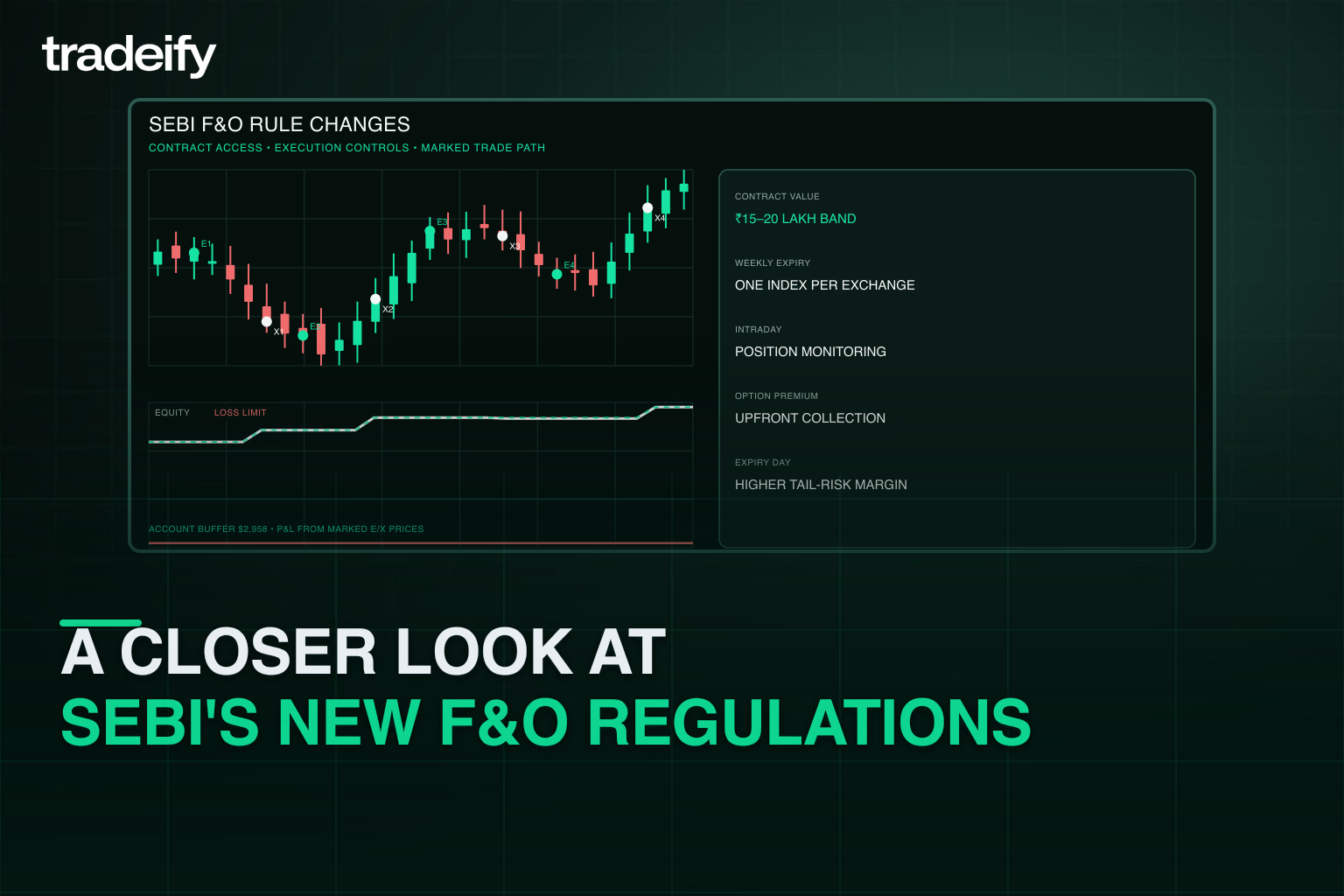
Acting on recommendations from an Expert Working Group (EWG), SEBI rolled out a six-step framework starting in late 2024 and continuing through 2025 and 2026. The rules change the basic mechanics of trading Indian derivatives.
Larger Minimum Contract Sizes
The minimum contract size for index derivatives had been ₹5 lakh to ₹10 lakh since 2015. Under the new framework, the minimum contract value at introduction is ₹15 lakh, with periodic recalibrations to keep contract values between ₹15 lakh and ₹20 lakh.
That translates directly into bigger lot sizes. When the framework rolled out in late 2024, the Nifty 50 lot jumped from 25 to 75, BankNifty from 15 to 30, and Midcap Nifty from 50 to 120. Because lots are recalibrated periodically by NSE to stay inside the ₹15-20 lakh band, the numbers have moved since. As of January 1, 2026, Nifty 50 sits at 65 (revised down from 75 after the index moved past the upper band), BankNifty at 30 (revised down from 35 effective January 2026, after an earlier increase from 30 to 35 that took effect with the July 2025 expiry), and Midcap Nifty back at 120 (after a brief stop at 140). Whatever the specific lot count in a given quarter, the economic effect is the same: required margin to open a trade has roughly tripled from pre-2024 levels, pushing undercapitalized retail participants out.
One Weekly Expiry per Exchange
The Indian market had become reliant on expiry day trading, especially zero-days-to-expiry (0DTE) contracts that offered heavy borrowing power and extreme gamma risk. Before the new rules, traders could pick a different weekly expiry almost every day across NSE and BSE indices — Nifty, BankNifty, FinNifty, Midcap Nifty, Sensex, and Bankex.
SEBI now allows each exchange to offer weekly derivative contracts on only one benchmark index. NSE and BSE each pick a single flagship index for weekly expiries, ending the daily expiry rotation that fueled most retail gambling behavior. The avenues for naked option buying and selling are significantly narrower.
Upfront Collection of Option Premiums
Effective February 1, 2025, SEBI requires trading and clearing members to collect the full option premium upfront from buyers. Previously, traders could lean on intraday borrowing power from brokers for cover orders or bracket orders, exposing the clearing system to risk. Eliminating intraday borrowing for option buyers means retail traders can only take positions fully backed by cash already in their accounts.
Intraday Position Monitoring
To stop traders and brokers from breaching risk thresholds during volatile sessions, SEBI moved from end-of-day monitoring to real-time intraday monitoring. Exchanges now take at least four position snapshots during the trading day. If a trader breaches the Market-Wide Position Limit (MWPL) or entity-level caps at any snapshot, penal action and forced liquidation follow.
No Calendar Spread Benefits on Expiry Day
Calendar spreads used to let traders hedge a near-term expiring position with a longer-dated contract for significant margin benefit. Basis risk spikes on expiry days, though, so as of February 10, 2025, the margin benefit on calendar spreads is revoked on the day the near-term contract expires. A hedged trader is suddenly required to post the full unhedged margin on expiry day, often triggering immediate margin calls and forced liquidations on accounts without surplus capital.
Updated Market-Wide Position Limits
SEBI updated the MWPL calculation to tie derivative exposure more closely to actual cash market liquidity. The new MWPL is the lower of 15% of free-float market capitalization or 65 times the average daily cash market volume. Individual retail traders are also capped at 10% of MWPL in any single stock, forcing more conservative position sizing relative to proprietary desks and FPIs.
Table 1: Summary of SEBI F&O Rule Changes
| Regulatory Measure | Previous Framework | New SEBI Framework (2024–2026) |
|---|---|---|
| Minimum Contract Size | ₹5 lakh – ₹10 lakh | ₹15 lakh – ₹20 lakh (recalibrated) |
| Nifty 50 Lot Size | 25 units | 75 units (Nov 2024) → 65 units (Jan 2026) |
| BankNifty Lot Size | 15 units | 30 units (Nov 2024) → 35 units (July 2025) → 30 units (Jan 2026) |
| Midcap Nifty Lot Size | 50 units | 120 → 140 → 120 units (Jan 2026) |
| Weekly Expiries | Multiple per exchange | One benchmark index per exchange |
| Option Premium Collection | Intraday borrowing allowed | 100% upfront from buyers (Feb 1, 2025) |
| Position Monitoring | End-of-Day | Intraday (4+ snapshots/day) |
| Calendar Spreads | Margin benefit until expiry | Revoked on expiry day (Feb 10, 2025) |
| Retail MWPL Cap | Loose individual caps | 10% of total MWPL for individuals |
What These Rules Mean for the Amateur Day Trader
The combined effect of the six rules is a real squeeze on retail participation. SEBI's goal of protecting retail wealth is reasonable, but for the amateur day trader the practical reality is harsh: the Indian F&O market is no longer viable for small accounts.
Take a basic option-selling strategy. A BankNifty short straddle that used to require around ₹1.2 lakh to ₹1.5 lakh in margin now requires ₹2 lakh to ₹2.5 lakh under bigger lot sizes and higher Extreme Loss Margins (ELM). For a trader with ₹5 lakh in capital, that drops simultaneous positions to two at most, which makes diversification and drawdown management much harder.
Removing multiple weekly expiries cuts the number of high-probability setups, and intraday monitoring plus upfront premium collection close the door on small-capital intraday momentum trading. The Indian derivatives market has effectively been institutionalized. Undercapitalized retail traders are left with a stark choice: stop trading, or find a different market.
Why Indian Traders Are Looking at US Futures

As the regulatory walls tighten on NSE and BSE, the structural advantages of the US futures markets — particularly the Chicago Mercantile Exchange (CME) and the Chicago Board of Trade (CBOT) — start to look very attractive.
The US futures market offers several advantages over Indian equity options:
- Deep liquidity and transparency. Markets like the E-mini S&P 500 (ES) and Nasdaq 100 (NQ) are the most liquid centralized markets in the world. Unlike OTC Forex or CFD platforms — flagged by the Reserve Bank of India (RBI) — US futures trade on regulated, transparent centralized exchanges.
- Micro contracts. The CME offers Micro E-mini contracts (MES, MNQ), letting traders execute strategies with granular precision. They're well suited to traders learning the ropes or scaling risk dynamically without needing large capital.
- No expiration timing, no strike selection, no time decay. This is the big one. Options trading forces you to fight time decay (Theta) and volatility (Vega) on top of getting the direction right. You also have to pick the right strike and the right expiration — get either wrong and you lose even when the underlying moves your way. Futures cut all of that out. You pick a direction, up or down, and if price moves in your favor, your contract gains value point for point. There's no premium decay to manage and no strike-selection guesswork. For a former options trader, this alone is a significant edge.
- Trading hours that fit Indian schedules. US regular trading hours (RTH) run roughly 7:00 PM to 1:30 AM IST, which lets Indian professionals trade US markets in the evening without giving up their day jobs.
The catch is that trading US futures directly requires substantial capital to meet exchange margins, plus the complications of cross-border capital remittance. That's where proprietary trading firms come in.
What a Futures Prop Firm Offers Traders Shut Out of SEBI F&O

A proprietary trading firm, or "prop firm," evaluates retail traders in a simulated trading environment. Traders pay a one-time evaluation fee to take a "challenge." If they hit the profit target while staying inside the firm's risk rules — maximum drawdowns, daily loss limits, consistency rules — the firm moves them to a simulated funded account.
Once funded, the trader continues to trade on simulated capital and earns real cash payouts on the profits they generate, paid out from the firm. The trader keeps the large majority of the profits (90% in Tradeify's case) and carries no downside risk on the trades themselves. If the trader loses money, the only loss is the original evaluation fee. They are never liable for losses inside the simulated funded account.
Legal and Compliance Notes for Indian Traders Using US Prop Firms
A common question among Indian traders is whether interacting with foreign prop firms is legal. The model fits comfortably within Indian regulatory frameworks.
Because traders are paying an evaluation fee for a software service — the simulated trading platform — and not depositing funds for actual margin trading, the model is generally understood to fall outside the prohibited margin-trading and overseas-derivatives uses under the Foreign Exchange Management Act (FEMA). The evaluation fee (typically $50 to $200) sits well within the RBI's Liberalised Remittance Scheme (LRS), which allows Indian residents to remit up to $250,000 annually for permitted purposes. That said, FEMA/LRS interpretation in this area is a grey zone that authorized dealer banks read differently, so traders should confirm their bank's position and consult a chartered accountant before remitting.
Tax treatment of payouts is a separate question that depends on individual circumstances, and traders should consult a qualified Indian tax professional or chartered accountant before relying on any specific classification. The general point is that the evaluation-fee structure avoids the cross-border margin issues that cause friction with retail forex and CFD providers.
Introducing Tradeify, a US Futures Prop Firm Built for This Shift
Among the prop firms available, Tradeify (tradeify.co) stands out as a trader-focused platform built around the needs of the modern amateur day trader. With over 80,000 funded traders and a 4.8/5 rating on Trustpilot, Tradeify has built a reputation on transparency, payout speed, and fair structure.
Tradeify offers simulated funded account sizes from $25,000 up to $150,000, with up to five simultaneously funded accounts per trader. Instead of opaque rules and hidden fees, Tradeify gives traders a built-in trade journal, clear rules, and a straightforward path to consistent payouts.
For an Indian day trader leaving the new SEBI environment behind, Tradeify offers what NSE no longer can: meaningful buying power, minimal upfront capital risk, and the freedom to run different strategies.
Tradeify Account Programs
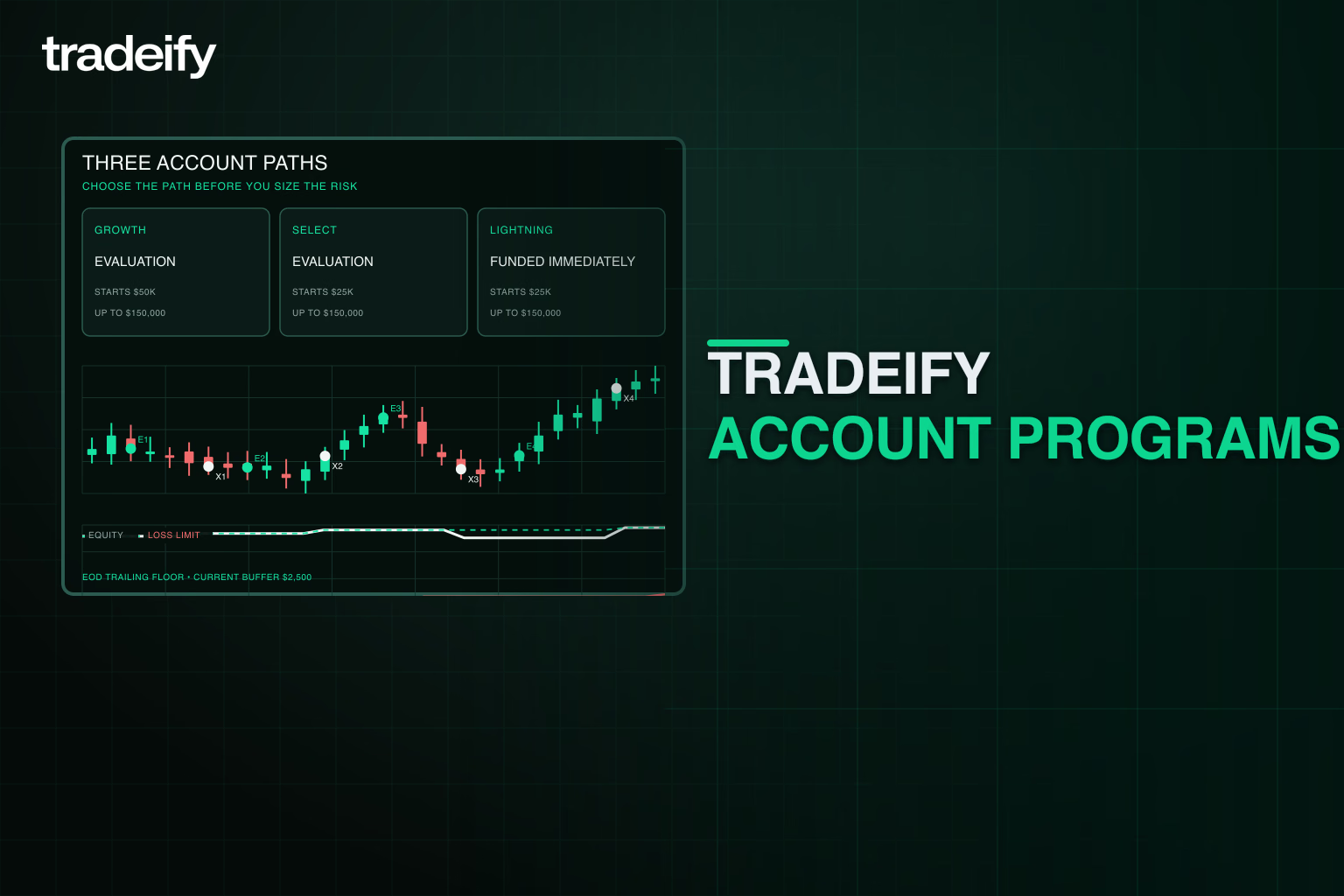
Tradeify offers three account pathways: Growth, Select, and Lightning Funded. Each is designed for a different trading style and risk profile. All three plans share zero activation fees — passing an evaluation activates the simulated funded account at no extra cost on Growth and Select, and Lightning is funded immediately on purchase.
A note on account sizes: Growth starts at $50,000, while Select and Lightning Funded start at $25,000. All three plans go up to $150,000.
The Growth Plan
Growth is designed for swing traders or anyone who wants a more relaxed evaluation environment.
- Evaluation rules. Reach the profit target without breaching the End-of-Day (EOD) trailing drawdown. Growth has no consistency rule during evaluation, so you can pass quickly if you catch a strong trend.
- Speed. A Growth evaluation can be passed in as little as a single trading day.
- Funded rules. Once funded, Growth uses a 35% consistency rule on payouts.
- Profit split. 90/10 in favor of the trader from the very first payout.
The Select Plan
Select is built for active day traders who want immediate liquidity and flexibility.
- Evaluation rules. No daily loss limit during evaluation, which gives more room to manage intraday volatility. Traders must hit a 40% consistency rule to pass, which means at least three trading days.
- Post-funding flexibility. After passing, traders pick between two paths: Flex or Daily.
- Flex Path. Payouts every 5 winning days with account-size-scaled caps: $1,250 (25K), $3,000 (50K), $4,000 (100K), and $5,000 (150K) per payout period.
- Daily Path. Payouts requested daily, with caps that also scale by account size: $600 (25K), $1,000 (50K), $1,500 (100K), and $2,500 (150K) per request.
- Profit split. 90/10 from day one. The funded stage has no consistency rule, so a strong day doesn't put your account at risk.
The Lightning Funded Plan (Instant Funding)
For experienced traders who don't want to spend time in evaluation, Lightning Funded skips the eval entirely.
- Immediate live trading. A slightly higher one-time fee gets you straight to a simulated funded account.
- Profit split. 90/10 from the first payout.
- Rules. Risk parameters are enforced from day one. The 50K, 100K, and 150K accounts have an account-size-scaled daily loss limit (no DLL on the 25K). Lightning accounts purchased after September 12, 2025 use a progressive consistency rule on payouts: 20% for the first payout, 25% for the second, and 30% for all subsequent payouts.
Table 2: Tradeify Plan Comparison
| Feature | Growth Plan | Select Plan | Lightning Funded |
|---|---|---|---|
| Evaluation Required? | Yes | Yes | No (Instant) |
| Daily Loss Limit (Eval) | Yes | None | N/A |
| Daily Loss Limit (Funded) | N/A | Daily path only | Yes (50K+ only; none on 25K) |
| Consistency Rule (Eval) | 0% | 40% | N/A |
| Consistency Rule (Funded) | 35% | 0% | 20% → 25% → 30% |
| Profit Split | 90/10 | 90/10 | 90/10 |
| Activation Fee | $0 | $0 | $0 |
| Payout Frequency | Periodic | Daily or 5-Days | Periodic |
The Elite Live Performance Reward Pool
Alongside its 3.0 update, Tradeify introduced the Elite Live Performance Reward Pool — a performance-based bonus program that sits on top of the standard payout structure. Each funded account is assigned a pool ranging from $2,000 to $18,000, with Select accounts receiving a 1.5x multiplier on reward pool earnings. For full qualification criteria and distribution timing, consult Tradeify's help center.
How Tradeify's EOD Trailing Drawdown Helps Futures Traders
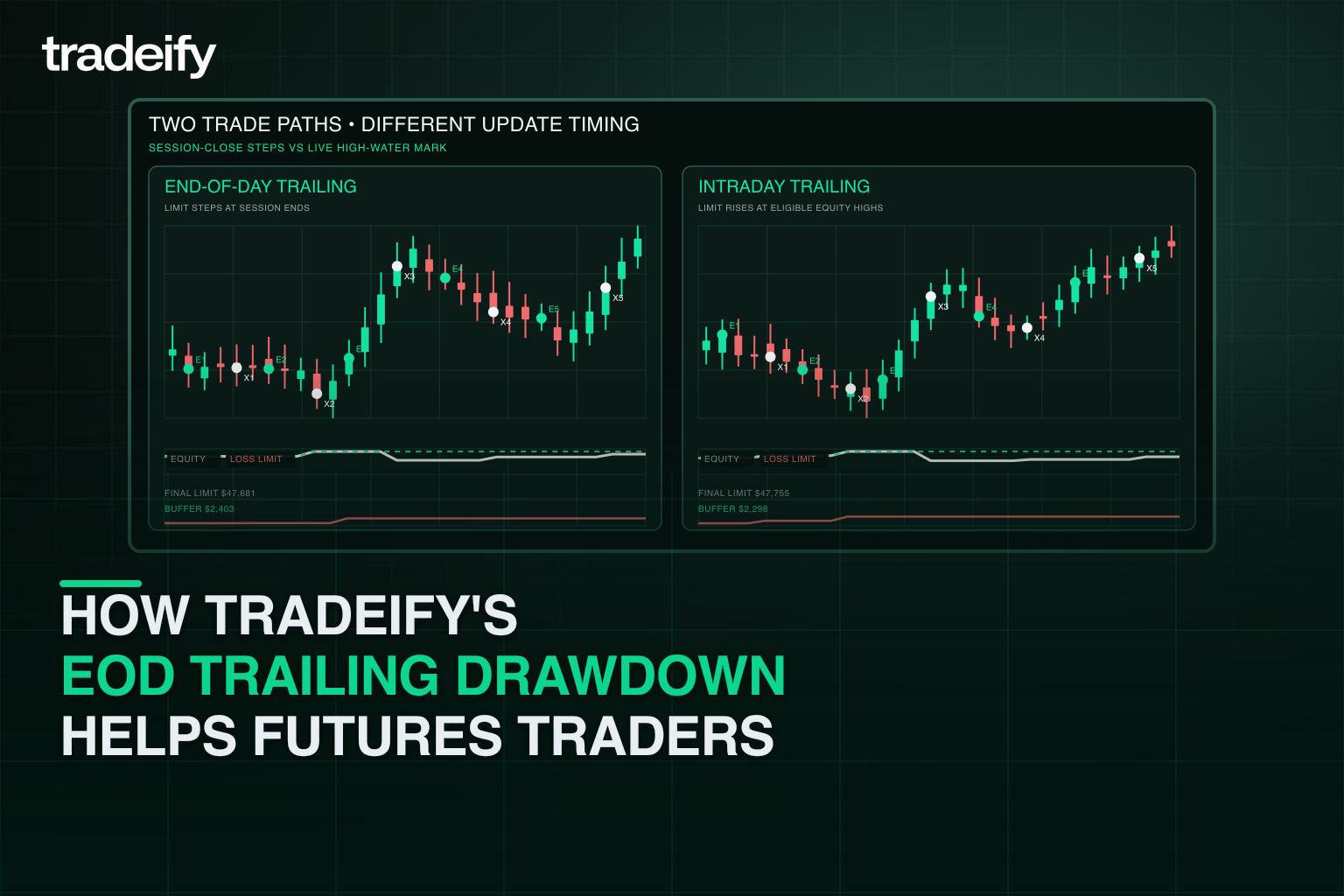
One of the most important variables in any prop firm's structure is how the maximum drawdown is calculated. Many firms use a "Tick-by-Tick" or intraday trailing drawdown. In that model, the drawdown floor trails your highest unrealized equity during an open trade. If you're up $1,000 mid-trade but the market pulls back and you close for $200, your drawdown floor still moved up as if you'd captured the full $1,000. That punishes swing traders and anyone using wider stops.
Tradeify uses an End-of-Day (EOD) trailing drawdown across all its plans.
Under the EOD model, the drawdown floor updates once per day, at the close (4:59 PM ET), based on your realized closing balance — not intraday equity spikes.
- Intraday volatility doesn't trigger early margin calls.
- You can hold positions through choppy market structure without your drawdown floor closing in on you.
- The floor only moves up when your end-of-day balance hits a new high, and it stops trailing entirely (locks in) once your account balance reaches the starting balance plus the drawdown threshold.
For Indian day traders used to BankNifty-style index volatility, EOD drawdown materially improves the odds of holding a funded account long-term.
Tradeify's Payout Infrastructure for Indian Traders
For Indian traders working with foreign platforms, getting profits home is often the biggest practical challenge. Traditional international bank wires come with high SWIFT fees, unfavorable FX conversion rates from Indian banks, and FEMA documentation overhead.
Tradeify uses Rise as its primary payout platform, with Plane available as a backup for traders in countries where Rise isn't supported.
Payout Timing
Tradeify's published policy is that approved payouts are processed within 24 to 48 hours during normal business hours (Mon-Fri, 8:00 AM – 5:00 PM EST), and may take up to 72 hours when submitted outside those hours. Lightning Funded traders can submit payout requests directly from the dashboard once the consistency and profit objectives are met.
Payout Methods
Once Tradeify approves a payout, the funds move into the trader's Rise wallet. From Rise, the trader chooses how to take the funds out — Rise supports both bank transfers and cryptocurrency withdrawals, and that choice belongs to the trader, not Tradeify.
For Indian traders, Rise's bank transfer route is the most straightforward and produces a clear paper trail tying the funds back to a software service fee paid earlier. The crypto option is available for traders who already have a setup for handling stablecoin withdrawals and understand the local rules around digital asset conversion. Either way, the funds originate with Tradeify, sit briefly in Rise, and then move out via the rail the trader picks.
A note on documentation: Indian banks typically expect a clear source-of-funds trail when foreign income arrives. Bank-transfer payouts produce that trail naturally. Traders considering the crypto route should plan ahead for how they'll demonstrate the source of funds when converting back to INR, and should consult a qualified Indian tax professional or chartered accountant on the right way to handle that.
Table 3: Payout Method Comparison
| Feature | Traditional Foreign Bank Wire (SWIFT) | Tradeify Payout via Rise |
|---|---|---|
| Processing Time | 3 to 7 business days | Approved by Tradeify within 24-48 hours; final settlement depends on the withdrawal method chosen in Rise |
| FX Conversion Fees | High (bank spreads + SWIFT fees) | Depends on withdrawal method (bank vs. crypto) |
| Friction / Documentation | High (bank compliance checks each time) | Lower (handled within the Rise platform) |
What the SEBI Rules Mean for the Future of Indian Day Traders
The regulatory overhaul SEBI started in 2024 and finished rolling out through 2025 and 2026 was needed. Retail losses in the domestic F&O market had reached a level the regulator couldn't ignore. But by raising contract sizes into the ₹15-20 lakh band, eliminating daily expiries, and requiring high upfront margins, the Indian equity derivatives market has effectively closed the door on the amateur day trader.
For the disciplined trader, that's not the end of the road — it's a redirection. The skills built in BankNifty and Sensex transfer cleanly to the E-mini S&P 500 and Nasdaq 100.
US futures provide the liquidity, transparency, and directional simplicity options traders gravitate toward, without the drag of time decay. And proprietary trading firms have made global futures liquidity accessible without needing to risk personal savings or work around SEBI's capital rules.
Tradeify has built an environment where skill is the only requirement. With evaluation fees starting under $100 for a $25,000 account, zero activation fees on every plan, EOD trailing drawdowns, and payouts handled through Rise, the structural friction between an Indian trader and US capital markets is minimal.
For the amateur Indian day trader looking to take their craft seriously, the path is clear. Step away from the new SEBI restrictions, use the simulated funded account model, and trade in the world's deepest markets through Tradeify.
Trading futures involves substantial risk and is not suitable for all investors. All trading on Tradeify simulated funded accounts is conducted in a simulated environment. Payouts are based on simulated trading performance and processed at Tradeify's discretion in accordance with the applicable account rules. Information in this article is for general informational purposes only and is not legal, tax, or financial advice. Indian residents should consult a qualified Indian chartered accountant or tax professional for guidance on FEMA, LRS, and tax matters specific to their situation.
.svg)
.svg)
.svg)
.svg)




.webp)