.svg)

.svg)
.svg)

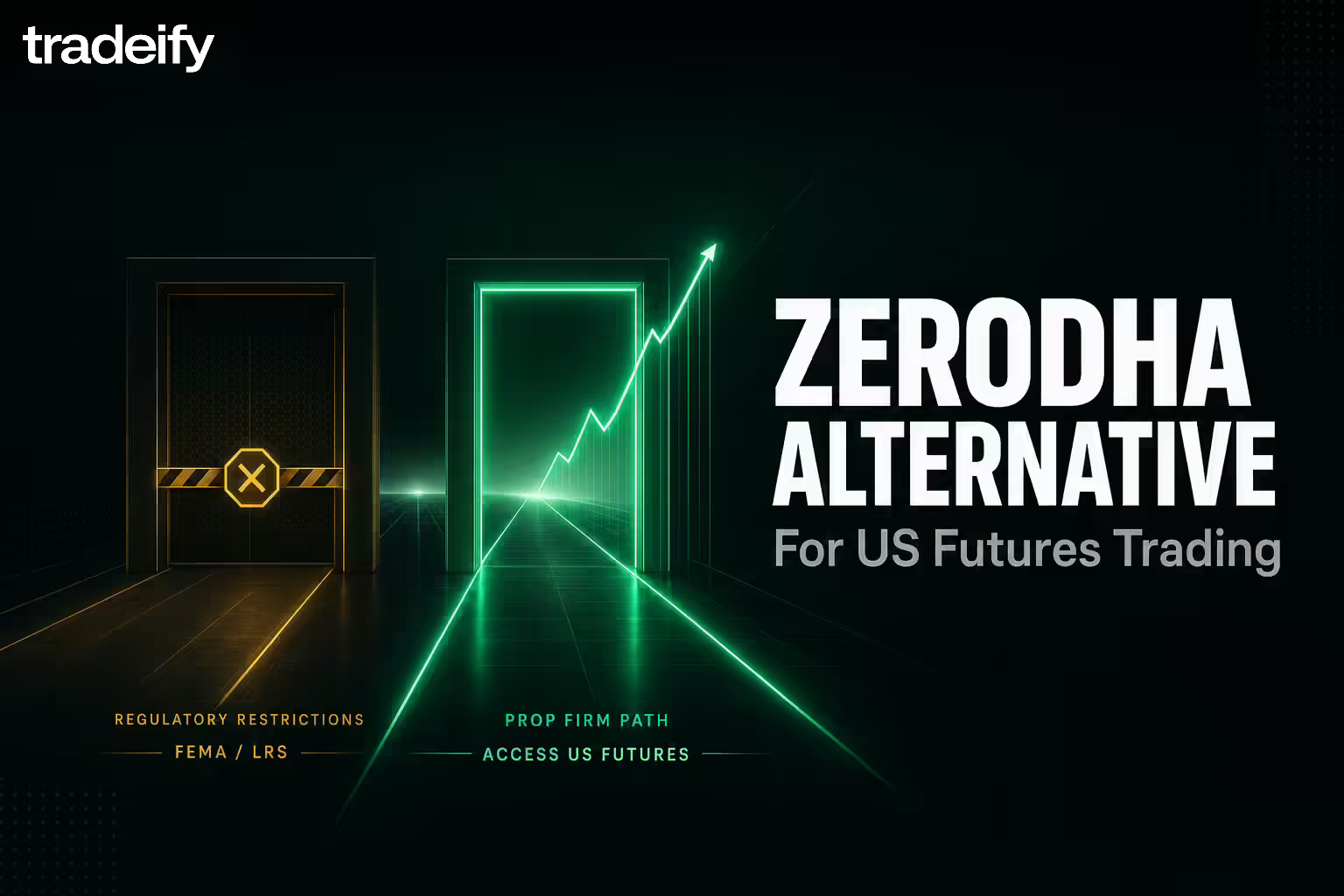


Table of Contents
- LRS, FEMA, and the Prohibition of Overseas Derivatives
- Why Zerodha Cannot Offer US Futures
- How the Prop Firm Alternative Works
- Tradeify as a Zerodha Alternative for US Futures
- Trading Platforms for Indian Day Traders
- Payout Mechanism for Indian Traders
- What Indian Traders Need to Know Before Switching
- The Path to Live CME Capital with Tradeify Elite
- Step-by-Step Setup Guide for Indian Traders
- Final Takeaway on Tradeify as a Zerodha Alternative
Key Points
- Indian residents cannot use the Liberalised Remittance Scheme (LRS) for margin trading or overseas derivatives, including US futures and options.
- Domestic brokerages like Zerodha do not and cannot offer access to US derivatives due to Reserve Bank of India (RBI) and Foreign Exchange Management Act (FEMA) regulations.
- Proprietary trading firms such as Tradeify offer a compliant structural alternative by providing traders with simulated corporate capital after a software-based evaluation, which removes the need for personal margin remittance.
- Tradeify offers three programmatic pathways (Growth, Select, and Lightning) designed to match different risk tolerances, with features such as End-of-Day (EOD) trailing drawdowns and a 90/10 profit split in favor of the trader.
- Moving from domestic futures trading to a prop firm model significantly changes the psychological and risk-management dynamics for amateur day traders, shifting the burden of capital loss from the individual to the firm.
Background: The globalization of financial markets has generated strong interest among Indian retail traders who want access to the liquidity and volatility of United States equities and derivatives. However, domestic regulatory frameworks heavily restrict cross-border capital flows intended for speculative purposes. As a result, amateur day traders in India are largely confined to domestic instruments via brokers like Zerodha, which, while highly efficient, expose traders to significant personal capital risk and high margin requirements.
The Regulatory Impasse: The fundamental barrier to international derivatives trading for Indian residents is the strict enforcement of the Liberalised Remittance Scheme (LRS) by the RBI. While the LRS permits the outflow of capital for specific investments, it explicitly prohibits using those funds for margin-based or derivative trading. This creates a functional impasse for Indian day traders who want to participate in the Chicago Mercantile Exchange (CME) or other US futures markets without relocating or using potentially non-compliant offshore entities.
The Proposed Alternative: This report systematically evaluates the proprietary trading firm model (specifically Tradeify) as a viable, risk-mitigated alternative to traditional retail brokers like Zerodha for Indian day traders. By taking evaluation challenges, traders pay a one-time fee for a simulated environment rather than remitting personal margin capital. After passing the evaluation, they get access to simulated funded accounts where profits are paid out as independent contractor revenue. This document provides an exhaustive analysis of Tradeify's operational mechanics, pricing structures, regulatory compliance nuances, and strategic implications for amateur Indian day traders.
LRS, FEMA, and the Prohibition of Overseas Derivatives
To fully understand why a domestic brokerage like Zerodha cannot offer US futures trading to Indian residents, one must first analyze the regulatory architecture governing outward capital flows from India. The Reserve Bank of India (RBI) administers the Liberalised Remittance Scheme (LRS), which allows resident individuals to remit up to $250,000 per financial year for permitted current or capital account transactions.
While the LRS is highly beneficial for purchasing foreign equities (buy-and-hold strategies), overseas education, or travel, it contains explicit prohibitive clauses regarding speculative finance. The LRS does not permit remittances for activities such as margin trading, investments in derivatives, or short-selling. According to experts and banking guidelines, using LRS-funded remittances to obtain margin for trading on US futures and options markets is universally disallowed by authorized dealer banks.
Zerodha's educational portal, Varsity, confirms this restriction, noting that while investing in foreign stocks is permitted under LRS, trading in foreign derivatives is prohibited under current Indian regulations (see Zerodha's Varsity module on foreign investing for the full explanation). Therefore, if an Indian resident wants to trade US futures through a standard retail brokerage account, they would be unable to legally fund the margin requirements using their domestic capital. Furthermore, trying to get around these rules by using offshore grey-market brokers carries severe legal risks under the Foreign Exchange Management Act (FEMA), because what cannot be done directly cannot be done indirectly.
Why Zerodha Cannot Offer US Futures
In the absence of direct access to US futures, Indian day traders typically rely on domestic brokerages like Zerodha to trade instruments such as Nifty or Bank Nifty futures and options. Zerodha is the preeminent discount broker in India, known for its robust technology and low latency. However, trading domestic futures on Zerodha carries inherent structural and financial burdens for the amateur trader.
First, futures and options are widely regarded as the highest-risk segments in the stock market. To transact in a futures contract on a domestic exchange, the trader must deposit a token advance called the margin, which is blocked in their trading account for the duration of the trade. If the trade moves against the trader, this margin can be rapidly depleted, and the broker may issue a margin call or liquidate the position, resulting in direct, catastrophic losses of the trader's personal capital.
Second, the liquidity and macroeconomic drivers of the Indian markets, while substantial, operate on a different temporal and volatility scale compared to the US markets (for example, S&P 500, Nasdaq 100, Crude Oil, or Gold futures). Many Indian traders who analyze global macroeconomic events or US corporate earnings find themselves unable to act on these insights due to the lack of access to US F&O. They are forced to be spectators during the highly liquid US trading sessions, which conveniently overlap with the Indian evening hours, making it an ideal secondary income pursuit for those with standard daytime employment.
How the Prop Firm Alternative Works
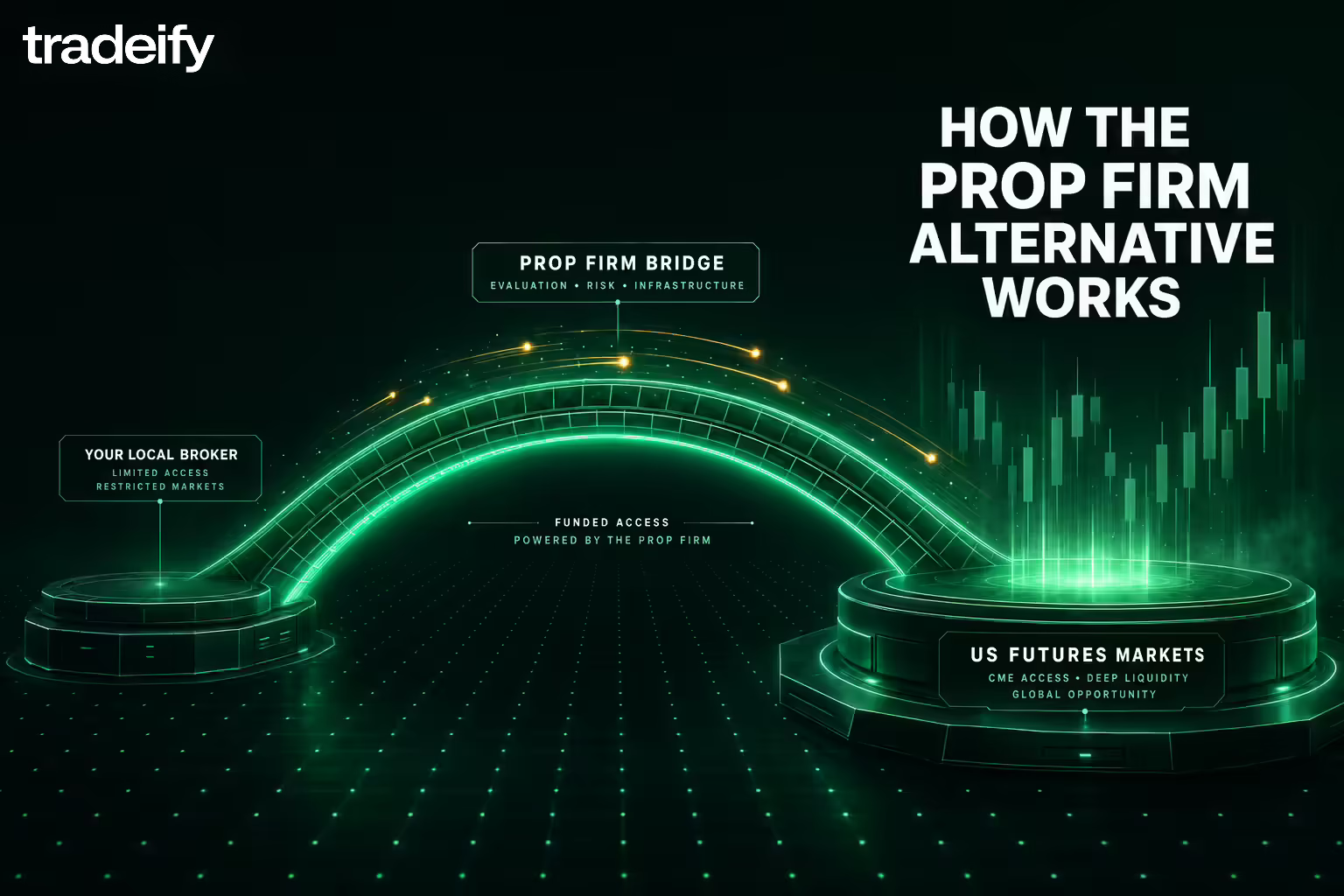
The proprietary trading (prop firm) model has fundamentally disrupted the retail trading industry by shifting the capitalization burden from the individual trader to the corporate entity. Historically, accessing the CME order books required tens of thousands of dollars in personal margin. Today, prop firms offer a merit-based system where traders pay a nominal fee to take an evaluation in a simulated environment.
Operational Mechanics and Regulatory Compliance
From the perspective of an Indian resident, the prop firm model theoretically bypasses the LRS restrictions on derivative trading. The trader is not remitting funds to open a brokerage account, nor are they depositing margin to trade derivatives. Instead, the trader purchases a software evaluation or data feed subscription from a US-based firm. If the trader passes the evaluation parameters, the prop firm provides access to a "simulated funded" account. The trader executes trades on live data within a simulated environment, and the prop firm's proprietary algorithms copy successful trades into their own master live accounts.
When the trader requests a payout, the firm disburses a portion of the simulated profits as a performance fee or independent contractor payment. This model fundamentally changes the legal nature of the transaction: the initial outflow is a software or service purchase, and the inflow is freelance or contractual revenue, neither of which traditionally violates the LRS prohibition on margin trading.
Tradeify as a Zerodha Alternative for US Futures
Among the global proprietary trading firms suitable for Indian residents, Tradeify presents a structurally optimized solution that aligns with the financial and regulatory reality of the Indian retail demographic. Tradeify offers a layered tier structure that allows traders to select an evaluation path that matches their risk tolerance, capital availability, and trading style.
Evaluation Pathways and Pricing
Tradeify provides three primary pathways: the Growth Evaluation, the Select Evaluation, and the Lightning Instant Funding program. Each pathway has its own rule set governing drawdown, daily loss limits, and consistency.
| Account Type | Account Size | Profit Target | Max Trailing Drawdown | Daily Loss Limit (DLL) | Consistency Rule | One-Time Fee |
|---|---|---|---|---|---|---|
| Growth Eval | $25K | $1,500 | $1,000 | $600 | None (Eval) / 35% (Funded) | $99 |
| Growth Eval | $50K | $3,000 | $2,000 | $1,250 | None (Eval) / 35% (Funded) | $169 |
| Growth Eval | $100K | $6,000 | $3,500 | $2,500 | None (Eval) / 35% (Funded) | $259 |
| Growth Eval | $150K | $9,000 | $5,000 | $3,750 | None (Eval) / 35% (Funded) | $369 |
| Select Eval | $25K | $1,500 | $1,000 | None (Eval) | 40% (Eval Only) | $109 |
| Select Eval | $50K | $3,000 | $2,000 | None (Eval) | 40% (Eval Only) | $179 |
| Select Eval | $100K | $6,000 | $3,000 | None (Eval) | 40% (Eval Only) | $269 |
| Select Eval | $150K | $9,000 | $4,500 | None (Eval) | 40% (Eval Only) | $379 |
| Lightning Funded | $25K | N/A (Instant) | $1,000 | None | Progressive (20%/25%/30%) | $219 |
| Lightning Funded | $50K | N/A (Instant) | $2,000 | $1,250 | Progressive (20%/25%/30%) | $309 |
| Lightning Funded | $100K | N/A (Instant) | $4,000 | $2,500 | Progressive (20%/25%/30%) | $439 |
| Lightning Funded | $150K | N/A (Instant) | $6,000 | $3,750 | Progressive (20%/25%/30%) | $619 |
The pricing reflects a competitive structure where the user pays a fee in lieu of providing margin capital. The maximum risk on any Tradeify trade is essentially capped at the cost of the evaluation fee, plus any additional reset fees if the trader violates a rule and chooses to restart.
The End-of-Day (EOD) Trailing Drawdown
One of Tradeify's most psychologically beneficial features for the amateur day trader is the End-of-Day (EOD) trailing drawdown across all account types. Many competing firms enforce intraday or static trailing drawdowns, which can prematurely terminate accounts due to volatile mid-session swings even when the trader closes the day in profit.
The EOD trailing mechanism only updates the drawdown limit based on the closing balance of the account at the end of the trading day, not on the unrealized peak balance during the session. This is a critical advantage. For a day trader executing high-velocity strategies on instruments like the Nasdaq E-mini (NQ) or Crude Oil futures, this mechanism reduces the technical pressure of having to immediately exit a winning trade for fear of ratcheting their drawdown floor closer to their balance. Importantly, the EOD floor is enforced in real time intraday — meaning if the account balance touches the current drawdown limit during the session, it still fails — but the floor itself only moves up at the close based on the day's settlement.
Lightning Instant Funding for Amateur Indian Traders
The Lightning Instant Funding program is a notable structural feature for amateur traders who do not want to undergo a multi-stage evaluation process. With one-time fees ranging from $219 (25K) to $619 (150K), traders bypass the evaluation phase and gain immediate access to a simulated funded account.
While the Lightning accounts come with stricter consistency rules (Progressive 20% for the first payout, escalating to 25% and 30% for subsequent payouts), they are designed for traders who have demonstrated discipline elsewhere and want immediate capital access. For an Indian trader who is already familiar with futures trading on Zerodha but lacks the personal capital to trade large lot sizes, the Lightning 50K account at $309 represents a high-leverage entry point into the US markets without the capital-intensive overhead of trying to acquire margin via LRS.
Trading Platforms for Indian Day Traders
The technology stack supporting the trader is critical for execution quality. Tradeify supports six trading platforms across three broker groups that are selected at checkout: Tradovate, WealthCharts, and Rithmic.
- Tradovate (broker group): Selecting Tradovate at checkout unlocks the Tradovate native platform, NinjaTrader, and TradingView. This is the most popular choice for Indian traders due to TradingView's universal recognition and its rich ecosystem of community indicators (such as the Volume Profile and Cumulative Delta).
- WealthCharts (broker group): A modern, web-based platform with smart chart-based order entry. Suitable for visual traders who prefer drag-and-drop trade management.
- Rithmic (broker group): Selecting Rithmic at checkout unlocks Tradesea, Quantower, and Sierra Chart. Rithmic is the data feed of choice for institutional-grade scalpers and order flow specialists due to its low latency and high fidelity tick data.
Across these six platforms, Indian traders can choose the level of complexity and analytical depth that best suits their strategy. From the simple bracket orders of Tradovate to the deep order flow analysis available in Sierra Chart, the platform diversity ensures that whether the trader is a beginner needing a simple interface or a quant looking for a deep order book, they have a solution at hand. Note that platform selection is locked in at checkout — if you want to use a platform from a different broker group later, you'll need to purchase a new evaluation under that group.
Payout Mechanism for Indian Traders
The capital extraction mechanism is the most important factor for amateur day traders evaluating prop firms.
Profit Splits and Payout Frequency
Tradeify operates on a 90/10 profit split for Sim Funded accounts (the trader retains 90% of the profits, the firm retains 10%). For Elite Live accounts, the profit split is 80/20.
One of Tradeify's most important features for the day trader is the 7-day-a-week payout system. Unlike traditional brokerages where settlement and withdrawal cycles are restricted by banking days, Tradeify offers daily payouts for Elite Live accounts and rapid payouts on Sim Funded accounts. For a beginner trader needing immediate liquidity to fund living expenses or scale their operations, this feature is critical.
Cross-Border Compliance via Rise
For Indian traders, the practicalities of receiving USD-denominated payouts can be a hurdle. Tradeify partners with Rise, a global payments platform, to facilitate cross-border transfers. Rise allows for direct payouts to Indian bank accounts via standard banking infrastructure or, for crypto-savvy users, instant payouts via stablecoins (USDC) to a self-custody wallet.
This dual-channel payout system effectively bypasses the slow correspondent banking networks that typically plague international USD transfers. For a trader executing the Lightning 50K account, the ability to convert Sim funded profits to liquid INR within hours of a successful payout request is a paradigm shift compared to the traditional brokerage model.
What Indian Traders Need to Know Before Switching
Moving from trading domestic F&O on Zerodha to trading US futures via Tradeify requires a deep psychological recalibration.
Risk Asymmetry Between Zerodha and a Prop Firm
When trading on Zerodha, the risk asymmetry is entirely tilted against the retail trader. A black swan market event can result in a negative account balance, putting the trader's personal assets at risk. In the Tradeify model, the maximum possible financial loss is restricted strictly to the upfront evaluation fee (for example, $99 for a Growth 25K account — potentially less with the DASH promo code). This capped downside fundamentally changes the trader's psychological burden, allowing them to execute trades with less emotional interference.
The Math of the Consistency Rule
The consistency rules Tradeify uses (35% for Growth, 40% for Select Eval, Progressive for Lightning) are not merely obstacles; they are pedagogical tools designed to enforce professional risk management.
The consistency formula dictates that:
Max_Daily_Profit ≤ Consistency_Percentage × Total_Earned_Profit
For example, if an Indian amateur trader is prone to "gambling" on high-impact news events (like US CPI or NFP) and makes a massive windfall in a single day, they cannot immediately withdraw the entire sum. They must continue to trade with discipline on subsequent days to build a total profit base where the windfall day represents no more than the allowed percentage. While some traders find this restrictive, it effectively filters out gamblers and rewards statistically positive-expectancy trading strategies.
The Path to Live CME Capital with Tradeify Elite
While the simulated funded phase (Sim Funded) provides excellent capital extraction opportunities, Tradeify also offers a definitive path to trading real, live capital on the CME. A trader becomes eligible to be considered for the Tradeify Elite program once they meet one of the following minimum thresholds: 3 payouts on a single account, or 10 total payouts across all plan types since their last live transition. Reaching these thresholds represents the minimum for consideration, not automatic qualification — Tradeify evaluates traders holistically on consistency, risk management, and overall trading behavior.
In the Elite Live stage, the trader is provided with a live brokerage account routed directly to the exchange. The profit split for Elite Live accounts shifts to 80/20, but it represents the pinnacle of retail prop trading: trading institutional capital in the real market without personal margin risk. Note that Live accounts are subject to CME professional market data fees (typically over $100 per month), which are standard exchange pass-through costs.
Step-by-Step Setup Guide for Indian Traders
For an amateur day trader based in India using Zerodha for equity delivery and wanting to pivot to Tradeify for US futures, the operational sequence is highly streamlined:
- Platform Selection: Indian traders must ensure they have a stable internet connection and a secondary backup (like a mobile hotspot) because the trader is liable for losses incurred due to connection failure during an active trade.
- Plan Acquisition: Go to tradeify.co and purchase an evaluation. For beginners moving over from the Indian market, the Select 50K Evaluation is a strong starting point because of the absence of a Daily Loss Limit during evaluation, which provides maximum breathing room while adapting to the volatility of US indices (Nasdaq/ES).
- Broker and Platform Group Selection: Tradeify supports six platforms across three broker groups selected at checkout: Tradovate (which unlocks NinjaTrader and TradingView integration), WealthCharts, and Rithmic (which unlocks Tradesea, Quantower, and Sierra Chart). For most Indian traders starting out, Tradovate is a practical choice thanks to its cloud-based web interface and seamless TradingView integration.
- Execution and Passing: Trade the US market hours (typically optimal during the New York open, which corresponds to 7:00 PM / 8:00 PM IST depending on Daylight Saving Time). Follow the EOD drawdown limit strictly, and remember it is enforced in real-time intraday.
- Funding and Payouts: On reaching the profit target, the account transitions to Sim Funded status instantly (no activation fee on any plan). Build up profits and request a payout via the dashboard.
- Capital Repatriation: Set up a Rise account. The USD funds are transferred to Rise, which then facilitates the cross-border transfer to the trader's domestic Indian bank account or to a personal crypto wallet as USDC/USDT.
Tax Note: While this document does not provide formal tax advice, Indian traders should consult a chartered accountant regarding the classification of prop firm payouts. Unlike standard capital gains derived from Zerodha equity trading, prop firm payouts are generally classified as business income or professional freelance receipts, which are taxed according to the individual's applicable domestic income tax slab.
Final Takeaway on Tradeify as a Zerodha Alternative
The regulatory environment in India, governed by the RBI and FEMA through the LRS, definitively bars Indian residents from using domestic capital for overseas margin and derivative trading. As a result, domestic platforms like Zerodha, while excellent for local equities, cannot serve as a gateway to the highly lucrative US futures markets.
The proprietary trading firm model completely bypasses this regulatory friction by restructuring the financial transaction from speculative margin remittance to educational software purchasing and freelance contracting. Among the many firms available, Tradeify stands out as the top alternative. Its transparent one-time pricing (no subscriptions), lack of activation fees across every plan, competitive 90/10 profit split, End-of-Day drawdowns with Sim Funded lock mechanisms, and a fast payout infrastructure create an environment specifically built for trader success.
For the amateur Indian day trader, moving to Tradeify not only provides legal and functional access to the deepest financial markets in the world but also enforces disciplined risk management while entirely eliminating personal capital ruin. Tradeify is not merely an alternative to Zerodha for US futures; it is an evolutionary upgrade in how retail traders approach global financial markets.
.svg)
.svg)
.svg)
.svg)



.webp)