


Table of Contents
- How Proprietary Trading Grew for Indian Traders
- Key Factors for Indian Traders Choosing a Futures Prop Firm
- Comprehensive Review of Top Prop Firms for Indian Traders in 2026
- Tradeify Plan-by-Plan Analysis
- Prop Firm Payout Mechanisms and Speed for Indian Traders
- Moving Prop Firm Traders from Simulated to Live Capital
- Strategic Prop Firm Advice for Amateur Indian Day Traders
- Choosing the Best Futures Prop Firm in 2026
Key Points
- Market Shift: The proprietary trading industry has continued to grow rapidly, with increased adoption among Indian traders responding to tighter SEBI F&O regulations throughout 2025 and into 2026.
- Top Contenders: For futures trading specifically, Tradeify and Topstep remain the dominant market leaders. For broader asset classes including forex and Indian stocks, firms like FundingPips, ThinkCapital, and FundedStock are frequently cited.
- Tradeify's Edge: Tradeify stands out with its Lightning Funded accounts (skipping evaluations), EOD trailing drawdown across all plan types, one-time pricing (no subscriptions after the 3.0 overhaul), real-time dashboard updates, and instant account activation upon objective achievement.
- Payout Infrastructure: Fast and reliable payout systems are a primary concern for Indian traders. Firms using platforms like Rise (which offers crypto/USDC) and Plane have an advantage in handling international financial transfers.
- Complexity of Rules: Amateur traders must work through prop firm metrics such as the Consistency Rule, Daily Loss Limits (DLL), and trailing drawdowns, which are designed to enforce disciplined risk management rather than penalize traders.
Scope of the Report This report evaluates the proprietary trading firm market in 2026, focused on amateur day traders residing in India. It examines the leading firms, the mechanics of their evaluation and funding phases, and the nuances of their payout policies. This post is published on the Tradeify blog — it's not independent journalism — but the competitor comparisons are grounded in publicly verifiable 2026 data from each firm's own site or documented third-party reviews. Readers should always verify current terms directly on each firm's site before committing capital.
Market Context Indian traders face unique infrastructural and regulatory environments, ranging from currency exchange regulations to distinct time zone dynamics during peak CME futures trading hours. Selecting a prop firm requires analyzing geographical accessibility, payout reliability, and platform integration (such as TradingView, Tradovate, Rithmic, and WealthCharts). Flexible drawdown policies and rapid payout speeds are currently the highest priorities for the Indian trading demographic.
How Proprietary Trading Grew for Indian Traders
The retail day trading market in India has gone through a massive paradigm shift by 2026. Across major metropolitan hubs such as Delhi, Hyderabad, Pune, and Bangalore, ambitious amateur traders are increasingly looking beyond local retail brokers. The primary catalyst for this migration is the tightening of margin requirements, lot sizes, and position-sizing limits at the local retail level under SEBI's 2024–2026 F&O overhaul, which has made it difficult for undercapitalized amateur traders to generate significant, sustainable income.
Proprietary trading firms offer a structural option for this capital deficit. These firms provide simulated capital to traders who can successfully pass an evaluation phase, proving their ability to manage risk and generate consistent profits. In exchange, the trader and the firm split the generated profits, typically heavily favoring the trader. The appeal for Indian traders is broad: access to substantial trading capital (with Tradeify, up to $750,000 in aggregate sim capital across five funded accounts at $150k each, with even higher aggregate limits possible across some competitors), reduced personal financial risk, and the ability to earn in USD, which provides a favorable currency conversion dynamic.
The Indian trading environment is nuanced. Differences in market access, international payment gateways, and firm policies mean that not every global prop firm is optimally suited for traders based in India. As the industry has matured, independent analysts have begun filtering prop firms based on their legal accessibility, track record of reliable payouts, and transparency in evaluation rules specifically for the Indian demographic. This report provides an analysis of the best futures prop firms available to Indian traders in 2026, comparing their structural advantages, payout mechanisms, and risk parameters.
Key Factors for Indian Traders Choosing a Futures Prop Firm

When an amateur day trader in India evaluates a prop firm, the criteria must extend beyond the advertised maximum capital or the initial entry fee. The complexities of cross-border payments, trading platforms, and strict risk rules mean traders must be highly analytical in their selection process.
Payout Speed, Reliability, and Infrastructure
The primary concern for Indian traders operating in global markets is fast and reliable access to their rewards without unnecessary delays, excessive transfer fees, or arbitrary payout denials. A firm's payout infrastructure is often the most critical differentiator. Traditional international wire transfers to Indian banks can take up to 7–10 days and incur intermediary fees. Prop firms that integrate modern payment processors like Rise (which offers instant crypto and USDC options alongside direct bank transfers) are heavily favored. The ability to receive payouts in stablecoins avoids many of the friction points associated with traditional cross-border transfers, though traders must remain compliant with local taxation laws regarding virtual digital assets.
Drawdown Mechanics (End-of-Day vs. Intraday)
Amateur traders often struggle with the psychological pressure of real-time, intraday trailing drawdowns. An intraday trailing drawdown calculates the maximum allowable loss based on the highest open equity reached during a trade. If a trade spikes into profit but then retraces, the trader's drawdown limit moves up, potentially causing an account failure even if the trade is closed for a net profit. Conversely, an End-of-Day (EOD) trailing drawdown only calculates the new risk threshold based on the account balance at the market close. This gives amateur traders the flexibility to endure normal intraday volatility without immediately breaching their risk limits.
Consistency Rules and Profit Splits
Most established prop firms employ Consistency Rules to encourage repeatable trading behavior. These rules don't force traders to hit a profit target — they simply require that no single trading day represent more than a specified percentage of total profits when a payout is requested. The percentage varies by account type (commonly 20%, 25%, 30%, 35%, or 40%). In practice, if a trader has an oversized day, they aren't penalized; they just need to add enough additional profit so the big day falls back within the consistency threshold before requesting a payout. The profit split — how much of the profit the trader keeps versus the firm — is the other core metric. The industry standard has settled at 90/10 in favor of the trader on Sim Funded accounts, with live-stage programs typically using a slightly different split that reflects the change in risk profile.
Platform Integration
The choice of trading platform is highly relevant. A significant portion of Indian retail traders rely heavily on TradingView for charting and technical analysis. Prop firms that offer seamless integration with TradingView, Tradovate, Rithmic, NinjaTrader, or WealthCharts (allowing traders to execute directly from their preferred charts without latency) give a substantial operational advantage.
Comprehensive Review of Top Prop Firms for Indian Traders in 2026
The prop firm ecosystem is divided broadly into firms that specialize in futures (trading on exchanges like the CME) and those that specialize in Forex, indices, and CFDs. Firms like FundingPips and FTMO have strong presence in the CFD space, while Tradeify, Topstep, and Apex lead the futures market.
Tradeify is the Premier Futures Prop Firm for Instant Funding
Tradeify has rapidly climbed to the top tier of futures prop firms in 2026 following its comprehensive "3.0 overhaul." Based in the U.S., Tradeify gives institutional capital access ranging from $25,000 to $150,000 per account, with traders allowed to hold up to 5 Simulated Funded Accounts per household — totaling up to $750,000 in aggregate sim capital when stacking five $150k accounts.
Tradeify's primary competitive advantage for Indian traders lies in its combination of speed, flexible drawdowns, and a clean, consistent payout structure. Tradeify uses an EOD trailing drawdown across all of its account types, which is mathematically more forgiving for amateur traders compared to intraday-tracking models. Once a trader's daily closing balance crosses a certain threshold, the drawdown stops trailing and locks at a fixed safety floor for the rest of the account's life. Combined with real-time dashboard updates, integrated journal tools, and instant account activation when an evaluation objective is met, the experience is built to remove friction between hitting a target and getting paid.
Rise ensures that Indian traders can receive their payouts swiftly, often within 24 to 48 hours via crypto or bank transfer.
Key Tradeify Features:
- 90/10 Profit Split: Tradeify's Sim Funded accounts (Growth, Select, and Lightning) all use a flat 90/10 split in favor of the trader, applied from the very first payout. There is no tiered or introductory split — it is 90/10 across the board.
- Lightning Funded (No Evaluation): Tradeify offers a direct-to-funded path where traders pay a higher one-time fee to skip the evaluation phase entirely, immediately trading for simulated payouts.
- EOD Trailing Drawdown: The drawdown trails the highest end-of-day balance and stops trailing after the account finishes a day above a defined threshold (starting balance + max drawdown + $100), establishing a permanent safety floor for the rest of the account's life.
- No Activation Fees on Growth, Lightning, and Select Evaluations: Following the 3.0 overhaul, evaluation purchases are one-time fees with no monthly subscriptions and no activation fee at the eval stage. Lightning is instant funding with no evaluation, so it has no activation step at all. Select Funded accounts have a one-time activation fee tied to the chosen payout path (Daily or Flex) when transitioning into the funded phase.
- No Subscriptions: Tradeify's 3.0 overhaul eliminated recurring monthly subscription fees entirely — all evaluation fees are now one-time.
Topstep is the Most Established Brand for Futures Prop Traders
Topstep is widely recognized as one of the founding fathers of the modern retail prop firm industry and commands immense respect for its educational ecosystem and reliable payout history. It is an excellent choice for Indian traders who value a disciplined, highly structured environment with a proven track record of longevity.
Topstep's model requires traders to pass a single-phase Trading Combine. Once funded (Express Funded Account), traders must work through specific withdrawal constraints. Topstep enforces a Winning Days rule, defining a winning day as any day where the Net PnL meets a minimum threshold. Indian traders should always verify current Topstep payout requirements directly on topstep.com before committing capital, as the firm has revised its rules multiple times.
Key Topstep Features:
- Payout Structure: A 90/10 profit split in favor of the trader.
- Winning Days Requirement: To request a payout from an Express Funded Account, a trader must accumulate a minimum number of qualifying winning days as defined by Topstep's current published rules.
- End-of-Day Drawdown: Topstep also uses an EOD drawdown, which protects traders from intraday stop-outs based on unrealized gains.
- Minimum Payout: $125.
Apex Trader Funding Built for Prop Firm Scalability
Apex Trader Funding is a massive player in the futures space, with between $600M and $700M+ paid out historically according to various industry sources (Apex has not published a consolidated figure we could verify). It appeals to traders who wish to scale aggressively, as it allows individuals to trade up to 20 funded accounts simultaneously using copy-trading software.
Apex was historically less forgiving for amateur traders compared to Tradeify or Topstep because it used only a real-time intraday trailing drawdown. However, as of the March 2026 "4.0" overhaul, Apex now offers both EOD Trail and Intraday Trail as explicit product choices across all account sizes (25K, 50K, 100K, and 150K) on Tradovate, Rithmic, and WealthCharts. This brings Apex's drawdown flexibility closer to Tradeify's, though Indian traders should still carefully choose the EOD variants for the same psychological benefits.
Key Apex Features:
- Drawdown Flexibility: Both EOD Trail and Intraday Trail available as separate SKUs per account size and platform (post-March 2026).
- Bi-Weekly Payouts via Deel: Payouts are constrained to bi-weekly windows (every 14 days) and require a minimum of 5 qualifying trading days per cycle (reduced from 7–8 under the March 2026 4.0 overhaul).
- High Account Limits: Up to 20 accounts allow for massive scale via trade copiers.
- Relaxed Consistency: The consistency rule was relaxed from 30% to 50% in the March 2026 overhaul.
- Profit Split: The post-4.0 split is commonly cited as 90/10 on the funded stage; specific terms vary by product line — confirm current terms on apextraderfunding.com.
CFD and Forex Prop Firm Alternatives for Indian Traders
While futures trading offers centralized exchange execution and favorable tax treatments in some jurisdictions, many Indian traders prefer the 24/5 accessibility of the Forex and CFD markets.
- FundingPips: Frequently cited as a top-tier multi-asset option for Indian traders. It has low entry costs, flexible payout cycles, and a transparent "Zero Reward Denial Policy." A solid choice for traders looking for affordability and reliability in the CFD space.
- FTMO: One of the most established brands globally for CFDs. FTMO offers an 80% profit split, scaling to 90% via its Scaling Plan, and strong professional infrastructure. Its entry costs are relatively high, and the evaluation process is rigorous.
- FundedNext: A strong competitor with an 80/20 profit split across its Rapid, Legacy, and Bolt models. FundedNext markets itself as having paid out hundreds of millions across its product suite — though specific current figures should be verified on fundednext.com, as the company has revised its product lineup multiple times.
- ThinkCapital: One of several prop firms offering native TradingView execution, which is a quality-of-life benefit for Indian technical analysts. (Note: Tradeify also supports TradingView via its Tradovate integration, and many other firms do as well.)
Local Indian Prop Firms for Domestic Traders
The Indian domestic prop trading scene has specialized firms for traders who want to stay on the NSE/BSE/MCX. FundedStock is an evaluation platform built for trading the National Stock Exchange (NSE), Bombay Stock Exchange (BSE), and Multi Commodity Exchange (MCX); traders should verify current payout cycles (historically advertised as 7-day UPI) directly on fundedstock.com before committing. Professional local prop firms such as Entropy Trading (Kolkata), Palio (Pune), and QuantMonster (Bangalore) hire traders internally — these are traditional quant/institutional firms rather than retail evaluation platforms, and hiring is highly selective, typically requiring prior quantitative or institutional experience.
Prop Firm Plan-by-Plan Analysis
Lightning Funded is the Fast-Track Prop Firm Account
Lightning Funded is Tradeify's flagship offering for traders who want to bypass the typical evaluation process. It is a one-time purchase that grants immediate access to a Simulated Funded Account.
- Cost and Activation: Pricing for Lightning accounts is a one-time fee, typically ranging from approximately $349 for the 25K size to $729+ for the 150K, often discounted by 30–40% during seasonal promotions. There is no separate activation fee — Lightning is instant funding with no evaluation step to clear.
- Risk Parameters: Lightning utilizes an EOD trailing drawdown. The 25K account has no DLL, while the 50K, 100K, and 150K accounts have soft-breach DLLs of $1,250, $2,500, and $3,750 respectively. Hitting the DLL pauses trading for the day but does not fail the account.
- Consistency Rule: Lightning Funded accounts purchased after September 12, 2025 follow a progressive consistency rule: 20% on the first payout, 25% on the second, and 30% on the third payout onward. Lightning accounts purchased before that date keep a flat 20% rule. The rule does not penalize a big day on its own — if a trader has an outsized day, they simply need enough additional profit so the big day falls back within the consistency percentage before they request a payout.
- Profit Split: Lightning follows Tradeify's standard 90/10 split from the very first payout.
- Payout Caps: All payouts on Lightning are capped based on account size and payout number. For example, on a 50K account, the first payout is capped at $1,000, scaling up to $3,500 by the fourth payout. On a 25K account, the payout amount is fixed at $1,000 for every payout. Traders can take payouts indefinitely as long as they continue to meet the rules; Tradeify, at its discretion, considers qualifying traders for a transition to Elite Live based on the criteria described in the Elite section below.
Growth Evaluation is the Balanced Prop Firm Account
The Growth Evaluation is designed for traders seeking a balance between low entry costs and flexible trading parameters. It allows traders to pass the evaluation in as little as one single trading day.
- Cost and Activation: Prices are one-time fees ranging from $99 for the 25K account up to $349+ for the 150K account, with no activation fees at any stage. Tradeify eliminated monthly subscriptions with the 3.0 overhaul.
- Risk Parameters: Growth features an EOD trailing drawdown and a soft-breach Daily Loss Limit (DLL). The DLL for Growth accounts is $600 (25K), $1,250 (50K), $2,500 (100K), and $3,750 (150K). Hitting the DLL pauses trading for the rest of the session — it does not fail the account, and trading resumes the next session.
- Funded Stage Rules: Once funded, the Growth account enforces a 35% Consistency Rule for payouts.
- Payout Minimums (Growth Funded): $250 for $25K, $500 for $50K, $1,000 for $100K, and $1,500 for $150K accounts. Minimum account balance required to request a payout: $26,500 (25K), $53,000 (50K), $104,500 (100K), $156,500 (150K). Five or more trading days must show a profit greater than a threshold that scales with account size ($100 / $150 / $200 / $250).
- Profit Split: 90/10 in favor of the trader from the first payout.
- Payout Caps: Like Lightning, Growth Funded payouts are capped depending on account size and payout number. Traders should consult the current Tradeify payout policy article for the latest values.
Select Evaluation Offers Flexible Prop Firm Trading Rules
The Select Evaluation is a single-phase challenge characterized by the absence of a Daily Loss Limit during evaluation, offering maximum intraday flexibility for volatile market conditions.
- Evaluation Rules: It requires a minimum of 3 trading days to pass, a profit target, and a strict 40% consistency rule during the evaluation phase only. There is no consistency rule on Select once the account is funded.
- Funded Payout Paths: Upon passing, traders face a permanent choice between two payout policies — Select Flex or Select Daily — with an associated activation fee for whichever path is chosen.
- Select Flex (5-Day Payouts): Traditional milestone payouts. Withdrawals are permitted after 5 winning trading days (each netting $100+ in profit). Select Flex has no DLL — only the Max Trailing Drawdown applies. Payouts are capped at 50% of total profits (current balance minus starting balance), with per-payout caps of $1,250 (25K), $3,000 (50K), $4,000 (100K), and $5,000 (150K). Activation fees scale with account size (example: $4,000 on the Select Flex 150K tier).
- Select Daily: Traders are eligible for daily payouts subject to constraints including a DLL on the funded account.
- Profit Split: 90/10 from the first payout. Select traders receive a 1.5x multiplier on Elite Live Accelerator Reward Pools once they transition to Live.
Comparison of Tradeify Plans
Data sourced from tradeify.co homepage and help.tradeify.co payout policy articles (April 2026).
Prop Firm Payout Mechanisms and Speed for Indian Traders
For traders residing in India, earning the profit is only half the battle; successfully receiving it is the other.
Rise and Plane Power Tradeify Prop Firm Payouts
Tradeify processes its payouts 7 days a week primarily through Rise (operated by Riseworks), a modern payroll and compliance platform for global contractors.
- Rise Integration: Once a trader completes their KYC verification, Rise allows them to withdraw their prop firm earnings via direct bank transfer (supporting multiple currencies) or instantly via cryptocurrency (USDC). Crypto withdrawals are highly advantageous for Indian traders using compliant local exchanges, as funds arrive in minutes rather than days.
- Plane Integration: If Rise is unavailable in a specific region, Tradeify uses Plane as a backup processor, which handles fiat bank transfers typically arriving in 3–7 business days.
- Processing Speed: Tradeify's homepage markets "60-minute payouts" once approved, with the full cycle from request to funds-in-wallet typically running 24–48 hours. Payout requests submitted outside normal U.S. business hours (Mon–Fri, 8:00 a.m. – 5:00 p.m. EST, and U.S. federal holidays) may take up to 72 hours to process. The very first payout may require an additional 1–2 days due to initial KYC banking verification by Rise.
Topstep and Apex Prop Firm Payout Speeds
- Topstep: Uses ACH, Wise, and standard wire transfers. Processing typically takes 1 to 3 business days, but international wires to India can take up to 7–10 days.
- Apex: Uses Deel for processing with bi-weekly payout windows. Once requested, funds take 5 to 10 business days to clear, making it a slower option than Rise-based crypto rails.
Data Limitation Acknowledgement: While platforms like Rise facilitate USDC transfers, Indian traders must consult with local tax professionals regarding the 30% taxation on Virtual Digital Assets (VDAs) introduced by the Indian government — effective 31.2% with the 4% health and education cess — as local crypto realization laws in 2026 require strict adherence.
Moving Prop Firm Traders from Simulated to Live Capital
The ultimate goal of a prop firm trader is to graduate from a simulated environment to a real-money program where the firm allocates live capital based on demonstrated performance.
Tradeify offers a clear progression path to its Tradeify Elite program. A trader becomes eligible to be considered for Tradeify Elite Live once they meet one of the following minimum thresholds: 3 payouts on a single account, or 10 total payouts since the last live transition across all plan types. These are minimum thresholds for consideration, not automatic qualification — Tradeify evaluates traders holistically based on consistency, risk management, and overall trading behaviour. Traders located in restricted jurisdictions are not eligible for Elite Live and may have their accounts cancelled and contracts with Tradeify terminated when reaching these thresholds.
- Elite Mechanics: Elite Live accounts start with a $0 balance. All trading capital is provided by the firm, and any balance represents pure profit earned above the starting capital.
- Profit Split: 80/20 in the Elite tier, reflecting the increased risk of real market execution.
- No Daily Loss Limit: Elite accounts have no DLL, but the EOD drawdown still applies ($1,500 on 25K Elite, $2,000 on 50K, $3,000 on 100K, $4,500 on 150K).
- Drawdown Lock Trigger: EOD balance of $1,600 / $2,100 / $3,100 / $4,600 by account size.
- Daily Payouts: Traders in the Elite program can request payouts daily. If a payout brings the balance to $0, the Live Account will be closed.
Strategic Prop Firm Advice for Amateur Indian Day Traders
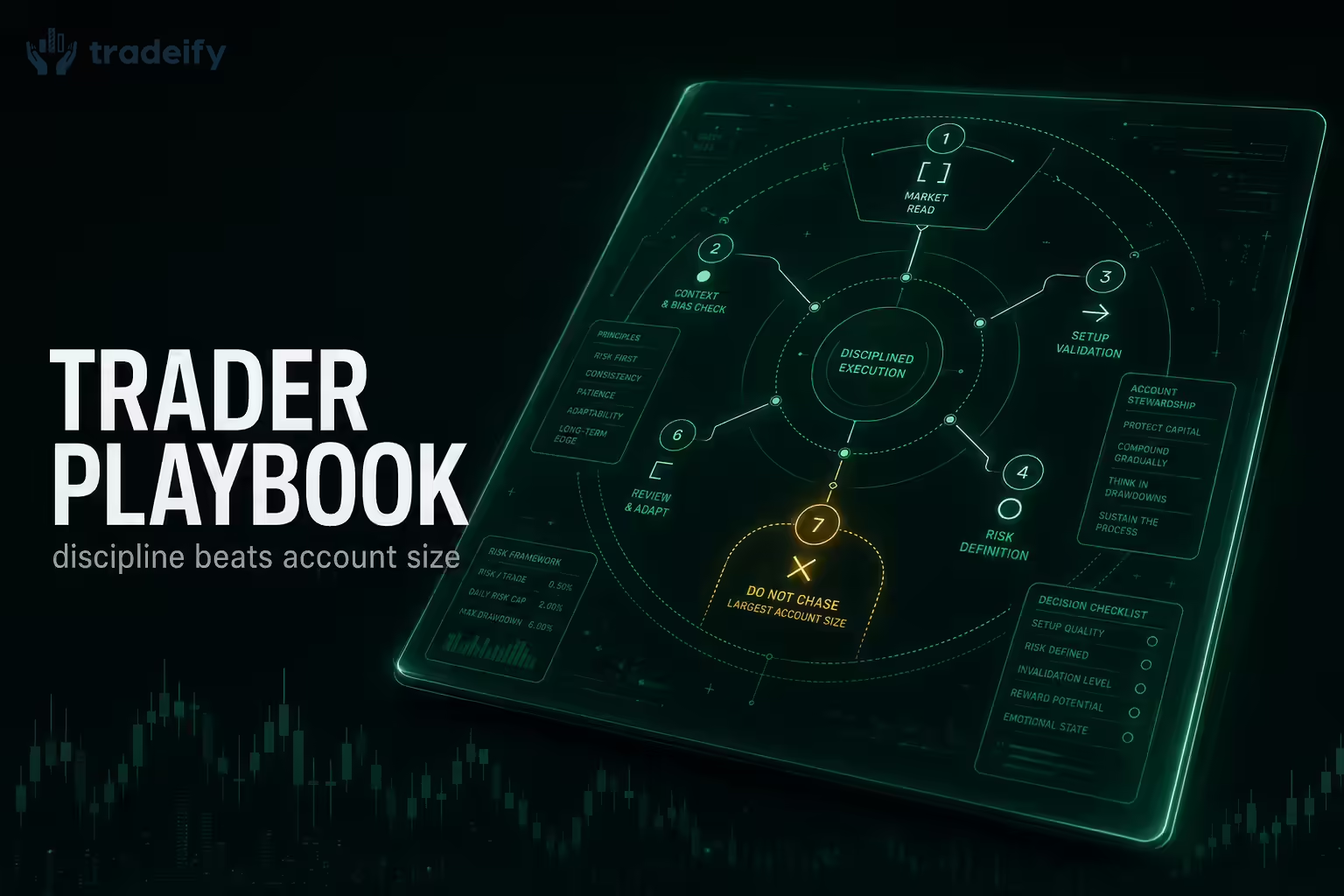
Trading a prop firm account requires a fundamentally different psychological approach than trading a personal retail account. For amateur Indian traders, the following best practices are highly recommended:
- Do Not Chase the Highest Account Size: While firms advertise accounts up to $150,000, the actual purchasing power is defined by the maximum trailing drawdown. A $50,000 account with a $2,000 drawdown effectively gives you $2,000 in risk capital. Trade mini and micro contracts accordingly.
- Respect the Daily Loss Limit (DLL): If your account has a soft-breach DLL (Growth, Lightning 50K+, or Select Daily), view it as an automated risk manager that prevents revenge trading and "tilt." Remember: hitting the DLL pauses you for the session but does NOT fail your account — the Max Trailing Drawdown is the hard limit.
- Work With the Consistency Rule, Not Against It: Instead of aiming for massive home-run trades, develop a systematic strategy that nets smaller, repeatable gains. The consistency rule does not stop you from having a big day — it simply means you'll need additional profitable days afterward so that big day represents 20%, 25%, 30%, 35%, or 40% of total profits (depending on your account type) before you can request a payout.
- Embrace End-of-Day Drawdowns: Amateur traders should almost exclusively seek out firms offering EOD drawdowns. Intraday drawdowns require algorithmic-level precision and tight stop-losses, which are difficult to master in early trading careers.
- Master the Trading Platform: Ensure your internet infrastructure in India can support low-latency connections to U.S. servers. Integrating Tradeify or Topstep with TradingView and tightening up your local network setup can meaningfully reduce slippage.
Choosing the Best Futures Prop Firm in 2026
The search for the optimal futures prop firm for Indian traders in 2026 reveals a highly competitive market. The days of struggling with undercapitalized retail accounts are fading, replaced by opportunities to manage institutional-grade capital.
For amateur Indian day traders specifically focused on futures, Tradeify is a strong and accommodating option. Its 3.0 overhaul addressed many of the pain points that plagued earlier retail prop firm structures: one-time pricing (no subscriptions), EOD trailing drawdowns across all plan types, no activation fees on Growth, Lightning, and Select Evaluations, the Lightning Funded program for traders who want to skip the evaluation, a flat 90/10 profit split from the first payout on every Sim Funded account, real-time dashboard updates, and the instant, crypto-friendly payout infrastructure of Rise.
Topstep remains a strong alternative for traders who prioritize a long-established brand with a proven payout history. Apex Trader Funding, after its March 2026 4.0 overhaul introducing EOD Trail as an option, is now more trader-friendly than its reputation suggests — and still offers the highest account-stacking capacity (up to 20 accounts).
Success in proprietary trading is not merely about selecting the firm with the highest advertised capital. It requires aligning the firm's specific risk management rules (consistency metrics, drawdown types, and loss limits) with your individual trading psychology and strategy. By prioritizing firms that offer transparent rules, rapid international payout processing, and trader-centric flexibility, Indian day traders are well-positioned to scale their careers on the global stage in 2026.