




TL;DR: A prop firm (proprietary trading firm) trades capital that is not a customer's; traditional prop desks risk the firm's own money with registered traders (FINRA Series 57 plus SIE for securities traders), while banks were largely pushed out by the Volcker Rule (Dodd-Frank Section 619, full conformance July 21, 2015). Most retail "prop firms" today are evaluation firms: you pay a one-time or recurring fee, trade a simulated account to a profit target (for example $3,000 on a 50K account) without touching a max drawdown (for example $2,000 on a 50K), then trade a simulated funded account and request payouts under a profit split such as 90/10. Pass or fail is decided by the drawdown type (static, intraday trailing or end-of-day trailing, where the floor still enforces in real time), daily loss limits, consistency rules (for example a 20% to 50% cap on your best day's share of total profit), contract caps (such as 4 minis or 40 micros on a 50K futures account) and bans on overnight holds, hedging or copy trading with others. Real costs are evaluation fees, resets, commissions (10 MES cost more than 1 ES) and data fees. Firm revenue comes mostly from those fees. Before buying, read the drawdown rule, payout conditions, refund policy and platform list, and size so one bad day cannot end the account.
You are probably not asking "what is a prop firm" out of idle curiosity. You are deciding whether to pay a fee to trade someone else's account, and if so, whose.
That decision is easier once you see the whole machine. Where the capital comes from, which rules end accounts, how payouts actually get approved, and how the firm itself makes money.
This guide covers all of it, with real contract math, so you can judge any prop firm on its rules instead of its marketing.
What a Prop Firm Is
A proprietary trading firm, or prop firm, trades for its own account. The profit or loss belongs to the firm, not to outside clients, which is what separates it from a broker (who executes trades for customers) or a fund (which manages investors' money).
For decades, "prop trading" meant two things. Large banks ran proprietary desks that traded the bank's own capital. Independent prop shops hired traders, gave them capital and risk limits, and split the profits.
The bank side shrank after the 2008 crisis. The Volcker Rule, written into Section 619 of the Dodd-Frank Act, generally bars banking entities from short-term proprietary trading in securities, derivatives, commodity futures and options, with exemptions for activities such as market making, underwriting and hedging. Per the Federal Reserve, covered banks had to fully conform by July 21, 2015.
Independent firms kept going. At firms that trade securities as broker-dealers, traders usually register with FINRA. The Series 57 Securities Trader exam, taken alongside the Securities Industry Essentials exam, lists proprietary trading among its covered activities, and candidates must be sponsored by a member firm.
That is the traditional model. It is not what most people mean when they search "prop firm" today: most retail prop firms are evaluation firms that sell traders a rules-based test, then pay a share of the profits made on a simulated funded account.
Traditional Prop Firms vs Evaluation Prop Firms
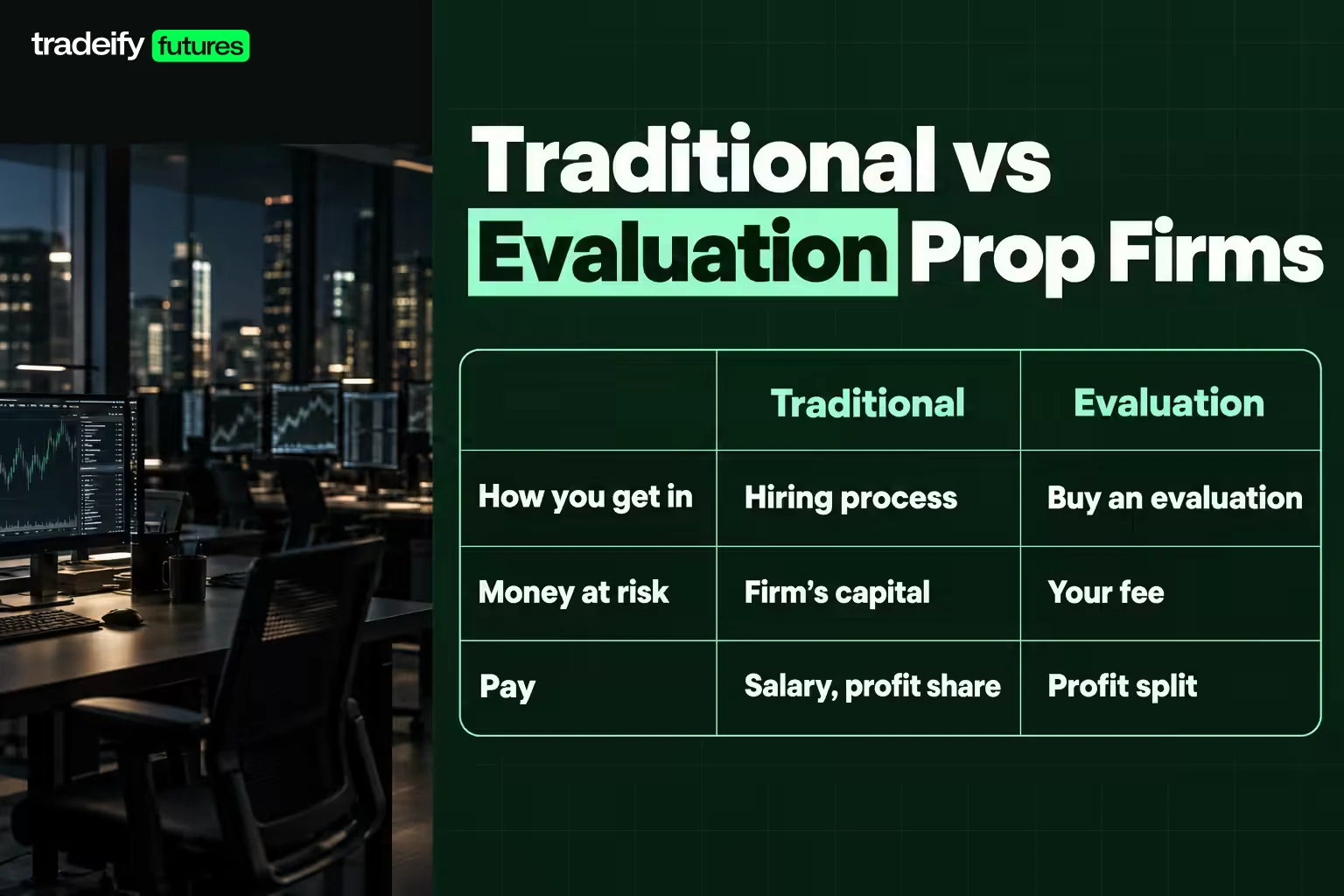
The modern retail prop firm is an evaluation firm. Instead of hiring you, it sells you a test.
You pay a fee, trade a simulated account under strict rules, and if you hit the profit target without breaking a rule, you move to a funded account and become eligible for payouts. No interview, no license, no capital deposit beyond the fee.
| Feature | Traditional prop firm | Evaluation prop firm |
|---|---|---|
| How you get in | Hiring process, sometimes a capital contribution | Buy an evaluation or an instant funded account |
| Whose money is at risk | The firm's real capital | Your fee; funded accounts are usually simulated |
| Licensing | Securities traders typically register (Series 57 plus SIE) | No trader license needed for a simulated account |
| Pay | Salary, profit share or both | Profit split on approved payouts |
| Risk limits | Set by the desk and risk manager | Published rules: drawdown, daily loss, contract caps |
| What ends it | Losing the job or the desk | Breaking a rule fails the account |
Neither model is "better." They solve different problems.
A traditional seat suits someone who wants a career inside a firm and can clear its hiring bar. An evaluation firm suits someone who wants to trade size beyond their own savings and is willing to be judged purely on rule-following and results.
Working at a Traditional Prop Firm
A seat at a traditional prop firm is a job, not a purchase. You apply, interview and, if hired, trade the firm's capital inside limits set by a risk manager. Pay is usually a salary, a share of the profits you generate, or both, and some independent shops ask new traders to put up capital of their own.
If the firm trades securities as a broker-dealer, expect to register with FINRA. That means passing the Series 57 Securities Trader exam alongside the Securities Industry Essentials exam, and you need a member firm to sponsor you before you can sit for it. In practice, the license comes after the hire, not before it.
The tradeoff is control. A traditional firm decides what you trade, how much you can size and whether you keep the seat. An evaluation prop firm gives you published rules instead of a manager, which is why the rest of this guide focuses on evaluation prop firms, especially futures firms. That is where almost every buying decision happens.
How Prop Trading Works at an Evaluation Firm
The path is similar across most evaluation firms, even when the names change.
- Choose an account size and type. Sizes are usually labeled by the simulated balance, such as 25K, 50K, 100K or 150K.
- Pay the fee. Some firms charge once, some charge monthly until you pass.
- Trade the evaluation. You need to reach a profit target while staying above the max drawdown and inside every other rule.
- Pass and activate. Some firms charge an activation fee here; others do not.
- Trade the funded account. You trade under a similar or tighter rule set, now with payout eligibility.
- Request payouts. Each request has conditions: minimum days, consistency, buffers or caps.
- Possibly move to live capital. Some firms move consistent traders to a live account, usually on different terms.
Some firms also sell instant funded accounts that skip the evaluation and the activation step and start you on a funded account. They cost more up front and usually add other guardrails, such as a stricter consistency rule or payout caps.
Prop Firm Evaluations and Profit Targets
The profit target is the number everyone looks at first. It matters less than you think.
What matters is the ratio between the target and the drawdown. A 50K evaluation with a $3,000 target and a $2,000 max drawdown asks you to make 1.5 times what you are allowed to lose. A trader who risks too much per trade can hit that drawdown long before the target, even with a strategy that wins more often than it loses.
Check two more things before you buy. Is there a time limit to pass, and is there a minimum number of trading days? A deadline pushes traders into forcing setups late in the window. A minimum-days rule means a single big day cannot finish the job on its own.
Prop Firm Funded Accounts Are Usually Simulated
This is the part ads tend to blur. At most evaluation firms, the "funded" account is a simulated account. Your trades are not routed to the exchange as a live position funded by the firm.
That does not make the payouts fake. The firm pays you real money based on your simulated results, under its payout rules. But it changes how you should think about the relationship.
- You are buying a service with conditions, not opening a brokerage account.
- The balance on screen is a performance measure, not cash you own.
- Fills come from a simulation, which can differ from what a live order would get in a fast market.
Once you are funded, the drawdown keeps applying, payouts open up under their own conditions, and breaking a hard rule ends the funded account rather than just the day. Read the terms for the words "simulated" or "sim funded." A firm that is clear about this up front is telling you how the business actually works.
Prop Firm Scaling Plans
A prop firm scaling plan decides how much size you can trade as a funded account grows. It comes in two forms, and the difference changes how you should plan your first weeks.
Position scaling: the contract limit starts below the account's maximum and rises as you build profit above the starting balance.
Account scaling: after a run of consistent payouts, the firm raises the account size itself or moves you to a larger or live account on new terms. This is the growth path firms advertise, so read what triggers it, whether it is automatic or discretionary, and whether the rules or split change on the way up.
Position scaling matters most early. If your strategy needs four contracts to make its math work and the account starts you on fewer, your first payout takes longer than the profit target suggests.
On our accounts, Growth and Lightning use their full position limit from day one, while Select funded accounts scale up as the account grows. Whichever firm you look at, check the scaling table before you size your plan around the account's headline maximum.
The Prop Firm Rules That Decide Pass or Fail
Plenty of accounts are not lost to bad analysis. They are lost to a rule the trader did not fully understand until it fired.
Prop Firm Drawdown Types
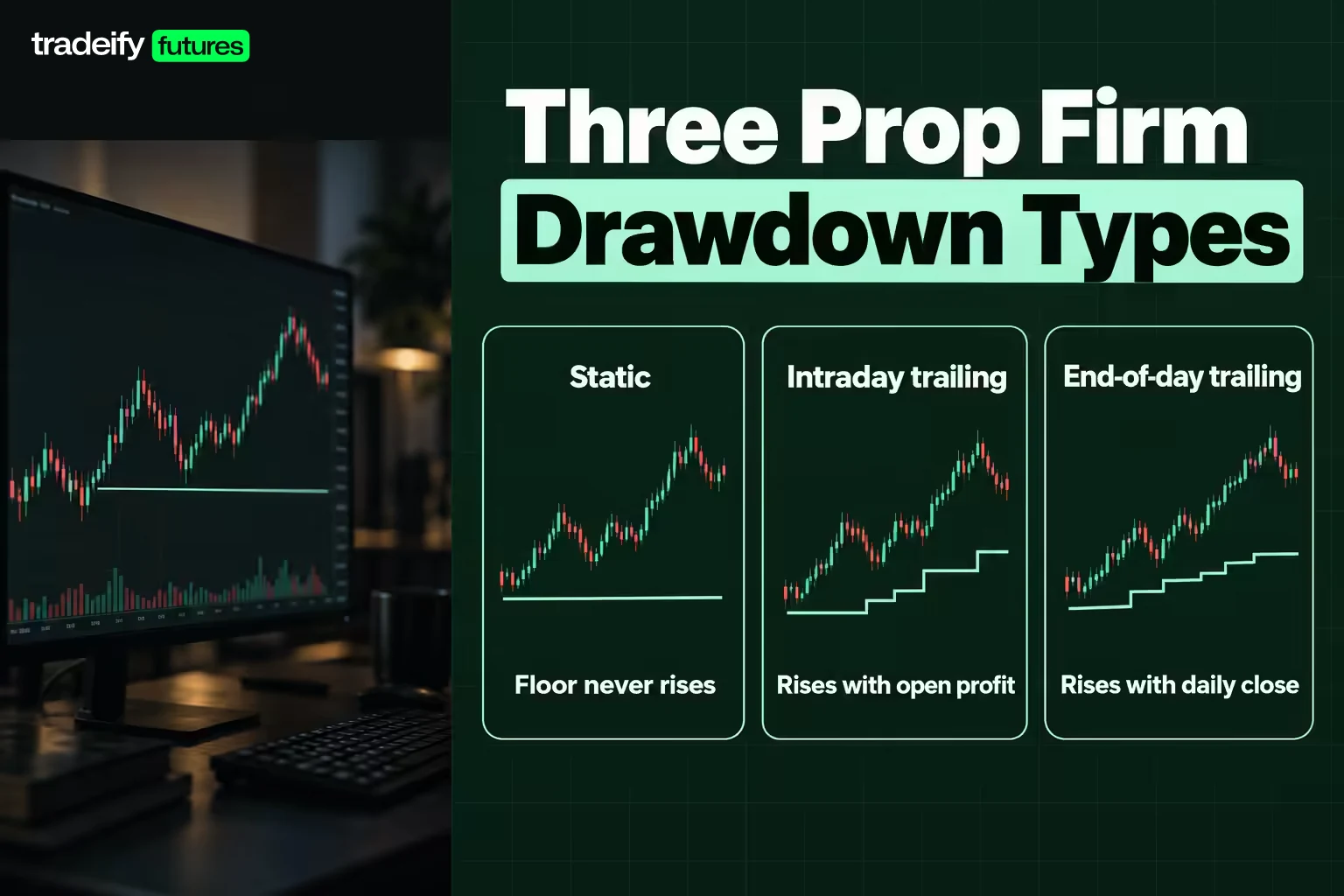
The max drawdown is the floor your account cannot touch. How that floor moves is the single most important rule in any prop firm.
| Drawdown type | How the floor moves | Where traders get caught |
|---|---|---|
| Static | Fixed at a set amount below the starting balance | Fewer surprises because the floor never rises; check the size of the allowance |
| Intraday trailing | Rises with your highest balance during the day, including open profit | Giving back unrealized profit raises the floor even if you never closed the trade |
| End-of-day trailing | Rises only with your highest end-of-day balance | Traders assume the floor only matters at the close; it still fails you intraday |
Here is the difference on a hypothetical 50K account with a $2,000 trailing drawdown. The starting floor is $48,000.
- Day 1 closes at $51,200. Under end-of-day trailing, the floor moves to $49,200.
- On Day 2 your account peaks at $52,000 on an open winner, then you close the day at $51,500.
- End-of-day trailing: the floor moves to $49,500, based on the $51,500 close.
- Intraday trailing: the floor would have moved to $50,000 at the $52,000 peak, even though you gave the profit back.
That $500 gap is room you either have or do not have on Day 3.
Now the end-of-day drawdown trap. On most end-of-day drawdown accounts, the floor only updates at the close but it is enforced in real time against your net liquidation value (balance plus open profit or loss). If an open trade pushes you to the floor at 10:15 AM, the account fails right then. Recovering by the close changes nothing.
So the temptation to "give it room because it only counts at the end of the day" is the exact behavior that kills these accounts.
Prop Firm Daily Loss Limits
A daily loss limit caps how much you can lose in one session. Firms handle it two ways.
- Soft breach: hitting the limit stops trading for the day, but the account survives.
- Hard breach: hitting the limit fails the account.
Know which one you have. Then set your own personal daily stop well inside it, because in a fast market a stop can fill past your price. Never treat the firm's daily limit as your stop loss. It is a backstop, not a plan.
Prop Firm Consistency Rules
A consistency rule says no single day can make up more than a set share of your total profit. It exists to filter out one lucky, oversized day.
The math is simple once you see it. Divide your best day by the consistency percentage to get the total profit you need.
Imagine a trader on an evaluation with a $3,000 target and a 40% consistency rule. Their first day makes $1,500. To meet the rule, total profit must reach $1,500 / 0.40 = $3,750. They now need $750 more than the target, spread over more days, and every one of those days has to stay below $1,500.
Two consequences most traders miss:
- Losing days make consistency worse. They shrink total profit while your best day stays the same.
- A rule that applies only to the evaluation is very different from one that applies to every payout. Read which one you are buying.
Prop Firm Contract Limits and Leverage
Futures prop firms rarely quote leverage ratios. They cap contracts instead. A 50K account that allows 4 minis or 40 micros is a typical example.
That cap hides a lot of leverage. Using CME Group's specs, one E-mini Nasdaq-100 (NQ) contract is $20 times the index, and one Micro (MNQ) is $2 times the index. At a hypothetical index level of 20,000:
- 1 NQ controls about $400,000 of notional exposure.
- 4 NQ control about $1.6 million.
- A $2,000 drawdown on 4 NQ is a 25-point move, roughly 0.125% of the index.
The account size is a label. Your real risk budget is the drawdown.
That is why sizing should start from the drawdown, not the contract cap. One MNQ with a 20-point stop risks $40. Five MNQ with the same stop risk $200, which is 10% of a $2,000 drawdown on one trade. Ten losers in a row at that size and the account is gone, and a streak that long can happen to a sound strategy over a large enough sample.
Futures are leveraged products, and losses on live futures accounts can exceed the money deposited. In a simulated prop account your loss is capped at what you paid, but the account can still be lost in minutes.
Prop Firm Rules on Overnight Holds, News, Hedging, Copy Trading and Bots
These prop firm rules vary more between firms than drawdowns do, and they are where honest traders get surprised.
- Overnight holds: some futures prop firms require you to be flat before a set time each afternoon.
- News trading: some ban trading around major releases; others allow it with warnings about slippage.
- Hedging: opposing positions in the same or correlated markets, including across accounts, are often banned.
- Copy trading: copying your own accounts is often allowed; copying someone else's trades usually is not.
- Algorithms and bots: often allowed only if you own the strategy and it is not high-frequency.
- Very short holds: some firms restrict payouts when most profit comes from trades held a few seconds.
- Inactivity: some accounts require a minimum level of activity to stay open.
If your strategy depends on any of these, read that specific rule before you buy. A rule you break by design is not bad luck.
Prop Firm Payouts and Profit Splits
The profit split tells you your share of profits. On a 90/10 split, $2,000 of approved profit means $1,800 to you and $200 to the firm.
The split is the easy part. The conditions that decide whether you can request a payout are where firms really differ.
- Minimum trading days or winning days per payout cycle.
- Consistency rules applied at payout time.
- Buffers: profit you must leave in the account above the starting balance.
- Caps: a maximum per request, sometimes a percentage of profit.
- Payout frequency: daily, weekly, every few winning days.
- Drawdown behavior after a payout, such as a floor that locks at a fixed level.
Do the math on a payout before you buy. If a firm caps each request at 50% of profits, $3,000 of profit means a request of up to $1,500, before the split. That is not a trick. It is the firm keeping a cushion in the account. But it changes how long it takes to get cash out.
Also be honest with yourself about what happens after a first payout. Plenty of traders change behavior once there is real money on the line again, sizing up to "get back to where I was" or freezing to protect a payout. Plan your post-payout sizing before you get there.
What a Prop Firm Really Costs
The sticker price is only the first line.
- Evaluation fee: one-time or monthly. Monthly fees keep charging until you pass or cancel.
- Resets: a discounted restart after a failed evaluation.
- Activation fee: some firms charge one when you pass.
- Commissions: charged per contract on every trade.
- Market data: usually free for non-professional traders who sign the right agreement, and expensive if you do not.
- Platform fees: some platforms need their own subscription.
Here is a hypothetical. Imagine an evaluation priced at $150 with $100 resets. A trader who fails twice and passes on the third try has spent $350 before the first payout. A trader on a $150-per-month plan who takes three months has spent $450.
Commissions add up faster than most people expect. On our accounts, 10 MES contracts cost $18.20 round trip versus $5.76 for one ES contract, for the same exposure. A trader who scalps micros all day pays for that choice.
Write your total cost to first payout as a number before you buy. Then compare it to what you can afford to lose entirely, because that is a real outcome.
How Prop Firms Make Money
If funded accounts are simulated, the firm is not earning from trading profits on customer capital. Its revenue comes from what traders pay it: evaluations, resets, subscriptions and add-ons. Payouts are a cost of running that business.
That is not sinister by itself. It is the business model. It does tell you what to watch.
- A firm with sustainable economics publishes clear rules and pays according to them.
- A firm under pressure may add vague rules, slow payouts or deny them on discretionary grounds.
- Rules that change often, especially right after a trader becomes payout-eligible, are a warning sign.
The question to ask is simple. Can you predict, from the written rules alone, whether a given payout request will be approved? If not, the firm is keeping discretion that belongs in the rulebook.
Prop Firm Pros and Cons
A prop firm trades one risk for another. You swap the risk of losing a full trading deposit for a fixed fee and a strict rulebook, and whether that is a good trade depends on how you trade.
| Pros of a prop firm | Cons of a prop firm |
|---|---|
| Trade a larger account than your own savings would allow | Fees, resets and data costs add up before the first payout |
| Your loss on a simulated account is capped at what you paid | Breaking one rule can end the account, even on a winning strategy |
| Published risk rules force discipline you might skip alone | Funded accounts are usually simulated, so fills can differ from live |
| You keep most of the profit, often 90% on a 90/10 split | Payout conditions such as buffers, caps and consistency delay cash |
| No license, experience or capital deposit is needed to start | Rule changes, platform problems or a firm closing can disrupt the account |
The pros of a prop firm are strongest for a trader with a tested process and too little capital to trade it at size. The cons hit hardest for a trader still searching for a strategy, because every failed account turns tuition into fees.
A simple test: if your last 30 trades would have survived the firm's drawdown and consistency rules, the pros are real for you. If they would not, the cons are what you are buying.
Prop Firm Markets and Trading Platforms
Evaluation prop firms split roughly into two camps.
- Futures prop firms: exchange-listed futures such as index, energy, metals, agricultural and currency contracts. Pricing comes from the exchange, which makes simulated fills easier to compare against real market data.
- Forex and CFD prop firms: currency pairs, indices and commodities as CFDs, typically with leverage quoted as a ratio.
Platforms follow the market. Futures firms connect through data and order routing providers such as Tradovate or Rithmic, with front ends like NinjaTrader, TradingView, Quantower or Sierra Chart. Forex and CFD firms have historically leaned on MetaTrader 4 and 5, with cTrader and others as alternatives.
Platform access is a real risk, not a footnote. In February 2024, trade press including Finance Magnates reported that several forex-focused prop firms lost access to MetaTrader platforms, and many stopped serving U.S. clients or moved to other platforms. Traders on those firms had accounts disrupted for reasons unrelated to their trading.
Choose the platform before the firm. If you already trade on a platform you know well, buy where it is supported, and check whether your choice locks you into one data provider for the life of the account.
Is a Prop Firm Legit and Legal
Proprietary trading itself is legal. The harder question is what kind of company you are buying from and what protections you have.
An evaluation firm selling simulated accounts is usually not a broker holding your money. You are not depositing trading capital, so customer-fund protections that apply to brokerage accounts generally do not apply to your fee. Your protections come mostly from the firm's terms and its track record.
Regulators have shown interest in the model. In 2023 the CFTC sued a large forex evaluation firm, alleging it fraudulently booked at least $310 million in customer fees. In 2025 a federal judge dismissed the case and sanctioned the CFTC after a special master found the agency had acted in bad faith, according to Reuters. The point for a trader is not who won. It is that the rules around evaluation firms are still being tested, so the written terms matter more than the marketing.
Practical checks:
- Find the company's legal name and where it is based.
- If a broker or futures commission merchant handles any live accounts, look it up in the NFA's BASIC database. For securities firms, FINRA's BrokerCheck.
- Read the refund policy before you pay. Some prop firms, ours included, treat all sales as final.
- Read the payout and termination clauses for discretionary language.
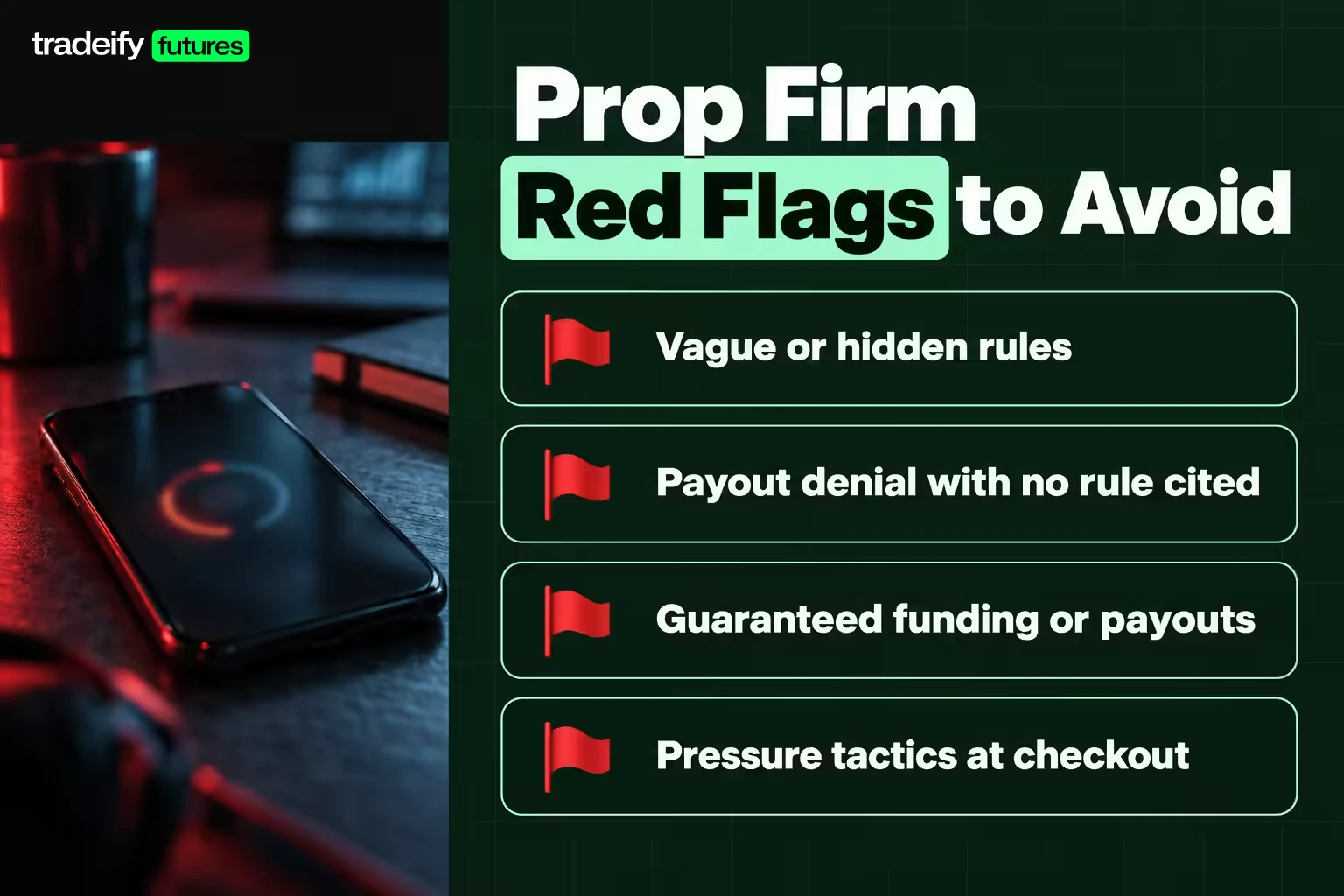
Prop Firm Red Flags
You will not find a perfect firm. You can avoid the obvious problems.
- Rules that are vague, hard to find, or different between the website and the terms.
- Discretionary payout denial with no specific rule cited.
- Frequent rule changes that apply to existing accounts.
- "Guaranteed" funding or payouts.
- Pressure tactics: countdown timers on permanent discounts, upsells at checkout you did not ask for.
- No clear statement of whether funded accounts are simulated or live.
- Payout claims with no way to see the conditions behind them.
One red flag is a reason to read more carefully. Several together are a reason to walk away.
How to Choose the Best Prop Firm for Your Trading
There is no single best prop firm. There is a best fit for how you trade. Use the same scorecard for every firm you consider.
| Question to ask | Why it matters | What a clear answer looks like |
|---|---|---|
| What drawdown type is it | Decides how much room you really have | Named type with a worked example in the help docs |
| Is there a daily loss limit, soft or hard | One bad day can end the account | Exact dollar amount per size and breach type |
| Is there a consistency rule, and when | Changes how many days passing and payouts take | Percentage, phase it applies to, formula shown |
| What are the contract limits | Sets your maximum exposure | Minis and micros per account size |
| What are the payout conditions | Decides when cash actually reaches you | Days, buffers, caps and split stated in writing |
| Are funded accounts simulated or live | Defines what you are buying | Plain statement in the terms |
| What is the full cost | Fee is not the whole bill | Fee, resets, activation, commissions, data |
| Which platforms and markets | Your strategy may not fit | Supported list by broker or data feed |
| What is the refund policy | Tells you your downside on the fee | Written policy before checkout |
Then match the firm to your style.
- A scalper who trades many small positions cares most about commissions, daily loss limits and short-hold rules.
- A trader who takes a few larger trades cares most about drawdown type and consistency.
- A trader with a day job cares about time limits, minimum days and session cutoffs.
- A trader who wants faster payouts cares about payout frequency and caps more than split percentage.
Matching Prop Firm Account Types to Your Style
Here is how that works on our own accounts at Tradeify, as one worked example. All three of our account types come in 25K, 50K, 100K and 150K sizes (Select also has a limited-release 300K), all are one-time purchases, and none charges an activation fee. Every one uses an end-of-day trailing drawdown that is enforced in real time, and our funded accounts are simulated with a 90/10 profit split.
| Account type | Evaluation | Daily loss limit | Consistency rule |
|---|---|---|---|
| Growth | Yes, can pass in 1 day | Yes, soft breach | 35% on the sim funded account |
| Select | Yes, minimum 3 days | None during evaluation | 40% during evaluation only |
| Lightning | None, funded immediately | Yes on most sizes | Progressive 20%, 25%, then 30% by payout |
Which Prop Firm Account Type Fits Which Trader
Using our Growth, Select and Lightning accounts as the example, the decision logic looks like this.
- If you tend to make your money in one or two strong sessions, Growth lets you pass on a single day, but its daily loss limit means a bad morning ends trading for that day.
- If you hate daily loss limits, Select removes them during the evaluation in exchange for a consistency rule and at least three trading days. After passing, you choose Select Flex (payouts every five winning days, no daily loss limit) or Select Daily (daily eligibility with a daily loss limit and buffer), and that choice is permanent for the account.
- If you already have a proven, steady process and want to skip the evaluation, Lightning funds you immediately, but there are no resets, and the consistency rule tightens with each payout.
On a 50K Growth or Select evaluation the max drawdown is $2,000 and the cap is 4 minis or 40 micros. On our funded accounts the drawdown floor locks at $50,100 once the end-of-day balance reaches $52,100 on a 50K. Positions must be closed by 4:45 PM ET, with no overnight holds.
What would change the choice? If your process breaks under a daily loss limit, Growth is the wrong fit no matter how cheap it is. If your returns come in bursts, Lightning's 20% first-payout consistency rule will slow you down.
Getting Started With a Prop Firm
If you have decided to try a prop firm, do it in this order.
- Write down your strategy in one paragraph: market, setup, stop, target, max trades per day.
- Pull 30 to 50 past trades from a journal or simulator and calculate your largest losing streak and best day as a share of total profit.
- Use those numbers to filter firms. A streak that would break the drawdown, or a best day that breaks the consistency rule, rules that account out.
- Read the full rulebook, payout policy and refund policy of your top choice. Highlight anything you do not understand and ask support before buying.
- Pick the smallest account that lets you trade your normal size with at least 10 losing trades of room inside the drawdown.
- Set personal limits inside the firm's: a daily stop, a trade count, and a hard flat time before the firm's cutoff.
- Track every day against the rules, including consistency, before you request a payout.
Step 2 is the one traders are most tempted to skip. It is also the one that tells you whether the account fits you or whether you are hoping it will.
Prop Firm FAQ
Are there options trading prop firms?
Yes, mostly on the traditional side, where firms trade options with their own capital and registered traders. Evaluation-based futures prop firms generally publish product lists made up of futures contracts, so check the list before assuming options are allowed. Our own supported list at Tradeify is futures contracts on CME, CBOT, NYMEX and COMEX.
Are prop firms closing down?
Some have. Evaluation firms are businesses with real cash flow pressures, and in 2024 trade press reported that several forex-focused firms lost access to MetaTrader platforms and stopped serving U.S. clients or relaunched on other platforms. That is why platform independence, clear rules and a track record of paying under written conditions matter when you choose.
Which prop firms offer instant funding without a consistency rule?
Few do, because instant funding accounts usually swap the evaluation for other guardrails, and a consistency rule is the most common one. Our Lightning Funded accounts, for example, use a progressive 20%, 25% then 30% consistency rule by payout. If an instant account has no consistency rule, look for where the protection moved instead: a smaller drawdown, payout caps, minimum days or a higher price.
What is the largest prop firm in the world?
There is no audited ranking of prop firms. The biggest proprietary trading companies are institutional firms trading their own capital at very large scale, often as market makers, and they are a different business from retail evaluation firms. Evaluation firms rarely publish audited trader counts or payout totals, so treat any "largest" claim in an ad as marketing.
Is prop trading worth it?
It can be, if your strategy already fits the firm's rules and the total cost to first payout is money you can afford to lose. It is a poor fit if you are using the evaluation to find a strategy rather than to prove one. Run your past trades through the rules before deciding.
Do you need experience to join a prop firm?
Evaluation firms do not require experience or a license, which is exactly why preparation matters. A beginner can buy an account on day one, but the rules punish undisciplined sizing quickly. Practicing your exact plan in a simulator first, under the same limits, is a cheap way to find out whether you are ready.
Do prop firms use real money?
At most evaluation firms the funded account is simulated, and payouts are real money paid based on simulated results. Some firms later move traders to live capital on separate terms. Traditional prop firms trade the firm's real capital.
What is the difference between a broker and a prop firm?
A broker executes your orders in your own account, holds your money and charges you for the service, and the profits and losses are yours. A prop firm trades its own capital or, at an evaluation firm, pays you a share of simulated results under its rules. With a broker your deposit is at risk; with an evaluation prop firm, the fee is what you can lose.
What happens if you lose a prop firm's money?
At an evaluation firm, hitting the drawdown or a hard rule fails the account, and you lose what you paid for it, not money beyond the fee. That fee is your real downside, so treat it as money you can afford to lose. On our accounts, a failed Growth or Select evaluation can be reset at a reduced price, while a failed Lightning account or a breached funded account means a new purchase. At a traditional firm, the firm absorbs the loss, and the trader risks the seat and any capital they contributed.
Your Next Step Before Buying a Prop Firm Account
Pick one prop firm you are considering and answer the nine checklist questions from its help center, not its homepage: drawdown type, daily loss limit, consistency rule, contract limits, payout conditions, simulated or live funding, full cost, platforms and markets, and refund policy. Then run your last 30 trades through its drawdown, daily loss and consistency rules.
If your history survives the rules, you have a real candidate. If it does not, you have just saved the fee. Trading futures involves substantial risk, and no prop firm account guarantees a pass or a payout.