

TL;DR: Start learning futures prop trading with free exchange education, official contract specifications, regulator fraud resources, platform help centers, and the rulebook for the account you are considering. CME Institute offers futures education and a free practice simulator; FRED and official release calendars provide macro context. Use each resource to complete a practical task. Free education is different from a free funded account, and reading alone does not demonstrate readiness to pay for an evaluation.
You can spend weeks collecting trading videos and still be unsure how much one tick is worth or what would fail a funded account.
A better learning plan starts with the decisions you need to make. What product are you trading? How does the order work? Where is the account’s actual loss boundary? What record will tell you whether you followed the plan?
Free resources can answer much of that before you buy an evaluation. The key is to use a small set deliberately rather than collecting more material than you can apply.
Choose a free resource by the task you need to complete
Use this short list as a starting curriculum. The educational pages are separate from any paid platform, market-data service, or evaluation they may discuss.
Resource | Use it for | Practical output |
|---|---|---|
Futures mechanics and practice | One contract specification and a correct tick-value calculation | |
Chart and order-tool documentation | A tested entry, protection, cancellation, and flatten sequence | |
Checking claims and credentials | A verified claim and a list of unresolved questions | |
Economic-series definitions and history | One documented macro series, including its revision limits | |
Evaluation and funded-policy rules | A stage-by-stage rule sheet before a paid evaluation |
Learn futures mechanics with exchange resources
CME Institute’s education hub provides futures and options courses, product material, and practice tools. Its education page also links to a free trading simulator.
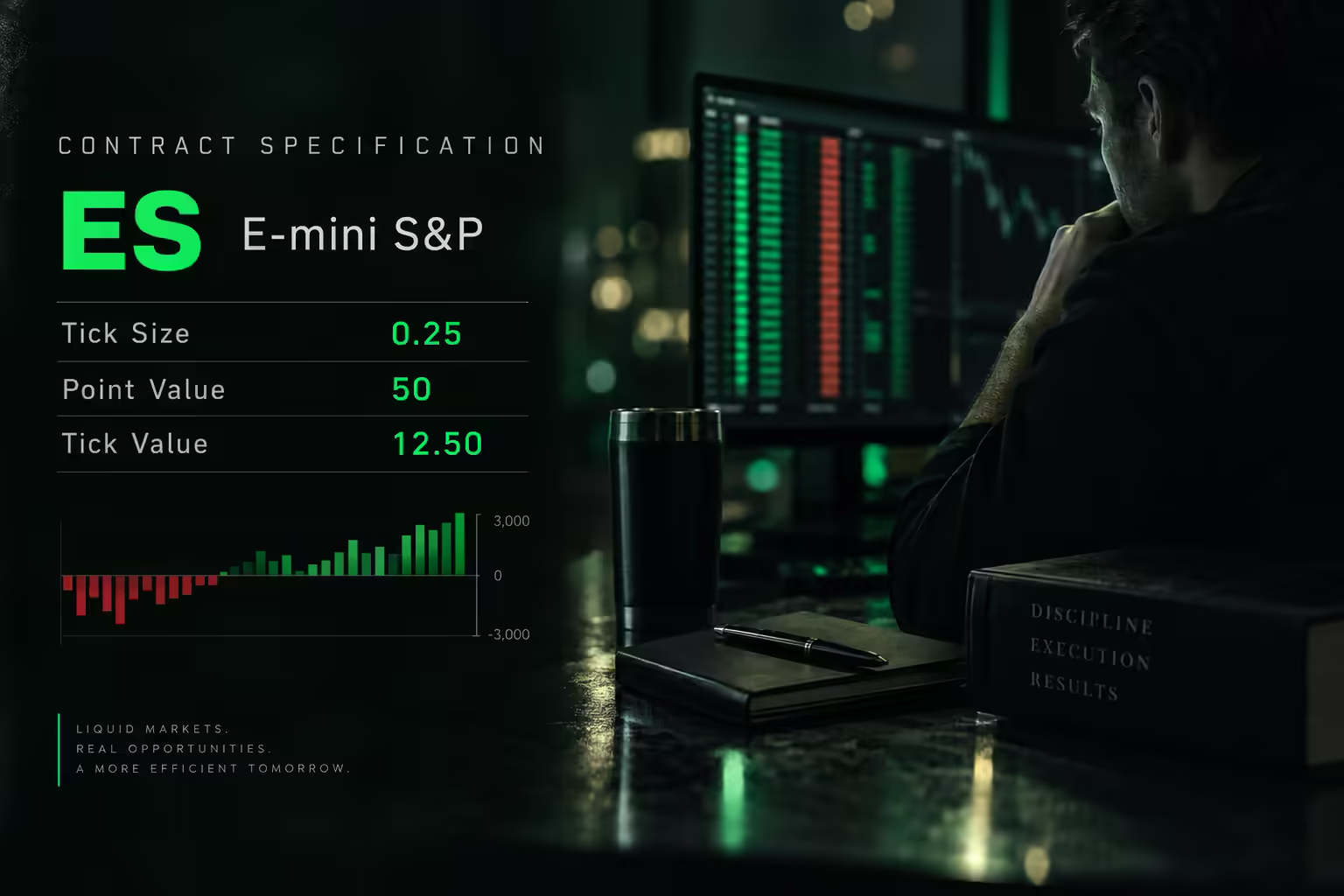
Start with the mechanics of one contract family. Learn the tick size, point value, trading session, expiration, and settlement method. Use the exchange’s product specifications as the source for the contract you actually intend to trade.
Your first task is simple: calculate the dollar effect of a hypothetical five-point move at one contract and then at your intended size. Explain the difference between margin, notional exposure, and a prop program’s allowed drawdown.
If you cannot do that calculation without guessing, another strategy video is unlikely to solve the immediate problem.
Learn order mechanics with free platform help centers
The TradingView Help Center explains chart settings, indicators, and supported trading features. Your broker or execution platform should provide the equivalent documentation for its own order types and controls.
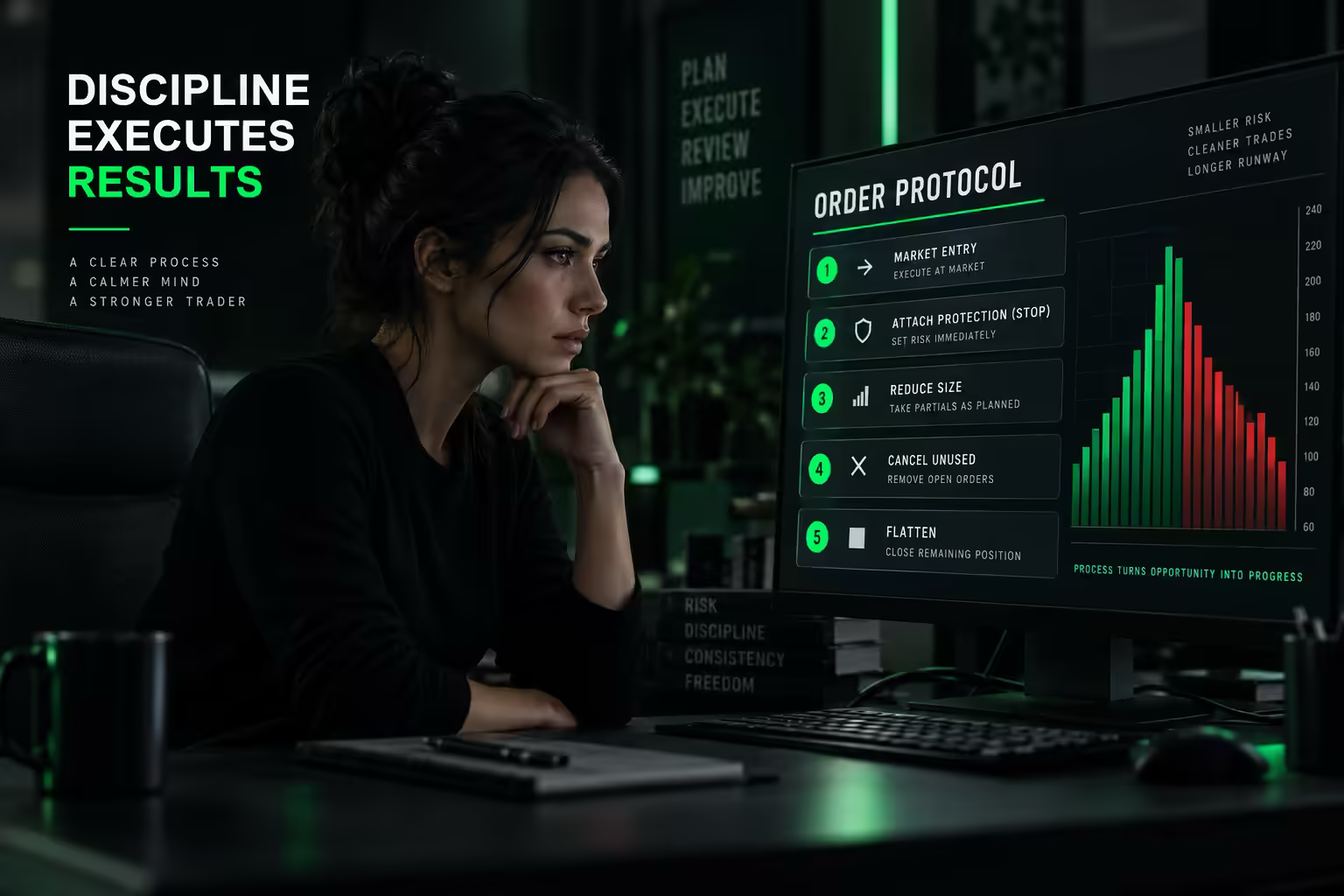
Read the pages for market orders, limit orders, stop orders, bracket orders, and cancellation behavior. Confirm whether protective orders are held locally or on a server for your particular connection where that information is provided.
Then practice the full sequence in simulation: enter, attach protection, reduce size, cancel the unused order, and flatten the position.
The goal is to understand the platform before a fast market exposes a misunderstanding. A simulator’s fills can differ from live execution, but it remains useful for learning the controls.
Use official prop-firm rulebooks as study material

A firm’s help center is essential reading for its program. It should answer what counts toward drawdown, whether the threshold moves intraday or at the close, how payouts qualify, and what changes after evaluation.
Treat the rules as account-specific. A brand can offer several plans with different loss limits, consistency conditions, or payout schedules.
Build a short comparison sheet with the exact plan name and stage. Record the failure threshold, daily loss control, contract cap, prohibited behavior, inactivity condition, and payout requirements.
Your practice task is to work through three hypothetical days and explain whether each day leaves the account eligible. If the rulebook does not resolve the example, ask the firm before buying.
Learn to assess claims with regulator resources
The CFTC’s Learn & Protect pages cover fraud awareness and ways to check claimed credentials. These resources help you evaluate the people and services selling trading access, education, or advice.
Look for unsupported earnings claims, pressure to pay immediately, and unclear descriptions of what is being sold. Separate an educational service from account management or personalized advice.
Do not assume that a polished website, a large following, or a screenshot establishes that a claim is reliable. Also avoid assuming that every kind of educator or simulated evaluation provider has the same registration obligations as a broker.
The practical task is to verify a specific claim through the relevant official source rather than relying on the seller’s badge or wording.
Build macro context with free economic data
FRED provides economic time series, while issuing agencies publish release calendars and source reports. These can help you understand inflation, employment, interest rates, and other conditions that affect futures markets.
Use them to learn what a release measures, not to manufacture a trade signal from every data point. A strong number can already be expected, and revised historical data can differ from the initial release.
For one upcoming event, write the release time, the series definition, the prior reading, and the expectation from your chosen calendar provider. Afterward, distinguish the actual data from your interpretation of the price response.
That exercise teaches a more useful habit than memorizing “good news means buy.”
Practice prop trading without confusing free and risk-free
Free educational access does not mean a program provides free funded capital. Evaluation fees, data subscriptions, platform features, and later account costs are separate questions.
Similarly, paper trading removes direct market P&L from the practice exercise, but its fills and emotional demands can differ from live or paid evaluation trading.
Use simulation to rehearse a written process with realistic size, costs, and account constraints. Avoid treating an oversized simulated gain as evidence that the same behavior would survive a real program’s limits.
The useful output is a record of decisions you can review, including losses and rule violations.
Follow a practical free-learning sequence
Begin with contract mechanics and order entry. Move to a single setup with written entry, stop, exit, and session rules. Then practice it under the constraints of the account type you are considering.
Keep a journal with the setup, planned risk, actual execution, costs, and whether the rules were followed. Review a meaningful sample rather than using one profitable session as a graduation test.
For a beginner-friendly video curriculum, Tradeify TV’s Futures Foundations course provides another free starting point for traders who are new to futures.
For a plan-specific rulebook exercise, Tradeify’s Select Evaluation guide explains the distinction between the evaluation and its later payout-policy choices. It covers Tradeify’s own program rules and should not be treated as a general guide to prop trading.
Decide when free learning has done its job
Before spending money, you should be able to explain the contract, execute the platform controls, calculate the planned risk, and identify what would violate the account rules.
You should also have records showing how consistently you follow the process. Knowledge and execution are different skills.
Choose one resource and complete one practical task today. The objective is better decisions and fewer avoidable mistakes, not finishing the largest possible list of courses.
Frequently asked questions
Can you learn prop trading for free?
You can learn most of the groundwork for free, including contract mechanics, order types, rule reading, and fraud awareness. Exchange education, platform help centers, regulator pages, and official rulebooks cover these topics. Evaluation fees, data subscriptions, and platform costs are separate questions from free education.
What should you learn before paying for a prop firm evaluation?
You should be able to explain the contract you plan to trade, execute the platform controls, and calculate your planned risk in dollars. You should also know exactly what would violate the account rules and have records showing how consistently you follow your process.
Is a free trading simulator enough to prepare for a prop firm evaluation?
A simulator is useful for learning order controls and rehearsing a written process with realistic size and account constraints. Its fills and emotional demands can differ from live or paid evaluation trading, so treat simulated results as practice records rather than proof of readiness.
Does free prop trading education mean a free funded account?
No. Free educational access does not mean a program provides free funded capital. Evaluation fees, market data, platform features, and later account costs should each be checked in the official rules for the plan you are considering.
How can you check claims made by trading educators?
Use regulator resources such as the CFTC’s Learn & Protect pages to check claimed credentials and common fraud warning signs. Watch for unsupported earnings claims, pressure to pay immediately, and unclear descriptions of what is being sold, and verify specific claims through the relevant official source.