.svg)

.svg)
.svg)



TL;DR: A market order tells the venue to buy or sell now at the best prices available, so it prioritizes execution but does not guarantee your fill price. A limit order sets the highest price you will pay or the lowest price you will accept, so it protects price but may fill partially or not at all. For a liquid futures contract with a tight spread, a small order, and a time-sensitive exit, a market order may match the job. For a planned entry where one or two ticks would materially change the setup, a limit order may fit better. Check the live bid and ask, depth, volatility, order size, time in force, and your platform's exact order behavior before choosing. Around news and session reopenings, price can gap past a level, so a market or stop order may fill well away from it while a limit order may not fill at all. If you trade under an evaluation or funded-account drawdown limit, include possible slippage in your dollar-risk calculation and decide in advance what you will do if a limit order misses. The right order is the one whose remaining uncertainty your trade plan can absorb.
Market Order vs Limit Order at a Glance
Your setup can be right and your execution can still damage the trade.
You click buy because the chart shows your entry. The market moves before the order reaches the book. You get filled higher, your stop stays where planned, and the trade now carries more risk than you intended. Or you place a limit order at the perfect level, price touches it, your order does not fill, and you chase the move two minutes later.
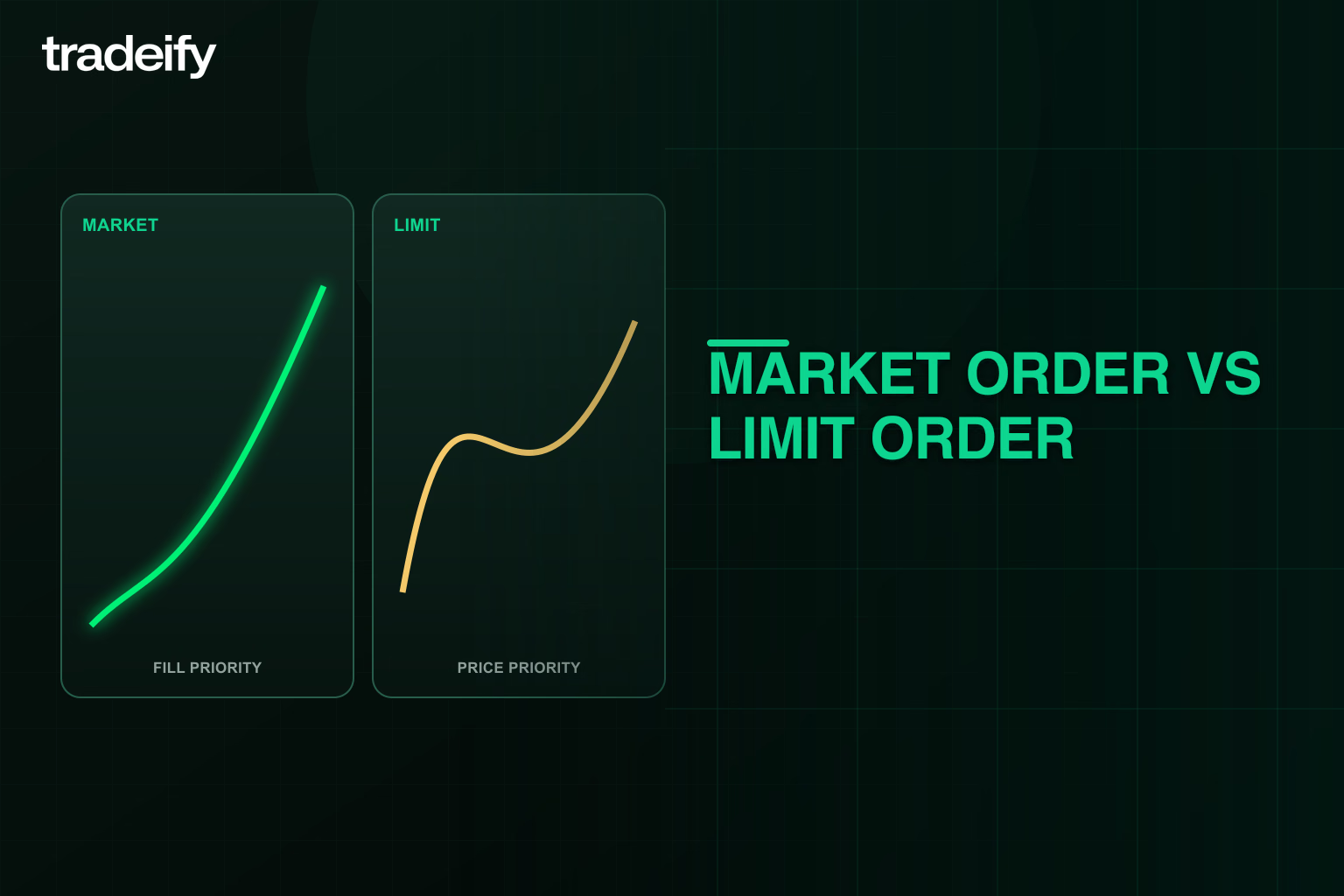
That is the real market order vs limit order decision. You are choosing which uncertainty you are willing to keep.
Order | What it prioritizes | What it controls | Main risk |
|---|---|---|---|
Market order | Fast execution | Direction and quantity | The fill may be worse than the price you expected |
Limit order | Price control | Maximum buy price or minimum sell price | The order may fill partially or not at all |
Marketable limit order | Seeking immediate execution within a price cap | Worst acceptable price | It can still remain partially or fully unfilled if available liquidity is insufficient |
The Investor.gov order guide states the distinction plainly. A market order seeks immediate execution but does not guarantee the execution price. A limit order restricts the execution price but does not guarantee execution.
That tradeoff applies whether you are entering, scaling, or exiting. The stakes are higher when one unexpected fill can consume a meaningful part of your daily loss limit or remaining drawdown room.
How Market Orders Work
A market order is an instruction to buy or sell immediately at the best available prices.
It does not mean “fill me at the last price on the chart.” A buy market order interacts with available sell orders, beginning at the best ask. A sell market order interacts with available buy orders, beginning at the best bid. If the quantity available at the best price is smaller than your order, the rest may execute at the next available prices.
Market Orders Prioritize the Fill
The main advantage is speed. You are not waiting for the market to trade at a chosen limit price. That can matter when:
- You need to close a position promptly.
- Your setup becomes valid only after a specific event and delay would change the trade.
- The contract is liquid, the spread is tight, and your size is small relative to available depth.
- The cost of missing the trade is greater than a small, planned amount of price movement.
Execution is still not absolute under every possible market condition or venue rule. Trading halts, price limits, platform controls, connection problems, and insufficient liquidity can interfere. “Market” describes the price instruction, not a promise that technology and the market cannot fail.
Market Orders Do Not Guarantee Price
The last traded price is history. Even when it is only milliseconds old, it is not necessarily the price available for your order.
Suppose a futures contract shows:
- Best bid at 100
- Best ask at 101
- Last trade at 100
A buy market order does not target 100. It starts with the best available offers, beginning at 101 in this example. If the offer changes or available size is consumed first, the order may fill higher.
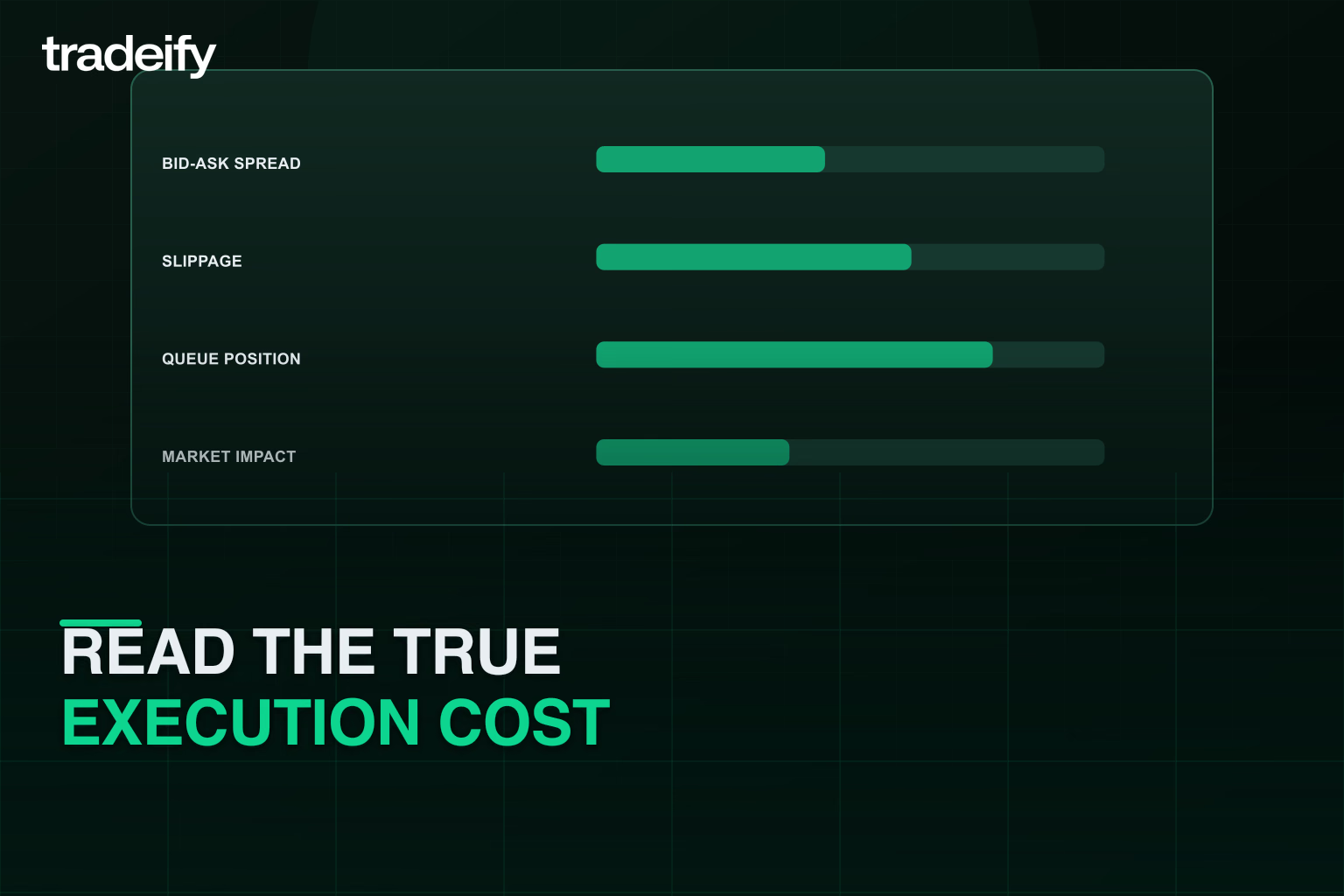
The difference between the price you expected and the price you received is commonly called slippage. Slippage can be small in a deep, orderly market and larger when the market is moving quickly, the spread widens, liquidity thins, or the order is large relative to resting size.
For a prop-firm trader, slippage is not just an execution statistic. It can change the distance from entry to stop, the dollar risk on the position, and the amount of drawdown room left after the trade.
How Limit Orders Work
A limit order tells the market the worst price you will accept.
- A buy limit can execute at the limit price or lower.
- A sell limit can execute at the limit price or higher.
If your buy limit is 100, you will not pay 101 for that order. If your sell limit is 104, you will not sell at 103. That protection is the reason traders use limits for planned entries and targets.
Limit Orders Protect Price, Not Participation
A limit order can remain unfilled even when the trade idea works.
Price may never reach your level. It may touch the level without enough opposite-side quantity to reach your place in the queue. The market may trade there briefly, fill part of your order, and move away.
This is where traders get caught. They read “price touched my limit” as “my broker skipped me.” In a central order book, other orders may have been waiting at the same price before yours. The available volume can be exhausted before your order reaches the front.
The CME Group futures order-types lesson confirms that a futures limit order cannot fill worse than its limit, can fill better, and may not fill in a fast-moving market.
Partial Fills Need a Plan
If you place an order for several contracts, only some may fill.
That creates a decision:
- Keep the remaining order working.
- Cancel the unfilled quantity.
- Replace it at a new price.
- Manage the smaller position you received.
None of those choices should be improvised under pressure. Before submitting a multi-contract limit order, decide whether a partial fill is acceptable and how it changes the stop, target, and total risk.
Limit Order Duration Matters
The price is only one instruction. The time in force decides how long the order can remain active.
A day order generally expires at the end of the applicable trading session if it is not filled. A good-till-canceled order can remain active until it fills, is canceled, or reaches a platform or broker expiration condition.
Names and exact behavior can vary. The safe practice is to verify the platform's definition rather than assume.
This matters for futures traders because a forgotten resting order can become a new position in a later session. If the original setup is no longer valid, the order should not still be waiting for price.
On CME Globex, the exchange's own order qualifier reference lists the main choices, and your platform may label them differently:
- Day. Active only for that trading day, then expires. CME Globex treats an order as a day order unless you specify otherwise.
- Good till canceled (GTC). Stays in the book until it fills, you cancel it, or the contract expires.
- Good till date (GTD). Stays working until it fills, you cancel it, or the date you set passes.
- Fill and kill (FAK). Executes immediately against whatever resting quantity is available and cancels the rest.
- Fill or kill (FOK). Fills the entire quantity immediately or cancels the whole order.
FAK and FOK are the time-in-force answer to the partial-fill problem above. FAK accepts a partial fill now and refuses to leave a remainder working. FOK refuses a partial fill altogether. Both remove the forgotten-order risk, but both can leave you with nothing if the size you need is not resting at your price.
When to Use Each Order Type
Do not ask which order is better in isolation. Ask what the trade requires.
When a Market Order May Fit
A market order may fit when execution matters more than a small difference in price and current conditions make that difference tolerable.
Examples include:
- Closing a position when your thesis is invalid and delay creates additional exposure.
- Trading a highly liquid contract during an active session when the spread and depth are stable.
- Entering a time-sensitive setup only after confirming that the live order book can absorb your size.
- Reducing risk quickly after discovering that position size or direction is wrong.
This is not permission to ignore the order book. A market order should be a deliberate acceptance of current liquidity and possible slippage.
When a Limit Order May Fit
A limit order may fit when price is part of the setup and you are willing to miss the trade.
Examples include:
- Entering on a planned pullback to a specific level.
- Taking profit at a predefined price.
- Trading when a worse entry would make the stop too wide or the reward-to-risk relationship unacceptable.
- Working an order where urgency is low and price control matters more than immediate participation.
The key sentence is “I am willing to miss the trade.” If that is not true, a passive limit can turn into a chase.
When a Marketable Limit Order May Fit
A marketable limit order is a limit priced to interact with the current opposite side of the market.
Suppose the best ask is 101. A buy limit at 102 can seek immediate execution at 101 or better while refusing prices above 102. It combines urgency with a worst-price boundary.
It does not guarantee a complete fill. If there is not enough available liquidity within the limit, some or all of the order can remain unfilled. Platform support and handling vary, so confirm the exact order behavior before relying on it.
This can be useful when you need a position now but cannot accept unlimited slippage. It is not a shortcut around checking depth and volatility.
Use a missed limit order decision tree

A missed limit order creates urgency because the original idea may be working without you. That does not make the current price the same trade.
Use this sequence before replacing the order:
- Check the original setup. If the entry condition expired or price has already reached the area where profit was supposed to be taken, cancel the idea.
- Recalculate from the current price. Keep the structural invalidation where the thesis fails. Do not move the stop closer just to preserve the old position size.
- Recheck the payoff and account risk. Include the new entry, current spread, possible slippage, contract count, and remaining distance to the next obstacle.
- Choose a new trade or no trade. Enter only if the current setup independently passes the plan. Otherwise, let the missed fill remain the final outcome.
Current condition | Decision |
|---|---|
Setup valid, risk still fits, and reward remains realistic | A new order may be justified using the recalculated plan |
Setup valid, but the stop now makes the trade too large | Reduce size if allowed or skip the trade |
Price is extended and the original target is too close | Do not chase |
Entry condition has changed | Wait for a different setup |
The decision tree removes one dangerous shortcut: replacing “my order did not fill” with “I still deserve the trade.” Markets do not owe participation. The current price must earn a new decision.
How Futures Execution Changes the Choice
Most page-one explanations of market and limit orders focus on stocks and ETFs. Futures traders need a few additional checks.
The Bid, Ask, and Depth Matter More Than the Last Print
The DOM shows resting interest at multiple prices. It can help you see:
- The current best bid and ask
- The spread between them
- Visible quantity at nearby price levels
- Whether your size is small or large relative to displayed depth
Displayed depth can change quickly. Orders can be added, canceled, or filled before your order arrives. Treat it as current information, not a guarantee.
Contract and Session Liquidity Can Change
Execution quality is not constant.
The same order size can behave differently across contracts, expiration months, trading sessions, and market events. A tight spread during an active period can widen when participation drops. Scheduled economic releases and unexpected news can cause prices and available liquidity to change rapidly.
Before using a market order, look at the conditions that exist now. Before leaving a limit working, consider the conditions that could exist when it fills.
Price Gaps and Fast Markets
A price gap is a jump from one price to another with little or no trading in between. In futures it shows up when trading resumes after a pause, such as a session break, a weekend, or a halt, and when a scheduled release or surprise headline pulls resting orders out of the book.
Each order type fails differently through a gap:
- A market order fills at whatever is available after the jump, which can be several ticks or more past the last price you saw.
- A stop order triggers once price trades through the stop, then fills at the next available price. Gapping through a stop does not mean the order fills at the stop.
- A limit order never fills worse than its price. If price gaps past a buy limit to the downside, it can fill better. If price gaps away from it, it may not fill at all.
The practical rule is to decide before the event which risk you would rather hold. If a gap through your stop would break a trailing drawdown limit, reduce size or stand aside before the release instead of trusting the stop price. The news event playbook covers how to plan those windows.
Futures Venues May Add Order Protection
CME explains that its market-order implementations can include protection ranges intended to prevent fills at extreme prices. The specific behavior depends on the order type, product, venue, broker, and platform.
Do not translate “protection” into “guaranteed price.” Verify what your ticket sends, how the venue handles remaining quantity, and what happens when liquidity inside the protected range is insufficient.
Quantity Changes the Execution Problem
One contract may fill entirely at the best available price. A larger order may consume several price levels or fill only in part.
Position size therefore affects both market and limit orders:
- More market-order quantity can increase price impact or slippage.
- More limit-order quantity can increase the chance of a partial fill.
- Scaling across prices can change the average entry and the total risk.
Order type cannot repair an oversized trade. Size the position first, then choose how to execute it.
How Order Choice Affects Prop-Firm Risk
Prop-firm traders operate with constraints that make execution discipline visible.
An evaluation or funded account may include daily loss, trailing drawdown, consistency, position-size, or other account rules. The exact rules vary by firm and account. Your job is to know the rules that apply to you and calculate trade risk from the actual fill, not the entry you hoped to get.
Build Slippage Into Planned Risk
A basic futures risk estimate is:
Estimated risk = stop distance in ticks × tick value × contracts
For a market order, add a reasonable slippage allowance based on the contract and current conditions. Also account for transaction costs where relevant.
If the fill is worse than planned, recalculate immediately. Do not widen the stop just to restore the original chart distance unless that wider risk still fits the account plan. Moving the stop after a poor fill can turn a small execution difference into a rule-threatening loss.
Treat a Missed Limit as a Valid Outcome
A missed trade is cheaper than a forced trade.
If your limit does not fill, you need a prewritten response:
- Let the trade go.
- Wait for a new setup with a new risk calculation.
- Use a different order only if the current price, stop, and size still meet the plan.
Chasing because the original idea was good ignores the price you now have to pay. Under a drawdown limit, that emotional entry can be more damaging than the missed opportunity.
Separate Entry Quality From Trade Quality
A precise limit fill does not make a bad setup good. A small amount of market-order slippage does not automatically make a good setup bad.
Judge the whole trade:
- Is the setup still valid?
- Does the actual entry preserve the planned risk?
- Is the size appropriate?
- Is the exit logic clear?
- Does the trade fit the account's remaining risk room?
Good execution supports a risk plan. It does not replace one.
Common Market and Limit Order Mistakes
Using the Last Price as the Expected Fill
The chart's last price is not necessarily available. Read the bid and ask before sending the order.
Using a Market Order Without Checking Conditions
A liquid contract can become fast or thin around news, session changes, or sudden volatility. Check spread and depth at the moment of entry.
Setting a Limit, Then Chasing
If you are not willing to miss the trade, decide that before placing a passive limit. Repeatedly moving the limit toward price removes the protection that made you choose the order.
Assuming a Touch Guarantees a Fill
Queue position and available quantity matter. A brief trade at your level does not prove enough volume reached your order.
Ignoring Partial Fills
Know whether the platform leaves the remaining quantity working. Confirm the actual position before sending another order.
Leaving Old Orders Active
Review working orders before a session ends, before stepping away, and before changing the trade plan. Cancel orders that no longer have a valid reason to exist.
Confusing Entry Orders With Protective Stops
Market and limit orders answer how you want to trade now. Stop and stop-limit orders add a trigger that activates later. The fill risks are different.
How Stops Differ From Market and Limit Orders
A stop order waits for a trigger price. After the trigger, it commonly becomes a market-style order, subject to the venue's protection rules. It prioritizes getting out after activation but can fill away from the stop price.
A stop-limit order also waits for a trigger. After activation, it becomes a limit order. It protects the execution price but can fail to fill while the market keeps moving.
That distinction is critical for exits:
- Stop order risk is price slippage after the trigger.
- Stop-limit risk is remaining in the position after the trigger.
Neither order guarantees that a loss will be limited to an exact amount. Confirm the behavior supported by your platform and contract.
Frequently Asked Questions About Market and Limit Orders
What Is the Difference Between a Market Order and a Limit Order?
A market order buys or sells immediately at the best available prices, so it prioritizes getting filled but does not guarantee the price. A limit order sets the worst price you will accept, so it protects the price but may fill partially or not at all.
Is a Market Order Risky?
The risk is the fill price, not the order itself. In a liquid contract with a tight spread and small size, a market order usually fills close to the quote. Around news, session reopenings, thin liquidity, or large size, it can fill several ticks or more away from the last price.
Which Is Better, a Market Order or a Limit Order?
Neither is always better. Use a market order when timely execution is the priority and current price uncertainty fits your risk plan. Use a limit order when the worst acceptable price is the priority and you can accept a partial or missed fill.
Can a Limit Order Fill at a Better Price?
Yes. A buy limit can fill below its limit, and a sell limit can fill above its limit. The limit is the worst acceptable execution price, not a required execution price.
Why Did Price Touch My Limit Without Filling It?
There may have been orders ahead of yours at the same price, and the available opposite-side quantity may have run out before reaching your order. A brief touch does not guarantee a full fill.
Are Market Orders Bad for Futures Trading?
No. They are a tool for prioritizing execution. Their main risk is uncertain price, especially when spreads widen, depth is thin, volatility is high, or size is large. Use them only when that uncertainty fits the plan.
Can a Marketable Limit Order Replace a Market Order?
It can provide a worst-price cap while seeking immediate execution, but it can also remain partially or fully unfilled. Whether it is a good substitute depends on urgency, available liquidity, and platform behavior.
A Pre-Trade Order Checklist
Before you click, answer these questions:
- Is execution or price control more important for this specific trade?
- What are the live bid, ask, spread, and nearby depth?
- Is the market moving normally, or is volatility expanding?
- How large is the order relative to visible liquidity?
- What is the worst fill price the risk plan can accept?
- Can the account absorb reasonable slippage without threatening a loss or drawdown limit?
- If a limit fills only partially, what will you do?
- If a limit does not fill, are you willing to let the trade go?
- What time in force is active, and could the order remain working after the setup expires?
- Does the platform send the exact order type and protection behavior you expect?
Choose the uncertainty before you place the order. Then honor the choice.
Futures trading involves substantial risk and is not suitable for every trader. Order types can help manage execution, but they cannot remove market risk or guarantee a fill, a price, profitability, account qualification, or a payout.
.svg)
.svg)
.svg)
.svg)





.webp)